http://go.warwick.ac.uk/lib-publications
Original citation:
Drechsler, Hauke and McAinsh, Andrew D.. (2012) Exotic mitotic mechanisms. Open
Biology, Vol.2 (No.12). Article no. 120140.
Permanent WRAP url:
http://wrap.warwick.ac.uk/52713
Copyright and reuse:
The Warwick Research Archive Portal (WRAP) makes the work of researchers of the
University of Warwick available open access under the following conditions.
This article is made available under the Creative Commons
Attribution-NonCommercial-NoDerivs 3.0 Unported (CC BY-NC-ND 3.0) license and may be reused according to the
conditions of the license. For more details see:
http://creativecommons.org/licenses/by-nc-nd/3.0/
A note on versions:
The version presented in WRAP is the published version, or, version of record, and may
be cited as it appears here.
doi: 10.1098/rsob.120140
2012
2
, 120140
Open Biol.
Hauke Drechsler and Andrew D. McAinsh
Exotic mitotic mechanisms
References
http://rsob.royalsocietypublishing.org/content/2/12/120140.full.html#ref-list-1
This article cites 100 articles, 43 of which can be accessed freeany medium, provided the original work is properly cited.
Attribution License, which permits unrestricted use, distribution, and reproduction in
This is an open-access article distributed under the terms of the Creative Commons
Subject collections
(32 articles)
cellular biology
biophysics
(7 articles)
biochemistry
(27 articles)
Articles on similar topics can be found in the following collections
rsob.royalsocietypublishing.org
Review
Cite this article:
Drechsler H, McAinsh AD.
2012 Exotic mitotic mechanisms. Open Biol 2:
120140.
http://dx.doi.org/10.1098/rsob.120140
Received: 28 September 2012
Accepted: 13 November 2012
Subject Area:
biochemistry/biophysics/cellular biology
Keywords:
kinetochore, nuclear pore complex, mitosis,
spindle, chromosome
Author for correspondence:
Andrew D. McAinsh
e-mail: [email protected]
Exotic mitotic mechanisms
Hauke Drechsler and Andrew D. McAinsh
Centre for Mechanochemical Cell Biology, Division of Biomedical Cell Biology,
Warwick Medical School, University of Warwick, Coventry CV4 7AL, UK
1. Summary
The emergence of eukaryotes around two billion years ago provided new chal-lenges for the chromosome segregation machineries: the physical separation of multiple large and linear chromosomes from the microtubule-organizing centres by the nuclear envelope. In this review, we set out the diverse solutions that eukaryotic cells use to solve this problem, and show how stepping away from ‘mainstream’ mitosis can teach us much about the mechanisms and mechanics that can drive chromosome segregation. We discuss the evidence for a close functional and physical relationship between membranes, nuclear pores and kinetochores in generating the forces necessary for chromosome segregation during mitosis.
2. Introduction
The accurate segregation of replicated genomes into daughter cells during cell division is a prerequisite for life in all three domains of life: Archaea, bacteria,
Eukaryota. The segregation process is essentially a mechanochemical problem in that the chromosomes, which have mass, need to be pulled or pushed into daughter cells. All mechanisms known so far can be reduced to two basic com-ponents: (i) directional force-generating mechanisms that consume chemical energy provided by hydrolysis of nucleotide triphosphates (NTP), and (ii) an adaptor that physically links this machinery to the carriers of genetic infor-mation (chromosomes/plasmids; figure 1). In prokaryotes, the task of DNA segregation is simplified, because the circular chromosome and plasmids are not located within a nucleus. Prokaryotes therefore do not need to do a nuclear division (mitosis). Instead, they partition the duplicated DNA into opposite halves of the cell prior to cell division (binary fission). Basic plasmid partition-ing machineries have been identified that involve a centromeric DNA-bindpartition-ing protein and one of three NTPase (for reviews, see [1,2]). The ParM, ParA and TubZ NTPases can form filaments that undergo cycles of nucleotide-dependent polymerization/depolymerization to generate the pulling and/or pushing forces necessary for partitioning (figure 1a,b). ParM forms filaments that are structurally similar to eukaryotic actin [3], whereas recent work has revea-led a third partitioning machine that involves the treadmilling of TubZ-a protein with a tubulin/FtsZ fold [4]. Thus, prokaryotes contain simple DNA-partitioning machines that use proteins resembling the cytoskeletal proteins driving chromosome segregation in eukaryotes. One exception is the segre-gation of high-copy-number plasmids in prokaryotes, which are thought to use passive diffusion [5,6]. Furthermore, the mechanisms that drive directional chromosome segregation remain elusive [7]. Chromosome segregation in eukar-yotes occurs during mitosis and has been under investigation for over 150 years [8], with early work in plant and animal cells, whose chromosomes and their movements could be visualized and described with a light microscope. In this review, we aim to rekindle interest in how natural selection, within eukaryotes, has driven the development of diverse solutions to the task of chromosome segregation. Therefore, we do not provide a comprehensive
description of all mitoses that are known, but rather focus on a number of key organisms that exemplify divergence.
3. ‘Mainstream’ mitosis
It is necessary to first set out the cell biological transitions and biophysics that underpin ‘mainstream’ mitosis in animal cells. For a comprehensive treatment of this subject, we point the reader to the excellent recent review by McIn-tosh et al. [9]. ‘Mainstream’ mitosis in animal cells is powered by a microtubule-based machine called the mitotic spindle. Microtubules are hollow tubes of 25 nm diameter that assemble from heterodimers of a- and b-tubulin. The head-to-tail assembly of subunits gives rise to a polar poly-mer with a plus-end and minus-end that differ in their dynamic properties. The mitotic spindle is a bipolar array of microtubules, in which the minus-ends of microtubules are focused at spindle poles, and the plus-ends radiate outwards towards the opposite pole. In animal cells, the primary microtubule-organizing centre (MTOC) is the centro-some, which is located at the spindle pole and consists of two centrioles and the associated pericentriolar material. Non-centrosomal pathways also contribute, and include chromosome- and microtubule-based microtubule nucleation events [10,11]. Spindle microtubules can be separated into those whose plus-ends terminate at kinetochores (K-MTs) and those that remain free in the spindle (non-kinetochore
MTs, nK-MTs; also termed inter-polar MTs). nK-MTs have a half-life an order of magnitude shorter than K-MTs [12], but can also form anti-parallel overlaps that are important for spindle bipolarity (figure 1c).
K-MT polymerization and depolymerization function as the central motor that drives chromosome movements in mitosis [13] (figure 1c, inset 1). Polymerization involves the binding of GTP–tubulin heterodimers to the microtubule end. Subsequent GTP hydrolysis evokes a conformational change in the heterodimer, resulting in energy being stored as strain within the MT lattice. MT polymerization can do work by overcoming Brownian fluctuations, resulting in the generation of pushing forces [14], whereas depolymerization of MTs can also do work because kinetochores have the capacity to grip and maintain attachment to the K-MT plus-end during shrinkage [15]. In addition, the release of lattice strain (see above) causes the bending of protofila-ments that could function as a powerstroke (figure 1c, inset 1). Kinetochores are thus the eukaryotic equivalent of the centromeric binding component of the prokaryotic parti-tioning machines, with tubulin being the functional counterpart of the ParA/M/TubZ components. However, unlike these basic prokaryotic two-component systems that use a simple adaptor protein, kinetochores are megadalton-sized protein machines that form attachments to microtubule plus-ends and are assembled from around 150 protein sub-units [16–19]. Kinetochores are also pulled polewards, because K-MTs are disassembled at their minus-ends,
cortex
cortex
+
+ + +
Fpull
Fpush/pull
Fpush
Fpull
Fpull
Fpush/pull
+
Fpull
Fpull
Fpush Fpush
nucleoid
– – – – –
+
-+
Fpull
1 (a)
(c)
(b)
ParA–ParB ParM–ParR
kinetochore MT
non-kinetochore MT
astral MT
a/btubulin–kinetochore
spindle pole
kinetochore kinetochore
chromosome
MT
MTOC, centriolar NTPase polymer
chromosome
depolymerization
motors plasmid polymer/DNA binding factor polymerization
[image:4.595.114.488.42.351.2]1
Figure 1.
Schematic diagram showing the set-up of the chromosome segregation machinery in bacteria and mammalian cells. The basic requirement for
chromosome segregation is a dynamic NTPase polymer (ParA, ParM in prokaryotes or tubulin in eukaryotes; green) that can create pushing (F
pushin
a,c
) or pulling
forces (F
pullin
b,c
) by polymerization or depolymerization, respectively. Dynamic NTPase polymers are connected to DNA by centromere binding factor: ParB, ParR in
prokaryotes (
a
,
b
) or the kinetochore complex in mammalian cells (
c
) (orange). In contrast to the simplified prokaryote machinery (
a
,
b
), chromosome segregation
in eukaryotes is driven by a sum of forces created by tubulin (de)polymerization at kinetochores (plus-end) and depolymerization at spindle poles (minus-ends),
in addition to MT-dependent motors bound at kinetochores, chromosome arms, microtubule-organizing centres and the cell cortex. Inset: longitudinal section through a
kinetochore-bound microtubule. Curling of kinetochore-MT protofilaments at the plus-end produces pulling forces on the attached kinetochore-chromosome.
rsob.r
oy
alsocietypublishing.org
Open
Biol
2:
120140
which are embedded at spindle poles (figure 1c). The segre-gation of sister chromatids towards spindle poles (anaphase A) is thus a composite of subunit removal at the minus-and plus-ends of kinetochore-bound MTs. Completion of anaphase additionally requires spindle elongation (anaphase B), which is driven by microtubule–microtubule sliding within the mid-zone, and the pulling forces exerted by astral–microtubule cortex interactions [20] (figure 1c).
In animal cells, disjunction of sister chromatids necessitates the formation of bi-oriented (amphitelic) sister kinetochore attachments; that is, sister kinetochores forming attachments to microtubules emanating from opposite spindle poles, prior to anaphase onset. A sister kinetochore is therefore tasked with not only forming end-on attachment to spindle microtu-bule plus-ends (capture) in early mitosis, but also forming the selective stabilization of bi-oriented attachments as mitosis progresses. This process involves active error correction mech-anisms that destabilize inappropriate attachments (e.g. both sisters bound to a single pole) [21]. In animal cells, these events are coincident with the movement of chromosomes to the spindle equator during prometaphase (congression). Kine-tochores can also form attachments to the lattice of microtubules and, through the action of the molecular motor CENP-E, ‘slide’ towards the plus-end of microtubules and the spindle equator [22–24]. In fact, experiments show that congression can occur in the complete absence of end-on attachments, suggesting a more ‘basic’ alignment process that does not involve microtubule dynamics [25]. Finally, kineto-chores mediate the spindle assembly checkpoint (SAC), which senses when sister kinetochores are incorrectly attached and generates a soluble signal that inhibits anaphase onset until all sister kinetochores are correctly attached [26,27]. The nature of the signal that the kinetochore senses and how it is sat-isfied remains unknown, but is likely to reflect the occupancy of MT attachment sites and/or the imposition of tension/force balance across the sister pairs.
4. Nuclear envelope breakdown
The evolution of the eukaryotic lineage has, however, presented major new challenges for the chromosome segregation machin-ery because the genome, which is organized into multiple linear chromosomes, is carried during interphase within a nucleus, whose boundary is a double lipid bilayer called the nuclear envelope (NE). The evolutionary advantage of a nucleus is likely to be the capacity to compartmentalize biochemical pro-cesses, such as splicing and transcription, and to maintain the integrity of the genome. The NE contains nuclear pore com-plexes (NPCs), which are multi-protein (i.e. nucleoporins) assemblies that control the trafficking of molecules between the nucleus and cytoplasm [28]. The problem is that the MTOC, which is necessary for bipolar spindle formation, has to be located in the cytoplasm in order to nucleate the (interphase) microtubule cytoskeleton and organize the assembly of flagella and cilia, whereas the chromosomes are located in the nucleus.
The most obvious route, and the one taken by higher eukar-yotes, is to simply disassemble the nucleus at the onset of mitosis (prophase). This process, called NE breakdown (NEBD), begins with dispersal of nucleoporins, followed by the physical defor-mation and tearing of the NE by forces generated by dynein motors and microtubules, and finally the disassembly of the nuclear lamina, which is required for the structural integrity of
the nucleus [29]. Concurrent with this process is the disassembly of the interphase microtubule cytoskeleton and the formation of asters around the two centrosomes, which then migrate to oppo-site sides of the nucleus. This migration is driven by molecular motors, which drive the extensile sliding of anti-parallel-oriented microtubules that originate from the two asters [30,31]. It is worth considering whether the two asters, con-nected by anti-parallel microtubule overlaps, constitute a bipolar spindle (rather than the textbook view that the bipolar spindle only assembles after NEBD). In fact, certain diatoms (e.g.Lithodesmium undulatum,Surirella ovalis) fully pre-assemble the spindle outside the nucleus. As NEBD occurs, the spindle sinks down into the chromosome mass [32–34]. In both diatoms and animals, the result is that the asters can access the chromo-somal mass (and kinetochores), the mitotic spindle matures and the animal cell performs an ‘open’ mitosis (figure 2a).
5. Partial breakdown
The complete breakdown of the NE is, however, not always necessary. In principle, local openings within the NE (fenestrae), close to the MTOCs, are sufficient to allow MTs to capture the chromosomes; in Caenorhabditis elegans
and syncytialDrosophila melanogasterembryos, for example, the mitotic spindle is established through polar fenestrae during prometaphase [35–37]. Unlike animal cells, NEBD in C. elegans is delayed until late anaphase. Interestingly, the multi-step process of NEBD (beginning with NPC removal) starts earlier in later embryo stages (from 30 cells, prometaphase) when compared with earlier (and smaller) embryo stages (2–24 cells, early anaphase) [37], suggesting that maintaining NE integrity for a longer time period pro-vides benefits to smaller cell agglomerations. A variant of the semi-open mitosis that might represent an intermediate between semi-closed and fully closed mitosis can be found inPlasmodiophora brassicae, a unicellular plant pathogen caus-ing root diseases in members of the Brassicaceae family. Electron microscopy (EM) reveals that the NE again disinte-grates only around the centrioles, once they have fully separated during prophase [38]. The centrioles establish asters, and K-MTs radiate into the nucleus, where they cap-ture the condensed chromosomes (figure 2b). Like animal cells, chromosomes attach to one or more spindle MTs via kinetochores, and EM data show that these kinetochores are bi-oriented [38]. Tension across sister kinetochores and the existence of a functional SAC are therefore possible. How-ever, anti-parallel overlapping nK-MTs have not been described, suggesting that in anaphase chromosome segre-gation is driven by MT depolymerization and spindle elongation by aster-mediated cortical pulling forces only. The chromosomes do congress to the spindle equator, form-ing a metaphase plate, although the chromosomes are excluded from the centre of the plate owing to the positioning of the nucleolus. Chromosomes therefore adopt a ring-like conformation within the plate [38]. Whether the positioning of the nucleolus is a cause or consequence of this chromo-some positioning is unknown. It is interesting to note that in human cells and mouse oocytes the chromosomes also adopt a radial organization early in mitosis that accelerates chromosome bi-orientation [39,40]. The ring-like metaphase plate in P. brassicae forces the spindle MTs into a cup-like structure, with the MTOC at its base and the chromosomes
rsob.r
oy
alsocietypublishing.org
Open
Biol
2:
120140
arranged around the opening. Interestingly, at the bottom of this cup-like arrangement, a remnant of the NE shields cen-trioles from the ‘nucleoplasm’ on axis with the nucleolus. Thus, the opening for the spindle MTs within the NE must have a ring-like shape with an NE-derived membrane centre. Membrane cisternae containing nuclear pores radiate along spindle MTs into the nucleus and also seem to be associated with chromatin, but EM data suggest that these cisternae are not continuously linked to the NE [38] (figure 2b, inset 2).
Like P. brassicae, the mitotic nuclei of the biflagellated algae Chlamydomonas reinhardtii open at the spindle poles into fenestrae, but unlike in P. brassicae, NE material is absent from the inner nucleus and the chromosomes. The fla-gella resolve during mitosis and allow the basal bodies to migrate towards the nucleus. At the end of this movement, basal bodies could be found proximal to at least one of the polar fenestrae [41,42]. The centrioles, however, seem to be dispensable for nucleation of spindle MTs [43,44]. Spindle MTs gain access to the chromosomes through the polar fenes-trae and drive the formation of a metaphase plate [41]. Owing to weak contrast of MTs in the EM pictures provided in refer-ences [41,44], it remains unclear whetherC. reinhardtiipossess inter-polar microtubules and/or kinetochores. Thus, current data do not allow conclusions about the forces powering chromosome segregation and spindle elongation.
Although (partial) NE breakdown appears to be a straight-forward solution that allows the MTOCs to gain access to the chromosomes, this approach might be hazardous as it exposes the genetic material to the cytosolic environment. Thus, especially for unicellular organisms, it might be favourable to maintain integrity of the NE during mitosis. On the other hand, maintaining the NE as a permeability barrier during mitosis could, in principle, allow for continuous transcription. Consequently, one element of the mitotic spindle (excluding the dynamic unstable MTs) has to span the NE in these organ-isms. Next, we present examples for organisms that have developed either membrane-based MTOCs or kinetochores that allow a fully closed mitosis.
6. Nuclear-membrane-based
microtubule-organizing centres
Prominent and well-described examples of nuclear-membrane-based MTOCs can be found in the fungal Ascomycetes phylum: the MTOCs (spindle pole bodies, SPBs) ofSchizosaccharomyces pombecan be regarded as a further functional step from partial open mitosis towards consequent closed mitosis. Its SPBs dupli-cate on the outer surface of the NE and are transiently inserted into nuclear fenestrae, which close again after anaphase onset and extrude the SPBs back into the cytoplasm [45]. By contrast,
nu
nu
nu k-fibre
interpolar MT
+
+ +
– –
–
chromatin
+ –
chromatin
+ –
1
2
3
1
1 2
3 cytoplasmic
tunnels FMT FMT
motors
nuclear envelope nucleolus chromosome(s) (liquid crystal) chromosome(s) kinetochore MTOC, plaque-like MTOC, acentriolar MTOC, centriolar
MT Fmotors
Fmotors FMT (a)
(b)
(c)
[image:6.595.117.484.43.407.2](d) (e) (f)
Figure 2.
Diverse metaphase spindle set-ups in eukaryotes: (
a
) animals, (
b
)
Plasmodiophora brassicae
, (
c
)
Saccharomyces cerevisiae
, (
d
)
Trypanosoma bruceri
,
(
e
)
Crypthecodinium cohnii
and (
f
)
Oodinium, Amphidinium carterae
. For clarity, the outline of the cell has been omitted. Free microtubule-organizing centres in (
d
)
and (
e
) correspond to basal bodies that are not involved in the set-up of the mitotic spindle. Numbered insets on the right-hand side are magnifications of the
MT–kinetochore–chromosome interaction sites in the corresponding overviews on the left.
rsob.r
oy
alsocietypublishing.org
Open
Biol
2:
120140
the composition ofSaccharomyces cerevisiaeSPBs represents an MTOC configuration fully adapted to permanent insertion into the NE. It consists of three distinct layers: a crystalline cen-tral protein plaque residing in the plane of the NE and attached to it; and an inner and outer plaque, both independently organizing microtubules in the nucleus and the cytoplasm, respectively (figure 2c). For a comprehensive overview of fungi SPBs, we would like to refer to the review by Jaspersen & Winey [46]. Although best studied in fungi, membrane-based MTOCs are not restricted to them. Microtubule-organiz-ing activity in the cytoplasm and nucleus of the flagellated unicellular parasiteTrypanosoma bruceiis clearly separated. Cen-trioles of the basal body organize the flagellum and the distribution of the kinetoplast (a single large mitochondrion, containing a complex network of mitochondrial DNA) during closed mitosis [47]. Separate EM-evident MTOC structures within the NE organize the mitotic spindle. Like P. brassicae
(see above), spindle MTs are aligned around the nucleolus, which stretches from pole to pole during metaphase [48,49]. Unlike yeast SPBs, the MTOCs ofT. bruceilack any sub-layer on the cytoplasmic face of the NE and consequently do not nucleate any astral microtubules [48]. To date, a biochemical or structural analysis of these structures is missing (figure 2d). As expected,T. brucei[48] and other species that use NE-based MTOCs have classical ‘animal-like’ kinetochores that allow for bi-orientation and the possibility of a tension-dependent SAC. Kinetochore-intension-dependent segregation mech-anisms are also possible and have been discussed forT. brucei
because the large number of chromosomes (approx. 100 mini-chromosomes and approx. 20 large mini-chromosomes [50,51]) does not match the small number of visible kinetochores (approx. 8) [48] and spindle MTs (approx. 20) [49]. However, the fact that the chromosomes ofT. bruceido not condensate [52] during mitosis makes an EM-based assignment of kine-tochores to single chromosomes difficult. This led to the proposal that several chromosomes share one kinetochore structure [48]. Nevertheless, mini-chromosomes do congress to the spindle equator and are segregated synchronously in an MT-dependent manner [53].
7. Nuclear-membrane-based kinetochores
Like yeast, members of the phylum Dinoflagellata and the class of Parabasalia (from the Protista kingdom) also conduct a closed mitosis. Dinoflagellates are unicellular, flagellated organisms that are mainly free-swimming in the sea as part of the plankton, although fresh-water and parasitic (Oodinium
[54]) species have also been described [55]. Parabasalids are anaerobic multi-flagellated organisms that are obligatory, symbiotic or parasitic, and can be found in the digestive tracts of organisms such as termites and cockroaches. Amazingly, these species actually insert their chromosome–microtubule interface into the NE. This implies that these organisms have to assemble the mitotic spindle outside the nucleus. In the case of the dinoflagellates, this has led to a rather unconven-tional spindle set-up: in Crypthecodinium cohnii, the bipolar spindle is organized by two acentriolar MTOCs that are located in the cytoplasm on either side of the nucleus [56]. Unlike com-monly known nuclei, those in mitotic dinoflagelates possess tunnels (called channels) that span the nucleus from one MTOC to the other (figure 2e). Spindle MTs pass through these channels, resulting in a weakly focused spindle without
asters [56,57]. The chromosomes ofC. cohnii are attached to the inside of the nuclear membrane. This is opposite the pos-ition within the nuclear channels where spindle MTs terminate [58,59] (figure 2e). Thus, chromosomes and microtu-bules are physically separated by the NE. The membrane geometry of these attachment sites suggests that MTs are attached end-on, and the concepts of bi-orientation and tension generation might apply (figure 2, inset 3). However, early studies assumed that chromosomes attach to the lattice of the microtubules, and proposed that membrane synthesis drives chromosome separation towards the poles along the spindle exoskeleton [57]. In terms of kinetochores, the literature has been indecisive: Bhaud et al. [59] described a membrane thickening at the attachment sites that might harbour transmembrane elements that link chromosomes and micro-tubules. They could not, however, detect any classical kinetochore-like structure. By contrast, earlier EM data show ill-defined electron-dense material on both membrane faces of the attachment site, arguing for the existence of kinetochores [57,58]. The end-on nature of these attachments could allow the generation of pulling forces through MT depolymerization.
In other dinoflagellates (i.e.Oodinium,Amphidinium carterae
andSyndinium), a single central channel spans the nucleus from pole to pole, harbouring nK-MTs and K-MTs [54,60,61] (figure 2e). EM stills from different times in the cell cycle suggest that this central channel starts as an NE invagination around the MTOCs that eventually pierces through the nucleus during spindle pole separation, leaving one central channel [54,61]. As soon as the duplicated MTOCs invaginate into the NE the chromosomes become clustered proximal to the MTOCs (figure 3c). EM data reveal an electron-dense material at the attachment sites of chromosomes and MTs [54,61]. These structures show a fibrous corona towards the end-on-attached MTs and have been described as a bilayered structure—one layer associated with the chromosome, the other with the microtubule itself–thus showing properties of a classical kinetochore [61]. In the presented sections, kinetochores of
OodiniumandA. carteraeare occupied by one or two microtu-bules only [54,60], whereas kinetochores of Syndinium are attached to multiple MTs [61]. Once spindle pole separation has occurred, and the central channel has been established, sister chromosomes inOodiniumare aligned along the central channel and seem to be bi-oriented as proximal kinetochores are diametrically attached to K-MTs emanating from oppo-site poles (figure 2f). Geometry of the surrounding membrane (i.e. a 45–908angle between channel axis and kine-tochore plate) further suggests that these kinekine-tochore pairs experience tension [54] (figure 2, inset 3). Because nK-MTs span the central channel, both depolymerization of kineto-chores MTs and motor-driven lateral sliding of K-MTs along nK-MTs could empower tension generation and polewards chromosome movement in anaphase. Interestingly, this mech-anism of chromosome segregation is not exclusive to protista/ dinoflagellates. For example, Ostreococcus tauri, an unflagel-lated algae described to be the smallest eukaryote yet discovered [62], establishes a mitotic spindle through a single nuclear spindle tunnel and uses microtubule-dependent chromosome segregation [63]. Hence, we speculate that this organism also uses membrane-based kinetochores. Although no kinetochores have been described by EM, classical kineto-chore components such as Ndc80, Nuf2, CENP-C and SAC proteins (Mad1, Mad2, Cdc20, Bub1) have been identified in its genome [64].
rsob.r
oy
alsocietypublishing.org
Open
Biol
2:
120140
kinetochore
Ndc80 complex
Hec1 Nuf2Spc24Spc25 CENP-E
γ-TuRC
Nup133 Nup37 Nup43 Nup85 Nup96 Nup107 Nup160
Sec13 Seh1
Nup107–Nup160 comple
x
high curvature membrane
?
?
organelle arrangement in dinoflagellate prophase outer nuclear membrane
inner nuclear membrane scheme of NE– membrane fusion
chromosome
kinetochore membrane insertion Trychonympha agilis (adapted from Kubai [93] POM121
nuclear envelope reticulons
pore membrane proteins (POMs)
ALPS-motif NUPs
MTOC MT kinetochore chromosome(s) (liquid crystal)
NPC
NPC
stage I
nuclear envelope fibrous kinetochore
material
stage II
kinetochore disc
stage III
stage IV
microtubules
(a)
(d)
(b)
[image:8.595.110.487.39.605.2](c)
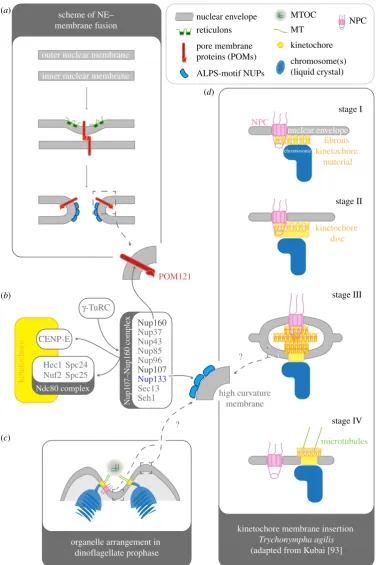
Figure 3.
Hypothetical overview of interactions and mechanisms that might mediate the insertion of membrane-bound kinetochores into the nuclear envelope (NE).
(
a
) Summary of the mechanisms that lead to
de novo
insertion of nuclear pore complexes (and spindle pole bodies) into the NE. Collaborative action of transmembrane
pore membrane proteins (POMs) (red) and reticulons (green) results in the convergence of the inner and outer nuclear membrane, leading to the eventual fusion of
membranes. The result is a pore in the NE. Once the pore has established POMs and nucleoporins (NUPs) containing ALPS-motifs (see main text) line the highly curved
membrane within the nuclear pore and provide a membrane-scaffold for further members of the nuclear pore complex (NPC) to assemble on. (
b
) The Nup107/160 complex
is a central hub that links to the kinetochore and might mediate membrane insertion of kinetochores. Nup107/160 interacts with CENP-E and the Ndc80-complex at the
kinetochore, as well as with the gamma tubulin ring complex (
g
-TuRC)—a ring-like matrix that contributes to MT-nucleation. Nup160 was shown to bind to POM121
within the membranes around the nuclear pore. Nup133 was shown to contain a functional ALPS-motif (see text) that specifically binds to membranes of high curvature
and is thus able to directly interact with the membrane environment within the pore. (
c
) Diagram of a prophase arrangement in (some) dinoflagellates in which
kinetochores are inserted in the NE. The MTOC(s) have invaginated into the nucleus. Chromosomes cluster by this invagination, which is characterized by a high density of
nuclear pore complexes and membranes with high curvatures. (
d
) Kinetochore maturing and membrane insertion in
Trychonympha agilis
as described by Kubai [93]. Stage
I: fibrous kinetochore material, associated with a NPC, starts to assemble between the chromosome and the NE. Stage II: the kinetochore matures as a dense disc
positioned between chromosome and the fibrous material. Stage III: an intermediate structure within the insertion process, resembling an intra-membrane vesicle. The
dense kinetochore disc has already been inserted into the NE. The vesicle structure is filled with the filamentous material and contains at least one NPC. Stage IV:
the vesicle structure has resolved. The fibrous kinetochore material is now on the cytoplasmic surface of the NE and able to accept spindle MTs.
rsob.r
oy
alsocietypublishing.org
Open
Biol
2:
120140
We have reasoned that membrane-based kinetochores are a hallmark of dinoflagellate mitosis. Most dinoflagellates, such asC. cohnii, contain uniquely compacted chromosomes in that DNA is condensed throughout the cell cycle and associated to the NE. With exceptions such as Syndinium, DNA condensation is not achieved by ‘conventional’ nucleo-somes packaging [65], but by the formation of liquid crystal structures [59,66–68]. These chromosomes contain a low protein content, dominated by a few dinoflagellate-specific, basic histone-like proteins (HLPs) [69] that locate to the chromosome periphery and non-crystalline, transcriptionally active loops [70–72]. One could now reason that a liquid crystal must demand a specialized protein–DNA (crystal) interface, arguing that dinoflagellate membrane-bound kinetochores might significantly differ from those ofO. tauri
or other ‘classical’ kinetochores. However, EM data show that DNA–membrane attachments are mediated by decon-densed loops of the chromosome [58,59]. Thus, described HLPs might serve as scaffold for a kinetochore structure. More likely, though, dinoflagellates also might use the ‘classi-cal’ kinetochore DNA-binding interface, as a recent analysis of dinoflagellate expressed sequence tag (EST) libraries reveals the existence of conventional histone H2B, H3, H4 and the H2A variant H2A.X [73] (see also [74] for a comprehensive review on this topic). This would suggest that their kinetochores differ from their animal counterparts only in the transmembrane part.
8. Using existing infrastructure?
Nuclear pores and membrane-based
kinetochores
In the context of nuclear-membrane-based kinetochores, the interesting question remains as to how new kinetochores insert into the membrane. Given the limited data on this pro-cess, it is worth summarizing the current view on how MTOCs (i.e. SPBs in yeast; for a detailed review, see [75]) are inserted into the NE. In budding yeast, the SPB duplicates on the cytosolic surface of the NE and has to be inserted into the NE across both the inner and the outer membranes. It emerged that NPC and SPB insertion requires the same NE modification steps that eventually end in the fusion of outer and inner nuclear membrane, leaving an opening in the NE. Fusion starts with constriction of the inner and outer NE bi-layer, thereby narrowing the perinuclear space (figure 3a). The mem-brane constriction is probably mediated by protein–protein interactions between perinuclear parts of transmembrane pro-teins (POMs) in both bi-layers. ER-derived intra-membrane proteins called reticulons are thought to stabilize the resulting curvature of the membrane by interleaving into the outer lipid layer [28,75,76]. Following nuclear membrane fusion, POMs are thought to mediate the attachment of the nuclear pore and SPB complexes to the membrane (figure 3a). InS. cerevisiae, the POM Ndc1 has been reported to take part in both SPB and NPC insertion, and tethering in the NE [77–80]. However, while Ndc1 is essential to SPB insertion, its role in NPC inser-tion seems to be redundant with POM152 [79,81]. By contrast, POMs seem to be dispensable for the insertion of NPC into the NE inA. nidulans—as long as they express a functional Nup84/ 120 complex [28,82]. This points to an alternative mechanism that associates nucleoporins with the NE [83].
In this regard,S. cerevisiaeNup85 and Nup120 (both part of the fungal Nup84/120 complex), as well as human Nup133 [84], are predicted to contain an ArfGAP1 lipid packing sensor (ALPS) motif, which has shown to be a membrane-binding, amphipathic alpha-helix [84,85]. The ALPS motif selectively binds membranes of a high curvature, presumably by interleaving hydrophobic residues in between exposed lipid molecules on the convex site of the curvature [85]. Thus, these motifs have been proposed to mediate nucleoporin interaction with the highly curved membrane around the insertion site of the NPC complex [28,75,84] (figure 3a,b). Interestingly, human Nup133 is a subunit of the Nup107/160 complex (figure 3b), which, besides being a structural component of the NPC, is also important during mitosis, when it transiently localizes to chromatin and kinetochores [86,87]. Selective removal of the kineto-chore-bound pool of the complex affects recruitment of RanGAP/CRM1 [88], the chromosomal passenger complex [89] and the microtubule-nucleating gamma tubulin ring complex [90], resulting in pleiotropic effects on chromosome segregation (for comprehensive reviews, see [88,89,91,92]). With regard to membrane-based kinetochores, we would like to emphasize that kinetochore localization of Nup107/ Nup160 is mediated by the outer kinetochore components CENP-F and the Ndc80-complex [88] (figure 3b). We hypothesize that in protists, which use membrane-based kinetochores, a conserved interaction between the outer kine-tochore and a Nup107/Nup160-like complex could mediate the insertion of the kinetochore into the NE via ALPS-motif-containing nucleoporins. Alternative mechanisms, ana-logous to those involved in SPB/NPC insertion (i.e. usage of POMs and reticulons), are also possible (figure 3).
In either case, NPC structures have to be shared. Hence, insertion of kinetochore discs into the NE should occur prox-imal to an already inserted NPC, as during SPB insertion. This is indeed the case inOodinium andSyndinium, where (new) kinetochores are always established adjacent to nuclear pores [54,61] (figure 3c). Furthermore,Oodiniumkinetochores are thought to mature during mitosis [54], a view that is strengthened by ultra-structural observations on the closed mitosis of the parabasalid Trychonympha agilis. In contrast to the dinoflagellates, T. agilisdoes not generate a nuclear channel, but builds a ‘conventional’ exospindle that laterally attaches to the nucleus [93]. Nevertheless,T. agilisconnects its spindle to chromosomes via membrane-based kinetochores. Kubai [93] described a possible mechanism (figure 3d), in which kinetochores assemble between chromatin and the inner nuclear membrane on a precursor that is associated to nuclear pores throughout interphase. Ultra-structural data suggest that the kinetochore gets inserted from inside the nucleus into the NE, passing through a putative transient state that resembles an intra-membrane vesicle structure within the NE. This structure contains the already inserted kinetochore disc, as well as nuclear pores, and is made of curved mem-branes, allowing speculation that this yet uncharacterized mechanism of kinetochore insertion might use ALPS-motifs (figure 3). Although this review does not reveal how these struc-tures are established or resolved, it suggests that nuclear pores play an important role in the process of kinetochore insertion.
Interestingly, a more precise look at the EM data of kineto-chores in the aforementionedP. brassicae(see §5) also shows an intimate relation between nuclear membrane and kinetochore structures. AlthoughP. brassicaconducts a partial open mitosis,
rsob.r
oy
alsocietypublishing.org
Open
Biol
2:
120140
it also seems to use membrane-associated kinetochores. Associ-ated membrane material is evident in nearly all kinetochore close-ups provided. Especially, figure 23b of [38] (figure 2, inset 2) shows that the thickness of the kinetochores nicely cor-relates with that of the membrane attached to it. Although these electron micrographs do not show clear evidence of adja-cent nuclear pores, the authors report that this membrane material contained NPCs. In summary, it is plausible that the insertion of kinetochores and SPBs evolved using an existing intra-membrane structure, the nuclear pore, as an entry vector into the NE.
9. Architecture of a membrane-based
kinetochore
Membrane-based kinetochores must feature a transmembrane element, not found in classical kinetochores. This element could range from a specialized intra-(trans)-membrane protein that independently recruits an MT-binding interface on the outer face and a DNA-binding interface on the inner NE-surface, to a compact kinetochore complex that fully penetrates the NE. In either case, conventional models of kinetochore-centric mechanisms will be challenged: if both binding interfaces can be recruited independently, how would simultaneous attachment be coordinated, and how could there be any communication between cytosol and nucleus? Observations made inC. cohnii
suggest that this organism possesses an APC-dependent SAC [94]. Some communication must therefore take place between compartments. Furthermore, chromosomes seem to be bi-oriented in dinoflagellates (see §7). How could an Aurora-B-based tension-sensing mechanism [21,95], thought to depend on mechanical deformations within the kinetochores complex, work across the NE? Hence, we would favour the existence of a compact kinetochore complex that spans the NE. So, what would the central, intra-membrane part look like? Would it be analogous to the crystalline central plaque of yeast SPBs or could it use subcomponents of NPCs? Owing to the close linkage between the NPC and kinetochore/SAC components (see §8), and the fact that tension sensing by mechanical defor-mation seems to be incompatible with a crystalline central layer, we would hypothesize that the central layer of membrane-based kinetochores will be related to NPC com-ponents. Future investigations into the structure and composition of the transmembrane element, as well as the mechanism of (de novo) insertion into the membrane, should provide new insights into how large protein complexes (such as the NPC and SPB) are inserted into the NE.
10. Future perspectives
In this review, we focused on a major challenge during chromo-some segregation: to join cytoplasmic MTOCs and nuclear
chromosomes, spatially separated by the NE. We highlighted solutions that are significantly different from those that have intensively been studied in human, mouse, fly and yeast. We would like to encourage (re-)examination of mitosis and chromosome segregation in these non-model organisms for the following reasons. First, particular model organisms have been chosen for different reasons; once for their relevance (human cell culture), but mostly just for practical issues such as small genome size, feasibility of genomic manipulation, abil-ity to culture the organism in the laboratory and so on. This does not necessarily mean that the studied organism is repre-sentative of the majority of its species; it could as well be the exception, not the rule. Second, a comparison of different evol-utionary approaches to the same problem might reveal a conserved, basic mechanism. Third, most the work on the non-model organisms that we describe in this review is based on pioneering use of thin section negative stain electron microscopy mainly generated during the 1970s. These allow insights into the ultra-structure of spindle apparatus geometry as well as the topography of MTOCs and/or kinetochores. However, these snapshots of fixed cells are not adequate to decipher complex dynamic cell biological processes such as mitosis. We believe that the application of contemporary cryo-EM tomography on these organisms might improve the spatial resolution of crucial structures such as MTOCs or kinetochores and reveal information on the mechanism that inserts them into the NE. In the recent past, methods have been established in yeast that allow purification of kinetochore sub-complexes, or even complete kinetochores [96–101]. Successful adaption of these methods to dinoflagellates could allow us to identify the nature of membrane-based kinetochores and how they differ from free ‘classical’ ones. This can be backed up by next-generation sequencing and bioinformatics approaches to search for protein-orthologues of known kinetochore com-ponents in the dinoflagellate genome. The huge number and the crystalline nature of dinoflagellate chromosomes might hinder this approach at the DNA level, but the feasibility to identify homologues from EST libraries has been proved [68]. Finally, the development of methods to genetically modify these non-model organisms will allow us to use fluorescent pro-teins and live-cell microscopy to provide the first complete dynamic description of these exotic mitotic mechanisms.
11. Acknowledgements
We apologize to colleagues whose work could not be cited owing to space constraints. We thank Masanori Mishima, Jonathan Millar, Anne Straube and Dimitris Liakopoulos for helpful discussion and comments on the manuscript, as well as Elina Vladimirou for critical reading. This work was supported by research grants from Marie Curie Cancer Care and the BBSRC (BB/I021353/1).
References
1. Gerdes K, Howard M, Szardenings F. 2010 Pushing and pulling in prokaryotic DNA segregation.Cell141, 927–942. (doi:10.1016/j. cell.2010.05.033)
2. Schumacher MA. 2012 Bacterial plasmid partition machinery: a minimalist approach to survival.Curr. Opin. Struct. Biol.22, 72–79. (doi:10.1016/j.sbi. 2011.11.001)
3. Salje J, Gayathri P, Lo¨we J. 2010 The ParMRC system: molecular mechanisms of plasmid segregation by actin-like filaments.Nat. Rev. Microbiol.8, 683–692. (doi:10.1038/nrmicro2425)
rsob.r
oy
alsocietypublishing.org
Open
Biol
2:
120140
4. Aylett CHSet al. 2010 Filament structure of bacterial tubulin homologue TubZ.Proc. Natl Acad. Sci. USA.
107, 19 766–19 771. (doi:10.1073/pnas.1010176107) 5. Jensen MR, Løbner-Olesen A, Rasmussen KV. 1990
Escherichia coliminichromosomes: random segregation and absence of copy number control.
J. Mol. Biol.215, 257–265. (doi:10.1016/S0022-2836(05)80344-4)
6. Løbner-Olesen A, Atlung T, Rasmussen KV. 1987 Stability and replication control ofEscherichia coli
minichromosomes.J. Bacteriol.169, 2835–2842. 7. Le Chat L, Espe´li O. In press. Let’s get ‘fisical’ with
bacterial nucleoid.Mol. Microbiol.
8. Mitchison TJ, Salmon ED. 2001 Mitosis: a history of division.Nat. Cell Biol.3, E17–E21. (doi:10.1038/ 35050656)
9. McIntosh JR, Molodtsov MI, Ataullakhanov FI. 2012 Biophysics of mitosis.Q. Rev. Biophys.45, 147–207. (doi:10.1017/S0033583512000017) 10. Goshima G, Kimura A. 2010 New look inside the
spindle: microtubule-dependent microtubule generation within the spindle.Curr. Opin. Cell Biol.
22, 44–49. (doi:10.1016/j.ceb.2009.11.012) 11. Kalab P, Heald R. 2008 The RanGTP gradient: a GPS
for the mitotic spindle.J. Cell Sci.121, 1577–1586. (doi:10.1242/jcs.005959)
12. Zhai Y, Kronebusch PJ, Borisy GG. 1995 Kinetochore microtubule dynamics and the metaphase-anaphase transition.J. Cell Biol.131, 721–734. (doi:10.1083/ jcb.131.3.721)
13. Joglekar AP, Bloom KS, Salmon ED. 2010 Mechanisms of force generation by end-on kinetochore– microtubule attachments.Curr. Opin. Cell Biol.22, 57–67. (doi:10.1016/j.ceb.2009.12.010) 14. Dogterom M, Yurke B. 1997 Measurement of the
force-velocity relation for growing microtubules.
Science278, 856–860. (doi:10.1126/science.278. 5339.856)
15. McIntosh JR, Volkov V, Ataullakhanov FI, Grishchuk EL. 2010 Tubulin depolymerization may be an ancient biological motor.J. Cell. Sci.123, 3425–3434. (doi:10.1242/jcs.067611) 16. Santaguida S, Musacchio A. 2009 The life and
miracles of kinetochores.EMBO J.28, 2511–2531. (doi:10.1038/emboj.2009.173)
17. Cheeseman IM, Desai A. 2008 Molecular architecture of the kinetochore–microtubule interface.Nat. Rev. Mol. Cell Biol.9, 33–46. (doi:10.1038/nrm2310) 18. McAinsh AD, Tytell JD, Sorger PK. 2003 Structure,
function, and regulation of budding yeast kinetochores.Annu. Rev. Cell Dev. Biol.19, 519–539. (doi:10.1146/annurev.cellbio.19.111301.155607) 19. Lampert F, Westermann S. 2011 A blueprint for
kinetochores: new insights into the molecular mechanics of cell division.Nat. Rev. Mol. Cell Biol.
12, 407–412. (doi:10.1038/nrm3133)
20. Brust-Mascher I, Scholey J. 2011 Mitotic motors and chromosome segregation: the mechanism of anaphaseB.Biochem. Soc. Trans.39, 1149–1153. (doi:10.1042/BST0391149)
21. Lampson MA, Cheeseman IM. 2011 Sensing centromere tension: Aurora B and the regulation of
kinetochore function.Trends Cell Biol.21, 133–140. (doi:10.1016/j.tcb.2010.10.007)
22. Kapoor TM. 2006 Chromosomes can congress to the metaphase plate before biorientation.Science311, 388–391. (doi:10.1126/science.1122142) 23. Wood KWet al. 1997 CENP-E is a plus end-directed
kinetochore motor required for metaphase chromosome alignment.Cell91, 357–366. (doi:10. 1016/S0092-8674(00)80419-5)
24. Schaar BTet al. 1997 CENP-E function at kinetochores is essential for chromosome alignment.
J. Cell. Biol.139, 1373–1382. (doi:10.1083/jcb.139. 6.1373)
25. Cai S, O’Connell CB, Khodjakov A, Walczak CE. 2009 Chromosome congression in the absence of kinetochore fibres.Nat. Cell Biol.11, 832–838. (doi:10.1038/ncb1890)
26. Musacchio A, Salmon ED. 2007 The spindle-assembly checkpoint in space and time.Nat. Rev. Mol. Cell Biol.8, 379–393. (doi:10.1038/nrm2163) 27. Lara-Gonzalez P, Westhorpe FG, Taylor SS. 2012 The
spindle assembly checkpoint.Curr. Biol.22, R966–R980. (doi:10.1016/j.cub.2012.10.006) 28. Grossman E, Medalia O, Zwerger M. 2012 Functional
architecture of the nuclear pore complex.Annu. Rev. Biophys.41, 557–584. (doi:10.1146/annurev-bio phys-050511-102328)
29. Guttinger S, Laurell E, Kutay U. 2009 Orchestrating nuclear envelope disassembly and reassembly during mitosis.Nat. Rev. Mol. Cell Biol.10, 178–191. (doi:10.1038/nrm2641)
30. Slangy A, Lane HA, D’ha˜rin P, Harper M, Kress M, Niggt EA. 1995 Phosphorylation by p34cdc2 regulates spindle association of human Eg5, a kinesin-related motor essential for bipolar spindle formationin vivo.Cell83, 1159–1169. (doi:10. 1016/0092-8674(95)90142-6)
31. Sawin KE, LeGuellec K, Philippe M, Mitchison TJ. 1992 Mitotic spindle organization by a plus-end-directed microtubule motor.Nature359, 540–543. (doi:10.1038/359540a0)
32. Manton I, Kowallik K, Von Stosch H. 1969 Observations on the fine structure and development of the spindle at mitosis and meiosis in a marine centric diatom (Lithodesmium undulatum).
J. Microsc.89, 295–320. (doi:10.1111/j.1365-2818. 1969.tb00678.x)
33. Tippit D, Pickett-Heaps J. 1977 Mitosis in the pinnate diatomSurirella ovalis.J. Cell Biol.73, 705–727. (doi:10.1083/jcb.73.3.705) 34. De Martino A, Amato A, Bowler C. 2009 Mitosis in
diatoms: rediscovering an old model for cell division.
BioEssays31, 874–884. (doi:10.1002/bies.200900007) 35. Kiseleva E, Rutherford S, Cotter LM, Allen TD,
Goldberg MW. 2001 Steps of nuclear pore complex disassembly and reassembly during mitosis in early
Drosophilaembryos.J. Cell Sci.114, 3607–3618. 36. Harel A, Zlotkin E, Nainudel-Epszteyn S, Feinstein N,
Fisher PA, Gruenbaum Y. 1989 Persistence of major nuclear envelope antigens in an envelope-like structure during mitosis inDrosophila melanogaster
embryos.J. Cell Sci.94, 463–470.
37. Lee KK, Gruenbaum Y, Spann P, Liu J, Wilson KL. 2000 C. elegans nuclear envelope proteins emerin, MAN1, lamin, and nucleoporins reveal unique timing of nuclear envelope breakdown during mitosis.Mol. Biol. Cell.11, 3089–3099. 38. Garber RC, Aist JR. 1979 The ultrastructure of
mitosis inPlasmodiophora brassicae
(Plasmodiophorales).J. Cell Sci.40, 89–110. 39. Kitajima TT, Ohsugi M, Ellenberg J. 2011 Complete
kinetochore tracking reveals error-prone homologous chromosome biorientation in mammalian oocytes.Cell146, 568–581. (doi:10. 1016/j.cell.2011.07.031)
40. Magidson V, O’Connell CB, Lona¨arekc J, Paul R, Mogilner A, Khodjakov A. 2011 The spatial arrangement of chromosomes during prometaphase facilitates spindle assembly.Cell146, 555–567. (doi:10.1016/j.cell.2011.07.012)
41. Coss RA. 1974 Mitosis inChlamydomonas reinhardtii: basal bodies and the mitotic apparatus.J. Cell Biol.63, 325–329. (doi:10.1083/ jcb.63.1.325)
42. Harper J, John P. 1986 Coordination of division events in theChlamydomonascell cycle.Protoplasma131, 118–130. (doi:10.1007/BF01285034)
43. Ehler LL, Holmes JA, Dutcher SK. 1995 Loss of spatial control of the mitotic spindle apparatus in a
Chlamydomonas reinhardtiimutant strain lacking basal bodies.Genetics141, 945–960.
44. Johnson UG, Porter KR. 1968 Fine structure of cell division in Chlamydomonas reinharditi.
J. Cell Biol. 38, 403–425. (doi:10.1083/ jcb.38.2.403)
45. Ding R, West RR, Morphew DM, Oakley BR, Mclntosh JR. 1997 The spindle pole body of
Schizosaccharomyces pombeenters and leaves the nuclear envelope as the cell cycle proceeds.Mol. Biol. Cell.8, 1461–1479.
46. Jaspersen SL, Winey M. 2004 The budding yeast spindle pole body: structure, duplication, and function.Annu. Rev. Cell Dev. Biol.20, 1–28. (doi:10.1146/annurev.cellbio.20.022003.114106) 47. Robinson DR, Gull K. 1991 Basal body movements
as a mechanism for mitochondrial genome segregation in the trypanosome cell cycle.Nature
352, 731–733. (doi:10.1038/352731a0) 48. Ogbadoyi E, Ersfeld K, Robinson D, Sherwin T, Gull
K. 2000 Architecture of theTrypanosoma brucei
nucleus during interphase and mitosis.Chromosoma
108, 501–513. (doi:10.1007/s004120050402) 49. Vickermann K, Preston TM. 1970 Spindle
microtubules in the dividing nuclei of trypanosomes.J. Cell Sci.6, 365–383. 50. Van der Ploeg LHT, Smith CL, Polvere RI,
Gottesdiener KM. 1989 Improved separation of chromosome-sized DNA fromTrypanosoma brucei, stock 427–60.Nucleic Acids Res.17, 3217–3227. (doi:10.1093/nar/17.8.3217)
52. Hecker H, Gander E. 1985 The compaction pattern of the chromatin of trypanosomes.Biol. Cell.
53, 199–208. (doi:10.1111/j.1768-322X.1985. tb00368.x)
53. Ersfeld K, Gull K. 1997 Partitioning of large and minichromosomes inTrypanosoma brucei.
Science276, 611–614. (doi:10.1126/science.276. 5312.611)
54. Cachon J, Cachon M. 1977 Observations on the mitosis and on the chromosome evolution during the lifecycle ofOodinium, a parasitic dinoflagellate.Chromosoma
60, 237–251. (doi:10.1007/BF003 29773) 55. Go´mez F. 2012 A checklist and classification of living
dinoflagellates (Dinoflagellata, Alveolata).CICIMAR Ocea´nides27, 65–140.
56. Perret E, Davoust J, Albert M, Besseau L, Soyer-Gobillard MO. 1993 Microtubule organization during the cell cycle of the primitive eukaryote dinoflagellateCrypthecodinium cohnii.J. Cell Sci.
104, 639–651.
57. Kubai DF, Ris H. 1969 Division in the dinoflagellate
Gyrodinium cohnii(Schiller).J. Cell Biol.40, 508– 528. (doi:10.1083/jcb.40.2.508)
58. Spector DL, Triemer RE. 2000 Chromosome structure and mitosis in the dinoflagellates: an ultrastructural approach to an evolutionary problem.BioSystems
14, 289–298. (doi:10.1016/0303-2647(81)90035-6) 59. Bhaud Y, Guillebault D, Lennon J, Defacgue H,
Soyer-Gobillard MO, Moreau H. 2000 Morphology and behaviour of dinoflagellate chromosomes during the cell cycle and mitosis.J. Cell Sci.113, 1231–1239.
60. Oakley BR, Dodge JD. 1974 Kinetochores associated with the nuclear envelope in the mitosis of a dinoflagellate.J. Cell Biol.63, 322–325. (doi:10. 1083/jcb.63.1.322)
61. Ris H, Kubai DF. 1974 An unusual mitotic mechanism in the parasitic protozoanSyndiniumsp.
J. Cell Biol.60, 702–720. (doi:10.1083/jcb.60.3.702) 62. Courties C, Vaquer A, Troussellier M, Lautier J,
Chra˜tiennot-Dinet MJ, Neveux J, Machado C, Claustre H. 1994 Smallest eukaryotic organism.
Nature370, 255. (doi:10.1038/370255a0) 63. Gan L, Ladinsky MS, Jensen GJ. 2011 Organization
of the smallest eukaryotic spindle.Curr. Biol.21, 1578–1583. (doi:10.1016/j.cub.2011.08.021) 64. Derelle Eet al. 2006 Genome analysis of the smallest
free-living eukaryoteOstreococcus tauriunveils many unique features.Proc. Natl Acad. Sci. USA103, 11 647–11 652. (doi:10.1073/pnas.0604795103) 65. Bodansky S, Mintz LB, Holmes DS. 1979 The
mesokaryoteGyrodinium cohniilacks nucleosomes.
Biochem. Biophys. Res. Commun.88, 1329–1336. (doi:10.1016/0006-291X(79)91126-4)
66. Bouligand Y, Norris V. 2001 Chromosome separation and segregation in dinoflagellates andbacteria may depend on liquid crystalline states.
Biochimie83, 187–192. (doi:10.1016/S0300-9084(00)01211-6)
67. Chow MH, Yan KTH, Bennett MJ, Wong JTY. 2010 Birefringence and DNA condensation of liquid crystalline chromosomes.Eukaryot. Cell9, 1577–1587. (doi:10.1128/EC.00026-10)
68. Gautier A, Michel-Salamin L, Tosi-Couture E, McDowall AW, Dubochet J. 1986 Electron microscopy of the chromosomes of dinoflagellatesin situ: confirmation of Bouligand’s liquid crystal hypothesis.J. Ultrastruct. Mol. Struct. Res.97, 10–30. (doi:10.1016/S0889-1605(86)80003-9)
69. Rizzo PJ. 1981 Comparative aspects of basic chromatin proteins in dinoflagellates.
BioSystems14, 433–443. (doi:10.1016/0303-2647(81)90048-4)
70. Sala-Rovira M, Geraud ML, Caput D, Jacques F, Soyer-Gobillard MO, Vernet G, Herzog M. 1991 Molecular cloning and immunolocalization of two variants of the major basic nuclear protein (HCc) from the histone-less eukaryoteCrypthecodinium cohnii(Pyrrhophyta).Chromosoma100, 510–518. (doi:10.1007/BF00352201)
71. Chan Y-H, Wong JTY. 2007 Concentration-dependent organization of DNA by the dinoflagellate histone-like protein HCc3.Nucleic Acids Res.35, 2573–2583. (doi:10.1093/nar/gkm165) 72. Sigee DC. 1983 Structural DNA and genetically
active DNA in dinoflagellate chromosomes.
BioSystems16, 203–210. (doi:10.1016/0303-2647(83)90004-7)
73. Lin S, Zhang H, Zhaung Y, Tran B, Gill J. 2010 Spliced leader-based metatranscriptomic analyses lead to recognition of hidden genomic features in dinoflagellates.Proc. Natl Acad. Sci. USA
107, 20 033–20 038. (doi:10.1073/pnas. 1007246107)
74. Wisecaver JH, Hackett JD. 2011 Dinoflagellate genome evolution.Annu. Rev. Microbiol.65, 369–387. (doi:10.1146/annurev-micro-090110-102841)
75. Jaspersen SL, Ghosh S. 2012 Nuclear envelope insertion of spindle pole bodies and nuclear pore complexes.
Nucleus3, 226–236. (doi:10.4161/nucl.20148) 76. Voeltz GK, William AP, Shibata Y, Rist JM, Rapoport
TA. 2006 A class of membrane proteins shaping the tubular endoplasmic reticulum.Cell124, 573–586. (doi:10.1016/j.cell.2005.11.047)
77. Casey AK, Dawson TR, Chen J, Friederichs JM, Jaspersen SL, Wente SR. 2012 Integrity and function of theSaccharomyces cerevisiaespindle pole body depends on connections between the membrane proteins Ndc1, Rtn1, and Yop1.Genetics192, 441–455. (doi:10.1534/genetics.112.141465) 78. Winey M, Hoyt MA, Chan C, Goetsch L, Botstein D,
Byers B. 1993 NDC1: a nuclear periphery component required for yeast spindle pole body duplication.J. Cell Biol.122, 743–751. (doi:10.1083/jcb.122.4.743) 79. Chial HJ, Rout MP, Giddings TH, Winey M. 1998
Saccharomyces cerevisiaeNdc1p Is a shared component of nuclear pore complexes and spindle pole bodies.J. Cell Biol.143, 1789–1800. (doi:10. 1083/jcb.143.7.1789)
80. Onischenko E, Stanton LH, Madrid AS, Kieselbach T, Weis K. 2009 Role of the Ndc1 interaction network in yeast nuclear pore complex assembly and maintenance.J. Cell Biol.185, 475–491. (doi:10. 1083/jcb.200810030)
81. Madrid AS, Mancuso J, Cande WZ, Weis K. 2006 The role of the integral membrane nucleoporins Ndc1p and Pom152p in nuclear pore complex assembly and function.J. Cell Biol.173, 361–371. (doi:10. 1083/jcb.200506199)
82. Hoelz A, Debler EW, Blobel G. 2011 The structure of the nuclear pore complex.Annu. Rev. Biochem.80, 613–643. (doi:10.1146/annurev-biochem-060109-151030)
83. Liu H-L, De Souza CPC, Osmani AH, Osmani SA. 2009 The three fungal transmembrane nuclear pore complex proteins ofAspergillus nidulansare dispensable in the presence of an intact An-Nup84–120 complex.Mol. Biol. Cell.20, 616–630. (doi:10.1091/mbc.E08-06-0628) 84. Drin G, Casella JF, Gautier R, Boehmer T, Schwartz
TU, Antonny B. 2007 A general amphipathic
a-helical motif for sensing membrane curvature.
Nat. Struct. Mol. Biol.14, 138–146. (doi:10.1038/ nsmb1194)
85. Bigay J, Casella JF, Drin G, Mesmin B, Antonny B. 2005 ArfGAP1 responds to membrane curvature through the folding of a lipid packing sensor motif.
EMBO J.24, 2244–2253. (doi:10.1038/sj.emboj. 7600714)
86. Belgareh Net al. 2001 An evolutionarily conserved NPC subcomplex, which redistributes in part to kinetochores in mammalian cells.
J. Cell Biol.154, 1147–1160. (doi:10.1083/jcb. 200101081)
87. Loiodice I, Alves A, Rabut G, Van Overbeek M, Ellenberg J, Sibarita JB, Doye V. 2004 The entire Nup107–160 complex, including three new members, is targeted as one entity to kinetochores in mitosis.Mol. Biol. Cell.15, 3333–3344. (doi:10. 1091/mbc.E03-12-0878)
88. Zuccolo Met al. 2007 The human Nup107–160 nuclear pore subcomplex contributes to proper kinetochore functions.EMBO J.26, 1853–1864. (doi:10.1038/sj.emboj.7601642)
89. Platani M, Santarella-Mellwig R, Posch M, Walczak R, Swedlow JR, Mattaj IW. 2009 The Nup107–160 nucleoporin complex promotes mitotic events via control of the localization state of the chromosome passenger complex.Mol. Biol. Cell.20, 5260–5275. (doi:10.1091/mbc. E09-05-0377)
90. Mishra RK, Chakraborty P, Arnaoutov A, Fontoura BMA, Dasso M. 2010 The Nup107–160 complex andg-TuRC regulate microtubule polymerization at kinetochores.Nat. Cell Biol.12, 164–169. (doi:10. 1038/ncb2016)
91. Chatel G, Fahrenkrog B. 2011 Nucleoporins: leaving the nuclear pore complex for a successful mitosis.
Cell Signal23, 1555–1562. (doi:10.1016/j.cellsig. 2011.05.023)
92. Wozniak R, Burke B, Doye V. 2010 Nuclear transport and the mitotic apparatus: an evolving relationship.
Cell Mol. Life Sci.67, 2215–2230. (doi:10.1007/ s00018-010-0325-7)
93. Kubai DF. 1973 Unorthodox mitosis inTrichonympha agilis: kinetochore differentiation and chromosome movement.J. Cell Sci.13, 511–552.
94. Yeung P, New DC, Leveson A, Yam CH, Poon RY, Wong JT. 2000 The spindle checkpoint in the dinoflagellateCrypthecodinium cohnii.Exp. Cell Res.254, 120–129. (doi:10.1006/excr. 1999.4749)
95. Liu D, Vader G, Vromans MJM, Lampson MA, Lens SMA. 2009 Sensing chromosome bi-orientation by spatial separation of aurora B kinase from kinetochore substrates.Science323, 1350–1353. (doi:10.1126/science.1167000)
96. Gonen S, Akiyoshi B, Iadanza MG, Shi D, Duggan N, Biggins S, Gonen T. 2012 The structure of purified
kinetochores reveals multiple microtubule-attachment sites.Nat. Struct. Mol. Biol.19, 925–929. (doi:10.1038/nsmb.2358)
97. Akiyoshi Bet al. 2010 Tension directly stabilizes reconstituted kinetochore-microtubule
attachments.Nature468, 576–579. (doi:10.1038/ nature09594)
98. Wigge PA, Kilmartin JV. 2001 The Ndc80p complex fromSaccharomyces cerevisiaecontains conserved centromere components and has a function in chromosome segregation.J. Cell. Biol.152, 349–360. (doi:10.1083/jcb.152.2.349)
99. Cheeseman IMet al. 2001 Implication of a novel multiprotein Dam1p complex in outer kinetochore function.J. Cell. Biol.155, 1137–1146. (doi:10. 1083/jcb.200109063)
100. Westermann Set al. 2003 Architecture of the budding yeast kinetochore reveals a conserved molecular core.
J. Cell. Biol.163, 215–222. (doi:10.1083/jcb. 200305100)
101. De Wulf P, McAinsh AD, Sorger PK. 2003 Hierarchical assembly of the budding yeast kinetochore from multiple subcomplexes.Genes Dev.17, 2902–2921. (doi:10.1101/gad.1144403)