http://wrap.warwick.ac.uk
Original citation:
Reeve, Joanne L., Dowrick, C. F., Freeman, G. K., Gunn, J., Mair, F., May, C., Mercer,
S., Palmer, V., Howe, A., Irving, G., Shiner, A. and Watson, J.. (2013) Examining the
practice of generalist expertise : a qualitative study identifying constraints and solutions.
JRSM Short Reports, Volume 4 (Number 12). ISSN 2042-5333
Permanent WRAP url:
http://wrap.warwick.ac.uk/67025
Copyright and reuse:
The Warwick Research Archive Portal (WRAP) makes this work of researchers of the
University of Warwick available open access under the following conditions.
This article is made available under the Creative Commons Attribution Non-Commercial
2.0 Licence (CC BY-NC 2.0) and may be reused according to the conditions of the
license. For more details see:
http://creativecommons.org/licenses/by-nc/2.0/
A note on versions:
The version presented in WRAP is the published version, or, version of record, and may
be cited as it appears here.
Examining the practice of generalist expertise:
a qualitative study identifying constraints and solutions
Joanne Reeve
1, Christopher F Dowrick
1, George K Freeman
2, Jane Gunn
3, Frances Mair
4,
Carl May
5, Stewart Mercer
4, Victoria Palmer
3, Amanda Howe
6, Greg Irving
1, Alice Shiner
6and Jessica Watson
71
Department of Health Services Research, University of Liverpool, Liverpool L69 3GB, UK
2Imperial College London, London SW7 2AZ, UK 3
University of Melbourne, Melbourne, VIC 3010, Australia
4
University of Glasgow, Glasgow, Lanarkshire G12 8QQ, UK
5
University of Southampton, Southampton SO17 1BJ, UK
6
University of East Anglia, Norwich, Norfolk NR4 7TJ, UK
7
University of Bristol, Bristol BS8 1TH, UK
Corresponding author:Joanne Reeve. Email: [email protected]
Abstract
Objectives:Provision of person-centred generalist care is a core component of quality primary care systems. The World Health Organisation believes that a lack of generalist primary care is con-tributing to inefficiency, ineffectiveness and inequity in healthcare. In UK primary care, General Practitioners (GPs) are the largest group of practising generalists. Yet GPs fulfil multiple roles and the pressures of delivering these roles along with wider contextual changes create real challenges to generalist practice. Our study aimed to explore GP perceptions of enablers and constraints for expert generalist care, in order to identify what is needed to ensure health systems are designed to support the generalist role. Design:Qualitative study in General Practice.
Setting:UK primary care.
Main outcome measures:A qualitative study – interviews, surveys and focus groups with GPs and GP trainees. Data collection and analysis was informed by Normalisation Process Theory. Design and setting: Qualitative study in General Practice. We conducted interviews, surveys and focus groups with GPs and GP trainees based mainly, but not exclusively, in the UK. Data collection and analysis were informed by Normalization Process Theory.
Participants:UK based GPs (interview and surveys); European GP trainees (focus groups).
Results: Our findings highlight key gaps in current training and service design which may limit development and implementation of expert generalist practice (EGP). These include the lack of a consistent and universal understanding of the distinct expertise of EGP, competing priorities inhibiting the delivery of EGP, lack of the consistent development of skills in interpretive practice and a lack of resources for monitoring EGP.
Conclusions:We describe four areas for change: Translating EGP, Priority setting for EGP, Trusting EGP and Identifying the impact of EGP. We outline proposals for work needed in each area to help enhance the expert generalist role.
Keywords
generalism, generalist practice, normalisation process theory, primary care, generalist expertise
Introduction
Provision of person-centred generalist care is a recog-nized core component of quality primary care systems.1,2 The World Health Organisation (WHO) believes that a lack of generalist primary care is con-tributing to inefficiency, ineffectiveness and inequity in healthcare.3
Generalism is a professional philosophy of health-care practice4; described as ‘expertisein whole person medicine’.5The ‘expertise’ of generalism relates to an approach to care which is person not disease ori-ented; taking a continuous rather than an episodic view; integrating biomedical and biographical under-standing of illness; to support decisions which recog-nize health as a resource for living and not an end in itself.6 In primary care, General Practitioners (GPs) are the largest group of practising generalists. Holistic, or whole person, care lies at the heart of definitions of being a GP7and is a core component in the GP curriculum.8
In the UK, GPs fulfil multiple roles: including delivering community-based care for chronic disease, health promotion, and now commissioning, as well as the person-centred role of the expert generalist. The pressures of delivering multiple roles (an ‘all-rounder view’ of the generalist role) along with wider context-ual changes create real challenges9to generalist prac-tice, contributing to the concerns raised by the WHO.3
Particular concern relates to the care of people living with chronic conditions and with multimorbid-ity.10,11 May et al.10 argue that a lack of person-centred, rather than condition focused, care is contributing to an excessive burden on patients.
!2013 The Author(s)
This is an open-access article distributed under the terms of the Creative Commons Non-commercial Attribution License (http://creativecommons.org/licenses/by-nc/2.0/), which permits non-commercial use, distribution and reproduction in any medium, provided the original work is properly cited.
Yet much of this care is being delivered in the pri-mary care context – raising questions about whether we lack capacity to deliver person-centred expert gen-eralist primary care for this group of people.
Our study therefore focuses on the delivery of expert generalist care in the primary care context. We set out to answer the question, what factors enable or constrain expert generalist practice (EGP)?
Methods
Theoretical framework: assessing provision of EGP
Generalism is a professional philosophy of practice:4 described in the seminal texts of authors such as McWhinney and Freeman12 and accounts of the biopsychosocial approach to consultation.13 As such, it is deeply engrained14 in the philosophy and ideals of practice. However, in order to study provi-sion of care, we need to translate rich descriptions of a philosophy of generalism into a framework we can use to study practice.
Accounts of generalism recognize multiple and variable components5 which both contribute to and arise from person-centred care in different contexts5 (p.7) (for example, continuity and coordination of care, communication skills and relational care). However, our focus is on the distinct expertise of the generalist: that which is unique to and distin-guishes generalist care from other approaches to practice; namely a person, rather than condition, focused approach to making decisions about care needs.6 It is this that we recognize as EGP. EGP refers to the distinct form through which the philoso-phy of generalism is operationalized.
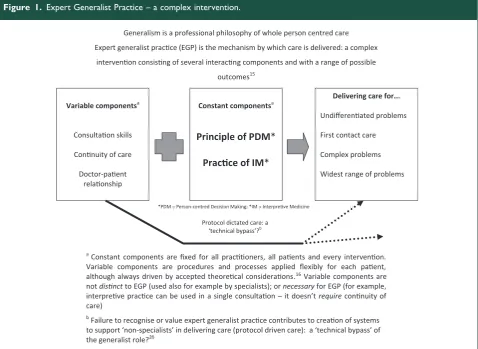
From this description, we thus recognize EGP as a complex intervention as described within the Medical Research Council Complex Interventions frame-work.15 It has several interacting and variable com-ponents (patient, practitioner and context), and a range of possible outcomes.15At its core are two dis-tinct or ‘constant components’ (understood as fixed for all practitioners, all patients and every treat-ment).16 These are firstly the principle of person-centred decision making which recognizes health as a resource for living and not an end in itself.6,17 Secondly, the practiceof interpretive medicine: inte-grating multiple sources of knowledge (including bio-medical, biographical and professional) in a dynamic exploration and interpretation of individual illness experience.17 Practice leads to decisions about what is wrong, and what is needed to intervene, which sup-port an outcome of health as a resource for living.18 By framing EGP as a complex intervention, we open it up to critical review using theoretical models
designed to understand the integration of complex interventions into usual practice. Built on a robust theoretical programme by May et al.,19 Normalization Process Theory (NPT) identifies 16 domains of work, grouped within four categories (Sense making, Engagement, Action and Monitoring) which need to be successfully underta-ken if a complex intervention is to be introduced and integrated into usual care. NPT has been used to investigate healthcare interventions especially in the field of chronic illness,20–22 including in the development of a toolkit to ‘help think through implementation and integration problems in health-care’.19 We have adapted the NPT toolkit to focus on EGP, and explicitly the constant components described above (Table 1). We used this toolkit to explore contextual23 factors which enable or con-strain delivery of the complex intervention of EGP, focusing on the care of people living with multimorbidity.
Sampling and data collection
We collected three datasets (see Box 1).
Analysis
A Framework Analysis approach24 was used to cat-egorize the data. Transcripts and survey responses were read to identify examples of work related to EGP which fell into the 16 domains identified within the modified NPT framework (Table 1). We categorized activities as ‘enablers’ where they offered examples of the work necessary for integration of EGP in usual care. Where we identified an absence of work, or a contradiction to EGP, we categorized these activities as constraints. JR analysed the full dataset; GI conducted a parallel analysis of the focus groups, VP coded five of the GP interviews. We used a Red/Amber/Green approach to summar-ize the findings in each of the 16 domains: green if we identified examples of the necessary work (enablers) with no constraints; red if we failed to identify any examples of the necessary work; amber if we saw a mixed picture.
Results
A summary of results across the 16 NPT domains is shown in Table 1, highlighting constraints across all four categories of work: Sense making, Engagement, Action and Monitoring. Detailed datasets are available from the authors. Here we present examples from the dataset to illustrate our key findings.
Table 1. The NPT-EGP framework – the Normalization Process Theory19toolkit adapted to examine the complex intervention that is EGP.
Domain of work predicted by NPT* Activity identified**
Sense making
1a. Participants can describe the distinctexpertiseof the generalist practitioner:whole person centred interpretive practice – decision making that recognises/addresses needs of this individual in their personal context
1b. Participants can describe what an expert generalist approach offers that isdifferent
to /distinctfrom other approaches:supporting health as a resource for living, not an end in
itself
1c. Participants can describe what specific tasks the generalist must do: adopt a principle of person centred care and practice of interpretive medicine including establishing trustworthiness of decisions
1d. Participants can describe why expert generalist care matters, with reference to the needs of the individual as well as communities, health service, wider society: avoid burden of care, support health as resource for living
Engagement
2a. Champions for expert generalist practice (‘trusted colleagues’25) exist and support others (‘communities of practice’25) in developing, delivering and evaluating EGP
2b. Participants recognise their own role in developing, delivering and evaluating expert generalist care
2c. Participants organise practice to accommodate/support EGP for people with multimorbidity
2d. Participants respond and adapt to change to keep EGP going
Action
3a. Participants are able to adopt a principle of person-centred decision making supporting health as resource for living and perform the tasks of interpretive medicine (discovery, integration, application, reflection)
3b. EGP supportscommunitiesof practice –collectivesense of trust in their work
3c. The right people with the right skills are available to do the necessary tasks of EGP
3d. The wider system/team supports EGP through supportive resourcing, priority setting, policies etc
Monitoring
4a. Practitioners and patients are able to monitor the impact of EGP
4b. Formal monitoring of impact supports a collective sense that EGP is worthwhile
4c. Individual patients and practitioners think EGP is worthwhile
4d. Feedback and monitoring of EGP supports individual and collective learning and development
Sense making
We explored participants’ perceptions of individual and collective understanding of what EGP is, how it is different from other forms of care, and why it matters. Responses revealed widespread acknow-ledgement that offering person-centred care mattered, but with problems in the other three domains of Sense making (Table 1).
All participants described a belief in a person-centred approach to care as an essential component for General Practice and primary healthcare. Some articulated this specifically as an iterativeinterpretive practice supporting personalized decision making
framed by a view of thewhole person.
[I work in] in a speciality of generalism in general practice. . .My role is to look after patients and their illnesses, which is very much a counterpoint to what happens in secondary care, where the systems are set up to look after people’s diseases. (Interview group, experienced GP)
However, others found it hard to articulate the distinct expertise of the generalist role. Some described instead the type of problems they were able to ‘manage’.
[The generalist] is someone who knows a bit about everything and knows when to ask for help. . .We manage simple things, and we ask for help for more complicated things. (Interview group, middle career GP)
Others spoke of the importance of continuity and relationships, the ‘variables’ in EGP (Figure 1), but also reflected that these were not unique to
generalist practice. For some, they recognized a dis-tinct expertise of professional practice but which they described as ‘intuition’ or a ‘sixth sense’. They reveal practice which relies on instinctive feeling rather than conscious reasoning – a tacit process of professional practice.25The tacit nature of this process may con-tribute to the reported perceptions that whilst patients and primary care practitioners value EGP, the wider community lack an understanding of the role.
Engagement
There was evidence of personal commitment from GPs to engage with EGP. For example, some GPs spoke of the importance of continuous investment – of working in the same practice over an extended period in order to gain the historical contextual knowledge they felt they needed to work as an expert generalist. Other strategies included work to support continuity of care and relationship building (Figure 1).
In order to investigate how the ‘ideal’ of EGP translates into daily practice, participants were also asked about the organization of care for complex patients with multimorbidity. Responses revealed that these patients were often more likely to be receiv-ing care organized around protocol-driven care.
As a locum, I note this is structured very differently between practices. It is common for the practice nurse to manage chronic health conditions using the guideline/silo approach. (Survey respondent, locum GP)
This was perceived to stem from a lack of a system wide engagement with the personalized approach of
Box 1.Describing the three datasets
1.Interviews with practising GPs in Merseyside(Autumn 2011: JR, FM, CFD, SM, CM, JG, VP, GF)
All GPs on a local peer support group email list (n¼160) were invited to take part in an interview exploring experiences of delivering generalist care to people with multimorbidity. Ten GPs replied, one practice manager also took part. All GPs had completed specialist training; seven women, three men; three early career, seven experienced GPs. An interview schedule based on the modified NPT Toolkit (Table 1) was used (available from the authors) to explore enablers and constraints for EGP. JR conducted all interviews.
2.Survey of attendees at an RCGP Conference workshop on Generalism(October 2012, JR, GF, AH)
Workshop attendees (approximately 250 people) were all invited to complete an online survey developed from the modified NPT toolkit (revised in light of findings from dataset 1). The Survey monkey link was also circulated in an RCGP newsletter and participants invited to pass the link on to interested parties (https://www.surveymonkey.com/s/QCL6R3K). Ninety-six replies were received, 94 from practising GPs.
3.Focus groups with International GPs in training attending RCGP Conference(October 2012, GI, JW, AS, JR)
Organized by the Junior International Committee of the Royal College of General Practitioners, two focus groups were held with conference delegates to explore international GP Trainee and First five GPs’ perspectives on expert generalist practice. Sixteen people attended one of two groups run by GI, AS and JW. Participants came from Portugal, Spain, Austria, Poland, Italy, Romania, Denmark and Israel. The interview schedule was developed from the survey tool and is available from the authors.
EGP. External priorities were perceived to be unsup-portive of EGP, with competing priorities, a lack of time and a general increasing workload placing a sig-nificant constraint on EGP.
Daily task is dealing with acute problems when the complex patients can be silo’d or overlooked. Actually time well spent going through complex patients but no time for this in busy day. (Survey respondent, qualified GP)
None of our participants spoke of champions for EGP acting as beacons for colleagues, although our interview/survey schedules did not explicitly probe for this. Whilst we saw repeated examples of people continuing to commit to the ideal of General Practice despite the pressures, there was a suggestion that external constraints threatened to limit, rather than enhance, engagement with EGP.
Unfortunately the tick box protocol driven model we currently run under is promoting a lack of generalist skills and indeed an inability to think outside the boxes. (Survey respondent, qualified GP)
Action
Here we sought evidence of capacity for delivery of the ‘constant components’ of EGP. Again, analysis revealed a mixed picture.
Some participants clearly described being comfort-able with interpretive practice and having the skills for the task. For example, GPs described case his-tories of personalized decision making and interpret-ive practice; delinterpret-ivering ‘beyond protocol care’ which focused on the person rather than the medicine. Some described having had formal training in the skills needed; one survey participant spoke of gaining skills through research science training. For the majority, expertise came through experiential learn-ing (64% in the survey). However these skills were not perceived to be universal.
sadly, some experienced GPs and consultants either do not have these skills or do not feel able to use them. (Survey group, qualified GP)
[image:6.595.66.545.71.420.2]The distinction between ‘knowing’ and ‘doing’ generalist practice was a common theme.
Figure 1. Expert Generalist Practice – a complex intervention.
Generalism is a professional philosophy of whole person centred care
Expert generalist pracce (EGP) is the mechanism by which care is delivered: a complex
intervenon consisng of several interacng components and with a range of possible
outcomes15
*PDM = Person-centred Decision Making; *IM = Interpreve Medicine
a Constant components are fixed for all praconers, all paents and every intervenon.
Variable components are procedures and processes applied flexibly for each paent, although always driven by accepted theorecal consideraons.16 Variable components are
not disnct to EGP (used also for example by specialists); or necessary for EGP (for example, interpreve pracce can be used in a single consultaon – it doesn’t require connuity of care)
b
Failure to recognise or value expert generalist pracce contributes to creaon of systems to support ‘non-specialists’ in delivering care (protocol driven care): a ‘technical bypass’ of the generalist role?26
Variable componentsa
Consultaon skills
Connuity of care
Doctor-paent relaonship
Delivering care for...
Undifferenated problems
First contact care
Complex problems
Widest range of problems
Protocol dictated care: a ‘technical bypass’?b Constant componentsa
Principle of PDM
*
Some respondents described the impact of external constraints on their capacity to implement the skills and expertise of generalist practice.
You’ve always got the targets coming out at you from the computer. . .I think the problem is time. . .you’ve got your 10 minutes to try and have that consultation. It’s sometimes easier just to say ‘the evidence shows that this is the best for your blood pressure to be’, and you know, press on. And so sometimes I suppose you do do that. (Interview group, experienced GP)
For others, the constraint lay in the lack of ‘devel-opment of a sense of personal and collective trust in EGP through practice’ (Table 1). For example, those who spoke of practice as being ‘intuitive’ also described a fear of how others might judge this type of practice.
I think we do have more kind of guidelines, protocols and things. Which are, as if ‘this is what you should do in this’. You sort of almost feel like you don’t follow the protocols, that you’re doing the wrong thing. (Interview group, qualified GP)
Personally I am afraid to do something against guidelines. . .If I only use my intuition, I cannot defend [myself]. That’s why I am afraid of it. (Focus group, GP trainee)
Clinical governance systems were not perceived to support a sense of ‘building accountability through EGP’ (Table 1). As highlighted above, GPs spoke of being fearful of ‘being wrong’. Yet they also recog-nized that turning away from EGP towards ‘following a protocol’ brought potential adverse consequences.
In an increasingly litigious medical society. . .with growing patient expectations it is difficult to know when to stop following EBM guidelines which inev-itably causes the over-medicalising of many ailments. (Survey group, practising GP)
These uncertainties about the implementation of EGP are perhaps captured in a comment from one survey respondent.
In theory we can do this but in practice don’t always. (Survey group, qualified GP)
Monitoring and feedback
Our final category explored the impact of feedback and monitoring in supporting the integration of EGP
into usual practice. GPs reported that they were able to monitor the impact of care through following up their patients. Several also highlighted the import-ance of shared peer reflection on experiential know-ledge and practice. Both contributed to an individual and collective sense (at least amongst GPs) that EGP was worthwhile: 83% of GPs responding to the survey said that EGP was worth the effort. However in one focus group, GPs reflected that feed-back was only of value if a person was receptive to it.
A: I think that the only way to learn this to be an expert in generalisation is to meet every day, many, many patients and to learn from them, I think that they are the best teacher to us. B: Yes but you have to be open to it. Some colleagues of ours aren’t. (Focus group participants; two trainee GPs)
There was a perception of a mismatch between the monitoring required by external systems and that to support EGP. With a sense that those outside of General Practice failed to understand or value the EGP approach (only 19% of survey participants thought that their Primary Care Trust thought EGP was worthwhile). We noted a lack of ‘formal moni-toring of impact which supports a collective sense that EGP is worthwhile’ (Table 1).
nowadays when standard care is the norm, you could be criticised for offering exceptional or special care. (Survey respondent, qualified GP)
Discussion
Principle findings
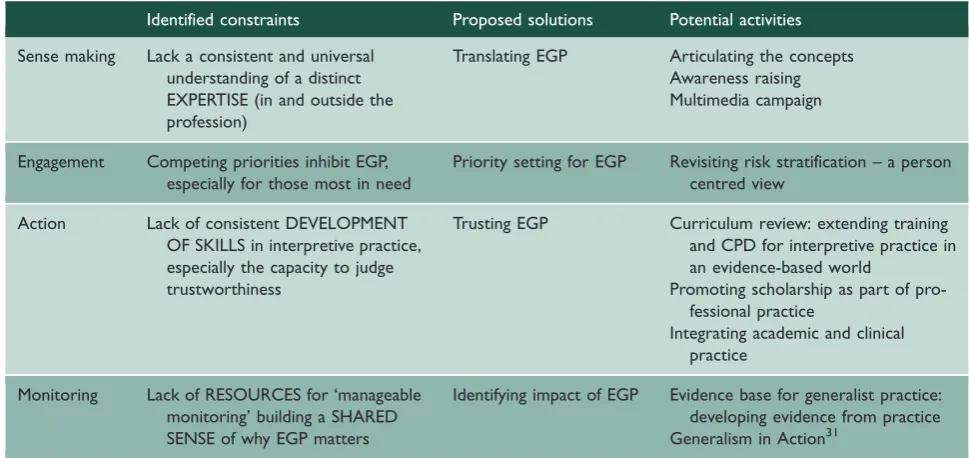
Our study identified support for the principles of gen-eralism across the GP community. However, we iden-tified a number of constraints to implementation to the delivery of EGP in the primary care setting. Constraints were identified in most of the domains of work predicted by NPT as necessary to support successful integration of a complex intervention into usual practice. Our findings also highlight potential areas for targeted change which may address these concerns. We summarize our findings in Table 2.
Strengths and limitations of our study
We recognize a number of limitations to our study methods. Our data are derived from convenience samples, predominantly from the UK. It may not be representative of the wider (and international) General Practice community. The majority of the
data comes from GPs, and so we lack the insights of other primary care stakeholders including patients. We were not able to compare what GPs report of their work with what they do in practice; to explore differences between the ‘rhetoric’ and ‘reality’ of prac-tice. Finally, enablers and constraints to practice will be context specific and so we cannot assume that the issues identified in this study would apply – for exam-ple – to hospital generalists. However, the strengths of our work lie in providing a novel and practical framework which could be applied in multiple con-texts to systematically identify barriers to practice, and in turn to evaluate the impact of change.
Implications for practice
EGP makes sense to practising GPs but we note that some practitioners struggled to articulate the distinct expertise of EGP. Our data not only support the view that generalism is ‘deeply known’14to (at least some) practitioners, but also suggest that the practice of EGP has become ‘lost in translation’. Some practi-tioners know what it is, but have no language to describe (and defend) it; referring instead to ‘intuitive practice’. Others appear to define the generalist role primarily as an all-rounder role, describing their key function as filtering out complex problems to refer on. It is perhaps unsurprising therefore that those outside of the profession fail to understand EGP.
We therefore propose the need for a body of work on Translating EGP: raising the understanding and profile of this distinct role both within the profession and beyond. The recent Royal College of General
Practitioners (RCGP) report5has started a conversa-tion. We offer our account of EGP as a complex intervention (Figure 1) as a further step in opening up a tacit professional model to all. We emphasize that this is not just ‘doing good general practice’. Rather this is to highlight and celebrate the two cen-tral components of EGP – a distinct expertise that is in the toolbag of some, but not all, GPs.26 Further work is needed to translate these ideas into frame-works that make sense to wider stakeholder groups, including patients as well as policy makers; for example making use of multimedia to support com-munication (see for example www.youtube.com/ watch?v=PZ7vfumUuHk).
We not only saw evidence of GPs and practice teams seeking to engage with EGP, but also a percep-tion of barriers created by external, competing prio-rities for resources including GP time. This lack of external engagement with EGP may be altered by work to improve understanding of EGP. However, our findings resonate with a wider literature con-cerned by an overemphasis on community delivery of disease focused care3: defining need for care on the basis of condition focused guidelines27and popu-lation need rather than a personal assessment of need. We propose a new body of work onPriority setting
[image:8.595.60.545.84.313.2]for EGP. To explore how to assign need for care based on an understanding of personal experiences of health as a resource for living. Our longitudinal study of the experience of living with chronic illness suggests we need to design needs assessment for per-sonalized care on the capacity to manage the work of daily living.28 We need new priority setting and risk
Table 2. Summary and implications – what needs to change to enhance expert generalist practice?
Identified constraints Proposed solutions Potential activities
Sense making Lack a consistent and universal understanding of a distinct EXPERTISE (in and outside the profession)
Translating EGP Articulating the concepts Awareness raising Multimedia campaign
Engagement Competing priorities inhibit EGP, especially for those most in need
Priority setting for EGP Revisiting risk stratification – a person centred view
Action Lack of consistent DEVELOPMENT
OF SKILLS in interpretive practice, especially the capacity to judge trustworthiness
Trusting EGP Curriculum review: extending training and CPD for interpretive practice in an evidence-based world
Promoting scholarship as part of pro-fessional practice
Integrating academic and clinical practice
Monitoring Lack of RESOURCES for ‘manageable monitoring’ building a SHARED SENSE of why EGP matters
stratification approaches supporting a generalist approach.
Not all GPs reported that they had the skills for EGP. Even GPs who reported having skills in EGP expressed concerns about their capacity to defend the use of these skills, especially if making ‘beyond proto-col’ decisions. These findings suggest a shortage of confidence or skills in the interpretive medicine elem-ents of EGP and particularly in a key element of that role – the ability to judge the trustworthiness of the interpretation. We highlightTrusting EGPas a third constraint to practice.
The GP curriculum describes that a GP should have specific problem-solving skills including the cap-acity to ‘selectively gather and interpret informa-tion. . .and apply it in an appropriate management plan’.8 Elsewhere, that GPs should take a holistic approach using the ‘biopsychosocial’ approach to understand the whole patient.8 The biopsychosocial model is recognized to have ‘broaden[ed] the scope of the clinician’s gaze’.29 But gathering more informa-tion is not enough unless we also have a framework by which to use it. The biopsychosocial model has been criticized for not ‘guid[ing] us on how to priori-tise’.30 Our findings suggest that we perhaps need to revisit and extend these elements in order to support interpretive practice, particularly in a modern context where a particular view of evidence-based practice is dominant.6
We suggest the need to review the RCGP GP cur-riculum and continuing professional training to include greater emphasis on the critical interpretive skills of practice. Gabbay and le May’s25 ethno-graphic study of how contextually adroit GPs engage in interpretive practice to generate knowl-edge-in-practice-in-context, or mindlines, offers one source of study. Our own Exploratory Decision Map,6 translating thinking on demonstrating the trustworthiness of interpretive practice from the qualitative research field into clinical practice, offers another approach. Both identify skills of scholarship (discovery, integration, application and inspiration – see www.sapc.ac.uk/index-php/academic-primary-care) at the heart of professional primary care prac-tice: both clinical and academic. This indicates that generalist primary care would be strengthened by closer working between the clinical and academic arms of the discipline.
Finally, we saw evidence that GPs already moni-tor the impact of personalized decision making through their continued relationship with patients. However, they felt that external quality monitoring processes did not recognize or support this learning. Current monitoring fails to support the development of trust in, and understanding of, the merits and
limitations of EGP. We therefore propose the need for a fourth body of work onIdentifying the impact of EGP. Supporting practitioners in evaluating their individual practice has the potential to enhance skills and confidence in interpretive practice (Trusting EGP). If we can also capture that learn-ing, we may also support development of an evi-dence base from practice on how and when expert generalist care offers something different to, and better than, specialist care. We have recently described a framework by which to generate this evidence from practice – the Generalism in Action framework.31
Future research
Our goal was to understand how we might enhance the practice of generalist expertise in the primary care setting. Our study has identified four key constraints to EGP and proposed solutions to system wide approach supporting a primary healthcare vision of Health For All.3The next step will then be to identify if changes to enhance EGP make a difference to patient outcomes. This will be a focus of the next stages in our research.
Declarations
Competing interests: JR is funded by an NIHR Clinician Scientist Award supporting development of a body of work on Generalist Solutions to Complex Problems. AH and GF both con-tributed to the authorship of the 2011 and 2012 Royal College of General Practitioner reports on Medical Generalism. There are no interests to declare for the remaining authors.
Funding: The fieldwork in this study was supported by funding from JR’s NIHR fellowship.
Ethical approval: The project was reviewed by NHS NorthWest 10 Research Ethics Committee and Liverpool University Ethics Committee and judged to constitute service evaluation not requiring formal ethical review. Nonetheless, the work adhered fully to the standards of practice required by Good Clinical Practice.
Guarantor: JR
Contributorship: JR conceived the work. JR, FM, CFD, SM, CM, JG, VP and GF supported the adaptation of the NPT framework for this study. Data collection was undertaken by JR, GF, AH, GI, AS and JW. Analysis was undertaken by JR, VP and GI. All authors have contributed to writing of paper and approved the final draft. The authors would like to acknowledge the contributions of all participants in the three datasets. An overview of this work has also been submitted to the 2013 NIHR New Media competition and can be seen at www. primarycarehub.org.uk/egp.
Acknowledgements: The authors would like to thank all the participants who took part in this study.
Provenance: Not commissioned; peer-reviewed by Iona Heath.
References
1. Starfield B. Politics, primary care and health: was Virchow right? J Epidemiol Community Health 2011; 65: 653–655.
2. Kringos DS, Boerma WGW, Hutchinson A, van der Zee J and Groenewegen PP. The breadth of primary care: a systematic literature review of its core dimen-sions.BMC Health Serv Res2010; 10: 65.
3. Primary health care: now more than ever. Geneva; London: World Health Organisation, 2008.
4. Gunn J, Palmer VNL, Kokanovic R, Pope C and Lathlean J. What is the place of generalism in the 2020 primary care team? Melbourne: Australian Primary Health Care Institute, 2007.
5. Medical generalism: why expertise in whole person medi-cine matters. London: Royal College of General Practitioners, 2012.
6. Reeve J, Irving G and Dowrick C. Can generalism help revive the primary healthcare vision? J R Soc Med
2011; 104: 395–400.
7. The European definition of general practice/family prac-tice. WONCA, 2011.
8. Being a general practitioner. London: RCGP, 2012. 9. Guiding patients through complexity: modern medical
generalism. London: RCGP, 2011.
10. May C, Montori VM and Mair F. We need minimally disruptive medicine.BMJ2009; 339: b2803.
11. Mercer SW, Gunn J, Bower P, Wyke S and Guthrie B. Managing patients with mental and physical multimor-bidity.BMJ2012; 345: e5559.
12. McWhinney IR and Freeman T. Textbook of family medicine. Oxford: Oxford University Press, 2009. 13. Howie JG. Developing a ‘consultation quality index’
(CQI) for use in general practice.Fam Pract2000; 17: 455–461.
14. Stange K. The generalist approach. Ann Fam Med
2009; 7: 198–203.
15. Complex interventions guidance. London: Medical Research Council, 2008.
16. McPherson H and Schroer S. Acupuncture as a com-plex intervention for depression: a consensus method to develop a standardised treatment protocol for a rando-mised controlled trial.Complement Ther Med2007; 15: 92–100.
17. Reeve J.Interpretive medicine: supporting generalism in a changing primary care world. Occasional Paper Series 88. London: Royal College of General Practitioners, 2010.
18. Reeve J and Bancroft R. Generalist solutions to over-prescribing: a joint challenge for clinical and academic primary care. Prim Health Care Res Dev, FirstView
article. Available from: http://dx.doi.org/10.1017/ S1463423612000576 (last accessed 28 October 2013). 19. May C, Murray E, Finch T, Mair F, Treweek S,
Ballini L, et al. Normalisation process theory on-line users manual and toolkit. Available from: http:// www.normalizationprocess.org (last accessed 18 September 2013).
20. Gallacher K, May C, Montori VM and Mair F. Understanding patients’ experiences of treatment burden in chronic heart failure using normalisation process theory.Ann Fam Med2011; 9: 235–243. 21. Franx G, Oud M, de Lange J, Wensing M and Grol R.
Implementing a stepped-care approach in primary care: results of a qualitative study. Implement Sci
2012; 7: 8.
22. Blakeman T, Protheroe J, Chew-Graham C, Rogers A and Kennedy A. Understanding the management of early stage kidney disease in primary care: a qualitative study.Br J Gen Pract2012; 62: 233–242.
23. Campbell NC, Murray E, Darbyshire J, Emery J, Farmer A, Griffiths F, et al. Designing and evaluating complex interventions to improve health care. BMJ
2007; 334: 455–459.
24. Ritchie J and Lewis J.Qualitative research practice – a guide for social science students and researchers. London: Sage, 2003.
25. Gabbay J and le May A. Practice-based evidence for health care. Clinical mindlines. Oxon: Routledge, 2010. 26. Reeve J, Irving G and Freeman GK. Dismantling Lord Moran’s ladder: the primary care expert generalist.Br J Gen Pract2013; 63: 34–35.
27. Johnson S.Risk stratification and next steps with DH risk prediction tools – patients at risk of re-hospitalisa-tion and the combined predictive model. London: Department of Health, 2011.
28. Reeve J and Cooper L.Health as a resource for living: an outcome of person-centred care?, Oral presentation at North American Primary Care Research Group meet-ing 2012. Available from: http://www.napcrg.org/ 2012Abstracts.pdf (last accessed 18 September 2013). 29. Borrell-Carrio F, Suchmann AL and Epstein RM. The
biopsychosocial model 25 years later: principles, prac-tice and scientific inquiry. Ann Fam Med 2004; 2: 576–582.
30. Ghaemi SM. The rise and fall of the biopsychosocial model.Br J Psychiatry2009; 195: 3–4.