http://wrap.warwick.ac.uk/
Original citation:Abramitzky, Ran and Lavy, Victor (2013) How responsive is investment in schooling to changes in redistributive policies and in returns? Working Paper. Coventry, UK:
Department of Economics, University of Warwick. (CAGE Online Working Paper Series).
Permanent WRAP url:
http://wrap.warwick.ac.uk/59240
Copyright and reuse:
The Warwick Research Archive Portal (WRAP) makes this work of researchers of the University of Warwick available open access under the following conditions. Copyright © and all moral rights to the version of the paper presented here belong to the individual author(s) and/or other copyright owners. To the extent reasonable and practicable the material made available in WRAP has been checked for eligibility before being made available.
Copies of full items can be used for personal research or study, educational, or not-for-profit purposes without prior permission or charge. Provided that the authors, title and full bibliographic details are credited, a hyperlink and/or URL is given for the original metadata page and the content is not changed in any way.
A note on versions:
The version presented here is a working paper or pre-print that may be later published elsewhere. If a published version is known of, the above WRAP url will contain details on finding it.
WORKING PAPER SERIES
Centre for Competitive Advantage in the Global Economy
Department of Economics
Sep 2013
No.150
How Responsive is Investment in Schooling to Changes in
Redistributive Policies and in Returns?
Ran Abramitzky
Stanford University and NBER
How Responsive is Investment in Schooling to Changes in Redistributive Policies
and in Returns?
*Ran Abramitzky Victor Lavy
Stanford University
Hebrew University,
and NBER University of Warwick and NBER
August 2013
Abstract
This paper uses an unusual pay reform to test the responsiveness of investment in schooling to changes in redistribution schemes that increase the rate of return to education. We exploit an episode where different Israeli kibbutzim shifted from equal sharing to productivity-based wages in different years and find that students in kibbutzim that reformed earlier invested more in high school education. This effect is stronger for males and is largely driven by students whose parents have lower levels of education. We also show that, in the long run, students in kibbutzim that reformed earlier were more likely to complete post-high school academic colleges. Our findings support the prediction that education is highly responsive to changes in the redistribution policy, especially for students from weaker backgrounds.
* This paper is a revised and substantially shortened version of NBER working paper 17093. We thank
1
I. IntroductionWe study a unique episode where some kibbutzim (plural of kibbutz) changed their decades-long policy of setting wages independent of an individual’s human capital to setting wages to reflect the market rate of return. This sharp change in the redistributive policy from equal sharing to pay-for-productivity introduced a dramatic increase in the returns to schooling for kibbutz members. We test whether and to what extent this policy change induced high school students to invest more in their education, as reflected by their academic achievements during high school and in adulthood.
We use administrative records collected by the Israeli Ministry of Education for six consecutive cohorts (from 1995 to 2000) of 10th grade students, following them to graduation,
combined with National Social Security Administrative data on completed years of higher education when individuals in our sample were 28 to 33 years old. One important outcome we examine is whether the student passed all the matriculation exams successfully and got a matriculation diploma (equivalent to a baccalaureate diploma in most European countries), which is necessary for post-high school education in Israel and yields a substantial earning premium in the general Israeli labor market. Other outcomes of interest are whether the student graduated high school, her average score in the matriculation exams, and whether her diploma meets the university entrance requirements. We then study whether, in the long run, these students enrolled in post-high school education of various types and how many years of schooling they completed. Our identification strategy relies on the fact that the pay reform was not implemented in all kibbutzim in the same year. We use a difference-in-differences approach, comparing educational outcomes of high school students in kibbutzim that reformed early (1998-2000) and late (2003-2004), before and after the early reforms. We show evidence that students in early-reforming (the treatment group) and late-early-reforming kibbutzim (control group) are very similar in their observable background characteristics and in their pre-reform schooling outcomes.
Overall, we find that students in kibbutzim that reformed early experienced an improvement in all high school outcomes. For example, the mean score in the matriculation exams (Bagrut) increased by 3.55 points (0.17 standard deviations of the test score distribution) and the university qualified Bagrut rate by 6.0 percentage points (about 12 percent). We further show that the effect is mainly driven by students in kibbutzim that reformed to a larger degree. This total positive effect of the reform on educational outcomes appears to be largely driven by males and by the subgroups of students who have less educated parents.
2
teachers’ colleges during the decade following the reform, and gained on average 0.2 additional years of college schooling during this period.
This paper contributes to two strands of the literature. From a public economics perspective, this paper sheds light on the extent to which redistributive policy influences long run labor supply, as mediated through educational choices. While it is well known that changes in taxes affect labor supply decisions in the short run (Saez, Slemrod and Giertz 2009), much less is known about how such changes affect labor supply decisions in the long run, because it is difficult to identify empirically how such tax changes affect educational choices. This paper fills this gap by studying how responsive educational choices are to tax changes.
From a labor economics perspective, economic models of optimal human capital investment (Ben Porath 1967) suggest that the level of investment in schooling is expected to increase in the perceived rate of return to education.1 However, despite its centrality in modern
labor economics, this fundamental assumption has hardly been tested empirically, both because variation across individuals in the rate of return to schooling is rarely observed and because sharp changes in this return rarely occur.2
While the pay reform in kibbutzim sharply increased the returns to schooling, it could influence schooling outcomes through two other channels. First, via the reduction in social incentives for encouraging education that had been used under equal sharing (pre reform). Under equal sharing, the kibbutz provided members with various services and communal organization, and members might have felt indebted to their kibbutz and invested in education for the common cause. Such social norms would be reduced following the pay reform. Second, via the changes in income levels of parents, which might affect education decisions through liquidity constraints, because children’s education is a normal good, or through the concavity of utility in income assuming some intergenerational transfers. Our paper cannot fully disentangle these mechanisms, Moreover, as far as we know, ours is the first study to document the short- and long-run responses to an increase in the rate of return to schooling.
1 Note simple models of investment in education, such as presented in Eaton and Rosen (1980), show that,
when the only cost of education is the opportunity cost of foregone earnings, a proportional change in the income tax rate does not affect private incentives to invest in education. However, because education inevitably involves effort costs and likely other costs besides, theory predicts that the change in income tax rates that we study will affect investment in education.
2 Freeman (1976) and Kane (1994) find a positive response of schooling investments to increased returns.
3
but we provide suggestive evidence that the returns to education channel operated above and beyond the social incentives channels, and that the income channel played only a limited role.
The rest of the paper is structured as follows. The next section presents a brief background of kibbutzim and the pay reform, and of the Israeli high school system. Section III describes the data and discusses the empirical framework and identification strategy. Section IV presents the results on the effect of the reform on high school outcomes, section V presents the results on the long term effect on post-high school education, and section VI concludes.
II. Brief Background
The pay reform in kibbutzim: Kibbutzim are voluntary communities that have provided their members with a high degree of income equality for almost a century.3
The episode that we study is a unique pay reform that kibbutzim in Israel adopted beginning in 1998. During the following years, many kibbutzim shifted from equal sharing by introducing compensation schemes based on members’ productivity, which created a link between productivity and earnings in kibbutzim for the first time. These pay reforms were a response to changing external pressures and circumstances facing kibbutzim. Some contributing factors were a decline in world prices of agricultural goods, bad financial management, and a high-tech boom during the mid-1990s, which increased members’ outside options considerably. Perhaps the biggest problem was the 1985 stabilization program in Israel following a few years of high inflation, which raised interest rates dramatically and left many kibbutzim with huge debts they could not repay. As a result, living standards in many kibbutzim fell substantially, members left in large numbers during the late 1980s and early 1990s, and talk about a major reform of kibbutz life began.
Traditionally, all kibbutzim were based on full income sharing between members. Specifically, each member of a kibbutz was paid an equal wage, regardless of her contribution to the community. Kibbutz members who worked outside their kibbutz brought their salaries in, and these were split equally among members. This meant that monetary returns to ability and effort were close to zero.
In reformed kibbutzim, members’ wages reflected market wages.Members who worked outside their kibbutzim (about a quarter of all members) largely kept the wages they received from their employers. Members who worked inside received wages based on the wages of non-kibbutz workers of similar occupation, education, skills, and experience. A non-kibbutz ‘tax’ was deducted from these gross wages to guarantee older members and very low wage earners in the
4
kibbutz a safety net (i.e. a minimum wage).4 The pay reform was essentially a sharp decrease in
the income tax rate. Before the reform, the income tax rate in kibbutzim was 100%. Post reform, the tax rates in kibbutzim became more similar to the Israeli tax rates. Specifically, kibbutz members faced a progressive tax system, with marginal tax rates ranging from 20 to 50%.5
The pay reform was also highly salient. The move from equal sharing to differential pay strongly signaled an increase in the financial rewards for human capital to young adults. This increase in the return to skills was noticeable within a family, as students’ parents experienced a decrease or increase in their earnings depending on their skills. Moreover, with the implementation of the reforms, kibbutz members received detailed information about the new sharing rule and how earnings were now going to be linked to productivity and reflect market forces. The productivity-based sharing rules were hotly debated by members in the kibbutzim and the reforms also received a lot of attention in the media both in Israel and abroad.
The Israeli high school system: When entering high school (10th grade), students choose
whether to enroll in the academic or non-academic track. Students enrolled in the academic track obtain a matriculation certificate (Bagrut) if they pass a series of national exams in core and elective subjects taken between 10th and 12th grade. Students choose to be tested at various
proficiency levels, with each test awarding one to five credit units per subject, depending on difficulty. Advanced level subjects are those subjects taken at a level of four or five credit units; a minimum of 20 credit units is required to qualify for a Bagrut certificate. About 52 percent of all high school seniors received a Bagrut in the 1999 and 2000 cohorts (Israel Ministry of Education, 2001). The Bagrut is a prerequisite for university admission and receiving it is an economically important educational milestone. For more details on the Israeli high school system, see Angrist and Lavy (2009).
III. Data and Estimation
The empirical analysis is based on a sample that includes students who live in kibbutzim at the start of 10th grade, and on information drawn from several administrative data files obtained from
the Ministry of Education in Israel. We obtained data for six consecutive cohorts (from 1995 to
4 Traditionally, kibbutzim paid income taxes to the government based on members’ average income. 5Data we collected on two particular kibbutzim that are currently reforming their pay systems, presented in
5
2000) of 10th grade students. Each record contains an individual, a school and a class identifier,
student date of birth, gender, parental education, number of siblings, year of immigration, ethnicity and schooling outcomes (graduating high school, receiving a Bagrut, receiving a Bagrut
that meets university entrance requirements6
We use a difference-in-differences (DID) approach comparing educational outcomes of high school students in kibbutzim that reformed early (1998-2000, treatment group) vs. late (2003-2004, control group), before and after the early reforms (but before the late reforms).
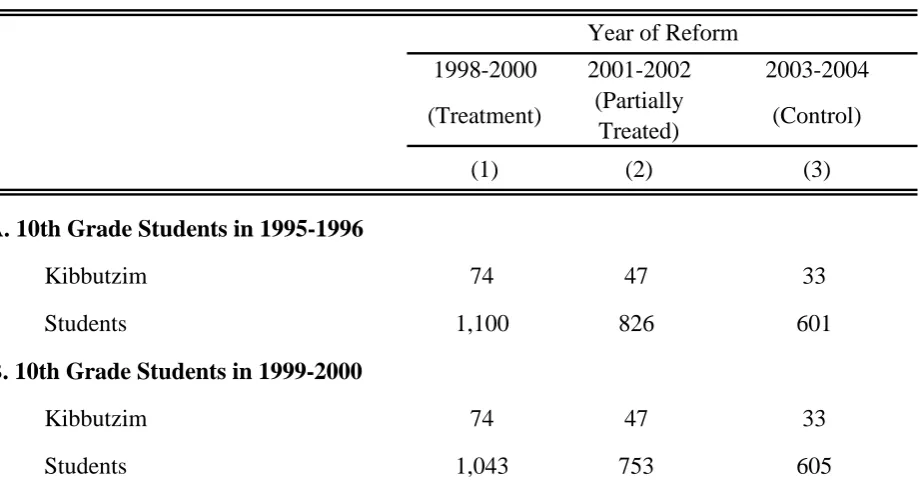
[image:8.612.91.529.331.471.2]and the average score in the matriculation exams). We link these student-level data with additional data collected by the Institute for Research of the Kibbutz and the Cooperative Idea (Getz 1998-2004) on the date at which each kibbutz reformed. Table A3 in Online Appendix presents the number of kibbutzim that reformed and number of students by year of reform. We also use data on post-high school educational outcomes that we obtained from the National Insurance Institute of Israel. We describe these data in Section V.
7
These timings are illustrated in Figure 1 below.
In section IV.c. we take a more continuous treatment approach by exploiting the time-varying “intensity” of the reform. The difference between pre- and post-reform cohorts in the treatment kibbutzim relative to control kibbutzim can be modeled as in the following simple DID regression:
(1) where Yikc is the achievement outcome of student i in kibbutz k in cohort c, are cohort
dummies (for students starting high school in 1995, 1996, 1999 and 2000),
6 A Bagrut that meets university entrance requirement is one that contains at least 4 credits in English and
another subject at a level of 4 or 5 credits.
7 We exclude kibbutzim that reformed in 2001-2002 to avoid anticipation effects (see discussion in section
II).
year
1995 1996 1997 1998 1999 2000 2001 2002 2003 2004 2005
treatment kibbutzim
reformed control kibbutzim reformed pre-reform cohort
6
denotes whether the student belonged to a kibbutz that implemented the reform early, and is the interaction of interest, namely whether the student belonged to the affected (post-reform) cohort and lived in a kibbutz that reformed early. Standard errors are adjusted for clustering at the kibbutz level. We also estimate a specification that includes kibbutz fixed effects, cohort fixed effects, and a vector of the student’s background characteristics, as follows:
(2) where are kibbutz fixed effects, are student i’s characteristics, and the rest of the variables are as in equation (1). Note that when comparing pre- and post-reform students, the kibbutz fixed effects essentially also capture school fixed effects because almost all students from the same kibbutz attend the same high school. Note also that kibbutz children typically go to high schools located outside of kibbutzim, together with children from other kibbutzim and from villages. This means that the effects we document are due to the behavioral responses of students rather than changes in the quality of the educational system.
The identifying assumption of our strategy is that the exact timing of the reform is unrelated to potential outcomes of students. This assumption implies that older cohorts of early- and late-reforming (treatment and control) kibbutzim should have had similar high school outcomes on average. We next provide evidence in support of the research strategy and this identification assumption.
7
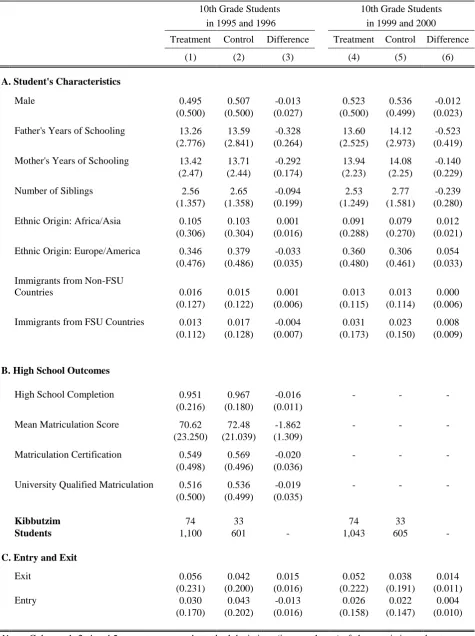
European/American ethnic origin in the post-reform sample.8
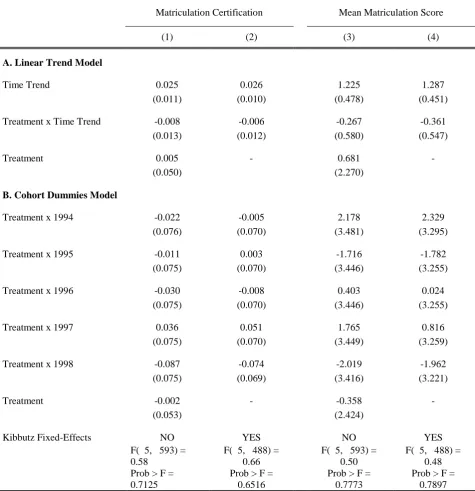
Were the control and treatment kibbutzim on different pre-reform time trends? We use pre-reform datafrom 1993 to 1998 to estimate differential time trends in outcomes for treatment and control kibbutzim. The unit of observation in this analysis is a kibbutz-year. First, we estimate a constant linear time trend model while allowing for an interaction of the constant linear trend with the treatment indicator. We also include specifications with the main effect for the treatment group instead of kibbutz fixed effects. Second, we estimate a model where we replace the linear time trend variable with a series of year dummies and include in the regression an interaction of each of these cohort dummies with the treatment indicator. The estimates from both models suggest that there is a time trend in the educational outcomes used, but this trend is identical for treatment and control kibbutzim. These results are presented in Table 2 for the mean matriculation rate and Bagrut mean test score (two representative outcomes; the evidence for the other outcomes is identical). The mean trend is an annual increase of 0.025 in the matriculation rate and a 1.225 point annual increase in test scores. The estimated coefficient on the interaction of this trend with the treatment indicator is practically zero in both cases. Moreover, the estimated coefficient of the treatment indicator main effect is zero in both cases, again confirming the balancing tests’ results on pre-reform outcomes presented in Table 1. The evidence presented in the cohort dummies model is fully consistent with the linear trend model. The interaction terms of the treatment indicator with the year dummies are all small and not significantly different from zero; we also note that some are positive and others are negative, lacking any consistent pattern. This conclusion is supported by the fact that based on the F tests presented in the table we cannot reject the hypothesis that all the interaction terms are jointly equal to zero. We conclude that both groups were on a similar time trend of educational matriculation outcomes in the six years prior to the reform.
Similarly small and insignificant differences in pre-reform mean outcomes of the control and treatment groups in 1995/1996 are presented in Panel B of Table 1. We conclude that students in the treatment and control groups are similar in their mean background characteristics and pre-reform mean schooling outcomes.
Did the control and treatment kibbutzim experience different exit or entry rates? We address this concern by checking whether the likelihood that a student leaves or enters a kibbutz is associated with the timing of the reform in his kibbutz. We define a student as exiting if he
8 In Online Appendix Tables A4-A11 we present additional evidence on the well balanced comparison
8
lived in his kibbutz at the start of the 10th grade and lived outside it at the end of the 12th grade.9
We define a student as entering if he did not live in his kibbutz at the start of the 10th grade and
lived in by the end of the 12th grade. We estimate whether there is such a differential exit or entry
rate for the pre-treatment (1995-96) and post treatment sample (1999-2000). Panel C of Table 1 shows that the likelihood that a student leaves or enters his kibbutz is relatively low and unrelated to the implementation of the pay reform: the DID in exit and entry rates are essentially zero, and exit and entry rates remained the same over time in both the treatment and control groups.10
Are kibbutzim that never reformed an appropriate comparison group? Kibbutzim that never reformed differ from those that did in that they had different experiences in the decade leading to the reform period (Abramitzky 2008). Specifically, kibbutzim that reformed experienced a deeper financial crisis and higher exit rates in the decade leading to the reform. Subsequently, kibbutzim that never reformed formed the “egalitarian/communal wave” (zerem shitufi) that revived the traditional egalitarian norms by instilling communal and equality norms in members, opposed the reforms in other kibbutzim and proudly became “the only kibbutzim like in the good old days”. These kibbutzim have often become even more successful economically and socially. There are thus reasons to believe kibbutzim that didn’t reform strengthened their group identity and social norms, which may have improved educational outcomes through a different channel. Empirically, in Online Appendix Tables A12-A14 we present versions of these three tests that compare treatment kibbutzim with kibbutzim that never reformed. We show a large and significant difference in exit rates of the post-reform cohort, and significant differences in some of the students’ observable characteristics. These results suggest students in kibbutzim that never reformed differ from the early reformers in ways that make them an inappropriate comparison group. We also show in Online Appendix Tables A15 that kibbutzim that reformed in 2001-2002 had a larger and significant exit rate among the 1999 and 2000 10th grade cohorts, which suggests
that it is preferable not to use these kibbutzim as a control group.
Were there anticipation effects? We cannot rule out that members in kibbutzim that reformed later observed the reforms in other kibbutzim, and anticipated that at some later date their kibbutz would reform too. However, three relevant things are worth noting. First, conceptually, any anticipation effects that were present make it more difficult for us to find an impact of the reform. Second, our choice of kibbutzim that reformed at least four years after the treatment kibbutzim reformed as our control group makes such anticipation effects less likely and less prominent if
9 Note students are included in the sample based on their location at the start of 10th grade, so students who
exit a kibbutz during high school are included, whereas those who enter are not.
10A similar analysis of entry and exit rates for the 1997-98 cohorts yields comparable results, which are
9
they exist. Third, empirically, we do not find evidence of anticipation effects, in the sense that educational outcomes in control kibbutzim are similar for the earlier and later cohorts.11
IV. The Effect of the Reform on High School Educational Outcomes
a. Basic results: This section shows the basic results without taking the intensity of the reforms into account. Panel A, first row, of Table 3 reports simple DID estimates with no additional controls (equation 1) and in the second row we present the DID estimates which are based on regressions that also include individual characteristics and kibbutz fixed effects (equation 2). Each cell in the table shows the estimated coefficient on the post cohort in treated kibbutzim. We find a positive coefficient of interest for all schooling outcomes. Two things are worth noting before we discuss the results further. First, the simple and controlled DID estimates of this treatment effect are similar, which is a result of the similarity between treatment and control groups in observables characteristics and in pre-reform outcomes. Second, the estimated coefficient on one of the four outcomes is not statistically significant and another one is only marginally significant. We later show that this lack of significance in the average effect is driven by the heterogeneities of the effects.
Turning to the estimated treatment effect on the other outcomes, the mean exam score is up by 3.55 points relative a pre-treatment mean of 70.6, or 0.17 standard deviations of the test score distribution. The matriculation rate is up by 4.9 percentage points and the university qualified Bagrut rate is up by 6 percentage points, which amounts to almost 12 percent of the pre-reform university qualified Bagrut rate in the control group. The improvement in the university qualified Bagrut rate could be driven by two particular improvements. The first is an increase in the proportion of students who enroll in and pass the English matriculation program at more than a basic level. The second is an increase in the proportion of students who pass the matriculation program in at least one advanced placement subject. These two criteria are an admission requirement for all universities and most colleges in Israel. The improvement we observe likely reflects a higher intention to enroll in post-secondary schooling. Finally, it is worth noting that in Online Appendix A16 we present the cross section regressions for the pre and post reform period, which show that most of the difference-in-difference estimates reflect post treatment differences in favor of the treatment group.
We also explore an alternative dependent variable that combines the information of three of our outcomes, an index variable that is 0 for high school dropouts, 1 for high school
11Students whose kibbutzim reformed a year after they left high school are also similar to students whose
10
graduation, 2 for matriculation certification, and 3 for university-qualified matriculation. Imposing cardinality, we estimate an OLS regression with this outcome index as the dependent variable. The estimated difference-in-differences effects on this index are presented in column 5 of Table 3. The controlled difference-in-differences estimate is 0.141 (sd=0.071).
We also use a probit specification instead of the linear probability models to estimate equation (2). These estimates are presented in Table 3 (Panel A, forth row). The implied respective estimated marginal effects are similar to those reported in the second row of this table. In Panel B of Table 3, we present a placebo control experiment. We contrast the outcomes of two pre- reform cohorts, the 10th graders in 1995-1996 and the 10th graders in 1997-1998. These placebo estimated DID are very different from the treatment estimates presented in Panel A of Table 3, and they are very close to zero. For example, the placebo estimate of the effect on average Bagrut score is 0.304 (s.e. 1.544) and the estimates on the two Bagrut diploma outcomes are actually negative, though not significantly different from zero. We also conduct a placebo test contrasting the outcomes of the 10th graders in 1995 against the 10th graders in 1996
and find similar results, i.e. no effect.
b. Controlling for other reforms: One potential concern is that the pay reforms affected schooling outcomes by changing social incentives more broadly. In fact, the 1990s saw a number of other reforms in kibbutzim that are likely to have changed social incentives to invest in schooling without changing the financial returns to education. If our estimates of the effects of the pay reform are insensitive to the inclusion of controls for these social reforms, and the estimated effects of these reforms are small, this will suggest the social incentives channel is unlikely to be a major driver of our estimated effect of the pay reform. We collected information on the precise years in which four relevant reforms were implemented: the introduction of user fees for (1) meals in the common dining room, (2) electricity at home, (3) personal laundry, and (4) private health insurance. Controlling for these social reforms does not alter the estimated effect of the pay reform. These results are presented in the third row in panel A of Table 3. We also note that none of the estimated effect of these four other social reforms is significant (see estimates in online appendix Table A17).12
c. Allowing for differential effect by “intensity” of reform: The pay reform was not identical across kibbutzim. Specifically, some kibbutzim introduced a full pay reform, moving to a “safety net” model that reflected market forces. Other kibbutzim introduced only a partial pay reform,
12 In Online Appendix Table A17b we present the cross section regressions that include controls for the
11
moving to a “combined” model (meshulav) that was still based on market forces, but combined them with a more progressive tax and wider safety net for members.13 In this section we take
advantage of the variation over time in the degree of pay reform, which is present because some kibbutzim changed immediately from an equal sharing system to a full differential pay system, while others introduced a partial differential pay system initially, but later changed to a complete differential pay structure. We can exploit these changes to define treatment intensity because some of these kibbutzim made the second change within the period of treatment.14 We therefore
measure intensity of the pay reform by counting the number of years each student’s kibbutz operated under a system of full differential pay while he was of high school age. We define four treatment groups, ranging from 3 years of full reform to 0 years of full reform (3 years of partial reform).15
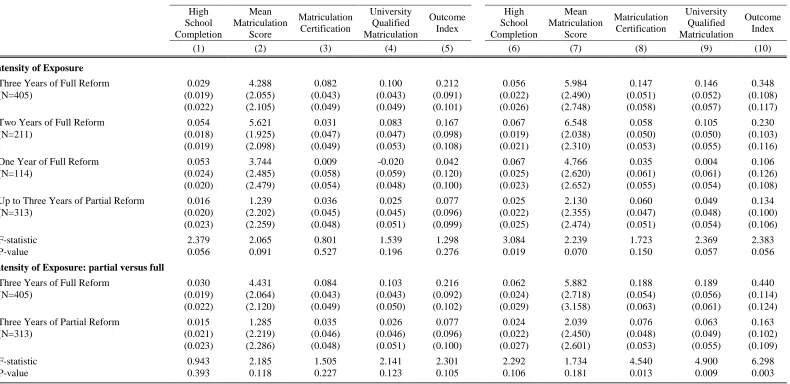
The results presented in panel B are very similar to the results in panel A, and they highlight the difference in estimated treatment effect of three years of full differential pay versus The group with zero intensity of full pay has the lowest estimated effects, while the highest estimated effects are for the group with the highest intensity of treatment. These results are presented in Table 4, columns 1-4. The first panel presents the estimates with four intensity levels used as treatment measures. In panel B we use only two treatment groups, students exposed throughout high school (three years) to a partial pay reform versus students exposed to a full differential pay reform throughout their high school. Therefore panel B is based on a sample that excludes the two other treatment groups. The estimated effects of the lowest level of reform intensity on all four outcomes are very small and not significantly different from zero. On the other hand, the effect of being under a full differential pay system for 2 or 3 years has large and significant effect on all four outcomes. For example, three years in high school under a full differential pay system causes an 8.2 percentage point increase in the matriculation rate and a 10.0 percentage point increase in the university qualified matriculation rate. In columns 6-9 we present treatment intensity effect from a specification that also includes controls for the other four social reforms. These estimates have the same pattern as in columns 1-4 with the largest effect for exposure to three years of full pay reform.
13 We could not obtain information on kibbutz tax schemes so cannot quantify the partial and full pay
reform.
14Specifically, of the 37 kibbutzim that reformed in 1998, 17 introduced a full pay reform and 20 a partial
reform, and of the latter group only 6 changed to a full reform within the treatment period (before 2003). Of the 14 kibbutzim that reformed in 1999, 7 introduced a full pay reform and 7 a partial reform; of the latter group 6 kibbutzim changed to full reform by 2002. Of the 22 kibbutzim that reformed in 2000, 13 introduced a full pay reform and 9 a partial reform; of the latter group 4 kibbutzim changed to full reform by 2002.
15 We perform balancing tests similar to those presented in Table 3, and the results suggest that the students
12
three years of partial differential pay. Overall, the evidence reported in Table 4 suggests the magnitude of the treatment effect increases with years of exposure to a system of full differential pay. Especially important is the much larger estimated effect of three years of exposure relative to the effect of only one year of exposure, because it is based on a comparison of the same type of treatment but with different duration.
We also explore an alternative specification that exploits information on students in all kibbutzim that reformed between 1998 and 2004, and assign separate treatment dummy indicators for students in cohorts that spent 1, 2, and 3 years of their high school in a reformed kibbutz. We then regress the outcome variable on these three indicators of length of exposure to treatment, a full set of year of reform dummies, a full set of cohort dummies, controls for the other four social reforms and all other student’s control variables. Like the difference-in-differences specification, the treatment variable is identified by (reform year)*cohort interactions, but now exploits all possible variation. The results of this estimation are presented in Online Appendix Table A18 and the estimates are similar to our benchmark difference-in-differences specification and sample, which are reported in Table 4, columns 6-9.
d. Allowing for heterogeneous effects: Heterogeneous effect by social background: First, we look at whether the pay reform, full or partial, affected students with different social backgrounds differently. On the one hand, assuming utility is concave in income, we expect students from lower social classes, who will face a decrease in parental income and are expected to have lower personal income on average, to be more affected by the decrease in the income tax because a future dollar increase in earnings is more valuable for them. Moreover, we expect students from lower social backgrounds to be more affected by the change in return if they are less likely to have inherent motivation to invest in schooling and will only do so when given external incentives. On the other hand, students whose parents are more educated might receive more help at home or elsewhere, because their parents are more able to help them or pay someone to do so, and thus be in a better position to improve their schooling when given the incentives. We stratify by parental schooling, splitting the sample into two groups as follows: students whose mothers have 13 or more years of schooling (50% percent of students) and other students. Alternatively, we stratify by the father’s years of schooling and find similar results.16
The heterogeneous estimates by parental schooling presented in Panel A of Table 3 suggest that the total effect on educational outcomes is largely driven by students who have less
16 We also ran balancing tests like those reported in Table 3 for these sub-samples. The results suggest that
13
educated parents (although the differences are not statistically significant). That is, these estimated treatment effects for these students appear larger than the basic controlled difference-in-differences results presented in Table 3, and their percentage increases are also larger because their counterfactual means are much lower than the mean of the overall sample.
Next, we allow for heterogeneity of the effect by parental education and intensity of reform simultaneously. Consistent with the evidence presented in this section and the previous one, Online Appendix Table A19 suggests that the total effect on educational outcomes seems to be largely driven by students who were exposed to a full differential pay system throughout their high schools and whose parents have lower levels of education. These results by parents’ education level are the opposite of Jensen’s (2010). We note that the less educated parents in the kibbutz are on average more educated than the more educated parents in the Dominican Republic, meaning that financial constraints are likely to be less important in our context. We again note that this finding that students whose parents are less educated respond more rules out a possible income effect whereby we would expect more educated people who gained from the reform to respond more because they could invest more in their children’s education. However, less educated parents experienced a decline in their income following the pay reform. This change may have triggered children, potentially with encouragement from their parents, to invest more in schooling in order to offset the lower wellbeing associated with lower relative income at adulthood, as suggested by Luttmer (2005).
Our result that children from low educated families respond more strongly to the reduction in the income tax rate could reflect a higher rate of return to schooling perceived by this group. A growing body of evidence suggests that indeed the rate of return to schooling is higher among individuals who are more credit constrained, have greater immediate need to work, or have greater distaste for school (Card, 1995 and 2001). Brenner and Rubinstein (2011) show evidence of higher returns to schooling for individuals in poor families in the US.
Next we allow for heterogeneity by gender. Male and female students have been shown to respond differently to incentives (e.g. Schultz 2004, Angrist and Lavy 2009), with females typically being more responsive. However, our estimates stratified by gender, presented in Panel A of Table 3 suggest a stronger effect on males than on females, although the standard errors of the estimates are not precise enough to reject no gender differences. For example, the estimated effect on high school completion is 0.051 (s.e. 0.026) for males and 0.012 (s.e. 0.020) for females, almost significantly different from each other.
14
years, but it is the largest for boys who were fully exposed. The treatment effect of the full differential pay system for boys is a 4.2 percentage point increase (0.8 percentage points for girls) in high school completion rates, a 6.0 point increase (2.8 for girls) in mean exam score, a 10 percentage point increase (3.5 for girls) in the matriculation rate, and a 9.6 percentage point increase (4.8 for girls) in the university qualified matriculation rate.
Our findings that boys are more affected by the pay reform, in particular in the school completion outcome, stand in contrast to Schultz (2004), who finds that girls’ school completion responded more to the incentives introduced by Progresa in Mexico. Our findings are also different from Angrist and Lavy (2009), who find that girls’ Bagrut diploma attainment is affected by conditional bonus payments, whereas boys do not react to this monetary incentive. In these papers, girls respond more to an increase in incentives designed to directly increase educational outcomes. In our context, the pay reform does not increase such short run incentives to perform better in school. In contrast, the pay reform we study operates through affecting the future rewards in the labor market. It is possible that females perceive a lower return to education in the labor market, expect to work in lower paying jobs on average, perhaps because they do not expect to become the main earner (for example because they plan to play a bigger role in raising children). Indeed, in regressions we run using the 1998-2000 Israeli labor force surveys and matching occupations to their mean earnings using income surveys, we find that females (both in kibbutzim and outside them) are substantially more likely to work in lower paying occupations; they sort into occupations and industries that pay around 20% less on average (regression results are available from the authors upon request).
V. The Effect of the Reform on Post-High School Educational Outcomes
15
kibbutzim. If these two effects are similar then the estimates reported below capture mainly the first channel of effect on post-high school education.
The post high school academic schooling system in Israel includes seven universities (one of which confers only graduate and PhD degrees), over 45 colleges that confer academic undergraduate degrees (some of these also give master’s degrees), and dozens of teachers’ and practical engineering colleges that confer bachelor of education or practical engineering degrees.17 All universities and colleges require a Bagrut for enrollment. Most teachers’ and
practical engineering colleges also require a Bagrut, though some look at specific Bagrut
components without requiring full certification. For a given field of study, it is typically more difficult to be admitted to a university than to a college. The national enrollment rates for the cohort of graduating seniors in 1995 (through 2003) was 55.4 percent, of which 27.6 percent were enrolled in universities, 8.5 percent in academic colleges, 7 percent in teachers’ colleges, and 7.6 practical engineering colleges.18
The post-high school outcome variables of interest here are indicators of ever having enrolled in a post-high school institution of a type described above, as of the 2010–2011 school year, and the number of years of schooling completed in these institutions by this date. We measure these two outcomes for our 1995-2000 high school graduating cohorts. The youngest cohorts (1999 and 2000) in our sample are 28-29 years old in 2010-2011. Even after accounting for compulsory military service19
Our information on postsecondary enrollment comes from administrative records provided by Israel’s National Insurance Institute (NII). The NII is responsible for social security and mandatory health insurance in Israel; it tracks postsecondary enrollment because students pay a lower health insurance tax rate. Postsecondary schools are therefore required to send a list of enrolled students to the NII every year. For the purposes of our project, the NII Research and
, we expect that most students who enrolled in post-high school education, including those who continued schooling beyond undergraduate studies, to have graduated by the 2010–2011 academic year. We therefore present evidence both for enrollment and for completed years of post-high school education.
17 Practical engineering colleges run two- to three-year programs awarding degrees or certificates in fields
like electronics, computers, and industrial production. Two further years of study in an engineering school are required in order to complete a BSc in engineering. A 1991 reform sharply increased the supply of postsecondary schooling in Israel by creating publicly funded regional and professional colleges.
18 These data are from the Israel Central Bureau of Statistics, Report on Post Secondary Schooling of High
School Graduates in 1989–1995 (available at:
19 Boys serve for three years and girls for two (longer if they take a commission). Ultra-orthodox Jews are
16
Planning Division constructed an extract containing the 2001–2011 enrollment status and number of years of post secondary schooling of students in our study. This file was merged with the other information in our sample and we used it for analysis at the protected research lab with restricted access at NII headquarters in Jerusalem.
We coded three indicators for enrollment in post-high school education. The first indicator identifies if the person ever enrolled in one of the seven universities (at any time from 2001–11); the second identifies if she ever enrolled in one of the certified academic colleges; and the third identifies if she ever enrolled in a teachers’ or practical engineering college. The overall ever enrolled rate in any post secondary schooling in our sample is 69 percent, of which 31 percentage points is in one of the seven universities, 32 percent is in an academic college, and 2.3 percentage points is in a teachers’ college.20
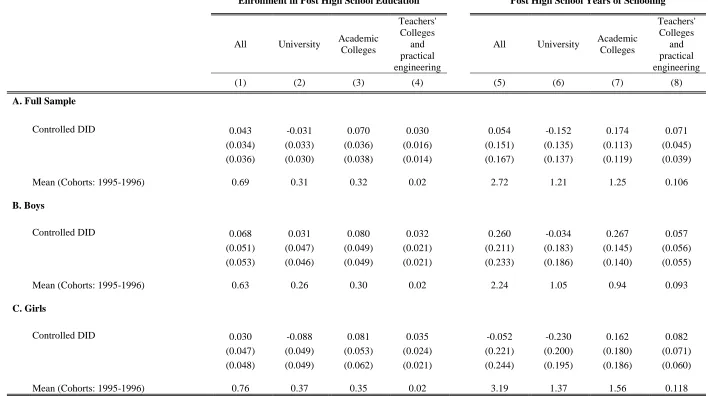
We focus on results from our basic sample and specification of the controlled difference-in-differences presented in Table 3. Specifically, the sample includes students of cohorts 1995, 1996, 1999 and 2000 from kibbutzim that reformed in 1998-2000 and 2003-2004. These results are reported in Table 5, panel A. Overall, the results suggest the reform increased post-high school enrollment by 4.3% points, although the coefficient is not statistically significant. Interestingly, while the reform did not positively affect (in fact insignificantly negatively affected) university enrollment (column 2), it increased academic college enrollment by a statistically significant 7% points (column 3), which reflects a 22% increase relative to the baseline of the treatment group, and increased teachers’ college and practical engineering enrollment by 3% points, an over 100% increase. In columns 5-8 we present the estimated effects on completed years of post-high school education by the various categories of higher education. The evidence here shows the same pattern as the effects on enrollment: an average increase of 0.174 years of academic college schooling and a 0.071 increase in years of teachers’ college education, though the latter effect is not significantly different from zero, and a negative but insignificant effect on university schooling.
The average number of post-high school years of schooling completed until the school year 2010-2011 in our sample is 2.7, of which 1.21 are in university schooling, 1.25 are in college education and 0.05 are in teachers’ and practical engineering colleges.
21
20 Note very few students ever enroll in more than one type of post-school educational institution.
21We also estimated the effect of the pay reform on post-high school education within 14 years of being in
17
We also estimated the effect of the pay reform on higher education using a specification that includes controls for the four other major reforms implemented in the kibbutzim since the early 1990’s. These estimates follow the same pattern of the evidence presented in panel A, though the estimated effect on academic college outcomes is marginally higher and the estimated effect on teachers’ colleges is marginally lower and less precisely measured.22
There are several possible reasons for why the reform increased enrollment in colleges but not in universities. First, we showed that the effect on high school outcomes was largely driven by the subgroup of students whose parents were less educated, and such students are more likely to enroll in colleges, where admission requirements tend to be less strict than universities.23
22 We also estimated these models by including in the sample the cohorts of 1997 and 1998 and the results
are very similar to those reported in Table 5. We also estimated the models of the effect of measures of reform intensity on post high school schooling outcomes and the results suggest as well a positive effect on college education. However, the distinction between and interpretation of the estimated effects by intensity of treatment are less clear in this case because it has been more than a decade since the end of high school, and some time since even the control kibbutzim reformed.
Second, the number of academic colleges expanded dramatically since the mid 1990’s, making them more accessible and less costly than university education, since these colleges are located in all regions of the country. The proximity of many kibbutzim to these new colleges made it possible for kibbutz members to enroll in higher education without having to move to a big city, where the universities are located. Third, the decline in university enrollment may reflect a shift in preferences of kibbutz students among different tracks of higher education following the pay reform. For example, kibbutz members may now find university education, especially in the humanities and social sciences, to be less attractive and less ‘practical’ in terms of financial rewards in the “new” kibbutz in comparison with law, economics, and business education, which are now available in almost all the academic colleges. Such a shift in preferences may have been more relevant to women, who tended to enroll in larger proportions in humanities at universities, and now may be shifting to more financially rewarding subjects. Consistent with this idea, in panels B and C of Table 5 we present the estimates obtained from separate samples of boys and girls. These panels suggest that the reform induced a shift of girls away from university enrollment and towards colleges. Regrettably, our data do not allow a more rigorous examination of this conjecture. However, we note that the net effect on girls is close to zero, consistent with our findings in the previous section of no effect of the pay reform on girls’ high school outcomes. In the sample of boys on the other hand the effect is positive both on university and academic
23 We also estimated the effect of the pay reform separately for students of low and high parental education.
18
college enrollment though only the later is significant. The effect on boys’ academic college years of schooling is quite large, over a quarter of a year of schooling, which is about a 28 percent increase.
VI. Conclusions and Implications
In this paper we use a natural experiment to estimate the responsiveness of investment in education to changes in redistributive policy that change the returns to education. This is, to the best of our knowledge, one of the first studies24
The pay reform increased the returns to schooling, which encouraged students to invest more in education. However, the pay reform could have influenced schooling outcomes through two other channels. First, via the reduction in social incentives for encouraging education that had been used under equal sharing (pre reform). Second, via the changes in income levels of parents, which might affect education decisions through liquidity constraints, because children’s education is a normal good, or through the concavity of utility in income assuming some intergenerational transfers. Our paper cannot fully disentangle these mechanisms, but our findings provide suggestive evidence that the returns to education channel operated above and beyond the social incentives channels, and that the income channel played only limited role. Specifically, when we control for other reforms in the kibbutzim that arguably changed social incentives without altering the returns to education, the effect of the pay reform is largely unaffected. Moreover, if liquidity constraints or the normality of children’s education were important, then we would expect students whose parents experienced declines in their income (less educated parents) to reduce investment in schooling. Instead, we find the improvement in schooling outcomes is largely driven by students whose parents have low education. Parental income effects
that use non-experimental data with an actual change in the rate of return to schooling to study the impact of an increase in the benefit from schooling on human capital investment. We find students are indeed responsive to changes in the redistributive policies: when their kibbutzim reformed, they considerably improved their educational outcomes such as whether they graduated and their average matriculation exam scores. Students who spent their entire three years of high school in a kibbutz that reformed to a greater extent improved their educational outcomes more. Males seem to have reacted more strongly than females, and students with less educated parents appear to have reacted more strongly than those with more educated parents, although these differences between subgroups are not statistically significant.
24 Foster and Rosenzweig (1996) shows that the green revolution in India increased returns to primary
19
that operate through the concavity of utility also seem unlikely the main drivers of the results because they should be small on average within a kibbutz as some parents face income increases and others decreases, yet the overall effect of the reform is positive on average (even if not always statistically significant).
We further show that for many students the increase in high school outcomes translated into increased post-high school education, especially in terms of enrollment in academic and teachers’ colleges. The sharpest rise is in enrollment in academic colleges, a 7 percentage point increase with an increase in completed years of schooling of almost 0.2. These increases seem likely to have generated substantial economic gains, since evidence suggests the returns to post-high school education in Israel are post-high.25
While an important advantage of our setting is the high internal validity of the estimates, we believe that our findings also have implications beyond the Israeli context. First, they shed light on the educational responses that could result from a decrease in the income tax rate, thus are informative on the long-run labor supply responses to tax changes. Second, they shed light on the educational responses expected when the returns to education increase. For example, such changes might be occurring in many countries as technology-oriented growth increases the return to skills.
26
Our findings also contribute to the literature on the increase in earnings inequality in the US and many other developed countries over the past decades, which perhaps is one of the most important aggregate phenomena in labor markets since WWII (known as “Skill Biased Technological Change”). A large body of research focuses on the implications of technological advancement for the demand for skill (see Katz and Autor, 1999 and recent updates of this survey), yet no attention is given to estimating the impact of the returns to education on the While the pay reform in kibbutzim is likely larger than many other policy changes aiming to reduce the income tax rates or increase the rates of return to education, the kibbutz serves as a microcosm for learning about other important episodes with similarly large reforms. Examples of such episodes include the transitions of central and eastern European countries from centrally planned to market economies after the fall of the Iron Curtain, the abolition of village collectives in China in the 1980s, and Vietnam’s labor market liberalization in the mid 1980s.
25For example, Frisch and Moalem (1999) estimate the return to a year of college to be about 11 percent in
the late 1990s, while Frisch (2007) estimates the average return to having any post-high school education to be about 34 percent. Since the average rate of return to schooling in kibbutzim appears to be similar to the national average rate of return, we expect that the payoff to higher education in kibbutzim will be similar to the national rate. Of course, the economic returns to schooling for affected students in our study may differ from 11 percent. For example, Card (1995) argues that the returns to schooling for credit-constrained students should be higher than population average returns.
26 See, for example, the discussion in Autor, Katz and Krueger (1999), Card and Dinardo (2002), and
20
supply of educated workers. This is a key factor for understanding the longer-run consequences of changes in the demand structure in the era of “Skill Biased Technological Change”. To the best of our knowledge, this paper is the first to tackle this question. Estimating the supply elasticity requires an external source of variation in the returns to education, solely driven by demand factors, and independent of preexisting stocks and current flows of skilled labor. This might explain the lack of credible empirical research on this front. The experience of the Israeli economy during the 1980s-1990s in general, and the kibbutzim communities in particular, provides a unique setting for estimating the causal impact of the returns to education on school choices and the supply of educated workers.
References
Abramitzky, RanQuarterly Journal
of Economics, 123:3, 1111-1159, 2008.
Abramitzky, Ran, “Lessons from the Kibbutz on the Equality-Incentives Trade-Off,” Journal of Economic Perspectives, 25:1, 185-208, 2011.
Angrist, D. Joshua, and Victor Lavy,
American Economic Review, 99:4,
1384-1414, 2009.
Attansio, Orazio Pietro, and Katja Maria Kaufmann, “Educational Choices, Subjective Expectations, and Credit Constraints,” NBER Working Paper 15087, 2009.
Autor, David, Lawrence Katz, and Alan B. Krueger, “Computing Inequality: Have Computers Changed the Labor Market?” Quarterly Journal of Economics 113, 1169-1214, 1999.
Aydemir, Abdurrahman, and Arthur Sweetman, “First and Second Generation Immigrant Educational Attainment and Labor Market Outcomes: A Comparison of the United States and Canada,” IZA Discussion Paper No. 2298, 2006.
Brainerd, Elizabeth, “Winners and Losers in Russia’s Economic Transition,” American Economic Review, 88:5, 1094-1116, 1998.
Becker, Gary, Human Capital and the Personal Distribution of Income, Ann Arbor Michigan: University of Michigan Press, 1967.
Ben-Porath, Yoram, “The Production of Human Capital and the Life Cycle of Earning,” Journal of Political Economy, 75, 352-365, 1967.
Betts, Julian, “What Do Students Know About Wages? Evidence From a Survey of Undergraduates,” Journal of Human Resources, 31:1, 27-56, 1996.
Card, David E. 1995. "Earnings, Schooling, and Ability Revisited." Research in Labor Economics, 14: 23-48.
Card, David, “The Causal Effect of Education on Earnings,” in Orley Ashenfelter and David Card, eds., Handbook of Labor Economics, Volume 3A, Amsterdam and New York: North Holland, 1999.
Card, David, and John DiNardo,
21
Chetty, Raj, John Friedman, Tore Olsen, and Luigi Pistaferr Quarterly Journal of Economics.
Eaton, Jonathan and Rosen, Harvey S, 1980.
Freeman, Richard B., The Overeducated American, New York: Academic Press, 1976.
Frisch, R., and J. Moalem. 1999. “The Rise in the Return to Schooling in Israel in 1976-1997.” Research Department, Bank of Israel, Working Paper No.99.06.
Frisch, R. 2007. “The Return to Schooling - the Causal Link Between Schooling and Earnings.” Research Department, Bank of Israel, Working Paper No.2007.03.
Getz, Shlomo, “Surveys of Changes in Kibbutzim,” Institute for Research of the Kibbutz and the Cooperative Idea, University of Haifa, Reports, 1998–2004 (in Hebrew).
Jensen, Robert, “The (Perceived) Returns to Education and the Demand for Schooling,"
Quarterly Journal of Economics, 125:2, 515 −548, 2010.
Kane, Thomas J., “College Entry by Blacks since 1970: The Role of College Costs, Family Background, and Returns to Education,” Journal of Political Economy, 102:5, 878-911, 1994.
Katz Lawrence, and David Autor, “
Changes in the Wage Structure and Earnings Inequality,”
in O. Ashenfelter and D. Card, eds.,
Handbook of Labor Economics
, vol. 3A,
North-Holland, 1463-1555, 1999.
Klinov, Ruth, and Michal Palgi, “Standard of Living in Kibbutzim – a comparison with Urban Families,” Working Paper Number A06.05, The Falk Research Institute, Jerusalem Israel, 2006.
Luttmer, ErzoQuarterly
Journal of Economics, 120:3, 963-1002, 2005.
Mooc Transition Economy (Vietnam), 1998.
Saez, Emmanuel, Joel B. Slemrod, and Seth H. Giertz, “The Elasticity of Taxable Income With Respect To Marginal Tax Rates: A Critical Review,” Working Paper 15012, 2009.
Schultz, T. Paul, “School Subsidies for the Poor: Evaluating the Mexican Progresa Poverty Program,” Journal of Development Economics, 74(1): 199–250, 2004.
Svejnar, Jan, “Labor Markets in the Transitional Central and East European Economies”, in Orley Ashenfelter and David Card (eds.), Handbook of Labor Economics, Vol. 3, North Holland, 1999.
Trumper, Ricardo, “Differences in Motivation Towards Science Subjects Among Kibbutz and Urban High School Students,” Interchange, 28:2, 205-218, 1997.
Weiss, Andrew, Journal of Economic
Table 1: Balancing Tests of Students' Characteristics and Outcomes in Treatment and Control Kibbutzim
10th Grade Students 10th Grade Students in 1995 and 1996 in 1999 and 2000
Treatment Control Difference Treatment Control Difference
(1) (2) (3) (4) (5) (6)
A. Student's Characteristics
Male 0.495 0.507 -0.013 0.523 0.536 -0.012
(0.500) (0.500) (0.027) (0.500) (0.499) (0.023)
Father's Years of Schooling 13.26 13.59 -0.328 13.60 14.12 -0.523 (2.776) (2.841) (0.264) (2.525) (2.973) (0.419)
Mother's Years of Schooling 13.42 13.71 -0.292 13.94 14.08 -0.140 (2.47) (2.44) (0.174) (2.23) (2.25) (0.229)
Number of Siblings 2.56 2.65 -0.094 2.53 2.77 -0.239
(1.357) (1.358) (0.199) (1.249) (1.581) (0.280)
Ethnic Origin: Africa/Asia 0.105 0.103 0.001 0.091 0.079 0.012 (0.306) (0.304) (0.016) (0.288) (0.270) (0.021)
Ethnic Origin: Europe/America 0.346 0.379 -0.033 0.360 0.306 0.054 (0.476) (0.486) (0.035) (0.480) (0.461) (0.033)
Immigrants from Non-FSU
Countries 0.016 0.015 0.001 0.013 0.013 0.000
(0.127) (0.122) (0.006) (0.115) (0.114) (0.006)
Immigrants from FSU Countries 0.013 0.017 -0.004 0.031 0.023 0.008 (0.112) (0.128) (0.007) (0.173) (0.150) (0.009)
B. High School Outcomes
High School Completion 0.951 0.967 -0.016 - - -
(0.216) (0.180) (0.011)
Mean Matriculation Score 70.62 72.48 -1.862 - - -
(23.250) (21.039) (1.309)
Matriculation Certification 0.549 0.569 -0.020 - - -
(0.498) (0.496) (0.036)
University Qualified Matriculation 0.516 0.536 -0.019 - - - (0.500) (0.499) (0.035)
Kibbutzim 74 33 74 33
Students 1,100 601 - 1,043 605 -
C. Entry and Exit
Exit 0.056 0.042 0.015 0.052 0.038 0.014
(0.231) (0.200) (0.016) (0.222) (0.191) (0.011)
Entry 0.030 0.043 -0.013 0.026 0.022 0.004
(0.170) (0.202) (0.016) (0.158) (0.147) (0.010)
Notes: Columns 1, 2, 4 and 5 present means and standard deviations (in parentheses) of characteristics and outcomes
Table 2: Treatment-Control Differences in Pre-Reform Time Trends in Schooling Outcomes, 10th Grade Students in 1993-1998
Matriculation Certification Mean Matriculation Score
(1) (2) (3) (4)
A. Linear Trend Model
Time Trend 0.025 0.026 1.225 1.287
(0.011) (0.010) (0.478) (0.451)
Treatment x Time Trend -0.008 -0.006 -0.267 -0.361
(0.013) (0.012) (0.580) (0.547)
Treatment 0.005 - 0.681 -
(0.050) (2.270)
B. Cohort Dummies Model
Treatment x 1994 -0.022 -0.005 2.178 2.329
(0.076) (0.070) (3.481) (3.295)
Treatment x 1995 -0.011 0.003 -1.716 -1.782
(0.075) (0.070) (3.446) (3.255)
Treatment x 1996 -0.030 -0.008 0.403 0.024
(0.075) (0.070) (3.446) (3.255)
Treatment x 1997 0.036 0.051 1.765 0.816
(0.075) (0.070) (3.449) (3.259)
Treatment x 1998 -0.087 -0.074 -2.019 -1.962
(0.075) (0.069) (3.416) (3.221)
Treatment -0.002 - -0.358 -
(0.053) (2.424)
Kibbutz Fixed-Effects NO YES NO YES
F( 5, 593) = 0.58
F( 5, 488) = 0.66
F( 5, 593) = 0.50
F( 5, 488) = 0.48
Prob > F =
0.7125
Prob > F = 0.6516
Prob > F = 0.7773
Prob > F = 0.7897
Notes: This table presents the results from OLS regressions run at the kibbutz level predicting the proportion of
Table 3: Difference-in-Differences Estimates High School Completion Mean Matriculation Score Matriculation Certification University Qualified Matriculation Outcome Index
(1) (2) (3) (4) (5)
A. Experiment of Interest, 10th Grade Students in 1995-1996 and 1999-2000 Difference-in-Differences Regressions
Simple Difference-in-Differences 0.033 3.112 0.029 0.040 0.101 (0.016) (1.517) (0.035) (0.035) (0.075) (0.016) (1.517) (0.035) (0.035) (0.072)
Controlled Difference-in-Differences 0.033 3.546 0.049 0.060 0.141 (0.015) (1.604) (0.035) (0.035) (0.073) (0.017) (1.605) (0.035) (0.036) (0.071)
Difference-in-Differences also Controlling for Other Social Reforms
0.048 4.501 0.076 0.082 .206
(0.020) (1.985) (0.042) (0.043) (0.087)
Probit Controlled Difference-in-Differences, Marginal Effects
0.402 - 0.142 0.168 -
(0.192) - (0.099) (0.102) -
Sample Stratification by Mother's Education
Low 0.049 6.175 0.116 0.100 .265
(0.028) (2.556) (0.053) (0.052) (0.110)
High 0.014 0.329 -0.031 0.002 -0.015
(0.019) (2.050) (0.046) (0.046) (0.092)
F-statistic (P-value) 1.28
(0.258) 3.11 (0.078) 4.27 (0.039) 1.88 (0.171) 3.49 (0.06)
Sample Stratification by Gender
Male 0.051 4.652 0.057 0.051 0.166
(0.026) (2.701) (0.053) (0.051) (0.111)
Female 0.012 2.685 0.026 0.033 0.068
(0.020) (2.153) (0.048) (0.051) (0.103)
F-statistic (P-value) 1.67
(0.196) 0.37 (0.543) 0.19 (0.664) 0.07 (0.797) 0.44 (0.51)
B. Control Experiment, 10th Grade Students in 1995-1996 and 1997-1998
Difference-in-Differences Regressions
Simple Difference-in-Differences 0.011 0.213 -0.016 -0.025 -0.030 (0.015) (1.527) (0.036) (0.036) (0.076)
Controlled Difference-in-Differences 0.011 0.304 -0.013 -0.027 -0.030 (0.016) (1.600) (0.035) (0.036) (0.076)
Notes: Treatment kibbutzim are those that reformed in 1998-2000; control kibbutzim are those that reformed in
Table 4: Controlled Difference in Differences Estimates by Intensity of Exposure to Full or Partial Pay Reform
No Controls for Other Social Reforms Controls for Other Social Reforms
High School Completion Mean Matriculation Score Matriculation Certification University Qualified Matriculation Outcome Index High School Completion Mean Matriculation Score Matriculation Certification University Qualified Matriculation Outcome Index
(1) (2) (3) (4) (5) (6) (7) (8) (9) (10)
A. Intensity of Exposure
Three Years of Full Reform 0.029 4.288 0.082 0.100 0.212 0.056 5.984 0.147 0.146 0.348
(N=405) (0.019) (2.055) (0.043) (0.043) (0.091) (0.022) (2.490) (0.051) (0.052) (0.108)
(0.022) (2.105) (0.049) (0.049) (0.101) (0.026) (2.748) (0.058) (0.057) (0.117)
Two Years of Full Reform 0.054 5.621 0.031 0.083 0.167 0.067 6.548 0.058 0.105 0.230
(N=211) (0.018) (1.925) (0.047) (0.047) (0.098) (0.019) (2.038) (0.050) (0.050) (0.103)
(0.019) (2.098) (0.049) (0.053) (0.108) (0.021) (2.310) (0.053) (0.055) (0.116)
One Year of Full Reform 0.053 3.744 0.009 -0.020 0.042 0.067 4.766 0.035 0.004 0.106
(N=114) (0.024) (2.485) (0.058) (0.059) (0.120) (0.025) (2.620) (0.061) (0.061) (0.126)
(0.020) (2.479) (0.054) (0.048) (0.100) (0.023) (2.652) (0.055) (0.054) (0.108)
Up to Three Years of Partial Reform 0.016 1.239 0.036 0.025 0.077 0.025 2.130 0.060 0.049 0.134
(N=313) (0.020) (2.202) (0.045) (0.045) (0.096) (0.022) (2.355) (0.047) (0.048) (0.100)
(0.023) (2.259) (0.048) (0.051) (0.099) (0.025) (2.474) (0.051) (0.054) (0.106)
F-statistic 2.379 2.065 0.801 1.539 1.298 3.084 2.239 1.723 2.369 2.383
P-value 0.056 0.091 0.527 0.196 0.276 0.019 0.070 0.150 0.057 0.056
B. Intensity of Exposure: partial versus full
Three Years of Full Reform 0.030 4.431 0.084 0.103 0.216 0.062 5.882 0.188 0.189 0.440
(N=405) (0.019) (2.064) (0.043) (0.043) (0.092) (0.024) (2.718) (0.054) (0.056) (0.114)
(0.022) (2.120) (0.049) (0.050) (0.102) (0.029) (3.158) (0.063) (0.061) (0.124)
Three Years of Partial Reform 0.015 1.285 0.035 0.026 0.077 0.024 2.039 0.076 0.063 0.163
(N=313) (0.021) (2.219) (0.046) (0.046) (0.096) (0.022) (2.450) (0.048) (0.049) (0.102)
(0.023) (2.286) (0.048) (0.051) (0.100) (0.027) (2.601) (0.053) (0.055) (0.109)
F-statistic 0.943 2.185 1.505 2.141 2.301 2.292 1.734 4.540 4.900 6.298
P-value 0.393 0.118 0.227 0.123 0.105 0.106 0.181 0.013 0.009 0.003
Table 5: The Effect of the Pay Reform on Post Secondary Schooling
Enrollment in Post High School Education Post High School Years of Schooling
All University Academic Colleges
Teachers' Colleges
and practical engineering
All University Academic Colleges
Teachers' Colleges
and practical engineering
(1) (2) (3) (4) (5) (6) (7) (8)
A. Full Sample
Controlled DID 0.043 -0.031 0.070 0.030 0.054 -0.152 0.174 0.071
(0.034) (0.033) (0.036) (0.016) (0.151) (0.135) (0.113) (0.045)
(0.036) (0.030) (0.038) (0.014) (0.167) (0.137) (0.119) (0.039)
Mean (Cohorts: 1995-1996) 0.69 0.31 0.32 0.02 2.72 1.21 1.25 0.106
B. Boys
Controlled DID 0.068 0.031 0.080 0.032 0.260 -0.034 0.267 0.057
(0.051) (0.047) (0.049) (0.021) (0.211) (0.183) (0.145) (0.056) (0.053) (0.046) (0.049) (0.021) (0.233) (0.186) (0.140) (0.055)
Mean (Cohorts: 1995-1996) 0.63 0.26 0.30 0.02 2.24 1.05 0.94 0.093
C. Girls
Controlled DID 0.030 -0.088 0.081 0.035 -0.052 -0.230 0.162 0.082
(0.047) (0.049) (0.053) (0.024) (0.221) (0.200) (0.180) (0.071)
(0.048) (0.049) (0.062) (0.021) (0.244) (0.195) (0.186) (0.060)
Mean (Cohorts: 1995-1996) 0.76 0.37 0.35 0.02 3.19 1.37 1.56 0.118
Notes: This table presents the results of difference-in-differences regressions examining post-high school education outcomes, comparing students in treatment (reformed