warwick.ac.uk/lib-publications
Original citation:
Biega, J. Asia , Ghazimatin, Azin , Ferhatosmanoglu, Hakan , Gummadi , Krishna P. and
Weikum, Gerhard (2017) Learning to un-rank : quantifying search exposure for users in
online communities. In: CIKM 2017 : The 26th 2017 ACM Conference on Information and
Knowledge Management, Singapore, 6-10 Nov 2017. Published in: Proceedings of the 26th
International Conference on Information and Knowledge Management (CIKM) 267-276.
Permanent WRAP URL:
http://wrap.warwick.ac.uk
/
92209
Copyright and reuse:
The Warwick Research Archive Portal (WRAP) makes this work by researchers of the
University of Warwick available open access under the following conditions. Copyright ©
and all moral rights to the version of the paper presented here belong to the individual
author(s) and/or other copyright owners. To the extent reasonable and practicable the
material made available in WRAP has been checked for eligibility before being made
available.
Copies of full items can be used for personal research or study, educational, or not-for profit
purposes without prior permission or charge. Provided that the authors, title and full
bibliographic details are credited, a hyperlink and/or URL is given for the original metadata
page and the content is not changed in any way.
Publisher’s statement:
"© ACM,2017. This is the author's version of the work. It is posted here by permission of
ACM for your personal use. Not for redistribution. The definitive version was published in :
Proceedings of the 26th International Conference on Information and Knowledge
Management (CIKM) 267-276
http://doi.acm.org/10.1145/3132847.3133040
"
A note on versions:
The version presented here may differ from the published version or, version of record, if
you wish to cite this item you are advised to consult the publisher’s version. Please see the
‘permanent WRAP url’ above for details on accessing the published version and note that
access may require a subscription.
Learning to Un-Rank:
Quantifying Search Exposure for Users in Online Communities
Asia J. Biega
Max Planck Institute for Informatics
Saarland Informatics Campus
jbiega@mpi- inf.mpg.de
Azin Ghazimatin
Max Planck Institute for Informatics
Saarland Informatics Campus
aghazima@mpi- inf.mpg.de
Hakan Ferhatosmanoglu
Department of Computer Science
University of Warwick
Krishna P. Gummadi
MPI-SWS
Saarland Informatics Campus
gummadi@mpi- sws.org
Gerhard Weikum
Max Planck Institute for Informatics
Saarland Informatics Campus
weikum@mpi- inf.mpg.de
ABSTRACT
Search engines in online communities such as Twitter or Facebook
not only return matching posts, but also provide links to the profiles
of the authors. Thus, when a user appears in the top-kresults for a sensitive keyword query, she becomes widely exposed in a sensitive
context. The effects of such exposure can result in a serious privacy
violation, ranging from embarrassment all the way to becoming a
victim of organizational discrimination.
In this paper, we propose the first model for quantifying search
exposure on the service provider side, casting it into a reverse
k-nearest-neighbor problem. Moreover, since a single user can be
exposed by a large number of queries, we also devise a
learning-to-rank method for identifying the most critical queries and thus
making the warnings user-friendly. We develop efficient algorithms,
and present experiments with a large number of user profiles from
Twitter that demonstrate the practical viability and effectiveness of
our framework.
KEYWORDS
Search Exposure, Ranking Exposure, Privacy, Information Retrieval
1
INTRODUCTION
Motivation.A query search engine in online communities, such as Twitter or Facebook, not only returns matching posts, but also
identifies the users who have written the posts. Thissearch exposure
riskis particularly pronounced when a user’s post appears in the top-k results for a sensitive keyword query.
Note that exposure is different from just having contents visible
within a community. When Facebook introduced theNews Feed feature, a lot of users responded with outrage. They felt their
pri-vacy was being violated, even though the new feature only meant
that newly generated content would be broadcasted to people who
would have access to that content anyway [5]. Analogously, in
Permission to make digital or hard copies of all or part of this work for personal or classroom use is granted without fee provided that copies are not made or distributed for profit or commercial advantage and that copies bear this notice and the full citation on the first page. Copyrights for components of this work owned by others than ACM must be honored. Abstracting with credit is permitted. To copy otherwise, or republish, to post on servers or to redistribute to lists, requires prior specific permission and /or a fee. Request permissions from [email protected].
CIKM’17, November 6–10, 2017, Singapore.
© 2017 ACM.ISBN 978-1-4503-4918-5/17/11. . . $15.00 DOI: https://doi.org/10.1145/3132847.3133040
the context of search systems, while a user may be fine with
post-ing about health problems, controversial political issues or uspost-ing
swearwords, she may feel very uncomfortable with the posts being
returned as top-ranked results. Content found this way could be
used, for example, in stories written by journalists or bloggers, and
attract uninvited attention to the user’s account. Beyond topically
sensitive queries, there are also risks regarding search exposure by
unique strings. An adversary could search for people posting urls of
sensitive domains, such as pirate websites, or certain price tokens,
such as $1K. An adversary with a list of e-mails could issue these
to find answers to security questions necessary to reset passwords.
An adversary with a list of generated credit card numbers could
issue these as queries to find other personal information necessary
for credit card transactions.
State of the Art and Limitations. Despite the existence of such threats, to the best of our knowledge, there is no support
for users to find out about their search exposure risks. The only
way would be to try out all possible queries and inspect their top-k
results, yet this is all but practical. The service providers – search
engines or social network platforms – do not provide such support
at all.
Work in the broad area of exposure has been tangibly motivated
by a study showing the discrepancy between the expected and
actual audience of user-generated content [2]. Exposure has been
addressed in other contexts so far, including information exposure
among friends in social networks [24], location exposure [29],
longi-tudinal information exposure [25], controlled information sharing
[27], or exposure with respect to sensitive topics [3]. The
impor-tance of exposure control has led service providers to introduce
features such as Facebook’sView As, which informs a user how her profile appears to other people. However, this does not quantify
the exposure, and the problem of search exposure in particular has
been disregarded completely.
Problem and Challenges.To the best of our knowledge, this paper is the first to address the problem of modeling, analyzing and
quantifying search exposure risks. As the risk is most significant
when a user is spotted in the top-k results of a query, our goal
is to identify these top-k exposing queries for each user. Such
information can then be used to guide the user, for example, in
deleting posts or restricting their visibility. In an online setting,
a tool based on our model could even alert the user about the
The search exposure problem poses a number of challenges:
• Efficiency:A user could possibly be found by millions of distinct queries. An algorithm to identify the critical queries thus faces
a huge scalability and efficiency problem.
• Dynamics:With the high rate of new online contents, the critical queries cannot simply be computed offline from a query log.
The exposure of users keeps continuously shifting.
• Usability:Showing all queries for which a user appears in the top-k results would in many cases flood the user with millions
of irrelevant or small-risk queries and miss the point of guiding
the user. Thus, it is crucial that the queries are ranked by an
informative measure of, possibly user-specific, sensitivity.
An interesting thing to note is that from the perspective of a
user, reducing search exposure can be seen as a problem of“inverse
search engine optimization”, inverse SEO for short. SEO aims to push a user to the top-ranked results for certain queries. Here,
the goal is the opposite – the users would like to be moved to the
low-ranked tail of answers, or even completely removed from the
search results of particularly sensitive queries.
Approach and Contributions.Keyword search with answer ranking can be seen as the problem of finding the top-k
nearest-neighbor posts according to a given similarity function. Thus, we
can model search exposure as areverse k-nearest-neighborproblem (RkNN): for each post, we want to find the queries for which the post
is among the top-k results. To identify these queries, we develop an
efficient algorithm that builds on threshold-based pruning [18, 33].
To assist a user in understanding her search exposure risks, we
devise an algorithm for ranking the queries in the user’s RkNN set,
which potentially contains hundreds of queries. To this end, we
combine informative features ranging from topical sensitivity (e.g.,
usually higher for queries about health problems than for those
about movies), through query selectivity and entropy (e.g., higher
for queries containing birth dates, or social security numbers),
to user surprisal (e.g., high for queries matching a post about a
user’s children in an otherwise professional profile). The salient
contributions of this paper are:
• A model of the search exposure problem;
• An efficient algorithm for computing the RkNN set of queries
for which a user appears in the top-k results;
• A learning to rank method with informative features for ranking
the queries in the exposure sets according to a new notion of
search exposure relevance;
• An experimental study with a large set of Twitter profiles,
pro-viding insights on the exposure sets and the effectiveness of our
query ranking methods.
2
PROBLEM STATEMENT
Preliminaries.Assume we have a set of usersUand a set of doc-umentsDposted by the users. We denote the fact that a postdis written by the userubyd∈u. The profile of each user is defined as the set of all documents she has posted in a community.
Search exposure.The problem of search exposure of userucan be formalized as finding all the reversek-nearest neighbors ofu,
i.e, the set of all the queries for which any of the posts ofucomes among the top-kresults. We call the sets of such queries asexposure
sets.
Generation of exposure sets. Before computing the exposure sets of all users, we first computeRkN Ns(d)for each documentd as follows:
RkN Ns(d)={(q,r)|q∈Q∧dis therth NN of q∧r ≤k} (1)
whereQis the set of all queries and r is the rank ofdfor the
queryq(r =rank(q,d)). According to Emrich et al., the above equation is equivalent to the definition of a bichromatic RkNN [12].
Accordingly, we define the exposure set of each user as the union
of the exposure sets of all the documents in his profile. We denote
the exposure set of the userubyRkN Ns(u)which is defined as follows:
RkN Ns(u)={(d,q,r)|(q,r)∈RkN Ns(d)∧d∈u} (2)
We discuss efficient generation of exposure sets in Sec. 3.
Ranking of queries in exposure sets.Exposure sets of certain users might be big and dominated by rare, informative, or
non-critical queries. On the other hand, exposure by certain sensitive
queries might leave the user uncomfortable. Therefore, to make
the exposure sets user-friendly, we want to rank the triples in
RkN Ns(u) such thatthe queries the users would not want to be
searched by appear at the top. This defines the notion of relevance in our ranking problem, termedsearch exposure relevance. We discuss the exposure set ranking methods and our notion of relevance in
Sec. 4.
3
GENERATING EXPOSURE SETS
Ranking model.Generating the exposure set (set of RkNNs) re-quires the knowledge of the ranking model. In this work, we assume
the documents are ranked using language models. More specifically,
given a queryqthe relevance of the documentdis measured by
the likelihood of modeldgeneratingq. Assuming no dependency between terms, the logarithmic query likelihood is computed as
follows [11]:
ρ(q=t1t2...tn,d)=
n
X
i=1
log
fti,d+µ cti
|C|
|d|+µ , (3)
where f
ti,d is the frequency of theith term ofqind,cti is the frequency of the termtiin the whole corpus,|C|is the total number
of terms in the corpus andµis the Dirichlet smoothing coefficient.
Queries. Any combination of words is a valid query. However, considering all the possible queries makes our problem intractable.
Therefore, we limit the set of queries to those that consist of at
mostMwords and have at least one exact match in our data set. In other words, for each queryq=t1,t2, ...tn, (1)n≤Mand (2) there
should be at least one document in the dataset that contains all the
termst1,t2, …tn.
Approach. Informing the users about the exposing queries can be either retroactive or preventive. In the retroactive approach,
users are notified about their exposed documents posted so far.
Learning to Un-Rank: Quantifying Search Exposure CIKM’17, , November 6–10, 2017, Singapore.
at the time of uploading a document. Depending on the approach
chosen, a service provider may opt for static or dynamic generation
of RkNNs. In the former case, the exposure sets of users can be computed statically and fetched upon the user’s request. However,
as the insertion, deletion or update of documents may affect the
exposure set of a user, the recomputation of the RkNNs would be necessary every so often. On the other hand, preventive warnings
require dynamic generation of the RkNNs for a document in an efficient way.
The problem ofBichromaticReversekNearestNeighbors (BRkNNs) has been extensively studied so far. However, there is no generic
effi-cient solution for this problem as the efficiency is achieved through
applying various pruning techniques that are mainly dependent
on the distance function. For example, for the models with the
Eu-clidean distance or cosine similarity, many filtering methods have
been suggested based on different geometric properties [20, 26, 30].
However, for the models with textual queries only a few works
exist, which cannot be fully applied to our problem as either the
setting is monochromatic [21], the indexing tree of the queries
should be built which is not scalable to very high dimensions [39],
the storage ofknearest neighbors for all the queries is required
with a fixedk[9], or only the conjunctive queries are considered [1]. In the remainder of this section, we present our algorithm for
the dynamic generation of the RkNNs for the textual data. In the considered ranking model, it can be shown that finding an
exposing query of lengthl(q=t1t2...tl) for a particular documentd
wheredis the nearest neighbor ofqis NP-hard1. Even if we bound the maximum length of the queries (M) to two or three words, the query search space is still large. Therefore, we introduce the “RkNN Growth” algorithm for more precise pruning of the query search
space.
RkNN Growth Algorithm (RGA).The underlying idea of this algorithm is to use the information on the one-word RkNNs to find the two-word RkNNs. For simplicity, we assume that the maximum
length of the queries is two (M = 2), which resembles the 1.64 average query length on Twitter [32]. In this algorithm, we first
start with finding the unigram RkNNs for the given documentd.
For this, we build an inverted index and sort the posting listLtiof each termti based on the relevance of the documents (posts) toti.
Now, we can compare the score of thekth document inLt
iwith ρ(q=ti,d)in constant time to decide whether the termtiis among the RkNNs of the documentdor not.
In order to find the bigram RkNNs, we label the terms appearing
in the documentdas follows:
• “T” which stands for Top, if the term appears among the
RkNNs of documentd.
• “NT” which stands for Not Top, if the term is not an RkNN
of the documentd.
We refer to the other terms as “NE” (Not Existing) as they do not
appear in the documentd. Accordingly, there are five possible
labelings for the two-word queries (T-T, T-NT, T-NE, NT-NT and
NT-NE). Note that due to the disjunctive nature of the queries,
labels T-NE and NT-NE are also allowed. It is straightforward to
show that the two following propositions hold in our model:
1
By reduction from 3-SAT
Proposition 1. Ifrank(ti,d) =k0andrank(tj,d) =k00and
k0+k00<k, then the queryq=titjis an RkNN of the documentd.
Proof. Because of the monotonicity of our ranking model, for a
documentd0to be more relevant to the queryq=titjthand, either
ρ(ti,d0) > ρ(ti,d)orρ(tj,d0) > ρ(tj,d)should hold. However, these conditions hold for less thankdocuments in total ask0+k00<
k.
Proposition 2. If the termtiin the documentdhas the label “NT”
and the termtjhas label “NE”, then the queryq=titjcannot be an RkNN of the documentdif there are at leastkdocuments that are both shorter and more relevant to the termtithan the documentd.
Proof. As the relevance score is negatively proportional to the
length of the documents, and due to the Dirichlet smoothing, among
the documents without the termtj longer documents receive a
lower relevance score than the shorter ones. Therefore, the above
statement can be interpreted as the documentdbeing dominated by
more thankother documents in terms of the relevance to both the termstiandtj. As a result,dcannot haveq=titjas an RkNN.
We use the above statements to prune the query search space. For
the remaining queries, we adopt the Reverse Threshold Algorithm
(RTA) introduced by Vlachou et al. [33]. In this algorithm, the goal
is to avoid unnecessary computations of thekNNs of the queries using a buffer. Details can be found in [33].
Algorithm 1 illustrates the steps of RGA. For each tokenti in the input documentd, first the set of all the candidate queries (C)
containingti is extracted (Line 2). As all of the candidate queries contain the termti, we initiate the buffer for the reverse threshold algorithm (RTA) with thek nearest neighbors ofti by running
threshold algorithm on the inverted indexI(Line 3). We perform the first step of pruning (if possible) in Line 5 by removing all the
possible extensions of type “NT-NE”. Next, we test the applicability
of Proposition 1 for pruningC(Line 7). The remaining queries are
passed to the function RTA where the queries are either filtered
or added to the exposure set ofd(Line 8). Finally, the exposure set of the documentdis reported. Although the worst case time
(and space) complexity of RGA is the same as that of the RTA, our
experiments show a significant speed improvement in practice.
Algorithm 1:RkNN Growth Algorithm
Input : Documentd,k, set of queriesQ, inverted indexI, set of documentsD
Output:Rk N N s(d)
1 foreachtokenti ∈ddo
2 Compute the candidate set of queriesC
3 Compute theknearest neighbors ofq=tiusingIand store them inbuf f er
4 iftihas label “NT” and Proposition 2 holdsthen
5 Remove all the queriesq=titjof type “NT-NE” fromC
6 end
7 PruneCby Proposition 1 (if possible)
8 Run RTA(d,D,C,k,buf f er)
9 end
4
RANKING OF QUERIES IN EXPOSURE SETS
Generating the exposure sets is not enough for the results to be
presentable to end users for two reasons. First of all, for many users
the size of theirRkN Nset is simply too big for easy consumption.
Our experiments on a sample of 50Kuser profiles from Twitter later confirm this – even when only unigram and bigram queries
are considered, more than 35Kusers are exposed by more than 100
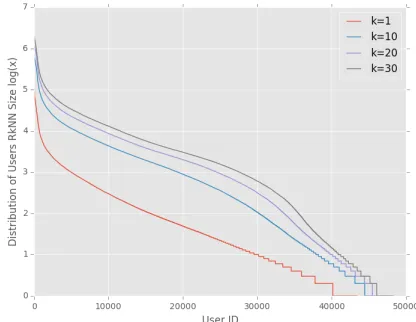
queries, with some users exposed by millions. Figure 1 shows the
distribution of exposure set size for users from the sample.
Moreover, since we do not a priori exclude queries such as
infre-quent or numerical tokens most RkNN sets will end up dominated
by garbage queries. Leaving such queries in during the generation
phase is a design choice motivated by the ’worst case scenario’
principle that often guides privacy and security research. While
most users will find these queries uninformative, for some people
it might be important to know they are searchable by certain URLs
(e.g., when the domain is known to contain sensitive content) or
numbers (e.g., their year of birth or the prices of products they
buy). Table 1 shows examples of the top queries in the raw
expo-sure sets where queries are ordered by the rank position of the
corresponding user post. These examples illustrate the need for
ranking the queries before presentation to end users – raw sets are
uninformative when mostly garbage queries are shown to the users
first.
4.1
Learning to rank the exposing queries
Recall the search exposure sets defined by Eq. 2. We want to rank
the triples within these sets according to search exposure relevance,
i.e., such that the queries the users would not want to be searched
by appear at the top. The traditional IR learning to rank setup, in
which the learned function orders the documents by relevance to
queries, is replaced by one where we rank the queries according to
relevance to users.
Each user-document-query triple can be represented as a
fea-ture vectorΦ(u,d,q). For each user, together with the relevance
score annotations, these form partial rankings determining
pair-wise relevance constraints between the data points (e.g., for a user
u, an exposing queryq1matching a documentd1should be ranked
higher than the queryq2matching a documentd2.) We want to
learn a ranking function that minimizes a loss measure over these
partial training rankings. For example, when learning to rank using
SV Mr ank[19], it is the number of violated pairwise constraints that is minimized, which implicitly leads to maximization of Kendall’s
τbetween the golden and learned rankings.
We describe the features and relevance scores we used to learn
the ranking function in the following two sections.
4.2
Features
4.2.1 Semantic features.The meaning of words plays an impor-tant role in determining criticality of search exposure. In a similar
context, user studies have shown topical sensitivity to be useful
in the context of privacy risk quantification from text [3]. To
cap-ture the coarse-grained semantics of the queries, we annotate them
with categories from the LIWC dictionaries [31]. LIWC categorizes
words into 80 linguistically and psychologically meaningful
cate-gories such aspositive emotion(love, nice, sweet),affective processes
(happy, cry, abandon),swear words(damn, piss, fuck),anxiety (wor-ried, fearful, nervous), orsexual(horny, love, incest). We create one binary feature based on each category, with a value of 1 if any of
the query words matches any of the words from the category.
4.2.2 Uniqueness of queries.While any query generated from a community’s text contents search-exposes some of its members,
from the perspective of a single user, these are the rare tokens
that are more likely to lead to exposure. While a considerable
portion of rare queries are simply meaningless noise, it is possible
that there are meaningful infrequent tokens with the potential to
violate privacy. Recall some of our motivating examples where an
adversary searches for information associated with a given sensitive
domain, or an e-mail address.
We propose two features to capture how rare a query is: query
selectivity and query entropy. We define the query selectivity as
the number of documents matching the query exactly:
selectivity(q)=|{d:q∈d}| (4)
This measure will be low for queries which appear infrequently.
Another aspect of a query being unique is how skewed the
distribution of the relevance scores is. We capture this by measuring
the entropy over the distribution of ranking scores of the top-k
returned results. LetRbe the distribution of the relevance scores of the top-kresults. We measure the entropy of the query as:
entropy(q)=H(R), whereR(i)= score(q,di)
Pk
j score(q,dj)
(5)
Note that these measures are not dependent on a given user, but
are dependent on the community as a whole, i.e., the relative
rank-ings of queries in different communities might differ. For instance,
while the queryLyme borreliosismight be an infrequent query on Twitter, it could be more popular in a medical Q&A forum.
4.2.3 User surprisal.The lexical context of a user might also matter when determining the criticality of a query. Imagine a user
with a Twitter profile where she posts mostly professional content.
It would not be surprising, and perhaps even desirable, that the
user’s posts are returned as top results to the queries from that
professional domain. However, if it turns out that the user profile
comes up at the top only to the queryfunny catsthat matches that single post the user has ever made outside of the professional
domain, this might be both unexpected and undesirable.
We propose to capture this intuition using surprisal, which is
measured by reversing the probability of the query being generated
from a user’s vocabulary distribution estimated from the posts:
surprisal(q,u)=loд 1 P(q|u)
!
=loд Q 1
w∈qP(w|u)
!
(6)
To account for the sparsity of user profiles, we compute these
probabilities using Dirichlet smoothing.
4.2.4 Document surprisal.Even though these are the queries that are ranked, the users might not want to be matched to a
non-critical query when it exposes a non-critical post. Similarly to surprisal
of queries, we define the surprisal of posts that are matched by the
Learning to Un-Rank: Quantifying Search Exposure CIKM’17, , November 6–10, 2017, Singapore.
Table 1: Example queries from unprocessed exposure sets.
aim oshtitsbaj, asleep oshtitsbaj, http://ra*.com/teh ba splash, mac vanilla, suck wake, mood sick
emma sun, watch xxxxxx, forget toast, @jeff * fall, heavyweight ladder, omg tan, alcohol nice
blown death, comin lake, parilla wait, bathroom wanna, crush hannah, friend lord, record woman
4.2.5 RkNN features.Two traditional methods for ranking the reverse nearest neighbors by relevance to the user are the proximity
of the reverse neighbor to the user and the rank of the reverse
neighbor. While not likely to be useful when the relevance is
defined as criticality, we include these features for comparison. We
measure proximity using the probability of generating the query
from the posting history ofu:
proximity(q,u)=loд(P(q|u)) (7)
Letdube the post of a useruthat is returned as an answer to query
qat positionrank(q,du):
rankposition(q,u)=rank(q,du) (8)
4.2.6 Syntactic features.We also introduce a number of binary post-dependent features that characterize emotional display or
content the users might not want to be exposed by through search.
These include:
• has url(set to 1 if the post contains a URL),
• has at mention(set to 1 if the post mentions another user),
• has hashtag(set to 1 of the query contains a hashtag).
• has emoticon(set to 1 if the post contains an emoticon),
• has repeated punctuation(set to 1 is any token in the post ends with a double exclamation mark, double question mark, or an
ellipsis),
• has repeated vowels(set to 1 if any token in a post contains a vowel repeated at least three times in a row),
• has laughter(set to 1 if any token contains a substring likehaha, with different vowels).
4.3
Relevance
Search exposure relevance differs in many ways from the topical
relevance of traditional IR tasks. A query might be relevant not only
because it’s topically sensitive, but also because it could embarrass,
offend, or otherwise violate the privacy of the exposed person. The
subjective nature of such judgments makes the manual collection
of relevance at scale an extremely time-consuming task, especially
if done by external evaluators. To decide which queries would be
relevant, a judge would have to put themselves in the shoes of the
evaluated user, imagine who that person is based on the contents of
the profile, and decide which queries would concern her. Moreover,
a judge would have to come up with likely threat scenarios. It
is a non-trivial task to prime the judges regarding these issues
without biasing them. With all these considerations, we derive
implicit relevance scores from other user-generated signals that
indicate reluctance to be associated with a given content. Implicit
relevance signals, especially in the form of clickthrough patterns,
are commonly used in traditional retrieval tasks [7]. The remainder
of this section presents our method for synthesizing the search
exposure relevance scores.
User score.If a user deletes a post, it is a signal she does not want to be associated with its content. Thus, a query matching a post that
got deleted after publication receives a user score of 1, whereas a
query matching a non-deleted post receives a user score of 0. While
a service provider quantifying exposure would have a direct access
to this information, there are also ways for collecting it outside of
the system [25]. We describe our collection method in more detail
in the experimental section.
Community score. The deletion information is a noisy signal, however, as users delete posts for a variety of reasons, including
language or double posting errors. We want to sanitize these scores
using stronger, community-wide signals that encode the differences
in language distributions in anonymous and non-anonymous
com-munities. These linguistic differences have been observed, for
in-stance, when comparing posts from Twitter and Whisper (an
anony-mous microposting platform) [10]. Having estimated the
vocabu-lary distributions in an anonymous (Panon) and a non-anonymous (Pnon−anon) community, we treat the relative probability of a query
being generated from these distributions as a community-wide
sig-nal that users do not want to be associated with the keywords.
More precisely, we set the community score of a query to:
community score(q)= Panon(q) Pnon−anon(q) =
Y
w∈q
Panon(w) Pnon−anon(w)
Golden ranking.Finally, we derive the relevance as a linear com-bination of both scores:
score(q)=α·user score(q)+(1−α)·community score(q)
Combining both scores allows us to discount the relevance of noisy
queries that match deleted posts, as well as add relevance to
sen-sitive queries matching posts that did not get deleted, as the user
perhaps did not have any privacy concerns in mind.
5
EXPERIMENTS: RKNN GENERATION
5.1
Dataset
For our experiments, we use a sample of Twitter profiles from the
longitudinal exposure study by Mondal et al. [25]. It consists of
51,550 user profiles with a total of about 5.5 million tweets posted
over the year 2009.
5.2
R
k
NN Generation
5.2.1 Data preparation.Before generating the RkNNs, we per-formed data cleaning, including stop word removal, lemmatization
and stemming. As a result, we extracted around 2 million unique
Query Type Average number of
candidate queries
Queries present
in the exposure
set (%)
T-T 0.5 100
T-NT 4.6 99
NT-NT 15.5 73
T-NE 348.6 90
[image:7.612.75.277.83.176.2]NT-NE 125112.1 0.4
Table 2: Statistics on query types.
and bigrams appearing in at least one tweet, which means around
45 million queries in total.
5.2.2 Static generation. In order to report the exposure sets of all users, we found theknearest neighbors of each query using
the threshold algorithm with 16 parallel processes, and added the
query to the exposure sets of the resulting tweets’ authors. Using a
cluster node with 1.5 TB memory and 48 CP U cores, it took about
10 hours in total to generate the exposure sets of all users.
5.2.3 Dynamic generation. In Section 3, we introduced five types of bigram queries. Table 2 shows the average number of
different types of candidate queries per tweet. For example, among
all the candidates for exposure sets, around 349 queries are of type
“T-NE”. The last column of Table 2 shows the average percentage of
each type appearing in the exposure sets. The values in the last row
confirm the importance of pruning based on Proposition 2 in RkNN Growth Algorithm, as only 0.4 percent of the candidate “NT-NE”
queries end up in the exposure sets. For example, neither the query
“garden” nor any of its extensions (21,112 queries) were RKNN of
the tweet “planting the garden today”.
We experimented the dynamic generation of the exposure set
with RGA on a random sample of 1000 tweets. Our experiments
showed the effectiveness of our pruning technique as the extension
of around 87% of queries with label “NT” to the type “NT-NE” was
prevented. More precisely, if the documentdis not among the topkresults of the queryq=ti, then with probability of at least
0.87 the documentdwould not be among the topkresults of any queryq=titjwith the type “NT-NE”. The RGA pruned 99% (96% through Proposition 2 and 3% through RTA) of all the candidate
queries of type “NT-NE” per document on average. As a result, we
observed a significant amount of speed improvement in generating
the exposure set of a tweet (2.24 seconds on average) compared to
the baseline RTA (around 8.6 minutes on average).
5.3
Exposure Sets Analysis
Figure 1 shows the distribution of the size of exposure sets of the
users in the dataset for different values ofk. Notably, there are
a few users whose exposure set is huge (in the order of millions)
– they are referred to ashubs. On the other hand, there are 3196 users (6% of all users) with an empty exposure set. These users are
referred to asanti-hubs, as their profile does not show up as a result for any query.
Table 3 shows example tweets of hubs and anti-hubs in our
dataset. Examining the user with the largest exposure set, we
[image:7.612.331.539.97.258.2]noticed she did not have anything personal in her profile but only
Figure 1: Distribution of the size of exposure sets. The values onY axis are in logarithmic scale with base 10.
posted titles of the songs broadcast on the radio. However, the
profile of the 7th hub is mainly personal, containing tweets like the
one in the second row of the table. The last row of Table 3 shows
that a tweet may contain sensitive words (’hate animals’), but still
not appear among the top-kresults of any query.
6
EXPERIMENTS: EXPOSURE SET RANKING
In this section, we discuss our insights into the search exposure
problem through evaluation of the ranking methods, as well as an
analysis of user perceptions regarding exposing queries collected
in an experiment on Amazon Mechanical Turk.
6.1
Query ranking in exposure sets
6.1.1 Exposure sets cleaning.For the evaluation results to be meaningful, we excluded the following queries from the exposure
sets: queries with tokens shorter than 3 letters, queries for which
none of the tokens is an English word, queries with numerical
tokens, urls, and references to other accounts. We also excluded
users whose posts are primarily written in a language other than
English. While all of these queries could be search exposure relevant
in certain contexts, it is unlikely that human judges who evaluate
the ranking outputs would be able to associate any meaning with
them.
6.1.2 Relevance score statistics.We construct the relevance scores as described in Sec. 4.3. Community scores are derived from the
Whisper dataset collected by Correa et al. [10], and the Twitter
dataset collected by Mondal et al. [25]. The Twitter dataset,
more-over, comes with the information regarding tweet deletion. More
precisely, by querying the Twitter API using a subset of the tweet
IDs, the authors were able to determine which tweets got deleted
after publication. This information was collected for 11M tweets,
400K of which turned out to have been removed. We use these
signals as the user score.
Because the information about post deletion is limited, the ground
Learning to Un-Rank: Quantifying Search Exposure CIKM’17, , November 6–10, 2017, Singapore.
User type User ID Tweet example Example of query to find the tweet Size of exposure set
Hub 19519947 Now on 50s on 5: In Dreams by Roy Orbison Roy Orbison 3,993,702
Hub 20463153 I hate being claustrophobic, esp when I have
to go into a tight space or in a cave
claustrophobic 2,809,290
Anti-hub 29664249 studying No query 0
Anti-hub 2847248 i hate animals No query 0
Table 3: Examples of hubs and anti-hubs.
Table 4: Most important semantic features learned by the L2R model together with example queries.
Feature Example queries
Sexual gross kiss, breast whitney, gay shirt
Humans dumbest guy, girl xoxo, chess kid
Friend pal wife, fellow fool, ummm honey
Anger buy weapon, mad scientist, idiot vegetarian
We therefore exclude the queries for which we cannot infer
rele-vance from the evaluation in this part. These include: (i) the queries
matching posts for which we do not have the deletion information,
(ii) the queries with only a partial overlap with the source post
(it might happen that a post is returned in the top-kresults for a query even though not all query words appear in the post; for
such queries we do not assume the deletion information signals
not wanting to be associated with the words). Excluding exposure
sets with less than 30 queries, which do not need ranking to be
presentable to users, we are left with around 15Kprofiles under
evaluation.
6.1.3 Ranking algorithm.To learn the ranking function, we use
SV Mr ank [19] with the linear kernel. ParameterCis tuned on a random sample of 10% RkNN sets, and the rest of the data is used to evaluate the L2R method in a 10-fold cross-validation.
6.1.4 Feature analysis. The weights of the decision boundary vector learned using SVM with a linear kernel can be interpreted
as feature importance weights. Table 4 lists the most important
features learned by our model together with example queries
ex-hibiting the features. The model captures well that the categories
related to personal issues are the ones people feel more
uncomfort-able sharing. High importance of words related to sexuality stems
from the bias of the Whisper data – a large majority of anonymous
posts from this community regard sexuality. However, the
method-ology we propose is general enough to handle different types of
anonymous contents. For instance, as an alternative, it would be
possible to collect anonymous posts from more general Question
& Answer communities such as Quora.
6.2
User-study evaluation
Because the relevance scores used for training the algorithm
con-stitute noisy signals for search exposure relevance, we evaluate
the reranked exposure sets in a user study. The leading question
is whether users themselves would find the output useful,
feel-ing that exposure by top-ranked keywords would make them feel
uncomfortable. This section provides the details of the study.
6.2.1 Evaluation setup. To evaluate the rankings, we sample a number of exposure sets and a number of queries from each.
User sampling:The first important thing to note is that not all of the exposure sets contain sensitive queries. To account for this and
make sure we cover the sensitive users in the evaluation, we sample
users non-uniformly in the following way. Queries within exposure
sets are ordered by the predicted relevance scores. The score of
the highest ranking query within a set can be thought of as an
indicator of how sensitive the exposure set is overall (i.e., the lower
the highest score, the less sensitive content there is overall). For
evaluation, we choose the 50 most sensitive exposure sets, and 50
exposure sets sampled from the remaining tail with the probability
proportional to the predicted relevance of the highest scoring query.
We thus evaluate 100 exposure sets in total.
Query sampling:To construct assignments with reasonable work-loads, we evaluate 50 queries from each of the sampled exposure
sets. Having the queries ranked by the L2R method under
evalua-tion, we choose 25 highest scoring queries (to see how useful the
top of the ranking is), and 25 queries chosen uniformly randomly
from the remaining tail (to control if the head of the ranking does
not miss critical queries).
6.2.2 AMT survey.Each set of 50 sampled queries was shown to 3 Amazon Mechanical Turk workers. The queries were displayed
in a random order. We required that the workers have a master
qualification (to ensure the quality of annotations) and are located in
the USA (to prevent language misunderstanding). Upon explaining
the basic pipeline of the Twitter search engine and priming the users
about what exposure is, the survey asked the following question:
Would you feel concerned (uncomfortable, embar-rassed, privacy-violated, or threatened) if your tweet was returned as one of the top answers to these search terms? (Yes/No)
Having three people evaluate each query leads to a 4-graded (0..3)
relevance scale, based on how many people choseYes.
Out of 5Kevaluated queries, 10% had a score of 3, 12% had a score of 2, 24% had a score of 1, 54% had a score of 0. Inter-annotator
agreement measured by Fleiss’κwas 0.376, which corresponds to a fair agreement.
6.2.3 Results.We report the values for NDCG@[5,10,20] and Kendall’sτ. Moreover, since the collected scores offer good
in-terpretability in terms of binary relevance as well, we also report
Precision@[5,10,20], assuming a query is search exposure relevant
if it was marked by at least one judge.
Table 5 shows the results of the user-study evaluation. Note that,
although the queries were sampled from the L2R-ranked exposure
heuristics. We use the rankings based on the values of several
high-level features as baselines. Majority of these perform significantly
worse than the L2R method – differences significant by a paired
t-test withp<0.05 are marked with the∗symbol. The strongest heuristics include document surprisal and selectivity. Both of these
quantities capture a different aspect of the rareness of the content,
and thus shine in situations where, for instance, the judges thought
that exposure by a typo might lead to embarrassment. We also
observed that a number of query tokens are typos that can be
mapped to a sensitive word. Such queries were often marked by the
judges as relevant, and because of their rareness, heuristics such as
selectivity gain in performance.
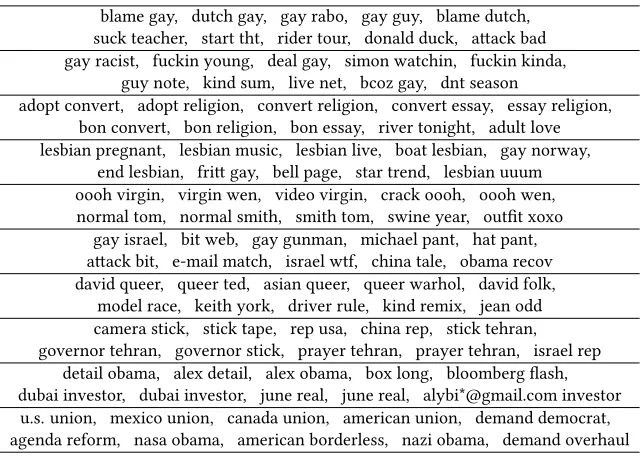
6.2.4 Anecdotal examples of sensitive exposure sets.Table 6 presents examples of exposure sets with the top-10 queries ranked by the
L2R method and is meant as an overview of the types of sensitive
keywords a user might be exposed by in Twitter. Queries were
generated from the contents of user posts, which means that each
presented word combination matches at least one post in our
sam-ple. We resort to showing a manually chosen subset of examples, as
the top sensitive exposure sets were highly explicit and offensive.
7
INSIGHTS INTO SEARCH EXPOSURE
RELEVANCE
7.1
Tweet context
An interesting question regarding search exposure relevance is
whether it is influenced by the context of the returned tweet. It
might happen that a query that looks sensitive is constructed from
words that do not form a coherent context within a post, thus being
a false alarm. On the other hand, innocent looking queries might
bring out posts that do contain sensitive content otherwise.
To gain preliminary insight into this problem, we conducted a
second survey on AMT, in which the workers assessed the relevance
of queries, also knowing the tweet that is being returned as a result;
the rest of the setup remained analogous. Comparison of these two
surveys is summarized in Figure 2. Existence of dark squares outside
of the diagonal suggests indeed that the context might change the
exposure relevance judgement. This happens both ways, suggesting
that both scenarios we mentioned in the previous paragraph are
plausible. We believe that investigating the factors that influence
the search exposure relevance is an interesting topic for future
work.
7.2
Search exposure relevance vs topical
sensitivity
Topical sensitivity is a concept introduced for studying privacy
risks of text, in particular for quantifying R-Susceptibility
(Rank-Susceptibility) in communities where user profiles consist of textual
contents [3]. It measures how likely the presence of words from
different topics (understood as distributions over words) leads to
privacy risks, irrespective of the user or community context. We
want to understand if there is a correlation between topical
sensi-tivity defined this way and the search exposure relevance. We thus
annotate each query from our evaluation set using the topical
[image:9.612.330.528.97.245.2]sen-sitivity annotationssensitivity(t)collected in the R-Susceptibility
Figure 2: Influence of the tweet context on search exposure relevance. The number in a squarex(q), y(q+t) denotes the number of tweets that received the score ofx in the study with queries only, and the score ofyin the study with queries in context.
paper [3]. We define the sensitivity of a query as:
sensitivity(q)= 1
|q|
X
w∈q
X
t
sensitivity(t)·P(w|t) (9)
whereP(w|t)is the probability of a wordwin the topict. We measure the correlation between these sensitivity-annotations
and the collected relevance scores using the Pearson correlation
coefficient. We find a strong correlation between these scores in
case of the relevance collected for queries without the tweet context
(Pearson coefficient of 0.44), and a little lower correlation (Pearson
coefficient of 0.32) in case of the relevance judgments for queries
with the tweet context. This result reconfirms the findings from
the evaluation of the L2R method – the meaning of the query is an
important factor in determining search exposure relevance, and
top-ical sensitivity is a viable alternative for implicit relevance scores.
8
RELATED WORK
Exposure.Although, to the best of our knowledge, the problem of search exposure has not been addressed in the past, there are
different aspects of user and data exposure that have been studied
in the prior literature. Mondal et al. proposed exposure control as
an alternative solution to access control in social networks [24], and
later devised solutions for longitudinal exposure control [25]. Biega
et al. quantify privacy risks for sensitive topics in rankings based
on textual posts using the notion of R-Susceptibility [3]. Exposure
has also been studied in the context of individual attribute leakege,
such as location [29]. Another interesting problem is that of
usabil-ity of exposure warnings. Example solutions include depicting the
current size of content audience by the size of a displayed pair of
eyes [27].
Privacy-preserving IR.Problems studied in privacy-preserving IR include sanitization of query logs prior to a release [15, 38],
Learning to Un-Rank: Quantifying Search Exposure CIKM’17, , November 6–10, 2017, Singapore.
Table 5: Exposure set ranking user-study results averaged over all users. Methods marked with∗perform significantly worse than L2R on a given metric (paired t-test,p<0.05).
Prec@5 Prec@10 Prec@20 NDCG@5 NDCG@10 NDCG@20 Kendall’sτ
L2R 0.636 0.566 0.509 0.515 0.496 0.530 0.107
Surprisal 0.448∗ 0.449∗ 0.447∗ 0.210∗ 0.245∗ 0.316∗ -0.035∗
Document Surprisal 0.480∗ 0.471∗ 0.470∗ 0.229∗ 0.262∗ 0.350∗ 0.016∗
Entropy 0.472∗ 0.489∗ 0.494 0.209∗ 0.262∗ 0.347∗ 0.026∗
Selectivity 0.548∗ 0.508∗ 0.489 0.278∗ 0.305∗ 0.378∗ 0.037∗
[image:10.612.145.467.227.455.2]Rank 0.460∗ 0.463∗ 0.466∗ 0.204∗ 0.248∗ 0.330∗ 0.018∗
Table 6: Top-10sensitive exposing queries returned by the L2R model for a subset of users.
blame gay, dutch gay, gay rabo, gay guy, blame dutch,
suck teacher, start tht, rider tour, donald duck, attack bad
gay racist, fuckin young, deal gay, simon watchin, fuckin kinda,
guy note, kind sum, live net, bcoz gay, dnt season
adopt convert, adopt religion, convert religion, convert essay, essay religion,
bon convert, bon religion, bon essay, river tonight, adult love
lesbian pregnant, lesbian music, lesbian live, boat lesbian, gay norway,
end lesbian, fritt gay, bell page, star trend, lesbian uuum
oooh virgin, virgin wen, video virgin, crack oooh, oooh wen,
normal tom, normal smith, smith tom, swine year, outfit xoxo
gay israel, bit web, gay gunman, michael pant, hat pant,
attack bit, e-mail match, israel wtf, china tale, obama recov
david queer, queer ted, asian queer, queer warhol, david folk,
model race, keith york, driver rule, kind remix, jean odd
camera stick, stick tape, rep usa, china rep, stick tehran,
governor tehran, governor stick, prayer tehran, prayer tehran, israel rep
detail obama, alex detail, alex obama, box long, bloomberg flash,
dubai investor, dubai investor, june real, june real, alybi*@gmail.com investor
u.s. union, mexico union, canada union, american union, demand democrat,
agenda reform, nasa obama, american borderless, nazi obama, demand overhaul
queries [14, 34]. A number of works also investigate the viability
of personalized search under privacy constraints [8, 28, 35, 40].
User protection and internal audits.Service providers increas-ingly come under close scrutiny by external organizations and
observers, including journalists and researchers. This pressure
en-courages the SPs to perform proactive, internal audits to improve
their services and infrastructure. New solutions for increased
pri-vacy are constantly introduced to mitigate the threats for users
from external adversaries in services like maps [17]. User data
itself has also been analyzed, for example, to deliver better security
protections in the context of account recovery personal questions
[4]. Beyond privacy, there are also other societal issues that press
SPs to audit their services, including the issues of fairness and bias
[13], or user satisfaction with search results [23].
Search exposure can be seen as another dimension for internal
audits. Along these lines, we believe more work can be done to
ex-amine which types of search queries should be blocked altogether,
and which search results should be removed to protect against
find-ing users in sensitive contexts. While certain ad-hoc protections are
already in place (for instance, it seems impossible to explicitly query
for credit card numbers in Google, Twitter, or Facebook, since these
tokens get post-processed and end up matching other numerical
tokens as well), there is a need for a more direct examination and
protection mechanisms regarding the exposure of users in search
systems.
(Reverse)k-nearest-neighbors problems.Finding the set of re-verseknearest neighbors (a.k.a. the influence set) of a point has
been studied in various contexts such as matching the user
pref-erences to a given product [33] or the assignment of a publication
to a set of subscriptions [1, 9]. The setting of such problems falls
into either of these categories: monochromatic or bichromatic. This
classification is based on whether the points and their reverse
near-est neighbors come from an identical set (monochromatic) or not
(bichromatic) [12]. Our model is an instance of a bichromatic RkNN
based on the fact that the set of queries and the set of the documents
are disjoint.
Many algorithms have been introduced for efficient generation of
the sets of RkNNs, differing mainly in their approach to pruning the search space. Some of these pruning methods are the grid-based
branch and bound on hierarchical grid structure [36] and branch
and bound on indexing trees whose nodes have either the shape of a
circle or a cone [26] or a rectangle (minimum bounding rectangles)
[39]. The existing algorithms, however, are not sufficiently efficient
for our problem due to high dimensionality, large cardinality and
sparsity of the query vector space.
With an increase in the size of the (R)kNN problem, distributed
and parallel computation usually becomes inevitable to guarantee
scalability. Effective data partitioning [16, 37], load balancing [1]
and minimizing the communication cost of the machines [6] have
been studied for the (R)kNN problem so far. In this work, however,
we leave a distributed version of the proposed algorithm as a future
work.
9
CONCLUSION
This paper introduces the problem of quantifying user search
expo-sure, that is, finding the queries for which any of the user’s posts
is returned as a top-ranked result in a given search system. We
proposed an efficient RkNN Growth Algorithm for computing the exposing queries, as well as methods for ranking the queries in
the resulting exposure sets to make the output user-friendly. To
solve this ranking task, we moreover defined the concept of search
exposure relevance, and studied it in a series of AMT surveys.
We believe there are a number of fascinating research questions
that could be studied as an extension to the work presented in
this paper. On the generation side, considering other ranking
mod-els, expanding the query length and efficient stream processing of
search exposure requests, including parallel computation, caching
and request partitioning would be necessary in a real-world
deploy-ment. On the usability and ranking side, further understanding of
exposure relevance, designing better ranking methods, studying
the exposure under different search models, incorporating the
prob-abilities of queries being asked to the overall setup, or detecting
exposure in black-box systems, are only a few of such extension
possibilities. Finally, further investigating layman perceptions
re-garding search exposure, as well as developing the expert
under-standing of the possible threats, would give us a better grip of this
newly defined privacy question.
Acknowledgements.This work was partly supported by the ERC Synergy
Grant 610150 (imPACT) and Alexander von Humboldt Foundation.
REFERENCES
[1] Fuat Basık, Bu ˘gra Gedik, Hakan Ferhatosmano ˘glu, and Mert Emin Kalender. 2015. S3-TM: scalable streaming short text matching.The VLDB Journal - The
International Journal on Very Large Data Bases(2015).
[2] Michael S Bernstein, Eytan Bakshy, Moira Burke, and Brian Karrer. Quantifying the invisible audience in social networks. InCHI ’13.
[3] J Asia Biega, Krishna P Gummadi, Ida Mele, Dragan Milchevski, Christos Try-fonopoulos, and Gerhard Weikum. 2016. R-susceptibility: An IR-centric approach to assessing privacy risks for users in online communities. InSIGIR ’16. [4] Joseph Bonneau, Elie Bursztein, Ilan Caron, Rob Jackson, and Mike Williamson.
Secrets, Lies, and Account Recovery: Lessons from the Use of Personal Knowl-edge Questions at Google. InWWW ’15.
[5] danah boyd. 2008. Facebook’s privacy trainwreck: Exposure, invasion, and social convergence.Convergence(2008).
[6] B Barla Cambazoglu, Enver Kayaaslan, Simon Jonassen, and Cevdet Aykanat. 2013. A term-based inverted index partitioning model for efficient distributed query processing.ACM Transactions on the Web (TWEB)(2013).
[7] Ben Carterette and Rosie Jones. Evaluating search engines by modeling the relationship between relevance and clicks. InNIPS ’08.
[8] Gang Chen, He Bai, Lidan Shou, Ke Chen, and Yunjun Gao. UPS: efficient privacy protection in personalized web search. InSIGIR ’11.
[9] Lisi Chen and Gao Cong.Diversity-Aware Top-k Publish/Subscribe for Text Stream. InSIGMOD ’15.
[10] Denzil Correa, Leandro Ara ´ujo Silva, Mainack Mondal, Fabr´ıcio Benevenuto, and Krishna P Gummadi. The Many Shades of Anonymity:Characterizing Anonymous Social Media Content.. InICWSM ’15.
[11] W Bruce Croft, Donald Metzler, and Trevor Strohmann. 2010.Search engines. Pearson Education.
[12] Tobias Emrich, Hans-Peter Kriegel, Peer Kr ¨oger, Johannes Niedermayer, Matthias Renz, and Andreas Z ¨ufle. 2015. On reverse-k-nearest-neighbor joins.
GeoInfor-matica(2015).
[13] Michael Feldman, Sorelle A. Friedler, John Moeller, Carlos Scheidegger, and Suresh Venkatasubramanian.Certifying and Removing Disparate Impact. In
KDD ’15.
[14] Arthur Gervais, Reza Shokri, Adish Singla, Srdjan Capkun, and Vincent Lenders. Quantifying Web-Search Privacy. InCCS ’14.
[15] Michaela Gotz, Ashwin Machanavajjhala, Guozhang Wang, Xiaokui Xiao, and Johannes Gehrke. 2012. Publishing search logs - a comparative study of privacy guarantees.IEEE Transactions on Knowledge and Data Engineering(2012). [16] Yupeng Hu, Chong Yang, Cun Ji, Yang Xu, and Xueqing Li. Efficient Snapshot
KNN Join Processing for Large Data Using MapReduce. InICPADS ’16. [17] Danny Yuxing Huang, Doug Grundman, Kurt Thomas, Abhishek Kumar, Elie
Bursztein, Kirill Levchenko, and Alex C. Snoeren. Pinning Down Abuse on Google Maps. InWWW ’17.
[18] Ihab F Ilyas, George Beskales, and Mohamed A Soliman. 2008. A survey of top-k query processing techniques in relational database systems.ACM Computing
Surveys (CSUR)(2008).
[19] Thorsten Joachims. Training linear SVMs in linear time. InKDD ’06. [20] Ken CK Lee, Baihua Zheng, and Wang-Chien Lee. 2008. Ranked reverse nearest
neighbor search.IEEE Transactions on Knowledge and Data Engineering(2008). [21] Jiaheng Lu, Ying Lu, and Gao Cong. Reverse spatial and textual k nearest
neighbor search. InSIGMOD ’11.
[22] Cheng Luo, Feng Yu, Wen-Chi Hou, Zhewei Jiang, Dunren Che, and Shan He. 2011. IRTA: An Improved Threshold Algorithm for Reverse Top-k Queries.. In
ICEIS (1).
[23] Rishabh Mehrotra, Ashton Anderson, Fernando Diaz, Amit Sharma, Hanna Wallach, and Emine Yilmaz. Auditing Search Engines for Differential Satisfaction Across Demographics. InWWW ’17.
[24] Mainack Mondal, Peter Druschel, Krishna P Gummadi, and Alan Mislove. Beyond access control: Managing online privacy via exposure. InUSEC ’14.
[25] Mainack Mondal, Johnnatan Messias, Saptarshi Ghosh, Krishna P Gummadi, and Aniket Kate. Forgetting in Social Media: Understanding and Controlling Longitudinal Exposure of Socially Shared Data. InSOUPS ’16.
[26] Parikshit Ram and Alexander G Gray. 2012.Maximum inner-product search using tree data-structures.arXiv preprint arXiv:1202.6101(2012).
[27] Roman Schlegel, Apu Kapadia, and Adam J Lee. Eyeing your exposure: quan-tifying and controlling information sharing for improved privacy. InSOUPS
’11.
[28] Xuehua Shen, Bin Tan, and ChengXiang Zhai. 2007. Privacy protection in personalized search. InACM SIGIR Forum.
[29] Reza Shokri, George Theodorakopoulos, George Danezis, Jean-Pierre Hubaux, and Jean-Yves Le Boudec. Quantifying location privacy: the case of sporadic location exposure. InPETS ’11.
[30] Yufei Tao, Dimitris Papadias, and Xiang Lian. Reverse kNN search in arbitrary dimensionality. InVLDB ’04.
[31] Yla R Tausczik and James W Pennebaker. 2010. The psychological meaning of words: LIWC and computerized text analysis methods.Journal of language and
social psychology(2010).
[32] Jaime Teevan, Daniel Ramage, and Merredith Ringel Morris. # TwitterSearch: a comparison of microblog search and web search. InWSDM ’11.
[33] Akrivi Vlachou, Christos Doulkeridis, Yannis Kotidis, and Kjetil Norvag. 2011. Monochromatic and bichromatic reverse top-k queries.IEEE Transactions on
Knowledge and Data Engineering(2011).
[34] Peng Wang and Chinya V Ravishankar. On masking topical intent in keyword search. InICDE ’14.
[35] Yabo Xu, Ke Wang, Benyu Zhang, and Zheng Chen. Privacy-enhancing person-alized web search. InWWW ’07.
[36] Man Lung Yiu and Nikos Mamoulis. 2007. Reverse nearest neighbors search in ad hoc subspaces.IEEE Transactions on Knowledge and Data Engineering(2007). [37] Oren Zamir, Oren Etzioni, Omid Madani, and Richard M Karp. Fast and Intuitive
Clustering of Web Documents.. InKDD ’97.
[38] Sicong Zhang, Hui Yang, and Lisa Singh. Anonymizing Query Logs by Differen-tial Privacy. InSIGIR ’16.
[39] Zhao Zhang, Cheqing Jin, and Qiangqiang Kang. Reverse k-ranks query. In
VLDB ’14.