University of Warwick institutional repository: http://go.warwick.ac.uk/wrap
A Thesis Submitted for the Degree of PhD at the University of Warwick
http://go.warwick.ac.uk/wrap/60133
This thesis is made available online and is protected by original copyright. Please scroll down to view the document itself.
1
On Exploring the Communicative Impact of
Facilitated Modelling during Strategic Group
Decision Making: An Interaction Analysis Study
by
Orestis G. Afordakos
A thesis submitted in partial fulfilment of the requirements
for the degree of
Doctor of Philosophy in
Operational Research & Management Sciences.
2
To mom, for teaching me Persistence and Humility. God bless her soul.
To dad, for teaching me Optimism and Pride. God bless his soul.
3
Table of Contents
1 Introduction ... 21
1.1 Background to the Study... 21
1.2 Primary Research Question. ... 23
1.3 Contribution of exploring the Primary Research Question. ... 23
1.4 Structure of the thesis. ... 25
2 Literature Review ... 26
2.1 Introduction ... 26
2.2 Strategic Decision Making... 27
2.2.1 Introduction ... 27
2.2.2 Strategic Decision Making in Context ... 27
2.2.3 Summary ... 31
2.3 Group Decision Making... 32
2.3.1 Introduction ... 32
2.3.2 GDM -- Not Problem Free. ... 33
2.3.2.1 Conflict: A Definintion. ... 34
2.3.2.2 Effective Negotiation = Effective Conflict Management ... 35
2.3.2.3 Effective Conflict Management. ... 37
2.3.2.4 Summary ... 39
2.3.3 Previous Responses to GDM Issues. ... 39
2.3.3.1 Formal Group Process Procedures - FGPP’s ... 40
2.3.3.2 Group Decision Support Systems - GDSS ... 40
2.3.3.3 Problem Structuring Methods - PSMs ... 42
2.3.3.3.1 SODA ... 44
2.3.3.4 Summary ... 46
2.4 Facilitated Modelling - FM ... 47
2.4.1 Introduction ... 47
2.4.2 FM -- Types. ... 48
2.4.3 FM -- The Role of the Facilitator. ... 49
2.4.4 FM -- Workshop Stages. ... 50
2.4.5 FM -- The Model ... 52
2.4.6 FM Models -- Claims for Effective Conflict Management ... 52
4
2.5.1 The Model as a Source of Structure. ... 61
2.5.2 Faithful Vs Ironic Model Appropriations. ... 62
2.5.3 Model Visibility Level. ... 64
2.5.4 Model Appropriation Complexity. ... 65
2.5.5 Summary. ... 66
2.6 Research Model. ... 67
2.6.1 Research Questions ... 68
2.6.1.1 Research Question 1 ... 69
2.6.1.2 Research Question 2 ... 69
2.6.1.3 Research Question 3 ... 70
2.6.1.4 Research Question 4 ... 71
2.6.1.5 Research Question 5 ... 72
2.6.1.6 Research Question 6 ... 73
2.6.1.7 Research Question 7 ... 73
2.6.2 Summary of Key Constructs. ... 74
3 Methodology ... 76
3.1 Introduction ... 76
3.2 Level and Unit of Analysis – Groups. ... 76
3.3 Data Collection ... 79
3.3.1 Group selection , group size and facilitation considerations ... 79
3.3.2 Data Recording ... 81
3.3.3 Ethics in Research. ... 83
3.4 Data Transformation. ... 83
3.4.1 From Interaction Records to Interaction Data. ... 84
3.4.2 Coding ... 88
3.4.2.1 Type of coding. ... 89
3.4.2.2 Coding Conflict Management Types and Confrontiveness- GWRCS. 89 3.4.2.3 Coding Model Appropriations and Faithfulness of Appropriations - MACS 90 3.4.3 Phase markers conversion. ... 92
3.4.3.1 Universal code – Typing. ... 93
3.4.3.2 Auxiliary Code for ‘Thought Unit’ based coding schemes. ... 93
3.4.4 Latitude of judgement accorded to coders... 93
5
3.4.5.1 Univocal versus multifunctional coding. ... 97
3.4.5.2 Domain of meaning to be coded. ... 98
3.4.5.3 Validity of the coding schemes used ... 98
3.4.5.4 Colour coding used ... 99
3.4.5.4.1 Universal colour codes: ... 99
3.4.5.4.2 Phasic timelines colour codes ... 100
3.5 Data Analysis-Statistical Analysis Techniques. ... 100
3.5.1 RQ1 - - Statistical Analysis Techniques. ... 101
3.5.1.1 Chi Square Requirements Met. ... 102
3.5.2 RQ2 - - Statistical Analysis Techniques. ... 103
3.5.2.1 Multinomial Logistic Regression for Matched Pairs. ... 104
3.5.2.1.1 Choosing a statistical analysis technique. ... 104
3.5.2.1.2 The log-odds... 107
3.5.2.1.3 Classification of the likelihood ... 109
3.5.2.1.4 Example of calculations ... 111
3.5.3 RQ3 - Statistical Analysis Techniques. ... 117
3.5.4 RQ4 - Statistical Analysis Techniques. ... 120
3.5.5 RQ5 - Statistical Analysis Techniques. ... 128
3.5.6 RQ6 - Statistical Analysis Techniques. ... 130
3.5.7 RQ7 - Statistical Analysis Techniques. ... 132
3.6 Statistical Analysis Datasets ... 133
3.7 Cases Observed – Brief Description ... 134
3.7.1 CASE A ... 134
3.7.2 CASE B ... 135
3.7.3 CASE C ... 136
4 Results and Findings ... 136
4.1 Descriptive Statistics... 137
4.1.1 A note on the raw data used. ... 137
4.1.2 Case A - Descriptive Statistics. ... 138
4.1.2.1 Stage 1 - Group Working Relationships. ... 138
4.1.2.2 Stage 2 - Group Working Relationships. ... 139
4.1.2.3 Stage 3 - Group Working Relationships. ... 141
4.1.2.4 Stage 4 - Group Working Relationships. ... 142
6
4.1.2.6 Stage 2 - Model Appropriations. ... 146
4.1.2.7 Stage 3 - Model Appropriations. ... 147
4.1.2.8 Stage 4 - Model Appropriations. ... 149
4.1.3 Case B - Descriptive Statistics. ... 150
4.1.3.1 Stage 1 - Group Working Relationships. ... 150
4.1.3.2 Stage 2 - Group Working Relationships. ... 152
4.1.3.3 Stage 3 - Group Working Relationships. ... 154
4.1.3.4 Stage 4 - Group Working Relationships. ... 155
4.1.3.5 Stage 1 - Model Appropriations. ... 156
4.1.3.6 Stage 2 - Model Appropriations. ... 158
4.1.3.7 Stage 3 - Model Appropriations. ... 159
4.1.3.8 Stage 4 - Model Appropriations. ... 161
4.1.4 Case C - Descriptive Statistics.. ... 162
4.1.4.1 Stage 1 - Group Working Relationships. ... 162
4.1.4.2 Stage 2 - Group Working Relationships. ... 164
4.1.4.3 Stage 3 - Group Working Relationships. ... 165
4.1.4.4 Stage 4 - Group Working Relationships. ... 167
4.1.4.5 Stage 5- Group Working Relationships. ... 168
4.1.4.6 Stage 1 - Model Appropriations. ... 170
4.1.4.7 Stage 2 - Model Appropriations. ... 172
4.1.4.8 Stage 3 - Model Appropriations. ... 173
4.1.4.9 Stage 4 - Model Appropriations. ... 175
4.1.4.10 Stage 5 - Model Appropriations. ... 177
4.1.5 A Clarification Note on Time Delineation. ... 179
4.1.6 Summary of Key Descriptive Statistics. ... 182
4.2 RQ1: Statistical Analysis Results ... 183
4.3 RQ 1: Interpretative Analysis ... 187
4.3.1 RQ 1: Findings Summary ... 189
4.3.1.1 RQ1 - Finding F1.1. ... 189
4.3.1.2 RQ1 - Finding F1.2. ... 189
4.4 RQ2: Statistical Analysis Results ... 190
4.5 RQ2: Interpretative Analysis. ... 196
4.5.1 RQ2: Stage 2 - Cross Case Interpretative Analysis. ... 196
4.5.1.1 RQ2: Stage 2 – Cross Case Findings ... 197
7
4.5.2.1 RQ2: Stage 3 – Cross Case Findings ... 200
4.5.3 RQ2: Stage 4 - Cross Case Interpretative Analysis ... 201
4.5.3.1 RQ2: Stage 4 – Cross Case Findings ... 203
4.5.4 Stage 5 – Single Case Interpretative Analysis ... 204
4.5.4.1 RQ2: Stage 5 – Single Case Findings ... 204
4.5.5 RQ2: Cross Stage Results ... 204
4.5.6 RQ2: Cross Stage Interpretative Analysis ... 206
4.5.6.1 RQ2: Cross Stage Findings:... 210
4.5.7 RQ2: Typology developed. ... 212
4.5.8 RQ 2: Findings Summary. ... 214
4.5.8.1 RQ 2 -Finding - F2.1 ... 214
4.5.8.2 RQ 2 -Finding - F2.2 ... 214
4.5.8.3 RQ 2 -Finding - F2.3 ... 214
4.5.8.4 RQ 2 -Finding - F2.4.1 ... 215
4.5.8.5 RQ 2 -Finding - F2.4.2 ... 215
4.5.8.6 RQ 2 -Finding - F2.4.3 ... 215
4.6 RQ 3: Statistical Analysis Results ... 215
4.7 RQ3: Interpretative Analysis ... 221
4.7.1 RQ3: Stage 1 – Single Case Analysis. ... 221
4.7.1.1 RQ3: Stage 1 – Single Case Findings. ... 222
4.7.2 RQ3: Stage 2 - Cross Case Analysis. ... 222
4.7.2.1 RQ3: Stage 2 – Cross Case Findings ... 224
4.7.3 RQ3: Stage 3 - Cross Case Analysis. ... 226
4.7.3.1 RQ3: Stage 3 – Cross Case Findings ... 227
4.7.4 RQ3: Stage 4 - Cross Case Analysis. ... 228
4.7.4.1 RQ3: Stage 4 – Cross Case Findings ... 229
4.7.5 RQ3: Stage 5 – Single Case Analysis. ... 231
4.7.5.1 RQ3: Stage 5 – Single Case Findings. ... 231
4.7.6 RQ3: Cross Stage Results ... 232
4.7.7 RQ3: Cross Stage Interpretative Analysis ... 235
4.7.7.1 RQ3: Cross Stage Findings. ... 236
4.7.8 RQ3: Typology developed. ... 238
4.7.9 RQ3: Findings Summary. ... 241
4.7.9.1 RQ3 - Finding - F3.1 ... 241
8
4.7.9.3 RQ3 - Finding - F3.3 ... 241
4.7.9.4 RQ3 - Finding - F3.4 ... 242
4.7.9.5 RQ3 - Finding - F3.5 ... 242
4.7.9.6 RQ3 - Finding - F3.6 ... 242
4.8 RQ 4: Statistical Analysis Results ... 242
4.9 RQ 4: Interpretative Analysis ... 245
4.9.1 RQ4: Findings Summary. ... 251
4.9.1.1 RQ4 - Finding - F4.1 ... 251
4.9.1.2 RQ4 - Finding - F4.2 ... 252
4.9.1.3 RQ4 - Finding - F4.3 ... 252
4.9.1.4 RQ4 - Finding - F4.4 ... 252
4.10 RQ 6: Statistical Analysis Results... 252
4.11 RQ 6: Interpretative Analysis... 255
4.11.1 RQ 6: Findings Summary ... 260
4.11.1.1 RQ 6 - Finding - F6.1 ... 260
4.11.1.2 RQ 6 - Finding - F6.2 ... 260
4.11.1.3 Proposition - P6.1 ... 260
4.12 RQs 5+7: Statistical Analysis Results ... 261
4.12.1 RQs 5+7: Interpretative Analysis ... 263
4.12.1.1 RQ 5 + 7 - Finding - F5+7 ... 264
4.12.2 RQs 5+7: Additional Analysis ... 264
4.12.3 RQ’s 5+7: “Soft” Findings Summary. ... 275
4.12.3.1 RQ’s 5+7 - “Soft” Finding - SF 5.1 ... 275
4.12.3.2 RQ’s 5+7 - “Soft” Finding - SF 5.2 ... 275
4.12.3.3 RQ’s 5+7 - “Soft” Finding - SF 5.3 ... 275
4.12.3.4 RQ’s 5+7 - “Soft” Finding - SF 7.1 ... 276
4.12.3.5 RQ’s 5+7 - “Soft” Finding - SF 7.2 ... 276
4.12.3.6 RQ’s 5+7 - “Soft” Finding - SF 7.3 ... 276
4.12.3.7 RQ’s 5+7 - “Soft” Finding - SF 5.4 and 7.4 ... 276
5 Discussion. ... 277
5.1 Theory Development ... 277
5.1.1 Contribution to Facilitated Modelling Theory. ... 277
5.1.1.1 FM Claims Tested. ... 278
5.1.2 The Role of Model Appropriations Complexity. ... 281
9
5.1.2.2 -in Adaptive Structuration Theory ... 282
5.1.3 Contribution to Adaptive Structuration Theory ... 283
5.1.4 Contribution to GDSS ... 286
5.1.5 Contribution to SDM in Practice. ... 290
5.1.6 Methodological Implications. ... 291
5.2 Areas for Improvement of the Facilitated Modeling Workshop... 292
5.2.1 Pre-workshop Areas of Improvement. ... 293
5.2.2 During workshop Areas of Improvement. ... 295
5.3 Limitations of this Study... 297
5.3.1 Philosophical Considerations ... 298
5.3.2 Theoretical Considerations ... 298
5.3.3 Conceptual Weaknesses. ... 298
5.3.4 Methodological Weaknesses. ... 299
5.4 Directions for Future Research. ... 301
6 Conclusion. ... 305
6.1 Personal Remarks ... 306
7 Reference: ... 308
8 Appendix 1 ... 332
9 Appendix 2 ... 335
10 Appendix 3 ... 337
11 Appendix 4 ... 338
12 Appendix 5 ... 343
13 Appendix 6 ... 346
10
List of Tables
Table 2:1 Stages, Processes and Task types of a typical FM workshop. ... 51
Table 2:2 Model Visibility Classification Table ... 65
Table 3:1 Level and Unit of Analysis. ... 77
Table 3:2 Positioning of Cameras for Video Recording ... 82
Table 3:3 Per Stage thought units for Case A ... 87
Table 3:4 Per Stage thought units for Case B ... 88
Table 3:5 Per Stage thought units for Case C ... 88
Table 3:6 Model Visibility Levels ... 93
Table 3:7 Coder Training ... 94
Table 3:8 Actual Coding ... 94
Table 3:9 Phasic Timelines Colour Coding ... 100
Table 3:10 Log-Odds Transformation ... 111
Table 3:11 Example of MLR Calculations. ... 112
Table 3:12 Example of Final Likelihood Values ... 114
Table 3:13 MVL-CMT Desirability Weights. ... 121
Table 3:14 Example of CMES-CMT calculations. ... 122
Table 3:15 Duration Based Classification of Level of Faithfulness of Model Appropriations. ... 129
Table 3:16 MVL-CL Desirability Weights. ... 131
Table 3:17 Example of CMES-CL calculations. ... 132
Table 4:1 Case A / Stage 1 / GWRCS - Descriptive Statistics. ... 138
Table 4:2 Case A / Stage 2 / GWRCS - Descriptive Statistics. ... 140
11
Table 4:4 Case A / Stage 4 / GWRCS - Descriptive Statistics. ... 143
Table 4:5 Case A / Stage 1 / MACS - Descriptive Statistics. ... 145
Table 4:6 Case A / Stage 2 / MACS - Descriptive Statistics. ... 146
Table 4:7 Case A / Stage 3 / MACS - Descriptive Statistics. ... 148
Table 4:8 Case A / Stage 4 / MACS - Descriptive Statistics. ... 149
Table 4:9 Case B / Stage 1 / GWRCS - Descriptive Statistics. ... 151
Table 4:10 Case B / Stage 2 / GWRCS - Descriptive Statistics. ... 152
Table 4:11 Case B / Stage 3 / GWRCS - Descriptive Statistics. ... 154
Table 4:12 Case B / Stage 4 / GWRCS - Descriptive Statistics. ... 155
Table 4:13 Case B / Stage 1 / MACS - Descriptive Statistics. ... 157
Table 4:14 Case B / Stage 2 / MACS - Descriptive Statistics. ... 158
Table 4:15 Case B / Stage 3 / MACS - Descriptive Statistics. ... 160
Table 4:16 Case B / Stage 4 / MACS - Descriptive Statistics. ... 161
Table 4:17 Case C / Stage 1 / GWRCS - Descriptive Statistics. ... 163
Table 4:18 Case C / Stage 2 / GWRCS - Descriptive Statistics. ... 164
Table 4:19 Case C / Stage 3 / GWRCS - Descriptive Statistics. ... 166
Table 4:20 Case C / Stage 4 / GWRCS - Descriptive Statistics. ... 167
Table 4:21 Case C / Stage 5 / GWRCS - Descriptive Statistics. ... 169
Table 4:22 Case C / Stage 1 / MACS - Descriptive Statistics. ... 171
Table 4:23 Case C / Stage 2 / MACS - Descriptive Statistics. ... 172
Table 4:24 Case C / Stage 3 / MACS - Descriptive Statistics. ... 174
Table 4:25 Case C / Stage 4 / MACS - Descriptive Statistics. ... 175
Table 4:26 Case C / Stage 5 / MACS - Descriptive Statistics. ... 177
12
Table 4:28 Summary of Descriptive Statistics. ... 182
Table 4:29 RQ1-- Case A- Cross stage Chi-Square tests and odds-ratios. ... 184
Table 4:30 RQ1-- Case B- Cross stage Chi-Square tests and odds-ratios. ... 185
Table 4:31 RQ1-- Case C- Cross stage Chi-Square tests and odds-ratios. ... 186
Table 4:32 RQ2 -- Case A - Cross Stage Chi Square tests. ... 191
Table 4:33 RQ2 -- Case B - Cross Stage Chi Square tests. ... 192
Table 4:34 RQ2 -- Case C - Cross Stage Chi Square tests. ... 192
Table 4:35 RQ2 -- Cross-Stage MVLs Vs CMTs Results Summary. ... 205
Table 4:36 RQ2 -- Stage specific Typology MVL--CME (CMT) ... 213
Table 4:37 RQ3 -- Case A - Cross Stage Chi Square tests. ... 216
Table 4:38 RQ3 -- Case B - Cross Stage Chi Square tests. ... 217
Table 4:39 RQ3 -- Case C - Cross Stage Chi Square tests. ... 217
Table 4:40 RQ3 -- Cross-Stage MVLs Vs CLs Results Summary. ... 233
Table 4:41 RQ3 -- Stage specific Typology MVL--CME(CL) ... 239
Table 4:42 RQ4 -- Model Related CMES-CMT Table ... 243
Table 4:43 RQ4 -- Model Appropriations Complexity Scores (MACoS) ... 244
Table 4:44 RQ6 -- Model Related CMES-CL Table. ... 253
Table 4:45 RQ6 -- Model Appropriations Complexity Scores (MACoS) ... 254
Table 4:46 RQs 5+7: Case A - Per Stage Duration Ironic Model Appropriations ... 261
Table 4:47 RQs 5+7: Case B - Per Stage Duration Ironic Model Appropriations ... 262
13
Table 4:49 RQs 5+7: Case A - Per Thought Unit Ironic Model Appropriations. 265 Table 4:50 RQs 5+7: Case B - Per Thought Unit Ironic Model Appropriations. 268 Table 4:51 RQs 5+7: Case C - Per Thought Unit Ironic Model Appropriations. 269 Table 4:52 RQs 5+7: Experience Vs CMT’s and Types of Ironic Model
Appropriations. ... 271
Table 4:53 RQs 5+7: Experience Vs CL’s and Types of Ironic Model Appropriations. ... 273
List of Figures.
Figure 1: SODA I Vs SODA II. ... 45Figure 2: Adaptive Structuration Theory. ... 59
Figure 3: Research Model ... 67
Figure 4: Research Question 1 ... 69
Figure 5: Research Question 2 ... 70
Figure 6: Research Question 3 ... 70
Figure 7: Research Question 4 ... 71
Figure 8: Research Question 5 ... 72
Figure 9: Research Question 6 ... 73
Figure 10: Research Question 7 ... 74
14
List of Graphs.
Graph 3:1Example of Likelihood of Observation MVL/CMT Case A-Stage 3 . 115
Graph 3:2 Example: Likelihood of Observation MVL/CMT Case A-Stage 2 .... 116
Graph 3:3 Example: Likelihood of Observation MVL/CL Case A-Stage 2 ... 118
Graph 3:4 Calculating the MACoS Example: GWRCS Phasic Timeline Transitions for Case A - Stage 3 ... 126
Graph 3:5 Calculating the MACoS Example: MACS Phasic Timeline Transitions for Case A - Stage 3 ... 126
Graph 4:1 Case A/ Stage 1 - Cumulative percentages of GWRCS codes. ... 139
Graph 4:2 Case A/ Stage 2 - Cumulative percentages of GWRCS codes. ... 140
Graph 4:3 Case A/ Stage 3 - Cumulative percentages of GWRCS codes. ... 142
Graph 4:4 Case A/ Stage 4 - Cumulative percentages of GWRCS codes. ... 143
Graph 4:5 Case A/ Stage 1 - Cumulative percentages of MACS codes. ... 145
Graph 4:6 Case A/ Stage 2 - Cumulative percentages of MACS codes. ... 147
Graph 4:7 Case A/ Stage 3 - Cumulative percentages of MACS codes. ... 148
Graph 4:8 Case A/ Stage 4 - Cumulative percentages of MACS codes. ... 150
Graph 4:9 Case B/ Stage 1 - Cumulative percentages of GWRCS codes. ... 151
Graph 4:10 Case B/ Stage 2 - Cumulative percentages of GWRCS codes. ... 153
Graph 4:11 Case B/ Stage 3 - Cumulative percentages of GWRCS codes. ... 154
Graph 4:12 Case B/ Stage 4 - Cumulative percentages of GWRCS codes. ... 156
Graph 4:13 Case B/ Stage 1 - Cumulative percentages of MACS codes. ... 157
Graph 4:14 Case B/ Stage 2 - Cumulative percentages of MACS codes. ... 159
Graph 4:15 Case B/ Stage 3 - Cumulative percentages of MACS codes. ... 160
15
Graph 4:17 Case C/ Stage 1 - Cumulative percentages of GWRCS codes. ... 163
Graph 4:18 Case C/ Stage 2 - Cumulative percentages of GWRCS codes. ... 165
Graph 4:19 Case C/ Stage 3 - Cumulative percentages of GWRCS codes. ... 166
Graph 4:20 Case C/ Stage 4 - Cumulative percentages of GWRCS codes. ... 168
Graph 4:21 Case C/ Stage 5 - Cumulative percentages of GWRCS codes. ... 169
Graph 4:22 Case C/ Stage 1 - Cumulative percentages of MACS codes. ... 171
Graph 4:23 Case C/ Stage 2 - Cumulative percentages of MACS codes. ... 173
Graph 4:24 Case C/ Stage 3 - Cumulative percentages of MACS codes. ... 174
Graph 4:25 Case C/ Stage 4 - Cumulative percentages of MACS codes. ... 176
Graph 4:26 Case C/ Stage 5 - Cumulative percentages of MACS codes. ... 178
Graph 4:27 RQ1-- Plotting Cross-Stages Odds Ratio Along Cases. ... 188
Graph 4:28 RQ2 -- Cross Case Likelihood of Co-Occurrence MVLs Vs CMTs. ... 194
Graph 4:29 RQ2 -- Cross Case Likelihood of Co-Occurrence MVLs Vs CMTs. (continued). ... 195
Graph 4:30 RQ3 -- Cross Case Likelihood of Co-Occurrence MVLs Vs CLs. .. 218
Graph 4:31 RQ3 -- Cross Case Likelihood of Co-Occurrence MVLs Vs CLs (continued). ... 219
16
Abbreviations
a. AIT: Advanced Information Technology. b. AST: Adaptive Structuration Theory c. CL: Confrontiveness Level
d. CM: Conflict Management
e. CME: Conflict Management Effectiveness
f. CMES: Conflict Management Effectiveness Score g. CMT: Conflict Management Type
h. DM: Decision Making.
i. FGPP’s: Formal Group Process Procedures j. FM: Facilitated Modelling
k. GDM: Group Decision Making
l. GDSS: Group Decision Support Systems.
m. GWRCS: Group Working Relations Coding System n. LFMA: Level of Faithfulness of Model Appropriations o. MA: Model Appropriation
p. MACo: Model Appropriations Complexity
q. MACoS: Model Appropriations Complexity Score. r. MACS: Model Appropriations Coding System s. MLR: Multinomial Logistic Regression t. MV: Model Visibility
u. MVL: Model Visibility Level v. PRQ: Primary Research Question w. PSM: Problem Structuring Method x. RQ: Research question
y. SAMM: Software Aided Meeting Management z. SDM: Strategic Decision Making
17
Acknowledgements.
First and foremost, I would like to thank my supervisor Alberto Franco for managing to put up with me throughout these years, somehow. He has gone way beyond what would be normally expected from an academic supervisor. He guided me academically, challenged me intellectually and supported me psychologically in my hours of need when all hope seemed lost. I would disappear just to show up after 6 months telling him how I am thinking of changing my research and Alberto, instead of sending me on my way, stood there (by the hours), listening to my ideas and trying to follow my chaotic way of thinking. No matter if it was a weekend or during vacations, Alberto always ‘made’ time for me. Words cannot describe my gratitude to him and I consider him no-less than a family member. If I ever manage to achieve a fraction of the excellence Alberto has displayed in social and professional situations, I will consider my life as a job well done.
My non-academic supervisor Kees Van Haperen further supported me. Not only he believed in me from when I was still a Master’s student but he went out of his way to finding me interesting work for financially supporting myself. His intellect went well beyond the practicalities of the research, and delved well into the ‘thickness’ of the actual research. Thinking about relevance to, and about, the ‘real world’ would not have been possible without his input. I cannot thank him enough for everything. Thanks Kees!
18
Papadopoulos, Luiz Felipe Nasser-Carvalho and Richard Akerele I thank you from the depths of my heart for the time you devoted to me.
The ‘behind the scenes’ heroes have been the administrative staff of the Doctoral Programme in Warwick Business School as well as the Warwick Graduate School. They have tirelessly attended to my personal issues facilitating the continuation of my enrolment in the PhD programme well beyond my deadline. They have been compassionate and understanding to the hardships I was faced with, while at the same time exhibiting the highest degree of professionalism. Special thanks should go to Jonathan Claydon, Mik Martin and the Chair of the Graduate School, Professor Jacqueline Labbe.
The acknowledgements would not have been complete without mentioning the psychological support and academic insight Frances O’ Brien and Professor George Wright offered me, each at different points in time. I thank them both.
19
Nikolas fiancée Maria stood by mine and Nikolas side through numerous hardships, supporting us psychologically in a multitude of ways. Maria’s family accepted me as an equal part to their family and further supported me in any way possible. I wish them all the best in their life.
Without the support of the aforementioned individuals and institutions this thesis would not have been possible.
20 ABSTRACT
21
1
Introduction
1.1
Background to the Study
Strategic Decision Making (SDM) usually takes place within (or about) organisations and is concerned with making decisions about problems that bear certain ‘strategic’ characteristics (Nutt & Wilson, 2010: 3).
SDM problems go beyond the realm of well defined organisational problems (often termed as operational problems) and are usually riddled with limited information, complexity, ambiguity and conflicting viewpoints about the very nature of the problem (Rosenhead & Mingers, 2001). Depending on the academic discipline one follows, such problems have been termed as strategic in Strategic Management (Nutt & Wilson, 2010:4), messes in Operational Research (Ackoff, 1981), wicked in Planning (Rittel & Weber, 1973), swampy in Systems (Schon, 1987), soft (as opposed to hard) in Systems Thinking (Checkland & Scholes, 1991) as well as practical (as opposed to technical) in Philosophy of Science (Ravetz, 1971).
22
A long stream of scholarly research indicates that GDM can act as a double edged sword (Hirokawa & Poole, 1996; Sunwolf & Seibold, 1999; Schultz, 1999). If the group communication processes during decision making are managed and performed effectively, GDM may prove to be helpful, thus having a multiplicative effect on the collective cognitive capability of the group and subsequently on its decision making ability, resulting in better decisions (Propp, 1999: 225). This effect has also been referred to as the “assembly-bonus effect” (Sunwolf & Seibold, 1999: 415). On the other hand if the group communication processes are managed and performed ineffectively it is likely that GDM will result in worse decisions than those made by a single individual. This is mainly due to communication related deficiencies observed in GDM processes, with the main ones being those of groupthink, social loafing and self-censorship (Sunwolf & Seibold, 1999: 396-397; Schultz, 1999: 382-383).
Facilitated Modelling (FM) emphasis lies on attending to multiple mental models thus uncovering and aiding to the effective negotiation of differences on perceptions and positions. It has been further argued that this may prove a fruitful avenue towards effective conflict management as well as towards reaching to ‘commitment to action’ for a given problematic situation (Ackermann, 2012: 655; Ackermann & Eden, 2011; Franco & Montibeller, 2010).
23
transitional object as well as a script assisting group interaction, should, among others, allow for more effective conflict management.
Persistent calls for more process related research in order to uncover the effects models have in Strategic GDM, have gone largely unnoticed (Ackermann, 2012; Eden, 1995; Finlay, 1998; Franco & Rouwette, 2011). Unfortunately, little research has been conducted, in an empirical and systematic manner, that could offer evidence, for or against, the model appropriation and process related claims FM scholars make, with most of the evidence being confined to anecdotal and subjective accounts of FM interventions (Ackermann, 2012: 656; Franco & Rouwette, 2011: 169; Franco & Montibeller, 2010: 498; for an exception see Ackermann & Eden, 2011).
This thesis is an attempt to answer these calls and put the conflict management related claims to the test by exploring, in a systematic and rigorous manner, the intricate relationships between the complex nature of model appropriations and conflict management behaviours, within the context of Strategic Group Decision Making.
1.2
Primary Research Question.
From the above the following Primary Research Question (PRQ) is stated:
What, if any, is the relationship between appropriations of FM models and
conflict management?
1.3
Contribution of exploring the Primary Research Question.
24
academia and practice. In terms of academia, this research touches upon a number of academic fields.
In the academic field of Management Science and Decision Support Systems, scholars have explicitly raised concerns about the lack of empirical evidence that when systematically analysed would offer support for or against the usefulness of FM models (Eden, 1995; Finlay, 1998; Franco & Rouwette, 2010; Ackermann, 2012).
Furthermore, this research offers insight as to ‘What takes place within a FM workshop’ within the context of conflict management, a to-date neglected area (Ackermann, 2012; Franco & Rouwette, 2010).
In the academic subfield of Strategic Management and Strategic Decision Making, scholars have persistently called for more systematic and rigorous process research in the view that doing so would allow contemporary scholarship to move from describing SDM interventions to prescribing specific behaviours for realising the desired benefits of SDM interventions (Beer, 1992; Bowman, Singh & Thomas, 2002:44; Nutt & Wilson, 2010:12-13; Nutt, 2010:581-582 & 589; Pettigrew, 1997; Pettigrew, Woodman & Cameron, 2001; Wright, Van der Heijden, Bradfield, Burt & Caims, 2004). I attempt to address this lacuna within the context of Facilitated Modelling as the analytical technique claiming to result in benefits towards the process of group strategic decision making processes.
25
FM roots are deeply buried in the field of practice (Rosenhead & Mingers, 2001; Rosenhead 1989). Thus practitioners, be it in the role of process designers, model users or facilitators, would gain a better appreciation of the strengths and weaknesses of FM in relation to conflict management.
1.4
Structure of the thesis.
This thesis is structured as follows:
In the second chapter, I begin my exploration by positioning this research within the realm of group strategic decision making and conflict management by identifying the issues that have been suggested as possible causes for inefficient conflict management. I then describe the various technology-led responses to these causes, clearly delineating the focus of this study as being into how the use of models may assist towards more effective conflict management. Moreover, I situate the thesis
within the theoretical realm of Adaptive Structuration Theory and the Research Questions derived from the Research Model are articulated.
In the third chapter, I describe the methodological approach adopted. Choices in terms of the level and unit of analysis are made explicit. Data related questions of collection, transformation and analysis are further covered.
In chapter four, I present the descriptive statistics for each stage of each case and further report on the results of the analysis. For reasons of clarity, the cross and within case interpretation and findings of the results is depicted on a per Research Question basis.
26
summarise the limitations of this thesis’s research and offer directions for future research.
In chapter 6, I conclude the thesis offering some personal remarks. In chapter 7, the list of reference is to be found.
As such my exploration journey starts with the following review of the relevant literature. Godspeed.
2
Literature Review
2.1
Introduction
This chapter attempts to highlight the key concepts in a wide area of disciplines that this thesis has been informed from.
This literature review is not meant to be exhaustive of the many published research conducted in each of the areas of interest.
The purpose of this review is to position the research within a specific ‘conversation’ in the world of academia and identify the key ‘conversants’.
This review starts by positioning the research within the broad area of Strategic Decision Making. The key issues and considerations are identified and discussed. What becomes apparent is that groups and teams play an important role in today’s SDM processes.
27
Adopting a specific viewpoint stemming from the areas of Management Sciences and Information Systems, I further identify the major MS-IS responses intended to alleviate the communication-related causes of conflict management ineffectiveness.
Last, I position the key constructs and conceptualisations of this thesis within the theoretical framework of Adaptive Structuration Theory.
2.2
Strategic Decision Making
2.2.1 Introduction
Well into the 21st century, decision making (DM) remains an issue of academic concern for a large number of scholars, coming from a number of scientific strands, be it from Management Science, Sociology, Psychology, Organisational Studies, Mathematics and Information Systems to name a few (Meyers & Brashers, 1999: 288; Nutt & Wilson, 2010: 3; Sunwolf & Seibold, 1999: 395). Decision making by individuals and groups, living in organised societies, remains (and is expected to remain) at the epicentre of any purposeful human activity.
2.2.2 Strategic Decision Making in Context
A specific branch of DM is strategic DM (SDM). SDM usually takes place within (or about) organisations and is concerned with making decisions about problems that bear certain ‘strategic’ characteristics (Nutt & Wilson, 2010: 3).
28
(Nutt & Wilson, 2010:4), messes in Operational Research (Ackoff, 1981), wicked in Planning (Rittel & Weber, 1973), swampy in Systems (Schon, 1987), soft (as opposed to hard) in Systems Thinking (Checkland & Scholes, 1991) as well as practical (as opposed to technical) in Philosophy of science (Ravetz, 1971).
This type of problems shall be further referred simply to as ‘problems’ adopting the strategic perspective.
A useful summary of the key characteristics that SDM problems display has been offered by Nutt & Wilson and can be summarised in the following (Nutt & Wilson, 2010:3-5):
Strategic decision making problems:
• Are elusive and lacking a precise definition.
• Require a thorough understanding for a viable solution to be found.
• Present a number of viable solutions instead of one best solution.
• Give rise to questions about priorities and trade-offs
• Offer no clear end point against which a possible solution can be assessed.
• Are of a systemic nature with other problems in the organisation. Fixing one problem may create a new one or cause deterioration on an existing problem.
• Present high levels of uncertainty and ambiguity in terms of their solutions.
• Are of high risk in terms of realising the hoped for benefits.
• Are subject to political pressures arising from conflicting interests amongst key stakeholders.
Therefore, SDM is about decisions that (Nutt & Wilson, 2010: 3-17):
29
• Are subjected to political interplays.
• Cannot be easily assessed.
• Are of high risk.
• Have a high (if not detrimental) impact on the future of the organisation.
• Decision makers may not have full control over their implementation.
• Are subjected to various, sometimes unknown, externalities within their application environment and organisational context.
Two main strands of research in SDM can be identified with the distinction being as to whether the focus of the research is on the content or on the process of SDM (Blair & Boal, 1991). Content research on SDM attempts to answers questions about what kind of strategic decisions were made and possibly implemented (Miller, 1989;
Miller, 2006; Jennings & Seaman: 1994), while process research attempts to explore how these decisions came to be made (Hart & Banbury, 2006; Huff & Reger, 1987;
Pettigrew, 2003).
30
For example, there is cumulative evidence supporting the notion that better decisions will be made if a rational approach towards decision making is adopted (Goll & Sambharya, 1998; Goll & Rasheed, 2005, Mueller, Mone & Barker, 2007).
These key characteristics SDM problems bear call for an as large a ‘pool of relevant information’ as possible to be considered when addressing them. Useful sources of information and knowledge that may result in novel problem-solving suggestions are to be found within the organisations’ stakeholders minds (Nonaka & Takeuchi, 1995; Nonaka, 1994).
Therefore, the need for ensuring that stakeholders and problem owners will be able to contribute to the ‘solution’ and express their concerns about it [the solution] becomes evident (Eden & Ackermann, 2010). Thus, the earlier view emerging in the 1950’s being that of the one great planner seeking the optimal solution, has been gradually adapted to incorporate groups of managers seeking to satisfy processes that may allow for reaching viable solutions (Eden, 1995; Eisenhardt & Zbaracki, 1992; Huber & Power, 1985; Hutzschenreuter & Kleindienst, 2006; Kilduff, Angelmar & Mehra, 2000; Miller, Burke & Glick, 1998; Olson, Parayitam & Yongjian, 2007; Rosenhead & Mingers, 2000: 12-13). It is reasonable to indicate that decision making at the strategic level of modern large organisations will most probably take place at the higher echelons of the organisational hierarchy (Hambrick & Mason, 1987).
31
planning. Furthermore, Papadakis and Barwise (2002) assessing strategic decision making, indicated that the context in which TMTs operate is more important than the personality traits of both the CEO and the TMTs. Contradicting these findings is the work by Brouthers et al. (2000) who identified that decision making processes will be influenced more by TMT’s individual characteristics than the contextual factors TMTs are faced with. Mathieu, Maynard, Rapp and Gilson (2008) concluded that the group processes TMTs are faced with are highly complex, and in need of further study if they are to be improved.
This view gives rise to the importance of groups and the DM processes they follow as they ‘strategize’ (Whittington, 2003), stressing that if group decision making processes are to be improved direct benefits for strategic group decision making shall accrue.
2.2.3 Summary
Thus far I have identified that SDM is at the epicentre of managerial and organisational life. I have further indicated that when SDM is made by groups it may result to both positive as well as negative impacts to the success of organisational strategy. Key to enhancing organisational strategic decision making, within the context of TMT’s, are the decision making processes followed when ‘strategizing’. SDM TMTs, as the name indicates, can be viewed as groups that make strategic decisions. Strategic group decision making is essentially group decision making about strategic issues.
32
2.3
Group Decision Making
2.3.1 Introduction
In the past 30 years Group Decision Making (GDM) has been gaining ground in academic publications and has become a widely adopted practice in today’s organisations (Hirokawa & Poole, 1996; Poole, 1991; Sunwolf & Seibold, 1999, Hambrick & Mason, 1984; Priem, 2006; Simons, Pelled & Smith, 1999).
The process of GDM usually happens in a face-to-face fashion and the organisational setting is that of a ‘meeting’ or ‘workshop’1 depending on the techniques, procedures and technologies used to assist in the process of GDM (Ackermann, 2012). Due to the high costs associated with GDM, ranging from transportation and accommodation to specialised technology and consultants’ costs, it is most often the case for GDM to be observed in situations that are of strategic importance to the organisation than not (Ackermann & Eden, 2011; Eden & Ackermann, 2010:239-241; Rosenhead & Mingers, 2000:9). In this research, GDM is viewed as a fundamentally communicative process involving the interaction of the group members2, also referred to as group interaction.
The definition of group interaction offered by McGrath and Altermatt (2001: 525) has been adopted for this research, being that:
1
Some scholars make the distinction between meeting and workshop in that a workshop is a “…meeting without formal agenda or chairing but with a shared commitment to making progress with the issue at hand” (Rosenhead & Mingers, 2001: 13), while others use the term meeting as to include workshop situations (Poole, 1991). In this research the term workshop is adopted so as to avoid confusion.
2
33
“By “group interaction” I mean the simultaneous and sequential behaviours (verbal and motor) of group members as they act in relation to one another and to
the tasks that the group is trying to accomplish, over time”.
2.3.2 GDM -- Not Problem Free.
A long stream of scholarly research indicates that GDM can act as a double edged sword (Hirokawa & Poole, 1996; Sunwolf & Seibold, 1999; Schultz, 1999). If the group communication processes during decision making are managed and performed effectively, GDM may prove to be helpful, thus having a multiplicative effect on the collective cognitive capability, of the group and subsequently on its decision making ability, resulting in better decisions (Propp, 1999: 225). This effect has also been referred to as the “assembly-bonus effect” (Sunwolf & Seibold, 1999: 415). On the other hand if the group communication processes are managed and performed ineffectively it is likely that GDM will result in worse decisions than those made by a single individual. This is mainly due to communication related deficiencies observed in GDM, with the main ones being those of groupthink, social loafing and self-censorship (Sunwolf & Seibold, 1999: 396-397; Schultz, 1999: 382-383).
It has been further advanced that, alongside information processing and member actions coordination, a key behaviour resulting in communication related deficiencies is the ineffective management of cognitive conflict3,4 during negotiations, arising during the face-to-face group interaction that takes place in
3
It is important to note that a distinction between two types of conflict can be made, one type is the conflict of interest stemming from differences in goals and motives, and the other is cognitive conflict stemming from differences in interpretation and understanding of a given complex problematic situation (McGrath, 1984), with the focus of this research being on cognitive conflict.
4
34
GDM workshops (McGrath & Argote, 2001: 608; Meyers & Brashers, 1999: 297-300; Schultz, 1999: 382-383; Sunwolf & Seibold, 1999: 396-397).
2.3.2.1 Conflict: A Definintion.
At this point I need to define conflict. I adopt the definition offered by Folger, Poole & Stutman (2009:4) being that:
“Conflict is the interaction of interdependent people who perceive incompatibility and the possibility of interference from others as a result of
this incompatibility”.
As such conflict is viewed as a fundamentally communicative and complex perceptual process, which has the potential to escalate and involve more parties than the ones that initialised it.
Moreover, conflict can be classified in two broad categories termed as cognitive conflict (also termed as issue-based conflict) and conflict of interests (also termed as relational conflict) (Miranda & Bostrom, 1993; Rahim, 1983; Rahim 2001; Sambamurthy & Poole, 1992:226). Cognitive conflict is conflict about the task and stems from individuals’ differences in interpretations and worldviews (Sambamurthy & Poole, 1992). Conflict of interests somehow detracts from the task and focuses on the differences of motives and goals (Sambamurthy & Poole, 1992; Miranda & Bostrom, 1999). In this thesis I am interested only in cognitive conflict.
35
2.3.2.2 Effective Negotiation = Effective Conflict Management
The usefulness for effective negotiations has been well documented in the managerial, social psychological and cognitive sciences (Carnevale & Leung, 2001; Carnevale & Pruitt, 1992; Fisher & Ury, 1983; Nutt, 2002:24-25; Pettigrew, 1973; Weingart, Hyder, & Prietula, 1996).
Depending on the academic literature one refers to, there appears to be striking similarities between the characteristics of effective negotiation and effective conflict management (Carnevale & Leung, 1999: 484; Kuhn & Poole, 2000). This is understandable since effective negotiation entails effective conflict management between group participants in order to reach a commonly accepted way forward in terms of agreed actions; on the other hand effective conflict management entails the negotiation of multiple perspectives in order to resolve the conflict in an acceptable manner by making mutual concessions. Negotiation, in its broader sense, may not necessarily involve conflict management and conflict management may not necessarily involve negotiation.
As such part of a decision making related negotiation may be conflict management, and part of conflict management may be (if the conflict management is to be termed as effective) the negotiation about a mutually agreed solution to that specific issue causing the conflict.
36
situations can influence decision making even when decisions do not display conflict. Past conflict situations achieve that by creating furure communicative norms in terms of shaping the quality of the critical thinking a group displays (Gouran & Hirokawa, 1996; Gouran, Hirokawa, Julian & Leatham, 1993; Hirokawa & Sheerhorn, 1986; Hirokawa & Rost, 1992; Kuhn & Poole, 2000; Mayer, 1998).
Notwithstanding the above discussion, there is a need for clarification in terms of the special case of negotiation this research is concerned with. The special type of negotiation this research refers to is that of social and psychological negotiation (henceforth referred to simply as ‘negotiation’), and can create both a new socially negotiated order (SNO5) as well as a new negotiated social order (NSO6) (Eden & Ackermann, 2010: 240). Its importance to DM lies in that if the negotiation process is managed effectively it may lead to improved implementation of the decisions made (Eden & Ackermann, 2010: 240). In terms of the cognitive and socio-political aspects of DM, the focus on the processes of negotiating meaning while managing multiple perspectives, is argued to enhance the ability of the participants to manage complexity and come closer towards politically feasible agreements (Ackermann, 2012: 655; Eden & Ackermann, 2010: 238-239).
In the context of this specific research effective conflict management is viewed as a key element of effective negotiation. As Haslett and Ruebush (1999: 124) argue, conflict occurrence “...appears to be inevitable in task groups because of the challenges inherent in getting individuals to work together and make decisions.”,
while stressing that conflict can go both ways and depending on how it is managed,
5
A socially negotiated order deals with the relationships amongst group members (Eden & Ackermann, 2010:240).
6
37
conflict may equally prove to be a positive or a negative, characteristic of a negotiation process (Haslett & Ruebush, 1999), group outcomes (Jehn, 1995; Jehn & Mannix, 2001), as well as of decision making per-se (Kuhn & Poole, 2000; Putnam, 1986).
2.3.2.3 Effective Conflict Management.
An effective cognitive conflict management process is when the group accomplishes two conflict related functions. First, the group must allow for the surfacing of the conflict and second for the effective resolution of the conflict surfaced (Sambamurthy & Poole, 1992).
Thus, conflict management, as a communicative process, needs to be split into four separate key conflict behaviours, one about the conflict surfacing and three about the possible ways a surfaced conflict may be resolved (Poole & Roth, 1989a; Kuhn & Poole, 2000; Sambamurthy & Poole, 1992).
Conflict surfacing is observed during interaction when it becomes evident that there is some sort of opposition amongst 2 or more group participants. This conflict causing opposition needs to be clearly separated from situations in which the group interaction progresses constructively and in a non-confrontational manner criticising each other’s ideas (Poole & Roth, 1989a; Kuhn & Poole, 2000; Sambamurthy & Poole, 1992).
38
and explore the causes of their differences. Ultimately, the conflict is resolved in an integrative manner by group participants making mutual concessions.
Second, the conflict can be resolved in an avoiding manner in which the conflict is tabled thus not allowing any further specific conflict-related discussion of the group participants.
Third, the conflict can be resolved in a distributive manner in which powerful group participant(s) impose their position(s) to powerless group members.
These four behaviours (i.e. conflict surfacing plus three behaviours for conflict resolution), result in the degree of confrontiveness a group displays at any given time (Sambamurthy & Poole, 1992).The notion put forth, argued for, and empirically supported by Sambamurthy and Poole’s research, is that higher levels of confrontiveness will result in higher degrees of post-meeting consensus.
Moreover, in their field study, Kuhn and Poole (2000), using a 29-item questionnaire indicated that groups that displayed an integrative type of conflict management resulted in more effective decisions7. On the other hand, experiments conducted by Sambamurthy and Poole (1992) indicated that higher levels of confrontiveness resulted in higher levels of post meeting consensus.
It has been further shown that group decision making outcomes such as satisfaction with the decision, decision quality and consensus also depend on the manner in which conflict is handled (Brett, Shapiro, & Lytle, 1998; deDreu, Weingart, & Kwon, 2000; Kuhn & Poole, 2000; Sambamurthy & Poole, 1992; Weingart, Hyder, & Prietula, 1996; Wall, Galanes, & Love, 1987).
7
39
2.3.2.4 Summary
In this section I have identified as a key issue for having suboptimal group decision making processes to be the ineffective conflict management, when the latter takes place within a negotiation context. In the next sections I will try and highlight the various ways in which the Information Systems, and Management Science disciplines have attempted to address the issue of ineffective conflict management. 2.3.3 Previous Responses to GDM Issues.
A number of ways for addressing the conflict related issues have been advanced in the literature and practice, with the main streams being those of technology8 and/or model9 and/or facilitation10 supported formal group process procedures11 as well as otherwise unsupported, formal group process procedures (Rosenhead & Mingers, 2001; Hollingshead, 2001; Scott, 1999; Sunwolf & Seibold, 1999;). From hereafter Formal Group Process Procedures shall be referred to as FGPP’s. We shall concern ourselves a bit more with exploring the three different types of dealing with the conflict related issues.
8
In this context by ‘technology’, the use of computer hardware and software is meant (Scott, 1999).
9
In this context by ‘model’, an amenable to formal analysis diagrammatic depiction of the problematic situation as perceived by the group members is meant (Rosenhead & Mingers, 2001: 13, Eden & Ackermann, 2001: 27).
10
In this context facilitation focuses only on the group level facilitation. By ‘facilitation’ is meant the process by which an individual acts as a process and content agent with the purpose of increasing the effectiveness of group members in resolving the ‘primary task’ the group is faced with (Phillips & Phillips, 1993; Franco & Montibeller, 2010, p.492;).
11
40
2.3.3.1 Formal Group Process Procedures - FGPP’s
By offering structure as well as a certain degree of restrictiveness in the processes a group follows, it is hoped that the instances of ineffective conflict management would be minimised.
Well known FGPP’s include, but are not limited to: Devil’s Advocacy, Brainstorming, Dialectical Inquiry, the Nominal Group Technique as well as the Delphi Technique (Delbecq, Van de Ven & Gustafson, 1975; Gallupe et al., 1992; Schweiger, Sandberg, & Ragan, 1986; Schwenk, 1990, 2006; Sutton & Hargadon, 1996; Van de Ven & Delbecq, 1971; Van de Ven & Delbecq, 1974)
FGPP’s when examined in terms of conflict management research have been predominantly concerned with the manner in which FGPP’s analyse, rather than resolve, conflict (Sunwolf & Seibold, 1999: 413). Such a comment seem to be in line with Kuhn & Poole (2000: 559) noting that most group conflict related studies focused on the direct outcomes of the conflict, be it in terms of decision quality, commitment to the solution or satisfaction (O’Connor, Gruenfeld & McGrath, 1993; Pelled, Eisenhardt & Xin, 1999). Attempts to enrich and improve the capabilities of FGPP’s gave rise to the field of Group Decision Support Systems (GDSS)
2.3.3.2 Group Decision Support Systems - GDSS
41
(GDSS) (DeSanctis & Gallupe, 1987; for a treatise on terminology and the different strands of technology aided groups see Hollingshead, 2001; and Scott, 1999;).
GDSS can be described in relation to three levels of support they are meant to provide decision making groups with. The key characteristics each GDSS level is meant to display are explicated in the following paragraphs.
The first level GDSS intends to “...remove common communication barriers” between participants (DeSanctis & Gallupe, 1987:593). As such, it offers technological support in terms of the participants each having a computer in front of them, which is linked to the main server as well as a large ‘public’ screen display. Other than the visual capabilities, Level 1 GDSS software allows for voting and rating of ideas as well as for summarisation of ideas and time keeping.
Level 2 GDSS intends to “...reduce uncertainty and ‘noise’ during the group decision processes” (DeSanctis & Gallupe, 1987:593). Therefore, they build on level
1 GDSS by offering additional technological capabilities by incorporating in their software advanced problem structuring and decision analysis aids such as: PERT, social judgement and MCDA models. Furthermore, level 2 GDSSs offer automation for FGPPs such as Delphi or Nominal Group Technique (Delbecq, Van de Ven & Gustafson, 1975; Van de Ven & Delbecq, 1971; Van de Ven & Delbecq, 1974).
Level 3 GDSS intend to fully automate the decision making process. As such, a level 3 GDSS further builds on level 2 GDSS by incorporating automated versions of Parliamentary Procedures (Davidson, 1968) and Robert’s Rules of Order (Robert & Honemann, 2011).
42
of ideas, anonymity of participants, electronic voting and greater reliance on written media) would result in more effective conflict management behaviours (Poole, Holmes & DeSanctis, 1991:945). While some of the research findings remain, to a certain degree, inconclusive12, the field of GDSS-related conflict management presents a solid background of scholarly research with a number of important findings under its belt (Meyers & Brashers. 1999: 297-300).
2.3.3.3 Problem Structuring Methods - PSMs
Around the same time as when GDSS were being developed, a different family of methods emerged bearing a similar focus on assisting groups in making better decisions and dealing with complex problems surrounded by uncertainty and conflict. The family of these participatory methods has been termed as Problem Structuring Methods (PSM’s) (Ackermann, 2012; Rosenhead & Mingers, 2001; Rosenhead, 1989).
PSM’s share similarities to GDSS in that they incorporate distinct FGPP’s, while some also share the technological element found in GDSS (Eden & Ackermann, 2001:27; Friend, 2001: 125). Moreover, the key difference of PSM’s to GDSS is their distinct focus in using qualitative, and sometimes diagrammatic, models as part (or even as the whole) of their FGPP’s (Rosenhead & Mingers. 2001; Ackermann, 2012). While certain strands of GDSS attempt to incorporate the use of diagrammatical models (i.e. Level 2 GDSS) (DeSanctis & Gallupe, 1988; Sambamurthy & Poole, 1991: 246; Poole, et al., 1991: 930), the theoretical and conceptual background offered by PSM model-building and analysis formal
12
43
procedures appear to be more advanced, offering a pluralism of theoretical and philosophical underpinnings (Rosenhead & Mingers, 2001; DeSanctis & Gallupe, 1987; Sambamurthy & Poole, 1991;).
Thus, the PSMs have incorporated in their FGPP’s clearly defined modelling languages, resulting in models amenable to formal analysis (Eden & Ackermann, 2001, p. 26-27). As such and while PSMs offer similar technological capabilities, the diagrams resulting from the model building process can be viewed as the very outputs of the group discussion and not merely as aids to the discussion. Scholars view the typical context in which PSMs operate as (Ackermann, 2012; Franco & Montibeller, 2010):
• dealing with messy, complex problems usually at the strategic level;
• operating in a group workshop fashion;
• group participants usually communicate via face-to-face group interaction;
• facilitation is required at different stages and to different extent according to the PSM used and the problematic situation the group is faced with.
44
2.3.3.3.1 SODA
SODA’s underlying philosophy was to find out using cognitive maps how people are continually striving to ‘make sense’ of their world in order to ‘manage and control’ that world. This thought was guided by the ‘Theory of Personal Constructs’ initially developed by Kelly (Adams-Weber & Kelly, 1979, Kelly, 1955) and has been also termed as Cognitive Theory. SODA’s approach essentially lies in ‘subjectivism’ meaning that the different worldviews and perceptions of individuals shall constitute different interpretation of ‘reality’ and the ‘real world’ (Rosenhead & Mingers, 2001).
45
Figure 1: SODA I Vs SODA II.
Adopted by Pidd (2003)
Developments by Eden and Ackermann (1998) suggested that SODA 1 and SODA 2 together form what they call JOURNEY Making. JOURNEY is the acronym for JOintly Understanding, Reflecting and NEgotiating strategy and it is used as a tool to reach an agreement towards the strategy to be followed. What JOURNEY Making actually is, as proposed by Eden and Ackermann (1998), is using cognitive mapping in order to gain as rich an appreciation as possible about what people believe about a situation, and how this situation can be improved in order to formulate a sound and feasible strategy.
46
essentially help people move to a joint commitment to action. Furthermore, for SODA to be applied it requires the analyst to work with what Pidd (2003) calls the ‘sense-making systems’ people use rather than with the world as the analyst sees it.
The fact that maps generated by large groups can get quite large in size making them hard to manage and manipulate, led to the development of specialised software13 to help consultants work through the SODA procedures more efficiently (Eden & Ackermann, 2010: 243). The twelve guidelines to cognitive mapping explicating the process can be viewed in appendix 1 (Eden, Ackermann & Cropper, 1992).
2.3.3.4 Summary
In this section I have highlighted the key responses, stemming from the field of Information Systems and Management Science that intend, among others, to improve the group communication processes causing ineffective conflict management. Formal Group Process Procedures (FGPPs) have been identified as offering participatory procedures for enhancing group communication processes. Group Decision Support Systems (GDSS) have been identified as systems that through computerisation intend to enhance the application of FGPPs. Problem Structuring Methods (PSMs) have been identified as a family of participatory methods that intend to enhance decision making and group communication procedures through the explicit development and appropriation of models. Furthermore, I have identified SODA to be the PSM utilised as part of the FM applications I examine in this thesis.
In the following section I explicate Facilitated Modelling and position it within the context of conflict management effectiveness. I further go on to describe the
13
47
claims made by FM scholars as to how the appropriation of model could enhance conflict management effectiveness.
2.4
Facilitated Modelling - FM
2.4.1 Introduction
Using content facilitation appears in the literature of GDSSs as a relatively scarce practice, with facilitation being predominantly confined to the process related aspects of the group workshop.
To elaborate, facilitation in GDSS predominantly focused on assisting group members with using the technology (e.g. data input to electronic computers etc.) with few exceptions such as Kelly and Bostrom (1998) who explored the manner in which facilitators should manage socioemotional issues. The overall purpose of facilitation in GDSS appears to have been in ensuring a smooth unfolding of the workshop process as well as in minimising training requirements and instruction-rigidity drawbacks (Anson, Bostrom & Wynne, 1995; Dickson, Partridge & Robinson, 1993; Wheeler & Valacich, 1996).
On the other hand, many PSMs have, albeit some more implicitly than others, been designed to use facilitation as an integral part of their overall process (Eden & Ackermann, 2001: 22).
48 2.4.2 FM -- Types.
Recent literature coined the term ‘Facilitation Modelling’ (FM) to denote the facilitated process of model building by combining facilitation with a number of FGPP’s and technologies (Franco & Montibeller, 2010; Franco & Rouwette, 2011).
Specifically, three types of FM are identified in the literature all bearing differences and similarities, these are (Franco & Montibeller, 2010: 495):
• Facilitated Problem Structuring: Based on the PSMs addressed in the earlier sections. Their philosophical underlining is that of subjectivism. Their modelling language is that of natural language with little to no emphasis on quantification. Facilitated problem structuring views the group as the key resource for effective SDM (Franco & Montibeller, 2010).
• Facilitated System Dynamics: Originating from the development of system dynamics by Forrester (for review see Forrester, 1994). Their focus is on identifying the unintended consequences an implemented decision may produce, thus placing strong emphasis on causal feedback loops. The process moves from building qualitative models to quantitative model building (Andersen & Richardson, 1997; Lane, 1992; Richardson & Andersen, 1995; Franco & Montibeller, 2010; Williams, Ackermann & Eden, 2003).
49
The focus of this research is on FM that is performed through the application of PSM-related analytical methodologies and FGPP’s. In the next section I will try and dissect the process of FM to its core components. I will then address the claims that FM literature makes in terms of the model appropriations and conflict management effectiveness. This discussion starts with explicating the role of the facilitator in FM interventions.
2.4.3 FM -- The Role of the Facilitator.
As the name clearly indicates Facilitated Modelling is a modelling practice that actively employs the assistance of one (or in some cases more) facilitator(s).
A key distinction that can be made in terms of facilitation is between process and content facilitation (Miranda & Bostrom, 1999). Process facilitation attempts to aid in adhering to the FGPP’s or GDSS processes the group has to follow. For, example process facilitation is explaining to group participants how to use the FM technology for voting. Another example is when the facilitator explains to group participants what FM ‘model building blocks’ mean and how they are to be used. Thus, in the context of a FM application using SODA a content facilitator would try and answer questions such as the following: “ what a line and arrow link means?” “Does the head signify a cause and effect relationship or the opposite?” (Miranda & Bostrom, 1999).
50
The FM process usually employs both types of facilitation, thus making the facilitator an inseparable part of the group interaction that takes place within a FM workshop (Eden, 1990).
A key role of the facilitator is to clearly delineate the different stages that the group is going through by constantly assessing whether the model has reached saturation in terms of the complexity and detail it intends to capture (i.e. requisite model) (Franco & Montibeller, 2010: 495). This process of situated closure generates clearly visible stages of interaction within a FM workshop. These stages are briefly summarised in the next section.
2.4.4 FM -- Workshop Stages.
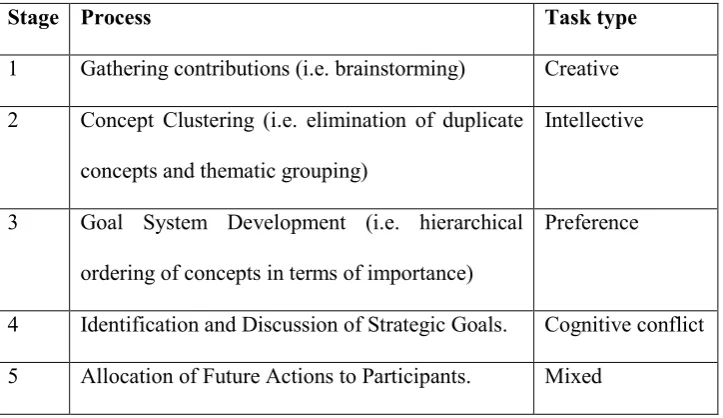
The task a group is faced with has been shown to be an important element that needs to be taken into account in any study concerned with how groups work (DeSanctis & Gallupe, 1987; Franco & Rouwette, 2011: 166; Hirokawa & Salazar, 1999). It is important at this point to make a clear distinction between the task and the issue that a group is faced with. In the context of this thesis, the task refers to the cognitive processes group participants have to undergo as the process of an FM workshop unfolds through stages. An example of two cognitive processes is brainstorming followed by criticism of the ideas produced. Brainstorming can be classified as a creativity task while criticism can be broadly classified as a cognitive conflict task (DeSanctis & Gallupe, 1987:601).
51
well as onto more generic group task types (McGrath, 1984). The focus of this thesis indicates that the most relevant mapping is the one followed in the GDSS literature.
[image:54.595.133.505.248.460.2]The stages and their corresponding processes and task types can be observed in table 2.1 (Eden and Ackermann. 2010:241; DeSanctis & Gallupe, 1987).
Table 2:1 Stages, Processes and Task types of a typical FM workshop.
Stage Process Task type
1 Gathering contributions (i.e. brainstorming) Creative 2 Concept Clustering (i.e. elimination of duplicate
concepts and thematic grouping)
Intellective
3 Goal System Development (i.e. hierarchical ordering of concepts in terms of importance)
Preference
4 Identification and Discussion of Strategic Goals. Cognitive conflict 5 Allocation of Future Actions to Participants. Mixed
As can be observed these stages display a rational approach towards decision making, thus fitting neatly within that paradigm (Dean & Sharfman, 1996).
It should be noted that the tasks are not mutually exclusive, meaning that it is possible to observe in any given stage a multitude of tasks. The above table merely intends to highlight the dominant task type expected to be observed across the stages of a FM workshop.
[image:54.595.140.502.250.459.2]