3016
Long-tail Relation Extraction via Knowledge Graph Embeddings and
Graph Convolution Networks
Ningyu Zhang1,2,3 Shumin Deng1,3 Zhanlin Sun1,3 Guanying Wang1,3
Xi Chen4 Wei Zhang2,3 Huajun Chen1,3∗
1. College of Computer Science and Technology, Zhejiang University 2. Alibaba Group
3. AZFT†Joint Lab for Knowledge Engine 4. Tencent
{3150105645,231sm,guanying wgy,huajunsir}@zju.edu.cn [email protected],{ningyu.zny,lantu.zw}@alibaba-inc.com
Abstract
We propose a distance supervised relation ex-traction approach for long-tailed, imbalanced data which is prevalent in real-world settings. Here, the challenge is to learn accurate ”few-shot” models for classes existing at the tail of the class distribution, for which little data is available. Inspired by the rich semantic cor-relations between classes at the long tail and those at the head, we take advantage of the knowledge from data-rich classes at the head of the distribution to boost the performance of the data-poor classes at the tail. First, we pro-pose to leverage implicit relational knowledge among class labels from knowledge graph em-beddings and learn explicit relational knowl-edge using graph convolution networks. Sec-ond, we integrate that relational knowledge into relation extraction model by coarse-to-fine knowledge-aware attention mechanism. We demonstrate our results for a large-scale benchmark dataset which show that our ap-proach significantly outperforms other base-lines, especially for long-tail relations.
1 Introduction
Relation extraction (RE) is an important task in in-formation extraction, aiming to extract the relation between two given entities based on their related context. Due to the capability of extracting tex-tual information and benefiting many NLP appli-cations (e.g., information retrieval, dialog genera-tion, and question answering), RE appeals to many researchers. Conventional supervised models have been widely explored in this task (Zelenko et al.,
2003; Zeng et al., 2014); however, their perfor-mance heavily depends on the scale and quality of training data.
∗
Corresponding author.
†
Alibaba-Zhejiang University Frontier Technology Re-search Center
0 10 20 30 40 50
Sorted Relation ID
0 10000 20000 30000 40000 50000 60000 70000
Relation Label Frequency
[image:1.595.323.490.236.356.2]~40 relation labels occur <1000 times
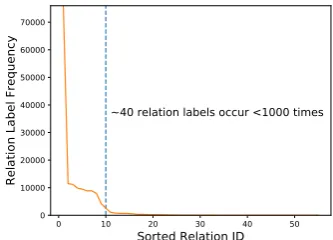
Figure 1: Label frequency distribution of classes with-outN Ain NYT dataset.
To construct large-scale data, (Mintz et al.,
2009) proposed a novel distant supervision (DS) mechanism to automatically label training in-stances by aligning existing knowledge graphs (KGs) with text. DS enables RE models to work on large-scale training corpora and has thus be-come a primary approach for RE recently (Wu et al., 2017; Feng et al., 2018). Although these DS models achieve promising results on common relations, their performance still degrades dramat-ically when there are only a few training instances for some relations. Empirically, DS can automat-ically annotate adequate amounts of training data; however, this data usually only covers a limited part of the relations. Many relations are long-tail and still suffer from data deficiency. Current DS models ignore the problem of long-tail relations, which makes it challenging to extract comprehen-sive information from plain text.
Long-tail relations are important and cannot be ignored. Nearly 70% of the relations are long-tail in the widely used New York Times (NYT) dataset1 (Riedel et al., 2010; Lei et al., 2018) as shown in Figure1. Therefore, it is crucial for
els to be able to extract relations with limited num-bers of training instances.
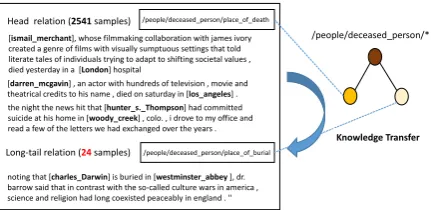
Dealing with long tails is very difficult as few training examples are available. There-fore, it is natural to transfer knowledge from data-rich and semantically similar head classes to data-poor tail classes (Wang et al., 2017). For example, the long-tail relation /peo-ple/deceased person/place of burial and head relation /people/deceased person/place of death are in the same branch /people/deceased person/* as shown in Figure2. They are semantically simi-lar, and it is beneficial to leverage head relational knowledge and transfer it to the long-tail relation, thus enhancing general performance. In other words, long-tail relations of one entity tuple can have class ties with head relations, which can be leveraged to enhance RE for narrowing potential search spaces and reducing uncertainties between relations when predicting unknown relations (Ye et al., 2017). If one pair of entities contains /people/deceased person/place of death, there is a high probability that it will contain /peo-ple/deceased person/place of burial. If we can incorporate the relational knowledge between two relations, extracting head relations will provide evidence for the prediction of long-tail relations.
However, there exist two problems: (1) Learn-ing relational knowledge: Semantically simi-lar classes may contain more relational informa-tion that will boost transfer, whereas irrelevant classes (e.g., /location/location/contains and /peo-ple/family/country) usually contain less relational information that may result in negative transfer. (2) Leveraging relational knowledge: Integrat-ing relational knowledge to existIntegrat-ing RE models is challenging.
To address the problem of learning relational knowledge, as shown in (Lin et al., 2016; Ye et al., 2017), we use class embeddings to rep-resent relation classes and utilize KG embed-dings and graph convolution networks (GCNs) to extract implicit and explicit relational knowl-edge. Specifically, previous studies (Yang et al.,
2015) have shown that the embeddings of se-mantically similar relations are located near each other in the latent space. For instance, the relation /people/person/place lived and /peo-ple/person/nationality are more relevant, whereas the relation /people/person/profession has less cor-relation with the former two cor-relations. Thus, it
[ismail_merchant], whose filmmaking collaboration with james ivory created a genre of films with visually sumptuous settings that told literate tales of individuals trying to adapt to shifting societal values , died yesterday in a [London] hospital
[darren_mcgavin] , an actor with hundreds of television , movie and theatrical credits to his name , died on saturday in [los_angeles] . the night the news hit that [hunter_s._Thompson] had committed suicide at his home in [woody_creek] , colo. , i drove to my office and read a few of the letters we had exchanged over the years .
noting that [charles_Darwin] is buried in [westminster_abbey ], dr. barrow said that in contrast with the so-called culture wars in america , science and religion had long coexisted peaceably in england . ''
/people/deceased_person/place_of_burial /people/deceased_person/place_of_death
Long-tail relation (24 samples) Head relation (2541 samples)
/people/deceased_person/*
[image:2.595.314.530.69.174.2]Knowledge Transfer
Figure 2: Head and long-tail relations.
is natural to leverage this knowledge from KGs. However, because there are many one-to-multiple relations in KGs, the relevant information for each class may be scattered. In other words, there may not be enough relational signal between classes. Therefore, we utilize GCNs to learn explicit rela-tional knowledge.
To address the problem of leveraging relational knowledge, we first use convolution neural net-works (Zeng et al., 2014, 2015) to encode sen-tences; then introduce coarse-to-fine knowledge-aware attention mechanism for combining rela-tional knowledge with encoded sentences into bag representation vectors. The relational knowledge not only provides more information for relation prediction but also provides a better reference message for the attention module to raise the per-formance of long-tail classes.
Our experimental results on the NYT dataset show that: (1) our model is effective compared to baselines especially for long-tail relations; (2) leveraging relational knowledge enhances RE and our model is efficient in learning relational knowl-edge via GCNs.
2 Related Work
Lin et al., 2016; Zhang et al., 2018a). To fur-ther improve the performance, some studies incor-porate external information (Zeng et al., 2017;Ji et al.,2017;Han et al.,2018a) and advanced train-ing strategies (Ye et al., 2017; Liu et al., 2017;
Huang and Wang, 2017;Feng et al., 2018;Zeng et al., 2018; Wu et al., 2017; Qin et al., 2018). These works mainly adopt DS to make large-scale datasets and reduce the noise caused by DS, re-gardless of the effect of long-tail relations.
There are only a few studies on long-tail for RE (Gui et al., 2016;Lei et al.,2018;Han et al.,
2018b). Of these, (Gui et al.,2016) proposed an explanation-based approach, whereas (Lei et al.,
2018) utilized external knowledge (logic rules). These studies treat each relation in isolation, re-gardless of the rich semantic correlations between the relations. (Han et al., 2018b) proposed a hierarchical attention scheme for RE, especially for long-tail relations. Different from those ap-proaches, we leverage implicit and explicit rela-tional knowledge from KGs and GCNs rather than data-driven learned parameter spaces where simi-lar relations may have distinct parameters, hinder-ing the generalization of long-tail classes.
Knowledge Graph Embedding. Recently,
several KG embedding models have been pro-posed. These methods learn low-dimensional vec-tor representations for entities and relations ( Bor-des et al., 2013; Wang et al., 2014; Lin et al.,
2015). TransE (Bordes et al., 2013) is one of the most widely used models, which views rela-tions as translarela-tions from a head entity to a tail en-tity on the same low-dimensional hyperplane. In-spired by the rich knowledge in KGs, recent works (Han et al., 2018a;Wang et al., 2018;Lei et al.,
2018) extend DS models under the guidance of KGs. However, these works neglect rich corre-lations between recorre-lations. Relation structure (re-lational knowledge) has been studied and is quite effective for KG completion (Zhang et al.,2018b). To the best of our knowledge, this is the first effort to consider the relational knowledge of classes (re-lations) using KGs for RE.
Graph Convolutional Networks. GCNs
gen-eralize CNNs beyond two-dimensional and one-dimensional spaces. (Defferrard et al., 2016) developed spectral methods to perform efficient graph convolutions. (Kipf and Welling,2016) as-sumed the graph structure is known over input instances and apply GCNs for semi-supervised
learning. GCNs were applied to relational data (e.g., link prediction) by (Schlichtkrull et al.,
2018). GCNs have also had success in other NLP tasks such as semantic role labeling ( Marcheg-giani and Titov, 2017), dependency parsing (Strubell and McCallum, 2017), and machine translation (Bastings et al.,2017).
Two GCNs studies share similarities with our work. (1) (Chen et al.,2017) used GCNs on struc-tured label spaces. However, their experiments do not handle long-tail labels and do not incorpo-rate attention but use an average of word vectors to represent each document. (2) (Rios and Kavu-luru,2018) proposed a few-shot and zero-shot text classification method by exploiting structured la-bel spaces with GCNs. However, they used GCNs in the label graph whereas we utilize GCNs in the hierarchy graph of labels.
3 Methodology
In this section, we introduce the overall framework of our approach for RE, starting with the notations.
3.1 Notations
We denote a KG asG=E,R,F, whereE,Rand F indicate the sets of entities, relations and facts respectively. (h, r, t) ∈ F indicates that there is a relationr ∈ R betweenh ∈ E andt ∈ E. We follow the MIL setting and split all instances into multiple entity-pair bags{Sh1,t1,Sh2,t2, ...}. Each bagShi,ti contains multiple instances{s1, s2, ...}
mentioning both entitieshi andti. Each instance
sin these bags is denoted as a word sequences=
{w1, w2, ...}.
3.2 Framework
Our model consists of three parts as shown in Fig-ure3:
Instance Encoder. Given an instance and its mentioned entity pair, we employ neural networks to encode the instance semantics into a vector. In this study, we implement the instance encoder with convolutional neural networks (CNNs) given both model performance and time efficiency.
Knowl-!" !# !$
%" %# %$
-Figure 3: Architecture of our proposed model.
edge Relation. We concatenate the outputs of GCNs and the pretrained KG embeddings to form the final class embeddings.
Knowledge-aware Attention. Under the guid-ance of final class embeddings, knowledge-aware attention is aimed to select the most informative instance exactly matching relevant relation.
3.3 Instance Encoder
Given an instance s = {w1, ..., wn} mentioning two entities, we encode the raw instance into a continuous low-dimensional vectorx, which con-sists of an embedding layer and an encoding layer.
Embedding Layer. The embedding layer is
used to map discrete words in the instance into continuous input embeddings. Given an instance
s, we map each word wi in the instance to a real-valued pretrained Skip-Gram (Mikolov et al.,
2013) embeddingwi ∈ Rdw . We adopt position embeddings following (Zeng et al., 2014). For each wordwi, we embed its relative distances to the two entities into two dp-dimensional vectors. We then concatenate the word embeddings and po-sition embeddings to achieve the final input em-beddings for each word and gather all the input embeddings in the instance. We thus obtain an em-bedding sequence ready for the encoding layer.
Encoding Layer. The encoding layer aims
to compose the input embeddings of a given in-stance into its corresponding inin-stance embedding. In this study, we choose two convolutional neu-ral architectures, CNN (Zeng et al., 2014) and PCNN (Zeng et al., 2015) to encode input
em-beddings into instance emem-beddings. Other neu-ral architectures such as recurrent neuneu-ral networks (Zhang and Wang,2015) can also be used as sen-tence encoders. Because previous works show that both convolutional and recurrent architectures can achieve comparable state-of-the-art performance, we select convolutional architectures in this study. Note that, our model is independent of the encoder choices, and can, therefore, be easily adapted to fit other encoder architectures.
3.4 Relational Knowledge Learning through
KG Embeddings and GCNs.
Given pretrained KG embeddings and predefined class (relation) hierarchies2, we first leverage the implicit relational knowledge from KGs and ini-tialize the hierarchy label graph; then we apply two layer GCNs to learn explicit fine-grained re-lational knowledge from the label space.
Hierarchy Label Graph Construction. Given a relation set R of a KG G (e.g., Freebase), which consists of base-level relations (e.g., /peo-ple/person/ethnicity), we can generate the corre-sponding higher-level relation set RH. The re-lations in a high-level set (e.g., people) are more general and common; they usually contain several sub-relations in the base-level set. The relation hierarchies are tree-structured, and the generation process can be done recursively. We use a virtual father node to construct the highest level
associa-2For datasets without predefined relation hierarchies,
[image:4.595.125.450.64.260.2]tions between relations as shown in Figure3. In practice, we start from R0 = R which is the set
of all relations we focus on for RE, and the gener-ation process is performedL−1times to get the hierarchical relation sets{R0,R1, ...,RL}, where
RL is the virtual father node. Each node has a specific type t ∈ {0,1, ..., L} to identify its layer hierarchies. For example, as shown in Fig-ure 3, node /people/person/ethnicity has a spe-cific type0to indicate it is in the bottom layer of the graph. The vectors of each node in the bot-tom layer are initialized through pretrained TransE (Bordes et al.,2013) KG embeddings. Other KG embeddings such as TransR (Lin et al.,2015) can also be adopted. Their parent nodes are initialized by averaging all children vectors. For example, the node vector of /people/person/ is initialized by averaging all the nodes under the branch of /peo-ple/person/* (all child nodes).
GCN Output Layer. Due to one-to-multiple
relations and incompleteness in KGs, the implicit relevant information obtained by KG embeddings for each label is not enough. Therefore, we ap-ply GCNs to learn explicit relational knowledge among labels. We take advantage of the structured knowledge over our label space using a two-layer GCNs. Starting with the pretrained relation em-bedding viimplicit ∈ Rd from KGs, we combine the label vectors of the children and parents for thei-th label to form,
vi1=f(W1vi+
X
j∈Np
Wp1vj
|Np| + X
j∈Nc
Wc1vj
|Nc| +b
1 g)
(1) where W1 ∈ Rq∗d, Wp1 ∈ Rq∗d, Wc1 ∈ Rq∗d,
b1g ∈ Rq, f is the rectified linear unit (Nair and
Hinton,2010) function, andNc(Np) is the index set of the i-th labels children (parents). We use different parameters to distinguish each edge type where parent edges represent all edges from high level labels and child edges represent all edges from low level labels. The second layer follows the same formulation as the first layer and outputs
viexplicit. Finally, we concatenate both pretrained
viimplicitwith GCNs node vectorviexplicit to form hierarchy class embeddings,
qr=viimplicit||v explicit
i (2)
whereqr∈Rd+q.
3.5 Knowledge-aware Attention
Traditionally, the output layer of PCNN/CNN would learn label specific parameters optimized by a cross-entropy loss. However, the label spe-cific parameters spaces are unique to each relation, matrices associated with the long-tails can only be exposed to very few facts during training, result-ing in poor generalization. Instead, our method attempts to match sentence vectors to their corre-sponding class embeddings rather than learning la-bel specific attention parameters. In essence, this becomes a retrieval problem. Relevant informa-tion from class embeddings contains useful rela-tional knowledge for long-tails among labels.
Practically, given the entity pair (h, t) and its bag of instances Sh,t = {s1, s2, ..., sm}, we achieve the instance embeddings {s1, s2, ..., sm} using the sentence encoder. We group the class embeddings according to their type (i.e., accord-ing to their layers in the hierarchy label graph), e.g., qri, i ∈ {0,1, ..., L}. We adopt qri, i 6= L
(layer L is the virtual father node) as layer-wise attention query vector. Then, we apply coarse-to-fine knowledge-aware attention to them to obtain the textual relation representationrh,t. For a rela-tion r, we construct its hierarchical chain of par-ent relations(r0, ..., rL−1)using the hierarchy la-bel graph, whereri−1is the sub-relation ofri. We propose the following formulas to compute the at-tention weight (similarity or relatedness) between each instances feature vectorskandqri,
ek=Ws(tanh[sk;qri]) +bs
αik= Pmexp(ek)
j=1exp(ej)
(3)
where [x1;x2] denotes the vertical concatenation
of x1 and x2, Ws is the weight matrix, and bs is the bias. We compute attention operations on each layer of hierarchy label graph to obtain cor-responding textual relation representations,
rh,ti =AT T(qri,{s1, s2, ..., sm}) (4)
attention weights on relation /location/br state/, it has a very high probability to have relation /loca-tion/br state/capital. Hence, we use an attention mechanism to emphasize the layers,
gi =Wgtanh(rh,t)
βi =
exp(gi)
PL−1
j=0 exp(gj)
(5)
whereWg is a weight matrix,rh,tis referred to as a query-based function that scores how well the input textual relation representations and the pre-dict relation r match. The textual relation repre-sentations in each layer are computed as,
rh,ti =βirh,ti (6)
We simply concatenate the textual relation repre-sentations on different layers as the final represen-tation,
rh,r=Concat(rh,t0 , .., rLh,t−1) (7)
The representationrh,t will be finally fed to com-pute the conditional probabilityP(r|h, t,Sh,t),
P(r|h, t,Sh,t) = Pexp(or)
˜
r∈Rexp(or˜)
(8)
whereois the score of all relations defined as,
o=M rh,t (9)
whereM is the representation matrix to calculate the relation scores. Note that, attention weightqri
is obtained from the outputs of GCNs and pre-trained KG embeddings, which can provide more informative parameters than data-driven learned parameters, especially for long-tails.
4 Experiments
4.1 Datasets and Evaluation
We evaluate our models on the NYT dataset de-veloped by (Riedel et al., 2010), which has been widely used in recent studies (Lin et al.,2016;Liu et al., 2017; Wu et al., 2017; Feng et al., 2018). The dataset has 53 relations including the N A
relation, which indicates that the relations of in-stances are not available. The training set has 522611 sentences, 281270 entity pairs, and 18252 relational facts. In the test set, there are 172448 sentences, 96678 entity pairs, and 1950 relational facts. In both training and test set, we truncate sen-tences with more than 120 words into 120 words.
Figure 4: Precision-recall curves for the proposed model and various baseline models.
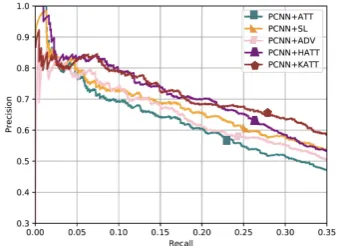
Figure 5: Precision-recall curves for the proposed model and various attention-based neural models.
We evaluate all models in the held-out evalua-tion. It evaluates models by comparing the rela-tional facts discovered from the test articles with those in Freebase and provides an approximate measure of precision without human evaluation. For evaluation, we draw precision-recall curves for all models. To further verify the effect of our model for long-tails, we follow previous studies (Han et al.,2018b) to report the Precision@N re-sults. The dataset and baseline code can be found on Github3.
4.2 Parameter Settings4
To fairly compare the results of our models with those baselines, we also set most of the experimen-tal parameters by following (Lin et al.,2016). We apply dropout on the output layers of our models to prevent overfitting. We also pretrain the sen-tence encoder of PCNN before training our model.
3
https://github.com/thunlp/OpenNRE
4Details of hyper-parameters settings and evaluation of
[image:6.595.331.500.64.191.2] [image:6.595.330.499.246.369.2]Training Instances Hits@K (Macro)
<100 <200
10 15 20 10 15 20
CNN
+ATT <5.0 <5.0 18.5 <5.0 16.2 33.3 +HATT 5.6 31.5 57.4 22.7 43.9 65.1 +KATT 9.1 41.3 58.5 23.3 44.1 65.4
PCNN
[image:7.595.71.293.61.146.2]+ATT <5.0 7.4 40.7 17.2 24.2 51.5 +HATT 29.6 51.9 61.1 41.4 60.6 68.2 +KATT 35.3 62.4 65.1 43.2 61.3 69.2
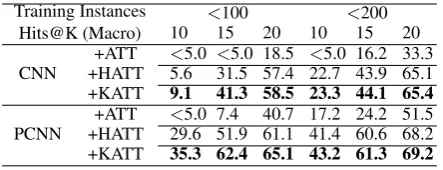
Table 1: Accuracy (%) of Hits@K on relations with training instances fewer than 100/200.
4.3 Overall Evaluation Results
To evaluate the performance of our proposed model, we compare the precision-recall curves of our model with various previous RE models. The evaluation results are shown in Figure4 and Figure 5. We report the results of neural ar-chitectures including CNN and PCNN with var-ious attention based methods: +KATT denotes our approach, +HATT is the hierarchical atten-tion method (Han et al., 2018b), +ATT is the plain selective attention method over instances (Lin et al., 2016), +ATT+ADV is the denoising attention method by adding a small adversarial perturbation to instance embeddings (Wu et al.,
2017), and+ATT+SLis the attention-based model using soft-labeling method to mitigate the side effect of the wrong labeling problem at entity-pair level (Liu et al., 2017). We also compare our method with feature-based models, including Mintz (Mintz et al., 2009), MultiR (Hoffmann et al.,2011) andMIML(Surdeanu et al.,2012).
As shown in both figures, our approach achieves the best results among all attention-based mod-els. Even when compared with PCNN+HATT, PCNN+ATT+ADV, and PCNN+ATT+SL, which adopt sophisticated denoising schemes and extra information, our model is still more advantageous. This indicates that our method can take advantage of the rich correlations between relations through KGs and GCNs, which improve the performance. We believe the performance of our model can be further improved by adopting additional mecha-nisms like adversarial training, and reinforcement learning, which will be part of our future work.
4.4 Evaluation Results for Long-tail Relations
To further demonstrate the improvements in per-formance for long-tail relations, following the study by (Han et al., 2018b) we extract a subset of the test dataset in which all the relations have
Training Instances Hits@K (Macro)
<100 <200
10 15 20 10 15 20 +KATT 35.3 62.4 65.1 43.2 61.3 69.2 w/o hier 34.2 62.1 65.1 42.5 60.2 68.1 w/o GCNs 30.5 61.9 63.1 39.5 58.4 66.1 Word2vec 30.2 62.0 62.5 39.6 57.5 65.8 w/o KG 30.0 61.0 61.3 39.5 56.5 62.5
Table 2: Results of ablation study with PCNN.
fewer than 100/200 training instances. We employ the Hits@K metric for evaluation. For each en-tity pair, the evaluation requires its corresponding golden relation in the first K candidate relations recommended by the models. Because it is diffi-cult for the existing models to extract long-tail re-lations, we selectK from{10,15,20}. We report the macro average Hits@K accuracies for these subsets because the micro-average score generally overlooks the influences of long-tails. From the results shown in Table1, we observe that for both CNN and PCNN models, our model outperforms the plain attention model and the HATT model. Although our KATT method has achieved better results for long-tail relations as compared to both plain ATT method and HATT method, the results of all these methods are still far from satisfactory. This indicates that distantly supervised RE mod-els still suffer from the long-tail relation problem, which may require additional schemes and extra information to solve this problem in the future.
4.5 Ablation Study
[image:7.595.304.528.61.135.2]perfor-(a) HATT (b) +KG (c) +GCNs (d) KATT
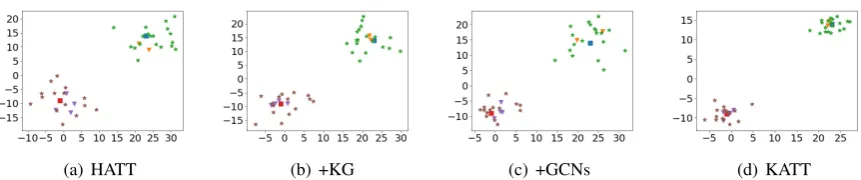
Figure 6: T-SNE visualizations of class embeddings. Cluster in the upper right is the relation /location/*/* and cluster in the bottom left is the relation /people/*/* ). The square, triangle, and star refer to the high (/location) middle (/location/location/) and base (/location/location/contains) level relations, respectively.
mance significantly degraded when we removed GCNs. This is reasonable because GCNs can learn more explicit correlations between relation labels, which boost the performance for long-tail rela-tions.
/people/deceased person/place of burial HATT KATT richard wagnerhad hisbayreuth, with
its festspielhaus specially designed to ac-commodate his music dramas.
0.21 0.07
wotan and alberich arerichard wagner; and the rheingold and valhalla are wag-ner’s real-life grail, the opera house in
bayreuth.
0.15 0.13
/location/br state/capital HATT KATT
there’s violence everywhere, said ms. mesquita, who, like her friend, lives in belo horizonte, the capital of mi-nas geraisstate
0.47 0.51
all the research indicates that we are cer-tain to find more gas in th amazon, ed-uardo braga, the governor ofamazonas, said in an interview inmanaus
[image:8.595.75.291.309.484.2]0.46 0.45
Table 3: Example sentences for case study.
4.6 Case Study
We give some examples to show how our method affects the selection of sentences. In Table 3, we display the sentence’s attention score in the lowest level5. Both the relation /people/deceased person/place of burial (24 in-stances) and /location/br state/capital (4 inin-stances) are long-tail relations. On one hand, relation /peo-ple/deceased person/place of burial has semanti-cally similar data-rich relation such as /peo-ple/deceased person/place of death. We observe that HATT erroneously assigns high attention to the incorrect sentence whereas KATT successfully assigns the right attention weights, which
demon-5Both HATT and KATT methods can successfully select
the correct sentence at the higher-level; details can be found in supplementary materials.
strates the efficacy of knowledge transfer from semantically similar relations (Both HATT and KATT methods can take advantage of knowledge transfer of high-level relations.). On the other hand, the relation /location/br state/capital does not have semantically similar relations. However, we notice that KATT still successfully assigns the right attention weights, which demonstrates the ef-ficacy of knowledge transfer from high-level rela-tions using coarse-to-fine knowledge-aware atten-tion.
4.7 Visualizations of Class Embeddings
We visualize the class embeddings via t-SNE (Maaten and Hinton, 2008) to further show how GCNs and KG embeddings can help RE for long-tail relations. We observe that (1) Figure 6(a)
and6(d)show that semantically similar class em-beddings are closer with GCNs and pretrained KG embeddings, which help select long-tail in-stances. (2) Figure 6(b) and 6(c) show that KG embeddings and GCNs have different con-tributions for different relations to learn rela-tional knowledge between classes. For example, /location/location/contain has a sparse hierarchy structure, which leads to inefficient learning for GCNs; therefore, the relative distance changes only slightly, which reveals the necessity of im-plicit relational knowledge from KGs. (3) Figure
5 Conclusion and Future Work
In this paper, we take advantage of the knowledge from data-rich classes at the head of distribution to boost the performance of the data-poor classes at the tail. As compared to previous methods, our approach provides fine-grained relational knowl-edge among classes using KG and GCNs, which is quite effective and encoder-agnostic.
In the future, we plan to explore the follow-ing directions: (1) We may combine our method with recent denoising methods to further improve performance. (2) We may combine rule mining and reasoning technologies to learn better class embeddings to boost performance. (3) It will be promising to apply our method to zero-shot RE and further adapt to other NLP scenarios.
Acknowledgments
We want to express gratitude to the anony-mous reviewers for their hard work and kind comments, which will further improve our work in the future. This work is funded by NSFC91846204/61473260, national key re-search program YS2018YFB140004, Alibaba CangJingGe (Knowledge Engine) Research Plan and Natural Science Foundation of Zhejiang Province of China (LQ19F030001).
References
Joost Bastings, Ivan Titov, Wilker Aziz, Diego Marcheggiani, and Khalil Sima’an. 2017. Graph convolutional encoders for syntax-aware neural ma-chine translation. arXiv preprint arXiv:1704.04675.
Antoine Bordes, Nicolas Usunier, Alberto Garcia-Duran, Jason Weston, and Oksana Yakhnenko. 2013. Translating embeddings for modeling multi-relational data. In Proceedings of NIPS, pages 2787–2795.
Meihao Chen, Zhuoru Lin, and Kyunghyun Cho. 2017. Graph convolutional networks for classifica-tion with a structured label space. arXiv preprint arXiv:1710.04908.
Micha¨el Defferrard, Xavier Bresson, and Pierre Van-dergheynst. 2016. Convolutional neural networks on graphs with fast localized spectral filtering. In Ad-vances in Neural Information Processing Systems, pages 3844–3852.
Jun Feng, Minlie Huang, Li Zhao, Yang Yang, and Xi-aoyan Zhu. 2018. Reinforcement learning for rela-tion classificarela-tion from noisy data. InProceedings of AAAI.
Yaocheng Gui, Qian Liu, Man Zhu, and Zhiqiang Gao. 2016. Exploring long tail data in distantly su-pervised relation extraction. In Natural Language Understanding and Intelligent Applications, pages 514–522. Springer.
Zhou GuoDong, Su Jian, Zhang Jie, and Zhang Min. 2005. Exploring various knowledge in relation ex-traction. InProceedings of the 43rd annual meeting on association for computational linguistics, pages 427–434. Association for Computational Linguis-tics.
Xu Han, Zhiyuan Liu, and Maosong Sun. 2018a. Neu-ral knowledge acquisition via mutual attention be-tween knowledge graph and text.
Xu Han, Pengfei Yu, Zhiyuan Liu, Maosong Sun, and Peng Li. 2018b. Hierarchical relation extraction with coarse-to-fine grained attention. In Proceed-ings of the 2018 Conference on Empirical Methods in Natural Language Processing, pages 2236–2245.
Raphael Hoffmann, Congle Zhang, Xiao Ling, Luke Zettlemoyer, and Daniel S Weld. 2011. Knowledge-based weak supervision for information extraction of overlapping relations. In Proceedings of ACL, pages 541–550. Association for Computational Lin-guistics.
Yi Yao Huang and William Yang Wang. 2017. Deep residual learning for weakly-supervised relation ex-traction. arXiv preprint arXiv:1707.08866.
Guoliang Ji, Kang Liu, Shizhu He, Jun Zhao, et al. 2017. Distant supervision for relation extraction with sentence-level attention and entity descriptions. InProceedings of AAAI, pages 3060–3066.
Stephen C Johnson. 1967. Hierarchical clustering schemes. Psychometrika, 32(3):241–254.
Thomas N Kipf and Max Welling. 2016. Semi-supervised classification with graph convolutional networks. arXiv preprint arXiv:1609.02907.
Kai Lei, Daoyuan Chen, Yaliang Li, Nan Du, Min Yang, Wei Fan, and Ying Shen. 2018. Coopera-tive denoising for distantly supervised relation ex-traction. InProceedings of Coling, pages 426–436.
Yankai Lin, Zhiyuan Liu, Maosong Sun, Yang Liu, and Xuan Zhu. 2015. Learning entity and relation em-beddings for knowledge graph completion. InAAAI, volume 15, pages 2181–2187.
Yankai Lin, Shiqi Shen, Zhiyuan Liu, Huanbo Luan, and Maosong Sun. 2016. Neural relation extraction with selective attention over instances. In Proceed-ings of ACL, volume 1, pages 2124–2133.
Tianyu Liu, Kexiang Wang, Baobao Chang, and Zhi-fang Sui. 2017. A soft-label method for noise-tolerant distantly supervised relation extraction. In
Laurens van der Maaten and Geoffrey Hinton. 2008. Visualizing data using t-sne. Journal of machine learning research, 9(Nov):2579–2605.
Diego Marcheggiani and Ivan Titov. 2017. En-coding sentences with graph convolutional net-works for semantic role labeling. arXiv preprint arXiv:1703.04826.
Tomas Mikolov, Kai Chen, Greg Corrado, and Jef-frey Dean. 2013. Efficient estimation of word representations in vector space. arXiv preprint arXiv:1301.3781.
Mike Mintz, Steven Bills, Rion Snow, and Dan Juraf-sky. 2009. Distant supervision for relation extrac-tion without labeled data. In Proceedings of the Joint Conference of the 47th Annual Meeting of the ACL and the 4th International Joint Conference on Natural Language Processing of the AFNLP: Vol-ume 2-VolVol-ume 2, pages 1003–1011. Association for Computational Linguistics.
Raymond J Mooney and Razvan C Bunescu. 2006. Subsequence kernels for relation extraction. In Ad-vances in neural information processing systems, pages 171–178.
Vinod Nair and Geoffrey E Hinton. 2010. Rectified linear units improve restricted boltzmann machines. InProceedings of ICML, pages 807–814.
Pengda Qin, Weiran Xu, and William Yang Wang. 2018. Dsgan: Generative adversarial training for distant supervision relation extraction. In Proceed-ings of ACL.
Sebastian Riedel, Limin Yao, and Andrew McCallum. 2010. Modeling relations and their mentions with-out labeled text. In Joint European Conference on Machine Learning and Knowledge Discovery in Databases, pages 148–163. Springer.
Anthony Rios and Ramakanth Kavuluru. 2018. Few-shot and zero-Few-shot multi-label learning for struc-tured label spaces. InProceedings of EMNLP, pages 3132–3142.
Michael Schlichtkrull, Thomas N Kipf, Peter Bloem, Rianne van den Berg, Ivan Titov, and Max Welling. 2018. Modeling relational data with graph convolu-tional networks. InEuropean Semantic Web Confer-ence, pages 593–607. Springer.
Emma Strubell and Andrew McCallum. 2017. De-pendency parsing with dilated iterated graph cnns.
arXiv preprint arXiv:1705.00403.
Mihai Surdeanu, Julie Tibshirani, Ramesh Nallapati, and Christopher D Manning. 2012. Multi-instance multi-label learning for relation extraction. In Pro-ceedings of EMNLP, pages 455–465. Association for Computational Linguistics.
Guanying Wang, Wen Zhang, Ruoxu Wang, Yalin Zhou, Xi Chen, Wei Zhang, Hai Zhu, and Huajun Chen. 2018. Label-free distant supervision for rela-tion extracrela-tion via knowledge graph embedding. In
Proceedings of EMNLP, pages 2246–2255.
Yu-Xiong Wang, Deva Ramanan, and Martial Hebert. 2017. Learning to model the tail. InProceedings of NIPS, pages 7029–7039.
Zhen Wang, Jianwen Zhang, Jianlin Feng, and Zheng Chen. 2014. Knowledge graph embedding by trans-lating on hyperplanes. InAAAI, volume 14, pages 1112–1119.
Yi Wu, David Bamman, and Stuart Russell. 2017. Ad-versarial training for relation extraction. In Proceed-ings of EMNLP, pages 1778–1783.
Bishan Yang, Wen-tau Yih, Xiaodong He, Jianfeng Gao, and Li Deng. 2015. Embedding entities and relations for learning and inference in knowledge bases. Proceedings of ICLR.
Hai Ye, Wenhan Chao, Zhunchen Luo, and Zhoujun Li. 2017. Jointly extracting relations with class ties via effective deep ranking. InProceedings of ACL, volume 1, pages 1810–1820.
Dmitry Zelenko, Chinatsu Aone, and Anthony Richardella. 2003. Kernel methods for relation ex-traction. Journal of machine learning research, 3(Feb):1083–1106.
Daojian Zeng, Kang Liu, Yubo Chen, and Jun Zhao. 2015. Distant supervision for relation extraction via piecewise convolutional neural networks. In Pro-ceedings of EMNLP, pages 1753–1762.
Daojian Zeng, Kang Liu, Siwei Lai, Guangyou Zhou, and Jun Zhao. 2014. Relation classification via con-volutional deep neural network. In Proceedings of COLING, pages 2335–2344.
Wenyuan Zeng, Yankai Lin, Zhiyuan Liu, and Maosong Sun. 2017. Incorporating relation paths in neural relation extraction. In Proceddings of EMNLP.
Xiangrong Zeng, Shizhu He, Kang Liu, and Jun Zhao. 2018. Large scaled relation extraction with rein-forcement learning. In Processings of AAAI, vol-ume 2, page 3.
Dongxu Zhang and Dong Wang. 2015. Relation classi-fication via recurrent neural network.arXiv preprint arXiv:1508.01006.
Ningyu Zhang, Shumin Deng, Zhanling Sun, Xi Chen, Wei Zhang, and Huajun Chen. 2018a. Attention-based capsule networks with dynamic routing for re-lation extraction. InProceedings of EMNLP.