Proceedings of NAACL-HLT 2019, pages 3671–3681 3671
Ranking and Selecting Multi-Hop Knowledge Paths to Better Predict
Human Needs
Debjit Paul
Research Training Group AIPHES Institute for Computational Linguistics
Heidelberg University
Anette Frank
Research Training Group AIPHES Institute for Computational Linguistics
Heidelberg University
Abstract
To make machines better understand senti-ments, research needs to move from polarity identification to understanding the reasons that underlie the expression of sentiment. Cate-gorizing the goals or needs of humans is one way to explain the expression of sentiment in text. Humans are good at understanding sit-uations described in natural language and can easily connect them to the character’s psycho-logical needs using commonsense knowledge. We present a novel method to extract, rank, fil-ter and select multi-hop relation paths from a commonsense knowledge resource to interpret the expression of sentiment in terms of their underlying human needs. We efficiently inte-grate the acquired knowledge paths in a neural model that interfaces context representations with knowledge using a gated attention mech-anism. We assess the model’s performance on a recently published dataset for categorizing human needs. Selectively integrating knowl-edge paths boosts performance and establishes a new state-of-the-art. Our model offers inter-pretability through the learned attention map over commonsense knowledge paths. Human evaluation highlights the relevance of the en-coded knowledge.
1 Introduction
Sentiment analysis and emotion detection are es-sential tasks in human-computer interaction. Due to its broad practical applications, there has been rapid growth in the field of sentiment analysis (Zhang et al., 2018). Although state-of-the-art sentiment analysis can detect the polarity of text units (Hamilton et al.,2016;Socher et al.,2013), there has been limited work towards explaining the reasons for the expression of sentiment and emo-tions in texts (Li and Hovy, 2017). In our work, we aim to go beyond the detection of sentiment, toward explaining sentiments. Such explanations
can range from detecting overtly expressed expla-nations or reasons for sentiments towards specific aspects of, e.g., products or films, as in user re-views to the explanation of the underlying reasons for emotional reactions of characters in a narrative story. The latter requires understanding of stories and modeling the mental state of characters. Re-cently,Ding and Riloff(2018) proposed to catego-rize affective events with categories based on hu-man needs, to provide explanations of people’s at-titudes towards such events. Given an expression such asI broke my leg, they categorize the reason for the expressed negative sentiment as being re-lated to a need concerning ‘health’.
In this paper we focus on the Modelling Naive Psychology of Characters in Simple
Common-sense Stories dataset of Rashkin et al. (2018),
which contains annotations of a fully-specified chain of motivations and emotional reactions of characters for a collection of narrative stories. The stories are annotated with labels from multiple the-ories of psychology (Reiss,2004;Maslow,1943; Plutchik, 1980) to provide explanations for the emotional reactions of characters.
to infer underlying reasons for emotions indicated in the text. In this work, we propose a computa-tional model that aims to categorize human needs of story characters by integrating commonsense knowledge from ConceptNet (Speer and Havasi, 2012). Our model aims to imitate human under-standing of a story, by (i) learning to select rele-vant words from the text, (ii) extracting pieces of knowledge from the commonsense inventory and (iii) associating them with human need categories put forth by psychological theories. Our assump-tion is that by integrating commonsense knowl-edge in our model we will be able to overcome the lack of textual evidence in establishing rela-tions between expressed emorela-tions in specific sit-uations and the inferable human needs of story characters. In order to provide such missing as-sociations, we leverage the graph structure of the knowledge source. Since these connections can be diverse and complex, we develop a novel approach to extract and rank multi-hop relation paths from ConceptNet using graph-based methods.
Our contributions are: (i) We propose a novel approach to extract and rank multi-hop relation paths from a commonsense knowledge resource using graph-based features and algorithms. (ii) We present an end-to-end model enhanced with atten-tion and a gated knowledge integraatten-tion component to predict human needs in a given context. To the best of our knowledge, our model is the first to ad-vance commonsense knowledge for this task. (iii) We conduct experiments that demonstrate the ef-fectiveness of the extracted knowledge paths and show significant performance improvements over the prior state-of-the-art. (iv) Our model provides interpretability in two ways: by selecting relevant words from the input text and by choosing relevant knowledge paths from the imported knowledge. In both cases, the degree of relevance is indicated via an attention map. (v) A small-scale human eval-uation demonstrates that the extracted multi-hop knowledge paths are indeed relevant. Our code is made publicly available.1
2 Related Work
Sentiment Analysis and Beyond. Starting with Pang et al. (2002), sentiment analysis and emo-tion detecemo-tion has grown to a wide research field. Researchers have investigated polarity
classifica-1https://github.com/debjitpaul/
Multi-Hop-Knowledge-Paths-Human-Needs
tion, sentiment and emotion detection and clas-sification (Tang et al., 2015;Yin et al., 2017; Li et al., 2017) on various levels (tokens, phrases, sentences or documents), as well as structured pre-diction tasks such as the identification of holders and targets (Deng and Wiebe,2015) or sentiment inference (Choi et al.,2016). Our work goes be-yond the analysis of overtly expressed sentiment and aims at identifying goals, desires or needs un-derlying the expression of sentiment.Li and Hovy (2017) argued that the goals of an opinion holder can be categorized by human needs. There has been work related to goals, desires, wish detec-tion (Goldberg et al., 2009;Rahimtoroghi et al., 2017). Most recently,Ding and Riloff(2018) pro-pose to categorize affective events into physiolog-ical needs to explain people’s motivations and de-sires. Rashkin et al. (2018) published a dataset for tracking emotional reactions and motivations of characters in stories. In this work, we use this dataset to develop a knowledge-enhanced system that ‘explains’ sentiment in terms of human needs.
Figure 1: Maslow and Reiss: Theories of Psychology as presented inRashkin et al.(2018).
between sentiment words in a text and underly-ing human needs by extractunderly-ing relevant multi-hop paths from structured knowledge bases.
3 Selecting and Ranking Commonsense Knowledge to Predict Human Needs Our task is to automatically predict human needs of story characters given a story context. In this task, following the setup ofRashkin et al.(2018),
weexplainthe probable reasons for the expression
of emotions by predicting appropriate categories from two theories of psychology: Hierarchy of
needs (Maslow, 1943) and basic motives(Reiss,
2002). The task is defined as a multi-label classifi-cation problem with five coarse-grained (Maslow) and 19 fine-grained (Reiss) categories, respec-tively (see Fig.1).1 We start with a Bi-LSTM
en-coder with self-attention as a baseline model, to efficiently categorize human needs. We then show how to select and rank multi-hop commonsense knowledge paths from ConceptNet that connect textual expressions with human need categories. Finally, we extend our model with a gated knowl-edge integration mechanism to incorporate rel-evant multi-hop commonsense knowledge paths for predicting human needs. An overview of the model is given in Figure2. We now describe each component in detail.
3.1 A Bi-LSTM Encoder with Attention to Predict Human Needs
Our Bi-LSTM encoder takes as input a sentence S consisting of a sequence of tokens, denoted as ws
1, ws2, ...., wns, orw1:sn and its preceding context
Cxt, denoted aswcxt1 , w2cxt, ...., wcxtm , orw1:cxtm. As further input we read the name of a story character, which is concatenated to the input sentence. For
1Details about the labels are given in the Supplement.
Si gm oi d l ay er BILSTMs De ns e la ye r Con te xt .… …. .… …. Attention Weights Co mmo n Se ns e Pa th
s Encoding layer
w1cxt
w2cxt
w3cxt
:::: wmcxt
char w1s
w2s
w3s
::: wms
Encoding layer Self-attention layer
Se nt en ce En co di ng En co di ng En co di ng En co di ng
cr1k
cr2k
cr3k
::: ::: :::
crmk
[image:3.595.75.288.65.178.2]Co nc at ena te La ye r( o) In pu t re pre se nt at io n xs xcxt xk Gated Layer
Figure 2: Attention over multi-hop knowledge paths.
this input the model is tasked to predict appropri-ate human need cappropri-ategory labelsz2Z, according to a predefined inventory.
Embedding Layer:We embed each word from the sentence and the context with a contextualized word representation using character-based word representations (ELMo) (Peters et al.,2018). The embedding of each word wi in the sentence and context is represented asesi andecxti , respectively. Encoding Layer: We use a single-layer Bi-LSTM (Hochreiter and Schmidhuber,1997) to ob-tain sentence and context representations hs and hcxt, which we form by concatenating the final states of the forward and backward encoders.
hs=BiLST M(es1:n);hcxt =BiLST M(ecxt1:m)
(1)
A Self-Attention Layer allows the model to dynamically control how much each token con-tributes to the sentence and context representation. We use a modified version of self-attention pro-posed byRei and Søgaard(2018), where both in-put representations are passed through a feedfor-ward layer to generate scalar values for each word in contextvcxti and sentencevis(cf. (2-5)).
asi =ReLU(Wishsi +bsi), (2)
acxti =ReLU(Wicxthcxti +bcxti ) (3)
vis=Wv isasi +bsvi (4)
vcxti =Wvcxtiacxti +bcxtv i (5) where, Ws, bs, Wcxt, bcxt, Ws
v, Wvcxt are train-able parameters. We calculate the soft attention weights for both sentence and context:
e
vi= 1
1 +exp( vi)
; ˆvi = PNvei
where, evi is the output of the sigmoid function, thereforeevi is in the range [0,1] andvˆi is the nor-malized version ofevi. Valuesˆviare used as atten-tion weights to obtain the final sentence and con-text representationsxsandxcxt, respectively:
xs =
N
X
i=1
ˆ
vishsi (7) x cxt =
M
X
i=1
ˆ
vicxthcxti
(8)
with N andM the number of tokens inS and Cxt. The output of the self-attention layer is gen-erated by concatenatingxsandxcxt. We pass this representation through a FF layer of dimensionZ:
y =ReLU(Wy[xs;xcxt] +by) (9)
whereWy, by are trainable parameters and ’;’ de-notes concatenation of two vectors. Finally, we feed the output layeryto a logistic regression layer to predict a binary label for each class z 2 Z, whereZis the set of category labels for a particu-lar psychological theory (Maslow/Reiss, Fig.1).
3.2 Extracting Commonsense Knowledge
To improve the prediction capacity of our model, we aim to leverage external commonsense know-ledge that connects expressions from the sen-tence and context to human need categories. For this purpose we extract multi-hop commonsense knowledge paths that connect words in the textual inputs with the offered human need categories, us-ing as resource ConceptNet (Speer and Havasi, 2012), a large commonsense knowledge inven-tory. Identifying contextually relevant information from such a large knowledge base is a non-trivial task. We propose an effective two-step method to extract multi-hop knowledge paths that asso-ciate concepts from the text with human need cat-egories: (i) collect all potentially relevant knowl-edge relations among concepts and human needs in a subgraph for each input sentence; (ii) rank, fil-ter and select high-quality paths using graph-based local measures and graph centrality algorithms.
3.2.1 Construction of Sub-graphs
ConceptNet is a graph G = (V, E)whose nodes
are concepts and edges are relations between con-cepts (e.g. CAUSES, MOTIVATEDBY). For each
sentence S we induce a subgraphG0 = (V0, E0)
where V0 comprises all concepts c 2 V that ap-pear in S and the directly preceding sentence in
contextCxt. V0 also includes all conceptsc 2V that correspond to one of the human need cate-gories in our label setZ. Fig.3shows an example. The sub-graph is constructed as follows:
Shortest Paths:In a first step, we find all short-est paths p0 from ConceptNet that connect any concept ci 2 V0 to any other concept cj 2 V0 and to each human needs conceptz 2Z. We fur-ther include in V0 all the conceptsc 2 V which are contained in the above shortest pathsp0.
Neighbours: To better represent the meaning of the concepts inV0, we further include inV0 all conceptsc2V that are directly connected to any c2V0that is not already included inV0.
Sub-graph: We finally construct a connected sub-graphG0 = (V0, E0)fromV0 by definingE0 as the set of all ConceptNet edgese 2 E that di-rectly connect any pair of concepts(ci, cj)2V0.
Overall, we obtain a sub-graph that contains re-lations and concepts which are supposed to be use-ful to “explain”whyandhow stronglyconceptsci that appear in the sentence and context are associ-ated with any of the human needsz2Z.
3.2.2 Ranking and Selecting Multi-hop Paths
We could use all possible pathspcontained in the sub-graphG0, connecting conceptscifrom the text and human needs conceptsz contained in G0, as additional evidence to predict suitable human need categories. But not all of them may be relevant. In order to select the most relevant paths, we pro-pose a two-step method: (i) we score each vertex with a score (Vscore) that reflects its importance in the sub-graph and on the basis of the vertices’
Vs-coreswe determine a path scorePscore, as shown
in Figure3; (ii) we select the top-k paths with re-spect to the computed path score (Pscore) .
(i) Vertex Scores and Path Scores: We hy-pothesize that the most useful commonsense rela-tion paths should include vertices that are impor-tantwith respect to the entire extracted subgraph. We measure the importance of a vertex using dif-ferent local graph measures: thecloseness
central-ity measure, page rankorpersonalized page rank.
vertexvi 2G0 is computed as
V scoreCC(vi) = |V
0 |
P
jd(vj, vi) (10) where|V0| represents the number of vertices in the graphG0 andd(vj, vi)represents the length of the shortest path betweenviandvj. For each path we compute the normalized sum ofVscoreX of all verticesvj contained in the path, for any measure
X2{CC, P R, P P R}.
P scoreX =
P
jV scoreX(vj)
N (11)
We rank the paths according to their PscoreCC, assuming that relevant paths will contain vertices that are close to the center of the sub-graphG0.
PageRank (PR) (Brin and Page, 1998) is a graph centrality algorithm that measures the rel-ative importance of a vertex in a graph. The Page-Rank score of a vertexvi2G0is computed as:
V scoreP R(vi) =↵
X
j
ujivj
Lj
+1 ↵
n (12)
where Lj = Piuji is the number of neighbors of vertexj,↵is a damping factor representing the
probability of jumping from a given vertex vi to another random vertex in the graph and n repre-sents the number of vertices inG0. We calculate
PscoreP R using Eq. 11 and order the paths
ac-cording to theirPscoreP R, assuming that relevant paths will contain vertices with high relevance, as reflected by a high number of incoming edges.
Personalized PageRank (PPR) (Haveliwala, 2002) is used to determine the importance of a ver-tex with respect to a certain topic (set of vertices). Instead of assigning equal probability for a ran-dom jump 1 ↵
n , PPR assigns stronger probability to certain vertices to prefer topical vertices. The PPR score of a vertexv2G0is computed as:
V scoreP P R(vi) =↵
X
j
uji
vj
Lj
+ (1 ↵)T
(13) where T = |T1
j| if nodes vi belongs to topic
Tj and otherwise T = 0. In our setting, Tj will contain concepts from the text and human needs, to assign them higher probabilities. We calculate PscoreP P R using Eq. 11 and order the paths according to their scores, assuming that rel-evant paths should contain vertices holding im-portance with respect to vertices representing con-cepts from the text and human needs.
Stewart has always been a big gamer since the age of 5. One day while at the mall he saw a sign for a video game tournament. He promptly signed up for the tournament.
Previous Sentence
He came home with a gold medal. Sentence
Concepts mentioned in the text (c)
The following weekhe ended
up winningthe tournament.
Narrative Story
week gold medal win tournament
Path connecting human need (z) and concepts (c) with Vscores and Pscores
gold medal jewelry
week time fine
position first gold medal
gold medal
Pscores
0.12 0.09 0.15
0.10 0.09 0.15
0.08 0.10 0.08 0.15 0.12 0.13
0.15
0.15
0.12
0.11
0.10 0.1375
Character: ‘Stewart’, Emotion:‘Joy’, Human need= ‘status’
gold medal
medal
first place first
position
status
jewelry
gold
Subgraph
status
status
status jewelry
[image:5.595.313.524.65.232.2]status
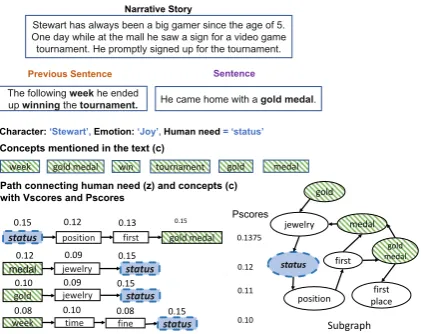
Figure 3: Illustration of commonsense path selection. Top: Context and sentence, Bottom: Selected knowl-edge paths with Vscores and Pscores (left) and the corresponding subgraph. Concepts from the text are marked with green dashed lines; blue boxes show the human need labelstatusassigned toStewart.
(ii) Path Selection: We rank knowledge paths based on their Pscore using the above relevance measures, and construct ranked lists of paths of two types: (i) paths connecting a human needs conceptz 2 Z to a concept mentioned in the text (pc z)2 and (ii) paths connecting concepts in the text (pc c)3. Ranked lists of paths are constructed individually for concepts that constitute the start or endpoint of a path: a human needs concept for pc z or any concept from the text forpc c.
Figure3illustrates an example where the char-acterStewartfeltjoyafter winning a gold medal. The annotated human need label is status. We show the paths selected by our algorithm that con-nect concepts from the text and the human need
status. We select the top-k paths of type pc z
for each human need to capture relevant knowl-edge about human needs in relation to concepts in the text. Similarly, we select the top-k paths of type pc c for each ci to capture relevant knowl-edge about the text (not shown in Fig. 3).
3.3 Extending the Model with Knowledge
We have seen how to obtain a ranked list of com-monsense knowledge paths from a subgraph ex-tracted from ConceptNet that connect concepts from the textual input and possible human needs categories that are the system’s classification
tar-2p
c z denotes path connecting a human needs concept
z2Zand a conceptcmentioned in the text.
3p
c cdenotes path connecting a concept cand another
gets. Our intuition is that the extracted common-sense knowledge paths will provide useful evi-dence for our model tolink the content expressed
in the text to appropriate human need categories.
Paths that are selected by the model as a relevant connection between the input text and the labeled human needs concept can thus provide
explana-tionsfor emotions or goals expressed in the textin
view of a human needs category. We thus integrate
these knowledge paths into our model, (i) to help the model making correct predictions and (ii) to provide explanations of emotions expressed in the text in view of different human needs categories. For each input, we represent the extracted ranked list ofncommonsense knowledge pathspas a list crk,1, crk,2, ...., crk,n, where eachcrk,i
1:l represents a path consisting of concepts and relations, withl the length of the path. We embed all concepts and relations incr1:k,il with pretrained GloVe (
Penning-ton et al.,2014) embeddings.
Encoding Layer: We use a single-layer BiL-STM to obtain encodings (hk,i) for each knowl-edge path
hk,i=BiLST M(ek,i1:n) (14)
wherehkrepresents the output of the BiLSTM for the knowledge path andiits the ranking index.
Attention Layer: We use an attention layer, where each encoded commonsense knowledge path interacts with the sentence representationxs to receive attention weights (ˆhk,i):
ehk,i= (xshk,i), ˆhk,i= eh
k,i
PN
i=1ehk,i
(15)
In Eq. 15, we use sigmoid to calculate the atten-tion weights, similar to Eq.6. However, this time we compute attention to highlight which knowl-edge paths are important for a given input repre-sentation (xs being the final state hidden repre-sentation over the input sentence, Eq. 7). To ob-tain the sentence-aware commonsense knowledge representationxk, we pass the output of the atten-tion layer through a feedforward layer.Wk,bkare trainable parameters.
xk=ReLU(Wk( N
X
i=1
ˆ
hk,ihk,i) +bk) (16)
3.4 Distilling Knowledge into the Model
In order to incorporate the selected and weighted knowledge into the model, we concatenate the
sen-Classification Train Dev Test
Reiss 5432 1469 5368
Reiss withoutbelongingclass 5431 1469 5366
[image:6.595.326.509.64.109.2]Maslow 6873 1882 6821
Table 1: Dataset Statistics: nb. of instances (sentences with annotated characters and human need labels).
tencexs, contextxcxtand knowledgexk represen-tation and pass it through a FF layer.
oi=ReLU(Wz[xsi;xcxti ;xki] +bz) (17)
We employ a gating mechanism to allow the model to selectively incorporate relevant informa-tion from commonsense knowledge xk and from the joint input representation yi (see Eq. 9)
sep-arately. We finally pass it to a logistic regression
classifier to predict a binary label for each classz in the setZ of category labels
zi= (Weyz(oi yi+oi x
k
i) +beyz) (18)
where represents element-wise multiplication, beyz ,Wyez are trainable parameters.
4 Experimental Setup
Dataset: We evaluate our model on the Mod-eling Naive Psychology of Characters in
Sim-ple Commonsense Stories (MNPCSCS) dataset
(Rashkin et al., 2018). It contains narrative sto-ries where each sentence is annotated with a character and a set of human need categories from two inventories: Maslow’s (with five coarse-grained) and Reiss’s (with 19 fine-coarse-grained) cat-egories (Reiss’s labels are considered as sub-categories of Maslow’s). The data contains the original worker annotations. Following prior work we select the annotations that display the “major-ity label” i.e., categories voted on by 2
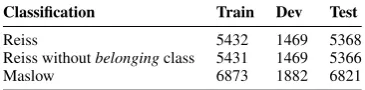
work-ers. Since no training data is available, similar to prior work we use a portion of the devset as train-ing data, by performtrain-ing a random split, ustrain-ing 80% of the data to train the classifier, and 20% to tune parameters. Data statistics is reported in Table1.
Rashkin et al. (2018) report that there is low annotator agreement i.a. between the belonging
and the approval class. We also find high co-occurrence of the belonging, approval and
so-cial contact classes, where belonging and
so-cial contact both pertain to the Maslow class
Maslow classEsteem. This indicates that belong-ing interacts with Love/belonging andEsteem in relation to social contact. We further observed during our study that in the Reiss dataset the number of instances annotated with the belong-ingclass is very low (no. of instances in training is 24, and in dev 5). The performance for this class is thus severely hampered, with 4.7F1score for BiLSTM+Self-Attention and 7.1F1 score for BiLSTM+Self-Attention+Knowledge. After es-tablishing benchmark results with prior work (cf. Table2, includingbelonging), we perform all fur-ther experiments with a reduced Reiss dataset, by eliminating thebelongingclass from all instances. This impacts the overall number of instances only slightly: byoneinstance for training andtwo in-stances for test, as shown in Table1.
Training: During training we minimize the weighted binary cross entropy loss,
L=
Z
X
z=1
wzyzlogyez+ (1 wz)(1 yz)log(1 yez)
(19)
wz = 1
1 exp pP(yz) (20)
whereZ is the number of class labels in the clas-sification tasks andwz is the weight. P(yz)is the marginal class probability of a positive label forz in the training set.
Embeddings:To compare our model with prior work we experiment with pretrained GloVe (100d) embeddings (Pennington et al.,2014). Otherwise we used GloVe (300d) and pretrained ELMo em-beddings (Peters et al.,2018) to train our model.
Hyperparameters for Knowledge Inclusion:
We compute ranked lists of knowledge paths of two types: pc z andpc c. We use the top-3pc z paths for each z using our best ranking strategy (Closeness Centrality + Personalized PageRank) in our best system results (Tables2,3,5), and also considered pathspc c(top-3 per pair) when eval-uating different path selection strategies (Table4).
Evaluation Metrics: We predict a binary label for each class using a binary classifier so the pre-diction of each label is conditionally independent of the other classes given a context representation of the sentence. In all prediction tasks we report the micro-averaged Precision (P), Recall (R) and F1 scores by counting the number of positive in-stances across all of the categories. All reported results are averaged over five runs. More
informa-Reiss Maslow
Model WE P R F1 P R F1
BiLSTM⇧ G
100d 18.35 27.61 22.05 31.29 33.85 32.52
CNN⇧ G
100d 18.89 31.22 23.54 27.47 41.01 32.09
REN⇧ G
100d 16.79 22.20 19.12 26.24 42.14 32.34
NPN⇧ G
100d 13.13 26.44 17.55 24.27 44.16 31.33
BM G100d 25.08 28.25 26.57 47.65 60.98 53.54
BM + K| G
100d 28.47 39.13 32.96 50.54 64.54 56.69
BM ELMo 29.50 44.28 35.41±0.23 53.8667.23 59.81±0.23
BM + K| ELMo 31.74 43.5136.70
±0.14 57.9066.07 61.72±0.11
[image:7.595.309.527.63.175.2]BM? ELMo 31.45 44.29 37.70 BM + K?|ELMo 36.76 42.53 39.44
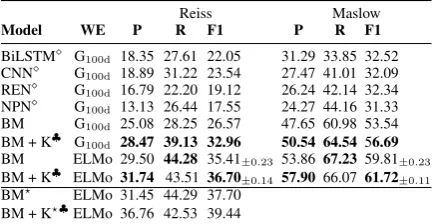
Table 2: Multi-label Classification Results:⇧: results in Rashkin et al.;?: w/obelonging; BM: BiLSTM+Self-Att.; +K:w/ knowledge,|:ranking method CC+PPR.
tion on the dataset, metrics and all other training details are given in the Supplement.
5 Results
Our experiment results are summarized in Table 2. We benchmark our baseline BiLSTM+Self-Attention model (BM, BM w/ knowledge) against the models proposed in Rashkin et al. (2018): a BiLSTM and a CNN model, and models based on the recurrent entity network (REN) (Henaff et al., 2016) and neural process networks (NPN) ( Bosse-lut et al., 2017). The latter differ from the basic encoding models (BiLSTM, CNN) and our own models by explicitly modeling entities. We find that our baseline model BM outperforms all prior work, achieving new state-of-the-art results. For Maslow we show improvement of 21.02 pp. F1 score. For BM+K this yields a boost of 6.39 and 3.15 pp.F1 score for Reiss and Maslow, respec-tively. When using ELMo with BM we see an im-provement in recall. However, adding knowledge on top improves the precision by 2.24 and 4.04 pp. for Reiss and Maslow. In all cases, injecting knowledge improves the model’s precision andF1 score.
Table2(bottom) presents results for the reduced dataset, after eliminating Reiss’ label belonging. Since belonging is a rare class, we observe fur-ther improvements. We see the same trend: adding knowledge improves the precision of the model.
5.1 Model Ablations
WE Atten K Gated P R F1 G300d - - - 23.31 34.69 27.89
G300d X - - 26.09 35.59 30.11
G300d X X - 27.99 37.73 32.14
G300d X X X 28.65 39.42 33.19
[image:8.595.91.273.62.148.2]ELMo - - - 32.35 42.66 36.80 ELMo X - - 31.45 44.29 37.70 ELMo X X - 32.65 45.60 38.05 ELMo X X X 36.76 42.53 39.44
Table 3: Model ablations for Reiss Classification on
MNPCSCSdataset w/obelonging.
Path Ranking P R F1
S+M(Pc z+Pc c) None 32.51 42.70 36.90
S+M(Pc z+Pc c) Random 31.63 43.35 36.57
Single Hop(Pc z) CC + PPR 33.00 44.63 37.94
S+M(Pc c+Pc z) CC + PPR 35.30 44.11 39.21
S+M(Pc z) CC 33.45 47.93 39.40
S+M(Pc z) PR 35.51 42.82 38.82
S+M(Pc z) PPR 36.23 43.09 39.34
[image:8.595.81.283.194.293.2]S+M(Pc z) CC + PPR 36.76 42.53 39.44
Table 4: Results for different path selection strategies
onMNPCSCSw/obelonging; S+M:Single+Multi hop.
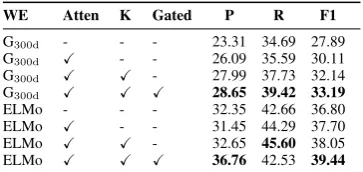
and knowledge components. We find that using self-attention over sentences and contexts is highly effective, which indicates that learning how much each token contributes helps the model to improve performance. We observe that integrating knowl-edge improves the overall F1 score and yields a gain in precision with ELMo. Further, integrat-ing knowledge usintegrat-ing the gatintegrat-ing mechanism we see a considerable increase of 3.58 and 1.74 pp. F1 score improvement over our baseline model for GloVe and ELMo representations respectively.
5.2 Commonsense Path Selection
We further examine model performance for (i) dif-ferent variants of selecting commonsense knowl-edge, including (ii) the effectiveness of the rele-vance ranking strategies discussed in §3.2.2. In Table 4, rows 3-4 use our best ranking method: CC+PPR; rows 5-8 show results when using the top-3 ranked pc z paths for each human need z with different ranking measures. Noneshows re-sults when no selection is applied to the set of extracted knowledge paths (i.e., using all possi-ble paths frompc z andpc c).Randomrandomly selects 3 paths for each human need from the set of paths used in None. This yields only a slight drop in performance. This suggests that not ev-ery path is relevant. We evaluate the performance when only considering single-hop paths (now top-3 ranked using CC+PPR)(Single-Hop). We see an improvement over random paths and no selection,
but not important enough. In contrast, using both single and multi-hop paths in conjunction with rel-evance ranking improves the performance consid-erably (rows 4-8). This demonstrates that multi-hop paths are informative. We also experimented with pc c+pc z. We find improvement in recall, however the overall performance decreases by 0.2 F1score compared to pathspc z ranked using CC + PPR. Among different ranking measures preci-sion for Personalized PageRank performs best in comparison with CC and PR in isolation, and re-call for CC in isolation is highest. Combining CC and PPR yields the best results among the different ranking strategies (rows 5-8).
6 Analysis
6.1 Performance per Human Need Categories
We examined the model performance on each cat-egory (cf. Figure4). The model performs well for basic needs likefood,safety,health,romance, etc. We note that inclusion of knowledge improves the performance for most classes (only 5 classes do not profit from knowledge compared to only using ELMo), especially for labels which are rare like
honor, idealism, power. We also found that the
annotated labels can be subjective. For instance,
Tom lost his jobis annotated withorderwhile our
model predicts savings, which we consider to be correct. Similar toRashkin et al. (2018) we ob-serve that preceding context helps the model to better predict the characters’ needs, e.g.,Context: Erica’s [..] class had a reading challenge [..]. If she was able to read 50 books [..] she won a pizza party!; Sentence: She read a book every day for
the entire semesteris annotated withcompetition.
Without context the predicted label is curiosity, however when including context, the model pre-dictscompetition, curiosity. We measure the mod-els performance when applying it only to the first sentence of each story (i.e., without the context). As shown in Table 5, also in this setting the in-clusion of knowledge improves the performance.
Model WE P R F1
BM ELMo 33.39 45.15 38.39
[image:8.595.349.489.674.711.2]BM+K ELMo 36.36 44.02 39.83
Table 5: Multi-label classification onMNPCSCS w/o
belonging classand w/o context (1stsentence only)
Figure 4: Best model’s performance per human needs (F1scores) for Reiss onMNPCSCSdataset.
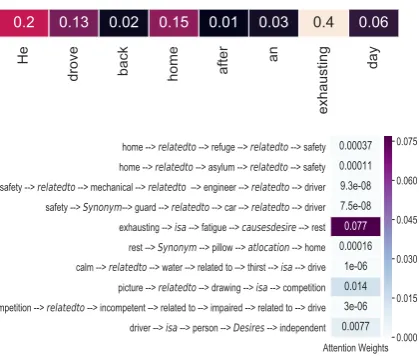
Context:Timmy had to renew his driver’s license. He went to his local DMV. He waited in line for nearly 2 hours. He took a new picture for his driver’s license.
Sentence:He drove back home after an exhausting day.
True Label:rest
Predicted Label (BM):status, approval, order Predicted Label (BM+K):rest
Figure 5: Interpreting the attention weights on sentence representation and selected commonsense paths.
6.2 Human Evaluation of Extracted Paths
We conduct human evaluation to test the effec-tiveness and relevance of the extracted common-sense knowledge paths. We randomly selected 50 sentence-context pairs with their gold labels from the devset and extracted knowledge paths that contain the gold label (using CC+PPR for ranking). We asked three expert evaluators to decide whether the paths are relevant to provide information about the missing links between the concepts in the sentence and the human need (gold label). The inter-annotator agreement had a Fleiss’
= 0.76. The result for this evaluation shows that
in 34% of the cases computed on the basis of ma-jority agreement, our algorithm was able to select a relevant commonsense path. More details about the human evaluation are given in the Supplement.
6.3 Interpretabilty
Finally we study the learned attention distributions of the interactions between sentence representa-tion and knowledge paths, in order to interpret how knowledge is employed to make predictions. Vi-sualization of the attention maps gives evidence of the ability of the model to capture relevant knowl-edge that connects human needs to the input text. The model provides interpretability in two ways: by selecting tokens from the input text using Eq.6 and by choosing knowledge paths from the im-ported knowledge using Eq.15 as shown in Fig-ure5. Figure5shows an example where including knowledge paths helped the model to predict the correct human need category. The attention map depicts which exact paths are selected to make the prediction. In this example, the model correctly picks up the token “exhausting” from the input sentence and the knowledge path “exhausting is
a fatigue causes desire rest”. We present more
examples of extracted knowledge and its attention visualization in the Supplement.
7 Conclusion
We have introduced an effective new method to rank multi-hop relation paths from a common-sense knowledge resource using graph-based algo-rithms. Our end-to-end model incorporates multi-hop knowledge paths to predict human needs. Due to the attention mechanism we can analyze the knowledge paths that the model considers in pre-diction. This enhances transparency and inter-pretability of the model. We provide quantitative and qualitative evidence of the effectiveness of the extracted knowledge paths. We believe our rele-vance ranking strategy to select multi-hop knowl-edge paths can be beneficial for other NLU tasks. In future work, we will investigate structured and unstructured knowledge sources to find explana-tions for sentiments and emoexplana-tions.
Acknowledgements
[image:9.595.79.289.285.463.2]References
Lisa Bauer, Yicheng Wang, and Mohit Bansal. 2018. Commonsense for Generative Multi-Hop Question Answering Tasks. InProceedings of the 2018 Con-ference on Empirical Methods in Natural Language
Processing, pages 4220–4230.
Alex Bavelas. 1950. Communication patterns in task-oriented groups. The Journal of the Acoustical So-ciety of America, 22(6):725–730.
Antoine Bordes, Sumit Chopra, and Jason Weston. 2014. Question Answering with Subgraph Embed-dings. In Proceedings of the 2014 Conference on Empirical Methods in Natural Language Processing
(EMNLP), pages 615–620.
Antoine Bosselut, Omer Levy, Ari Holtzman, Corin Ennis, Dieter Fox, and Yejin Choi. 2017.
Simulat-ing action dynamics with neural process networks.
CoRR, abs/1711.05313.
Sergey Brin and Lawrence Page. 1998. The anatomy of a large-scale hypertextual web search engine.
Com-puter networks and ISDN systems, 30(1-7):107–117.
Eunsol Choi, Hannah Rashkin, Luke Zettlemoyer, and Yejin Choi. 2016. Document-level sentiment infer-ence with social, faction, and discourse context. In
Proceedings of the 54th Annual Meeting of the As-sociation for Computational Linguistics (Volume 1:
Long Papers), volume 1, pages 333–343.
Lingjia Deng and Janyce Wiebe. 2015. Joint prediction for entity/event-level sentiment analysis using prob-abilistic soft logic models. In Proceedings of the 2015 Conference on Empirical Methods in Natural
Language Processing, pages 179–189.
Haibo Ding and Ellen Riloff. 2018. Human needs cate-gorization of affective events using labeled and unla-beled data. InProceedings of the 2018 Conference of the North American Chapter of the Association for Computational Linguistics: Human Language
Technologies, Volume 1 (Long Papers), volume 1,
pages 1919–1929.
Andrew B Goldberg, Nathanael Fillmore, David An-drzejewski, Zhiting Xu, Bryan Gibson, and Xiaojin Zhu. 2009. May all your wishes come true: A study of wishes and how to recognize them. In Proceed-ings of Human Language Technologies: The 2009 Annual Conference of the North American Chap-ter of the Association for Computational Linguistics, pages 263–271.
William L Hamilton, Kevin Clark, Jure Leskovec, and Dan Jurafsky. 2016. Inducing domain-specific senti-ment lexicons from unlabeled corpora. In Proceed-ings of the Conference on Empirical Methods in Nat-ural Language Processing. Conference on Empirical
Methods in Natural Language Processing, volume
2016, page 595. NIH Public Access.
Taher H Haveliwala. 2002. Topic-sensitive pagerank. InProceedings of the 11th international conference
on World Wide Web, pages 517–526. ACM.
Mikael Henaff, Jason Weston, Arthur Szlam, Antoine Bordes, and Yann LeCun. 2016. Tracking the
world state with recurrent entity networks. CoRR,
abs/1612.03969.
Sepp Hochreiter and J¨urgen Schmidhuber. 1997.
Long short-term memory. Neural Computation,
9(8):1735–1780.
Diederik P Kingma and Jimmy Lei Ba. 2014. Adam: Amethod for stochastic optimization. InProc. 3rd Int. Conf. Learn. Representations.
Jiwei Li and Eduard Hovy. 2017. Reflections on senti-ment/opinion analysis. InA Practical Guide to Sen-timent Analysis, pages 41–59. Springer.
Zheng Li, Yu Zhang, Ying Wei, Yuxiang Wu, and Qiang Yang. 2017. End-to-end adversarial memory network for cross-domain sentiment classification. InProceedings of the International Joint Conference on Artificial Intelligence (IJCAI 2017).
Abraham Harold Maslow. 1943. A theory of human motivation.Psychological review, 50(4):370.
Todor Mihaylov and Anette Frank. 2018. Knowledge-able reader: Enhancing cloze-style reading compre-hension with external commonsense knowledge. In
Proceedings of the 56th Annual Meeting of the As-sociation for Computational Linguistics (Volume 1:
Long Papers), pages 821–832.
Bo Pang, Lillian Lee, and Shivakumar Vaithyanathan. 2002. Thumbs up?: sentiment classification using machine learning techniques. InProceedings of the ACL-02 conference on Empirical methods in natural
language processing-Volume 10, pages 79–86.
Jeffrey Pennington, Richard Socher, and Christopher Manning. 2014. Glove: Global vectors for word representation. InProceedings of the 2014 confer-ence on empirical methods in natural language
pro-cessing (EMNLP), pages 1532–1543.
Matthew Peters, Mark Neumann, Mohit Iyyer, Matt Gardner, Christopher Clark, Kenton Lee, and Luke Zettlemoyer. 2018. Deep contextualized word
rep-resentations. In Proceedings of the 2018
Confer-ence of the North American Chapter of the Associ-ation for ComputAssoci-ational Linguistics: Human
Lan-guage Technologies, Volume 1 (Long Papers), pages
2227–2237.
Robert Plutchik. 1980. A general psychoevolutionary theory of emotion.Theories of emotion, 1(4):3–31.
Elahe Rahimtoroghi, Jiaqi Wu, Ruimin Wang, Pranav Anand, and Marilyn Walker. 2017. Modelling pro-tagonist goals and desires in first-person narrative.
InProceedings of the 18th Annual SIGdial Meeting
Hannah Rashkin, Antoine Bosselut, Maarten Sap, Kevin Knight, and Yejin Choi. 2018. Modeling naive psychology of characters in simple
common-sense stories. In Proceedings of the 56th Annual
Meeting of the Association for Computational
Lin-guistics (Volume 1: Long Papers), pages 2289–
2299.
Marek Rei and Anders Søgaard. 2018. Zero-shot se-quence labeling: Transferring knowledge from sen-tences to tokens. InProceedings of the 2018 Con-ference of the North American Chapter of the Asso-ciation for Computational Linguistics: Human
Lan-guage Technologies, Volume 1 (Long Papers),
vol-ume 1, pages 293–302.
Steven Reiss. 2002. Who am I?: 16 basic desires that motivate our actions define our persona. Penguin.
Steven Reiss. 2004. Multifaceted nature of intrinsic motivation: The theory of 16 basic desires. Review of general psychology, 8(3):179.
Richard Socher, Alex Perelygin, Jean Wu, Jason Chuang, Christopher D Manning, Andrew Ng, and Christopher Potts. 2013. Recursive deep models for semantic compositionality over a sentiment tree-bank. In Proceedings of the 2013 conference on
empirical methods in natural language processing,
pages 1631–1642.
Robert Speer and Catherine Havasi. 2012. Represent-ing General Relational Knowledge in ConceptNet 5. InLREC, pages 3679–3686.
Srikanth Tamilselvam, Seema Nagar, Abhijit Mishra, and Kuntal Dey. 2017. Graph Based Sentiment Ag-gregation using ConceptNet Ontology. In Proceed-ings of the Eighth International Joint Conference on Natural Language Processing (Volume 1: Long Pa-pers), volume 1, pages 525–535.
Duyu Tang, Bing Qin, and Ting Liu. 2015. Docu-ment modeling with gated recurrent neural network for sentiment classification. In Proceedings of the 2015 conference on empirical methods in natural
language processing, pages 1422–1432.
Dirk Weissenborn, Tom´aˇs Koˇcisk`y, and Chris Dyer. 2017. Dynamic Integration of Background Knowl-edge in Neural NLU Systems. arXiv preprint
arXiv:1706.02596.
Zhen Xu, Bingquan Liu, Baoxun Wang, Chengjie Sun, and Xiaolong Wang. 2017. Incorporating loose-structured knowledge into conversation mod-eling via recall-gate LSTM. In Neural Networks
(IJCNN), 2017 International Joint Conference on,
pages 3506–3513. IEEE.
Yichun Yin, Yangqiu Song, and Ming Zhang. 2017. Document-level multi-aspect sentiment classifica-tion as machine comprehension. InProceedings of the 2017 Conference on Empirical Methods in
Nat-ural Language Processing, pages 2044–2054.