Automatic Detection of Nonreferential
It
in Spoken Multi-Party Dialog
Christoph M ¨uller
EML Research gGmbH Villa Bosch
Schloß-Wolfsbrunnenweg 33 69118 Heidelberg, Germany [email protected]
Abstract
We present an implemented machine learning system for the automatic detec-tion of nonreferentialit in spoken dialog. The system builds on shallow features ex-tracted from dialog transcripts. Our exper-iments indicate a level of performance that makes the system usable as a preprocess-ing filter for a coreference resolution sys-tem. We also report results of an annota-tion study dealing with the classificaannota-tion of itby naive subjects.
1 Introduction
This paper describes an implemented system for the detection of nonreferentialit in spoken multi-party dialog. The system has been developed on the basis of meeting transcriptions from the ICSI Meeting Corpus (Janin et al., 2003), and it is in-tended as a preprocessing component for a coref-erence resolution system in the DIANA-Summ di-alog summarization project. Consider the follow-ing utterance:
MN059: Yeah. Yeah. Yeah. I’m sure I could learn a lot about um, yeah, just how to - how to come up with these structures, cuz it’s -it’s very easy to whip up something quickly, butitmaybe then makes sense to -to me, but not -to anybody else, and - and if we want -to share and integrate things, they must - well, they must be well designed really. (Bed017)
In this example, only one of the three instances of it is a referential pronoun: The firstit appears in thereparandum part of a speech repair (Heeman & Allen, 1999). It is replaced by a subsequent al-terationand is thus not part of the final utterance. The second it is the subject of an extraposition construction and serves as the placeholder for the postposed infinitive phrase to whip up something quickly. Only the thirditis a referential pronoun which anaphorically refers tosomething.
The task of the system described in the follow-ing is to identify and filter out nonreferential in-stances ofit, like the first and second one in the example. By preventing these instances from trig-gering the search for an antecedent, the precision of a coreference resolution system is improved.
Up to the present, coreference resolution has mostly been done on written text. In this domain, the detection of nonreferential it has by now be-come a standard preprocessing step (e.g. Ng & Cardie (2002)). In the few works that exist on coreference resolution in spoken language, on the other hand, the problem could be ignored, because almost none of these aimed at developing a sys-tem that could handle unrestricted input. Eck-ert & Strube (2000) focus on an unimplemented algorithm for determining the type of antecedent (mostly NP vs. non-NP), given an anaphorical pronoun or demonstrative. The system of Byron (2002) is implemented, but deals mainly with how referents for already identified discourse-deictic anaphors can be created. Finally, Strube & M¨uller (2003) describe an implemented system for re-solving 3rd person pronouns in spoken dialog, but they also exclude nonreferentialitfrom consider-ation. In contrast, the present work is part of a project to develop a coreference resolution system that, in its final implementation, can handle unre-stricted multi-party dialog. In such a system, no a prioriknowledge is available about whether an instance ofitis referential or not.
to our knowledge, has not been adressed before. Section 4 describes the setup and results of our machine learning experiments, Section 5 contains conclusion and future work.
2 Detecting NonreferentialItIn Text
Nonreferentialitis a rather frequent phenomenon in written text, though it still only constitutes a mi-nority of all instances ofit. Evans (2001) reports that his corpus of approx. 370.000 words from the SUSANNE corpus and the BNC contains 3.171 examples ofit, approx. 29% of which are nonref-erential. Dimitrov et al. (2002) work on the ACE corpus and give the following figures: the news-paper part of the corpus (ca. 61.000 words) con-tains 381 instances ofit, with 20.7% being nonref-erential, and the news wire part (ca. 66.000 words) contains 425 instances ofit, 16.5% of which are nonreferential. Boyd et al. (2005) use a 350.000 word corpus from a variety of genres. They count 2.337 instances ofit, 646 of which (28%) are non-referential. Finally, Clemente et al. (2004) report that in the GENIA corpus of medical abstracts the percentage of nonreferential it is as high as 44% of all instances ofit. This may be due to the fact that abstracts tend to contain more stereotypical formulations.
It is worth noting here that in all of the above studies the referential-nonreferential decision im-plicitly seems to have been made by the author(s). To our knowledge, no study provides figures re-garding the reliability of this classification.
Paice & Husk (1987) is the first corpus-based study on the detection of nonreferentialitin writ-ten text. From examples drawn from a part of the LOB corpus (technical section), Paice & Husk (1987) create rather complex pattern-based rules (like SUBJECT VERB it STATUS to TASK), and apply them to an unseen part of the corpus. They report a final success rate of 92.2% on the test corpus. Nowadays, most current coreference resolution systems for written text include some means for the detection of nonreferentialit. How-ever, evaluation figures for this task are not always given. As the detection of nonreferentialitis sup-posed to be a filtering condition (as opposed to aselection condition), high precision is normally considered to be more important than high recall. Afalse negative, i.e. a nonreferentialitthat is not detected, can still be filtered out later when reso-lution fails, while a false positive, i.e. a
referen-tialit that is wrongly removed, is simply lost and will necessarily harm overall recall. Another point worth mentioning is that mere classification accu-racy (percent correct) is not an appropriate eval-uation measure for the detection of nonreferential it. Accuracy will always be biased in favor of pre-dicting the majority classreferentialwhich, as the above figures show, can amount to over 80%.
The majority of works on detecting nonreferen-tialitin written text uses some variant of the partly syntactic and partly lexical tests described by Lap-pin & Leass (1994), the first work about computa-tional pronoun resolution to address the potential benefit of detecting nonreferential it. Lappin & Leass (1994) mainly supply a short list of modal adjectives and cognitive verbs, as well as seven syntactic patterns like It is Cogv-ed that S. Like many works that treat the detection of nonrefer-entialit only as one of several steps of the coref-erence resolution process, Lappin & Leass (1994) do not give any figures about the performance of this filtering method.
Dimitrov et al. (2002) modify and extend the approach of Lappin & Leass (1994) in several re-spects. They extend the list of modal adjectives to 86 (original: 15), and that of cognitive verbs to 22 (original: seven). They also increase the cov-erage of the syntactic patterns, mainly by allowing for optional adverbs at certain positions. Dimitrov et al. (2002) report performance figures for each of their syntactic patterns individually. The first thing to note is that 41.3% of the instances of non-referential it in their corpus do not comply with any of the patterns they use, so even if each pat-tern worked perfectly, the maximum recall to be reached with this method would be 58.7%. The ac-tual recall is 37.7%. Dimitrov et al. (2002) do not give any precision figures. One interesting detail is that the pattern involving the passive cognitive verb construction accounts for only three instances in the entire corpus, of which only one is found.
the text, like position of theitin its sentence, and position of the sentence in its paragraph. Sentence boundaries are also used to limit the search space for certain distance features. Evans (2001) reports a precision of 73.38% and a recall of 69.25%.
Clemente et al. (2004) work on the GENIA cor-pus of medical abstracts. They assume perfect pre-processing by using the manually assigned POS tags from the corpus. The features are very similar to those used by Evans (2001). Using an SVM ma-chine learning approach, Clemente et al. (2004) obtain an accuracy of 95.5% (majority base line: approx. 56%). They do not report any precision or recall figures. Clemente et al. (2004) also perform an analysis of the relative importance of features in various settings. It turns out that features pertain-ing to the distance or number of complementizers following the it are consistently among the most important.
Finally, Boyd et al. (2005) also use a machine learning approach. They use 25 features, most of which represent syntactic patterns like it VERB ADJthat. These features are numeric, having as their value the distance from a given instance of it to the end of the match, if any. Pattern match-ing is limited to sentences, sentence breaks bematch-ing identified by punctuation. Other features encode the (simplified) POS tags that surround a given in-stance ofit. Like in the system of Clemente et al. (2004), all POS tag information is obtained from the corpus, so no (error-prone) automatic tagging is performed. Boyd et al. (2005) obtain a precision of 82% and a recall of 71% using a memory-based machine learning approach, and a similar preci-sion but much lower recall (42%) using a decipreci-sion tree classifier.
In summary, the best approaches for detecting nonreferentialitin written text already work rea-sonably well, yielding an F-measure of over 70% (Evans, 2001; Boyd et al., 2005). This can at least partly be explained by the fact that many instances are drawn from texts coming from rather stereo-typical domains, like e.g. news wire text or scien-tific abstracts. Also, some make the rather unreal-istic assumption of perfect POS information, and even those who donotmake this assumption take advantage of the fact that automatic POS tagging is generally very good for these types of text. This is especially true in the case of complementizers (likethat) which have been shown to be highly in-dicative of extraposition constructions. Structural
properties of the context ofit, including sentence boundaries and position within sentence or para-graph, are also used frequently, either as numeri-cal features in their own right, or as means to limit the search space for pattern matching.
3 NonreferentialItin Spoken Dialog
Spontaneous speech differs considerably from written text in at least two respects that are rele-vant for the task described in this paper: it is less structured and more noisy than written text, and it contains significantly more instances ofit, includ-ing some types of nonreferential it not found in written text.
3.1 The ICSI Meeting Corpus
The ICSI Meeting Corpus (Janin et al., 2003) is a collection of 75 manually transcribed group dis-cussions of about one hour each, involving 3 to 13 speakers. It features a semiautomatically gener-ated segmentation in which the corpus developers tried to track the flow of the dialog by inserting segment starts approximately whenever a person started talking. Each of the resultingsegments is associated with a single speaker and contains start and end time information. The transcription con-tains manually added punctuation, and it also ex-plicitly records disfluencies and speech repairs by marking bothinterruption points and word frag-ments(Heeman & Allen, 1999). Consider the fol-lowing example:
ME010: Yeah. Yeah. No, no. There was a whole co- There was a little contract signed. It was - Yeah. (Bed017)
Note, however, that the extent of thereparandum (i.e. the words that are replaced by following words) is not part of the transcription.
3.2 Annotation ofIt
We performed an annotation with two external an-notators. We chose annotators outside the project in order to exclude the possibility that our own pre-conceived ideas influence the classification. The purpose of the annotation was twofold: Primar-ily, we wanted to collect training and test data for our machine learning experiments. At the same time, however, we wanted to investigate how re-liably this kind of annotation could be done. The annotators were asked to label instances of it in five ICSI Meeting Corpus dialogs1 as belonging
1
to one of the classesnormal, vague, discarded,
extrapos it, prop-it, orother.2 The idea behind using this five-fold classification (as opposed to a binary one) was that we wanted to be able to in-vestigate the inter-annotator reliability for each of the sub-types individually (cf. below). The first two classes are sub-types of referentialit:Normal
applies to the normal, anaphoric use ofit. Vague
it (Eckert & Strube, 2000) is a form of it which is frequent in spoken language, but rare in written text. It covers instances ofitwhich are indeed ref-erential, but whose referent is not an identifiable linguistic string in the context of the pronoun. A frequent (but not the only) type ofvagueitis the one referring to the current discourse topic, like in the following example:
ME011: [...] [M]y vision of it is you know each of us will have our little P D A in front of usPauseand so the acoustics - uh you might want to try to match the acoustics. (Bmr001)
Note that we treat vagueitas referential here even though, in the context of a coreference resolution preprocessing filter, it would make sense to treat it as nonreferential since it does not have an an-tecedent that it can be linked to. However, we fol-low Evans (2001) in assuming that the information that is required to classify an instance of it as a mention of the discourse topic is far beyond the lo-cal information that can reasonably be represented for an instance ofit.
The classes discarded, extrapos it and prop-itare sub-types of nonreferentialit. The first two types have already been shown in the example in Section 1. The class prop-it3 was included to cover cases like the following:
FE004: Soitseems like a lot of - some of the issues are the same. [...] (Bed017)
The annotators received instructions including de-scriptions and examples for all categories, and a decision tree diagram. The diagram told them e.g. to use wh-question formation as a test to distin-guish extrapos it and prop-it on the one hand fromnormaland vagueon the other. The crite-rion for distinguishing between the latter two phe-nomena was to usenormalif an antecedent could be identified, and vague otherwise. Fornormal
2
The actual tag set was larger, including categories like idiomwhich, however, the annotators turned out to use ex-tremely rarely only. These values are therefore conflated in the categoryotherin the following.
3
Quirk et al. (1991)
pronouns, the annotators were also asked to indi-cate the antecedent. The annotators were also told to tag as extrapos it only those cases in which an extraposed element (to-infinitive, ing-form or that-clause with or without complementizer) was available, and to useprop-it otherwise. The an-notators individually performed the annotation of the five dialogs. The results of this initial anno-tation were analysed and problems and ambigui-ties in the annotation scheme were identified and corrected. The annotators then individually per-formed the actual annotation again. The results reported in the following are from this second an-notation.
We then examined the inter-annotator reliability of the annotation by calculating theκscore
(Car-letta, 1996). The figures are given in Table 1. The categoryothercontains all cases in which one of the minor categories was selected. Each table cell contains the percentage agreement and theκvalue
for the respective category. The final column con-tains the overallκfor the entire annotation.
The table clearly shows that the classification ofitin spoken dialog appears to be by no means trivial: With one exception, κ for the category normalis below.67, the threshold which is
nor-mally regarded as allowing tentative conclusions (Krippendorff, 1980). The κ for the
nonreferen-tial sub-categoriesextrapos itandprop-itis also very variable, the figures for the former being on average slightly better than those for the latter, but still mostly below that threshold. In view of these results, it would be interesting to see simi-lar annotation experiments on written texts. How-ever, a study of the types of confusions that oc-cur showed that quite a few of the disagreements arise from confusions of sub-categories belonging to the same super-category, i.e. referential resp. nonreferential. That means that a decision on the level of granularity that is needed for the current work can be done more reliably.
The data used in the machine learning experi-ments described in Section 4 is a gold standard variant that the annotators agreed upon after the annotation was complete. The distribution of the five classes in thegold standarddata is as follows:
normal vague discarded extrapos it prop-it other κ
[image:5.595.102.494.63.125.2]Bed017 81.8% / .65 36.4% / .33 94.7% / .94 30.8% / .27 63.8% / .54 44.4% / .42 .62 Bmr001 88.5% / .69 23.5% / .21 93.6% / .92 50.0% / .48 40.0% / .33 0.0% / -.01 .63 Bns003 81.9% / .59 22.2% / .18 80.5% / .75 58.8% / .55 27.6% / .21 33.3% / .32 .55 Bro004 84.0% / .65 0.0% / -.05 89.9% / .86 75.9% / .75 62.5% / .59 0.0% / -.01 .65 Bro005 78.6% / .57 0.0% / -.03 88.0% / .84 60.0% / .58 44.0% / .36 25.0% / .23 .58
Table 1: Classification ofitby two annotators in a corpus subset.
4 Automatic Classification
4.1 Training and Test Data Generation
4.1.1 Segmentation
We extracted all instances of itand the segments (i.e. speaker units) they occurred in. This pro-duced a total of 1.017 instances, 62.5% of which were referential. Each instance was labelled as ref ornonref accordingly. Since a single segment does not adequately reflect the context of the it, we used the segments’ time information to join segments to larger units. We adopted the concept and definition ofspurt(Shriberg et al., 2001), i.e. a sequence of speech not interrupted by any pause longer than500ms, and joined segments with time
distances below this threshold. For each instance ofit, features were generated mainly on the basis of this spurt.
4.1.2 Preprocessing
For each spurt, we performed the following pre-processing steps: First, we removed all single dashes (i.e. interruption points), non-lexicalised filled pauses (likeemandeh), and all word frag-ments. This affected only the string representa-tion of the spurt (used for pattern matching later), so the information that a certain spurt position was associated with e.g. an interruption point or a filled pause was not lost.
We then ran a simple algorithm to detect di-rect repetitions of 1 to up to 6 words, where re-moved tokens were skipped. If a repetition was found, each token in the first occurrence was tagged asdiscarded. Finally, we also temporarily removed potential discourse markers by matching each spurt against a short list of expressions like actually, you know, I mean, but alsosoand sort of. This was done rather agressively and without taking any context into account. The rationale for doing this was that while discourse markers do indeed convey important information to the dis-course, they are not relevant forthe task at hand and can thus be considered as noise that can be re-moved in order to make the (syntactic and lexical)
patterns associated with nonreferentialitstand out more clearly. For each spurt thus processed, POS tags were obtained automatically with the Stan-ford tagger (Toutanova et al., 2003). Although this tagger is trained on written text, we used it without any retraining.
4.1.3 Feature Generation
One question we had to address was which infor-mation from the transcription we wanted to use. One can assume that using information like sen-tence breaks or interruption points should be ex-pected to help in the classification task at hand. On the other hand, we did not want our system to be dependenton this type of human-added in-formation. Thus, we decided to do several setups which made use of this information to various de-grees. Different setups differed with respect to the following options:
-use eos information: This option controls the effect of explicit end-of-sentence information in the transcribed data. If this option is active, this information is used in two ways: Spurt strings are trimmed in such a way that they do not cross sen-tence boundaries. Also, the search space for dis-tance features is limited to the current sentence.
-use interruption points: This option controls the effect of explicit interruption points. If this op-tion is active, this informaop-tion is used in a similar way as sentence boundary information.
All of the features described in the following were obtained fully automatically. That means that errors in the shallow feature generation meth-ods could propagate into the model that was learned from the data. The advantage of this ap-proach is, however, that training and test data are homogeneous. A model trained on partly erro-neous data is supposed to be more robust against similarly noisy testing data.
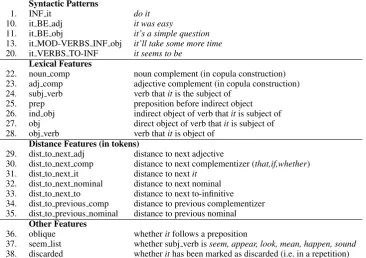
for two reasons: To get a simplified symbolic representation of the syntactic context of it, and to extract the other elements (nouns, verbs) from its predicative context. The patterns are matched using shallow (regular-expression based) methods only.
The second group of features contains lexical information about the predicative context ofit. It includes the verb that it is the grammatical sub-ject resp. obsub-ject of (if any). Further features are the nouns that serve as the direct object (if it is subject), and the noun resp. adjective complement in cases whereitappears in a copula construction. All these features are extracted from the patterns described above, and then lemmatized.
The third group of features captures the wider context ofitthrough distance (in tokens) to words of certain grammatical categories, like next com-plementizer, nextit, etc.
The fourth group of features contains the fol-lowing: oblique is a binary feature encoding whether the it is preceeded by a preposition. in seemlistis a feature that encodes whether or not the verb thatitis the subject of appears in the list seem, appear, look, mean, happen, sound (from Dimitrov et al. (2002)).discardedis a binary fea-ture that encodes whether theithas been tagged as discarded during preprocessing. The features are listed in Table 2. Features of the first group are only given as examples.
4.2 Machine Learning Experiment
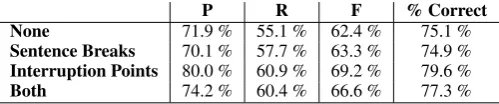
We then applied machine learning in order to build an automatic classifier for detecting nonreferential instances of it, given a vector of features as de-scribed above. We used JRip, the WEKA4 reim-plementation of Ripper (Cohen, 1995). All fol-lowing figures were obtained by means of ten-fold cross-validation. Table 3 contains all results dis-cussed in what follows.
In a first experiment, we did not use either of the two options described above, so that no in-formation about interruption points or sentence boundaries was available during training or test-ing. With this setting, the classifier achieved a re-call of 55.1%, a precision of 71.9% and a resulting F-measure of 62.4% for the detection of the class nonreferential. The overall classification accuracy was 75.1%.
The advantage of using a machine learning
sys-4
http://www.cs.waikato.ac.nz/ ml/
tem that produces human-readable models is that it allows direct introspection of which of the fea-tures were used, and to which effect. It turned out that thediscardedfeature is very successful. The model produced a rule that used this feature and correctly identified 83 instances of nonreferential it, while it produced no false positives. Similarly, the seem list feature alone was able to correctly identify 22 instances, producing nine false posi-tives. The following is an example of a more com-plex rule involving distance features, which is also very successful (37 true positives, 16 false posi-tives):
dist_to_next_to <= 8 and dist_to_next_adj <= 4
==> class = nonref (53.0/16.0)
This rule captures the common pattern for ex-traposition constructions likeIt is important to do that.
The following rule makes use of the feature en-coding the distance to the next complementizer (14 true positives, five false positives):
obj_verb = null and dist_to_next_comp <= 5
==> nonref (19.0/5.0)
Syntactic Patterns
1. INF it do it
10. it BE adj it was easy
11. it BE obj it’s a simple question 13. it MOD-VERBS INF obj it’ll take some more time 20. it VERBS TO-INF it seems to be
Lexical Features
22. noun comp noun complement (in copula construction) 23. adj comp adjective complement (in copula construction) 24. subj verb verb thatitis the subject of
25. prep preposition before indirect object 26. ind obj indirect object of verb thatitis subject of 27. obj direct object of verb thatitis subject of 28. obj verb verb thatitis object of
Distance Features (in tokens)
29. dist to next adj distance to next adjective
30. dist to next comp distance to next complementizer (that,if,whether) 31. dist to next it distance to nextit
32. dist to next nominal distance to next nominal 33. dist to next to distance to next to-infinitive 34. dist to previous comp distance to previous complementizer 35. dist to previous nominal distance to previous nominal
Other Features
36. oblique whetheritfollows a preposition
[image:7.595.116.483.64.322.2]37. seem list whether subj verb isseem, appear, look, mean, happen, sound 38. discarded whetherithas been marked as discarded (i.e. in a repetition)
Table 2: Our Features (selection)
57 true positives and only 30 false positives. We then wanted to compare the contribution of the sentence breaks to that of the interruption points. We ran another experiment, using only the latter and leaving everything else unaltered. This time, the overall performance of the classifier im-proved considerably: recall was 60.9%, precision 80.0%, F-measure 69.2%, and the overall accu-racy was 79.6%. The resulting model was rather complicated, including seven complex rules. The increase in recall is mainly due to the following rule, which is not easily interpreted:5
it_s = match and
dist_to_next_nominal >=21 and dist_to_next_adj >=500 and subj_verb = null
==> nonref (116.0/31.0)
The considerable improvement (in particular in precision) brought about by the interruption points, and the comparatively small impact of sen-tence boundary information, might be explainable in several ways. For instance, although sentence boundary information allows to limit both the search space for distance features and the scope of pattern matching, due to the shallow nature of pre-processing, what is betweentwo sentence breaks is by no means a well-formed sentence. In that respect, it seems plausible to assume that smaller
5
The value 500 is used as a MAX VALUE to indicate that no match was found.
units (as delimited by interruption points) may be beneficial for precision as they give rise to fewer spurious matches. It must also be noted that inter-ruption points do not markarbitrarybreaks in the flow of speech, but that they can signal important information (cf. Heeman & Allen (1999)).
5 Conclusion and Future Work
This paper presented a machine learning system for the automatic detection of nonreferentialitin spoken dialog. Given the fact that our feature ex-traction methods are only very shallow, the re-sults we obtained are satisfying. On the one hand, the good results that we obtained when utilizing information about interruption points (P:80.0% / R:60.9% / F:69.2%) show the feasibility of detect-ing nonreferentialitin spoken multi-party dialog. To our knowledge, this task has not been tackled before. On the other hand, the still fairly good results obtained by only using automatically de-termined features (P:71.9% / R:55.1% / F:62.4%) show that a practically usable filtering compo-nent for nonreferentialitcan be created even with rather simple means.
All experiments yielded classifiers that are con-servativein the sense that their precision is consid-erably higher than their recall. This makes them particularly well-suited asfiltercomponents.
P R F % Correct None 71.9 % 55.1 % 62.4 % 75.1 % Sentence Breaks 70.1 % 57.7 % 63.3 % 74.9 % Interruption Points 80.0 % 60.9 % 69.2 % 79.6 % Both 74.2 % 60.4 % 66.6 % 77.3 %
Table 3: Results of Automatic Classification Using Various Information Sources
work is part of, only the fully automatic variant is an option. Therefore, future work must try to im-prove its recall without harming its precision (too much). One way to do that could be to improve the recognition (i.e. correct POS tagging) of grammat-ical function words (in particular complementizers likethat) which have been shown to be important indicators for constructions with nonreferentialit. Other points of future work include the refinement of the syntactic pattern features and the lexical fea-tures. E.g., the values (i.e. mostly nouns, verbs, and adjectives) of the lexical features, which have been almost entirely ignored by both classifiers, could be generalized by mapping them to common WordNet superclasses.
Acknowledgements
This work has been funded by the Deutsche Forschungsgemeinschaft (DFG) in the context of the project DIANA-Summ (STR 545/2-1), and by the Klaus Tschira Foundation (KTF), Heidelberg, Germany. We thank our annotators Irina Schenk and Violeta Sabutyte, and the three anonymous re-viewers for their helpful comments.
References
Boyd, A., W. Gegg-Harrison & D. Byron (2005). Identifying non-referentialit: a machine learning approach incor-porating linguistically motivated patterns. In Proceed-ings of the ACL Workshop on Feature Selection for Ma-chine Learning in NLP, Ann Arbor, MI, June 2005, pp. 40–47.
Byron, D. K. (2002). Resolving pronominal reference to ab-stract entities. InProc. of ACL-02, pp. 80–87. Carletta, J. (1996). Assessing agreement on classification
tasks: The kappa statistic. Computational Linguistics, 22(2):249–254.
Clemente, J. C., K. Torisawa & K. Satou (2004). Improv-ing the identification of non-anaphoricitusing Support Vector Machines. InInternational Joint Workshop on Natural Language Processing in Biomedicine and its Applications,Geneva, Switzerland.
Cohen, W. W. (1995). Fast effective rule induction. In Proc. of the 12th International Conference on Machine Learning, pp. 115–123.
Dimitrov, M., K. Bontcheva, H. Cunningham & D. Maynard (2002). A light-weight approach to coreference resolu-tion for named entities in text. InProc. DAARC2. Eckert, M. & M. Strube (2000). Dialogue acts, synchronising
units and anaphora resolution. Journal of Semantics, 17(1):51–89.
Evans, R. (2001). Applying machine learning toward an auto-matic classification ofIt.Literary and Linguistic Com-puting, 16(1):45 – 57.
Heeman, P. & J. Allen (1999). Speech repairs, intonational phrases, and discourse markers: Modeling speakers’ utterances in spoken dialogue.Computational Linguis-tics, 25(4):527–571.
Janin, A., D. Baron, J. Edwards, D. Ellis, D. Gelbart, N. Mor-gan, B. Peskin, T. Pfau, E. Shriberg, A. Stolcke & C. Wooters (2003). The ICSI Meeting Corpus. In Proceedings of the IEEE International Conference on Acoustics, Speech and Signal Processing,Hong Kong, pp. 364–367.
Krippendorff, K. (1980). Content Analysis: An introduction to its methodology.Beverly Hills, CA: Sage Publica-tions.
Lappin, S. & H. J. Leass (1994). An algorithm for pronom-inal anaphora resolution. Computational Linguistics, 20(4):535–561.
Ng, V. & C. Cardie (2002). Improving machine learning ap-proaches to coreference resolution. InProc. of ACL-02, pp. 104–111.
Paice, C. D. & G. D. Husk (1987). Towards the automatic recognition of anaphoric features in English text: the impersonal pronoun ’it’. Computer Speech and Lan-guage, 2:109–132.
Quirk, R., S. Greenbaum, G. Leech & J. Svartvik (1991). A Comprehensive Grammar of the English Language. London, UK: Longman.
Shriberg, E., A. Stolcke & D. Baron (2001). Observations on overlap: Findings and implications for automatic processing of multi-party conversation. InProceedings of the 7th European Conference on Speech Communi-cation and Technology (EUROSPEECH ’01),Aalborg, Denmark, 3–7 September 2001, Vol. 2, pp. 1359–1362. Strube, M. & C. M¨uller (2003). A machine learning approach to pronoun resolution in spoken dialogue. In Proceed-ings of the 41st Annual Meeting of the Association for Computational Linguistics,Sapporo, Japan, 7–12 July 2003, pp. 168–175.