Parsing Mildly Non-projective Dependency Structures
∗Carlos G´omez-Rodr´ıguez
Departamento de Computaci´on Universidade da Coru˜na, Spain
David Weir and John Carroll
Department of Informatics University of Sussex, United Kingdom
{davidw,johnca}@sussex.ac.uk
Abstract
We present parsing algorithms for vari-ous mildly non-projective dependency for-malisms. In particular, algorithms are pre-sented for: all well-nested structures of gap degree at most1, with the same com-plexity as the best existing parsers for con-stituency formalisms of equivalent genera-tive power; all well-nested structures with gap degree bounded by any constant k; and a new class of structures with gap de-gree up tokthat includes some ill-nested structures. The third case includes all the gap degreekstructures in a number of de-pendency treebanks.
1 Introduction
Dependency parsers analyse a sentence in terms of a set of directed links (dependencies) express-ing the head-modifier and head-complement rela-tionships which form the basis of predicate argu-ment structure. We take dependency structures to be directed trees, where each node corresponds to a word and the root of the tree marks the syn-tactic head of the sentence. For reasons of effi-ciency, many practical implementations of depen-dency parsing are restricted to projective struc-tures, in which the subtree rooted at each word covers a contiguous substring of the sentence. However, while free word order languages such as Czech do not satisfy this constraint, parsing without the projectivity constraint is computation-ally complex. Although it is possible to parse non-projective structures in quadratic time under a model in which each dependency decision is inde-pendent of all the others (McDonald et al., 2005),
∗Partially supported by MEC and FEDER
(HUM2007-66607-C04) and Xunta de Galicia (PGIDIT07SIN005206PR, INCITE08E1R104022ES, INCITE08ENA305025ES, IN-CITE08PXIB302179PR, Rede Galega de Proc. da Linguaxe e RI, Bolsas para Estad´ıas INCITE – FSE cofinanced).
the problem is intractable in the absence of this as-sumption (McDonald and Satta, 2007).
Nivre and Nilsson (2005) observe that most non-projective dependency structures appearing in practice are “close” to being projective, since they contain only a small proportion of non-projective arcs. This has led to the study of classes of dependency structures that lie be-tween projective and unrestricted non-projective structures (Kuhlmann and Nivre, 2006; Havelka, 2007). Kuhlmann (2007) investigates several such classes, based on well-nestedness and gap degree constraints (Bodirsky et al., 2005), relating them to lexicalised constituency grammar formalisms. Specifically, he shows that: linear context-free rewriting systems (LCFRS) with fan-outk (Vijay-Shanker et al., 1987; Satta, 1992) induce the set of dependency structures with gap degree at most k −1; coupled context-free grammars in which the maximal rank of a nonterminal isk(Hotz and Pitsch, 1996) induce the set of well-nested depen-dency structures with gap degree at most k−1; and LTAGs (Joshi and Schabes, 1997) induce the set of well-nested dependency structures with gap degree at most1.
These results establish that there must be polynomial-time dependency parsing algorithms for well-nested structures with bounded gap de-gree, since such parsers exist for their correspond-ing lexicalised constituency-based formalisms. However, since most of the non-projective struc-tures in treebanks are well-nested and have a small gap degree (Kuhlmann and Nivre, 2006), devel-oping efficient dependency parsing strategies for these sets of structures has considerable practical interest, since we would be able to parse directly with dependencies in a data-driven manner, rather than indirectly by constructing intermediate con-stituency grammars and extracting dependencies from constituency parses.
for well-nested dependency structures of gap de-gree1, and prove its correctness. The parser runs in time O(n7
), the same complexity as the best existing algorithms for LTAG (Eisner and Satta, 2000), and can be optimised toO(n6
)in the non-lexicalised case; (2) we generalise the previous al-gorithm to any well-nested dependency structure with gap degree at mostkin timeO(n5+2k); (3)
we generalise the previous parsers to be able to analyse not only well-nested structures, but also ill-nested structures with gap degree at mostk sat-isfying certain constraints1, in timeO(n4+3k); and
(4) we characterise the set of structures covered by this parser, which we call mildly ill-nested struc-tures, and show that it includes all the trees present in a number of dependency treebanks.
2 Preliminaries
A dependency graph for a string w1. . . wn is a
graph G = (V, E), where V = {w1, . . . , wn}
and E ⊆ V ×V. We write the edge (wi, wj)
aswi → wj, meaning that the wordwi is a
syn-tactic dependent (or a child) ofwj or, conversely,
thatwj is the governor (parent) ofwi. We write
wi →? wj to denote that there exists a
(possi-bly empty) path from wi to wj. The projection
of a nodewi, denotedbwic, is the set of
reflexive-transitive dependents ofwi, that is:bwic={wj ∈
V |wj →? wi}. An interval (with endpointsiand
j) is a set of the form[i, j] ={wk|i≤k≤j}.
A dependency graph is said to be a tree if it is: (1) acyclic:wj ∈ bwicimplieswi →wj 6∈E; and
(2) each node has exactly one parent, except for one node which we call the root or head. A graph verifying these conditions and having a vertex set V ⊆ {w1, . . . , wn}is a partial dependency tree.
Given a dependency treeT = (V, E) and a node u ∈ V, the subtree induced by the node uis the graphTu = (buc, Eu)whereEu = {wi → wj ∈
E |wj ∈ buc}.
2.1 Properties of dependency trees
We now define the concepts of gap degree and well-nestedness (Kuhlmann and Nivre, 2006). Let T be a (possibly partial) dependency tree for w1. . . wn: We say thatT is projective ifbwic is
an interval for every word wi. Thus every node
in the dependency structure must dominate a con-tiguous substring in the sentence. The gap degree
1Parsing unrestricted ill-nested structures, even when the
gap degree is bounded, is NP-complete: these structures are equivalent to LCFRS for which the recognition problem is NP-complete (Satta, 1992).
of a particular nodewkinTis the minimumg∈N
such thatbwkccan be written as the union ofg+ 1
intervals; that is, the number of discontinuities in bwkc. The gap degree of the dependency treeT is
the maximum among the gap degrees of its nodes. Note that T has gap degree 0 if and only ifT is projective. The subtrees induced by nodeswpand
wqare interleaved ifbwpc ∩ bwqc =∅and there
are nodeswi, wj ∈ bwpcandwk, wl ∈ bwqcsuch
that i < k < j < l. A dependency tree T is
well-nested if it does not contain two interleaved
subtrees. A tree that is not well-nested is said to be ill-nested. Note that projective trees are always well-nested, but well-nested trees are not always projective.
2.2 Dependency parsing schemata
The framework of parsing schemata (Sikkel, 1997) provides a uniform way to describe, anal-yse and compare parsing algorithms. Parsing schemata were initially defined for constituency-based grammatical formalisms, but G´omez-Rodr´ıguez et al. (2008a) define a variant of the framework for dependency-based parsers. We use these dependency parsing schemata to de-fine parsers and prove their correctness. Due to space constraints, we only provide brief outlines of the main concepts behind dependency parsing schemata.
The parsing schema approach considers pars-ing as deduction, generatpars-ing intermediate results called items. An initial set of items is obtained from the input sentence, and the parsing process involves deduction steps which produce new items from existing ones. Each item contains informa-tion about the sentence’s structure, and a success-ful parsing process produces at least one final item providing a full dependency analysis for the sen-tence or guaranteeing its exissen-tence. In a depen-dency parsing schema, items are defined as sets of partial dependency trees2. To define a parser by means of a schema, we must define an item set and provide a set of deduction steps that operate on it. Given an item setI, the set of final items for strings of lengthnis the set of items inI that contain a full dependency tree for some arbitrary string of length n. A final item containing a de-pendency tree for a particular stringw1. . . wn is
said to be a correct final item for that string. These
2The formalism allows items to contain forests, and the
concepts can be used to prove the correctness of a parser: for each input string, a parsing schema’s deduction steps allow us to infer a set of items, called valid items for that string. A schema is said to be sound if all valid final items it produces for any arbitrary string are correct for that string. A schema is said to be complete if all correct final items are valid. A correct parsing schema is one which is both sound and complete.
In constituency-based parsing schemata, deduc-tion steps usually have grammar rules as side con-ditions. In the case of dependency parsers it is also possible to use grammars (Eisner and Satta, 1999), but many algorithms use a data-driven ap-proach instead, making individual decisions about which dependencies to create by using probabilis-tic models (Eisner, 1996) or classifiers (Yamada and Matsumoto, 2003). To represent these algo-rithms as deduction systems, we use the notion of D-rules (Covington, 1990). D-rules take the form a → b, which says that wordb can havea as a dependent. Deduction steps in non-grammar-based parsers can be tied to the D-rules associated with the links they create. In this way, we ob-tain a representation of the underlying logic of the parser while abstracting away from control struc-tures (the particular model used to create the de-cisions associated with D-rules). Furthermore, the choice points in the parsing process and the infor-mation we can use to make decisions are made ex-plicit in the steps linked to D-rules.
3 The WG1 parser
3.1 Parsing schema for WG1
We define WG1, a parser for well-nested
depen-dency structures of gap degree≤1, as follows: The item set isIW G1 =I1∪ I2, with
I1 ={[i, j, h,,]|i, j, h∈N,1≤h≤n,
1≤i≤j≤n, h=6 j, h6=i−1},
where each item of the form [i, j, h,,] repre-sents the set of all well-nested partial dependency trees3with gap degree at most 1, rooted atwh, and
such thatbwhc={wh} ∪[i, j], and
I2 ={[i, j, h, l, r]|i, j, h, l, r∈N,1≤h≤n,
1≤i < l≤r < j ≤n, h6=j, h6=i−1, h6=l−1, h6=r}
3In this and subsequent schemata, we use D-rules to
ex-press parsing decisions, so partial dependency trees are as-sumed to be taken from the set of trees licensed by a set of D-rules.
where each item of the form[i, j, h, l, r]represents the set of all well-nested partial dependency trees rooted at wh such that bwhc = {wh} ∪([i, j]\
[l, r]), and all the nodes (except possiblyh) have gap degree at most 1. We call items of this form gapped items, and the interval [l, r] the gap of the item. Note that the constraints h 6= j, h 6= i+ 1, h 6= l −1, h 6= r are added to items to avoid redundancy in the item set. Since the result of the expression{wh} ∪([i, j]\[l, r])for a given
head can be the same for different sets of values of i, j, l, r, we restrict these values so that we cannot get two different items representing the same de-pendency structures. Itemsιviolating these con-straints always have an alternative representation that does not violate them, that we can express with a normalising functionnm(ι)as follows:
nm([i, j, j, l, r]) = [i, j−1, j, l, r](ifr≤j−1orr=), or[i, l−1, j,,](ifr=j−1).
nm([i, j, l−1, l, r]) = [i, j, l−1, l−1, r](ifl > i+ 1), or[r+ 1, j, l−1,,](ifl=i+ 1).
nm([i, j, i−1, l, r]) = [i−1, j, i−1, l, r]. nm([i, j, r, l, r]) = [i, j, r, l, r−1](ifl < r),
or[i, j, r,,](ifl=r).
nm([i, j, h, l, r]) = [i, j, h, l, r]for all other items.
When defining the deduction steps for this and other parsers, we assume that they always produce normalised items. For clarity, we do not explicitly write this in the deduction steps, writingιinstead ofnm(ι)as antecedents and consequents of steps.
The set of initial items is defined as the set
H={[h, h, h,,]|h∈N,1≤h≤n},
where each item [h, h, h,,] represents the set containing the trivial partial dependency tree con-sisting of a single node wh and no links. This
same set of hypotheses can be used for all the parsers, so we do not make it explicit for subse-quent schemata. Note that initial items are sepa-rate from the item setIW G1and not subject to its
constraints, so they do not require normalisation. The set of final items for strings of lengthnin WG1is defined as the set
F ={[1, n, h,,]|h∈N,1≤h≤n},
which is the set of items inIW G1 containing
de-pendency trees for the complete input string (from position1ton), with their head at any wordwh.
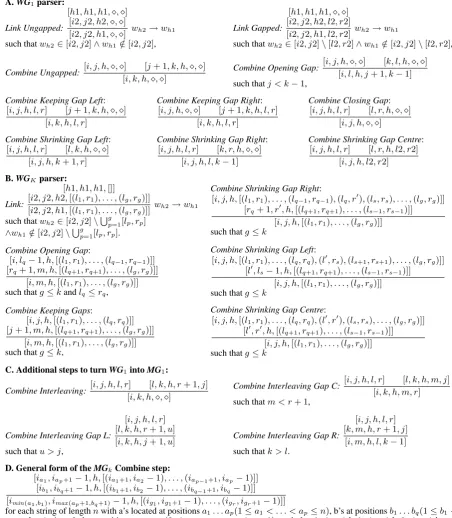
The deduction steps of the parser can be seen in Figure 1A.
The WG1 parser proceeds bottom-up, by
A. WG1parser:
Link Ungapped:
[h1, h1, h1,,] [i2, j2, h2,,]
[i2, j2, h1,,] wh2→wh1
such thatwh2∈[i2, j2]∧wh1∈/[i2, j2],
Link Gapped:
[h1, h1, h1,,] [i2, j2, h2, l2, r2]
[i2, j2, h1, l2, r2]wh2→wh1
such thatwh2∈[i2, j2]\[l2, r2]∧wh1∈/[i2, j2]\[l2, r2],
Combine Ungapped: [i, j, h,,] [j+ 1, k, h,,] [i, k, h,,]
Combine Opening Gap: [i, j, h,,] [k, l, h,,] [i, l, h, j+ 1, k−1]
such thatj < k−1,
Combine Keeping Gap Left: [i, j, h, l, r] [j+ 1, k, h,,]
[i, k, h, l, r]
Combine Keeping Gap Right: [i, j, h,,] [j+ 1, k, h, l, r]
[i, k, h, l, r]
Combine Closing Gap: [i, j, h, l, r] [l, r, h,,]
[i, j, h,,]
Combine Shrinking Gap Left: [i, j, h, l, r] [l, k, h,,]
[i, j, h, k+ 1, r]
Combine Shrinking Gap Right: [i, j, h, l, r] [k, r, h,,]
[i, j, h, l, k−1]
Combine Shrinking Gap Centre: [i, j, h, l, r] [l, r, h, l2, r2]
[i, j, h, l2, r2]
B. WGKparser:
Link:
[h1, h1, h1,[]]
[i2, j2, h2,[(l1, r1), . . . ,(lg, rg)]]
[i2, j2, h1,[(l1, r1), . . . ,(lg, rg)]]
wh2→wh1
such thatwh2∈[i2, j2]\Sgp=1[lp, rp]
∧wh1∈/[i2, j2]\Sgp=1[lp, rp].
Combine Shrinking Gap Right:
[i, j, h,[(l1, r1), . . . ,(lq−1, rq−1),(lq, r0),(ls, rs), . . . ,(lg, rg)]]
[rq+ 1, r0, h,[(lq+1, rq+1), . . . ,(ls−1, rs−1)]]
[i, j, h,[(l1, r1), . . . ,(lg, rg)]]
such thatg≤k
Combine Opening Gap:
[i, lq−1, h,[(l1, r1), . . . ,(lq−1, rq−1)]]
[rq+ 1, m, h,[(lq+1, rq+1), . . . ,(lg, rg)]]
[i, m, h,[(l1, r1), . . . ,(lg, rg)]]
such thatg≤kandlq≤rq,
Combine Shrinking Gap Left:
[i, j, h,[(l1, r1), . . . ,(lq, rq),(l0, rs),(ls+1, rs+1), . . . ,(lg, rg)]]
[l0, l
s−1, h,[(lq+1, rq+1), . . . ,(ls−1, rs−1)]]
[i, j, h,[(l1, r1), . . . ,(lg, rg)]]
such thatg≤k
Combine Keeping Gaps:
[i, j, h,[(l1, r1), . . . ,(lq, rq)]]
[j+ 1, m, h,[(lq+1, rq+1), . . . ,(lg, rg)]]
[i, m, h,[(l1, r1), . . . ,(lg, rg)]]
such thatg≤k,
Combine Shrinking Gap Centre:
[i, j, h,[(l1, r1), . . . ,(lq, rq),(l0, r0),(ls, rs), . . . ,(lg, rg)]]
[l0, r0, h,[(l
q+1, rq+1), . . . ,(ls−1, rs−1)]]
[i, j, h,[(l1, r1), . . . ,(lg, rg)]]
such thatg≤k
C. Additional steps to turn WG1into MG1:
Combine Interleaving: [i, j, h, l, r] [l, k, h, r+ 1, j] [i, k, h,,]
Combine Interleaving Gap C: [i, j, h, l, r] [l, k, h, m, j] [i, k, h, m, r]
such thatm < r+ 1,
Combine Interleaving Gap L:
[i, j, h, l, r] [l, k, h, r+ 1, u] [i, k, h, j+ 1, u]
such thatu > j,
Combine Interleaving Gap R:
[i, j, h, l, r] [k, m, h, r+ 1, j]
[i, m, h, l, k−1]
such thatk > l.
D. General form of the MGkCombine step:
[ia1, iap+1−1, h,[(ia1+1, ia2−1), . . . ,(iap−1+1, iap−1)]] [ib1, ibq+1−1, h,[(ib1+1, ib2−1), . . . ,(ibq−1+1, ibq−1)]] [imin(a1,b1), imax(ap+1,bq+1)−1, h,[(ig1, ig1+1−1), . . . ,(igr, igr+1−1)]]
for each string of lengthnwith a’s located at positionsa1. . . ap(1≤a1 < . . . < ap≤n), b’s at positionsb1. . . bq(1≤b1< . . . < bq≤n), and g’s at positionsg1. . . gr(2≤g1< . . . < gr ≤n−1), such that1≤p≤k,1≤q≤k,0≤r≤k−1,
[image:4.595.67.520.64.583.2]p+q+r=n, and the string does not contain more than one consecutive appearance of the same symbol.
Figure 1: Deduction steps for the parsers defined in the paper.
the parser can be understood by considering how it infers the item corresponding to the subtree in-duced by a particular node, given the items for the subtrees induced by the direct dependents of that node. Suppose that, in a complete dependency analysis for a sentence w1. . . wn, the word wh
haswd1. . . wdp as direct dependents (i.e. we have dependency links wd1 → wh, . . . , wdp → wh). Then, the item corresponding to the subtree
in-duced bywhis obtained from the ones
correspond-ing to the subtrees induced bywd1. . . wdp by: (1) applying the Link Ungapped or Link Gapped step to each of the items corresponding to the subtrees induced by the direct dependents, and to the hy-pothesis [h, h, h,,]. This allows us to infer p items representing the result of linking each of the dependent subtrees to the new head wh; (2)
items obtained in the previous step into a single item. The Combine steps perform a union oper-ation between subtrees. Therefore, the result is a dependency tree containing all the dependent sub-trees, and with all of them linked to h: this is the subtree induced by wh. This process is
ap-plied repeatedly to build larger subtrees, until, if the parsing process is successful, a final item is found containing a dependency tree for the com-plete sentence.
3.2 Proving correctness
The parsing schemata formalism can be used to prove the correctness of a parsing schema. To prove that WG1 is correct, we need to prove
its soundness and completeness.4 Soundness is proven by checking that valid items always con-tain well-nested trees. Completeness is proven by induction, taking initial items as the base case and showing that an item containing a correct subtree for a string can always be obtained from items corresponding to smaller subtrees. In order to prove this induction step, we use the concept of
order annotations (Kuhlmann, 2007; Kuhlmann
and M¨ohl, 2007), which are strings that lexicalise the precedence relation between the nodes of a de-pendency tree. Given a correct subtree, we divide the proof into cases according to the order annota-tion of its head and we find that, for every possible form of this order annotation, we can find a se-quence of Combine steps to infer the relevant item from smaller correct items.
3.3 Computational complexity
The time complexity of WG1 is O(n7), as the
step Combine Shrinking Gap Centre works with7 free string positions. This complexity with respect to the length of the input is as expected for this set of structures, since Kuhlmann (2007) shows that they are equivalent to LTAG, and the best ex-isting parsers for this formalism also perform in O(n7
) (Eisner and Satta, 2000). Note that the Combine step which is the bottleneck only uses the 7indexes, and not any other entities like D-rules, so its O(n7
) complexity does not have any addi-tional factors due to grammar size or other vari-ables. The space complexity of WG1 is O(n5)
for recognition, due to the5indexes in items, and O(n7
)for full parsing.
4Due to space constraints, correctness proofs for the
parsers are not given here. Full proofs are provided in the extended version of this paper, see (G´omez-Rodr´ıguez et al., 2008b).
It is possible to build a variant of this parser with time complexity O(n6
), as with parsers for unlexicalised TAG, if we work with unlexicalised D-rules specifying the possibility of dependencies between pairs of categories instead of pairs of words. In order to do this, we expand the item set with unlexicalised items of the form [i, j, C, l, r], where C is a category, apart from the existing items [i, j, h, l, r]. Steps in the parser are dupli-cated, to work both with lexicalised and unlex-icalised items, except for the Link steps, which always work with a lexicalised item and an un-lexicalised hypothesis to produce an unun-lexicalised item, and the Combine Shrinking Gap steps, which can work only with unlexicalised items. Steps are added to obtain lexicalised items from their unlex-icalised equivalents by binding the head to partic-ular string positions. Finally, we need certain vari-ants of the Combine Shrinking Gap steps that take 2 unlexicalised antecedents and produce a lexi-calised consequent; an example is the following:
Combine Shrinking Gap Centre L:
[i, j, C, l, r] [l+ 1, r, C, l2, r2]
[i, j, l, l2, r2]
such thatcat(wl)=C
Although this version of the algorithm reduces time complexity with respect to the length of the input toO(n6
), it also adds a factor related to the number of categories, as well as constant factors due to using more kinds of items and steps than the original WG1 algorithm. This, together with
the advantages of lexicalised dependency parsing, may mean that the original WG1algorithm is more
practical than this version.
4 The WGkparser
The WG1 parsing schema can be generalised to
obtain a parser for all well-nested dependency structures with gap degree bounded by a constant k(k≥ 1), which we call WGkparser. In order to
do this, we extend the item set so that it can contain items with up tokgaps, and modify the deduction steps to work with these multi-gapped items.
4.1 Parsing schema for WGk
The item set IW Gk is the set of all
[i, j, h,[(l1, r1), . . . ,(lg, rg)]] wherei, j, h, g∈N
, 0≤g≤k, 1≤h≤n, 1≤i≤j≤n , h6=j, h6=i−1; and for each p ∈ {1,2, . . . , g}: lp, rp ∈ N, i < lp ≤rp < j, rp < lp+1−1,
h6=lp−1,h6=rp.
An item [i, j, h,[(l1, r1), . . . ,(lg, rg)]]
trees rooted atwhsuch thatbwhc={wh}∪([i, j]\ Sg
p=1[lp, rp]), where each interval[lp, rp]is called
a gap. The constraints h 6= j, h 6= i+ 1, h 6= lp−1, h6=rpare added to avoid redundancy, and
normalisation is defined as in WG1. The set of
fi-nal items is defined as the setF = {[1, n, h,[]] | h∈N,1≤h≤n}. Note that this set is the same as in WG1, as these are the items that we denoted
[1, n, h,,]in the previous parser.
The deduction steps can be seen in Figure 1B. As expected, the WG1parser corresponds to WGk
when we make k = 1. WGk works in the same
way as WG1, except for the fact that Combine
steps can create items with more than one gap5. The correctness proof is also analogous to that of WG1, but we must take into account that the set of
possible order annotations is larger when k > 1, so more cases arise in the completeness proof.
4.2 Computational complexity
The WGk parser runs in time O(n5+2k): as in
the case of WG1, the deduction step with most
free variables is Combine Shrinking Gap Cen-tre, and in this case it has 5 + 2k free indexes. Again, this complexity result is in line with what could be expected from previous research in con-stituency parsing: Kuhlmann (2007) shows that the set of well-nested dependency structures with gap degree at most k is closely related to cou-pled context-free grammars in which the maxi-mal rank of a nonterminal is k+ 1; and the con-stituency parser defined by Hotz and Pitsch (1996) for these grammars also adds ann2factor for each unit increment of k. Note that a small value of k should be enough to cover the vast majority of the non-projective sentences found in natural lan-guage treebanks. For example, the Prague Depen-dency Treebank contains no structures with gap degree greater than 4. Therefore, a WG4 parser
would be able to analyse all the well-nested struc-tures in this treebank, which represent99.89%of the total. Increasing k beyond 4 would not pro-duce further improvements in coverage.
5 Parsing ill-nested structures
The WGk parser analyses dependency structures
with bounded gap degree as long as they are well-nested. This covers the vast majority of
5
In all the parsers in this paper, Combine steps may be applied in different orders to produce the same result, causing spurious ambiguity. In WG1 and WGk, this can be avoided
when implementing the schemata, by adding flags to items so as to impose a particular order.
the structures that occur in natural-language tree-banks (Kuhlmann and Nivre, 2006), but there is still a significant minority of sentences that con-tain ill-nested structures. Unfortunately, the gen-eral problem of parsing ill-nested structures is NP-complete, even when the gap degree is bounded: this set of structures is closely related to LCFRS with bounded fan-out and unbounded production length, and parsing in this formalism has been proven to be NP-complete (Satta, 1992). The reason for this high complexity is the problem of unrestricted crossing configurations, appearing when dependency subtrees are allowed to inter-leave in every possible way. However, just as it has been noted that most non-projective struc-tures appearing in practice are only “slightly” non-projective (Nivre and Nilsson, 2005), we charac-terise a sense in which the structures appearing in treebanks can be viewed as being only “slightly” ill-nested. In this section, we generalise the algo-rithms WG1 and WGk to parse a proper superset
of the set of well-nested structures in polynomial time; and give a characterisation of this new set of structures, which includes all the structures in several dependency treebanks.
5.1 The MG1and MGkparsers
The WGkparser presented previously is based on
a bottom-up process, where Link steps are used to link completed subtrees to a head, and Combine steps are used to join subtrees governed by a com-mon head to obtain a larger structure. As WGkis a
parser for well-nested structures of gap degree up tok, its Combine steps correspond to all the ways in which we can join two sets of sibling subtrees meeting these constraints, and having a common head, into another. Thus, this parser does not use Combine steps that produce interleaved subtrees, since these would generate items corresponding to ill-nested structures.
to parse a dependency structure (well-nested or not) if there exists a binarisation of that structure that has gap degree at most k. The parser im-plicitly works by finding such a binarisation, since Combine steps are always applied to two items and no intermediate item generated by them can ex-ceed gap degree k (not counting the position of the head in the projection).
More formally, letT be a dependency structure for the string w1. . . wn. A binarisation of T is
a dependency treeT0 over a set of nodes, each of
which may be unlabelled or labelled with a word in{w1. . . wn}, such that the following conditions
hold: (1) each node has at most two children, and (2) wi → wj inT if and only if wi →? wj in
T0. A dependency structure is mildly ill-nested
for gap degreekif it has at least one binarisation of gap degree ≤ k. Otherwise, we say that it is
strongly ill-nested for gap degree k. It is easy to prove that the set of mildly ill-nested structures for gap degreekincludes all well-nested structures with gap degree up tok.
We define MG1, a parser for mildly ill-nested
structures for gap degree 1, as follows: (1) the item set is the same as that of WG1, except that
items can now contain any mildly ill-nested struc-tures for gap degree1, instead of being restricted to well-nested structures; and (2) deduction steps are the same as in WG1, plus the additional steps
shown in Figure 1C. These extra Combine steps allow the parser to combine interleaved subtrees with simple crossing configurations. The MG1
parser still runs in O(n7), as these new steps do
not use more than 7 string positions.
The proof of correctness for this parser is sim-ilar to that of WG1. Again, we use the concept
of order annotations. The set of mildly ill-nested structures for gap degreekcan be defined as those that only contain annotations meeting certain con-straints. The soundness proof involves showing that Combine steps always generate items contain-ing trees with such annotations. Completeness is proven by induction, by showing that if a subtree is mildly ill-nested for gap degree k, an item for it can be obtained from items for smaller subtrees by applying Combine and Link steps. In the cases where Combine steps have to be applied, the order in which they may be used to produce a subtree can be obtained from its head’s order annotation.
To generalise this algorithm to mildly ill-nested structures for gap degreek, we need to add a Com-bine step for every possible way of joining two structures of gap degree at most k into another.
This can be done systematically by considering a set of strings over an alphabet of three symbols: aandbto represent intervals of words in the pro-jection of each of the structures, and g to repre-sent intervals that are not in the projection of ei-ther structure, and will correspond to gaps in the joined structure. The legal combinations of struc-tures for gap degree k will correspond to strings where symbolsaandbeach appear at mostk+ 1 times,gappears at mostktimes and is not the first or last symbol, and there is no more than one con-secutive appearance of any symbol. Given a string of this form, the corresponding Combine step is given by the expression in Figure 1D. As a particu-lar example, the Combine Interleaving Gap C step in Figure 1C is obtained from the stringabgab.
Thus, we define the parsing schema for MGk, a
parser for mildly ill-nested structures for gap de-gree k, as the schema where (1) the item set is like that of WGk, except that items can now
con-tain any mildly ill-nested structures for gap degree k, instead of being restricted to well-nested struc-tures; and (2) the set of deduction steps consists of a Link step as the one in WGk, plus a set of
Com-bine steps obtained as expressed in Figure 1D. As the string used to generate a Combine step can have length at most 3k+ 2, and the result-ing step contains an index for each symbol of the string plus two extra indexes, the MGkparser has
complexityO(n3k+4
). Note that the item and de-duction step sets of an MGkparser are always
su-persets of those of WGk. In particular, the steps
for WGk are those obtained from strings that do
not containababorbabaas a scattered substring.
5.2 Mildly ill-nested dependency structures
The MGk algorithm defined in the previous
sec-tion can parse any mildly ill-nested structure for a given gap degreekin polynomial time. We have characterised the set of mildly ill-nested structures for gap degreekas those having a binarisation of gap degree≤ k. Since a binarisation of a depen-dency structure cannot have lower gap degree than the original structure, this set only contains struc-tures with gap degree at mostk. Furthermore, by the relation between MGkand WGk, we know that
it contains all the well-nested structures with gap degree up tok.
Language
Structures
Total
Nonprojective
Total
By gap degree By nestedness
Gap degree1
Gap degree2
Gap degree3
Gap deg.>3
Well-Nested
Mildly Ill-Nested
Strongly Ill-Nested
Arabic 2995 205 189 13 2 1 204 1 0
Czech 87889 20353 19989 359 4 1 20257 96 0
Danish 5430 864 854 10 0 0 856 8 0
Dutch 13349 4865 4425 427 13 0 4850 15 0
Latin 3473 1743 1543 188 10 2 1552 191 0
Portuguese 9071 1718 1302 351 51 14 1711 7 0
Slovene 1998 555 443 81 21 10 550 5 0
Swedish 11042 1079 1048 19 7 5 1008 71 0
[image:8.595.74.526.61.206.2]Turkish 5583 685 656 29 0 0 665 20 0
Table 1: Counts of dependency trees classified by gap degree, and mild and strong ill-nestedness (for their gap degree);
appear-ing in treebanks for Arabic (Hajiˇc et al., 2004), Czech (Hajiˇc et al., 2006), Danish (Kromann, 2003), Dutch (van der Beek et al., 2002), Latin (Bamman and Crane, 2006), Portuguese (Afonso et al., 2002), Slovene (Dˇzeroski et al., 2006), Swedish (Nilsson et al., 2005) and Turkish (Oflazer et al., 2003; Atalay et al., 2003).
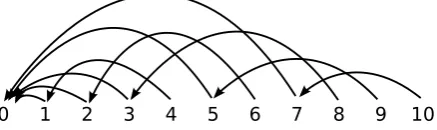
Figure 2: One of the smallest strongly ill-nested structures.
This dependency structure has gap degree 1, but is only mildly ill-nested for gap degree≥2.
located at position0), it can be shown that all the structures of any gap degreekwith length smaller than 10 are well-nested or only mildly ill-nested for that gap degreek.
Even if a structure T is strongly ill-nested for a given gap degree, there is always somem ∈ N
such thatT is mildly ill-nested form(since every dependency structure can be binarised, and binari-sations have finite gap degree). For example, the structure in Figure 2 is mildly ill-nested for gap de-gree2. Therefore, MGkparsers have the property
of being able to parse any possible dependency structure as long as we makeklarge enough.
In practice, structures like the one in Figure 2 do not seem to appear in dependency treebanks. We have analysed treebanks for nine different lan-guages, obtaining the data presented in Table 1. None of these treebanks contain structures that are strongly ill-nested for their gap degree. There-fore, in any of these treebanks, the MGkparser can
parse every sentence with gap degree at mostk.
6 Conclusions and future work
We have defined a parsing algorithm for well-nested dependency structures with bounded gap degree. In terms of computational complexity, this algorithm is comparable to the best parsers for related constituency-based formalisms: when the gap degree is at most 1, it runs in O(n7
),
like the fastest known parsers for LTAG, and can be made O(n6
) if we use unlexicalised depen-dencies. When the gap degree is greater than 1, the time complexity goes up by a factor of n2
for each extra unit of gap degree, as in parsers for coupled context-free grammars. Most of the non-projective sentences appearing in treebanks are well-nested and have a small gap degree, so this algorithm directly parses the vast majority of the non-projective constructions present in natural languages, without requiring the construction of a constituency grammar as an intermediate step.
Additionally, we have defined a set of struc-tures for any gap degree k which we call mildly ill-nested. This set includes ill-nested structures verifying certain conditions, and can be parsed in O(n3k+4
) with a variant of the parser for well-nested structures. The practical interest of mildly ill-nested structures can be seen in the data ob-tained from several dependency treebanks, show-ing that all of the ill-nested structures in them are mildly ill-nested for their corresponding gap de-gree. Therefore, ourO(n3k+4
)parser can analyse all the gap degreekstructures in these treebanks.
The set of mildly ill-nested structures for gap degreekis defined as the set of structures that have a binarisation of gap degree at mostk. This defini-tion is directly related to the way the MGk parser
works, since it implicitly finds such a binarisation. An interesting line of future work would be to find an equivalent characterisation of mildly ill-nested structures which is more grammar-oriented and would provide a more linguistic insight into these structures. Another research direction, which we are currently working on, is exploring how vari-ants of the MGk parser’s strategy can be applied
[image:8.595.73.292.265.330.2]References
Susana Afonso, Eckhard Bick, Renato Haber, and Di-ana Santos. 2002. “Floresta sint´a(c)tica”: a tree-bank for Portuguese. In Proc. of LREC 2002, pages 1968–1703, Las Palmas, Spain.
Nart B. Atalay, Kemal Oflazer, and Bilge Say. 2002. The annotation process in the Turkish treebank. In Proc. of EACL Workshop on Linguistically Inter-preted Corpora - LINC, Budapest, Hungary. David Bamman and Gregory Crane. 2006. The design
and use of a Latin dependency treebank. In Proc. of 5th Workshop on Treebanks and Linguistic Theories (TLT2006), pages 67–78.
Manuel Bodirsky, Marco Kuhlmann, and Mathias M¨ohl. 2005. Well-nested drawings as models of syntactic structure. Technical Report, Saar-land University. Electronic version available at:
http://www.ps.uni-sb.de/Papers/.
Michael A. Covington. 1990. A dependency parser for variable-word-order languages. Technical Re-port AI-1990-01, Athens, GA.
Saˇso Dˇzeroski, Tomaˇz Erjavec, Nina Ledinek, Petr Pa-jas, Zdenˇek ˇZabokrtsk´y, and Andreja ˇZele. 2006. Towards a Slovene dependency treebank. In Proc. of LREC 2006, pages 1388–1391, Genoa, Italy. Jason Eisner and Giorgio Satta. 1999. Efficient
pars-ing for bilexical context-free grammars and head au-tomaton grammars. In Proc. of ACL-99, pages 457– 464, Morristown, NJ. ACL.
Jason Eisner and Giorgio Satta. 2000. A faster parsing algorithm for lexicalized tree-adjoining grammars. In Proc. of 5th Workshop on Tree-Adjoining Gram-mars and Related Formalisms (TAG+5), pages 14– 19, Paris.
Jason Eisner. 1996. Three new probabilistic models for dependency parsing: An exploration. In Proc. of COLING-96, pages 340–345, Copenhagen.
Carlos G´omez-Rodr´ıguez, John Carroll, and David Weir. 2008a. A deductive approach to dependency parsing. In Proc. of ACL’08:HLT, pages 968–976, Columbus, Ohio. ACL.
Carlos G´omez-Rodr´ıguez, David Weir, and John Car-roll. 2008b. Parsing mildly non-projective depen-dency structures. Technical Report CSRP 600, De-partment of Informatics, University of Sussex. Carlos G´omez-Rodr´ıguez, Marco Kuhlmann, Giorgio
Satta, and David Weir. 2009. Optimal reduction of rule length in linear context-free rewriting systems. In Proc. of NAACL’09:HLT (to appear).
Jan Hajiˇc, Otakar Smrˇz, Petr Zem´anek, Jan ˇSnaidauf, and Emanuel Beˇska. 2004. Prague Arabic depen-dency treebank: Development in data and tools. In Proc. of NEMLAR International Conference on Ara-bic Language Resources and Tools, pages 110–117. Jan Hajiˇc, Jarmila Panevov´a, Eva Hajiˇcov´a, Jarmila Panevov´a, Petr Sgall, Petr Pajas, Jan ˇStˇep´anek, Jiˇr´ı Havelka, and Marie Mikulov´a. 2006. Prague depen-dency treebank 2.0. CDROM CAT: LDC2006T01, ISBN 1-58563-370-4.
Jiˇr´ı Havelka. 2007. Beyond projectivity: Multilin-gual evaluation of constraints and measures on non-projective structures. In Proc. of ACL 2007, Prague, Czech Republic. ACL.
G¨unter Hotz and Gisela Pitsch. 1996. On pars-ing coupled-context-free languages. Theor. Comput. Sci., 161(1-2):205–233. Elsevier, Essex, UK. Aravind K. Joshi and Yves Schabes. 1997.
Tree-adjoining grammars. In Handbook of
for-mal languages, pages 69–124. Springer-Verlag, Berlin/Heidelberg/NY.
Matthias T. Kromann. 2003. The Danish dependency treebank and the underlying linguistic theory. In Proc. of the 2nd Workshop on Treebanks and Lin-guistic Theories (TLT2003).
Marco Kuhlmann and Mathias M¨ohl. 2007. Mildly context-sensitive dependency languages. In Proc. of ACL 2007, Prague, Czech Republic. ACL.
Marco Kuhlmann and Joakim Nivre. 2006. Mildly non-projective dependency structures. In Proc. of COLING/ACL main conference poster sessions, pages 507–514, Morristown, NJ, USA. ACL. Marco Kuhlmann. 2007. Dependency Structures and
Lexicalized Grammars. Doctoral dissertation, Saar-land University, Saarbr¨ucken, Germany.
Ryan McDonald and Giorgio Satta. 2007. On the com-plexity of non-projective data-driven dependency parsing. In IWPT 2007: Proc. of the 10th Confer-ence on Parsing Technologies. ACL.
Ryan McDonald, Fernando Pereira, Kiril Ribarov, and Jan Hajiˇc. 2005. Non-projective dependency pars-ing uspars-ing spannpars-ing tree algorithms. In Proc. of HLT/EMNLP 2005, pages 523–530, Morristown, NJ, USA. ACL.
Jens Nilsson, Johan Hall, and Joakim Nivre. 2005. MAMBA meets TIGER: Reconstructing a Swedish treebank from antiquity. In Proc. of NODALIDA 2005 Special Session on Treebanks, pages 119–132. Joakim Nivre and Jens Nilsson. 2005. Pseudo-projective dependency parsing. In Proc. of ACL’05, pages 99–106, Morristown, NJ, USA. ACL. Kemal Oflazer, Bilge Say, Dilek Zeynep Hakkani-T¨ur
and G¨okhan T¨ur. 2003. Building a Turkish tree-bank. In A. Abeille, ed., Building and Exploit-ing Syntactically-annotated Corpora. Kluwer, Dor-drecht.
Giorgio Satta. 1992. Recognition of linear context-free rewriting systems. In Proc. of ACL-92, pages 89–95, Morristown, NJ. ACL.
Klaas Sikkel. 1997. Parsing Schemata — A Frame-work for Specification and Analysis of Parsing Al-gorithms. Springer-Verlag, Berlin/Heidelberg/NY. L. van der Beek, G. Bouma, R. Malouf, and G. van
Noord. 2002. The Alpino dependency treebank. In Computational Linguistics in the Netherlands (CLIN), Twente University.
K. Vijay-Shanker, David J. Weir, and Aravind K. Joshi. 1987. Characterizing structural descriptions pro-duced by various grammatical formalisms. In Proc. of ACL-87, pages 104–111, Morristown, NJ. ACL. Hiroyasu Yamada and Yuji Matsumoto. 2003.