Modelling Polysemy in Adjective Classes by Multi-Label Classification
Gemma Boleda GLiCom
Universitat Pompeu Fabra 08003 Barcelona [email protected]
Sabine Schulte im Walde IMS
University of Stuttgart 70174 Stuttgart schulte@ims. uni-stuttgart.de
Toni Badia GLiCom
Universitat Pompeu Fabra 08003 Barcelona [email protected]
Abstract
This paper assesses the role of multi-label classification in modelling polysemy for lan-guage acquisition tasks. We focus on the ac-quisition of semantic classes for Catalan ad-jectives, and show that polysemy acquisition naturally suits architectures used for multi-label classification. Furthermore, we ex-plore the performance of information drawn from different levels of linguistic descrip-tion, using feature sets based on morphol-ogy, syntax, semantics, andn-gram distribu-tion. Finally, we demonstrate that ensemble classifiers are a powerful and adequate way to combine different types of linguistic ev-idence: a simple, majority voting ensemble classifier improves the accuracy from 62.5% (best single classifier) to 84%.
1 Introduction
This paper reports on a series of experiments to ex-plore the automatic acquisition of semantic classes for Catalan adjectives. The most important chal-lenge of the classification task is to model the assign-ment of polysemous lexical instances to multiple se-mantic classes, combining a) a state-of-the-art Ma-chine Learning architecture for Multi-label Classi-fication (Schapire and Singer, 2000; Ghamrawi and McCallum, 2005) and an Ensemble Classifier (Di-etterich, 2002) with b) the definition of features at various levels of linguistic description.
A proper treatment of polysemy is essential in the area of lexical acquisition, since polysemy
repre-sents a pervasive phenomenon in natural language. However, previous approaches to the automatic ac-quisition of semantic classes have mostly disre-garded the problem (cf. Merlo and Stevenson, 2001 and Stevenson and Joanis, 2003 for English seman-tic verb classes, or Schulte im Walde, 2006 for Ger-man seGer-mantic verb classes). There are a few excep-tions to this tradition, such as Pereira et al. (1993), Rooth et al. (1999), Korhonen et al. (2003), who used soft clustering methods for multiple assign-ment to verb semantic classes.
Our work addresses the lack of methodology in modelling a polysemous classification. We imple-ment a multi-label classification architecture to han-dle polysemy. This paper concentrates on the clas-sification of Catalan adjectives, but the general na-ture of the architecna-ture should allow related tasks to profit from our insights.
As target classification for the experiments, a set of 210 Catalan adjectives was manually classified by experts into three simple and three polysemous se-mantic classes. We deliberately decided in favour of a small-scale, broad classification. So far, there is little work on the semantic classification of adjec-tives, as opposed to verbal semantic classification. The semantic classification we propose is a first step in characterising adjectival meaning, and can be re-fined and extended in subsequent work.
The experiments also provide a thorough compar-ison of feature sets based on different levels of lin-guistic description (morphology, syntax, semantics). A set of features is defined for each level of descrip-tion, and its performance is assessed within the se-ries of experiments. An ensemble classifier
ments the classification architecture, by optimising the combination of these different types of linguistic evidence.
Our task is motivated by the fact that adjectives play an important role in sentential semantics: they are crucial in determining the reference of NPs, and in defining properties of entities. Even using only three different classes, the information acquired could be applied to, e.g., identify referents in a given context in Dialog or Question Answering systems, and to induce properties of objects within Informa-tion ExtracInforma-tion tasks. Furthermore, with the seman-tic classes corresponding to broad sense representa-tions, they can be exploited for Word Sense Disam-biguation.
The remainder of this paper is organised as fol-lows. Section 2 provides background on Catalan ad-jectives, and Section 3 presents the Gold Standard classification. Section 4 introduces the methodology of the multi-label classification experiments, Sec-tion 5 discusses the results, and the improved en-semble classifier is presented in Section 6.
2 Catalan adjective classes
The definition and characterisation of our target se-mantic classification follows the proposal by Raskin and Nirenburg (1998) within the framework of On-tological Semantics(Nirenburg and Raskin, 2004). In Ontological Semantics, an ontology of concepts modelling the world is explicitly defined, and the semantics of words are mapped onto elements of the ontology. The classification pursued in this pa-per is drawn up based on the ontological sort of ad-jectival denotation: all adjectives denote properties, but these properties can be instantiated as simple at-tributes (basic adjectives), relationships to objects (object-related adjectives), or relationships to events (event-related adjectives).
Basic adjectives are the prototypical adjectives which denote attributes or properties and cannot be decomposed further (such as bonic ‘beautiful’, gran ‘big’). In Ontological Semantics, these adjectives are mapped to concepts of type attribute. For in-stance, the semantics of the adjective gran specifies a mapping to the size-attribute element in the onto-logy. As for event-related adjectives, they have an event component in their meaning and are therefore
mapped onto event concepts in the ontology. For instance, the semantics of tangible (‘tangible’) in-cludes a pointer to the event element touch in the ontology. Similarly, object-related adjectives are mapped onto object concepts in the ontology: defor-mació nasal (‘nasal deformity’) can be paraphrased as deformity that affects the nose, so nasal evokes the object nose.
The semantic distinctions are mirrored at sev-eral levels of linguistic description, such as mor-phology, syntax, and semantics. For instance, there is a clear relationship between morphological type and semantic class: basic adjectives are typically non-derived, object adjectives tend to be denomi-nal, and event adjectives are usually deverbal. This is the default mapping that one expects from the morphology-semantics interface. As an example for syntactic evidence, basic adjectives in Catalan can be used non-restrictively (in a pre-nominal position) and also predicatively, while object adjectives typi-cally cannot.
However, the correspondences between the lin-guistic properties and the semantic classes are not one-to-one mappings. Taking the morphological le-vel as an example, some denominal adjectives are basic (such as vergonyós ‘shy’, from vergonya ‘shy-ness’). Conversely, some object adjectives are not synchronically denominal (such as botànic ‘botan-ical’), and some deverbal adjectives are not event-related, such as amable (lit. ‘suitable to be loved’; has evolved to ‘kind, friendly’). In such cases, the semantic class can be better traced in the distribu-tional properties, not the morphological properties of the adjective.
The proposed classification accounts for some cases of adjectival polysemy. For instance, familiar has an object reading (related to the Catalan noun for ‘family’), and a basic reading (corresponding to the English adjective ‘familiar’):
(1) reunió meeting
familiar familiar / /
cara face
familiar familiar
‘family meeting / familiar face’
(2) conseqüència consequence
sabuda known / /
home man
sabut wise
‘known consequence / wise man’
The polysemy between our proposed classes, as exemplified in (1) and (2), is the kind of polysemy we aim to model in the acquisition experiments re-ported in this paper.
3 Gold Standard classes
As a Gold Standard for the experiments to fol-low, 210 Catalan adjectives were classified by three experts. The adjectives were randomly sampled from an adjective database (Sanromà, 2003), bal-ancing three factors of variability: frequency, mor-phological type, and suffix. An equal number of adjectives was chosen from three frequency bands (low, medium, high), from four derivational types (denominal, deverbal, non-derived, participle), and from a series of suffixes within each type. The derivational type and suffix of each adjective were available in the adjective database, and had been manually encoded.
Three experts assigned the 210 lemmata to one out of six classes: each adjective was tagged as ba-sic (B), event (E), object (O), or as polysemous be-tween basic and event (BE), bebe-tween basic and ob-ject (BO), or between event and obob-ject (EO). The decisions were reached by consensus. The distribu-tion of the Gold Standard material across classes is shown in the last column of Table 6 (Section 5.2).
In the acquisition experiments, our aim is to auto-matically assign a class to each adjective that can be simple (B, E, O) or complex (BE, BO, EO), in case of polysemy.
4 Classification method
Adjective classification was performed within a two-level architecture for multi-label classification: first, make a binary decision on each of the classes, and then combine the classifications to achieve a final, multi-label classification. We therefore decomposed the global decision on the (possibly polysemous) class of an adjective into three binary decisions: Is it basic or not? Is it event-related or not? Is it object-related or not? The individual decisions were then combined into an overall classification that included
polysemy. For example, if a lemma was classified both as basic and as object in each of the binary de-cisions, it was deemed polysemous (BO). The mo-tivation behind this approach was that polysemous adjectives should exhibit properties of all the classes involved. As a result, positive decisions on each bi-nary classification can be made by the algorithm, which can be viewed as implicit polysemous assign-ments.
This classification architecture is very popu-lar in Machine Learning for multi-label problems, cf. (Schapire and Singer, 2000; Ghamrawi and Mc-Callum, 2005), and has also been applied to NLP problems such as entity extraction and noun-phrase chunking (McDonald et al., 2005). The remainder of this section describes other methodological aspects of our experiments.
4.1 Classifier: Decision Trees
As classifier for the binary decisions we chose De-cision Trees, one of the most widely used Ma-chine Learning techniques for supervised experi-ments (Witten and Frank, 2005). Decision Trees provide a transparent representation of the decisions made by the algorithm, and thus facilitate the in-spection of results and the error analysis. The ex-periments were carried out with the freely available Weka software package. The particular algorithm chosen, Weka’s J48, is the latest open source ver-sion of C4.5 (Quinlan, 1993). For an explanation of decision tree induction and C4.5, see Quinlan (1993) and Witten and Frank (2005, Sections 4.3 and 6.1).
4.2 Feature definition
Five levels of linguistic description, formalised as different feature sets, were chosen for our task. They included evidence from morphology (morph), syn-tax (func, uni, bi), semantics (sem), plus a combi-nation of the five levels (all). Table 1 lists the lin-guistic levels, their explanations, and the number of features used on each level.1 Morphological fea-tures (morph) encode the derivational type (denomi-nal, deverbal, participial, non-derived) and the suffix (in case the adjective is derived) of each adjective, and correspond to the manually encoded
informa-1
Level Explanation # Features
morph morphological (derivational) properties 2
func syntactic function 4
uni uni-gram distribution 24
bi bi-gram distribution 50
[image:4.612.158.451.61.162.2]sem distributional cues of semantic properties 18 all combination of the 5 linguistic levels 10.3
Table 1: Linguistic levels as feature sets.
tion from the adjective database. Syntactic and se-mantic features encode distributional properties of adjectives. Syntactic features comprise three sub-types: (i) the syntactic function (level func) of the adjective, as assigned by a shallow Constraint Gram-mar (Alsina et al., 2002), distinguishing the modifier (pre-nominal or post-nominal) and predicative func-tions; (ii) a unigram distribution (level uni), inde-pendently encoding the parts of speech (POS) of the words preceding and following the adjective, respec-tively; and (iii) a bigram distribution (level bi), the POS bigram around the target adjective, considering only the 50 most frequent bigrams to avoid sparse features. Semantic features (level sem) expand syn-tactic features with heterogeneous shallow cues of semantic properties. Table 2 lists the semantic prop-erties encoded in the features, as well as the number of heuristic cues defined for each property. As an example, one of the shallow cues used for gradabil-ity was the presence of degree adverbs (més ‘more’, menys ‘less’) to the left of the target adjectives. The last set of features, all, combines features from all levels of description. However, it does not contain all features, but a selection of the most relevant ones (further details in Section 4.3).
property #
non-restrictivity 1
predicativity 4
gradability 4
syntactic function of head noun 3
distance to the head noun 1
binaryhood (adjectives with two arguments) 1
agreement properties 2
Table 2: Semantic features.
4.3 Feature selection
Irrelevant features typically decrease performance by 5 to 10% when using Decision Trees (Witten and Frank, 2005, p. 288). We therefore applied a fea-ture selection algorithm. We chose a feafea-ture selec-tion method available in Weka (WrapperSubsetEval) that selects a subset of the features according to its performance within the Machine Learning algorithm used for classification. Accuracy for a given sub-set of features is estimated by cross-validation over the training data. Because the number of subsets in-creases exponentially with the number of features, this method is computationally very expensive, and we used a best-first search strategy to alleviate this problem.
We additionally used the feature selection pro-cedure to select the features for level all: for each class, we used only those features that were selected by the feature selection algorithm in at least 30% of the experiments.
4.4 Differences across linguistic levels
[image:4.612.75.296.561.674.2]er-ror probability when reusing data (Dietterich, 1998). Instead, we used the corrected resampled t-test as proposed by Nadeau and Bengio (2003).2
5 Classification results
5.1 Accuracy results
The accuracy results for each of the binary deci-sions (basic/non-basic, event/non-event, object/non-object) are depicted in Table 3.3 Level bl corre-sponds to the baseline: the baseline accuracy was determined by assigning all lemmata to the most fre-quent class. The remaining levels follow the nomen-clature in Table 1 above. Each column contains the mean and the standard deviation (marked by±) of the accuracy for the relevant level of information over the 100 results obtained with 10x10 cv.
Basic Event Object
bl 65.2±11.1 76.2±9.9 71.9±9.6
morph 72.5±7.9 89.1±6.0 84.2±7.5
func 73.6±9.3 76.0±9.3 81.7±7.4
uni 66.1±9.4 75.1±10.6 82.2±7.5
bi 67.4±10.6 72.3±10.2 83.0±8.3
sem 72.8±9.0 73.8±9.6 82.3±8.0
[image:5.612.352.497.361.471.2]all 75.3±7.6 89.4±5.7 85.4±8.7
Table 3: Accuracy results for binary decisions.
As one might have expected, the best results were obtained with the all level (bold faced in Table 3), which is the combination of all feature types. This level achieved a mean improvement of 12.3% over the baseline. The differences in accuracy results between most levels of information were, however, rather small. For the object class, all levels except for func and uni achieved a significant improvement over the baseline. For the basic class, no
improve-2Note that the corrected resampledt-test can only compare
accuracies obtained under two conditions (algorithms or, as is our case, feature sets); ANOVA would be more adequate. In the field of Machine Learning, there is no established correc-tion for ANOVA for the purposes of testing differences in ac-curacy (Bouckaert, 2004). Therefore, we used multiplet-tests instead, which increases the overall error probability of the re-sults for the significance tests.
3
The accuracy for each decision was computed indepen-dently. For instance, a BE adjective was judged correct within the basic class iff the decision was basic; correct within the event class iff the decision was event; and correct within the object class iff the decision was non-object.
ment over the baseline was significant according to the corrected resampled t-test. And for the event class, only levels morph and all offered a significant improvement in accuracy; the remaining levels even obtained a slightly lower accuracy score.
These results concern the three individual binary decisions. However, our goal was not to obtain three separate decisions, but a single classification includ-ing polysemy. Table 4 shows the accuracy results for the classification obtained by combining the three individual decisions for each adjective. We report two accuracy measures, full and partial: full ac-curacy required the class assignments to be identi-cal; partial accuracy only required some overlap in the classification of the Machine Learning algorithm and the Gold Standard for a given class assignment. The motivation for calculating partial overlap was that a class assignment with some overlap with the Gold Standard (even if they were not identical) is generally more useful than a class assignment with no overlap.
Full Partial
bl 51.0±0.0 65.2±0.0
morph 60.6±1.3 87.8±0.4
func 53.5±1.8 79.8±1.3
uni 52.3±1.7 76.7±1.0
bi 52.9±1.9 76.9±1.8
sem 52.0±1.3 78.7±1.7
all 62.3±2.3 90.7±1.6
Table 4: Accuracy results for combined decisions.
Again, the best results were obtained with the all level. The second best results were obtained with level morph. These results could have been expected from the results obtained by the individual decisions (Table 3); however, note that the differences between the various levels are much clearer in the combined classification than in the individual binary decisions. Table 5 shows the two-by-two comparisons of the accuracy scores. Each cell contains the difference in accuracy means between two levels of description, as well as the level of significance of the difference. The significance is marked as follows: * for p <
accu-agreement level bl morph func uni bi sem
full
morph 9.7***
func 2.5* -7.1***
uni 1.4 -8.3*** -1.1
bi 2.0 -7.7*** -0.6 0.6
sem 1.0 -8.7*** -1.5 -0.4 1.0
all 11.4*** 1.7 8.9*** 10.0*** 9.4*** 10.4***
partial
morph -22.6***
func 14.6*** -8.0***
uni 11.4*** -11.1*** -3.1**
bi 11.7*** -10.9*** -2.9** 0.2
sem 13.4*** -9.1*** -1.1 2.0 1.8
[image:6.612.104.501.62.242.2]all 25.4*** 2.9* 10.9*** 14.0*** 13.8*** 12.0***
Table 5: Comparison of accuracy scores across linguistic levels.
racy), only levels morph, func, and all significantly improved upon the baseline. Levels morph and all are better than the remaining levels, to a similar ex-tent. In the partial evaluation condition, all levels achieved a highly significant improvement over the baseline (p <0.001). Therefore, the classifications obtained with any of the feature levels are more use-ful than the baseline, in the sense that they present more overlap with the Gold Standard.
The best result obtained for the full classifica-tion of adjectives with our methodology achieved a mean of 62.3% (full accuracy) or 90.7% (partial ac-curacy), which represents an improvement of 11.3% and 25.5% over the baselines, respectively. Levels including morphological information were clearly superior to levels using only distributional informa-tion.
These results suggest that morphology is the best single source of evidence for our task. However, re-call from Section 3 that the sampling procedure for the Gold Standard explicitly balanced for morpho-logical factors. As a result, denominal and particip-ial adjectives are underrepresented in the Gold Stan-dard, while non-derived and deverbal adjectives are overrepresented. Moreover, previous experiments on different datasets (Boleda et al., 2004; Boleda et al., 2005) provided some evidence that distributional information outperforms morphological information for our task. Therefore, we cannot conclude from the experiments that morphological features are the most important information for the classification of
Catalan adjectives in general.
5.2 Error analysis
The error analysis focuses on the two best fea-ture sets, morph and all. Table 6 compares the er-rors made by the experiment classifications (based on the two sets of features) against the Gold Stan-dard classification. To obtain a unique experiment classification for each feature level in this compar-ison, we applied majority voting across the 10 dif-ferent classifications obtained in the 10 experiment runs for each of the linguistic levels. The table rows correspond to the Gold Standard classification and the columns correspond to the experiment classifi-cations with the feature levels all and morph, re-spectively. The matches (the diagonal elements) are in italics, and off-diagonal cells representing the largest numbers of mismatches are boldfaced. The overall number of mistakes made by both levels with majority voting is almost the same: 86 (morph) vs. 89 (all). However, the mismatches are qualitatively quite different.
as-all morph
B BE BO E EO O B BE BO E EO O Total
GS
B 94 12 0 0 1 0 82 2 10 11 2 0 107
BE 1 6 0 0 0 0 0 1 0 6 0 0 7
BO 16 1 5 1 0 0 5 0 16 2 0 0 23
E 5 23 1 7 1 0 4 7 0 25 1 0 37
EO 0 2 0 0 4 0 0 0 0 6 0 0 6
O 16 1 6 2 0 5 6 0 21 3 0 0 30
[image:7.612.113.494.63.186.2]Total 132 45 12 10 6 5 97 10 47 53 3 0 210
Table 6: Levels all and morph against the Gold Standard.
signed to the basic class in the Gold Standard, be-cause they did not fit the narrower definitions of the event and object classes, but these adjectives do not behave like typical basic adjectives.
As for event adjectives, the morph level assigned almost all deverbal adjectives to the event class, which worked well in most cases (26). However, this mapping cannot distinguish deverbal adjectives with a basic meaning (11 basic and 6 BE adjectives in the Gold Standard). Level all, including morpho-logical and distributional cues, also shows difficul-ties with the event class, but of a different nature. Feature examination showed that the distributional differences between basic and event adjectives are not robust. For instance, according to t-tests per-formed on the Gold Standard (α= 0.05), only three of the 18 semantic features exhibit significant mean differences for classes basic and event. In contrast, ANOVA across the 6 classes (α= 0.05) yields signif-icant differences for 16 out of the 18 features, which indicates that most features serve to distinguish ob-ject adob-jectives from basic and event adob-jectives. As a result of the lack of robust distributional differences between basic and event adjectives, 35 basic or event adjectives were classified as BE when using the all level as feature set.
Further 23 event adjectives were incorrectly clas-sified as BE by the all level, but correctly classi-fied by the morph level, because they are deverbal adjectives. These cases involved adjectives derived from stative verbs, such as abundant (‘abundant’) or preferible (‘preferable’). Feature analysis revealed that deverbal adjectives derived from stative verbs are more similar to basic adjectives than those de-rived from process-denoting verbs.
To sum up, the default morphological mapping mentioned in Section 2 works well in most cases but has a clear ceiling, as it cannot account for de-viations from the expected mapping. Distributional cues are more sensitive to these deviations, but fail mostly in the distinction between basic and event, because the differences in syntactic distribution be-tween these classes are not robust.
6 An improved classifier
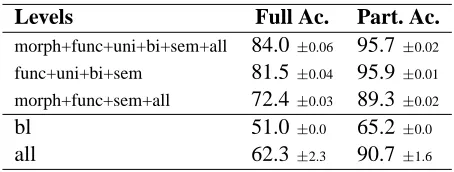
Levels Full Ac. Part. Ac.
morph+func+uni+bi+sem+all 84.0±0.06 95.7±0.02
func+uni+bi+sem 81.5±0.04 95.9±0.01
morph+func+sem+all 72.4±0.03 89.3±0.02
bl 51.0±0.0 65.2±0.0
[image:8.612.69.296.62.148.2]all 62.3±2.3 90.7±1.6
Table 7: Results for ensemble classifier.
al., 1998). The main reason for the general success of ensemble classifiers is that they gloss over the bi-ases introduced by the individual systems.
We implemented an ensemble classifier by using the different levels of description as different subsets of features, and applying majority voting across the class proposals from each level. Intuitively, this ar-chitecture is analogous to having a team of linguists and NLP engineers, each contributing their knowl-edge on morphology,n-gram distribution, syntactic properties, etc., and have them reach a consensus classification. We thus established a different classi-fication for each of the 10 cross-validation runs by assigning each adjective to the class that received most votes. To enable a majority vote, at least three levels have to be combined. Table 7 contains a rep-resentative selection of the combinations, together with their accuracies. Also, the accuracies obtained with the baseline (bl) and the best single level (all) are included for comparison.
In any of the combinations tested, accuracy im-proved over 10% with respect to the all level. The best result, a mean of 84% (full accuracy), was ob-tained by combining all levels of description. These results represent a raw improvement over the base-line of 33%, and 21.7% over the best single classi-fier. Also note that with this procedure 95.7% of the classifications obtained with the ensemble classifier present partial overlap with the class assignments in the Gold Standard.
These results show that the combination of differ-ent sources of linguistic evidence is more important than the type of information used. As an example, consider the second ensemble classifier in Table 7: this classifier excludes the two levels that contain morphological information (morph and all), which represents the most successful individual source of information for our dataset. Nevertheless, the com-bination achieved 19.2/20.9% more accuracy than
levels all and morph, respectively.
7 Related work
Adjectives have received less attention than verbs and nouns within Lexical Acquisition. Work by Hatzivassiloglou and colleagues (Hatzivassiloglou and McKeown, 1993; Hatzivassiloglou and McKe-own, 1997; Hatzivassiloglou and Wiebe, 2000) used clustering methods to automatically identify adjecti-val scales from corpora.
Coordination information was used in Bohnet et al. (2002) for a classification task similar to the task we pursue, using a bootstrapping approach. The authors, however, pursued a classification that is not purely semantic, between quantitative adjectives (similar to determiners, like viele ‘many’), referen-tial adjectives (heutige, ‘of today’), qualitative ad-jectives (equivalent to basic adad-jectives), classifica-tory adjectives (equivalent to object adjectives), and adjectives of origin (Stuttgarter, ‘from Stuttgart’).
In a recent paper, Yallop et al. (2005) reported experiments on the acquisition of syntactic subcat-egorisation patterns for English adjectives.
Apart from the above research with a classifica-tory flavour, other lines of research exploited lexi-cal relations among adjectives for Word Sense Dis-ambiguation (Justeson and Katz, 1995; Chao and Dyer, 2000). Work by Lapata (2001), contrary to the studies mentioned so far, focused on the mean-ing of adjective-noun combinations, not on that of adjectives alone.
8 Conclusion
Furthermore, we have argued that polysemy ac-quisition naturally suits multi-label classification ar-chitectures. We have implemented a standard archi-tecture for this class of problems, and demonstrated its applicability and success. The general nature of the architecture should be useful for related tasks that involve polysemy within the area of automatic lexical acquisition.
Our work has focused on a broad classification of the adjectives, similarly to Merlo and Stevenson (2001), who classified transitive English verbs into three semantic classes. The small number of classes might be considered as an over-simplification of ad-jective semantics, but the simplified setup facilitates a detailed qualitative evaluation. In addition, as there has been virtually no work on the acquisition of semantic classes for adjectives, it seems sensible to start with a small number of classes and incre-mentally build upon that. Previous work has demon-strated that multi-label classification is applicable also to a large number of classes as used in, e.g., doc-ument categorisation (Schapire and Singer, 2000). This potential can be exploited in future work, ad-dressing a finer-grained adjective classification.
Finally, we have demonstrated that the combina-tion of different types of linguistic evidence boosts the performance of the system beyond the best single type of information: ensemble classifiers are a more adequate way to combine the linguistic levels of de-scription than simply merging all features for tree construction. Using a simple, majority voting en-semble classifier, the accuracy jumped from 62.5% (best single classifier) to 84%. This result is im-pressive by itself, and also in comparison to similar work such as (Rigau et al., 1997), who achieved a 9% improvement on a similar task. Our insights are therefore useful in related work which involves the selection of linguistic features in Machine Learning experiments.
Future work involves three main lines of re-search. First, the refinement of the classification itself, based on the results of the experiments pre-sented. Second, the use of additional linguistic ev-idence that contributes to the semantic class dis-tinctions (e.g., selectional restrictions). Third, the application of the acquired information to broader NLP tasks. For example, given that each semantic class exhibits a particular syntactic behaviour,
infor-mation on the semantic class should improve POS-tagging for adjective-noun and adjective-participle ambiguities, probably the most difficult distinctions both for humans and computers (Marcus et al., 1993; Brants, 2000). Also, semantic classes might be use-ful in terminology extraction, where, presumably, object adjectives participate in terms more often than basic adjectives.4
Acknowledgements
We thank Roser Sanromà for providing us with the manually annotated database of adjectives, and for being part of the Gold Standard annotation commit-tee. Special thanks also to the Institut d’Estudis Catalans for proding us with the research corpus. The comments of three anonymous reviewers helped improve the paper. Finally, the financial support of the Universitat Pompeu Fabra and its Translation and Philology Department and the Fundación Caja Madrid is gratefully acknowledged.
References
À. Alsina, T. Badia, G. Boleda, S. Bott, À. Gil, M. Quixal, and O. Valentín. 2002. CATCG: a general purpose parsing tool applied. In Proceedings of Third International Conference on Language Resources and Evaluation (LREC-02), Las Palmas, Spain.
B. Bohnet, S. Klatt, and L. Wanner. 2002. An approach to automatic annotation of functional information to adjectives with an application to German. In Proceed-ings of the LREC Workshop on Linguistic Knowledge Acquisition and Representation, Las Palmas, Spain.
G. Boleda, T. Badia, and E. Batlle. 2004. Acquisition of semantic classes for adjectives from distributional evidence. In Proceedings of the 20th International Conference on Computational Linguistics (COLING 2004), pages 1119–1125, Geneva, Switzerland.
G. Boleda, T. Badia, and S. Schulte im Walde. 2005. Morphology vs. syntax in adjective class acquisition. In Proceedings of the ACL-SIGLEX 2005 Workshop on Deep Lexical Acquisition, pages 1119–1125, Ann Arbor, USA.
R. Bouckaert. 2004. Estimating replicability of classifier learning experiments. In Proceedings of ICML.
T. Brants. 2000. Inter-annotator agreement for a german newspaper corpus. In Second International Confer-ence on Language Resources and Evaluation (LREC-2000), Athens, Greece.
4
L. Breiman. 2001. Random forests. Mach. Learn., 45:5– 23.
G. Chao and M. G. Dyer. 2000. Word sense disambigua-tion of adjectives using probabilistic networks. In Pro-ceedings of COLING, pages 152–158.
T.G. Dietterich. 1998. Approximate statistical tests for comparing supervised classification learning algo-rithms. Neural Computation, 10(7):1895–1924.
T.G. Dietterich. 2000. An experimental comparison of three methods for constructing ensembles of decision trees: Bagging, boosting, and randomization. Mach. Learn., 40:5–23.
T.G. Dietterich. 2002. Ensemble learning. In M. A. Ar-bib, editor, The Handbook of Brain Theory and Neural Networks. The MIT Press.
Y. Freund and R.E. Schapire. 1996. Experiments with a new boosting algorithm. In Proceedings of ICML, pages 148–156.
N. Ghamrawi and A. McCallum. 2005. Collective multi-label classification. In Proceedings of 14th Conf. on Information and Knowledge Management.
V. Hatzivassiloglou and K. R. McKeown. 1993. Towards the automatic identification of adjectival scales: Clus-tering adjectives according to meaning. In Proceed-ings of ACL, pages 172–182.
V. Hatzivassiloglou and K.R. McKeown. 1997. Predict-ing the semantic orientation of adjectives. In Proceed-ings of ACL/EACL, pages 174–181.
V. Hatzivassiloglou and J. M. Wiebe. 2000. Effects of adjective orientation and gradability on sentence sub-jectivity. In Proceedings of COLING, pages 299–305, Morristown, NJ, USA. Association for Computational Linguistics.
J. S. Justeson and S. M. Katz. 1995. Principled disam-biguation: Discriminating adjective senses with modi-fied nouns. Computational Linguistics, 21(1):1–27.
A. Korhonen, Y. Krymolowski, and Z. Marx. 2003. Clustering polysemic subcategorization frame distri-butions semantically. In Proceedings of ACL, pages 64–71.
M. Lapata. 2001. A corpus-based account of regular polysemy: The case of context-sensitive adjectives. In Proceedings of NAACL.
M. Marcus, B. Santorini, and M. Marcinkiewicz. 1993. Building a large annotated corpus of English: The Penn Treebank. Computational Linguistics, 19:313– 330.
R. McDonald, K. Crammer, and F. Pereira. 2005. Flexi-ble text segmentation with structured multilabel classi-fication. In Proceedings of HLT-EMNLP, pages 987– 994.
P. Merlo and S. Stevenson. 2001. Automatic verb clas-sification based on statistical distributions of argument structure. Comp. Ling., 27(3):373–408.
C. Nadeau and Y. Bengio. 2003. Inference for the gener-alization error. Mach. Learn., 52(3):239–281.
S. Nirenburg and V. Raskin. 2004. Ontological Seman-tics. MIT Press.
F. Pereira, N. Tishby, and L. Lee. 1993. Distributional Clustering of English Words. In Proceedings of ACL, pages 183–190.
R. Quinlan. 1993. C4.5: Programs for Machine Learn-ing. Morgan Kaufmann.
V. Raskin and S. Nirenburg. 1998. An applied ontologi-cal semantic microtheory of adjective meaning for nat-ural language processing. Mach. Trans., 13(2-3):135– 227.
G. Rigau, J. Atserias, and E. Agirre. 1997. Combin-ing unsupervised lexical knowledge methods for word sense disambiguation. In Proceedings of EACL, pages 48–55.
M. Rooth, S. Riezler, D. Prescher, G. Carroll, and F. Beil. 1999. Inducing a Semantically Annotated Lexicon via EM-Based Clustering. In Proceedings of ACL.
R. Sanromà. 2003. Aspectes morfològics i sintàctics dels adjectius en català. Master’s thesis, Universitat Pom-peu Fabra.
R.E. Schapire and Y. Singer. 2000. Boostexter: A boosting-based system for text categorization. Mach. Learn., 39(2-3):135–168.
S. Stevenson and E. Joanis. 2003. Semi-supervised verb class discovery using noisy features. In Proceedings of CoNLL.
H. van Halteren, J. Zavrel, and W. Daelemans. 1998. Im-proving data driven wordclass tagging by system com-bination. In Proceedings of ACL, pages 491–497.
I.H. Witten and E. Frank. 2005. Data Mining: Practi-cal Machine Learning Tools and Techniques with Java Implementations. Morgan Kaufmann.