Proceedings of the 2019 Conference on Empirical Methods in Natural Language Processing and the 9th International Joint Conference on Natural Language Processing, pages 749–758,
749
KnowledgeNet: A Benchmark Dataset for Knowledge Base Population
Filipe Mesquita, Matteo Cannaviccio, Jordan Schmidek, Paramita Mirza
Diffbot Technologies Corp. Menlo Park, California
{filipe,matteo,jay,paramita}@diffbot.com
Denilson Barbosa
Department of Computing Science University of Alberta
Edmonton, Canada [email protected]
Abstract
KnowledgeNet is a benchmark dataset for the task of automatically populating a knowledge base (Wikidata) with facts expressed in natural language text on the web. KnowledgeNet pro-vides text exhaustively annotated with facts, thus enabling the holistic end-to-end evalua-tion of knowledge base populaevalua-tion systems as a whole, unlike previous benchmarks that are more suitable for the evaluation of individ-ual subcomponents (e.g., entity linking, rela-tion extracrela-tion). We discuss five baseline ap-proaches, where the best approach achieves an F1 score of 0.50, significantly outperforming a traditional approach by 79% (0.28). However, our best baseline is far from reaching human performance (0.82), indicating our dataset is challenging. The KnowledgeNet dataset and baselines are available athttps://github. com/diffbot/knowledge-net
1 Introduction
Knowledge Bases (KBs) are valuable resources for developing intelligent applications, including search, question answering, data integration, and recommendation systems. High-quality KBs still rely almost exclusively on human-curated struc-tured or semi-strucstruc-tured data. Such a reliance on human curation is a major obstacle to the creation of comprehensive, always-up-to-date KBs.
KB population (KBP) is the task of automati-cally augmenting a KB with new facts. Tradition-ally, KBP has been tackled with datasets for in-dividual components to be arranged in a pipeline,
typically: (1) entity discovery and linking (Ji et al.,
2017;Shen et al., 2015) and (2) relation
extrac-tion (Angeli et al.,2015;Zhang et al.,2017).
En-tity discovery and linking seeks to recognize and disambiguate proper names in text that refer to en-tities (e.g., people, organizations and locations) by linking them to a reference KB. Relation
extrac-tion seeks to detect facts involving two entities (or an entity and a literal, such as a number or date).
KnowledgeNet is a benchmark dataset for pop-ulating a KB (Wikidata) with facts expressed in natural language on the web. KnowledgeNet facts
are of the form (subject; property;object), where
subjectandobjectare linked to Wikidata. For
in-stance, the dataset contains text expressing the fact
(Gennaro Basile1; RESIDENCE;Moravia2), in the
passage:
“Gennaro Basile was an Italian painter, born in Naples but active in the
German-speaking countries.Hesettled at Br¨unn,
inMoravia, and lived about 1756...”
KnowledgeNet’s main goal is to evaluate the overall task of KBP rather than evaluating its sub-components in separate. We refer to this type of
evaluation asend-to-end. The dataset supports the
end-to-end evaluation of KBP systems by exhaus-tively annotating all facts in a sentence. For
in-stance, the dataset contains all RESIDENCE facts
(two) from the sentence “He settled at Br¨unn, in Moravia, and lived about 1756”. This allows our
evaluation to assess precision and recall of
RESI-DENCEfacts extracted from this sentence.
A popular initiative to evaluate KBP is the
Text Analysis Conference, or TAC (Getman et al.,
2018). TAC evaluations are performed manually
and are hard to reproduce for new systems. Un-like TAC, KnowledgeNet employs an automated and reproducible way to evaluate KBP systems at any time, rather than once a year. We hope a faster evaluation cycle will accelerate the rate of improvement for KBP.
In addition to providing an evaluation bench-mark, KnowledgeNet’s long-term goal is to pro-vide exhaustively annotated training data at large
1
http://www.wikidata.org/wiki/Q1367602
scale. Our goal for the coming years is to annotate
100,000 facts for 100 properties. To accomplish
this goal, we propose a new framework for anno-tating facts with high accuracy and low effort.
Contributions. Our contributions are as fol-lows. We introduce KnowledgeNet, a benchmark dataset for end-to-end evaluation of KBP systems
(Section 3). We propose a new framework for
exhaustive yet efficient annotation of facts
(Sec-tion3.1). We implement five baseline approaches
that build upon state-of-the-art KBP systems
(Sec-tion4). Finally, we present an experimental
anal-ysis of our baseline approaches, comparing their
performance to human performance (Section5).
2 Related Work
KBP has traditionally been tackled with pipeline
systems. For instance, Stanford’s TAC 2015
winning system employs the following pipeline:
named entity recognition (NER)→entity linking
→relation extraction (Angeli et al.,2015).
Stan-ford’s latest TAC system continues to use the same pipeline architecture with one additional
com-ponent: coreference resolution (Chaganty et al.,
2017).
The main shortcoming of pipeline systems is er-ror propagation. Mistakes made by components in the beginning of the pipeline are propagated to the final output of the system, negatively affecting the overall precision and recall. For instance, our experiments show that the pipeline employed by Stanford’s TAC 2015 winning system can achieve
a maximum recall of 0.32 in KnowledgeNet3.
End-to-end systems (Liu et al.,2018;Miwa and
Bansal, 2016) are a promising solution for
ad-dressing error propagation. However, a major
roadblock for the advancement of this line of re-search is the lack of benchmark datasets. We hope KnowledgeNet can help support this line of re-search.
2.1 Datasets
TAC is a series of evaluation workshops organized
as several tracks by NIST (Getman et al., 2018).
The Cold Start track provides an end-to-end eval-uation of KBP systems, while other tracks focus on subtasks (e.g., entity disambiguation and link-ing). The Cold Start track is the current standard
3Maximum recall is the recall of candidate facts, which
are used as input to the last component of the pipeline (rela-tion extrac(rela-tion).
to evaluate KBP systems. To compete in this track, participants have a limited time window to submit the results of their KBP systems. After this win-dow, the systems are evaluated by pooling facts
extracted by the contestants. Despite its
effec-tiveness for running a contest, this methodology has been shown to be biased against new systems,
which are not part of the pooling (Chaganty et al.,
2017). TAC also manually evaluates a system’s
“justification”, a span of text provided as evidence for a fact. A correct fact with an incorrect justifica-tion is considered invalid. Therefore, reproducing TAC’s evaluation for new systems is challenging.
We propose KnowledgeNet as an automated and reproducible alternative to TAC’s evaluation. Before creating KnowledgeNet, we considered
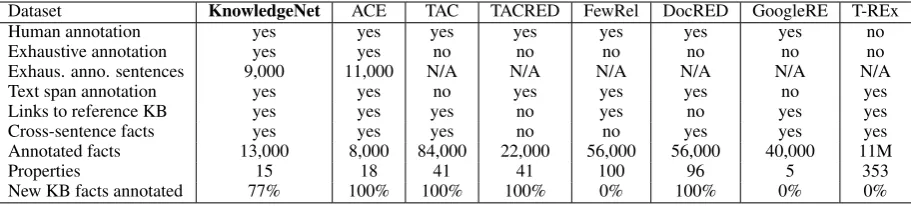
us-ing one of the datasets presented in Table 1. We
compare these datasets according to five criteria that we consider desirable for a KBP benchmark dataset:
• Human annotation: the dataset should be annotated by (multiple) humans to support accurate evaluation.
• Exhaustive annotation: for each property, the dataset should exhaustively enumerate all facts of that property that are expressed in the text. Exhaustive annotation allows measuring true precision and recall for a system.
• Text annotation: the dataset should con-tain text spans for entities involved in a fact. This allows evaluating whether the text ex-presses an extracted fact (as alternative to TAC’s manual justification assessments).
• Links to reference KB: the dataset should contain a link to the reference KB for entities involved in every fact (or indicate that such an entity doesn’t exist in the KB). This allows the evaluation to confirm that the reference KB is being correctly populated.
• Cross-sentence facts: the dataset should
contain facts involving entities whosenames
never appear in the same sentence. This is be-cause a significant portion of facts expressed in text require coreference resolution of en-tity mentions spanning multiple sentences.
ACE 20054 is a popular dataset for
end-to-end relation extraction systems (Li and Ji, 2014;
4https://catalog.ldc.upenn.edu/
Dataset KnowledgeNet ACE TAC TACRED FewRel DocRED GoogleRE T-REx
Human annotation yes yes yes yes yes yes yes no
Exhaustive annotation yes yes no no no no no no
Exhaus. anno. sentences 9,000 11,000 N/A N/A N/A N/A N/A N/A
Text span annotation yes yes no yes yes yes no yes
Links to reference KB yes yes yes no yes no yes yes
Cross-sentence facts yes yes yes no no yes yes yes
Annotated facts 13,000 8,000 84,000 22,000 56,000 56,000 40,000 11M
Properties 15 18 41 41 100 96 5 353
[image:3.595.74.530.62.165.2]New KB facts annotated 77% 100% 100% 100% 0% 100% 0% 0%
Table 1: A dataset comparison according to our criteria for a desirable KBP benchmark dataset. “Exhaus. anno. sentences” shows the number of exhaustively annotated sentences. “New KB facts annotated” shows the percent-age of annotated facts that can be found in the reference KB. Most datasets contain only facts with no links to a reference KB (100% new facts) or contain only facts that exist in the KB (0% new facts).
Miwa and Bansal,2016). According to our crite-ria, ACE might seem the most complete bench-mark dataset for end-to-end evaluation of KBP. It exhaustively annotates every sentence of 599 documents with mentions, coreference chains and facts for 18 properties. Also, ACE has been
inde-pendently extended with links to Wikipedia (
Ben-tivogli et al., 2010). However, a closer look at ACE’s annotations reveals that most of them are ill-suited for general-purpose KBs. These anno-tations include facts about broad properties (e.g., part-whole, physical location) or mentions that do not refer to named entities (e.g., “two Moroccan men”, “women on the verge of fainting”, “African immigrants who came ashore Thursday”). Per-haps not coincidently, we are unaware of any work using it for the purpose of evaluating a KBP sys-tem.
Our annotation framework (Section 3.1) is
in-spired by ACE’s framework but tailored towards KBP. First, we only annotate mentions that re-fer to named entities. Second, while our anno-tation is exhaustive, we focus on annotating sen-tences rather than documents, eliminating the need to annotate every fact described in the entire doc-ument. Such a requirement creates a significant imbalance in the number of annotations per prop-erty. For instance, the most popular property from ACE has 1,400 annotated facts, while the majority of properties from ACE have less than 300 anno-tated facts. This might explain why most relation extraction evaluations use only 6 properties from ACE.
Annotating every sentence with facts for all properties is also detrimental to the incremental nature of KnowledgeNet. Adding one property to the dataset would require an annotator to re-annotate every sentence in the dataset. In contrast,
our framework selects a limited set of sentences to be annotated for a particular property. The re-maining sentences are ignored during annotation and evaluation. As a consequence, our annotation framework allows incremental annotation of new properties and is better suited for the goal of anno-tating 100,000 facts for 100 properties.
Datasets employing non-exhaustive annotation.
Recent datasets like T-REx automatically anno-tate facts in text as a way to produce training data cheaply. This is performed by aligning facts in
the KB to sentences referring to them (Elsahar
et al.,2018). Other datasets go further and use hu-man annotators to label every alignment as correct or incorrect. These semi-supervised datasets
in-clude TACRED (Zhang et al.,2017), GoogleRE5,
FewRel (Han et al., 2018) and DocRED (Yao
et al.,2019). Annotations created in this way are useful for training KBP systems. However, they do not provide an exhaustive annotation of facts, which is needed for end-to-end evaluation of KBP.
For instance, Zhang et al.(2017) train their KBP
system with TACRED, but rely on TAC to evaluate the system.
3 KnowledgeNet Dataset
This section discusses the first release of Knowl-edgeNet and our annotation framework. The doc-uments in this first release are either DBpedia ab-stracts (i.e., first paragraphs of a Wikipedia page) or short biographical texts about a person or or-ganization from the web. These web texts were
collected using the Diffbot Knowledge Graph6.
Table2 presents the number of annotated facts
for each property. We chose 9,073 sentences
5
https://code.google.com/archive/p/ relation-extraction-corpus/downloads
Property Facts Sent. Relevant DATE OF BIRTH (PER–DATE) 761 731 468 DATE OF DEATH (PER–DATE) 664 512 347 RESIDENCE (PER–LOC) 1,456 796 387 BIRTHPLACE (PER–LOC) 1137 936 407 NATIONALITY (PER–LOC) 639 801 396 EMPLOYEE OF (PER–ORG) 1,625 650 543 EDUCATED AT (PER–ORG) 951 463 335 POLITICAL AFF. (PER–ORG) 635 537 318 CHILD OF (PER–PER) 888 471 296 SPOUSE (PER–PER) 1,338 504 298 DATE FOUNDED (ORG–DATE) 500 543 315 HEADQUARTERS (ORG–LOC) 880 564 296 SUBSIDIARY OF (ORG–ORG) 544 481 299 FOUNDED BY (ORG–PER) 764 558 346 CEO (ORG–PER) 643 526 350
[image:4.595.72.293.58.235.2]Total 13,425 9,073 5,423
Table 2: KnowledgeNet properties and their number of annotated facts and sentences. “Relevant” indicates the number of relevant sentences (i.e., those with one or more annotated facts). Subjects and objects belong to one of the following types: person, organization, loca-tion and date.
from 4,991 documents to be exhaustively anno-tated with facts about a particular property of in-terest. Because our annotation is exhaustive, neg-ative examples of facts can be automatically gen-erated. In total, KnowledgeNet comprises 13,425 facts from 15 properties.
Holdout test set. We split the documents into five folds in a round-robin manner, keeping the fifth fold (20% of the dataset) as the test set. To preserve the integrity of the results, we will release the test set without annotations and will provide a service through which others can evaluate their KBP systems. In our experiments, we used folds 1-3 for training and fold 4 for development and validation, including hyperparameter tuning.
3.1 Dataset Annotation
The dataset has been generated by multiple an-notators using a new multi-step framework. We conjecture our framework can help annotators pro-duce higher quality annotations by allowing them to focus on one small, more specific task at a time.
The annotation consists of four different steps:(1)
fetch sentences, (2)detect mentions,(3)classify
facts and(4)link entities.
Step 1: Fetch sentences. We employ two meth-ods of choosing a sentence for annotation. The first method leverages T-REx’s automatic
align-ments (Elsahar et al.,2018) to find sentences that
are likely to describe facts from Wikidata. The
(a) Interface to detect mentions of an entity type.
(b) Interface to classify facts.
[image:4.595.312.520.206.647.2](c) Interface to link a mention to a Wikidata entity.
second method chooses sentences that contain a keyword that might indicate the presence of a fact
for a property (e.g., “born” for DATE OF BIRTH).
We have chosen these keywords by leveraging Wikidata’s “also known as” values for properties as well as WordNet synonyms. By using these keywords, we prevent the dataset to be exclusively annotated with facts that are known in Wikidata. In fact, only 23% of facts annotated in this release are present in Wikidata.
For each fetched sentence, an annotator decides
whether the sentence is relevantfor the property
of interest (i.e., whether this sentence describes one or more facts for this property). Relevant sen-tences go through steps 2 through 4; while irrel-evant sentences are kept to be used for detecting incorrectly extracted facts (i.e., false positives).
It is worth noting that this step might not fetch some relevant sentences. Our framework does not require all relevant sentences to be annotated and does not penalize systems for extracting facts from sentences that were not annotated.
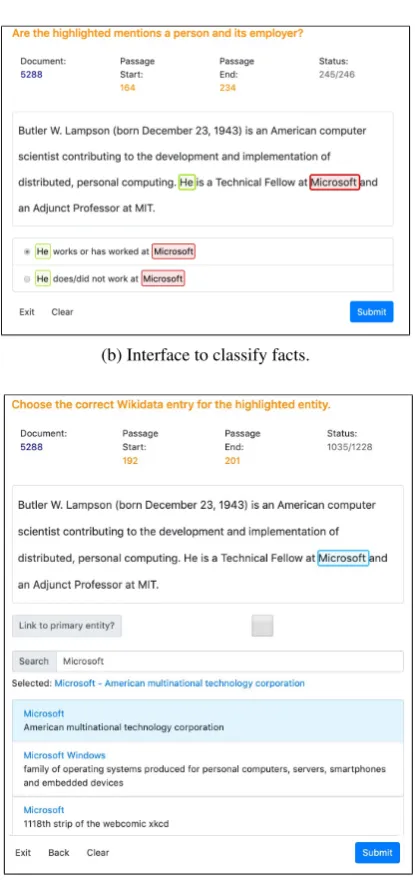
Step 2: Detect mentions. In this step, we ask
annotators to highlight entity names (Figure1a).
We consider only entities whose type is relevant to the property being annotated. For instance, an annotator will only be asked to highlight names of people and organizations when annotating the
property FOUNDED BY. Pronouns are
automati-cally annotated with a gazetteer. To decrease the likelihood of missing a mention, we consider the
union of mentions highlighted by two annotators
for the following step.
Step 3: Classify facts. We ask annotators to classify a candidate fact (i.e., a pair of mentions) in a sentence as a positive or negative example for
a property (Figure1b). Each candidate fact is
an-notated by at least two annotators. A third anno-tator breaks the tie when the first two annoanno-tators disagree.
We follow ACE’s reasonable reader rule,
which states that a fact should only be annotated when there is no reasonable interpretation of the sentence in which the fact does not hold. In other words, annotators are asked to only annotate facts that are either explicitly stated in the sentence or inferred with absolute certainty from the sentence alone (i.e., without using external world knowl-edge).
Step 4: Link entities. Finally, we ask annota-tors to link every mention involved in a fact to a single Wikidata entity. In this step, annotators can read the entire document and resolve mentions (e.g., pronouns) that refer to names in other sen-tences. Every mention is annotated by at least two annotators. When there is disagreement, we ask other annotators to join in the process until con-sensus is reached. In total, excluding the
proper-ties having literal objects (Table2) we can assign
a link to both subject and object for 52% of the facts.
Inter-annotator agreement. A total of five an-notators have contributed to KnowledgeNet so far. In Step 3, the initial two annotators have anno-tated 33,165 candidate facts with 96% agreement. They disagreed on 1,495 candidate facts, where 599 have been deemed positive by a third anno-tator. In Step 4, the initial two annotators have an-notated 13,453 mentions with agreement of 93%. The remaining 7% of mentions were resolved with additional annotators.
Timing. On average, annotating a sentence for one property takes 3.9 minutes. This total time in-cludes two annotators (plus additional annotators for tiebreaking). It also includes inspecting sen-tences that express no facts and therefore do not go through steps 2-4 (but are included in the dataset and are helpful for assessing false positives). The most expensive step is Step 3 (40% of the total time), followed by Step 4 (28%), Step 2 (22%) and Step 1 (10%).
3.2 Limitations
Our first release is comparable to other bench-marks in size (e.g., ACE 2005), but it is perhaps insufficient to train data-hungry models. This is by design. Most organizations do not have the re-sources to produce tens of thousands of examples for each property of interest. As we expand the number of properties to achieve our goal of anno-tating 100,000 facts, we expect to keep the number of facts per property to around a thousand. In this way, we hope to promote approaches that can learn from multiple properties, requiring less annota-tions per property. We also hope to promote ap-proaches using KnowledgeNet together with semi-supervised or unsemi-supervised datasets for training.
the object are explicitly mentioned by a name or pronoun in a sentence. Others have reported that the majority of facts fall into this category. For example, the authors of DocRED report that 41% of facts require reasoning over multiple sentences
in a document (Yao et al., 2019). This indicates
that a fact’s subject and object are mentioned by their full name in a single sentence 59% of the time. The percentage of facts that can be anno-tated in KnowledgeNet is significantly higher than 59%. This is because our framework can also an-notate facts that require resolving (partial) names and pronouns referring to full names in other sen-tences. These facts are particularly common in our document collection.
4 Baseline Approaches
This section presents five baseline approaches for KBP. We evaluate these approaches and compare their performance relative to human annotators in
Section5.
Figure 2 illustrates the architecture shared by
our five baseline approaches. We start by splitting a given document into sentences. For each sen-tence, we detect entity mentions using a named entity recognizer (NER) and a gazetteer for pro-noun mentions and their type (e.g., person, orga-nizations, location). We also detect coreference chains, that is, groups of mentions within a
docu-ment that refer to the same entity. Figure2
illus-trates how coreference chains help disambiguate pronouns and partial names by clustering them to-gether with the full name of an entity. Finally, we link these coreference chains to Wikidata entities. Next, we produce candidate facts by consider-ing pair of mentions from the same sentence, as
il-lustrated in Figure2. The relation extraction
com-ponent makes the final decision on whether a can-didate fact is expressed by the text.
4.1 Relation Extraction
Figure2illustrates our relation extraction model.
This model follow the literature by using a
Bi-LSTM network (Miwa and Bansal,2016;Xu et al.,
2015;Zhou et al.,2016;Zhang et al.,2017), which is effective in capturing long-distance dependen-cies between words. We train a single multi-task model for all properties using both positive exam-ples (i.e., annotated facts) and automatically gen-erated negative examples.
The model outputs two values for each property.
The first value represents the likelihood of the
sub-ject and obsub-jectmentions(i.e., text spans) to be
cor-rect, while the second value represents the
likeli-hood of the subject and objectlinksto be correct.
We learn individual thresholds for each value and property. When both values are above the thresh-old, the system outputs the fact with links. When the first value is above the threshold and the sec-ond value is below the threshold, we output the fact without links.
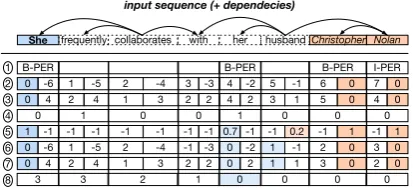
Features. Figure3 illustrates features encoding syntactic and positional information, which are concatenated to the embedding of every word.
1. Enriched NER: NER label for names (us-ing a NER system) and pronouns (us(us-ing gazetteers for each type).
2. Mention distance: distance between each word and the subject and object mention,
fol-lowingZhang et al.(2017).
3. Shortest dependency path (SDP) length:
number of edges in the SDP between the word and the subject and object.
4. SDP distance: number of edges separating the word to the closest word in the SDP be-tween the subject and object.
5. Coreference confidence: confidence score of the coreference resolution system that a word refers to the subject and object.
6. Coreference distance: distance to the clos-est mention in the coreference chain of the subject and object.
7. Coreference SDP length: number of edges in the SDP between the word and the closest mention in the subject and object chain.
8. Coreference SDP distance: number of edges separating the word to the closest word in the SDP between the subject and object coreference chains.
9. KB entity types: entity types for the subject and object from Wikidata.
+
nlp & entity linking
input document
generate candidates
She frequently collaborates with her husband Christopher Nolan She frequently collaborates with her husband Christopher Nolan She frequently collaborates with her husband Christopher Nolan She frequently collaborates with her husband Christopher Nolan
Bi LSTM sigmoid
Emma Thomas (born 9 December 1971) is a British film producer, known for co-producing films such as The Prestige (2006) and Interstellar (2014). She frequently collaborates with her husband Christopher Nolan.
She frequently collaborates with her husband Christopher Nolan. Emma Thomas (born 9 December 1971) is a British film producer, known for co-producing films such as The Prestige (2006) and Interstellar (2014).
Emma Thomas (Q242951)
United Kingdom (Q145)
Christopher Nolan (Q25191)
FCL
spouse (P26)
human (Q5) instance of (P31)
human (Q5) instance of (P31)
human (Q5) human (Q5)
spouse (P26) Wikidata
candidate pairs of mentions
with links processed
sentences
0.4
CHILD_OF SPOUSE NATIONALITYFOUNDED_BY CEO
0.4 0.90.70.20.10.20.3… 0.40.3
…
Q242951
Q25191 Q242951
Q242951
Q242951
Q242951 Q25191 Q25191
[image:7.595.89.513.65.246.2]Q25191 Q25191 Q25191
Figure 2: The architecture of our baseline approaches, illustrated with an example. Red arrows and boxes represent coreference chains and blue arrows represent links to Wikidata. The subject and object of candidate facts are highlighted in bold (blue) and italics (orange), respectively.
She frequently collaborates with her husbandChristopher Nolan
1 B-PER B-PER B-PER I-PER
input sequence (+ dependecies)
0 -6 1 -5 2 -4 3 -3 4 -2 5 -1 6 0 7 0
3 3 2 1 0 0 0 0
2
8
0 4 2 4 1 3 2 2 4 2 3 1 5 0 4 0
0 4 2 4 1 3 2 2 0 2 1 1 3 0 2 0
3
7
0 1 0 0 1 0 0 0
4
1 -1 -1 -1 -1 -1 -1 -1 0.7 -1 -1 0.2 -1 1 -1 1 5
0 -6 1 -5 2 -4 -1 -3 0 -2 1 -1 2 0 3 0
6
Figure 3: Features representing the relationships be-tween the words. Significant relationships with the sub-ject and obsub-ject are highlighted in blue and orange, re-spectively.
Features 9 and 10 are generated by querying Wikidata and are relative to a single entity pair. We concatenate those features to the Bi-LSTM output, as illustrated in Figure2.
4.2 Baseline Approaches
We propose five baselines obtained by improving the candidate generation and relation extraction components.
Baseline 1. Our first baseline is a standard pipeline approach inspired by the TAC 2015 Cold
Start winning system (Angeli et al.,2015). It
gen-erates candidate mentions by using NER and the pronoun gazetteers. For mentions of the correct
type (e.g., person for the propertySPOUSE), the
sys-tem then links these mentions using an entity link-ing system. The relation extraction component uses features 1-4.
Baseline 2. Our second baseline adds corefer-ence resolution. This baseline is inspired by
Stan-ford’s TAC 2017 system (Chaganty et al., 2017).
We leverage coreference chains to both increase the number of candidate mentions linked to KB entities (e.g., pronouns) as well as to introduce ad-ditional features. This model uses features 1-8.
Baseline 3. Our third baseline adds features 9 and 10 to the relation extraction model. These fea-tures leverage Wikidata information for the linked entities, such as entity types and known facts.
Baseline 4. Our fourth baseline seeks to de-crease error propagation by allowing more candi-date facts to be evaluated by the relation extraction component. This is done in two ways. First, Base-line 4 uses all mentions regardless of their NER type when creating candidate facts. Second, this baseline adds a candidate link to mentions that had no candidate link in Baseline 1-3 (due to incor-rect coreference chains). This is done by choos-ing a link outside of the mention’s coreference chain that maximizes a combination of entity link-ing score and coreference resolution score.
Baseline 5. Our final baseline seeks to improve the relation extraction component by employing
BERT’s pre-trained representations (Devlin et al.,
2018) in addition to all other features. To
pro-duce a contextual representation for every word, we learn a linear weighted combination of BERT’s
[image:7.595.75.282.322.417.2]4.3 Implementation
All our baseline systems follow the same
ar-chitecture (Figure 2). We use spaCy7 for the
NLP pipeline (sentence splitting, tokenization, POS tagging, dependency parsing, NER),
Hug-ging Face’s coreference resolution system8, and
the Diffbot Entity Linker9for entity linking.
For relation extraction we implement a standard BiLSTM network with two 500-dimensional hid-den layers. We use spaCy pre-trained word em-beddings (size 300) concatenated with additional
features illustrated in Figure3. The output of the
BiLSTM network is concatenated with features from Wikidata (Features 9-10).
We train all the networks using mini-batches of
128 examples and Adam optimizer (Kingma and
Ba, 2015) with a learning rate of 0.001. We use
the fourth fold of the dataset as validation set, se-lecting the model that minimize the loss function
value. The same validation set is used to find
thresholds for the output values that maximize the F1 score for each property.
5 Experiments
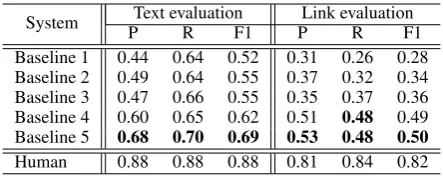
Table3 presents the performance of our baseline
systems compared to the human performance. We
report precision (P), recall (R) and F-score (F1):
P = correctly extracted facts
extracted facts ,
R= correctly extracted facts
annotated facts ,
F1 = 2·P ·R
P +R .
We evaluate our baseline systems from two
per-spectives. Thetext evaluationdeems an extracted
fact correct when the text spans of the subject and object overlap with the text spans of a ground truth
fact. Thelink evaluation deems an extracted fact
correct when the links of the subject and object match the links of a ground truth fact. In the link evaluation, we consider only facts where both the subject and object links are present.
Human performance. To measure the human performance on the end-to-end KBP task, one of our annotators was asked to enumerate all facts de-scribed in a sample of the test sentences. We
re-port the performance of our annotator in Table3.
7https://spacy.io/ 8
https://huggingface.co/coref/
9https://diffbot.com/
System Text evaluation Link evaluation
P R F1 P R F1
Baseline 1 0.44 0.64 0.52 0.31 0.26 0.28 Baseline 2 0.49 0.64 0.55 0.37 0.32 0.34 Baseline 3 0.47 0.66 0.55 0.35 0.37 0.36 Baseline 4 0.60 0.65 0.62 0.51 0.48 0.49 Baseline 5 0.68 0.70 0.69 0.53 0.48 0.50
[image:8.595.306.528.61.149.2]Human 0.88 0.88 0.88 0.81 0.84 0.82
Table 3: The performance of our baseline approaches is well below human performance.
A closer look at the annotator’s mistakes shows that 32% of the mistakes are due to incorrect an-notations in KnowledgeNet (i.e., the annotator is actually correct). The remaining mistakes (68%) are mostly due to the annotator entering an in-correct fact (30%) or missing a link on a in-correct fact (18%). These results show that our annota-tion framework produces significantly better anno-tations than individual annotators working without our framework.
Baseline performance. Table 3 presents the performance of our baselines. Our best baseline (Baseline 5) significantly outperforms the standard pipeline approach (Baseline 1) in both the text and link evaluation. However, the performance of Baseline 5 is well below the human performance. The most impactful improvements over Baseline 1 are due to (a) incorporating coreference when choosing candidate links for pronouns in Baseline 2; (b) allowing more candidate facts and links to be classified by the relation extraction component in Baseline 4; and (c) incorporating BERT’s pre-trained model in Baseline 5.
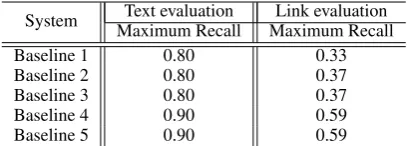
Table 4 shows the “maximum recall” for each
baseline (i.e., recall of candidate facts used as in-put for the relation extraction component). These results indicate that error propagation significantly limits recall. Our best baseline shows higher max-imum recall due to coreference resolution (intro-duced in Baseline 2) and removing the filtering of candidate facts based on NER types (introduced in Baseline 4). The low maximum recall for link evaluation is mainly due to incorrect candidate links, which can only be omitted (but not fixed) in our baselines.
6 Conclusion
We introduce KnowledgeNet, an end-to-end
System Text evaluation Link evaluation Maximum Recall Maximum Recall
Baseline 1 0.80 0.33
Baseline 2 0.80 0.37
Baseline 3 0.80 0.37
Baseline 4 0.90 0.59
[image:9.595.79.283.62.135.2]Baseline 5 0.90 0.59
Table 4: The relation extraction component’s recall is limited by error propagation. Maximum recall is the re-call of the candidate facts used as input for the relation extraction component on the dev set.
web. We build KnowledgeNet using a new multi-step framework that helps human annotators to produce high-quality annotations efficiently. We also introduce five baseline systems and evaluate their performance. Our best baseline outperforms a traditional pipeline approach by 79% (F1 score of 0.50 vs. 0.28). Human performance is sig-nificantly higher (0.82), indicating that Knowled-geNet can support further research to close this gap.
Our experiments show that the traditional pipeline approach for KB population is notably limited by error propagation. Performance gains achieved by our best baseline are mainly due to more candidates being passed along to the final pipeline component (relation extraction), allow-ing this component to fix errors made by previous components. A closer inspection reveals that even our best baseline is fairly limited by error propa-gation and can only achieve a maximum recall of 0.59. These results indicate that end-to-end mod-els might be a promising alternative to the tradi-tional pipeline approach.
Acknowledgments
We would like to thank Veronica Romualdez and Geraldine Fajardo for their diligent annotation work. We would also like to thank Mike Tung, Zhaochen Guo, Sameer Singh and the anonymous reviewers for their helpful comments. This work was supported by the Natural Sciences and En-gineering Research Council of Canada (NSERC) and Diffbot.
References
Gabor Angeli, Victor Zhong, Danqi Chen, Arun Te-jasvi Chaganty, Jason Bolton, Melvin Jose Johnson Premkumar, Panupong Pasupat, Sonal Gupta, and Christopher D. Manning. 2015. Bootstrapped self
training for knowledge base population. In TAC. NIST.
Luisa Bentivogli, Pamela Forner, Claudio Giu-liano, Alessandro Marchetti, Emanuele Pianta, and Kateryna Tymoshenko. 2010. Extending English ACE 2005 corpus annotation with ground-truth links to Wikipedia. InProceedings of the 2nd Workshop on The People’s Web Meets NLP: Collaboratively Constructed Semantic Resources, pages 19–27, Bei-jing, China. Coling 2010 Organizing Committee.
Arun Chaganty, Ashwin Paranjape, Percy Liang, and Christopher D. Manning. 2017. Importance sam-pling for unbiased on-demand evaluation of knowl-edge base population. InProceedings of the 2017 Conference on Empirical Methods in Natural Lan-guage Processing, pages 1038–1048, Copenhagen, Denmark. Association for Computational Linguis-tics.
Jacob Devlin, Ming-Wei Chang, Kenton Lee, and Kristina Toutanova. 2018. Bert: Pre-training of deep bidirectional transformers for language understand-ing. InNAACL-HLT.
Hady Elsahar, Pavlos Vougiouklis, Arslen Remaci, Christophe Gravier, Jonathon Hare, Frederique Laforest, and Elena Simperl. 2018. T-REx: A large scale alignment of natural language with knowledge base triples. In Proceedings of the 11th Language Resources and Evaluation Conference, Miyazaki, Japan. European Language Resource Association.
Jeremy Getman, Joe Ellis, Stephanie Strassel, Zhiyi Song, and Jennifer Tracey. 2018. Laying the Groundwork for Knowledge Base Population: Nine Years of Linguistic Resources for TAC KBP. In
Proceedings of the Eleventh International Confer-ence on Language Resources and Evaluation (LREC 2018), Miyazaki, Japan. European Language Re-sources Association (ELRA).
Xu Han, Hao Zhu, Pengfei Yu, Ziyun Wang, Yuan Yao, Zhiyuan Liu, and Maosong Sun. 2018. Fewrel: A large-scale supervised few-shot relation classifica-tion dataset with state-of-the-art evaluaclassifica-tion. In Pro-ceedings of the 2018 Conference on Empirical Meth-ods in Natural Language Processing, Brussels, Bel-gium, October 31 - November 4, 2018, pages 4803– 4809.
Heng Ji, Xiaoman Pan, Boliang Zhang, Joel Nothman, James Mayfield, Paul McNamee, and Cash Costello. 2017.Overview of TAC-KBP2017 13 languages en-tity discovery and linking. In Proceedings of the 2017 Text Analysis Conference, TAC 2017, Gaithers-burg, Maryland, USA, November 13-14, 2017.
Qi Li and Heng Ji. 2014. Incremental joint extrac-tion of entity menextrac-tions and relaextrac-tions. In Proceed-ings of the 52nd Annual Meeting of the Association for Computational Linguistics (Volume 1: Long Pa-pers), pages 402–412, Baltimore, Maryland. Asso-ciation for Computational Linguistics.
Yue Liu, Tongtao Zhang, Zhicheng Liang, Heng Ji, and Deborah L. McGuinness. 2018. Seq2rdf: An end-to-end application for deriving triples from nat-ural language text. In Proceedings of the ISWC 2018 Posters & Demonstrations, Industry and Blue Sky Ideas Tracks co-located with 17th International Semantic Web Conference (ISWC 2018), Monterey, USA, October 8th - to - 12th, 2018.
Makoto Miwa and Mohit Bansal. 2016.End-to-end re-lation extraction using lstms on sequences and tree structures. pages 1105–1116.
Jeffrey Pennington, Richard Socher, and Christo-pher D. Manning. 2014. Glove: Global vectors for word representation. InEmpirical Methods in Nat-ural Language Processing (EMNLP), pages 1532– 1543.
Matthew E. Peters, Sebastian Ruder, and Noah A. Smith. 2019. To tune or not to tune? adapt-ing pretrained representations to diverse tasks. In
Proceedings of the 4th Workshop on Representa-tion Learning for NLP, RepL4NLP@ACL 2019, Flo-rence, Italy, August 2, 2019., pages 7–14.
Pouya Pezeshkpour, Liyan Chen, and Sameer Singh. 2018. Embedding multimodal relational data for knowledge base completion. CoRR, abs/1809.01341.
Wei Shen, Jianyong Wang, and Jiawei Han. 2015. En-tity linking with a knowledge base: Issues, tech-niques, and solutions. IEEE Trans. Knowl. Data Eng., 27(2):443–460.
Quan Wang, Zhendong Mao, Bin Wang, and Li Guo. 2017. Knowledge graph embedding: A survey of approaches and applications. IEEE Trans. Knowl. Data Eng., 29(12):2724–2743.
Peng Xu and Denilson Barbosa. 2019. Connecting lan-guage and knowledge with heterogeneous represen-tations for neural relation extraction. In Proceed-ings of the 2019 Conference of the North American Chapter of the Association for Computational Lin-guistics: Human Language Technologies, NAACL-HLT 2019, Minneapolis, Minnesota, USA, June 2-7, 2019, Volume 2 (Short Papers), page 4.
Yan Xu, Lili Mou, Ge Li, Yunchuan Chen, Hao Peng, and Zhi Jin. 2015. Classifying relations via long short term memory networks along shortest depen-dency paths. In Proceedings of the 2015 Confer-ence on Empirical Methods in Natural Language Processing, pages 1785–1794, Lisbon, Portugal. As-sociation for Computational Linguistics.
Yuan Yao, Deming Ye, Peng Li, Xu Han, Yankai Lin, Zhenghao Liu, Zhiyuan Liu, Lixin Huang, Jie Zhou, and Maosong Sun. 2019. Docred: A large-scale document-level relation extraction dataset. In Pro-ceedings of the 57th Conference of the Association for Computational Linguistics, ACL 2019, Florence, Italy, July 28- August 2, 2019, Volume 1: Long Pa-pers, pages 764–777.
Yuhao Zhang, Victor Zhong, Danqi Chen, Gabor An-geli, and Christopher D. Manning. 2017. Position-aware attention and supervised data improve slot fill-ing. InProceedings of the 2017 Conference on Em-pirical Methods in Natural Language Processing, pages 35–45, Copenhagen, Denmark. Association for Computational Linguistics.
Peng Zhou, Wei Shi, Jun Tian, Zhenyu Qi, Bingchen Li, Hongwei Hao, and Bo Xu. 2016. Attention-based bidirectional long short-term memory net-works for relation classification. InProceedings of the 54th Annual Meeting of the Association for Com-putational Linguistics (Volume 2: Short Papers), pages 207–212, Berlin, Germany. Association for Computational Linguistics.
A Beyond Binary Relationships
While it would be convenient to express all facts as (subject; property;object) triples, this is not al-ways possible. Many facts require further annota-tions to be sufficiently and accurately expressed
in the KB. Take for instance (United States;
head of government;Barack Obama), which only
holds true in the past.
Qualifiersallow facts to be expanded or
contex-tualized beyond what can be expressed with binary relationships. More specifically, qualifiers can be used to constrain the validity of a fact in time or
space, e.g., (employment fact; end time; 2017);
represent n-ary relationships, e.g., (casting fact;
character role;Tony Stark); and track provenance.
This release contains 4,518 facts annotated
with three temporal qualifiers: IS CURRENT,
START TIME and END TIME. We use one of our baseline system to obtain facts to be annotated with qualifiers, along with the the sentence where each fact was found. Given a fact and a sentence, human annotators must decide the value of a
quali-fier (trueorfalseforIS CURRENTor a time
expres-sion for START TIME, END TIME). A third option
unclear can be chosen in the case of uncertainty.