Ireland’s
Competitiveness
Challenge 2015
Introduction to the National Competitiveness Council
The National Competitiveness Council reports to the Taoiseach and the Government, through the Minister for Jobs, Enterprise and Innovation on key competitiveness issues facing the Irish economy and offers recommendations on policy actions required to enhance Ireland’s competitive position.
Each year the NCC publishes two annual reports.
Ireland’s Competitiveness Scorecard provides a comprehensive statistical assessment of Ireland's competitiveness performance.
Ireland’s Competitiveness Challenge uses this information along with the latest research to outline the main challenges to Ireland’s competitiveness and the policy responses required to meet them.
As part of its work, the NCC also makes an annual Submission to the Action Plan for Jobs and other papers and bulletins on specific competitiveness issues.
National Competitiveness Council Members
Professor Peter Clinch Chair, National Competitiveness Council Liam Casey Chief Executive Officer, PCH International Ltd. Kevin Callinan Deputy General Secretary, IMPACT Trade Union
Micheál Collins Senior Research Officer, NERI - Nevin Economic Research Institute Isolde Goggin Chair, Competition and Consumer Protection Commission
John Herlihy Vice President, Managing Director Europe, Middle East and Africa, Linkedin Declan Hughes Assistant Secretary, Department of Jobs, Enterprise and Innovation Danny McCoy Chief Executive Officer, Ibec
Jane Magnier Joint Managing Director, Abbey Tours
Seán O'Driscoll Chairman and Chief Executive Officer, Glen Dimplex Group
Louise Phelan Vice President of Global Operations, Europe Middle East and Africa, PayPal Heather Reynolds Director, Eishtec
Dave Shanahan Chief Executive, Adagio Ventures Commercialisation Partners Martin Shanahan Chief Executive, IDA Ireland
Ian Talbot Chief Executive, Chambers Ireland Siobhán Talbot Group Managing Director, Glanbia
Council Advisers
John Callinan Department of the Taoiseach
Brid Cannon Department of Agriculture, Food and the Marine
Maria Graham Department of the Environment, Community and Local Government Katherine Licken Department of Communications, Energy and Natural Resources John McCarthy Department of Finance
Deirdre McDonnell Department of Education and Skills Conan McKenna Department of Justice and Equality
David Moloney Department of Public Expenditure and Reform Ray O’Leary Department of Transport, Tourism and Sport
Research and Administration
Marie Bourke Department of Jobs, Enterprise and Innovation Conor Hand 23 Kildare Street, Dublin 2
John Maher Tel: 01 6312121
Taoiseach’s Foreword
Ireland’s economic recovery is well underway. We are now the fastest growing economy in the EU and are forecast to achieve healthy, sustainable growth rates over the medium-term. In the recent budget, the Government has maintained and reinforced its commitment to a strong enterprise culture, with the prioritisation of many pro-growth and pro-job policies. Ireland is a highly open economy - our share of global trade is greater than our size might suggest. We are rightly known internationally for our dynamic and flexible approach, and our enterprises and entrepreneurs deserve huge credit for the innovation and productivity which have helped to rebuild our economy in recent years.
What was initially a recovery driven by exports, has now broadened and deepened and we are seeing domestic demand playing a bigger part, helping to drive growth, support job creation and spread the benefits more widely.
Much of the competitiveness lost during the boom years of the last decade has now been recovered. Internationally, our efforts are being recognised and we have been climbing up the various international rankings. But, as this report makes clear, we have also benefitted from stronger growth in our key trading partners, lower energy prices and exchange rate movements that have helped to make our exports more attractive. The overall picture is a good and improving one, but there can be no room for complacency.
International experience highlights not just the importance of competitiveness for economic prosperity, but also the direct correlation between highly competitive countries and those that have either withstood the global economic crisis or made a swift recovery from it. Analysis also shows that there is a close link between competitiveness and an economy’s ability to nurture, attract, leverage and support talent. And while unemployment remains unacceptably high – and the Government has made clear its intention to take the country back to full employment – competition for talent is intense and likely to become even tougher in the period ahead.
We need exporting firms that can compete successfully in increasingly competitive markets around the world, and we need a domestic sector that can source the inputs it needs at competitive prices. As a country, we need to be able to grow and to attract the talent we need to continue to take us forward.
This is not a time to allow our focus on competitiveness to weaken or drift. We must continue to avail of every opportunity to asses ourselves realistically and critically – as this report does – and to remain ready to take the steps necessary to improve our performance and to up our game. We must continue to invest in our people, our
infrastructure and our business environment.
Strategies such as the recently launched Enterprise 2025, build on our progress to date focusing our resources in order deliver sustainable enterprise growth and jobs. Ambitious targets for competitiveness and productivity,
unemployment, exports, and FDI projects form an integral part of the Strategy.
Appropriate capital expenditure in physical infrastructure is another crucial factor in enhancing our efficiency, productivity and competitiveness. The recently published Capital Plan, Building on Recovery, presents the
Government’s new €42 billion framework for infrastructure investment in Ireland over the period 2016 to 2021. It will help us to address emerging economic and social infrastructure bottlenecks that could constrain the economy, thus supporting strong and sustainable economic growth.
As a small open economy, we need to be constantly looking to the future, to new markets, new products, and new opportunities. Maintaining and improving our competitiveness will remain vital to our success. In this context, I welcome the latest report from the National Competitiveness Council, and I would like to thank the Council members for all of their work and their timely and valuable inputs to the policy making process.
Chairman’s Preface
As a small open economy, Ireland’s ability to achieve sustainable growth is dependent on our ability to maintain and, ideally, enhance our competitiveness. Earlier this year, the Council published Ireland’s Competitiveness Scorecard 2015 which provides a comprehensive analysis of our international competitiveness performance.
That report highlighted the significant improvements in Ireland’s international competitiveness that have been achieved in recent years. However, while much credit should go to the Government, business and employees, the Council’s analysis also warned that much of this improvement has been a result of a benign external environment. These factors that are outside of our control are currently working in our favour. Our ability to compete in international markets has been boosted by a weak euro exchange rate against two of our main trading partners (the UK and US), low international energy prices, and historically low interest rates. In striking a timely note of caution, the Council noted that these favourable factors could be quickly reversed, eroding the hard-earned competitiveness gains made to date.
These factors also serve to shield us from some harsh truths: Ireland’s continuing competitiveness is under threat, and there are indications that pressures are already emerging which are undermining our ability to compete
internationally. Further action is required to narrow the gap with the world’s most competitive countries. The immediate challenge is to sustain the recovery underway by remaining competitive. While growth prospects for the Irish economy are strong, we must continue to deliver aggressively the structural reforms required to support competitiveness, productivity and growth. The Council is concerned that as growth gathers pace, there is a threat to the sustainability of Ireland’s recovery.
For these reasons, this year’s Competitiveness Challenge report represents essential reading for all policymakers, highlighting, as it does, a range of obstacles to continued prosperity.
Firstly, we must ensure a sound budgetary position. This requires an appropriate balancing of the need to meet our obligations under the Stability and Growth Pact and put in place a sustainable, counter-cyclical, medium-term fiscal planning process with the need to increase capital investment to enhance competitiveness and support enterprise. A significant ramping up of capital expenditure in physical and knowledge infrastructure is required, above and beyond the commitments contained in the recent Capital and Investment Plan 2016-2021. Additional investment is particularly essential in the areas of broadband and transport. However, it is not just about the resources allocated to physical infrastructure that matter; it is the speed with which such essential infrastructure is delivered. We are still waiting for high speed broadband to be delivered to all of the regions. Such services are required now to support regional jobs, growth and competitiveness. Likewise, Ireland lags our peers in terms of investment in R&D and, unless the State’s capital budget is expanded, it is difficult to see how Ireland can come near meeting its target spend of 2.5 per cent of GNP by 2020.
Secondly, the enterprise sector provides the engine for economic growth. Our internationally trading firms must be able to win business in increasingly competitive international markets, while domestically we must grow a cadre of firms of sufficient scale and capability to make the leap into such markets. More productive and innovative indigenous firms acting as sub-suppliers to exporting sectors and serving the domestic market are also vital components of a balanced, vibrant and competitive economy. This too will require increased capital expenditure by the exchequer, through the supports provided to enterprise through the Development Agencies. Failure to address the resource constraints currently faced by the Development Agencies puts at risk Ireland’s ability to attract new foreign direct investment, and risks damaging the domestic recovery.
develop an innovation driven economy, we must ensure that we provide a competitive income tax regime. The increase in income tax rates since 2008 – a necessary response to the challenges of recent years - has weakened our competitiveness in this regard. This is particularly the case in relation to the marginal tax rate for higher income earners. While the changes announced as part of Budget 2016 are welcome, it is now timely to address this issue and reduce marginal rates below 50 per cent for all earners. Such a move will not only make Ireland a more attractive location for high-skilled workers, it will also help to embed potentially mobile activities of real substance in Ireland (since such activities are explicitly dependent on the presence of an appropriate highly-skilled work force), complementing the objectives of the Knowledge Development Box.
Fourthly, and also related to the issue of attracting high skilled workers, is the availability of affordable residential property. Rapid increases in both rental costs and purchase prices feed through into increased wage demands and rising living costs. A negative house price – wage rate – cost of living spiral adversely impacts on quality of life for those already living here, and makes Ireland a less attractive location for potential migrants, especially high-skilled migrants who have their choice of destinations. In this regard, it is an absolute priority and, indeed, an absolute necessity, to increase housing supply, whether through the provision of additional social housing or through the removal of barriers currently limiting construction of private housing. The shortage of commercial office space in key urban centres is equally of concern.
Finally, the issue of skills and talent is of particular concern to the Council. Traditionally, Ireland has been well served by our strong educational track record. The ability of the education and training system to react to the demands of the enterprise sector has long represented competitiveness strength, and our flexibility to respond to an ever-changing labour market has been much lauded. The Council is concerned, however, about the emergence of a range of skills shortages. Our still high rates of youth and long-term unemployment are also concerning, as is the relatively large cohort of workers with relatively low levels of educational attainment. It is hoped the proposed new National Skills Strategy will provide the bedrock for future skills development. It is vital that this Strategy is prioritised and that the necessary urgency is brought to bear to ensure its timely delivery and implementation.
This report presents actions designed to be implemented over the medium term, but also includes the Council’s submission to the Action Plan for Jobs (APJ) 2016 which, while recognising the important role the APJ has played in delivering structural change, focuses more on the short term.
The commitment to implementation inherent in the APJ process has been an important contributor to Ireland’s recovery. The focus on clear actionable recommendations, time bound targets and monitored, transparent
implementation provides a good practice template and we recommend that such an approach should be retained in the policymaking process, regardless of our economic circumstances or the political cycle.
I would like to thank the members and advisors of the Council for their valuable contributions in producing this report. On behalf of the Council, I would also like to acknowledge the work of the members of the Executive for their essential support and excellent research and analysis.
The recent economic crisis demonstrated how international and national authorities were watching the wrong indicators and missed significant economic threats emerging. The risk now is that, having concentrated on improving Ireland’s macroeconomic indicators; people will assume the hard work is done. The same urgency and commitment that went into bringing down the government deficit, stabilising debt levels and securing the banking system must now go into maintaining and improving the competitiveness of the Irish economy. Our future wage rates, our ability to pay for the health service (let alone improve it), our ability to pay for good education for our children, our ability to have a generous state pension and our ability as an economy to survive in the Eurozone, all depend on the
competitiveness of the Irish economy. In terms of maintaining competitiveness, the challenge has only just begun.
Table of Contents
Taoiseach’s Foreword 4
Chairman’s Preface 6
Table of Contents 8
Introduction to Ireland’s Competitiveness Challenge 9
Chapter 1: Sustainable Fiscal Policy 11
Why Fiscal Policy Matters for Competitiveness 11
Current Context 11
Policy Challenges and Recommendations 13
Chapter 2: Capital Investment in Physical and Knowledge Infrastructure 21
Why Capital Investment Matters for Competitiveness 21
Current Context 21
Policy Challenges and Recommendations 23
Chapter 3: Improving Cost Competitiveness 32
Why Costs Matters for Competitiveness 32
Current Context 32
Policy Challenges and Recommendations 33
Chapter 4: Enhancing Talent and Skills 48
Why Talent and Skills Matters for Competitiveness 48
Current Context 48
Policy Challenges and Recommendations 51
Chapter 5: Improving Access to Finance for Enterprise 58
Why Access to Finance Matters for Competitiveness 58
Current Context 58
Policy Challenges and Recommendations 61
Chapter 6: Supporting Innovation and Productivity 65
Why Productivity and Innovation Matters for Competitiveness 65
Current Context 65
Policy Challenges and Recommendations 68
Chapter 7: Broadening the Enterprise and Export Base 73
Why Enterprise and Exports Matters for Competitiveness 73
Current Context 73
Policy Challenges and Recommendations 75
Chapter 8: Submission to the Action Plan for Jobs 2016 85
Introduction 85
Introduction to Ireland’s Competitiveness Challenge
Background
National competitiveness is a broad concept that encompasses a diverse range of factors and policy inputs including education and training, entrepreneurship and innovation, Ireland’s economic and technological infrastructure and the taxation and regulatory framework. Competitiveness is not an end in itself, but is a means of achieving sustainable improvements in living standards and quality of life. Only by ensuring that Irish based firms can compete successfully here and abroad can we create the employment, income and wealth necessary to improve the lives of all of our citizens.
Ireland’s Competitiveness Performance
Earlier this year, the Council published two key benchmarking reports. In April, the Council launched its Costs of Doing Business in Ireland 2015 report which was undertaken as part of the Governments’ Action Plan for Jobs 2015. The Costs report benchmarks key business costs across over 50 indicators and focuses on areas where Irish enterprise costs are out of line with key competitors. This was followed in July by Ireland’s Competitiveness Scorecard 2015, which analysed Ireland’s competitiveness performance vis-à-vis 18 competitors.
These benchmarking exercises provide the Council with the necessary evidence to identify those policy areas most in need of action. The main findings from these reports are presented below to provide context and rationale for the subsequent prioritisation of actions herein.
Overall, Ireland’s improving competiveness performance over the period 2011-2014 has been central to the recovery in employment and economic growth. The drivers of growth are becoming more balanced. While exports remain the key contributor, consumption, government expenditure and public and private investment are making increasing
contributions to overall growth, albeit from low bases.
The exporting sectors of the economy continue to perform strongly and many of Ireland’s traditional strengths (such as our attractive taxation regime, highly skilled workforce, and generally pro-enterprise regulatory regime) remain in place.
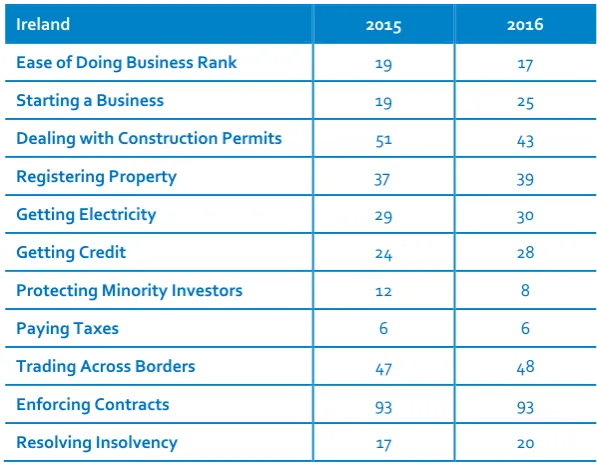
As a result, since 2011, Ireland’s relative international competitiveness as measured by a range of international indices has improved. Ireland moved from 24th to 15th in 2014 in the IMD’s World Competitiveness Yearbook, (but slipped back to 16th this year), and from 29th to 24th in the WEF Global Competitiveness Report. In addition, the World Bank’s most recent “Doing Business” report shows Ireland is now ranked 17th out of 189 countries, an improvement of two places on an annual basis.
At present, Ireland continues to benefit from a range of external factors including a weakened euro, low international energy prices and a degree of recovery in our key markets. Such favourable factors could be quickly reversed. Indeed, a range of risks to Irish competitiveness are already clear.
Cost pressures have emerged in key areas. Although costs have fallen significantly since 2009, Ireland remains an expensive location in which to do business, relative to some of our key competitors. Ireland is also the 3rd1 most expensive location in the euro area for consumer goods and services. While, in relative terms, Irish cost
competitiveness is improving (i.e. although costs are increasing, they are increasing at a slower rate than in many of
our competitors), this improvement is largely being driven by the external factors referenced above. Furthermore, a number of upward domestic cost pressures are now emerging, particularly in relation to labour, property and business services. The Council’s Costs report also highlights the difficulty of achieving further cost reductions against a
backdrop of low inflation throughout the EU, and the significant risk that recent competitiveness gains will be eroded as economic growth strengthens. Most immediately, Ireland’s international competitiveness reflects our cost competitiveness vis-à-vis our competitors and trading partners. Costs, therefore, continue to be a major focus for the Council.
Infrastructure bottlenecks and skills mismatches are again immediate challenges and a series of labour market challenges (i.e. relating to long term and youth unemployment and labour force participation) persist. Increasing productivity across all sectors and occupations, particularly in the indigenous economy remains a significant issue. The export base (i.e. the range of goods we export) is narrow, increasing the risk from external shocks. The legacy of the domestic property crash, banking issues and global recession is still evident in terms of debt and credit issues.
Against such a challenging backdrop, Ireland cannot depend on benign external factors beyond the direct influence of domestic policy makers to protect our international competitiveness. As a small open economy, dependent on exports and foreign investment as major drivers of growth, any reversal of these favourable external factors resulting in loss of competitiveness will have a major negative impact upon our economic prosperity, employment and our standard of living.
The Council takes the opportunity to strongly reiterate that as growth gathers pace, we are at risk of repeating past mistakes unless decisive action is now taken. If Ireland is to take advantage of the global economic growth (which remains positive but is showing signs of slowing), policy action is required to address a number of constraints which are currently undermining our competitiveness. Based on the benchmarking analysis contained in both the Costs and Scorecard reports, the Council has identified a range of themes and policy areas requiring action in order to deliver the growth and jobs required to enhance Ireland’s prosperity.
In the medium term, however, productivity improvements must be the primary driver of Irish competitiveness. The challenges in improving the quantity and quality of human and productive capital, and enhancing total factor productivity (through technological change, innovation and the application of competition policy) are significant but key to achieving sustainable competitiveness resulting in economic growth, jobs and improved living standards. The Council has assessed all of the challenges across seven thematic areas, each of which will be examined in greater detail in the chapters which follow. These themes are:
1. Maintaining Fiscal Sustainability;
2. Investing in Physical and Knowledge Infrastructure; 3. Improving Cost Competitiveness;
4. Enhancing Talent and Skills;
5. Improving Access to Finance for Enterprise; 6. Supporting Innovation and Productivity; and 7. Broadening the Enterprise and Export Base.
Chapter 1: Sustainable Fiscal Policy
Why Fiscal Policy Matters for Competitiveness
Sound public finances contribute to competitiveness and encourage economic growth mainly through their impact on borrowing costs. By avoiding excessive deficits and excessive debt levels, governments can invest in productivity and welfare enhancing areas of the economy (such as education, or infrastructure), rather than spending finite resources on interest payments. Essentially, fiscal governance has three main objectives:
Attaining sound budgetary positions in particular by containing the deficit bias, i.e. tackling the tendency to conduct unsustainable fiscal policies giving rise to high deficits and increasing debt ratios;
Reducing the cyclical nature of fiscal policy making; and Improving the efficiency of public spending.
Current Context
The lessons learned from the recent global economic, financial and sovereign debt crisis have led to successive reforms of the EU's fiscal rules. The EU introduced new monitoring and surveillance systems for budgetary and economic policies, and a new budgetary timeline for the euro area.
As well as responding to the effects of the recession, one of the key goals of recent years has been to reorient the Irish fiscal framework, to create a more predictable rules-based fiscal policy geared to restoring debt sustainability2. More specifically, to counter weaknesses exposed during the crisis, the Stability and Growth Pact has been reformed through initiatives such as the Six Pack (a fiscal law package of 5 regulations and 1 directive)3 and the Two Pack4, and the Treaty on Stability, Coordination and Governance. The new rules are grounded in the European Semester, the EU's policy-making calendar.
This integrated system ensures that there are clearer rules, better coordination of national policies throughout the year, regular follow-up and swifter sanctions for breaching the rules. This helps Member States to deliver on their budgetary and reform commitments while making the Economic and Monetary Union as a whole more robust. At a national level, the Fiscal Responsibility Act established the Irish Fiscal Advisory Council as a statutory body and legislated for the implementation of national and EU fiscal rules5.
2 This approach encompasses a series of policy rules, procedural rules, transparency norms, and a surveillance mechanism. According to Kopits “such a framework need not be a rigid toolkit that pre-empts the conventional functions of fiscal policy, namely, stabilization, income distribution, and allocative efficiency. On the contrary, a well-designed framework facilitates such functions in the path to a sustainable level of indebtedness” See Kopits, G., Ireland’s Fiscal Framework: Options for the Future, January 2014
3 Four of the six instruments in the Six Pack are used to conduct further reforms of the Stability and Growth Pact, focusing on improving compliance. These reforms do not change any of the conditions already imposed by the SGP, but aim to enforce greater budgetary discipline among the Member States of the euro area by stipulating that sanctions come into force earlier and more consistently. The remaining two pieces of legislation in the Six Pack relate to the Macroeconomic Imbalance Procedure, an early warning system and correction mechanism for excessive macroeconomic imbalances.
4 The Two Pack introduced additional coordination and surveillance of budgetary processes for all euro area members. The additional regulations complement the SGP's requirement for surveillance, by enhancing the frequency of scrutiny of Member States' policymaking. The provisions of the Two-pack only apply for euro area member states.
Ireland completed the EU-IMF financial assistance programme in 2013 and is currently subject to post-programme surveillance and European Semester surveillance. As a result, Ireland is currently in the corrective arm of the Stability and Growth Pact, which has implications for how much we can spend, and for how quickly fiscal adjustment must be achieved6. Ireland is due to exit the corrective arm this year and will then be impacted by the preventive arm of the Stability and Growth Pact which imposes two key rules:
Under the Medium Term Objective (MTO), Member States are expected to reach their MTOs (which for Ireland is a balanced budget in structural terms), or to be heading towards them by adjusting their structural budgetary positions by at least half a per cent of GDP annually; and
The Expenditure Benchmark requires that government expenditure grows at or below a country’s medium-term potential economic growth rate, depending on the country's position with respect to the MTO. Any spending increases beyond this rate must be matched by additional discretionary revenue measures.
In summary, the new fiscal framework imposes restrictions on the general government structural budget balance and on public indebtedness (fiscal policy rules), a medium-term stability program (procedural rule), independent
macroeconomic forecasts, adherence to accounting conventions (transparency standards), and establishment of an independent fiscal council (surveillance).
Ireland’s Performance
Significant fiscal adjustments were undertaken in Ireland over the period since 2008 in response to the impact of the global economic recession, and financial and sovereign debt crisis, as well as a series of domestically-based shocks. This adjustment consisted mostly of frontloaded measures, two thirds in expenditure cuts and one third in tax increases. This process, allied to enhanced international cost competitiveness has contributed to strong economic growth, increased tax revenues and cuts in expenditure. Ireland’s fiscal position has significantly improved as a result. The ongoing economic recovery is likely to result in further improvement in Ireland’s fiscal position – primarily facilitated by increased tax revenues, with a smaller contribution from the lower interest bill on the national debt.
Department of Finance Data7
Improved deficit year-on-year: End-August 2015 saw the Exchequer record a deficit of €1,291 million
compared to a deficit of €6,322 million in the same period last year
This improvement in the Exchequer balance is driven by increased tax and non-tax receipts and a number of one off transactions
6 The corrective arm of the Stability and Growth Pact (SGP) ensures that Member States adopt appropriate policy responses to correct excessive deficits by
implementing the Excessive Deficit Procedure (EDP). Member States can be placed in the Excessive Deficit Procedure if they have debt ratios above 60 per cent of GDP that are not being sufficiently reduced (where the excess over 60 per cent is not coming down by at least 5 per cent a year on average over three years). Member States in the Excessive Deficit Procedure must not only submit budgetary plans, but also Economic Partnership Programmes which contain detailed fiscal-structural reforms (for example, on pension systems, taxation or public healthcare) that will correct their deficits in a lasting way.
7 The Exchequer balance is the domestic budgetary aggregate which measures the net surplus or deficit position (the difference between cash inflows and outflows) of central government’s main treasury account, the Central Fund. The monthly Exchequer Statement presents the Exchequer balance and details cash inflows and outflows of the Central Fund. Revenue items include tax receipts, non-tax revenues and capital receipts. Expenditure is composed of Departmental voted spending and non-voted expenditures such as debt servicing costs.
Excluding a number of one off transactions the improvement in the deficit would be €3.5 billion
Increased tax revenue: Tax revenue of €27,376 million was collected to end-August 2015. This represents a
year-on-year increase of €2,430 million (9.8 %) and is €1,399 million (5.4 %) above profile
Reduced expenditure: Overall net voted expenditure for end-August 2015, at €27,344 million, was down €297
million (1.1%) on profile and down €130 million (0.5%) year-on-year
For 2014, a general government deficit of 4% of GDP was recorded, which was comfortably below the Excessive Deficit Procedure (EDP) ceiling of 5.1% of GDP
Lower general government deficit: For 2015, a general government deficit of 2.3% of GDP is forecast,
prudently below the ceiling of 3% of GDP required under the EDP
According to the Spring Economic Statement, a primary balance of 1.1% is expected
Budget 2015 forecast that general government debt would decline to 108.5% of GDP in 2015, and to 104% in 2016, and 95.4% by 2018; based on more recent projections included as part of the Stability Programme Update, and recent national accounts data, it is expected that the debt-to-GDP ratio will fall below 100% by the end of this year
The series of EU fiscal rules referred to above which govern Irish fiscal policy, are concerned with both the deficit and debt levels. Under the preventive arm of the Stability and Growth Pact, the government must achieve “rapid” progress towards its medium-term objective of a balanced budget in structural terms. The Department of Finance expect that this will be achieved by 2019 under the new forecasts, a year later than previously estimated8.
As noted by the IMF, however, exiting the EDP does not imply Ireland’s fiscal position is yet healthy9. Irish gross public debt is still estimated to be approximately 110 per cent of GDP at the end of 2014. According to the Department of Finance, gross debt is forecast to fall quicker than previously expected (to 97.8 per cent of GDP in 2017 and to 93.6 per cent the following year and to 85 per cent by 2020).
It is instructive to consider the cost of servicing that debt (i.e. debt servicing costs which are a function of the size of the debt stock as well as the interest rate). Interest payments on the general government debt are expected to absorb 13 per cent of general government revenues in 2015 – this is expected to stabilize in 2016 at 14 per cent of government revenues. A historical analysis of interest costs reveals that although present debt levels are significantly higher than in the past, the burden of financing the debt is significantly lower (and is more akin to the burden in the 1990’s)10.
Policy Challenges and Recommendations
Despite rapid improvement in Ireland’s situation, Ireland is still running a deficit and high levels of gross debt limit the room for fiscal policy to respond to economic shocks. There are also concerns about Ireland’s ability to stay the course without further structural reform. Indeed, the European Commission has already warned that “there appears to be a risk of a significant deviation from the required adjustment towards the medium-term objective in 2016, and further structural measures will be needed in that year. Based on its assessment of the Stability Programme and taking into
8 Department of Finance, Ireland’s Stability Programme Update Incorporating the Department of Finance’s Spring Forecasts, April 2015
9 Although leaving the deficit at about 3 per cent of GDP need not imply a further increase in the debt ratio if nominal GDP growth averages 3 per cent or more, the ratio would remain high, making Ireland vulnerable to shocks and limiting room for fiscal policy to cushion economic shocks. See IMF, Ireland: Country Report No.15/78, March 2015
account the Commission's 2015 spring forecast, the European Council is of the opinion that there is a risk that Ireland will not comply with the provisions of the Stability and Growth Pact”11.
While the Council welcomes the new rules and procedures that have been put in place as important safeguards against pro-cyclical fiscal policy (in particular the medium-term expenditure framework), there is still a need to maintain vigilance in relation to fiscal policy. It is vital that prudent and credible fiscal policy choices are made that support economic growth, enhance competitiveness and maintain the downward trajectory of our public debt.
The Council acknowledges that many of the challenges highlighted herein, will require a degree of State intervention and these will require a level of expenditure to be paid for through the taxation system (either immediately or over time through repayment of borrowings)12.
More Efficient Revenue Generation
In international terms Ireland is a low tax economy: total tax revenues in Ireland account for 27.3 per cent of GDP, compared with an OECD average of 33.7 per cent.
Tax reforms have contributed to the fiscal adjustment, but there is further scope to improve the efficiency of the tax system and to ensure that the tax system is as supportive of competitiveness, growth and job creation as possible, whilst having regard to wider societal objectives. Maintaining growth-friendly taxation system, while simultaneously broadening the tax base, is critical to maintaining existing levels of employment and creating new jobs in Ireland. In essence, efforts to increase Government revenue must continue to reflect the OECD tax hierarchy for growth13.
Recommendation: Continue to broaden the tax base and increase Government revenues in line with the OECD tax hierarchy for growth.
Responsibility: Department of Finance
Property Taxation
Taxing land and property is one of the most efficient and least distorting ways for governments to raise funds and to encourage economic and social development. Sustainable and broad based property taxes, when properly structured, can enhance Ireland’s fiscal stability while supporting competitiveness. In this regard, achieving an increased revenue stream from property taxes should act as part of a wider strategy to identify alternative revenue sources.
Property taxation has already been turned into a recurrent tax, but the Council believes that there is an opportunity to deliver fundamental reform of the approach taken to property taxation that would result in increased revenue for Government, whilst simultaneously increasing the supply of both residential and commercial property. A single, broad
11 European Commission, Recommendation for a Council Recommendation on the 2015 National Reform Programme of Ireland and delivering a Council opinion the 2015 Stability Programme of Ireland, COM(2015) 258, May 2015
and national approach should be taken with respect to the taxation of commercial property and land which is zoned and serviced for development14.
Specifically, the Council recommends that consideration should be given to introducing a site value tax (SVT) - that is, a tax on the unimproved value of commercial property and land which is zoned and serviced for development. It is proposed that this would replace the current system of commercial rates, and the vacant site levy15. It is important, however, that an SVT works in conjunction with the planning system.
Recommendation: Introduce an annually recurring site value tax on commercial property and land which is zoned and serviced for development, levied without regard to how land is used or what is built on it, and administered on a self-assessment basis with oversight by the Revenue Commissioners. An SVT should work in conjunction with the planning system.
Responsibility: Department of Finance
Labour Taxation
A competitive income tax regime is essential in attracting and retaining individuals in Ireland and more generally to encourage people to remain in or return to the labour market. Notwithstanding recent improvements, increases in taxes on labour (for simplicity sake, this includes income tax, PRSI16 and the Universal Social Charge) over the course of the financial crisis and economic recession eroded competitiveness and incentives to work.
Higher labour taxes raise the costs of labour and replacement rates (i.e. make work less attractive vis-à-vis social welfare), reduce take home pay and domestic demand, negatively impact on the incentive to work additional hours17, and risk stimulating the informal economy.
As illustrated in Table 1, Ireland is currently very reliant on taxes on income as a source of revenue, particularly when compared with other developed economies. On the other hand, significantly less revenue is generated through social security contributions in Ireland. While Ireland is relatively competitive in terms of the difference between the
employers’ cost of hiring an individual and the individual’s actual take-home pay, the gap has been increasing in recent years. The difference is wider for higher paid workers in Ireland18. While positive in terms of progressivity19, it is of concern as Ireland competes internationally for higher paid mobile talent20 and foreign direct investment (FDI).
14 The Planning and Development (No 1) Bill, 2014 provides for a vacant site levy of up to 3 per cent of the market value of vacant sites which exceed 0.05 hectares. The primary objective of the levy, which will come into effect in 2019, is to act as a mechanism to incentivise the development of vacant and underutilised sites in central urban areas, thereby facilitating the most efficient use of land and sites. The Urban Regeneration and Housing Bill 2015 published on 5 June, 2015 provides that the levy will now apply to land other than that owned by a housing authority (County and City Councils are designated housing authorities; previously all land in public ownership was exempt).
15 Previous considerations of site value taxes have identified a number of difficulties in relation to implementation (e.g. difficulties in ensuring acceptance by taxpayers, such as arriving at values that are evidence based, understandable and acceptable to the public, in addition to complexities and uncertainties in the valuation effort necessary to put an SVT in place). For further details see National Competitiveness Council, The Potential of Taxation Measures to Encourage Development of Zoned and Serviced Land, Submission to the Department of Finance Public Consultation, April 2015
16 Technically, PRSI is not a tax – social insurance contributions are paid to the Social Insurance Fund to provide for the Contributory State Pension and other entitlements.
17 Although average effective tax rates are useful in understanding distributions of the tax burden, the effects of taxes on individual s decisions to work are determined by the overall marginal tax rates and the entry point to the marginal tax rate.
18 Effective tax rates increased for all classes of income earners between 2008 and 2014. According to research conducted by Ibec, the change in effective tax rates over this period for single earners was highest amongst those earning between €35,000 and €100,000 with the largest increases for those earning between €35,000 and €60,000. See Ibec, Debunking Irish Income Tax Myths: An Analysis of the Taxation of Income In Ireland, September 2014
Table 1: Ireland’s tax structure, percentage of total tax revenue21, 2012
Ireland OECD
Taxes on personal income 33.2 24.5
Social security 15.3 26.2
- employee contributions 3.9 9.7
- employer contributions 10.6 14.6
Taxes on corporate income 8.4 8.5
Taxes on property 7.0 5.5
Taxes on consumption 32.3 30.9
Source: OECD Revenue Statistics, 2014
As a result of the OECD’s Base Erosion and Profit Shifting (BEPS) project, it is essential that firms that locate in Ireland can demonstrate they are engaged in activities of real substance. Attracting high skilled (and usually, therefore, highly paid and internationally mobile) talent into Ireland is a key element of ensuring that such activities are generated in Ireland. In this regard, a competitive income tax regime assumes even greater importance.
One of the key issues in this regard is the level at which employed individuals start paying the higher rate of income tax (€33,800 for single individuals). This is very low relative to other countries22, and as a consequence, the higher rate of income tax impacts on individuals earning less than the average wage of €36,626 in Q4 201423. Prior to Budget 2016, this meant that marginal rates (i.e. the income tax, universal social charge (USC) and PRSI paid on an individual’s last euro of income) were in excess of 50 per cent for single employed individuals earning €33,800 per annum.
As a result of changes to be introduced from 1st January 2016, the marginal rate for those earning up to €70,043 will drop to 49.5 per cent. However, with the marginal rate of taxation remaining above 50 per cent for employees earning in excess of €70,044, the headline tax rates in Ireland still remain comparatively high by international standards. Mirroring the OECD hierarchy of taxation, economic growth would be boosted by lowering the burden of taxation on labour – in particular, by reducing the maximum marginal rate (income tax, USC and PRSI). Over time, this could be achieved by moving the entry point to the top marginal income tax rate above the average wage, or through reductions in the marginal rate. At the same time, any changes to labour taxes must take account of the overall taxation burden on individuals and households (reflecting the importance of both direct and indirect taxation)24.
21 Social security (OECD classification 2000) is comprised of Employee contributions (2100), employer contributions (2200), self-employed, non-employed contributions (2300) and some “unallocable” contributions (2400). A breakdown of the first two of these categories is included in Table 1 above.
22 It should be noted that several countries use a range of different tax rates that kick in a different income thresholds. These rates, in effect, create additional step effects along the income continuum.
23 CSO Earnings and Labour Costs: Employment, Hours and Earnings by Type of Employee, Statistic, Industry Sector NACE Rev 2 and Quarter, Q4 2014
Recommendation: Review income taxes (e.g., credits, thresholds, rates, etc.) to support improvements in after-tax income – enhancing the incentive to work - while protecting labour cost competitiveness. Building on the changes in Budgets 2015 and 2016, the entry point to the top marginal income tax rate should be increased and maximum marginal rates for all employees should be brought below 50 per cent.
Responsibility: Department of Finance
Regardless of tax rates applied, the design of the tax and social insurance system should create the optimal conditions for entrepreneurship, enterprise and job creation. It is important that work pays and there are no barriers (from either an employer and employee perspective) for employees to work additional hours and to increase pay where
appropriate.
Currently, the PRSI system creates a disincentive to work – for example, a worker earning €18,304 does not pay PRSI, but a worker on €18.305 pays €732 - and comes out with lower take-home pay. Such “step-effects” act as a general disincentive to work, and specifically create disincentives for part-time workers to work additional hours or for full-time workers to work paid overfull-time (where it brings workers above these thresholds). The step effect also negatively impacts on an employers’ cost base, thus negatively impacting upon their incentive to increase hours worked or hourly wages25. The announcement in Budget 2016 to introduce a tapered relief (with a maximum level of €12 per week or €624 in annualised terms) is, therefore, welcome and will increase the incentive to work at all earnings levels. Throughout the boom years of the early and mid-2000’s large numbers of the workforce were removed from the personal tax net. Following the onset of the financial crisis and economic recession, the need to broaden the tax base was recognised and a range of measures were introduced to achieve this. As the economy has recovered, we have already seen a resumption of policies that result in a narrowing of the tax base (e.g. through increases in PAYE and USC bands); in 2014, for example, 856,000 individuals or approximately 39 per cent of the income tax base, did not pay income tax (although some were liable for USC and/or PRSI)26. To ensure the sustainability of the public finances, it is important that the principle of maintaining a broad tax base is applied in relation to personal taxation. Other
anomalies in relation to the taxation of employment should also be addressed. For instance:
Income related taxes are composed of three separate but concurrent taxation bases (i.e. the income tax base, the USC tax base and the PRSI tax base), each of which is administered with different inclusions and exclusions of income sources27.
The European Commission have already noted that Irish labour taxation lacks simplicity. The interaction between the Irish taxation system and the social welfare system, adds a further layer of complication.
The piecemeal changes to and exemptions from the Universal Social Charge implemented over recent years have undermined the original purpose of its introduction28.
25 The recent report of the Low Pay Commission also noted the impact of the step effect, whereby proposed increases in the national minimum wage would be entirely absorbed by the Exchequer through increased income tax, PRSI and USC deductions. See Low Pay Commission, Recommendations for the National Minimum Wage, LPC No.1, July 2015
26 Ireland has one of the highest entry points to the core income tax system. According to the Irish Tax Institute in 2014 an estimated 856,000 individuals (or 39 per cent of the income tax base) did not pay income tax as a result of the high entry point (i.e. while these individuals are subject to income tax, their liability does not exceed their tax credits , therefore, no income tax is paid. It is also worth noting that many of these individuals are not necessarily workers – they may be pensioners, for example). 27 Collins notes that, driven by incremental policy reforms, the latter two bases have become much closer and are both more comprehensive than the income tax base with continues to accommodate a myriad of credits, allowances, exemptions and tax. See Collins, M., Taxes and Income Related Taxes Since 2007, NERI WP 2015/No 25, March 2015
Those in employment and the self-employed are treated differently in relation to both the USC and PAYE – with the self-employed facing significant disadvantages vis-à-vis the employed counterparts. For instance, an
additional 3 per cent USC applies to self-employment income and almost all forms of non-PAYE income in excess of €100,000.
The introduction of an earned income tax credit of €550 for the self-employed and farmers, and business owner/managers who are not eligible for a PAYE credit on their salary income was announced in Budget 2016. While this is a step in the right direction, the credit is still less than the PAYE tax credit of €1,650. Previously, a single employee could earn a minimum of €16,500 before paying 20 per cent income tax, while a single self-employed individual could earn €8,250 before paying 20 per cent income tax; this new tax credit will narrow the discrepancy.
It may now be opportune to reconsider the entire structure of personal taxation in Ireland, and to develop a roadmap towards implementing a more simplified system of taxes and charges, incorporating income tax, PRSI and the USC that better supports employment and job creation.
Recommendation: Continue to reform and simplify the current regime of taxes and charges on employment, with the specific goal of further encouraging the take-up of employment opportunities and job creation, whilst simultaneously maintaining a broad personal tax base. Anomalies in relation to PAYE and the USC should be removed to support the self-employed, job creation and entrepreneurship.
Responsibility: Department of Finance
Targeting Current Expenditure to Support Competitiveness
The necessity of urgently addressing the fiscal crisis which enveloped Ireland saw a series of fiscal adjustment budgets introduced between 2008 and 2012. While cuts were undeniably necessary, it is of concern that the majority of cuts related to the capital budget: reductions in capital expenditure accounted for €5.5bn of the €7.8bn in cuts to gross public expenditure over the course of these budgets; as a result, capital expenditure in 2013 amounted to just 38 per cent of 2008 levels29. Acknowledging the necessity of these cuts, the Council believe that greater focus is required on the current expenditure side.
Current Expenditure: Efficient Public Services
In order to deliver efficient and effective public services, the public sector needs to continuously monitor its performance against predefined targets and outcomes. This would ensure that Departments and agencies work towards specific goals and objectives and public sector reform encompasses a results focus. The Council believes that greater emphasis should be placed on developing output and outcome targets. Equally, improved measurement and monitoring of progress towards these targets is required, and the results should be published periodically30.
29 Department of Public Expenditure and Reform, Expenditure Trends
Certain areas of Government expenditure are currently subject to less scrutiny than is desirable. Periodic independent external scrutiny has been a largely absent feature of public sector reform. The OECD has previously recommended that independent five year reviews of the public sector be conducted31. The Council believes that this should be taken a step further and include an international exercise to examine whether Ireland can learn from public sectors in other countries. Independent international five year comparative reviews of the performance of government departments would greatly enhance the reform process.
Recommendation: Develop key output and outcome indicators for Government Departments and Agencies that are measured, monitored and published over time. Mandatory, independent international five year comparative reviews of the performance of government departments should be also introduced.
Responsibility: Department of Public Expenditure and Reform, individual Government Departments
Capital Investment
On the capital side, while recent expenditure increases are welcome - capital expenditure in 2015 will total €3.5bn, an increase of €210m from 2014 – present levels of investment are insufficient to close the knowledge and economic infrastructure gap between Ireland and our key competitors which still persist. Indeed, such expenditure levels may actually be insufficient to even maintain the existing infrastructure stock.
In seeking to simultaneously invest in the economy and maintain prudent fiscal policy, a delicate balance must be struck. In order to comply with the required MTO of a balanced budget, an annual reduction in the structural budget balance of 0.5 percentage points per annum is required. To achieve this target, the rules set an “expenditure benchmark” limiting the allowable expenditure increases until the MTO is reached32. This benchmark requires that spending growth should not exceed potential economic growth thus minimising adverse pro-cyclical tendencies. Recent methodological changes may ease some of the more restrictive aspects of the expenditure benchmark. Further flexibility may be required to better reflect Ireland’s growth potential so that productivity enhancing capital
investment is not unnecessarily constrained. Any changes, however, must not result in a relaxation of fiscal discipline. A reduction in the structural deficit of 0.5 per cent will still be required on an annual basis, and expenditure will still need to be prioritised and targeted in a manner that supports, competitiveness, jobs, and growth33.
The importance of increasing public (and private) capital investment and delivering the necessary infrastructural projects as soon as possible to support competitiveness is discussed in more detail in Chapter 2, where a range of recommendations are proposed.
31 OECD, Public Management Reviews: Ireland – Towards an Integrated Public Service, 2008
Long Term Planning
As well as focusing on the short and medium term, there is a need to ensure that we do not ignore longer term challenges or store up problems for the future34. Like most developed economies, Ireland will be faced with significant demographic challenges in the decades ahead. While our young population currently represents a major positive for Ireland, changes in the dependency ratio over time will require a significant increase in State spending in the form of pensions and other social costs (such as healthcare etc.). A growing economy presents an opportunity to set aside funds to deal with these future liabilities.
Previously, taxpayers paid a levy into the National Pension Reserve Fund (NPRF). This supplementary fund was to be used to cope with the anticipated additional costs of an ageing population. The NPRF’s asset base had increased to over €22 billion in 2009. However, in response to the fiscal consequences of the economic and banking collapse, its assets have been diverted to respond to the crisis and to help meet the State’s fiscal commitments. As a result, the size of the fund has been reduced to approximately €7.1 billion. This money, in turn, has been earmarked for use by the Strategic Investment Fund to invest in large capital and commercial projects35. While such investment is necessary, and if properly targeted is likely to boost competitiveness, this does not negate the need to put in place structures and funds to address future pension issues. Options to revive the NPRF, or alternatively, to develop a Sovereign Wealth Fund should be explored as part of a sound, long term fiscal planning process.
Recommendation: Consideration should be given to reviving a national pension reserve fund, or alternatively, to developing a Sovereign Wealth Fund, to make provision for increasing pension costs arising from Ireland’s ageing population. This should take account of the assets represented by the holdings in the banks and of the return on assets that now constitute the Irish Strategic Investment Fund.
Responsibility: Department of Finance, National Treasury Management Agency
34 The National Risk Assessment exercise aims to identify strategic risks that may arise due to potential changes in the economic, financial, geo-political and social environments, and has such has a longer term focus. By its nature, it provides a high level overview of strategic risks but does not aim to replicate or displace the detailed work already undertaken by various Government Departments or the future work required to address the issues identified. See Department of the Taoiseach, Draft National Risk Assessment 2015: Overview of Strategic Risks, 2015
35 As a result of the National Treasury Management Agency (Amendment) Act, 2014, on 22 December 2014 all NPRF assets governed by Irish law automatically transferred by operation of law from the NPRF Commission to the NTMA (becoming assets of the ISIF) and the NPRF’s investment mandate ended.
Chapter 2: Capital Investment in Physical and Knowledge
Infrastructure
Why Capital Investment Matters for Competitiveness
The stock of human and physical capital, public and private, is perhaps the most tangible representation of Ireland’s wealth. Ireland’s economic growth and sustainable levels of employment depend on the ability of businesses to trade successfully in increasingly competitive global markets. The availability of competitively priced world-class
infrastructure (e.g. energy; telecoms; transport – road, public transport, airport, seaports; waste and water) and related services is critical to support competitiveness which in turn determines the sustainability of living standards, employment, wage rates and the financing of public services.
Strong investment up to 2008 and weaker demand for infrastructural services during the recession (e.g. reduced road traffic, declines in energy demand) has to some extent mitigated the sharp reduction in capital budgets to date36. However, as the country returns to growth, further targeted investment and reform is required to address existing and likely infrastructural bottlenecks which could constrain growth in the economy by dampening productivity growth, increasing costs and limiting sectoral opportunities for foreign direct investment (FDI) and indigenous enterprise development. As the economy grows, it is vital that we increase capital investment, and agree upon the appropriate, sustainable level of investment into the medium term.
Capital expenditure, however, is not just about physical infrastructure. Capital expenditure on enterprise development, skills, and to support research, development and innovation (RD&I) activity are particular areas of interest to the Council. Investment and growth in OECD economies is increasingly driven by knowledge based capital (KBC). In some OECD countries, firms now invest as much or more in KBC as they do in physical capital such as machinery, equipment and buildings37.
In terms of the public role for supporting KBC, OECD research finds that the strongest evidence for private under-investment exists for research and development (R&D)-related spending – suggesting a continued important role for public investment. The same research also underscores the importance of traditional areas of policy, in particular relating to skills development, and the need to develop a dynamic process of firm creation and exit to facilitate resource reallocation to new sources of growth based on KBC. In this regard, capital investment in both skills and enterprise development remain crucial.
Current Context
There was a significant reduction in public capital expenditure over the course of the recession from approximately €9bn in 2008 to €3.4bn in 2013, although weaker demand for infrastructural services (e.g. reduced road traffic, declines in energy demand), partially mitigated the impact of this reduction. Gross fixed capital formation began to recover in
36 The propensity to which the State invests in infrastructure and the private sector invests in capital is directly related to the performance of the economy. The collapse in capital investment (public and private) has been a particularly visible trend in recent years. Irish investment levels in all assets almost halved between 2008 and 2013, falling from 22 per cent to 11.2 per cent in GDP terms. By comparison, the euro area average declined by 18 per cent over the same period, albeit from a lower starting point. In Ireland private investment has declined from 16.7 per cent of GDP to 9.4 per cent while Government spending has fallen from 5.3 per cent of GDP in 2008 to 1.8 per cent in 2013. While it is encouraging to note that there has been some growth since 2011, the recovery remains fragile.
201438, and further growth in investment is forecast for 2015. This is likely to be driven primarily by increases in private sector investment. In GDP terms in 2014, Irish private investment (14.5%) compares relatively well with the euro area average (16.8%), while public investment (1.9%) is significantly below average (2.7%).
The Department of Public Expenditure and Reform has undertaken a review of the public capital investment needs of the State for the five year period 2016-2021. The results of this review and the capital envelope for the period 2016 to 2021 have been set out in a new capital investment plan39. In total €27 billion of exchequer funding is to be invested in capital projects across the six years of the plan, along with another €14 billion expected to come from commercial State-owned companies.
While welcoming the increase in resources, and acknowledging the constraints within which Irish fiscal policy must operate, the Council believes that there is a need to be more ambitious. Under the new plan, public capital investment will still significantly lag pre-recession investment levels; indeed, investment in 2016 (€3.8 billion) is only slightly above planned investment in 2015 (€3.6 billion). As well as additional public investment, there is a need to target such investment at those areas that can have the greatest positive impact upon Ireland’s competitiveness.
There is also a vital private sector dimension to consider as many economic infrastructure areas receive little if any Exchequer funding – including energy, telecoms, waste and air and sea ports infrastructure. Investment plans with a long-term focus are in place or at an advanced stage of development – key plans include:
Energy: Grid 2025, which outlines the electricity network investment plans to 2025, is currently under review and it is important that investment to address key competitiveness gaps is prioritised and the investment is efficient. Eirgrid and its French transmission system equivalent (RTE) are currently undertaking a joint feasibility study to investigate the development of an interconnector between the south of Ireland and north-west France. Water: Irish Water’s 25 year water services strategic plan which is currently being finalised shortly needs to
prioritise investment at least cost to address current gaps for enterprise, and to secure future enterprise investment at key sites40.
Telecoms: Accelerated investment is required across the country to meet the needs of enterprise41. The
supporting public investment strategy for areas where the market will not deliver needs to be finalised quickly42. The development of the new Science Strategy – which aims to place Research Prioritisation and the focus on research relevance and impact within a broader policy context – also provides an important context for any consideration of capital investment levels and programmes43. Likewise, the development of a new National Skills Strategy is a key milestone. This strategy will c0nsider, amongst other things, future skills requirements to ensure that Ireland continues to develop its potential as a competitive, innovation-driven, knowledge-based, participative and inclusive economy and society. Further, the Strategy will propose targets and metrics so that progress on talent and human capital development can be measured.
38 Gross fixed capital formation (GFCF) measures the value of acquisitions of new or existing fixed assets by the business sector, governments and households less disposals of fixed assets. GFCF is a component of GDP, and illustrates how much of the new value added in the economy is invested rather than consumed. 39 Department of Public Expenditure and Reform, Building on Recovery: Infrastructure and Capital Investment 2016-2021, October 2015
40 Irish Water published a draft of the first integrated plan for the delivery of water services in Ireland in February 2015. The draft was developed following an initial consultation with statutory bodies and the public in mid-2014 and underwent a Strategic Environmental Assessment (SEA) and an Appropriate Assessment (AA). Irish Water invited submissions on the draft together with the SEA Environmental Report and Natura Impact Statement (AA process) in February 2015. Following this consultation, the plan is now being finalised and a statement on the Strategic Environmental Assessment is being prepared.
41 Commercial operators are investing more than €2.5 billion in high speed broadband and other telecommunication services. However, some parts of the country are too remote or have too few people living in them to enable the operators to make a profit in these areas. The State plans to build this network in areas where there are no plans by commercial operators to deliver a high speed service by the end of 2016.
42 A draft broadband intervention strategy has been published by the Department of Communications, Energy and Natural Resources’ (DCENR) and is currently the subject of public consultation, with a view to finalising the strategy and proceeding to formal procurement by the end of 2015.
Policy Challenges and Recommendations
Increasing investmentPublic investment is essential to maintain and expand Ireland’s capital stock; it is also a significant driver of long term productivity growth and plays a crucial role in driving competitiveness – after all, the gains from public investment accrue not just to those undertaking the investment, but to a wide range of people and enterprises.
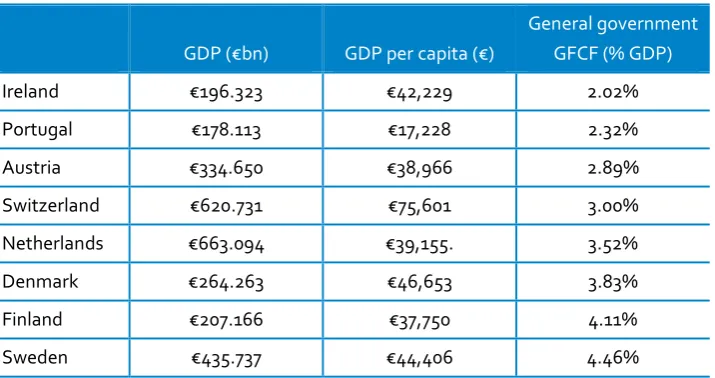
[image:24.595.53.411.335.524.2]As the economy returns to strong growth, the Council believes that it is time to significantly increase the capital expenditure budget, beyond the increases flagged in the Infrastructure and Capital Investment 2016-2021 plan. Given the lead time it takes to deliver capital projects, the capital budget should be increased as a matter of urgency. Table 2 illustrates the scale of Government investment across a range of developed, small economies – from this table it is clear that Ireland is investing significantly less than many of our peers and countries against whom we compete for trade and investment. This will remain the case, even allowing for the increased capital allocation outlined in the new 2016-2021 Capital plan. Capital investment (as a percentage of GDP) should at least mirror levels in competitor countries that are at a similar stage of infrastructural development.
Table 2: General government gross fixed capital formation (% GDP), 2015
GDP (€bn) GDP per capita (€)
General government GFCF (% GDP)
Ireland €196.323 €42,229 2.02%
Portugal €178.113 €17,228 2.32%
Austria €334.650 €38,966 2.89%
Switzerland €620.731 €75,601 3.00%
Netherlands €663.094 €39,155. 3.52%
Denmark €264.263 €46,653 3.83%
Finland €207.166 €37,750 4.11%
Sweden €435.737 €44,406 4.46%
Source: European Commission, AMECO Database
As it stands, the recently published Strategic Investment Framework for Land Transport (land transport accounts for a large proportion of public investment in infrastructure) concludes that present funding levels are not sufficient to maintain the existing land transport network44. Furthermore, there is essentially no scope for investment in infrastructure improvements vital to cater for future demand growth and to support competitiveness and economic development45.
44 The Framework aims to establish key principles and priorities to guide transport investment over the coming decades. Department of Transport, Tourism and Sport, Investing in our Transport Future: Strategic Investment Framework for Land Transport, August 2015
Boosting investment would help address competitiveness bottlenecks, and would increase potential growth in the medium term, while also increasing aggregate demand in the short term. Investment can also contribute towards unlocking the potential of the regions to grow.
Ireland’s likely demographic profile also necessitates an increase in investment. Based on CSO projections, Ireland’s population is expected to increase from 4.57 million in 2011 to between 4.85 and 5.31 million by 2026, and to between 5.0 and 6.7 million by 204646. Additional infrastructure will be required to meet the demand generated by this growing population.
Given historic low interest rates, and Ireland’s strong growth potential, the time is opportune to prioritise and increase investment levels. Government must also be ambitious in availing of external sources to fund infrastructure (e.g. the European Investment Bank, and institutional lenders such as pension funds).
Recommendation: Increase the level of public capital investment to deliver competitively priced world-class, productive infrastructure, whilst acknowledging the constraints within which Irish fiscal policy must operate. Such investment should be targeted at those areas that can have the greatest positive impact upon Ireland’s competitiveness.
Responsibility: Department of Public Expenditure
Leveraging private sector investment
The State has a critically important role to play in promoting private-service providers to improve infrastructure capacity and deliver more cost-effective, higher-quality services to business users.
We need to ensure the right policy framework is put in place to stimulate investor confidence in long-term projects (e.g. regulatory and planning certainty), and ensure the supply chain has the certainty and tools to deliver effectively. In the past, Ireland has successfully utilised public-private partnership (PPP) approaches to fund infrastructure delivery, and such models will continue to be an important source of funding.
While the Infrastructure and Capital Investment Plan announced the development of a new 3rd phase of the
Government’s PPP plan (to include about €500 million of PPP projects in addition to those already in existence), there may be scope to further expand private investment. It is important, however, to ensure that approaches such as PPPs are structured to maximise value for money in both the short term and over the longer term.