Original Article
Effect of a comprehensive rehabilitation nursing
program on patients undergoing elbow arthrolysis
Yiwei Xue1, Ziyang Sun1, Ping Hu1, Fei Wang1, Lili Zuo1, Yawen Chen2
Departments of 1Orthopedics, 2Nursing, Shanghai Sixth People’s Hospital East Affiliated to Shanghai University of
Medicine and Health Sciences, Shanghai City, China
Received February 26, 2018; Accepted April 3, 2018; Epub May 15, 2018; Published May 30, 2018
Abstract: Objective: To investigate the effect of a comprehensive rehabilitation nursing program on patients under-going elbow arthrolysis. Methods: Patients who received unilateral elbow arthrolysis in the Department of Orthope-dics in Shanghai Sixth People’s Hospital East Affiliated to Shanghai University of Medicine & Health Sciences from December 2016 to February 2017 were selected for the study and were randomized into two groups: experimental group and the control group. Patients in both groups received routine nursing care, while patients in the experimen-tal group also received comprehensive rehabilitation nursing, which was a program after elbow arthrolysis including postoperative pain management, standardized management of postoperative drainage, application of cryotherapy, prevention of heterotopic ossification, and personalized functional training. The visual analogue scale (VAS) was used to assess patients’ pain levels, and the elbow joint range of motion (ROM) was measured for evaluating the amount of movement around the joint. In addition, the Mayo elbow performance index (MEPI) was employed to as-sess patients’ elbow joint function. A satisfaction survey was also conducted. Results: A total of 60 patients were included in the study and were assigned to either the experimental group or the control group (30 cases in each group). As compared with the control group, patients in the experimental group achieved better results in elbow joint ROM with greater improvement. Flexion, extension, pronation, supination and rotation angles in the experimental group were (131±8)°, (7±8)°, (69±17)°, (82±18)° and (151±33)° respectively, which were all better than those in the control group ((120±14)°, (16±16)°, (48±32)°, (63±31)° and (111±58)°, P=0.001, 0.009, 0.002, 0.006 and 0.002). The experimental group also had higher MEPI score (experimental group: 95±7, control group: 86±9, P=0.000), higher percentage of excellent result evaluated by MEPI (experimental group: 70%, control group: 43.3%, P=0.034), and lower VAS score between 2nd and 5th day after operation (P<0.001, 0.001, 0.001, and 0.001) as compared with those in control group. Additionally, the patient satisfaction in the experimental group was also greater (P=0.026). Conclusion: A comprehensive rehabilitation nursing program can help relieve pain, improve el-bow joint ROM and promote recovery of the elel-bow joint function in patients who undergo elel-bow arthrolysis.
Keywords: Elbow arthrolysis, functional training, rehabilitation exercise, nursing care
Introduction
Elbow injuries, if not treated properly, can often
lead to ankylosis and heterotopic ossification,
which can cause elbow joint dysfunction and affect patient’s quality of life. Currently, elbow arthrolysis serves as an effective treatment method [1-6]. The stiffness is most likely to occur in elbow joint among all the joints, and the pathogenesis of the elbow joint dysfunction is quite complicated. It is believed that the only comprehensive rehabilitation intervention wo- uld be necessary in the treatment of elbow joint dysfunction occurring after bone fracture repair
in upper limb, which can help improve joint range of motion (ROM) and activities of daily liv-ing (ADL) [4, 7-10]. The comprehensive rehabili-tation nursing program refers to a set of
scien-tific, humanized and comprehensive
rehabili-tation nursing plans designed on the basis of evidence-based medicine and according to patient’s condition and need, so that patient can receive optimal, standardized, and effec-tive nursing care for improving and accelerating the recovery [2-4, 11]. Therefore, in order to
find ways to enhance the results of elbow
which was implemented in patients after the operation.
Materials and methods
Case selection and grouping
The study was approved by the Ethics Co- mmittee and informed consents were obtained. A total of 60 patients who underwent unilateral elbow arthrolysis in the department of orthope-dics in Shanghai Sixth People’s Hospital East
Affiliated to Shanghai University of Medicine &
Health Sciences from December 2016 until February 2017 were selected for the study. Participants were randomly assigned into either the experimental group or the control group (30 cases in each group).
Inclusion criteria: 1) Patients aged between 18 and 65 years; 2) Patients that had posttrau-matic elbow ankylosis; 3) Patients that had never received elbow arthrolysis in the past; 4) Patients that were available for a long-term fol-low-up after operation (the folfol-low-up period was no less than 6 months).
Exclusion criteria: 1) Patients that had chronic pain or pain in other parts; 2) Patients that had burn injury or traumatic brain injury; 3) Patients that were not willing to undergo cryotherapy; 4) Patients that were not available for a complete follow-up.
ing in addition to the routine nursing care, which included postoperative pain manage-ment, standardized drainage managemanage-ment,
prevention of heterotopic ossification, appropri -ate application of cryotherapy, and personal-ized functional training during early stage [2-4]. Details are as follows.
Postoperative pain management: Management was performed systematically for pain relief so that patients can participate in early functional training [12]. Pain was evaluated in a timely manner by nurse, and the pain relieving device and analgesics were appropriately used. Cr- yotherapy was also carried out during the exer-cise interval [4, 7-9, 13-15].
[image:2.612.91.420.84.298.2]Standardized management of postoperative drainage: If both the anterior and posterior sides of the articular capsules were opened in the surgery, drainage tubes were placed in both sides of the joint to help with full drainage [1]. Placement of drainage tube was performed appropriately and the drainage was monitored closely. Removal of the tube was conducted in a timely manner. Proper hemostatic and post-operative cryotherapy were also applied [13]. Innovative application of cryotherapy: Cold compression or a cryotherapy device was used to reduce postoperative hemorrhage, joint effu-sion, and joint swelling, which was helpful for early exercise [1, 3, 9, 16, 17].
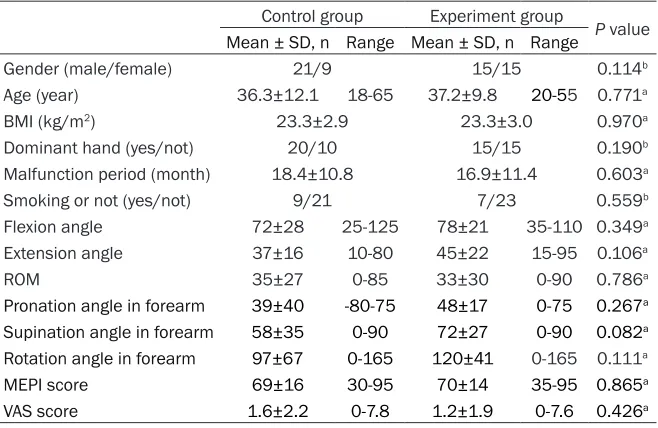
Table 1. Comparison of general information in two groups
Control group Experiment group P value Mean ± SD, n Range Mean ± SD, n Range
Gender (male/female) 21/9 15/15 0.114b
Age (year) 36.3±12.1 18-65 37.2±9.8 20-55 0.771a
BMI (kg/m2) 23.3±2.9 23.3±3.0 0.970a
Dominant hand (yes/not) 20/10 15/15 0.190b
Malfunction period (month) 18.4±10.8 16.9±11.4 0.603a
Smoking or not (yes/not) 9/21 7/23 0.559b
Flexion angle 72±28 25-125 78±21 35-110 0.349a
Extension angle 37±16 10-80 45±22 15-95 0.106a
ROM 35±27 0-85 33±30 0-90 0.786a
Pronation angle in forearm 39±40 -80-75 48±17 0-75 0.267a Supination angle in forearm 58±35 0-90 72±27 0-90 0.082a Rotation angle in forearm 97±67 0-165 120±41 0-165 0.111a
MEPI score 69±16 30-95 70±14 35-95 0.865a
VAS score 1.6±2.2 0-7.8 1.2±1.9 0-7.6 0.426a
Note: BMI: body mass index; ROM: range of motion; MEPI: Mayo elbow performance index; VAS:
visual analogue scale; aindependent samples t test; bPearson’s Chi-square test.
The comparison of patients’ general in- formation in two gr- oups prior to the op- eration can be seen in Table 1.
Methods
nurs-Prevention of heterotopic ossification: Patients
were given oral administration of celecoxib for relieving pain and prevention of heterotopic
ossification after the operation [1, 18].
Personalized functional training: Patient’s con-dition was well evaluated by nurse in order to determine the training time and training load correctly [19-21]. The training consisted of
elbow flexion and extension exercise and elbow
rotation exercise [13]. The timing for external
fixator removal was well controlled, and the
muscle training was also strengthened if pos-sible [9]. The training lasted for six months. The next step plan was made based on the results of outpatient re-evaluation.
Outcome measures
Pain evaluation: Patient’s pain level was
evalu-ated by visual analogue scale (VAS) once a day for five days after surgery. A score of 0 was defined as no pain, whereas a score of 10 indi -cated unbearable pain [22]. The assessment was conducted within one hour following the functional training on that day.
Evaluation of elbow joint ROM: Elbow joint ROM was measured for detecting the amount of movement around the joint. The forearm was
fixed in neutral position before and six months after the surgery. The flexion, extension, prona -tion and supina-tion ROMs in elbow joints were measured by protractor [22].
Evaluation of elbow joint performance: Patients were followed up prior to and six months after the operation respectively. The recoveries of elbow joint performance in patients were assessed by Mayo elbow performance index (MEPI) [7], which analyzed the joint
perfor-Patient satisfaction survey: The self-designed questionnaire consisted of 25 items, with 4 scores in each item. A score of 4 represented
very satisfied, a score of 3 meant satisfied, a
score of 2 meant neutral, and a score of 1
meant dissatisfied. The total score was 100, while a score ≥75 was classified as satisfied, and a score <75 was classified as dissatisfied.
Statistical analysis
SPSS 22.0 was applied for data analysis. The measurement data are presented as mean ± standard deviation; comparison between two groups was conducted using independent sam-ples t test, and the before versus after compari-son within the group was conducted by paired t test; the enumeration data were examined by Chi-square test. A value of P<0.05 was consid
-ered as statistically significant.
Results
Comparison of general information in two
groups
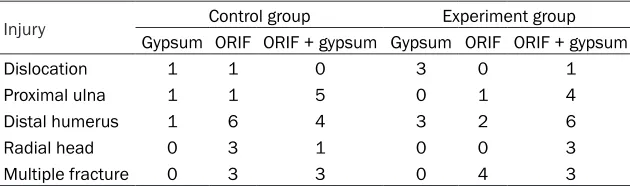
A total of 60 patients were enrolled in the study, including 35 males and 25 females, with age between 18-65 years (36.8±11.0). No inter-group difference was found in sex, age, type of fracture, and other general information (all P>0.05, Tables 1 and 2).
Comparison of treatment effects in two groups
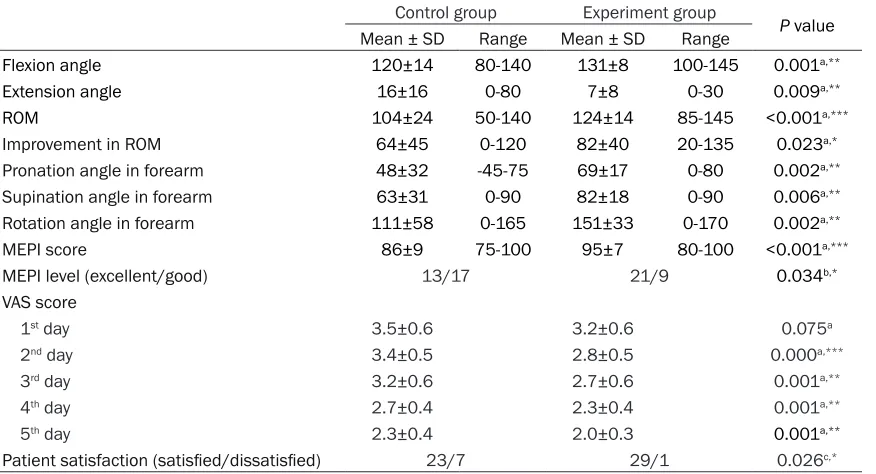
After the implementation of comprehensive re- habilitation nursing program, patients in experi-ment group achieved better elbow joint ROMs with greater improvements than patients in
[image:3.612.91.406.84.177.2]control group (all P<0.05). The MEPI score and percentage of excellent result evaluated by Table 2. Injury type and treatment in two groups
Injury Control group Experiment group
Gypsum ORIF ORIF + gypsum Gypsum ORIF ORIF + gypsum
Dislocation 1 1 0 3 0 1
Proximal ulna 1 1 5 0 1 4
Distal humerus 1 6 4 3 2 6
Radial head 0 3 1 0 0 3
Multiple fracture 0 3 3 0 4 3
Note: ORIF: open reduction and internal fixation; comparison of the injury type in two groups: χ2=3.867, P=0.145; comparison of the treatment methods in two groups: χ2=1.220,
P=0.875.
mance through the pain level, ROM, sta-bility, ADL and other aspects. The system is on a scale of 0-100
(score ≥90: excellent;
score 75-89: good; sc- ore 60-74: fair; score
<60, poor). The MEPI
scores in both groups and the percentage of excellent result (score
MEPI in experiment group were also higher
than those in control group (both P<0.05). VAS
scores in both groups were similar on the 1st day of the nursing program, whereas between the 2nd and 5th day, the scores in experiment
group were much lower (all P<0.05). In addition,
patient satisfaction in the experimental group
[image:4.612.92.530.87.324.2]was also much greater (P<0.05) as shown in
Table 3. Discussion
The elbow joint is a type of composite hinge joint that consists of three joints. Its function can be affected even by slight injuries. The mechanism behind elbow joint dysfunction after bone fracture repair is still unclear, and
scholars in the field of orthopedics are still
exploring ways for the effective treatment of this condition [18]. Currently, arthrolysis serves as a surgical method for improving elbow joint performance, however, patient’s involvement in functional training is also key to the recovery [19, 23].
The study found that the elbow joint ROM and its improvement in the experimental group
were significantly better than those in the con -trol group, indicating that the comprehensive rehabilitation nursing program can help im-
prove elbow joint ROM after arthrolysis, and enhance surgical effects. Some studies have reported that the rehabilitation nursing after operation can markedly increase the elbow joint ROM, which aligns with the results of our study [12]. Clinical practice has proven that functional training following the elbow joint sur-gery cannot be replaced by any alternatives. The exercises usually include a combination of muscle strength exercise and active exercise,
such as elbow flexion and extension, and fore -arm pronation and supination. The combination of exercise can help achieve good synergistic effects. A personalized and active rehabilita-tion plan can significantly improve the elbow
joint function [7]. The present study adopted a comprehensive rehabilitation nursing program featuring early functional training, in an effort to obtain optimal ROM and recovery of ADL. After nearly 6 months of functional treatment
and training, the flexion and extension ROMs as
well as rotation ROM in patients’ injured elbows could reach the excellent level, which was con-sistent with other studies [24].
Our study showed that the MEPI score in the experimental group (95±7) was much better than that in the control group (86±9). The per-centage of excellent results evaluated by using MEPI score in the experimental group was also Table 3. Comparison of treatment effects in two groups
Control group Experiment group
P value
Mean ± SD Range Mean ± SD Range
Flexion angle 120±14 80-140 131±8 100-145 0.001a,**
Extension angle 16±16 0-80 7±8 0-30 0.009a,**
ROM 104±24 50-140 124±14 85-145 <0.001a,***
Improvement in ROM 64±45 0-120 82±40 20-135 0.023a,*
Pronation angle in forearm 48±32 -45-75 69±17 0-80 0.002a,**
Supination angle in forearm 63±31 0-90 82±18 0-90 0.006a,**
Rotation angle in forearm 111±58 0-165 151±33 0-170 0.002a,**
MEPI score 86±9 75-100 95±7 80-100 <0.001a,***
MEPI level (excellent/good) 13/17 21/9 0.034b,*
VAS score
1st day 3.5±0.6 3.2±0.6 0.075a
2nd day 3.4±0.5 2.8±0.5 0.000a,***
3rd day 3.2±0.6 2.7±0.6 0.001a,**
4th day 2.7±0.4 2.3±0.4 0.001a,**
5th day 2.3±0.4 2.0±0.3 0.001a,**
Patient satisfaction (satisfied/dissatisfied) 23/7 29/1 0.026c,*
significantly higher. These findings displayed
that a comprehensive rehabilitation nursing program can improve the joint performance after elbow arthrolysis, enhance the surgical effects, and improve patient’s quality of life. Some studies reported that the postoperative rehabilitation nursing could increase elbow joint MEPI scores from 49.5±2.6 before opera-tion to 85.5±2.3 after operaopera-tion [12]. In the present study, we reinforced the early function-al training, in addition to the standardized man-agement of joint drainage, prevention of
het-erotopic ossification, and appropriate
cryoth-erapy, so that patient’s elbow joint performance and ADL could be improved, which was similar
to other research findings [8, 9].
In the study, we found that between 2nd and
5th day of the nursing program, the VAS score in the experimental group was significantly
lower than those in the control group. This sug-gested that the pain management adopted in the program could effectively relieve pain in patients who underwent elbow arthrolysis. Since much attention was paid to the pain management in the study, various measures were taken for controlling the pain after evalua-tion, which included the use of pain relieving device after operation, administration of anal-gesics for cases of mild pain, intramuscular injection of analgesics for cases of severe pain, and the application of cryotherapy. These mea-sures effectively controlled pain in patients and helped ensure compliance with functional training [14]. Since the pain after operation can negatively affect the early training, pain man-agement acts as a key component in the nurs-ing program. In the present study, standardized pain management was conducted and patients’ pain was controlled effectively, which was con-ducive to the implementation of early function-al training [13].
Since this study was a single-center study with a relatively small sample size, the results may not be applicable to all population. Hence, a multi-center study with a larger sample size would be necessary in the future, in order to support a wide application of the program. In conclusion, a comprehensive rehabilitation nursing program can be recommended for clini-cal application, as it can effectively control the pain, improve elbow joint ROM and perfor-mance, and promote the recovery by carrying
out postoperative pain management, standard-ized drainage management, measures for the
prevention of heterotopic ossification, appropri -ate cryotherapy, and early personalized func-tional training.
Disclosure of conflict of interest
None.
Address correspondence to: Yawen Chen, Depart- ment of Nursing, Shanghai Sixth People’s Hospital East Affiliated to Shanghai University of Medicine and Health Sciences, No.222 Huanhu Xisan Road, Pudong New Area, Shanghai City 201306, China. Tel: +86-18931077659; E-mail: cywhenaen@163. com
References
[1] Li XJ, He N, Xia Z, Ouyang Y, Wang CY, Ruan HY and Fan CY. Analysis of curative effect of ar-throlysis on the triad of old elbow injury. Chi-nese Journal of Orthopaedic Trauma 2013; 15: 357-359.
[2] Ma CH and Ning FY. Rehabilitation nursing af-ter the arthrolysis of elbow joint stiffness. The Journal of Traditional Chinese Orthopedics and Traumatology 2012; 24: 75-78.
[3] Wu JF, Guo GP, He LD, Pan QY, Ji Y and Pan XQ. Discussion on treatment of traumatic elbow joint dysfunction with floating-needle therapy combined with comprehensive rehabilitation. Zhejiang Clinical Medical Journal 2017; 19: 94-96.
[4] Zeng XD. Efficacy observation on comprehen-sive rehabilitation therapy for elbow joint dys-function after upper limb fracture. Contempo-rary Medicine 2016; 22: 81-82.
[5] Ruan HJ, Liu S, Fan CY and Liu JJ. Open arthrol-ysis and hinged external fixation for posttrau-matic ankylosed elbows. Arch Orthop Trauma Surg 2013; 133: 179-185.
[6] Ouyang Y, Wang Y, Li F and Fan C. Open release and a hinged external fixator for the treatment of elbow stiffness in young patients. Orthope-dics 2012; 35: e1365-1370.
[7] Dai M, Yang KY, Ai JB and Shuai L. Individual-ized rehabilitation treatment of elbow joint per-formance after the operation of distal humeral fractures in adult patients. Orthopedic Journal of China 2012; 20: 1257-1259.
[8] Rong K, Li XL, Xia QQ, Wu XH and Chen J. Clini-cal observation of elbow joint dysfunction after the fracture operation of upper limb with com-prehensive rehabilitation therapy. World Chi-nese Medicine 2016; 11: 580-581.
dysfunc-tion after fracture operadysfunc-tion of upper limb with comprehensive rehabilitation therapy. The Journal of Traditional Chinese Orthopedics and Traumatology 2014; 26: 36-38.
[10] Wang W, Liu JJ, Liu S, Ruan HJ, Li XJ and Fan CY. Arthrolysis combined with reconstruction for treatment of terrible triad injury with a poor outcome after surgical as well as conservative intervention. Arch Orthop Trauma Surg 2014; 134: 325-331.
[11] Chen S. Improvement of clinical symptoms and satisfaction of patients with gastrointestinal tumor complicated with intestinal obstruction by med nursing program. Today Nurse 2017; 88-91.
[12] Zhang CL, Sun SN and Sun Y. The evaluation of application efficacy of pain management among patients treated with elbow arthrolysis. Chinese Nursing Management 2014; 14: 805-807.
[13] Zhou XY and Xu HX. Postoperative rehabilita-tion nursing of patients with old injury of elbow joint treated with hinge external fixation. Chi-nese Manipulation & Rehabilitation Medicine 2011; 2: 38-39.
[14] Yang JC. Influence of nursing intervention on treatment compliance of patients with elbow release. Nursing Research of China 2017; 31: 752-753.
[15] Wang Y and Li Q. Nursing and functional exer-cise of arthroscopic elbow arthrolysis. Tianjin Journal of Nursing 2010; 18: 209.
[16] Cui GH. Clinical effect of comprehensive reha-bilitation therapy on elbow joint dysfunction after the fracture operation of upper limb. Chi-na JourChi-nal of Modern Medicine 2017; 19: 66-68.
[17] Liang LH. Effect of rehabilitation nursing on el-bow joint dysfunction. Chinese General Prac-tice Nursing 2010; 8: 2935-2936.
[18] Lin LP, Li T, Zhang J,Wang FY and Liu GY. Effect of hinged external fixator combined with open surgery on postoperative stifiness of elbow joint fracture. Chinese Journal of Gerontology 2015; 35: 3135-3136.
[19] Zong Y and Fan CY. Analysis of the causes of elbow joint dysfunction after distal humeral fracture. International Journal of Orthopaedics 2011; 32: 87-88.
[20] Wu SY. Observation on the effect of rehabilita-tion nursing of elbow joint dysfuncrehabilita-tion after elbow injury. Chinese Journal of Modern Drug Application 2010; 4: 198-199.
[21] Lin GM, Liu LL, Ye LJ, Li Q and Liu MF. Case-control study on comprehensive traditional Chinese medicine therapy for preventing post-surgical stiffness after operation for terrible triad of elbow. China Journal of Orthopaedics and Traumatology 2014; 27: 900-903. [22] Fu GY, Li W, Li MB, Su LW, Yang L, Luo LH, Jiang
HN and Liu SB. Observation of the efficacy of floating needle combined with rehabilitation in the treatment of dysfunction after elbow joint injury. Chinese Journal of Rehabilitation 2014; 29: 216-217.
[23] Cao HT, Zhao Y. Clinical efficacy analysis of sur-gical release of elbow joint dysfunction. Jilin Medical Journal 2014; 35: 1711-1712. [24] Shuai L, Feng Z. Effect of system rehabilitation