Original Article
Comprehensive nursing intervention decreases the
occurrence rate of patient’s complications during
chemotherapy for patients with lung cancer
Jinxiu Cui1, Jingjing Li2
Departments of 1Endocrinology, 2No.2 Respiratory Medicine, Zhucheng People’s Hospital, Weifang, Shandong,
China
Received May 30, 2018; Accepted July 25, 2018; Epub March 15, 2019; Published March 30, 2019
Abstract: Objective: To compare the application value of a comprehensive nursing intervention and a conventional
nursing protocol during chemotherapy for patients with lung cancer and assess its influence on patient respiratory
function. Method: We divided 208 patients who received lung cancer chemotherapy into a comprehensive group and conventional group, Clinical data, adverse reactions, quality of life assessment (EORTC QLQ-C30) results, and respiratory function of patients and their satisfaction with nursing and awareness rate of attentions were compared.
Results: Satisfaction with nursing was significantly higher in the comprehensive group (92.13%) than in the conven
-tional group (61.73%) (P < 0.01). The occurrence rate of complications in the comprehensive group was significantly lower than that in the conventional group (35.43% vs. 69.14%, respectively) (P < 0.01). The awareness rate of atten
-tions in the comprehensive groups (85.04%) was significantly higher than that in the conventional group (66.67%) (P < 0.01). The average EORTC QLQ-C30 score was 82.85 ± 8.22 points in the comprehensive group, which was significantly different from 67.37 ± 10.25 points in the conventional group (P < 0.01); this indicated that the results were significantly better in the comprehensive group than in the conventional group. Conclusions: A comprehensive
nursing intervention protocol during chemotherapy for patients with lung cancer leads to patients’ higher satisfac-tion with nursing, effectively decreases the occurrence rate of patient’s complicasatisfac-tions, and enhances the recovery of patient respiratory function.
Keywords: Comprehensive nursing, lung cancer, chemotherapy, respiratory function
Introduction
Lung cancer is the most common primary lung malignancy, and it mostly originates in the bronchiolar epithelium [1]. The worldwide
occurrence rate of lung cancer reached 26.85%
in 2015 according to the statistics of Brahmer et al. [2], making it the second most common malignancy [3]. The occurrence rate of lung cancer in regions with developed industries and larger population bases, such as England
and China, is significantly higher than that in
other regions [4]. Moreover, the results of mul-tiple studies conducted at home and abroad [5-7] reveal that the occurrence rate of lung cancer has been increasing yearly since 2010, along with increases in the number of motor vehicles and factories, and the number of patients from the city who develop lung cancer
is significantly higher than the number of
patients from rural areas.
At present, the pathogenesis of lung cancer is unknown, while lung cancer has the highest fatality rate of all malignancies [8]. The 5-year survival rate of patients with lung cancer is not
higher than 35.82% according to Fehrenbacher
et al. [9], and the death rate increases linearly each year. Lung cancer is always a popular focus of clinical research owing to its high mor-bidity and high death rate. As of yet, there have been no breakthrough research results regard-ing treatment of lung cancer, and surgical resection in combination with chemotherapy
remains the main curative approach. Fernandez
et al. [10] reported that the surgical removal of
lesions can be completed in about 82.24% of
radia-tion field can easily exhibit a series of inflamma -tory responses owing to radiation injury during postoperative chemotherapy [11]. Breathing disorders and lung function depression may occur in the case of slight injury, and serious
extensive pulmonary fibrosis that directly
endangers the life of patients may occur in the
case of heavy injury [12]. However, the findings
of Zhou et al. [13] show that the special nursing protocol plays an important role in the avoid-ance of secondary injury to patients with lung cancer caused by exposure to radiation during chemotherapy. At present, the application of a nursing protocol to patients with lung cancer at home and abroad remains controversial, whereas the study of Shin et al. [14] proved that the application of a comprehensive nursing intervention protocol during chemotherapy for patients with esophageal cancer effectively improves patient prognosis.
Therefore, we hypothesize that the application
value of a comprehensive nursing intervention during chemotherapy for patients with lung cancer was excellent. In the present study, patients who received lung cancer
chemothera-were as follows: serious cardiopulmonary and renal dysfunction; nerve dysfunction; cardioce-rebrovascular disease; other cancers; immune disease; infectious disease; physical disability; long-term bedridden state; gestational state; poor compliance; and transfer to other hospital midway through treatment period. After screen-ing, 208 patients were included in the study; these patients were divided into a sive group (127 patients, receiving comprehen-sive nursing intervention protocol) and a con-ventional group (81 patients, receiving conven-tional nursing protocol) based on the different nursing protocols practiced during chemother-apy at our hospital.
Method
[image:2.612.92.393.98.384.2]The nursing interventions in both groups of patients were performed strictly in accordance with the Guide for Nursing 2015 [15]. Contents of the nursing intervention in the conventional group included disease observation, medica-tion guide, and monitoring of vital signs. Comprehensive nursing intervention was per-formed in the comprehensive group based on Table 1. Comparison of clinical data between two groups of patients
[n (%)]
Comprehensive
Group (n = 127) Group (n = 81)Conventional Χ2 or t P Age 52.36 ± 8.43 53.08 ± 9.61 0.57 0.57 Body weight (KG) 79.34 ± 11.52 78.69 ± 12.87 0.38 0.71
Sex 0.20 0.66
Male 96 (75.59) 59 (72.84)
Female 31 (24.41) 22 (27.16)
Pathological location 0.24 0.63
Central type 49 (38.58) 34 (41.98) Surrounding type 78 (61.42) 47 (58.02)
Pathological type 0.43 0.51
Squamous cell carcinoma 71 (55.91) 49 (60.49) Adenocarcinoma 56 (44.09) 32 (38.51)
Pathological stage 0.55 0.46
I~II 39 (30.71) 21 (25.93)
III~IV 88 (69.29) 60 (74.07)
Place of residence 0.76 0.38
Urban 15 (11.81) 13 (16.05)
Country 112 (88.19) 68 (83.95)
Smoking < 0.01 0.94
Yes 6 (4.72) 4 (4.94)
No 121 (95.28) 77 (95.0600)
py and were treated with a comprehensive nursing intervention were retrosp- ectively examined to pro-vide clinically effective ref-erences and guidance. Materials and methods
General information
the protocol of the conventional group, and the contents included the requirement to commu-nicate further with patients, formulate
person-alized psychological counseling and health
guidance, carefully and patiently explain dis-ease-related knowledge and relevant informa-tion during chemotherapy to patients, encour-age patients to actively cooperate with the treatment, and channel the negative emotions of patients. A reasonable and healthy diet was formulated according to the personal physio-logical and dietary habits of patients, and crude
fiber foods with high protein and high fiber con
-tents were usually used. For patients experi -encing pain, shifting attention method was used, and analgesics were properly used on the premise of diagnosis and permission of a doc-tor. Nurses closely monitored the adverse reac-tions and vomiting of patients that resulted owing to chemotherapy; patients were intrave-nously infused with 20 mg of metoclopramide
and 100 mL of 5% glucose solution 1 h before
each chemotherapy session and were intrave-nously injected with 8 mg of ondansetron
with-in 4-6 h after chemotherapy. Forearm vewith-ins were the first choice for puncture, with a small amount of normal saline administered first and
the chemotherapy drug injected after comple-tion of the puncture. A chemotherapy regimen via a venous indwelling needle could be select-ed after the doctor communicatselect-ed with patients and their family members. Nurses would also
scoring system, in which 90 points and above were judged as excellent, 81-89 points were judged as good, 61-80 points were judged as general, and less than 60 points were judged as poor; excellent rate of satisfaction with nurs-ing = scornurs-ing as excellent + scornurs-ing as good); awareness rate of attentions; adverse tions (gastrointestinal reaction, allergic reac-tion, mucosal injury, bone marrow transplanta-tion, etc., number of patients with one or more complications); quality of life assessment
(using European Organization for Research and
Treatment of Cancer [EORTC] QLQ-C30 [16] for scoring; the scoring contents included physical function, role function, cognitive function, emo-tional function, and social function, and the higher the points, the better the situations); and patient’s respiratory function: draw 2 mL of radial artery blood from patients before chemo-therapy (T1), 7 days after chemochemo-therapy (T2), 14 days after chemotherapy (T3), and 21 days
after chemotherapy (T4), analyze the
alveolar-arterial oxygen tension difference (A-aDO2) and intrapulmonary shunt (Qs/Qt) by blood gas
ana-lyzer, and test the vital capacity (VC%) and max
-imum voluntary ventilation (MVV%) of patients.
Statistical analysis
SPSS 22.0 was used to analyze and handle the
data; measurement data, such as age, body weight, and quality of life score, were repre-Table 2. Comparison of nursing satisfaction between two groups
of patients [n (%)]
Comprehensive
Group (n = 127) Group (n = 81)Conventional Χ2 P
Excellent 86 (67.72) 11 (13.58)
Good 31 (24.41) 39 (48.15)
General 7 (5.51) 19 (23.46)
Difference 3 (2.36) 12 (14.81)
Excellent rate (%) 92.13 61.73 28.88 < 0.01
remind the patients to take a timely vitamin B supplement after each chemotherapy ses-sion and if myelosuppresses-sion occurred, chemotherapy was stopped immediately. When the level of white blood cells return to normal and be stable, chemotherapy was continued. Nurses would help and guide patients in simple rehabilita-tion training and would provide corresponding books, music, etc. to assist in patient relaxa- tion.
Observation index
[image:3.612.89.372.97.188.2]Clinical data of patients (such as age, course of disease, and pathological stage); general index: including satisfaction with nursing (using anonymity Table 3. Comparison of adverse reactions in two groups of
pa-tients [n (%)]
Comprehensive
Group (n = 127) Group (n = 81)Conventional Χ2 P Gastrointestinal reaction 34 (26.77) 49 (60.49)
Allergic reaction 29 (22.83) 42 (51.85) Mucosal injury 18 (14.17) 39 (48.15) Myelosup-pression 16 (12.60) 30 (37.04)
[image:3.612.92.371.235.325.2]sented with (X ± S), and the t-test was used for
comparison among groups. Enumeration data, such as patient’s sex, adverse reactions, and awareness rate of attentions, were presented
in percentage (%), and the chi-square test was
used for comparison among groups.
Results
Comparison of general information
To obtain accurate and effective experiment results, the age, body weight, course of dis-ease, sex, pathological type, pathological stage, place of residence, smoking history, etc. of patients were compared between the
two groups. No significant differences were
observed (P > 0.05), demonstrating that the patients in the two groups were comparable. See Table 1 for details.
Comparison of general index
The percentages of patients who were satisfied
with nursing, judged as excellent, good,
gener-al, and poor, were 67.72% (86 patients), 24.41% (31 patients), 5.51% (7 patients), and 2.36% (3
patients), respectively, in the comprehensive
group and 13.58% (11 patients), 48.15% (39 patients), 23.46% (19 patients), and 14.81%
(12 patients), respectively, in the conventional
group. Satisfaction with nursing was signifi
-cantly higher in the comprehensive group
(92.13%) than in the conventional group (61.73%) (P < 0.01) (Table 2).
Regarding complications, gastrointestinal reac-tion, allergic reacreac-tion, mucosal injury, and
myelosuppression occurred in 36.77% (34 patients), 22.83% (29 patients), 14.17% (18 patients), and 12.60% (16 patients) of patients,
respectively, in the comprehensive group and
in 60.49% (49 patients), 51.85% (42 patients), 48.15% (39 patients), and 37.04% (30 patients)
of patients, respectively, in the conventional group. The occurrence rate of complications in
patients in the comprehensive group (35.43%) was significantly lower than that in the conven
-tional group (69.14%) (P < 0.01) (Table 3).
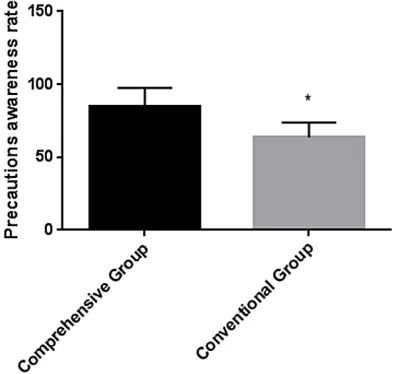
Moreover, the awareness rate of attentions of
patients in the comprehensive group (85.04%) was significantly higher than that in the conven
-tional group (66.67%) (P < 0.01) (Figure 1).
Comparison of EORTC QLQ-C30
The physical, role, cognitive, emotional, and
social functions were given scores of 81.26 ± 8.28, 79.57 ± 6.65, 85.18 ± 9.08, 81.95 ± 9.25, and 86.34 ± 7.85 points, respectively, in
the comprehensive group; these scores were
significantly better than those in the conven
-tional group (P < 0.01). The average EORTC
QLQ-C30 score in the comprehensive group
was 82.85 ± 8.22 points, which was statisti
-cally significantly higher than the 67.37 ± 10.25 points in the conventional group (P < 0.01). See
Table 4 for details.
Comparison of respiratory function
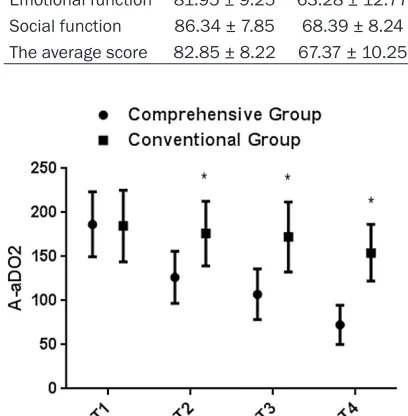
The A-aDO2 of patients at T1, T2, T3, and T4
was 184.64 ± 36.87, 126.46 ± 29.54, 107.26 ± 28.64, and 72.62 ± 22.34, respectively, in the comprehensive group and 184.82 ± 40.57, 176.25 ± 36.87, 172.36 ± 39.67, and 154.34 ±
32.12, respectively, in the conventional group.
There were no significant differences in the
A-aDO2 between the two groups at T1 (P > 0.05), whereas the A-aDO2 of patients at T2, T3,
and T4 was significantly higher in the conven -tional group than in the comprehensive group
(P < 0.05). The Qs/Qt of patients at T1, T2, T3, and T4 was 12.86 ± 1.87, 10.94 ± 1.64, 9.65 ± 1.42, and 9.02 ± 1.05, respectively, in the com
[image:4.612.90.287.74.261.2]-prehensive group and 12.73 ± 2.02, 12.74 ±
Figure 1. Comparison of the awareness rate of the
two groups of patients’ attention. *represents P <
0.05 compared with the integrated group.
Aware-ness in the comprehensive group is significantly
3.57, 11.57 ± 1.59, and 11.82 ± 2.25, respec -tively, in the conventional group. The Qs/Qt of
patients in the two groups was not significantly
different at T1 (P > 0.05), whereas the Qs/Qt of patients at T2, T3 and T4 in the conventional
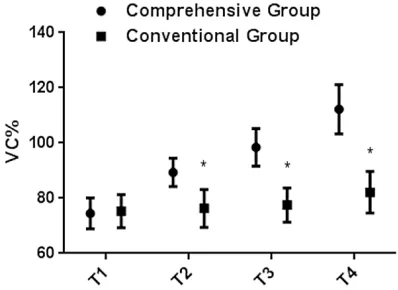
group was significantly higher than that of patients in the comprehensive group (P < 0.05). The VC% of patients at T1, T2, T3, and T4 was 74.53 ± 5.62, 89.37 ± 5.16, 98.42 ± 6.81, and 112.24 ± 8.96, respectively, in the comprehen
-sive group and 75.33 ± 6.01, 76.28 ± 6.84, 77.52 ± 6.24, and 82.15 ± 7.54, respectively, in the conventional group. The VC% of patients demonstrated no significant differences
between the groups at T1 (P > 0.05), whereas
the VC% of patients at T2, T3, and T4 was sig
-nificantly lower in the conventional group than in the comprehensive group (P < 0.05). The MVV% of patients at T1, T2, T3, and T4 was
comprehensive group (P < 0.05). See Figures 2-5 for details.
Discussion
Lung cancer is one of the most common malig-nancies in the human body, and its death rate is the highest among all malignance [17]. There are no obvious characteristics in the early stage of lung cancer as patients do not often receive timely diagnosis and treatment owing to the lack of medical knowledge. Therefore, the majority of patients with lung cancer are in the middle-to-late stage at the time of diagnosis and thus miss the prime treatment window [18]. At present, surgical resection in combina-tion with chemoradiotherapy remains the most common lung cancer treatment modality, although the lengthy period, painful process, and expensive cost of treatment pose a tre-mendous burden for patients and their family member [18]. Increasing numbers of studies [19-21] have shown that different nursing
pro-tocols directly result in different clinical findings
in patients with lung cancer. A modality that can effectively replace the traditional regimen for the cure of lung cancer has not been researched and developed clinically; thus, the nursing protocol used with patients becomes a
major influencing factor that may be controlled
clinically. At present, the appropriate nursing care for patients with lung cancer during che-motherapy remains unknown. Our hypothesis,
[image:5.612.93.356.101.204.2]in which we analyze relevant factors experi -enced by patients with lung cancer during che-motherapy together with relevant literature, is that the application of a comprehensive nurs-ing intervention protocol has a higher value. We screened study subjects strictly in accordance with the inclusion and exclusion criteria for Table 4. Comparison of two groups of patients
EORTCQLQ-C300
Comprehensive
Group (n = 127) Group (n = 81)Conventional t P Physical function 81.26 ± 8.28 62.12 ± 11.62 13.86 < 0.01
Role function 79.57 ± 6.65 72.71 ± 8.06 6.67 < 0.01
Cognitive function 85.18 ± 9.08 70.35 ± 10.58 10.76 < 0.01
Emotional function 81.95 ± 9.25 63.28 ± 12.77 12.21 < 0.01
Social function 86.34 ± 7.85 68.39 ± 8.24 15.77 < 0.01
The average score 82.85 ± 8.22 67.37 ± 10.25 12.01 < 0.01
Figure 2. Comparison of two groups of patients’ A-aDO2. *represents P < 0.05 compared with the in -tegrated group. The A-aDO2 of the comprehensive
group is significantly lower than that of the conven -tional group. The integrated group shows a steady decline, whereas the conventional group shows no
significant changes.
80.34 ± 4.24, 98.42 ± 8.21, 115.37 ±5.69, and 131.85 ± 6.96,
respectively, in the comprehensive
group and 81.05 ± 5.05, 82.34 ± 6.74, 86.43 ± 6.94, and 90.21 ±
4.84, respectively, in the
conven-tional group. There were no signifi
-cant differences in MVV% between
the groups at T1 (P > 0.05),
where-as the MVV% of patients at T2, T3, and T4 was significantly lower in
[image:5.612.88.292.171.379.2]data analysis to verify our hypothesis, with the aim of providing a credible guide for other healthcare providers in future clinical work with patients.
The results of this study showed that the com-prehensive group using a comcom-prehensive
nurs-ing intervention scored significantly better than
the conventional group using a conventional nursing protocol with respect to measures of nursing satisfaction, complications, respiratory function, and EORTC QLQ-C30 score, and the
root cause of clinical findings of patients in the
two groups was the intervention influence of
nursing protocol through analysis. The patients with lung cancer were affected by tension, mel-ancholy, dysphoria, despair, and other negative emotions [22], whereas those in the
compre-hensive group were given specific psychologi -cal guidance, and the nurses patiently intro-duced the successful treatment to help the patients eliminate unhealthy emotions, main-tain an optimistic attitude, and improve
self-confidence during hospitalization and to allow
[image:6.612.322.519.71.230.2]the patients and their family members to be able to actively cooperate with the treatment, thus improving the nursing service, satisfaction with nursing, and nursing prognosis. During communication, the patients had certain knowledge and understanding of their diseas-es, and the occurrence of secondary recur-rence was also greatly avoided. During chemo-therapy, the dietary intervention provided to patients ensured that they met the standard of daily nutritional intake that is required to improve immunity, increase resistance to dis-ease, and decrease the probability of occur-rence of complications. During chemotherapy, vomiting and anorexia are very common adverse reactions [23], and injections of meto-clopramide and ondansetron can effectively alleviate peristalsis and metabolism of gastro-intestinal function and reduce the probability of occurrence of gastrointestinal reaction. As che-motherapy drugs are irritants and a misopera-tion can cause phlebitis in patients, which directly damages the surrounding tissues and Figure 3. Comparison of Qs/Qt between two groups
of patients. *represents P < 0.05 compared with the
integrated group. The Qs/Qt of the comprehensive
group is significantly lower than that of the conven -tional group. The integrated group shows a steady decline, while the conventional group shows no
[image:6.612.92.287.73.232.2]sig-nificant changes.
Figure 4. Comparison of VC% in both groups. *repre
-sents P < 0.05 compared with the integrated group. The VC% of the comprehensive group is significantly
higher than that of the conventional group. The inte-grated group shows steady upward trend while the
conventional group shows no significant changes.
Figure 5. Comparison of MVV% between two groups. *represents P < 0.05 compared with integrated group. The MVV% in comprehensive group is signifi -cantly higher than that in conventional group. Inte-grated group shows steady upward trend while
[image:6.612.89.288.336.481.2]results in necrosis [24], puncturing the thick forearm veins with better elasticity during selection of a puncture point can effectively avoid secondary injury caused by chemothera-py drugs. Oral vitamin B supplements also pre-vent the occurrence of oral ulcers caused by chemotherapy, further improving patient
prog-nosis. These findings are also consistent with
the results obtained by Sheng et al. [25], pro-viding support for the viewpoint of the present study. Observation of changes in lung function indices in the two groups showed that all indi-ces of patients in the two groups improved, and the improvement in all indices in the
compre-hensive group was more significant and steady,
indicating that the application of a
comprehen-sive nursing intervention is more beneficial to
the rehabilitation of patient lung function. Through the application of glucocorticoids, the exudation of lung tissue can be effectively reduced, but dosage should be strictly con-trolled during administration to prevent drug resistance and side effects. Also in the course of chemotherapy, patients generally suffered from pulmonary dysfunction. Movement guid-ance and rehabilitation training accelerate the recovery of body functions of patients and the enhancement of body resistance. The immunity was enhanced as well so that recovery of lung
function was better, thus VC% and MVV% were bound to increase significantly. Close monitor
-ing of patient’s vital signs is more beneficial for
the physical rehabilitation of patients.
In the present study, patients with lung cancer receiving a comprehensive nursing interven- tion during chemotherapy and patients receiv-ing conventional nursreceiv-ing were compared. Limitations of the study include the smaller study population, relative homogeneity of study subjects, and relatively narrow age range of the study participants. In the future, we will per-form a long-term tracking investigation of the subjects in this study and complete and improve the experimental design to achieve optimal experiment results.
In conclusion, compared with that of a conven-tional nursing protocol, the application of a comprehensive nursing internal protocol during chemotherapy for patients with lung cancer achieves higher satisfaction with nursing and can effectively improve the occurrence rate of patient’s complications and enhance the recov-ery of patient’s respiratory function. The com-prehensive nursing protocol can thus be clini-cally applied.
Disclosure of conflict of interest
None.
Address correspondence to: Jingjing Li, Department of No.2 Respiratory Medicine, Zhucheng People’s Hospital, No.59, Nanhuan Road, Weifang 262200, Shandong, China. Tel: +86-0536-6212678; E-mail: [email protected]
References
[1] Rizvi NA, Hellmann MD, Snyder A, Kvistborg P,
Makarov V, Havel JJ, Lee W, Yuan J, Wong P and Ho TS. Mutational landscape determines sensitivity to PD-1 blockade in non-small cell lung cancer. Science 2015; 348: 124-128. [2] Brahmer J, Reckamp KL, Baas P, Crinò L,
Eberhardt WE, Poddubskaya E, Antonia S,
Pluzanski A, Vokes EE and Holgado E.
Nivolumab versus docetaxel in advanced squamous-cell non-small-cell lung cancer. N Engl J Med 2015; 373: 123-135.
[3] Herbst RS, Baas P, Kim DW, Felip E,
Pérez-Gracia JL, Han JY, Molina J, Kim JH, Arvis CD
and Ahn MJ. Pembrolizumab versus docetaxel
for previously treated, PD-L1-positive, advan- ced non-small-cell lung cancer (KEYNOTE-010): a randomised controlled trial. Lancet 2016; 387: 1540-1550.
[4] Borghaei H, Paz-Ares L, Horn L, Spigel DR, Steins M, Ready NE, Chow LQ, Vokes EE, Felip
E and Holgado E. Nivolumab versus docetaxel in advanced nonsquamous non-small-cell lung cancer. N Engl J Med 2015; 373: 1627-1639. [5] Garon EB, Rizvi NA, Hui R, Leighl N,
Balmanoukian AS, Eder JP, Patnaik A, Aggarwal
C, Gubens M and Horn L. Pembrolizumab for
the treatment of non-small-cell lung cancer. N Engl J Med 2015; 372: 2018-2028.
[6] Rizvi NA, Mazières J, Planchard D, Stinchcombe TE, Dy GK, Antonia SJ, Horn L, Lena H, Minenza
E and Mennecier B. Activity and safety of nivolumab, an anti-PD-1 immune checkpoint inhibitor, for patients with advanced, refractory squamous non-small-cell lung cancer (Check- Mate 063): a phase 2, single-arm trial. Lancet Oncol 2015; 16: 257-265.
[7] Reck M, Rodríguez-Abreu D, Robinson AG, Hui R, Csőszi T, Fülöp A, Gottfried M, Peled N, Tafreshi A and Cuffe S. Pembrolizumab versus
chemotherapy for PD-L1-positive non-small-cell lung cancer. N Engl J Med 2016; 375: 1823-1833.
[8] Gettinger SN, Horn L, Gandhi L, Spigel DR,
Antonia SJ, Rizvi NA, Powderly JD, Heist RS,
advanced non-small-cell lung cancer. J Clin Oncol 2015; 33: 2004.
[9] Fehrenbacher L, Spira A, Ballinger M, Kowanetz M, Vansteenkiste J, Mazieres J, Park K, Smith D, Artal-Cortes A and Lewanski C. Atezolizumab
versus docetaxel for patients with previously treated non-small-cell lung cancer (POPLAR): a multicentre, open-label, phase 2 randomised controlled trial. Lancet 2016; 387: 1837-1846. [10] Fernandez FG, Kosinski AS, Burfeind W, Park
B, DeCamp MM, Seder C, Marshall B, Magee
MJ, Wright CD and Kozower BD. The Society of
Thoracic Surgeons lung cancer resection risk model: higher quality data and superior out-comes. Ann Thorac Surg 2016; 102: 370-377. [11] Rizvi NA, Hellmann MD, Brahmer JR, Juergens
RA, Borghaei H, Gettinger S, Chow LQ, Gerber DE, Laurie SA and Goldman JW. Nivolumab in combination with platinum-based doublet che-
motherapy for first-line treatment of advanced
non-small-cell lung cancer. J Clin Oncol 2016; 34: 2969-2979.
[12] Soria JC, Wu YL, Nakagawa K, Kim SW, Yang JJ, Ahn MJ, Wang J, Yang JC, Lu Y, Atagi S, Ponce S, Lee DH, Liu Y, Yoh K, Zhou JY, Shi X, Webster
A, Jiang H, Mok TS. Gefitinib plus chemothera
-py versus placebo plus chemothera-py in
EGFR-mutation-positive non-small-cell lung cancer
after progression on first-line gefitinib
(IMP-RESS): a phase 3 randomised trial. Lancet Oncol 2015; 16: 990-998.
[13] Zhou C, Wu Y, Chen G, Feng J, Liu XQ, Wang C, Zhang S, Wang J, Zhou S and Ren S. Final over -all survival results from a randomised, phase III study of erlotinib versus chemotherapy as
first-line treatment of EGFR mutation-positive
advanced non-small-cell lung cancer (OPTIM- AL, CTONG-0802). Ann Oncol 2015; 26: 1877-1883.
[14] Shin SR and Park KY. Comparing satisfaction with nursing care and factors relevant to
hospi-tal revisit intent among hospihospi-talized patients in
comprehensive nursing care units and general care units. Journal of Korean Academy of Nursing Administration 2015; 21: 469-479. [15] Billings DM and Halstead JA. Teaching in
nurs-ing-e-book: a guide for faculty. Elsevier Health Sciences 2015.
[16] Ayana BA, Negash S, Yusuf L, Tigeneh W and Haile D. Reliability and validity of Amharic ver-sion of EORTC QLQ-C 30 questionnaire among gynecological cancer patients in Ethiopia. PLoS One 2016; 11: e0157359.
[17] Takeda M, Okamoto I and Nakagawa K. Pooled
safety analysis of EGFR-TKI treatment for EGFR
mutation-positive non-small cell lung cancer. Lung Cancer 2015; 88: 74-79.
[18] Oxnard GR, Thress KS, Alden RS, Lawrance R,
Paweletz CP, Cantarini M, Yang JC, Barrett JC
and Jänne PA. Association between plasma ge-notyping and outcomes of treatment with osimertinib (AZD9291) in advanced non-small-cell lung cancer. J Clin Oncol 2016; 34: 3375.
[19] Goldstraw P, Chansky K, Crowley J, Rami-Porta R, Asamura H, Eberhardt WE, Nicholson AG, Groome P, Mitchell A and Bolejack V. The IASLC Lung Cancer Staging Project: proposals for re-vision of the TNM stage groupings in the
forth-coming (eighth) edition of the TNM classifica -tion for lung cancer. J Thorac Oncol 2016; 11: 39-51.
[20] Langer CJ, Gadgeel SM, Borghaei H, Papa-
dimitrakopoulou VA, Patnaik A, Powell SF, Gentzler RD, Martins RG, Stevenson JP and
Jalal SI. Carboplatin and pemetrexed with or
without pembrolizumab for advanced,
non-squamous non-small-cell lung cancer: a ran-domised, phase 2 cohort of the open-label KEYNOTE-021 study. Lancet Oncol 2016; 17: 1497-1508.
[21] Ettinger DS, Wood DE, Akerley W, Bazhenova
LA, Borghaei H, Camidge DR, Cheney RT, Chirieac LR, D’Amico TA, Demmy TL, Dilling TJ, Dobelbower MC, Govindan R, Grannis FW Jr,
Horn L, Jahan TM, Komaki R, Krug LM, Lackner RP, Lanuti M, Lilenbaum R, Lin J, Loo BW Jr, Martins R, Otterson GA, Patel JD, Pisters KM, Reckamp K, Riely GJ, Rohren E, Schild SE, Shapiro TA, Swanson SJ, Tauer K, Yang SC, Gregory K, Hughes M; National comprehensive cancer network. Non-small cell lung cancer, version 6.2015. J Natl Compr Cancer Netw 2015; 13: 515-524.
[22] Holland JC and Alici Y. Management of distress in cancer patients. J Support Oncol 2010; 8: 4-12.
[23] Senan S, Brade A, Wang LH, Vansteenkiste J,
Dakhil S, Biesma B, Martinez Aguillo M, Aerts
J, Govindan R and Rubio-Viqueira B. PROCLAIM:
randomized phase III Trial of pemetrexed-cispl -atin or etoposide-cispl-atin plus thoracic radia-tion therapy followed by consolidaradia-tion chemo-therapy in locally advanced nonsquamous non-small-cell lung cancer. J Clin Oncol 2016; 34: 953-962.
[24] Eberhardt WE, Pöttgen C, Gauler TC, Friedel G,
Veit S, Heinrich V, Welter S, Budach W, Spengler W and Kimmich M. Phase III study of surgery
versus definitive concurrent chemoradiothera -py boost in patients with resectable stage IIIA (N2) and selected IIIB non-small-cell lung can-cer after induction chemotherapy and concur-rent chemoradiotherapy (ESPATUE). J Clin Oncol 2015; 33: 4194-4201.
[25] Sheng J, Fang W, Yu J, Chen N, Zhan J, Ma Y,
![Table 1. Comparison of clinical data between two groups of patients [n (%)]](https://thumb-us.123doks.com/thumbv2/123dok_us/297409.529304/2.612.92.393.98.384/table-comparison-clinical-data-groups-patients-n.webp)
![Table 2. Comparison of nursing satisfaction between two groups of patients [n (%)]](https://thumb-us.123doks.com/thumbv2/123dok_us/297409.529304/3.612.92.371.235.325/table-comparison-nursing-satisfaction-groups-patients-n.webp)