Predicting the resolution of referring expressions from user behavior
Nikos Engonopoulos1 Mart´ın Villalba1 Ivan Titov2 Alexander Koller1 1University of Potsdam, Germany 2University of Amsterdam, Netherlands
{nikolaos.engonopoulos, martin.villalba}@uni-potsdam.de
[email protected], [email protected]
Abstract
We present a statistical model for predicting how the user of an interactive, situated NLP system resolved a referring expression. The model makes an initial prediction based on the meaning of the utterance, and revises it con-tinuously based on the user’s behavior. The combined model outperforms its components in predicting reference resolution and when to give feedback.
1 Introduction
Speakers and listeners in natural communication are engaged in a highly interactive process. In order to achieve some communicative goal, the speaker will perform an utterance which they believe has a high chance of achieving that goal. They will then moni-tor the listener’s behavior to see whether this goal is actually being achieved. This process is a core part of what is commonly called grounding in the dia-logue literature (see e.g. (Clark, 1996; Traum, 1994; Paek and Horvitz, 1999; Hirst et al., 1994)). Inter-active computer systems that are to carry out an ef-fective and efficient conversation with a user must model this grounding process, and should ideally re-spond to the user’s observed behavior in real time. For instance, if the user of a pedestrian navigation system takes a wrong turn, the system should inter-pret this as evidence of misunderstanding and bring the user back on track.
We focus here on the problem of predicting how the user has resolved areferring expression (RE)that was generated by the system, i.e. a noun phrase that is intended to identify some object uniquely to the listener. A number of authors have recently offered
statistical models for parts of this problem. Golland et al. (2010) and Garoufi and Koller (2011) have presented log-linear models for predicting how the listener will resolve a given RE in a given scene; however, these models do not update the probabil-ity model based on observing the user’s reactions. Nakano et al. (2007), Buschmeier and Kopp (2012), and Koller et al. (2012) all predict what the listener understood based on their behavior, but do not con-sider the RE itself in the model. The models of Frank and Goodman (2012) and Vogel et al. (2013) aim at explaining the effect of implicatures on the listener’s RE resolution process in terms of hypothe-sized interactions, but do not actually support a real-time interaction between a system and a user.
In this paper, we show how to predict how the listener has resolved an RE by combining a statis-tical model of RE resolution based on the RE itself with a statistical model of RE resolution based on the listener’s behavior. To our knowledge, this is the first approach to combine two such models ex-plicitly. We consider the RE grounding problem in the context of interactive, situated natural language generation (NLG) for the GIVE Challenge (Koller et al., 2010a), where NLG systems must generate real-time instructions in virtual 3D environments. Our evaluation is based on interaction corpora from the GIVE-2 and GIVE-2.5 Challenges, which contain the systems’ utterances along with the behavior of human hearers in response to these utterances. We find that the combined model predicts RE resolu-tion more accurately than each of the two compo-nent models alone. We see this as a first step towards implementing an actual interactive system that per-forms human-like grounding based on our RE reso-lution model.
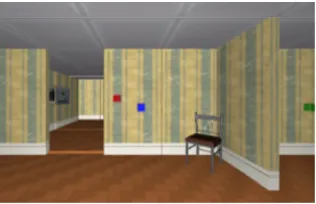
Figure 1: An example scene in the GIVE environment.
2 Problem definition
In the GIVE Challenge, an interactive NLG system faces the task of guiding a human instruction fol-lower (IF) through a treasure-hunt game in a vir-tual 3D environment (see Fig. 1). To complete the task, the IF must press a number of buttons in the correct order; these buttons are the colored boxes in Fig. 1, and are scattered all over the virtual environ-ment. The IF can move around freely in the virtual environment, but has no prior knowledge about the world. The NLG system’s task is to guide the IF to-wards the successful completion of the treasure-hunt task. To this end, it is continuously being informed about the IF’s movements and visual field, and can generate written utterances at any time. As a com-parative evaluation effort, the GIVE Challenges con-nected NLG systems to thousands of users over the Internet (see e.g. Koller et al. (2010a) for details).
Many system utterances aremanipulation instruc-tions, such as “press the blue button”, containing an RE in the form of a definite NP. We call a given part of an interaction between the system and the IF an
episodeof that interaction if it starts with a manip-ulation instruction, ends with the IF performing an
action (i.e., pressing a button), and contains only IF movements and no further utterances in between. Not all manipulation instructions initiate an episode, because the system may decide to perform further utterances (not containing REs) before the IF per-forms their action. An NLG system will choose the RE for an instruction at runtime out of potentially many semantically valid alternatives (“the blue but-ton”, “the button next to the chair”, “the button to the right of the red button”, etc.). Ideally, it will pre-dict which of these REs has the highest chance to be understood by the IF, given the current scene, and utter an instruction that uses this RE.
After uttering the manipulation instruction, the system needs to ascertain whether the IF understood the RE correctly, i.e. it must engage in grounding. A naive grounding mechanism might wait until the IF actually presses a button and check whether it was the right one. This is what many NLG systems in the GIVE Challenges actually did. However, this can make the communication ineffective (IF performs many useless actions) and risky (IF may press the wrong button and lose). Thus, it is important that the system updates its prediction of how the IF resolved the RE continuously by observing the IF’s behavior,
before the actual button press. For instance, if the IF walks towards the target, this might reinforce the system’s belief in a correct understanding; turning away or exiting the room could be strong evidence of the opposite. The system can then exploit the up-dated prediction to give the IF feedback (“no, the
bluebutton”) to prevent costly mistakes.
We address these challenges by estimating the probability distribution over the possible objects to which the IF may resolve the RE. We then update this distribution in real time by observing the IF’s movements. More specifically, assume that a sys-tem tries to refer to some objecta∗among some set
Aof available objects. Given an RErgenerated for
a∗ at timet0, the state of the worldsatt0, and the observed behavior σ(t) of the user at t ≥ t0, we estimate the probabilityp(a|r, s, σ(t))that the user resolvedrto an objecta∈A. When generating the instruction, an optimal NLG system will use the RE
rthat maximizesp(a∗|r, s, σ(t0)). It can then track
p(a|r, s, σ(t))for time pointst > t0 throughout the episode, and generate feedback whenp(a0|r, s, σ(t))
exceedsp(a∗|r, s, σ(t)) for some a0 6= a∗; that is, when the updated probability distribution predicts that the IF resolvedrto an incorrect button.
3 A model of RE resolution
In order to model the distribution over possible ob-jects, we assume the following generative story: when receiving an instruction containing an RErat a given world states, the IF resolves it to an object
a; depending on the objecta, the IF then moves to-wards it, exhibiting behaviorσ. These assumptions correspond to the following factorization:
The posterior probability distribution over objectsa
can be obtained by applying the Bayes rule and us-ing the above assumptions:
p(a|r, s, σ)∝p(a|r, s)p(a|σ)/p(a)
For simplicity, we assume a uniform p(a) over all objects in a world. We can thus representp(a|r, s, σ)
as the normalized product of a semantic model
psem(a|r, s) and anobservationalmodelpobs(a|σ).
We use log-linear models for both, and train them separately. The feature functions we use only con-sider general properties of objects (such as color and distance), and not the identity of the objects them-selves. This means that we can train a model on one virtual environment (containing a certain set of ob-jects), and then apply the model to another virtual environment, containing a different set of objects.
Semantic model The semantic model estimates for each objectain the environment the initial prob-ability psem(a|r, s) that the IF will understand a
given REr uttered in a scenesas referring toa. It represents the meaning ofr, contextualized tos, and is only ever evaluated at the timet0of the utterance. The features used by this model are:
• Semantic features aim to encode whether r
is a good description of a. IsColorModifying
evaluates to 1 ifa’s color appears as an adjec-tive modifying the head noun of r, e.g. “the blue button”. IsRelPosModifying evaluates to 1 ifa’s relative position to the IF is mentioned as an adjective inr, e.g. “the left button”.
• Confusion featurescapture the hypothesis that the IF may be confused by the description of a landmark when resolving the RE; e.g. an RE like “the button next to the red button” might confuse the IF into pressing a red button, rather than the one meant by the system. These are the same features as in the Semantic case, but looking for modifier keywords in the entire RE, including the head.
• Salience featuresaccount for the fact that an IF is more likely to resolvertoaifawas visu-ally salient ins. IsVisibleevaluates to 1 ifais visible to the IF ins. IsInRoomevaluates to 1 if the IF andaare in the same room. IsTarget-InFront evaluates to 1 if the angular distance
towardsa, i.e. the absolute angle between the
camera direction and the straight line from the IF toa, is less than π4. VisualSalience approx-imates the visual salience of Kelleher and van Genabith (2004), a weighted count of the num-ber of pixels on whichais rendered (pixels near the center of the screen have higher weights).
Observational model The observational model estimates for each objectathe probabilitypobs(a|σ)
that the IF will interact witha, given the IF’s recent behaviorσ(t) = (σ1, . . . , σn), whereσi is the state
of the world at timet−(i−1)·500ms, andn≥1
is the length of the observed behavior. pobs is
con-stantly re-evaluated for timest > t0as the IF moves around.pobsuses the following features:
• Linear distance featuresassume that the clos-est button is also the one the IF understood. In-Roomreturns the number of framesσi inσ in
which the IF andaare in the same room. But-tonDistancereturns the distance between the IF andaatσ1divided by a constant such that the result never exceeds 1. If a is neither in the same room nor visible, the feature returns 1.
• Angular distance featuresanalyze the direc-tion in which the IF looks. TargetInFront re-turns the angular distance towardsaatσ1.
An-gleToTarget returns TargetInFront divided by
π, or 1 if a is neither in the same room nor visible. LinearRegAngleTo applies linear re-gression to a list of observed angular distances towards a over all frames σi, and returns the
slope of the regression as a measure of varia-tion. Negative values indicate that the IF turned towardsa, while positive values mean the op-posite. If ais neither visible nor in the same room as the IF atσi, the angle is set toπ. • Combined distance feature: a weighted sum
of linear and angular distance towardsa, called
overall distancein Koller et al. (2012).
• Salience features capture visual salience and its change over time. DefiningVSias the result
of applying thepsem featureVisualSalienceto
σianda,LastVisualSaliencereturnsVSn. Lin-earRegVisualSalienceapplies linear regression to all valuesVSiand returns the slope as a
mea-sure of change in salience. VisualSalienceSum
most reliable predictor of the IF’s intentions.
• Binary featuresaim to detect concrete behav-ior patterns:LastIsVisibleapplies thepsem
fea-tureIsVisibletoσ1, andIsCloseevaluates to 1 if the IF is close enough and correctly oriented to manipulateain the GIVE environment atσ1.
4 Evaluation
Data We evaluated our model using data from the GIVE-2 (Koller et al., 2010b) and the GIVE-2.5 Challenges (Striegnitz et al., 2011), obtained from GIVE Organizers (2012). These datasets constitute
interaction corpora, in which the IF’s activities in the virtual environment were recorded along with the utterances automatically generated by the par-ticipating NLG systems. The data consists of 1833 games for GIVE-2 and 687 games for GIVE-2.5.
To extract training data for our model from the GIVE-2.5 data, we first identified moments in the recorded data where the IF pressed a button. From these, we discarded all instances from the tutorial phase of the GIVE game and those that happened within 200 ms after the previous utterance, as these clearly didn’t happen in response to it. This yielded 6478 training instances for pobs, each consisting of
σ at 1 second before the action, and the button a
which the IF pressed. We chose n = 4 for rep-resentingσ, except to ensure that the features only considered IF behavior that happened in response to an utterance. We achieved this by reducingnfor the first few frames after each utterance, such that the time of σn was always after the time of the
utter-ance. Finally, we selected those instances which are episodes in the sense of Section 2, i.e. those in which the last utterance before the action contained an RE
r. This gave us 3414 training instances for psem,
each consisting ofa,r, the timet0of the utterance, and the world statesat timet0.
We obtained test instances from the GIVE-2 data in the same way. This yielded 5028 instances, each representing an episode. We chose GIVE-2 for test-ing because the mean episode length is higher (3.3s, vs. 2.0s in GIVE-2.5), thus making the evaluation more challenging. Feature selection was done using the training data and a similar dataset from Koller et al. (2012). Note that the test data and training data are based on distinct sets of three virtual
environ-●
● ●
●
0.0
0.2
0.4
0.6
Accur
acy
● combined semantic observational KGSC random visible
(a)
● ●
● ●
−3 −2 −1 0
0.0
0.2
0.4
0.6
Time before action (sec)
Accur
acy
● combined semantic observational KGSC random visible
[image:4.612.314.533.58.306.2](b)
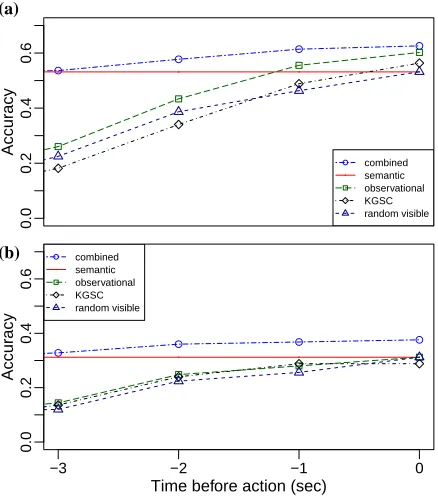
Figure 2: Prediction accuracy for (a) all episodes, (b) un-successful episodes as a function of time.
ments each, and were obtained with different NLG systems and users. This demonstrates the ability of our model to generalize to unseen environments.
An example video showing our models’ predic-tions on some training episodes can be found at
http://tinyurl.com/re-demo-v.
Prediction accuracy We first evaluated the abil-ity of our model to predict the button to which the IF resolved each RE. For each test instance
hr, s, σ, ai, we compare the object returned by
arg maxap(a|r, s, σ(t)) to the one manipulated by the IF. We call the proportion of correctly classified instances theprediction accuracy.
Fig. 2a compares our model’s prediction accuracy to that of several baselines. We plot prediction ac-curacy as a function of the time at which the model is queried for a prediction, by evaluating at 3s, 2s, 1s, and 0s before the button press. The graph is based on the 2094 test instances with an episode length of at least three seconds, to ensure that re-sults for different prediction times are comparable. As expected, prediction accuracy increases as we ap-proach the time of the action. Furthermore, the com-bined model outperforms both psem and pobs
pro-vide complementary useful information. Our model also outperforms two more baselines: KGSC pre-dicts that the IF will press the button with the min-imal overall distance, which is the distance metric used by the “movement-based system” of Koller et al. (2012); random visible selects a random button from the ones that are currently visible to the IF.
The fact that this last baseline does not approach 1 at action time suggests that multiple buttons tend to be visible when the IF presses one, confirming that the prediction task is not trivial.
Correctly predicting the button that the IF will press is especially useful, and challenging, in those cases where the IF pressed a different button than the one the NLG system intended. Fig. 2b shows a closer look at the 125 unsuccessful episodes of at least three seconds in the test data. These tend to be hard instances, and thus as expected, prediction accuracy drops for all systems. However, by inte-grating semantic and observational information, the combined model compensates better for this than all other systems, with an accuracy of 37.6% against 31.2% for each individual component.
Feedback appropriateness Second, we evaluated the ability of our model to predict whether the user misunderstood the RE and requires feedback. For all the above models, we assumed a simple feedback mechanism which predicts that the user misunder-stood the RE ifp(a0)−p(a∗) > θ for some object
a0 6=a∗, whereθis a confidence threshold; we used
θ = 0.1here. We can thus test on recorded data in which no actual feedback can be given anymore.
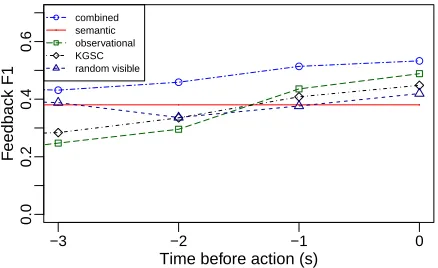
We evaluated the models on the 848 test episodes of at least 3s in which the NLG systems logged the button they tried to refer to. The results are shown in Fig. 3 in terms of F1 measure. Here precision is the proportion of instances in which the IF pressed the wrong button (i.e., where feedback should have been given) among the instances where the model actually suggested feedback. Recall is the propor-tion of instances in which the model suggested feed-back among the instances where the IF pressed the wrong button. Again, the combined model outper-forms its components and the baselines, primarily due to increased recall. The difference is particu-larly pronounced early on, which would be useful in giving timely feedback in an actual real-time system.
● ●
● ●
−3 −2 −1 0
0.0
0.2
0.4
0.6
Time before action (s)
F
eedback F1
[image:5.612.314.533.60.194.2]● combined semantic observational KGSC random visible
Figure 3: Feedback F1-measure as a function of time.
5 Conclusion and future work
We presented a statistical model for predicting how a user will resolve the REs generated by an interac-tive, situated NLG system. The model continuously updates an initial estimate based on the meaning of the RE with a model of the user’s behavior. It out-performs its components and two baselines on pre-diction and feedback accuracy.
Our model captures a real-time grounding process on the part of the interactive system. We thus believe that it provides a solid foundation for detecting mis-understandings and generating suitable feedback in an end-to-end dialogue system. We have presented our model in terms of a situated dialogue setting, where clues about what the hearer understood can be observed directly. However, we believe that the fun-damental mechanism should apply to other domains as well. This would amount to finding observable linguistic and non-linguistic clues of hearer under-standing that can be used as features ofpobs.
The immediate next step for future research is to extend our model to an implemented end-to-end situated NLG system for the GIVE Challenge, and evaluate whether this actually improves task perfor-mance. This requires, in particular, to compute the RE that is optimal with respect topsem. We will
fur-thermore improvepobs by switching to a more
tem-porally dynamic probability model.
References
Hendrik Buschmeier and Stefan Kopp. 2012. Adapting language production to listener feedback behaviour. In Proceedings of the Interdisciplinary Workshop on Feedback Behaviors in Dialog.
Herbert C. Clark. 1996. Using Language. Cambridge University Press.
Michael C. Frank and Noah D. Goodman. 2012. Predict-ing pragmatic reasonPredict-ing in language games. Science, 336(6084):998.
Konstantina Garoufi and Alexander Koller. 2011. Com-bining symbolic and corpus-based approaches for the generation of successful referring expressions. In Pro-ceedings of the 13th European Workshop on Natural Language Generation (ENLG).
GIVE Organizers. 2012. Give challenge web-site: Corpora. http://give-challenge.org/
research/page.php?id=corpora.
Dave Golland, Percy Liang, and Dan Klein. 2010. A game-theoretic approach to generating spatial descrip-tions. In Proceedings of the 2010 Conference on Empirical Methods in Natural Language Processing (EMNLP).
Graeme Hirst, Susan McRoy, Peter Heeman, Philip Ed-monds, and Diane Horton. 1994. Repairing conver-sational misunderstandings and non-understandings. Speech Communications, 15:213–229.
J. D. Kelleher and J. van Genabith. 2004. Visual salience and reference resolution in simulated 3-D environ-ments. Artificial Intelligence Review, 21(3).
Alexander Koller, Kristina Striegnitz, Donna Byron, Jus-tine Cassell, Robert Dale, Johanna Moore, and Jon Oberlander. 2010a. The First Challenge on Generat-ing Instructions in Virtual Environments. In E. Krah-mer and M. Theune, editors, Empirical Methods in Natural Language Generation, number 5790 in LNCS, pages 337–361. Springer.
Alexander Koller, Kristina Striegnitz, Andrew Gargett, Donna Byron, Justine Cassell, Robert Dale, Johanna Moore, and Jon Oberlander. 2010b. Report on the Second NLG Challenge on Generating Instructions in Virtual Environments (GIVE-2). InProceedings of the 6th International Natural Language Generation Con-ference (INLG).
Alexander Koller, Konstantina Garoufi, Maria Staudte, and Matthew Crocker. 2012. Enhancing referential success by tracking hearer gaze. InProceedings of the 13th Annual SIGdial Meeting on Discourse and Dia-logue (SIGDIAL), Seoul.
Yukiko Nakano, Kazuyoshi Murata, Mika Enomoto, Yoshiko Arimoto, Yasuhiro Asa, and Hirohiko Sagawa. 2007. Predicting evidence of understanding by monitoring user’s task manipulation in multimodal
conversations. InProceedings of the ACL 2007 Demo and Poster Sessions.
Tim Paek and Eric Horvitz. 1999. Uncertainty, utility, and misunderstanding: A decision-theoretic perspec-tive on grounding in conversational systems. InAAAI Fall Symposium on Psychological Models of Commu-nication in Collaborative Systems.
Kristina Striegnitz, Alexandre Denis, Andrew Gargett, Konstantina Garoufi, Alexander Koller, and Mariet Theune. 2011. Report on the Second Second Chal-lenge on Generating Instructions in Virtual Environ-ments (GIVE-2.5). In Proceedings of the 13th Eu-ropean Workshop on Natural Language Generation (ENLG).
David Traum. 1994. A computational theory of ground-ing in natural language conversation. Ph.D. thesis, University of Rochester.