Event Schema Induction with a Probabilistic Entity-Driven Model
Nathanael Chambers United States Naval Academy
Annapolis, MD 21402 [email protected]
Abstract
Event schema induction is the task of learning high-level representations of complex events (e.g., abombing) and their entity roles (e.g., perpetrator andvictim) from unlabeled text. Event schemas have important connections to early NLP research on frames and scripts, as well as modern applications like template extraction. Recent research suggests event schemas can be learned from raw text. In-spired by a pipelined learner based on named entity coreference, this paper presents the first generative model for schema induction that in-tegrates coreference chains into learning. Our generative model is conceptually simpler than the pipelined approach and requires far less training data. It also provides an interesting contrast with a recent HMM-based model. We evaluate on a common dataset for template schema extraction. Our generative model matches the pipeline’s performance, and out-performs the HMM by 7 F1 points (20%).
1 Introduction
Early research in language understanding focused on high-level semantic representations to drive their models. Many proposals, such as frames and scripts, used rich event schemas to model the situations de-scribed in text. While the field has since focused on more shallow approaches, recent work on schema induction shows that event schemas might be learn-able from raw text. This paper continues the trend, addressing the question, can event schemas be in-duced from raw text without prior knowledge? We present a new generative model for event schemas,
and it produces state-of-the-art induction results, in-cluding a 7 F1 point gain over a different generative proposal developed in parallel with this work.
Event schemasare unique from most work in in-formation extraction (IE). Current relation discovery (Banko et al., 2007a; Carlson et al., 2010b) focuses on atomic facts and relations. Event schemas build relations into coherent event structures, often called
templatesin IE. For instance, an election template jointly connects thatobama won a presidential elec-tionwithromney was the defeated,the election oc-curred in 2012, andthe popular vote was 50-48. The entities in these relations fill specific semantic roles, as in this template schema:
Template Schema for Elections
(events: nominate, vote, elect, win, declare, concede) Date: Timestamp
Winner: Person Loser: Person Position: Occupation Vote: Number
Traditionally, template extractors assume fore-knowledge of the event schemas. They know a Win-ner exists, and research focuses on supervised learn-ing to extract winners from text. This paper focuses on the other side of the supervision spectrum. The learner receives no human input, and it first induces a schema before extracting instances of it.
Our proposed model contributes to a growing line of research in schema induction. The majority of previous work relies on ad-hoc clustering algo-rithms (Filatova et al., 2006; Sekine, 2006; Cham-bers and Jurafsky, 2011). ChamCham-bers and Jurafsky is a pipelined approach, learning events first, and later learning syntactic patterns as fillers. It requires
several ad-hoc metrics and parameters, and it lacks the benefits of a formal model. However, central to their algorithm is the use of coreferring entity men-tions to knit events and entities together into an event schema. We adapt this entity-driven approach to a single model that requires fewer parameters and far less training data. Further, experiments show state-of-the-art performance.
Other research conducted at the time of this pa-per also proposes a generative model for schema in-duction (Cheung et al., 2013). Theirs is not entity-based, but instead uses a sequence model (HMM-based) of verb clauses. These two papers thus pro-vide a unique opportunity to compare two very dif-ferent views of document structure. One is entity-driven, modeling an entity’s role by its coreference chain. The other is clause-driven, classifying indi-vidual clauses based on text sequence. Each model makes unique assumptions, providing an interest-ing contrast. Our entity model outperforms by 7 F1 points on a common extraction task.
The rest of the paper describes in detail our main contributions: (1) the first entity-based gen-erative model for schema induction, (2) a direct pipeline/formal model comparison, (3) results im-proving state-of-the-art performance by 20%, and (4) schema induction from the smallest amount of training data to date.
2 Previous Work
Unsupervised learning for information extraction usually learns binary relations and atomic facts. Models can learn relations likePerson is married to Personwithout labeled data (Banko et al., 2007b), or rely on seed examples for ontology induction (dog is a mammal) and attribute extraction (dogs have tails) (Carlson et al., 2010b; Carlson et al., 2010a; Huang and Riloff, 2010; Durme and Pasca, 2008). These do not typically capture the deeper connections mod-eled by event schemas.
Algorithms that do focus on event schema extrac-tion typically require both the schemas and labeled corpora, such as rule-based approaches (Chinchor et al., 1993; Rau et al., 1992) and modern super-vised classifiers (Freitag, 1998; Chieu et al., 2003; Bunescu and Mooney, 2004; Patwardhan and Riloff, 2009; Huang and Riloff, 2011). Classifiers rely on
the labeled examples’ surrounding context for fea-tures (Maslennikov and Chua, 2007). Weakly su-pervised learning removes some of the need for la-beled data, but most still require the event schemas. One common approach is to begin with unlabeled, but clustered event-specific documents, and extract common word patterns as extractors (Riloff and Schmelzenbach, 1998; Sudo et al., 2003; Riloff et al., 2005; Filatova et al., 2006; Patwardhan and Riloff, 2007; Chen et al., 2011). Bootstrapping with seed examples of known slot fillers has been shown to be effective (Yangarber et al., 2000; Surdeanu et al., 2006).
Shinyama and Sekine (2006) presented unre-stricted relation discovery to discover relations in unlabeled documents. Their algorithm used redun-dant documents (e.g., all describe Hurricane Ivan) to observe repeated proper nouns. The approach re-quires many documents about the exact same event instance, and relations are binary (not schemas) over repeated named entities. Our model instead learns
schemas from documents with mixed topics that don’t describe the same event, so repeated proper nouns are less helpful.
Chen et al. (2011) perform relation extraction with no supervision on earthquake and finance do-mains. Theirs is a generative model that represents relations as predicate/argument pairs. As with oth-ers, training data is pre-clustered by event type and there is no schema connection between relations.
This paper builds the most on Chambers and Ju-rafsky (2011). They learned event schemas with a three-stage clustering algorithm that included a re-quirement to retrieve extra training data. This paper removes many of these complexities. We present a formal model that uniquely models coreference chains. Advantages include a joint clustering of events and entities, and a formal probabilistic inter-pretation of the resulting schemas. We achieve better performance, and do so with far less training data.
win-message: id dev-muc3-0112 (bellcore, mitre) incident: date 10 mar 89
incident: location peru: huanuco, ambo (town) incident: type bombing
incident: stage accomplished incident: instrument explosive: ”-”
perp: individual ”shining path members” perp: organization ”shining path”
Figure 1: A subset of the slots in a MUC-4 template.
dow for event transitions. Their model was created in parallel with our work, and provides a nice con-trast in both approach and results. Ours outperforms their model by 20% on a MUC-4 evaluation.
In summary, this paper extends most previous work on event schema induction by removing the supervision. Of the recent ‘unsupervised’ work, we present the first entity-driven generative model, and we experiment on a mixed-domain corpus.
3 Dataset: The MUC-4 Corpus
The corpus from the Message Understanding Con-ference (MUC-4) serves as the challenge text (Sund-heim, 1991), and will ground discussion of our model. MUC-4 is also used by the closest previ-ous work. It contains Latin American newswire about terrorism events, and it provides a set of hand-constructed event schemas that are tradition-ally called template schemas. It also maps labeled templates to the text, providing a dataset for tem-plate extraction evaluations. Until very recently, only extraction has been evaluated. We too evalu-ate our model through extraction, but we also com-pare our learned schemas to the hand-created tem-plate schemas. An example of a filled in MUC-4 template is given in Figure 1.
The MUC-4 corpus defines six template types:
Attack, Kidnapping, Bombing,Arson,Robbery,
andForced Work Stoppage. Documents are often
labeled with more than one template and type. Many include multiple events at different times in different locations. The corpus is particularly challenging be-cause template schemas are inter-mixed and entities can play multiple roles across instances.
The training corpus contains 1300 documents, 733 of which are labeled with at least one schema. 567 documents are not labeled with any schemas.
These unlabeled documents are articles that report on non-specific political events and speeches. They make the corpus particularly challenging. The de-velopment and test sets each contain 200 documents.
4 A Generative Model for Event Schemas
This paper’s model is an entity-based approach, sim-ilar in motivation to Haghighi and Klein (2010) and the pipelined induction of Chambers and Jurafsky (2011). Coreference resolution guides the learning by providing a set of pre-resolved entities. Each entity receives a schema role label, so it allowsall mentions of the entity to inform that role choice. This important constraint links coreferring mentions to the same schema role, and distinguishes our ap-proach from others (Cheung et al., 2013).
4.1 Illustration
The model represents a document as a set of enti-ties. An entity is a set of entity mentions clustered by coreference resolution. We will use the following two sentences for illustration:
A truck bomb exploded near the embassy. Three militia planted it, and then they fled.
This text contains five entity mentions. A perfect coreference resolution system will resolve these five mentions into three entities:
Entity Mentions Entities Roles
a truck bomb (a truck bomb, it) Instrument the embassy (the embassy) Target three militia (three militia, they) Perpetrator it
they
The schema roles, or templateslots, are the type of target knowledge we want to learn. Each en-tity will be labeled with both a slot variable sand a template variable t (e.g., the s=perpetrator of a
t=bombing). The lexical context of the entity men-tions guides the learning model to this end.
4.2 Definitions
A documentd∈Dis represented as a set of entities
Ed. Each entitye∈Edis a triple:e= (h, M, F)
1. heis the canonical word for the entity (typically
Text
A truck bomb exploded near the embassy. Three militia planted it, and then they fled.
Entity Representation
entity 1: h =bomb, F ={PHYS-OBJ},
M ={(p=explode, d=subject-explode) (p=plant, d=object-plant)}
entity 2: h =militia, F ={PERSON, ORG}, M ={(p=plant, d=subject-plant),
(p=flee, subject-flee)}
[image:4.612.325.543.269.386.2]entity 3: h =embassy, F ={PHYS-OBJ, ORG}, M ={(p=explode, d=prep near-explode)}
Figure 2: Example text mapped to our entities.
2. Meis a set of entity mentionsm ∈ Me. Each
mention is a pairm= (p, d): the predicate, and the typed dependency from the predicate to the mention (e.g.,pushandsubject-push).
3. Feis a set of binary entity features. This paper
only uses named entity types as features, but generalizes to other features as well.
A document is thus reduced to its entities, their grammatical contexts, and entity features. Figure 2 continues our example using this formulation. heis
chosen to bee’s longest non-pronoun mentionm∈
Me. Mentions are labeled with NER and WordNet
synsets to create an entity’s featuresFe ⊆ {Person, Org, Loc, Event, Time, Object, Other}. We use the Stanford NLP toolkit to parse, extract typed depen-dencies, label with NER, and run coreference.
4.3 The Generative Models
Similar to topics in LDA, each documentd in our model has a corresponding multinomial overschema typesθd, drawn from a Dirichlet. For each entity in
the document, a hidden variabletis drawn accord-ing toθd. Thesetvariables represent the high level
schema types, such asbombingorkidnapping. The predicates associated with each of the entity’s men-tions are then drawn from the schema’s multinomial over predicates Pt. The variable t also generates
a hidden variablesfrom its distribution over slots, such asperpetratorandvictim. Finally, the entity’s canonical head word is generated fromβs, all entity
mentions’ typed dependencies from δs, and named
entity types fromγs.
The most important characteristic of this model is the separation of event words from the lexical properties of specific entity mentions. The schema type variablestonly model the distribution of event words (bomb, plant, defuse), but the slot variables
s model the syntax (subject-bomb, subject-plant, object-arrest) and entity words (suspect, terrorist, man). This allows the high-level schemas to first se-lect predicates, and then forces predicate arguments to prefer slots that are in the parent schema type.
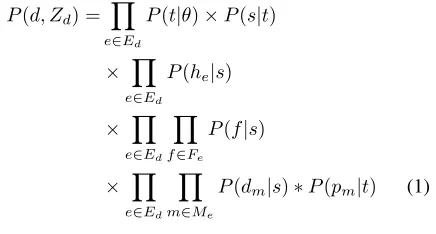
Formally, a document d receives a labeling Zd
where each entity e ∈ Ed is labeledZd,e = (t, s)
with a schema typetand a slots. The joint distribu-tion of a document and labeling is then as follows:
P(d, Zd) = Y e∈Ed
P(t|θ)×P(s|t)
× Y
e∈Ed
P(he|s)
× Y
e∈Ed
Y
f∈Fe
P(f|s)
× Y
e∈Ed
Y
m∈Me
P(dm|s)∗P(pm|t) (1)
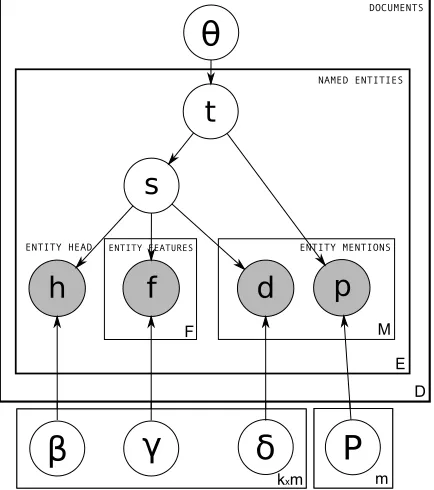
The plate diagram for the model is given in Fig-ure 3. The darker circles correspond to the observed entity components in Figure 2. We assume the fol-lowing generative process for a documentd:
Generateθdfrom Dir(α)
foreach schema typet= 1...mdo GeneratePtfrom Dir(η)
foreach slotst= 1...kdo Generateβsfrom Dir(µ)
Generateγsfrom Dir(ν)
Generateδsfrom Dir(ϕ)
foreach entitye∈Eddo
Generateschema typetfrom Multinomial(θd)
Generateslotsfrom UniformDist(k)
Generatehead wordhfrom Multinomial(βs)
foreach mentionm∈Medo
Generatepredicate tokenpfrom Multinomial(Pt) Generatetyped dependencydfrom Multinomial(δs) foreach entity typei= 1..|Fe|do
Generateentity typef from Multinomial(γs)
s
h
d
θ
f
β
γ
δ
k
E M F
t
v
V
m
s
h
d
θ
f
β
γ
δ
kxm
D E M F
t
p
P
m
NAMED ENTITIES
ENTITY MENTIONS ENTITY FEATURES
ENTITY HEAD
[image:5.612.310.535.51.228.2]DOCUMENTS
Figure 3: The full plate diagram for the event schema model. Hyper-parameters are omitted for readability.
The Flat Relation Model
We also experiment with aFlat Relation Modelthat removes the hidden t variables, ignoring schema types. Figure 4 visually compares this flat model with the full model. We found that the predicate distribution Pt hurts performance in a flat model.
Predicates are more informative at the higher level, but less so for slots where syntax is more important. We thus removedPtfrom the model, and everything
else remains the same. This flat model now learns a large set of k slots S that aren’t connected by a high-level schema variable. Each slots ∈ S has a corresponding triple of multinomials(h, M, F) sim-ilar to above: (1) a multinomial over the head men-tionsβs, (2) a multinomial over the grammatical
re-lations of the entity mentionsδs, and (3) a
multino-mial over the entity features γs. For each entity in
a document, a hidden slots∈Sis first drawn from Θ, and then the observed entity(h, M, F)is drawn according to the multinomials(βs, γs, δs). We later
evaluate this flat model to show the benefit of added schema structure.
4.4 Inference
We use collapsed Gibbs sampling for inference, sampling the latent variables te,d and se,d in
se-s
d
θ
δ
k D E M
h
β
s
d
θ
δ
k
D E M
t
p
P
|T|
h
[image:5.612.78.295.57.302.2]β
Figure 4: Simplified plate diagrams comparing the flat relation model to the full template model. The observed
f ∈Fvariables are not included for clarity.
quence conditioned on a full setting of all the other variables (Griffiths and Steyvers, 2004). Initial pa-rameter values are set by randomly setting tands
variables from the uniform distribution over schema types and slots, then computing the other parameter values based on these initial settings. The hyperpa-rameters for the dirichlet distributions were chosen from a small grid search (see Experiments).
Beyond standard inference, we added one con-straint to the model that favors grammatical distri-butionsδsthat do not contain conflicts. The subject
and direct object of a verb should not both receive high probability mass under the same schema slot
δs. For instance, thevictimof akidnappingshould
not favor both the subject and object of a single verb. Semantic roles should (typically) select one syntac-tic slot, so this constraint encourages that behavior. During sampling ofse,d, we use a penalty factorλ
to make conflicting relations less likely. Formally,
P(se,d = s|θ, he, Fe, Me) = λ iff there exists an
m ∈ Me such thatP(m|σs) < P(inv(m)|σs)and
P(inv(m)|σs) > 0.1, where inv(m) = object if
m=subjectand vice versa. Otherwise, the proba-bility is computed as normal. We normalize the dis-tributions after penalties are computed.
4.5 Entity Extraction for Template Filling
ad-ditional complexity. To evaluate the effectiveness of the model, we apply the model to perform standard template extraction on MUC-4. Previous MUC-4 induction required an extraction algorithm separate from induction because induction created hard clus-ters (Chambers and Jurafsky, 2011). Cluster scores don’t have a natural interpretation, so extraction re-quired several parameters/thresholds to tune. Our model instead simply relies on model inference.
We run inference as described above and each en-tity receives a template labelte,dand a template slot
labelse,d. These labels are the extractions, and it
re-quires no other parameters. The model thus rere-quires far less machinery than a pipeline, and the exper-iments below further show that this simpler model outperforms the pipeline.
Beyond parameters, the question of “irrelevant” documents is a concern in MUC-4. Approximately half the corpus are documents that are not labeled with a template, so past algorithms required extra processing stages to filter out these irrelevant doc-uments. Patwardhan and Riloff (2009) and Cham-bers and Jurafsky (2011) make initial decisions as to whether they should extract or not from a document. Huang and Riloff (2011) use a genre detector for this problem. Even the generative HMM-based model of Cheung et al. (Cheung et al., 2013) requires an ex-tra filtering parameter. Our formal model is unique in not requiring additional effort. Ours is the only approach that doesn’t require document filtering.
5 Evaluation Setup
Evaluating on MUC-4 has a diverse history that complicates comparison. The following balances comparison against previous work and enables fu-ture comparison to our results.
5.1 Template Schema Slots
Most systems do not evaluate performance on all MUC-4 template slots. They instead focus on four main slots, ignoring the parameterized slots that in-volve deeper reasoning (such as ‘stage of execution’ and ‘effect of incident’). The four slots and example entity fillers are shown here:
Perpetrator: Shining Path members
Victim: Sergio Horna
Target: public facilities
Instrument: explosives
We also focus only on these four slots. We merged MUC’s two perpetrator slots (individuals and orgs) into one gold Perpetrator. Previous work has both split the two and merged the two. We merge them because the distinction between an individual and an organization is often subtle and not practically important to analysts. This is also consistent with the most recent event schema induction in Chambers and Jurafsky (2011) and Cheung et al. (2013).
One peculiarity in MUC-4 is that some templates are labeled as optional (i.e., all its slots are optional), and some required templates contain optional slots (i.e., a subset of slots are optional). We ignore both optional templates and specific optional slots
when computing recall, as in previous work (Pat-wardhan and Riloff, 2007; Pat(Pat-wardhan and Riloff, 2009; Chambers and Jurafsky, 2011).
Comparison between the extracted strings and the gold template strings uses head word scoring. We do not use gold parses for the text, so head words are defined simply as the rightmost word in the noun phrase. The exception is when the extracted phrase is of the form “A of B”, then the rightmost word in “A” is used as the head. This is again consistent with previous work1. The standard evaluation metrics are precision, recall, and F1 score.
5.2 Mapping Learned Slots
Induced schemas need to map to gold schemas be-fore evaluation. Which learned slots correspond to MUC-4 slots? There are two methods of mapping. The first ignores the schema type variables t, and simply finds the best performingsvariable for each gold template slot2. We call this theslot-only map-pingevaluation. The second approach is to map each template variabletto the best gold template typeg, and limit the slot mapping so that only the slots un-dertcan map to slots underg. We call this the tem-plate mapping evaluation. The slot-only mapping can result in higher scores since it is not constrained to preserve schema structure in the mapping.
Chambers and Jurafsky (2011) used template mapping in their evaluation. Cheung et al. (2013) used slot-only mapping. We run both evaluations in this paper and separately compare both.
1
Personal communications with Patwardhan and Riloff 2
6 Experiments
We use the Stanford CoreNLP toolkit for text pro-cessing and parsing. We developed the models on the 1300 document MUC-4 training set. We then learned once on the entire 1700 training/dev/test set, and report extraction numbers from the inferred la-bels on the 200 document test set. Each experiment was repeated 10 times. Reported numbers are aver-aged across these runs.
There are two structure variables for the model: the number of schema types and the number of slots under each type. We searched for the optimal values on the training set before evaluating on test. The hyperparameters for all evaluations were set toα=
η=µ=ν = 1,ϕ=.1based on a grid search.
6.1 Template Schema Induction
The first evaluation compares the learned schemas to the gold schemas in MUC-4.
Since most previous work assumes this knowl-edge ahead of time, we align our schemas with the main MUC-4 template types to measure quality. We inspected the learned event schemas that mapped to MUC-4 schemas based on thetemplate mapping ex-traction evaluation.
Figure 5 shows some of the learned distribu-tions for two mapped schemas: kidnappings and bombings. The predicate distribution for each event schema is shown, as well as the top 5 head words and grammatical relations for each slot. The words and events that were jointly learned in these exam-ples appear quite accurate. The bombing and kidnap schemas learned all of the equivalent MUC-4 gold slots. Interestingly, our model also learned Loca-tions and Times as important entities that appear in the text. These entities are not traditionally included in the MUC-4 extraction task.
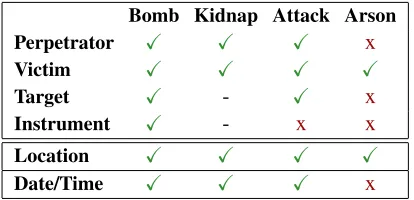
Figure 6 lists the MUC-4 slots that we did and did not learn for the four most prevelant types. We report 71% recall, with almost all errors due to the model’s failure to learn about arsons. Arson tem-plates only occur in 40 articles, much less than the 200 bombing and over 400 attack. We show below that overall extraction performs well despite this. The learned distributions for Attack end up extract-ing Arson perpetrators and Arson victims in the ac-tual extraction evaluation.
Bomb Kidnap Attack Arson
Perpetrator X X X x
Victim X X X X
Target X - X x
Instrument X - x x
Location X X X X
[image:7.612.324.531.54.154.2]Date/Time X X X x
Figure 6: The MUC-4 gold slots that were learned. The bottom two are not in the traditional evaluation, but were learned by our model nonetheless.
Evaluation: Template Mapping
[image:7.612.322.531.216.269.2]Prec Recall F1 C & J 2011 .48 .25 .33 Formal Template Model .42 .27 .33
Table 1: MUC-4 extraction with template mapping. A learned schema first maps to a gold MUC template. Learned slots can then only map to slots in that template.
6.2 Extraction Experiments
We now present the full extraction experiment that is traditionally used for evaluating MUC-4 per-formance. Although our learned schemas closely match gold schemas, extraction depends on how well the model can extract from diverse lexical con-texts. We ran inference on the full training and test sets, and used the inferred labels as schema labels. These labels were mapped and evaluated against the gold MUC-4 labels as discussed in Section 5.
Performance is compared to two state-of-the-art induction systems. Since these previous two mod-els used different methods to map their learned schemas, we compare separately. Table 1 shows the
template mappingevaluation with Chambers and Ju-rafsky (C&J). Table 2 shows theslot-only mapping
evaluation with Cheung et al.
Kidnapping Entities Victim(Person 88%)
businessman object-kidnap citizen object-release Soares prep of-kidnapping
Kent possessive-release hostage object-found
Perpetrator(Person 62%, Org 30%) guerrilla subject-kidnap
ELN subject-hold group subject-attack extraditables subject-demand
man subject-announce
Date(TimeDate 89%) TIME tmod-kidnap February prep on-kidnap
hours tmod-release morning prep on-release
night tmod-take
Bombing Entities
Victim(Person 86%, Location 8%) person object-kill guerrilla object-wound
soldier subject-die man subject-blow up civilian subject-try
Physical Target(Object 65%, Event 42%) building object-destroy
office object-damage explosive object-use
station and-office vehicle prep of-number
Instrument(Event 56%, Object 39%) bomb subject-explode explosion subject-occur
[image:8.612.82.561.64.225.2]attack object-cause charge object-place device subject-destroy
Figure 5: Select distributions for two learned events. Left columns are head word distributionsβ, right columns are syntactic relation distributionsδ, and entity types in parentheses are the learnedγ. Most probable words are shown.
Evaluation: Slot-Only Mapping
[image:8.612.322.530.273.327.2]Prec Recall F1 Cheung et al. 2013 .32 .37 .34 Flat Relation Model .26 .45 .33 Formal Template Model .41 .41 .41
Table 2: MUC-4 extraction with slot-only mapping. Any learned slot is allowed to map to any gold slot.
Entity Role Performance
Prec Recall F1 Perpetrator .40 .20 .26
Victim .42 .31 .34
Target .38 .28 .31
Instrument .57 .39 .45
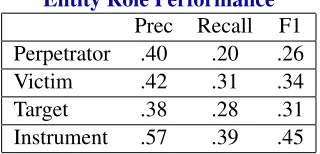
Table 3: Results for each MUC-4 template slot using the template-mapping evaluation.
The macro-level F1 scores can be broken down into individual slot performance. Table 3 shows these results ranging from .26 to .45. The Instrument role proves easiest to learn, consistent with C&J.
A large portion of MUC-4 includes irrelevant documents. Cheung et al. (2013) evaluated their model without irrelevant documents in the test set that to see how performance is affected. We com-pare against their numbers in Table 4. Results are closer now with ours outperforming .46 to .43 F1. This suggests that the HMM-based approach stum-bles more on spurious documents, but performs bet-ter on relevant ones.
Gold Document Evaluation
[image:8.612.79.292.279.343.2]Prec Recall F1 Cheung et al. 2013 .41 .44 .43 Formal Template Model .49 .43 .46
Table 4: Full MUC-4 extraction withgold document clas-sification. These results ignore false positives extracted from “irrelevant” documents in the test set.
6.3 Model Ablation
Table 2 shows that the flat relation model (no latent type variablest) is inferior to the full schema model. F1 drops 20% without the explicit modeling of both schema types tand their entity slots s. The entity features Fe are less important. Experiments
with-out them show a slight drop in performance (2 F1 points), small enough that they could be removed for efficiency. However, it is extremely useful to learn slots with NER labels like Person or Location.
Finally, we experimented without the sub-ject/object constraint (Section 4.4). Performance drops 5-10% depending on the number of schemas learned. Anecdotally, it merges too many schema slots that should be separate. We recommend using this constraint as it has little impact on CPU time.
6.4 Extension: Reduce Training Size
[image:8.612.106.266.394.471.2]docu-ments from an external corpus. This paper’s genera-tive model doesn’t require such a stage.
We thus attempted to induce and extract event schemas from just the 200 test set documents, with no training or development data. We repeated this experiment 30 times and averaged the results, setting the number of templatest= 20and slotss= 10as in the main experiment. The resulting F1 score for the template-mapping evaluation fell to 0.27 from the full data experiment of 0.33 F1. Adding more training documents in another experiment did not significantly increase performance over 0.27 until all training and development documents were in-cluded. This could be explained by the develop-ment set being more similar to the test set than train-ing. We did not investigate further to prevent over-experimentation on test.
7 Discussion
Our model is one of the first generative formula-tions of schema induction. It produces state-of-the-art performance on a traditional extraction task, and performs with less training data as well as a more complex pipelined approach. Further, our unique entity-driven approach outperforms an HMM-based model developed in parallel to this work.
Our entity-driven proposal is strongly influenced by the ideas in the pipeline model of Chambers and Jurafsky (2011). Coreference chains have been used in a variety of learning tasks, such as narrative learn-ing and summarization. Here we are the first to show how it can be used for schema induction in a proba-bilistic model, connecting predicates across a docu-ment in a way that is otherwise difficult to represent. The models perform similarly, but ours also includes significant benefits like a reduction in complexity, reproducibility, and a large reduction in training data requirements.
This paper also implies that learning and ex-traction need not be independent algorithms. Our model’s inference procedure to learn schemas is the same one that labels text for extraction. C&J re-quired 3-4 separate pipelined steps. Cheung et al. (2013) required specific cutoffs for document classi-fication before extraction. Not only does our model perform well, but it does so without these steps.
Highlighted here are key differences between this
proposal and the HMM-based model of Cheung et al. (2013). One of the HMM strengths is the in-clusion of sequence-based knowledge. Each slot la-bel is influenced by the previous lala-bel in the text, encouraging syntactic arguments of a predicate to choose the same schema. This knowledge is only loosely present in our document distributionθ. Che-ung et al. also include a hidden event variable be-tween the template and slot variables. Our model collapses this event variable and makes fewer depen-dency assumptions. This difference requires further investigation as it is unclear if it provides valuable information, or too much complexity.
We also note a warning for future work on proper evaluation methodology. This task is particularly difficult to compare to other models due to its combination of both induction and then extraction. There are many ways to map induced schemas to gold answers, and this paper illustrates how ex-traction performance is significantly affected by the choice. We suggest the template-mapping evalua-tion to preserve learned structure.
Finally, these induced results are far behind su-pervised learning (Huang and Riloff, 2011). There is ample room for improvement and future research in event schema induction.
Acknowledgments
References
Michele Banko, Michael J Cafarella, Stephen Soderland, Matt Broadhead, and Oren Etzioni. 2007a. Learning relations from the web. InProceedings of the Interna-tional Joint Conferences on Artificial Intelligence (IJ-CAI).
Michele Banko, Michael J Cafarella, Stephen Soderland, Matt Broadhead, and Oren Etzioni. 2007b. Open in-formation extraction from the web. InProceedings of the International Joint Conferences on Artificial Intel-ligence (IJCAI).
Razvan Bunescu and Raymond Mooney. 2004. Collec-tive information extraction with relational markov net-works. InProceedings of the Association for Compu-tational Linguistics (ACL), pages 438–445.
Andrew Carlson, J. Betteridge, B. Kisiel, B. Settles, E.R. Hruschka Jr., and T.M. Mitchell. 2010a. To-ward an architecture for never-ending language learn-ing. In Proceedings of the Conference on Artificial Intelligence (AAAI).
Andrew Carlson, J. Betteridge, R.C. Wang, E.R. Hr-uschka Jr., and T.M. Mitchell. 2010b. Coupled semi-supervised learning for information extraction. In Pro-ceedings of the ACM International Conference on Web Search and Data Mining (WSDM).
Nathanael Chambers and Dan Jurafsky. 2011. Template-based information extraction without the templates. In Proceedings of the Association for Computational Lin-guistics.
Harr Chen, Edward Benson, Tahira Naseem, and Regina Barzilay. 2011. In-domain relation discovery with meta-constraints via posterior regularization. In Pro-ceedings of the Association for Computational Lin-guistics (ACL).
Jackie Chi Kit Cheung, Hoifung Poon, and Lucy Van-derwende. 2013. Probabilistic frame induction. In Proceedings of the North American Chapter of the As-sociation for Computational Linguistics: Human Lan-guage Technologies.
Hai Leong Chieu, Hwee Tou Ng, and Yoong Keok Lee. 2003. Closing the gap: Learning-based information extraction rivaling knowledge-engineering methods. In Proceedings of the Association for Computational Linguistics (ACL).
Nancy Chinchor, David Lewis, and Lynette Hirschman. 1993. Evaluating message understanding systems: an analysis of the third message understanding confer-ence. Computational Linguistics, 19:3:409–449. Benjamin Van Durme and Marius Pasca. 2008. Finding
cars, goddesses and enzymes: Parametrizable acquisi-tion of labeled instances for open-domain informaacquisi-tion extraction. InProceedings of the 23rd Annual Con-ference on Artificial Intelligence (AAAI-2008), pages 1243–1248.
Elena Filatova, Vasileios Hatzivassiloglou, and Kathleen McKeown. 2006. Automatic creation of domain tem-plates. InProceedings of the Association for Compu-tational Linguistics (ACL).
Dayne Freitag. 1998. Toward general-purpose learning for information extraction. InProceedings of the As-sociation for Computational Linguistics (ACL), pages 404–408.
T. L. Griffiths and M. Steyvers. 2004. Finding scien-tific topics. InProceedings of the National Academy of Sciences of the United States of America, pages 5228– 5235.
Aria Haghighi and Dan Klein. 2010. An entity-level ap-proach to information extraction. In Proceedings of the Association for Computational Linguistics (ACL). Ruihong Huang and Ellen Riloff. 2010. Inducing
domain-specific semantic class taggers from (almost) nothing. InProceedings of the Association for Com-putational Linguistics (ACL).
Ruihong Huang and Ellen Riloff. 2011. Peeling back the layers: Detecting event role fillers in secondary con-texts. InProceedings of the 49th Annual Meeting of the Association for Computational Linguistics (ACL). Mstislav Maslennikov and Tat-Seng Chua. 2007.
Auto-matic acquisition of domain knowledge for informa-tion extracinforma-tion. InProceedings of the Association for Computational Linguistics (ACL).
Brendan O’Connor. 2012. Learning frames from text with an unsupervised latent variable model. Technical report, Carnegie Mellon University.
Siddharth Patwardhan and Ellen Riloff. 2007. Effective ie with semantic affinity patterns and relevant regions. InProceedings of the Conference on Empirical Meth-ods on Natural Language Processing (EMNLP). Siddharth Patwardhan and Ellen Riloff. 2009. A unified
model of phrasal and sentential evidence for informa-tion extracinforma-tion. InProceedings of the Conference on Empirical Methods on Natural Language Processing (EMNLP).
Lisa Rau, George Krupka, Paul Jacobs, Ira Sider, and Lois Childs. 1992. Ge nltoolset: Muc-4 test results and analysis. InProceedings of the Message Under-standing Conference (MUC-4), pages 94–99.
Ellen Riloff and Mark Schmelzenbach. 1998. An em-pirical approach to conceptual case frame acquisition. In Proceedings of the Sixth Workshop on Very Large Corpora.
Ellen Riloff, Janyce Wiebe, and William Phillips. 2005. Exploiting subjectivity classification to improve infor-mation extraction. InProceedings of AAAI-05. Satoshi Sekine. 2006. On-demand information
International Committee on Computational tics and the Association for Computational Linguis-tics, pages 731–738.
Yusuke Shinyama and Satoshi Sekine. 2006. Preemptive ie using unrestricted relation discovery. In Proceed-ings of NAACL.
Kiyoshi Sudo, Satoshi Sekine, and Ralph Grishman. 2003. An improved extraction pattern representation model for automatic ie pattern acquisition. In Pro-ceedings of the Association for Computational Lin-guistics (ACL), pages 224–231.
Beth M. Sundheim. 1991. Third message understand-ing evaluation and conference (muc-3): Phase 1 status report. InProceedings of the Message Understanding Conference.
Mihai Surdeanu, Jordi Turmo, and Alicia Ageno. 2006. A hybrid approach for the acquisition of information extraction patterns. InProceedings of the EACL Work-shop on Adaptive Text Extraction and Mining. Roman Yangarber, Ralph Grishman, Pasi Tapanainen,