Discovering Implicit Discourse Relations Through Brown Cluster Pair
Representation and Coreference Patterns
Attapol T. Rutherford
Department of Computer Science Brandeis University Waltham, MA 02453, USA
Nianwen Xue
Department of Computer Science Brandeis University Waltham, MA 02453, USA
Abstract
Sentences form coherent relations in a discourse without discourse connectives more frequently than with connectives. Senses of these implicit discourse rela-tions that hold between a sentence pair, however, are challenging to infer. Here, we employ Brown cluster pairs to rep-resent discourse relation and incorporate coreference patterns to identify senses of implicit discourse relations in naturally occurring text. Our system improves the baseline performance by as much as 25%. Feature analyses suggest that Brown clus-ter pairs and coreference patclus-terns can re-veal many key linguistic characteristics of each type of discourse relation.
1 Introduction
Sentences must be pieced together logically in a discourse to form coherent text. Many discourse relations in the text are signaled explicitly through a closed set of discourse connectives. Simply disambiguating the meaning of discourse connec-tives can determine whether adjacent clauses are temporally or causally related (Pitler et al., 2008; Wellner et al., 2009). Discourse relations and their senses, however, can also be inferred by the reader even without discourse connectives. These im-plicit discourse relations in fact outnumber exim-plicit discourse relations in naturally occurring text. In-ferring types or senses of implicit discourse re-lations remains a key challenge in automatic dis-course analysis.
A discourse parser requires many subcompo-nents which form a long pipeline. The implicit discourse relation discovery has been shown to be the main performance bottleneck of an end-to-end parser (Lin et al., 2010). It is also central to many applications such as automatic summarization and question-answering systems.
Existing systems, which make heavy use of word pairs, suffer from data sparsity problem as a word pair in the training data may not appear in the test data. A better representation of two adjacent sentences beyond word pairs could have a significant impact on predicting the sense of the discourse relation that holds between them. Data-driven theory-independent word classifica-tion such as Brown clustering should be able to provide a more compact word representation (Brown et al., 1992). Brown clustering algorithm induces a hierarchy of words in a large unanno-tated corpus based on word co-occurrences within the window. The induced hierarchy might give rise to features that we would otherwise miss. In this paper, we propose to use the cartesian product of Brown cluster assignment of the sentence pair as an alternative abstract word representation for building an implicit discourse relation classifier.
Through word-level semantic commonalities revealed by Brown clusters and entity-level rela-tions revealed by coreference resolution, we might be able to paint a more complete picture of the discourse relation in question. Coreference resolu-tion unveils the patterns of entity realizaresolu-tion within the discourse, which might provide clues for the types of the discourse relations. The information about certain entities or mentions in one sentence should be carried over to the next sentence to form a coherent relation. It is possible that coreference chains and semantically-related predicates in the local context might show some patterns that char-acterize types of discourse relations. We hypoth-esize that coreferential rates and coreference pat-terns created by Brown clusters should help char-acterize different types of discourse relations.
Here, we introduce two novel sets of features for implicit discourse relation classification. Fur-ther, we investigate the effects of using Brown clusters as an alternative word representation and analyze the impactful features that arise from
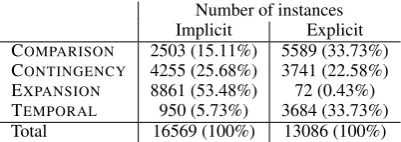
Number of instances Implicit Explicit COMPARISON 2503 (15.11%) 5589 (33.73%)
CONTINGENCY 4255 (25.68%) 3741 (22.58%)
EXPANSION 8861 (53.48%) 72 (0.43%)
TEMPORAL 950 (5.73%) 3684 (33.73%)
[image:2.595.81.282.62.133.2]Total 16569 (100%) 13086 (100%)
Table 1: The distribution of senses of implicit dis-course relations is imbalanced.
Brown cluster pairs. We also study coreferential patterns in different types of discourse relations in addition to using them to boost the performance of our classifier. These two sets of features along with previously used features outperform the base-line systems by approximately 5% absolute across all categories and reveal many important charac-teristics of implicit discourse relations.
2 Sense annotation in Penn Discourse Treebank
The Penn Discourse Treebank (PDTB) is the largest corpus richly annotated with explicit and implicit discourse relations and their senses (Prasad et al., 2008). PDTB is drawn from Wall Street Journal articles with overlapping an-notations with the Penn Treebank (Marcus et al., 1993). Each discourse relation contains the infor-mation about the extent of the arguments, which can be a sentence, a constituent, or an incontigu-ous span of text. Each discourse relation is also annotated with the sense of the relation that holds between the two arguments. In the case of implicit discourse relations, where the discourse connec-tives are absent, the most appropriate connective is annotated.
The senses are organized hierarchically. Our fo-cus is on the top level senses because they are the four fundamental discourse relations that various discourse analytic theories seem to converge on (Mann and Thompson, 1988). The top level senses are COMPARISON, CONTINGENCY, EXPANSION,
and TEMPORAL.
The explicit and implicit discourse relations al-most orthogonally differ in their distributions of senses (Table 1). This difference has a few im-plications for studying implicit discourse relations and uses of discourse connectives (Patterson and Kehler, 2013). For example, TEMPORALrelations
constitute only 5% of the implicit relations but 33% of the explicit relations because they might not be as natural to create without discourse
con-nectives. On the other hand, EXPANSION
rela-tions might be more cleanly achieved without ones as indicated by its dominance in the implicit dis-course relations. This imbalance in class distri-bution requires greater care in building statistical classifiers (Wang et al., 2012).
3 Experiment setup
We followed the setup of the previous studies for a fair comparison with the two baseline sys-tems by Pitler et al. (2009) and Park and Cardie (2012). The task is formulated as four sepa-rate one-against-all binary classification problems: one for each top level sense of implicit discourse relations. In addition, we add one more classifica-tion task with which to test the system. We merge ENTRELwith EXPANSIONrelations to follow the
setup used by the two baseline systems. An argu-ment pair is annotated with ENTRELin PDTB if
an entity-based coherence and no other type of re-lation can be identified between the two arguments in the pair. In this study, we assume that the gold standard argument pairs are provided for each re-lation. Most argument pairs for implicit discourse relations are a pair of adjacent sentences or adja-cent clauses separated by a semicolon and should be easily extracted.
The PDTB corpus is split into a training set, de-velopment set, and test set the same way as in the baseline systems. Sections 2 to 20 are used to train classifiers. Sections 0–1 are used for developing feature sets and tuning models. Section 21–22 are used for testing the systems.
The statistical models in the following exper-iments are from MALLET implementation (Mc-Callum, 2002) and libSVM (Chang and Lin, 2011). For all five binary classification tasks, we try Balanced Winnow (Littlestone, 1988), Maxi-mum Entropy, Naive Bayes, and Support Vector Machine. The parameters and the hyperparame-ters of each classifier are set to their default values. The code for our model along with the data ma-trices is available at github.com/attapol/
brown_coref_implicit.
4 Features
Toutanova and Manning, 2000), obtain the phrase structure and dependency parses for each sentence (De Marneffe et al., 2006; Klein and Manning, 2003), identify all named entities (Finkel et al., 2005), and resolve coreference (Raghunathan et al., 2010; Lee et al., 2011; Lee et al., 2013).
4.1 Features used in previous work
The baseline features consist of the following: First, last, and first 3 words, numerical ex-pressions, time exex-pressions, average verb phrase length, modality, General Inquirer tags, polarity, Levin verb classes, and production rules. These features are described in greater detail by Pitler et al. (2009).
4.2 Brown cluster pair features
To generate Brown cluster assignment pair fea-tures, we replace each word with its hard Brown cluster assignment. We used the Brown word clusters provided by MetaOptimize (Turian et al., 2010). 3,200 clusters were induced from RCV1 corpus, which contains about 63 million to-kens from Reuters English newswire. Then we take the Cartesian product of the Brown clus-ter assignments of the words in Arg1 and the ones of the words in Arg2. For example, sup-pose Arg1 has two words w1,1, w1,2, Arg2 has
three words w2,1, w2,2, w2,3, and then B(.) maps
a word to its Brown cluster assignment. A word wij is replaced by its corresponding Brown cluster assignment bij = B(wij). The result-ing word pair features are (b1,1, b2,1),(b1,1, b2,2), (b1,1, b2,3),(b1,2, b2,1),(b1,2, b2,2), and(b1,2, b2,3).
Therefore, this feature set can generate
O(32002) binary features. The feature set size is
orders of magnitude smaller than using the actual words, which can generateO(V2) distinct binary
features whereV is the size of the vocabulary.
4.3 Coreference-based features
We want to take advantage of the semantics of the sentence pairs even more by considering how coreferential entities play out in the sentence pairs. We consider various inter-sentential coreference patterns to include as features and also to better describe each type of discourse relation with re-spect to its place in the coreference chain.
For compactness in explaining the following features, we definesimilar wordsto be the words assigned to the same Brown cluster.
Number of coreferential pairs: We count the
number of inter-sentential coreferential pairs. We expect that EXPANSION relations should be
more likely to have coreferential pairs because the detail or information about an entity mentioned in Arg1 should be expanded in Arg2. Therefore, entity sharing might be difficult to avoid.
Similar nouns and verbs: A binary feature indicating whether similar or coreferential nouns are the arguments of the similar predicates. Predi-cates and arguments are identified by dependency parses. We notice that sometimes the author uses synonyms while trying to expand on the previous predicates or entities. The words that indicate the common topics might be paraphrased, so exact string matching cannot detect whether the two ar-guments still focus on the same topic. This might be useful for identifying CONTINGENCYrelations
as they usually discuss two causally-related events that involve two seemingly unrelated agents and/or predicates.
Similar subject or main predicates: A binary feature indicating whether the main verbs of the two arguments have the same subjects or not and another binary feature indicating whether the main verbs are similar or not. For our purposes, the two subjects are said to be the same if they are coreferential or assigned to the same Brown cluster. We notice that COMPARISON relations
usually have different subjects for the same main verbs and that TEMPORAL relations usually have
the same subjects but different main verbs.
4.4 Feature selection and training sample reweighting
Current Park and Cardie (2012) Pitler et al. (2009)
P R F1 F1 F1
COMPARISONvs others 27.34 72.41 39.70 31.32 21.96
CONTINGENCYvs others 44.52 69.96 54.42 49.82 47.13
EXPANSIONvs others 59.59 85.50 70.23 -
-EXP+ENTRELvs others 69.26 95.92 80.44 79.22 76.42
[image:4.595.79.521.64.162.2]TEMPORALvs others 18.52 63.64 28.69 26.57 16.76
Table 2: Our classifier outperform the previous systems across all four tasks without the use of gold-standard parses and coreference resolution.
COMPARISON
Feature set F1 % change
All features 39.70
-All excluding Brown cluster pairs 35.71 -10.05% All excluding Production rules 37.27 -6.80% All excluding First, last, and First 3 39.18 -1.40% All excluding Polarity 39.39 -0.79% CONTINGENCY
Feature set F1 % change
All 54.42
-All excluding Brown cluster pairs 51.50 -5.37% All excluding First, last, and First 3 53.56 -1.58% All excluding Polarity 53.82 -1.10% All excluding Coreference 53.92 -0.92% EXPANSION
Feature set F1 % change
All 70.23
-All excluding Brown cluster pairs 67.48 -3.92% All excluding First, last, and First 3 69.43 -1.14% All excluding Inquirer tags 69.73 -0.71% All excluding Polarity 69.92 -0.44% TEMPORAL
Feature set F1 % change
All 28.69
-All excluding Brown cluster pairs 24.53 -14.50% All excluding Production rules 26.51 -7.60% All excluding First, last, and First 3 26.56 -7.42% All excluding Polarity 27.42 -4.43%
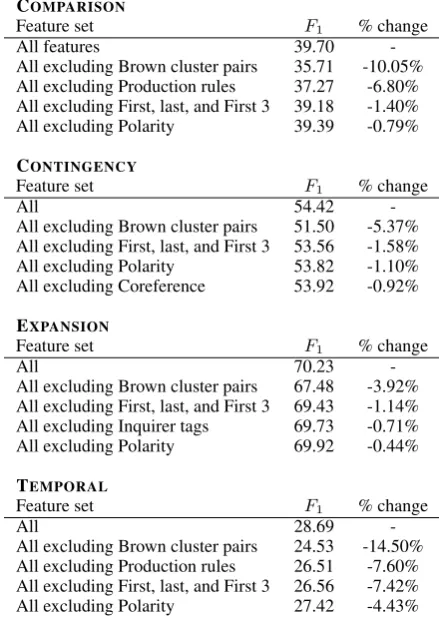
Table 3: Ablation study: The four most impact-ful feature classes and their relative percentage changes are shown. Brown cluster pair features are the most impactful across all relation types.
number of occurrences for each feature must be greater than a cut-off, which is also tuned on the development set to yield the highest performance on the development set.
5 Results
Our experiments show that the Brown cluster and coreference features along with the features from the baseline systems improve the performance for all discourse relations (Table 2). Consistent with the results from previous work, the Naive Bayes
classifier outperforms MaxEnt, Balanced Winnow, and Support Vector Machine across all tasks re-gardless of feature pruning criteria and training sample reweighting. A possible explanation is that the small dataset size in comparison with the large number of features might favor a generative model like Naive Bayes (Jordan and Ng, 2002). So we only report the performance from the Naive Bayes classifiers.
It is noteworthy that the baseline systems use the gold standard parses provided by the Penn Treebank, but ours does not because we would like to see how our system performs realistically in conjunction with other pre-processing tasks such as lemmatization, parsing, and coreference reso-lution. Nevertheless, our system still manages to outperform the baseline systems in all relations by a sizable margin.
Our preliminary results on implicit sense classi-fication suggest that the Brown cluster word rep-resentation and coreference patterns might be in-dicative of the senses of the discourse relations, but we would like to know the extent of the im-pact of these novel feature sets when used in junction with other features. To this aim, we con-duct an ablation study, where we exclude one of the feature sets at a time and then test the result-ing classifier on the test set. We then rank each feature set by the relative percentage change in F1 score when excluded from the classifier. The
data split and experimental setup are identical to the ones described in the previous section but only with Naive Bayes classifiers.
[image:4.595.70.290.221.533.2]ben-efit the most from Brown cluster features. With-out them, theF1 score drops by 4.12 absolute or
14.50% relative to the system that uses all of the features.
6 Feature analysis
6.1 Brown cluster features
This feature set is inspired by the word pair fea-tures, which are known for its effectiveness in pre-dicting senses of discourse relations between the two arguments. Marcu et al (2002), for instance, artificially generated the implicit discourse rela-tions and used word pair features to perform the classification tasks. Those word pair features work well in this case because their artificially gener-ated dataset is an order of magnitude larger than PDTB. Ideally, we would want to use the word pair features instead of word cluster features if we have enough data to fit the parameters. Con-sequently, other less sparse handcrafted features prove to be more effective than word pair features for the PDTB data (Pitler et al., 2009). We remedy the sparsity problem by clustering the words that are distributionally similar together and greatly re-duce the number of features.
Since the ablation study is not fine-grained enough to spotlight the effectiveness of the indi-vidual features, we quantify the predictiveness of each feature by its mutual information. Under Naive Bayes conditional independence assump-tion, the mutual information between the features and the labels can be efficiently computed in a pairwise fashion. The mutual information be-tween a binary featureXi and class labelY is de-fined as:
I(Xi, Y) =
X
y
X
x=0,1 ˆ
p(x, y) logpˆpˆ((xx, y)ˆp(y))
ˆ
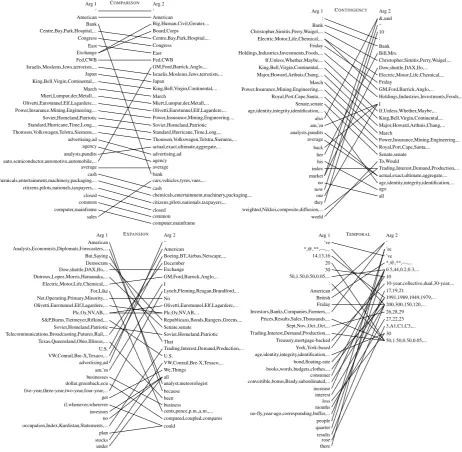
p(·)is the probability distribution function whose parameters are maximum likelihood estimates from the training set. We compute mutual infor-mation for all four one-vs-all classification tasks. The computation is done as part of the training pipeline in MALLET to ensure consistency in pa-rameter estimation and smoothing techniques. We then rank the cluster pair features by mutual in-formation. The results are compactly summa-rized in bipartite graphs shown in Figure 1, where each edge represents a cluster pair. Since mu-tual information itself does not indicate whether a feature is favored by one or the other label, we
also verify the direction of the effects of each of the features included in the following analysis by comparing the class conditional parameters in the Naive Bayes model.
The most dominant features for COMPARISON
classification are the pairs whose members are from the same Brown clusters. We can distinctly see this pattern from the bipartite graph because the nodes on each side are sorted alphabetically. The graph shows many parallel short edges, which suggest that many informative pairs consist of the same clusters. Some of the clusters that participate in such pair consist of named-entities from vari-ous categories such as airlines (King, Bell, Virgin, Continental, ...), and companies (Thomson, Volk-swagen, Telstra, Siemens). Some of the pairs form a broad category such as political agents (citizens, pilots, nationals, taxpayers) and industries (power, insurance, mining). These parallel patterns in the graph demonstrate that implicit COMPARISON
re-lations might be mainly characterized by juxtapos-ing and explicitly contrastjuxtapos-ing two different entities in two adjacent sentences.
Without the use of a named-entity recogni-tion system, these Brown cluster pair features ef-fectively act as features that detect whether the two arguments in the relation contain named-entities or nouns from the same categories or not. These more subtle named-entity-related features are cleanly discovered through replacing words with their data-driven Brown clusters without the need for additional layers of pre-processing.
If the words in one cluster semantically relates to the words in another cluster, the two clusters are more likely to become informative features for CONTINGENCY classification. For instance,
technical terms in stock and trading (weighted, Nikkei, composite, diffusion) pair up with eco-nomic terms (Trading, Interest, Demand, Produc-tion). The cluster withanalystsandpundits pairs up with the one that predominantly contains quan-tifiers (actual, exact, ultimate, aggregate). In ad-dition to this pattern, we observed the same par-allel pair pattern we found in COMPARISON
clas-sification. These results suggest that in establish-ing a CONTINGENCY relation implicitly the
au-thor might shape the sentences such that they have semantically related words if they do not mention named-entities of the same category.
speci-Arg 1 COMPARISON Arg 2
’ ’
American American
Bank Big,Human,Civil,Greater,... Centre,Bay,Park,Hospital,... Board,Corps
Congress Centre,Bay,Park,Hospital,...
East Congress
Exchange East
Fed,CWB Fed,CWB
Israelis,Moslems,Jews,terrorists,... GM,Ford,Barrick,Anglo,... Japan Israelis,Moslems,Jews,terrorists,... King,Bell,Virgin,Continental,... Japan
March King,Bell,Virgin,Continental,... Miert,Lumpur,der,Metall,... March
Olivetti,Eurotunnel,Elf,Lagardere,... Miert,Lumpur,der,Metall,... Power,Insurance,Mining,Engineering,... Olivetti,Eurotunnel,Elf,Lagardere,...
Soviet,Homeland,Patriotic Power,Insurance,Mining,Engineering,... Standard,Hurricane,Time,Long,... Soviet,Homeland,Patriotic Thomson,Volkswagen,Telstra,Siemens,... Standard,Hurricane,Time,Long,...
advertising,ad Thomson,Volkswagen,Telstra,Siemens,... agency actual,exact,ultimate,aggregate,... analysts,pundits advertising,ad
auto,semiconductor,automotive,automobile,... agency
average average
cash bank
chemicals,entertainment,machinery,packaging,... cars,vehicles,tyres,vans,... citizens,pilots,nationals,taxpayers,... cash
closed chemicals,entertainment,machinery,packaging,... common citizens,pilots,nationals,taxpayers,... computer,mainframe closed
sales common
computer,mainframe
Arg 1 CONTINGENCY Arg 2
: &,und
Bank –
Christopher,Simitis,Perry,Waigel,... 10 Electric,Motor,Life,Chemical,... ;
Friday Bank
Holdings,Industries,Investments,Foods,... Bill,Mrs.
If,Unless,Whether,Maybe,... Christopher,Simitis,Perry,Waigel,... King,Bell,Virgin,Continental,... Dow,shuttle,DAX,Ifo,... Major,Howard,Arthuis,Chang,... Electric,Motor,Life,Chemical,...
March Friday
Power,Insurance,Mining,Engineering,... GM,Ford,Barrick,Anglo,... Royal,Port,Cape,Santa,... Holdings,Industries,Investments,Foods,...
Senate,senate I
age,identity,integrity,identification,... If,Unless,Whether,Maybe,... also King,Bell,Virgin,Continental,... am,’m Major,Howard,Arthuis,Chang,...
analysts,pundits March
average Power,Insurance,Mining,Engineering,... back Royal,Port,Cape,Santa,...
her Senate,senate
his To,Would
index Trading,Interest,Demand,Production,... market actual,exact,ultimate,aggregate,...
no age,identity,integrity,identification,...
now ago
our all
they weighted,Nikkei,composite,diffusion,... world
Arg 1 EXPANSION Arg 2
American –
Analysts,Economists,Diplomats,Forecasters,... American
But,Saying Boeing,BT,Airbus,Netscape,...
Democrats December
Dow,shuttle,DAX,Ifo,... Exchange
Dutroux,Lopez,Morris,Hamanaka,... GM,Ford,Barrick,Anglo,... Electric,Motor,Life,Chemical,... I
For,Like Lynch,Fleming,Reagan,Brandford,... Net,Operating,Primary,Minority,... No
Olivetti,Eurotunnel,Elf,Lagardere,... Olivetti,Eurotunnel,Elf,Lagardere,... Plc,Oy,NV,AB,... Plc,Oy,NV,AB,...
S&P,Burns,Tietmeyer,Rifkind,... Republicans,Bonds,Rangers,Greens,... Soviet,Homeland,Patriotic Senate,senate
Telecommunications,Broadcasting,Futures,Rail,... Soviet,Homeland,Patriotic Texas,Queensland,Ohio,Illinois,... That
U.S. Trading,Interest,Demand,Production,... VW,Conrail,Bre-X,Texaco,... U.S.
advertising,ad VW,Conrail,Bre-X,Texaco,...
am,’m We,Things
businesses all
dollar,greenback,ecu analyst,meteorologist five-year,three-year,two-year,four-year,... because
get been
if,whenever,wherever business investors cents,pence,p.m.,a.m.,...
no compared,coupled,compares occupation,Index,Kurdistan,Statements,... could
plan stocks under
Arg 1 TEMPORAL Arg 2
’ve ’
*,@,**,—,... ’re
14,13,16 ’ve
20 *,@,**,—,...
30 0.5,44,0.2,0.3,... 50,1.50,0.50,0.05,... 10
: 10-year,collective,dual,30-year,...
American 17,19,21
British 1991,1989,1949,1979,... Friday 200,300,150,120,... Investors,Banks,Companies,Farmers,... 26,28,29
Prices,Results,Sales,Thousands,... 27,22,23 Sept,Nov.,Oct.,Oct,... 3,A1,C1,C3,... Trading,Interest,Demand,Production,... 30
Treasury,mortgage-backed 50,1.50,0.50,0.05,... York,York-based
[image:6.595.80.543.67.519.2]age,identity,integrity,identification,... bond,floating-rate books,words,budgets,clothes,... consumer convertible,bonus,Brady,subordinated,... increase interest loss months no-fly,year-ago,corresponding,buffer,... people quarter results rose there
Figure 1: The bipartite graphs show the top 40 non-stopword Brown cluster pair features for all four classification tasks. Each node on the left and on the right represents word cluster from Arg1 and Arg2 respectively. We only show the clusters that appear fewer than six times in the top 3,000 pairs to exclude stopwords. Although the four tasks are interrelated, some of the highest mutual information features vary substantially across tasks.
ficity within the scope of the relation. For exam-ple, a cluster with industrial categories (Electric, Motor, Life, Chemical, Automotive) couples with specific brands or companies (GM, Ford, Barrick, Anglo). Or such a pair might simply reflects a shift in plurality e.g.businesses-businessandAnalysts
-analyst. EXPANSION relations capture relations
in which one argument provides a specification of the previous and relations in which one argument
provides a generalization of the other. Thus, these shift detection features could help distinguish EX -PANSIONrelations.
All coreference Subject coreference
0.0 0.1 0.2 0.3 0.4 0.5
Compar ison
ContingencyExpansionT empor
al
Compar ison
ContingencyExpansionT empor
al
Coref
erential r
[image:7.595.93.270.60.201.2]ate
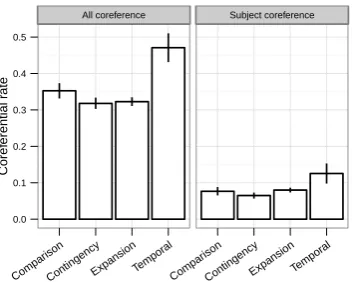
Figure 2: The coreferential rate for TEMPORAL
relations is significantly higher than the other three relations (p < 0.05, corrected for multiple com-parison).
informative for EXPANSIONrelations. For
exam-ple, the edges (not shown in the graph due to lack of space) from the first name clusters to the title (Mr, Mother, Judge, Dr) cluster.
Time expressions constitutes the majority of the nodes in the bipartite graph for TEMPORAL
rela-tions. More strikingly, the specific dates (e.g. clus-ters that have positive integers smaller than 31) are more frequently found in Arg2 than Arg1 in implicit TEMPORAL relations. It is possible that
TEMPORALrelations are more naturally expressed
without a discourse connective if a time point is clearly specified in Arg2 but not in Arg1.
TEMPORAL relations might also be implicitly
inferred through detecting a shift in quantities. We notice that clusters whose words indicate changes e.g.increase, rose, losspair with number clusters. Sentences in which such pairs participate might be part of a narrative or a report where one expects a change over time. These changes conveyed by the sentences constitute a natural sequence of events that are temporally related but might not need ex-plicit temporal expressions.
6.2 Coreference features
Coreference features are very effective given that they constitute a very small set compared to the other feature sets. In particular, excluding them from the model reducesF1scores for TEMPORAL
and CONTINGENCY relations by approximately
1% relative to the system that uses all of the features. We found that the sentence pairs in these two types of relations have distinctive coreference patterns.
We count the number of pairs of arguments that are linked by a coreference chain for each type of relation. The coreference chains used in this study are detected automatically from the training set through Stanford CoreNLP suite (Raghunathan et al., 2010; Lee et al., 2011; Lee et al., 2013). TEM -PORALrelations have a significantly higher
coref-erential rate than the other three relations (p <
0.05, pair-wiset-test corrected for multiple com-parisons). The differences between COMPARI -SON, CONTINGENCY, and EXPANSION, however,
are not statistically significant (Figure 2).
The choice to use or not to use a discourse connective is strongly motivated by linguistic fea-tures at the discourse levels (Patterson and Kehler, 2013). Additionally, it is very uncommon to have temporally-related sentences without using explicit discourse connectives. The difference in coreference patterns might be one of the factors that influence the choice of using a discourse con-nective to signal a TEMPORAL relation. If
sen-tences are coreferentially linked, then it might be more natural to drop a discourse connective be-cause the temporal ordering can be easily inferred without it. For example,
(1) Her story is partly one of personal down-fall. [previously] She was an unstinting teacher who won laurels and inspired stu-dents... (WSJ0044)
The coreference chain between the two temporally-related sentences in (1) can easily be detected. Inserting previously as suggested by the annotation from the PDTB corpus does not add to the temporal coherence of the sen-tences and may be deemed unnecessary. But the presence of coreferential link alone might bias the inference toward TEMPORAL relation while
CONTINGENCYmight also be inferred.
Additionally, we count the number of pairs of arguments whose grammatical subjects are linked by a coreference chain to reveal the syntactic-coreferential patterns in different relation types. Although this specific pattern seems rare, more than eight percent of all relations have coreferen-tial grammatical subjects. We observe the same statistically significant differences between TEM -PORAL relations and the other three types of
re-lations. More interestingly, the subject coreferen-tial rate for CONTINGENCYrelations is the lowest
It is possible that coreferential subject patterns suggest temporal coherence between the two sen-tences without using an explicit discourse connec-tive. CONTINGENCYrelations, which can only
in-dicate causal relationships when realized implic-itly, impose the temporal ordering of events in the arguments; i.e. if Arg1 is causally related to Arg2, then the event described in Arg1 must temporally precede the one in Arg2. Therefore, CONTIN -GENCYand TEMPORALcan be highly confusable.
To understand why this pattern might help distin-guish these two types of relations, consider these examples:
(2) He also asserted that exact questions weren’t replicated. [Then] When referred to the ques-tions that match, he said it was coincidental. (WSJ0045)
(3) He also asserted that exact questions weren’t replicated. When referred to the questions that match, she said it was coincidental.
When we switch out the coreferential subject for an arbitrary uncoreferential pronoun as we do in (3), we are more inclined to classify the relation as CONTINGENCY.
7 Related work
Word-pair features are known to work very well in predicting senses of discourse relations in an artificially generated corpus (Marcu and Echi-habi, 2002). But when used with a realistic cor-pus, model parameter estimation suffers from data sparsity problem due to the small dataset size. Bi-ran and McKeown (2013) attempts to solve this problem by aggregating word pairs and estimating weights from an unannotated corpus but only with limited success.
Recent efforts have focused on introducing meaning abstraction and semantic representation between the words in the sentence pair. Pitler et al. (2009) uses external lexicons to replace the one-hot word representation with semantic information such as word polarity and various verb classifica-tion based on specific theories (Stone et al., 1968; Levin, 1993). Park and Cardie (2012) selects an optimal subset of these features and establishes the strongest baseline to best of our knowledge.
Brown word clusters are hierarchical clusters induced by frequency of co-occurrences with other words (Brown et al., 1992). The strength of this
word class induction method is that the words that are classified to the same clusters usually make an interpretable lexical class by the virtue of their distributional properties. This word representation has been used successfully to augment the perfor-mance of many NLP systems (Ritter et al., 2011; Turian et al., 2010).
Louis et al. (2010) uses multiple aspects of coreference as features to classify implicit dis-course relations without much success while sug-gesting many aspects that are worth exploring. In a corpus study by Louis and Nenkova (2010), coref-erential rates alone cannot explain all of the rela-tions, and more complex coreference patterns have to be considered.
8 Conclusions
We present statistical classifiers for identifying senses of implicit discourse relations and intro-duce novel feature sets that exploit distributional similarity and coreference information. Our clas-sifiers outperform the clasclas-sifiers from previous work in all types of implicit discourse relations. Altogether these results present a stronger base-line for the future research endeavors in implicit discourse relations.
In addition to enhancing the performance of the classifier, Brown word cluster pair features close some of the new aspects of implicit dis-course relations. The feature analysis confirms our hypothesis that cluster pair features work well because they encapsulate relevant word classes which constitute more complex informative fea-tures such as named-entity pairs of the same cat-egories, semantically-related pairs, and pairs that indicate specificity-generality shift. At the dis-course level, Brown clustering is superior to a one-hot word representation for identifying inter-sentential patterns and the interactions between words.
Coreference chains that traverse through the discourse in the text shed the light on differ-ent types of relations. The preliminary analy-sis shows that TEMPORAL relations have much
higher inter-argument coreferential rates than the other three senses of relations. Focusing on only subject-coreferential rates, we observe that CON -TINGENCYrelations show the lowest coreferential
References
Or Biran and Kathleen McKeown. 2013. Aggregated word pair features for implicit discourse relation dis-ambiguation. In Proceedings of the 51st Annual Meeting of the Association for Computational Lin-guistics, pages 69–73. The Association for Compu-tational Linguistics.
Peter F Brown, Peter V deSouza, Robert L Mercer, Vincent J Della Pietra, and Jenifer C Lai. 1992. Class-based n -gram models of natural language. Computational Linguistics, 18(4):467–479, Decem-ber.
Chih-Chung Chang and Chih-Jen Lin. 2011. LIB-SVM: A library for support vector machines. ACM Transactions on Intelligent Systems and Technol-ogy, 2:27:1–27:27. Software available athttp://
www.csie.ntu.edu.tw/˜cjlin/libsvm.
Marie-Catherine De Marneffe, Bill MacCartney, Christopher D Manning, et al. 2006. Generat-ing typed dependency parses from phrase structure parses. InProceedings of LREC, volume 6, pages 449–454.
Jenny Rose Finkel, Trond Grenager, and Christopher Manning. 2005. Incorporating non-local informa-tion into informainforma-tion extracinforma-tion systems by gibbs sampling. InProceedings of the 43rd Annual Meet-ing on Association for Computational LMeet-inguistics, pages 363–370. Association for Computational Lin-guistics.
Nathalie Japkowicz. 2000. Learning from imbalanced data sets: a comparison of various strategies. In AAAI workshop on learning from imbalanced data sets, volume 68.
Michael Jordan and Andrew Ng. 2002. On discrimi-native vs. generative classifiers: A comparison of lo-gistic regression and naive bayes. Advances in neu-ral information processing systems, 14:841.
Dan Klein and Christopher D Manning. 2003. Accu-rate unlexicalized parsing. Inthe 41st Annual Meet-ing, pages 423–430, Morristown, NJ, USA. Associ-ation for ComputAssoci-ational Linguistics.
Heeyoung Lee, Yves Peirsman, Angel Chang, Nathanael Chambers, Mihai Surdeanu, and Dan Ju-rafsky. 2011. Stanford’s multi-pass sieve coref-erence resolution system at the conll-2011 shared task. InProceedings of the Fifteenth Conference on Computational Natural Language Learning: Shared Task, pages 28–34. Association for Computational Linguistics.
Heeyoung Lee, Angel Chang, Yves Peirsman, Nathanael Chambers, Mihai Surdeanu, and Dan Ju-rafsky. 2013. Deterministic coreference resolu-tion based on entity-centric, precision-ranked rules. Computational Linguistics.
Beth Levin. 1993. English verb classes and alter-nations: A preliminary investigation, volume 348. University of Chicago press Chicago.
Ziheng Lin, Hwee Tou Ng, and Min-Yen Kan. 2010. A PDTB-Styled End-to-End Discourse Parser. arXiv.org, November.
Nick Littlestone. 1988. Learning quickly when irrele-vant attributes abound: A new linear-threshold algo-rithm. Machine learning, 2(4):285–318.
Annie Louis and Ani Nenkova. 2010. Creating lo-cal coherence: An empirilo-cal assessment. InHuman Language Technologies: The 2010 Annual Confer-ence of the North American Chapter of the Associa-tion for ComputaAssocia-tional Linguistics, pages 313–316. Association for Computational Linguistics.
Annie Louis, Aravind Joshi, Rashmi Prasad, and Ani Nenkova. 2010. Using entity features to classify implicit discourse relations. In Proceedings of the 11th Annual Meeting of the Special Interest Group on Discourse and Dialogue, pages 59–62. Associa-tion for ComputaAssocia-tional Linguistics.
William C Mann and Sandra A Thompson. 1988. Rhetorical structure theory: Toward a functional the-ory of text organization. Text, 8(3):243–281.
Daniel Marcu and Abdessamad Echihabi. 2002. An unsupervised approach to recognizing discourse re-lations. In Proceedings of the 40th Annual Meet-ing on Association for Computational LMeet-inguistics, pages 368–375. Association for Computational Lin-guistics.
Mitchell P Marcus, Mary Ann Marcinkiewicz, and Beatrice Santorini. 1993. Building a large anno-tated corpus of english: The penn treebank. Compu-tational linguistics, 19(2):313–330.
Andrew Kachites McCallum. 2002. Mal-let: A machine learning for language toolkit. http://www.cs.umass.edu/ mccallum/mallet.
Joonsuk Park and Claire Cardie. 2012. Improving im-plicit discourse relation recognition through feature set optimization. InProceedings of the 13th Annual Meeting of the Special Interest Group on Discourse and Dialogue, pages 108–112. Association for Com-putational Linguistics.
Gary Patterson and Andrew Kehler. 2013. Predicting the presence of discourse connectives. In Proceed-ings of the Conference on Empirical Methods in Nat-ural Language Processing. Association for Compu-tational Linguistics.
Emily Pitler, Annie Louis, and Ani Nenkova. 2009. Automatic sense prediction for implicit discourse re-lations in text. InProceedings of the Joint Confer-ence of the 47th Annual Meeting of the ACL and the 4th International Joint Conference on Natural Lan-guage Processing of the AFNLP: Volume 2-Volume 2, pages 683–691. Association for Computational Linguistics.
Rashmi Prasad, Nikhil Dinesh, Alan Lee, Eleni Milt-sakaki, Livio Robaldo, Aravind K Joshi, and Bon-nie L Webber. 2008. The penn discourse treebank 2.0. InLREC. Citeseer.
Karthik Raghunathan, Heeyoung Lee, Sudarshan Ran-garajan, Nathanael Chambers, Mihai Surdeanu, Dan Jurafsky, and Christopher Manning. 2010. A multi-pass sieve for coreference resolution. In Proceed-ings of the 2010 Conference on Empirical Meth-ods in Natural Language Processing, EMNLP ’10, pages 492–501, Stroudsburg, PA, USA. Association for Computational Linguistics.
Alan Ritter, Sam Clark, Oren Etzioni, et al. 2011. Named entity recognition in tweets: an experimental study. InProceedings of the Conference on Empiri-cal Methods in Natural Language Processing, pages 1524–1534. Association for Computational Linguis-tics.
Philip Stone, Dexter C Dunphy, Marshall S Smith, and DM Ogilvie. 1968. The general inquirer: A com-puter approach to content analysis. Journal of Re-gional Science, 8(1).
Kristina Toutanova and Christopher D Manning. 2000. Enriching the knowledge sources used in a maxi-mum entropy part-of-speech tagger. InProceedings of the 2000 Joint SIGDAT conference on Empirical methods in natural language processing and very large corpora: held in conjunction with the 38th An-nual Meeting of the Association for Computational Linguistics-Volume 13, pages 63–70. Association for Computational Linguistics.
Kristina Toutanova, Dan Klein, Christopher D Man-ning, and Yoram Singer. 2003. Feature-rich part-of-speech tagging with a cyclic dependency network. InProceedings of the 2003 Conference of the North American Chapter of the Association for Computa-tional Linguistics on Human Language Technology-Volume 1, pages 173–180. Association for Compu-tational Linguistics.
Joseph Turian, Lev Ratinov, and Yoshua Bengio. 2010. Word representations: a simple and general method for semi-supervised learning. InProceedings of the 48th Annual Meeting of the Association for Compu-tational Linguistics, pages 384–394. Association for Computational Linguistics.
Xun Wang, Sujian Li, Jiwei Li, and Wenjie Li. 2012. Implicit discourse relation recognition by selecting typical training examples. InProceedings of COL-ING 2012, pages 2757–2772, Mumbai, India, De-cember. The COLING 2012 Organizing Committee.