Proceedings of the First Workshop on Aggregating and Analysing Crowdsourced Annotations for NLP, pages 1–5 1
Dependency Tree Annotation with Mechanical Turk
Stephen Tratz
CCDC Army Research Laboratory Adelphi, Maryland 20783 USA [email protected]
Abstract
Crowdsourcing is frequently employed to quickly and inexpensively obtain valuable lin-guistic annotations but is rarely used for pars-ing, likely due to the perceived difficulty of the task and the limited training of the avail-able workers. This paper presents what is, to the best of our knowledge, the first published use of Mechanical Turk (or similar platform) to crowdsource parse trees. We pay Turkers to construct unlabeled dependency trees for 500 English sentences using an interactive graph-ical dependency tree editor, collecting 10 an-notations per sentence. Despite not requiring any training, several of the more prolific work-ers meet or exceed 90% attachment agreement with the Penn Treebank (PTB) portion of our data, and, furthermore, for 72% of these PTB sentences, at least one Turker produces a per-fect parse. Thus, we find that, supported with a simple graphical interface, people with pre-sumably no prior experience can achieve sur-prisingly high degrees of accuracy on this task. To facilitate research into aggregation tech-niques for complex crowdsourced annotations, we publicly release our annotated corpus.
1 Introduction
State-of-the-art parsing models, which are im-portant components to countless natural language processing workflows, are trained using treebanks of manually annotated parse trees. Unfortunately, many languages do not have treebanks and even the treebanks that do exist possess significant lim-itations in terms of size, genre, style, topic cover-age, and/or other dimensions. Even the venerable Penn Treebank (Marcus et al., 1993)—one of the largest and most widely used treebanks—contains examples from only a single news source. Ex-panding existing treebanks or creating new ones tends to be quite expensive; for instance, the Prague Dependency Treebank, with over a million
syntactically linked words, cost approximately $600,000 (Böhmová et al.,2003). In this work, we explore the use of crowdsourcing both to mitigate this cost barrier and also because, perhaps more importantly, it serves as a proof-of-concept for the case in which only non-experts are available to produce the parse trees, which is likely to be the situation for most under-resourced languages. De-spite the widespread use of crowdsourcing to col-lect linguistic annotations, there have been few ef-forts to apply crowdsourcing to parsing—a fact we believe is largely due to concerns about the complexity of the task, the training requirements for the workers, as well as the skillfulness, dili-gence, and consistency of workers on crowdsourc-ing platforms such as Mechanical Turk.
This paper presents what is, to the best of our knowledge, the first use of Mechanical Turk or similar platform to crowdsource dependency parse trees. We request 10 annotations for each of 500 trees (250 from the Penn Treebank (PTB) and 250 from Wikipedia) and find that, despite not requir-ing any form of trainrequir-ing, several of the Turkers who annotate 50 or more PTB sentences achieve at least 90% attachment agreement with the depen-dency conversion reference trees. Furthermore, for 72% of the PTB sentences, at least one Turker produces a tree that fully matches the reference. Ultimately, these results establish a baseline for what people with presumably no prior training can achieve in performing this challenging task.
2 Approach
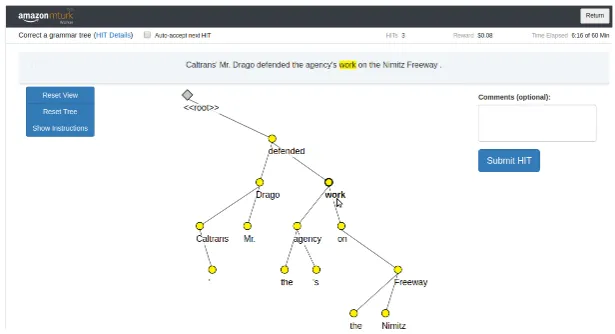
Figure 1: Screenshot of our annotation interface in the Mechanical Turk sandbox.
HITs, the annotation interface is hosted on an ex-ternal website, which is embedded on the Mechan-ical Turk page within an HTML iframe. Each of our HITs involves constructing an unlabeled1 de-pendency tree for a single sentence using the an-notation interface described below. When Turk-ers submit their work, it goes both to the external server and to Amazon’s Mechanical Turk website.
2.1 Graphical Annotation Interface
In our annotation interface (Tratz and Phan,2018), shown in Figure 1, words are displayed as nodes and dependencies are displayed as edges between them.2 Turkers create dependency arcs by drag-ging and dropping word nodes. Dropping one node onto another forms a dependency arc be-tween the two, with the dragged node as the de-pendent of the latter. While dragging, green circu-lar dropzones appear to highlight possible attach-ment sites.
The tool is configured to have all words initially attached to the dummy root node. The Submit HIT button becomes operable only when there is exactly one word connected to the dummy root. Thus, annotators are required to reattach all but one of the words.
Annotation guidelines are accessible by click-ing theInstructionsbutton, which brings up a box with the instructions that can be opened into a sep-arate window. Since many Turkers may be reluc-tant to read wordy guides, our instructions consist primarily of 55 small example trees.
1
We leave labeled dependency trees for future work, as labeling dependencies (e.g., ‘subject’, ‘object’) could be per-formed separately from the tree construction.
2
Several aspects of the visual layout and styling of our tool are inspired by TRED(Pajas and Štˇepánek,2008).
2.2 Data
For our Mechanical Turk HITs, we construct a dataset consisting of 250 sentences from the Penn Treebank (Marcus et al.,1993) and 250 from The Westbury Lab Wikipedia corpus (Shaoul, 2010), each consisting of 10 to 15 alphanumeric tokens. We ignore Penn Treebank sentences that merely report changes in earnings figures, prices, etc., since these types of sentences are particularly fre-quent in the Penn Treebank and make for an undi-verse (and, therefore, uninteresting) sample. With the Wikipedia data, we filter incomplete and un-grammatical sentences,3and sentences with
offen-sive language, heavy use of foreign words, or es-oteric technical content. We merge various date expressions (e.g.,March 15, 2000) into single to-kens since these elements can be recognized with high accuracy using regular expressions.
2.3 HIT configuration parameters
We require that Turkers who work on our HITs re-side in the USA or Canada, have a 95% or higher approval rating, and have previously had at least 20 other HITs approved. We pay $0.084per com-pleted assignment and request a total of 10 anno-tations per sentence (from 10 different workers).
2.4 Evaluation
For evaluation, we calculate both the percentage of words correctly attached (UAS: unlabeled at-tachment score) and the percentage of trees that
3Many of these errors may be due to the overly aggressive
nature of our sentence splitter.
4In practice, this proved to be rather low for the amount
Worker Trees Penn Treebank Wikipedia
Trees UAS FTM timeg Trees UAS FTM timeg
W1 177 90 0.921 0.500 53.5 87 0.935 0.552 51
W2 453 223 0.913 0.439 37 230 0.918 0.465 33
W3 499 249 0.906 0.454 44 250 0.907 0.428 41
W4 410 201 0.901 0.443 42 209 0.901 0.407 38
W5 412 194 0.840 0.211 40 218 0.865 0.261 36
W6 450 226 0.796 0.159 45.5 224 0.831 0.228 38.5 W7 411 207 0.774 0.077 54 204 0.792 0.127 47.5
W8 434 211 0.724 0.057 55 223 0.768 0.112 44
W9 119 61 0.724 0.115 34 58 0.708 0.138 35.5
W10 352 178 0.644 0.034 45.5 174 0.688 0.052 39 W11 197 107 0.500 0.000 111 90 0.518 0.000 94 W12 128 59 0.423 0.000 311 69 0.434 0.000 238 W13 379 185 0.228 0.000 48 194 0.245 0.000 46
[image:3.595.139.460.61.227.2]A1 500 250 0.969 0.712 — 250 1.000 1.000 —
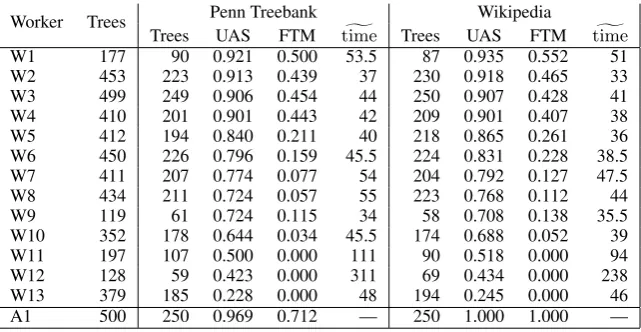
Table 1: Results for the 13 workers (W1–W13) who annotate 50 or more Penn Treebank trees, including the total number of trees annotated, unlabeled attachment scores (UAS), full tree match rate (FTM), and median time in seconds (timeg) between accepting a HIT and submitting results. For reference, we also include scores for the
primary author (A1).
fully match the reference (FTM: full tree match rate). In the case of the Penn Treebank sentences, the reference is the automatic dependency conver-sion; for the Wikipedia sentences, we use the pri-mary author’s annotation. A total of 112 Turk-ers participate; however, most only annotate 1 or 2 sentences, making it difficult to estimate their aptitude for this task. The 13 workers who anno-tated 50 or more sentence account for over 88% of the annotations received. The scores for these 13 most prolific annotators are presented in Table1, along with the scores for the primary author (who is, ideally, representative of an expert annotator) included as well for comparison.
2.5 Results Discussion
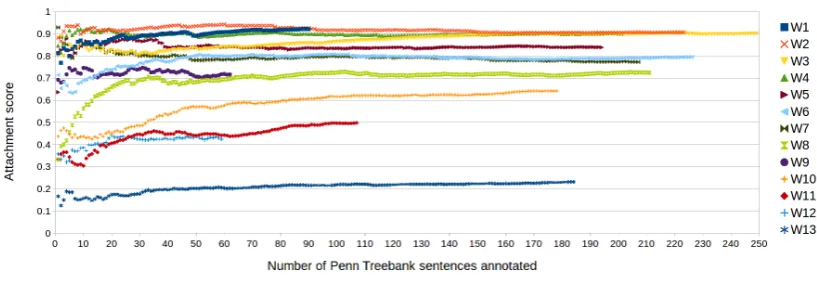
We note a high degree of variation in the quality of the work of the different annotators. Four of the more prolific Turkers achieve attachment scores of 90% or higher on the Penn Treebank portion of the data, but others are unable to reach even 50% agreement. To examine how the Turkers’ perfor-mance varies with time, we plot the change to their overall attachment scores as they perform annota-tions (see Figure 2). Several annotators, includ-ing W6, W8, W10, and W11, improve noticeably early on as they gain experience. A couple anno-tators (i.e., W2andW7) show slight decreases in their scores, which may be due to fatigue. Overall, there appears to be a very high degree of consis-tency over time for the individual Turkers.
For 72% of the Penn Treebank sentences, at least one annotator produces a dependency tree
that fully matches the reference completely. Tak-ing the Turker-provided tree that best matches the reference for each of the PTB sentences results in a set of trees with a 96.8% attachment score, 3257 of 3363 attachments agreeing. Examining the re-maining 106 disagreements in more detail, we ob-serve that approximately 13 are due to handling of business suffixes (e.g., Corp., Co.), at least 8 are due to errors in the reference, and 5 are re-lated to quantifying adverbs preceding expressions with numbers (e.g., about 8 %). Many of these disagreements could be brought into alignment by tweaking the annotation guide and/or fixing bugs in the dependency conversion. The remaining er-rors fall into a wide variety of categories. A sub-stantial portion are related to phenomena that are somewhat challenging to represent well with de-pendency parses, such as gapping, right node rais-ing, anditextraposition.
In general, the results seem to suggest that the Wikipedia sentences may be slightly easier to parse, but, overall, the results are quite similar to those for the PTB sentences.
3 Related Work
To date, there have been very few efforts to crowd-source parsing and no efforts, to the best of our knowledge, to do so directly with a full parse tree editor like ours other than in small classroom stud-ies like that ofGerdes(2013).
-Figure 2: Overall unlabeled attachment score on Penn Treebank sentences for the 13 most prolific workers (W1– W13), calculated as each annotation is received. (Note: Workers do not annotate sentences in the same order.)
BILINGO in order to crowdsource a French tree-bank (Fort et al., 2014; Guillaume et al., 2016; Fort et al.,2017). ZOMBILINGOparticipants, who are all volunteers, work on one attachment deci-sion at a time, using the metaphor that the gov-erning word is devouring the child just as zombies seek out brains. The participants must complete a training phase for each dependency relation type that they work on, and they are unable to proceed to relations deemed more difficult until they have demonstrated some skill on less challenging de-pendency relations.
Another related effort is that ofHe et al.(2016), who, in an initial step toward human-in-the-loop parsing, crowdsource individual attachment anno-tations by asking annotators multiple choice ques-tions automatically generated using parse trees produced by an existing parser. They are able to achieve some performance gains, including a 0.2 F1 improvement on their in-domain corpus (from 88.1 to 88.3) and a 0.6 F1 improvement on their out-of-domain corpus (from 82.2 to 82.8).
It is worth noting that there are a number of ethical concerns regarding the use of Mechanical Turk, and a variety of articles have been written on this subject. We refer the reader to a discussion of these issues byFort et al.(2011).
4 Conclusion and Future Work
This paper details the first effort to crowdsource treebanking using Mechanical Turk or similar on-line crowdsourcing platform. Using our graphical web-based treebanking tool, we collect 10 depen-dency parse annotations for each of 500 sentences. Despite not requiring any training, several of the annotators achieve attachment scores at or above
90%. Although this may not be of sufficient qual-ity to train a competitive English parser, it estab-lishes a baseline for dependency tree annotation using workers who are presumably non-experts, demonstrating the potential value that non-experts can bring to parsing annotation projects. More-over, treebanks with 90% attachment accuracy would still be useful for other languages, espe-cially those with little or no annotated data. To this end, we plan to investigate whether our approach will result in comparable accuracy for other lan-guages, which will likely require recruiting work-ers outside of Mechanical Turk.
We find that taking the best tree for each of the 250 Penn Treebank sentences results in a dataset that agrees with the Penn Treebank dependency conversion on 96.8% of attachments and agrees with the full dependency tree 72% of the time. Though unreasonable to assume that any such or-acle exists, it may be possible to approach this level of accuracy by employing a multi-step ap-proach in which workers review and judge the work of others, similar to the translation crowd-sourcing efforts of Zaidan and Callison-Burch (2011). To facilitate research among the greater community into techniques for aggregating com-plex crowdsourced annotations, we provide our annotated dataset at https://github.com/ USArmyResearchLab/ARL_CrowdTree.
[image:4.595.93.502.63.204.2]References
Alena Böhmová, Jan Hajiˇc, Eva Hajiˇcová, and Barbora Hladká. 2003. The Prague Dependency Treebank. In Anne Abeillé, editor, Treebanks: Building and Using Parsed Corpora, pages 103–127. Springer Netherlands.
Karën Fort, Gilles Adda, and K Bretonnel Cohen. 2011. Amazon Mechanical Turk: Gold Mine or Coal Mine? Computational Linguistics, 37(2):413– 420.
Karën Fort, Bruno Guillaume, and Hadrien Chastant. 2014. Creating Zombilingo, a Game With A Pur-pose for dependency syntax annotation. In Proceed-ings of the First International Workshop on Gamifi-cation for Information Retrieval, pages 2–6.
Karën Fort, Bruno Guillaume, and Nicolas Lefebvre. 2017. Who wants to play Zombie? A survey of the players on ZOMBILINGO. In Proceedings of Games4NLP: Using Games and Gamification for Natural Language Processing.
Kim Gerdes. 2013. Collaborative Dependency Anno-tation. InProceedings of the Second International Conference on Dependency Linguistics (DepLing 2013), pages 88–97.
Bruno Guillaume, Karen Fort, and Nicolas Lefeb-vre. 2016. Crowdsourcing Complex Language Re-sources: Playing to Annotate Dependency Syn-tax. InProceedings of the 26th International Con-ference on Computational Linguistics (COLING), pages 3041–3052.
Luheng He, Julian Michael, Mike Lewis, and Luke Zettlemoyer. 2016. Human-in-the-Loop Parsing. In
Proceedings of the 2016 Conference on Empirical Methods in Natural Language Processing (EMNLP 2016), pages 2337–2342.
Mitchell P. Marcus, Mary A. Marcinkiewicz, and Beat-rice Santorini. 1993. Building a Large Annotated Corpus of English: The Penn Treebank. Computa-tional Linguistics, 19(2):330.
Petr Pajas and Jan Štˇepánek. 2008. Recent Advances in a Feature-Rich Framework for Treebank Annota-tion. InProceedings of the 22nd International Con-ference on Computational Linguistics, pages 673– 680. Association for Computational Linguistics.
H Sebastian Seung, Manfred Opper, and Haim Som-polinsky. 1992. Query by Committee. In Proceed-ings of the fifth annual workshop on Computational learning theory, pages 287–294.
Cyrus Shaoul. 2010. The Westbury Lab Wikipedia Corpus. Edmonton, Alberta: University of Alberta.
Stephen Tratz and Nhien Phan. 2018. A Web-based System for Crowd-in-the-Loop Dependency Tree-banking. In Proceedings of the Eleventh Interna-tional Conference on Language Resources and Eval-uation (LREC-2018), pages 2189–2193.
Luis Von Ahn. 2006. Games with a Purpose. Com-puter, 39(6):92–94.