Proceedings of the 2019 Conference on Empirical Methods in Natural Language Processing 6268
Weakly Supervised Attention Networks for Entity Recognition
Barun Patra⇤, Joel Ruben Antony Moniz⇤
{barunpatra95, jramoniz}@gmail.com
Abstract
The task of entity recognition has tradition-ally been modelled as a sequence labelling task. However, this usually requires a large amount of fine-grained data annotated at the token level, which in turn can be expensive and cumbersome to obtain. In this work, we aim to circumvent this requirement of word-level an-notated data. To achieve this, we propose a novel architecture for entity recognition from a corpus containing weak binary presence/ab-sence labels, which are relatively easier to ob-tain. We show that our proposed weakly su-pervised model, trained solely on a multi-label classification task, performs reasonably well on the task of entity recognition, despite not having access to any token-level ground truth data.
1 Introduction
Entity Recognition frequently finds use as a first
step in numerous downstream NLP tasks (Wang
and Xue, 2017; Lee et al., 2018; Liang et al.,
2018). Traditionally, it has been posed as a
se-quence labeling task (Lample et al.,2016;Ma and
Hovy,2016), which in turn requires corpora with
token-based annotations. A key drawback of this formulation, however, lies in its dependence on corpora annotated at the token-level, which can of-ten be tedious to obtain and expensive to annotate. One potential way of overcoming this limitation is to move towards a method that utilizes a weaker form of supervision that is easier to obtain. In this work, we focus on one such form of weak su-pervision: binary labels that indicate the presence of an entity type. The cognitive load of selecting whether an entity type is present or not is usually less than that of actually highlighting and annotat-ing spans with their correct entity types. It also stands to reason that providing these binary labels
⇤Equal Contribution
might be faster. Both these properties are particu-larly advantageous for a human-in-the-loop setup in a user facing task, since a user is more likely to answer a yes/no question than to provide the annotated entity spans. This, in turn, facilitates cheaper and faster data collection; be it explicitly in the form of feedback questions, or implicitly from mined user logs (for example, clicked search engine results for queries related to ”movies” are
likely to contain the entity in question (Xu et al.,
2009)).
In this work, we make first steps towards moving away from span-based corpora, relying solely on binary presence/absence classification labels for extracting entities. We propose a novel attention-based model that, though trained on a multi-label classification task, can be used for en-tity recognition. We show the efficacy of our pro-posed model on the widely used 2003 CoNLL dataset. Our model achieves reasonable perfor-mance without having access to token-level anno-tations. We thus show that it is possible to extract
entities using a weak classification signal.1
2 Related Work
Commonly used methods for entity extraction rely on token-level annotated corpora.
Convention-ally, these supervised methods learn a CRF (
Laf-ferty et al.,2001) or a Seq2Seq (Sutskever et al.,
2014) model over either hand-crafter or neural
fea-tures. More recently, pre-trained embeddings from
language models trained on large corpora (Peters
et al.,2018;Devlin et al.,2018), when augmented with previous methods, have shown marked im-provements.
A contrasting line of work has been to ex-plore unsupervised entity extraction without using
1All our code can be found at https://github.
Thanos
did
nothing
wrong
ORG
MISC LOC
PER MISC
ORG PER
LOC
q α p
• • • •
• • • •
• • • •
• • • •
• •
• •
• •
• •
• •
• •
• •
• •
Sum • Product
•
Attention LOC
PER ORG MISC Key
Dense
BiGRU
BERT
ORG
MISC PER
LOC
MISC PER
LOC
MISC PER
LOC
MISC
ORG ORG ORG
[image:2.595.99.501.63.395.2]PER LOC
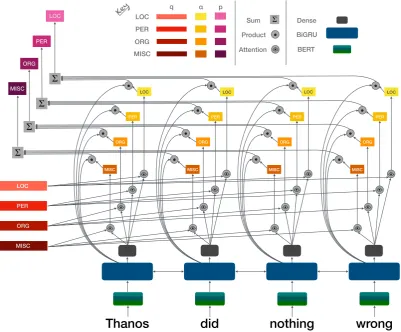
Figure 1: Model Architecture: Sentence-level Classifier.qrepresents the learned query vector per tag,↵denotes
the attention weights computed per token andpdenotes the probability of predicting each tag at the sentence level.
ground-truth token or sentence level annotations. For example, a common paradigm for unsuper-vised Named Entity Recognition involves relying
on a seed gazetteer, as in the case ofZhang and
El-hadad(2013) andGhiasvand and Kate(2015) both in the medical domain. In a more general setting,
Carlson et al. (2009) use gazetteers to bootstrap training by labelling sequences that can be confi-dently annotated, and then use this partly labelled data to train their proposed Partial Perceptron al-gorithm; although they make use of a gazetteer, being the closest in setting to our proposed
ap-proach, we use Carlson et al. (2009) as our
pri-mary baseline. Another common technique in-volves bootstrapping the system with a set of rule
templates, such as in (Etzioni et al., 2005) and
(Collins and Singer,1999). However, these meth-ods often rely on an initial seed rule-base or on the availability of gazetteers (or the effective gen-eration of these gazetteers using an online source such as Wikipedia).
Aside from directly improving performance on
various tasks, attention (Bahdanau et al., 2014;
Luong et al., 2015) has proven to be extremely useful when used indirectly in a wide variety of other ways (for example, for segmentation (Tang and Yang,2018) and unsupervised
speech-to-text alignment (Boito et al.,2017;Godard et al.,
2018)). In addition, using attention-based
mod-els for object segmentation in a weakly supervised setting has been well explored in the vision
do-main (Teh et al., 2016;Zhang et al., 2018).
In-spired by this, we leverage the attention weights of the model to identify entity spans.
3 Method
Figures 1 and 2 describe the different
compo-nents of our model. Our model comprises of 4 modules: a sentence representation module, an attention module, a token-level tagger and a sentence-level classifier. Concretely, given a
sen-tence(x1,· · ·xl), the model predicts whether a tag
t 2 T is present in the sentence, as well as an
attention distribution over the words for each tag
(↵1,t· · ·↵l,t)8t 2T (whereT is the set of entity
Thanos did nothing wrong
MISCORG PER
LOC
PER PER
PER PER PER
•
• • •
O O O
Sentence-level Classifier p (> 0.5)
p (< 0.5)
Threshold
PER
α
PER O
Token-level Prediction
[image:3.595.119.483.63.191.2]Key
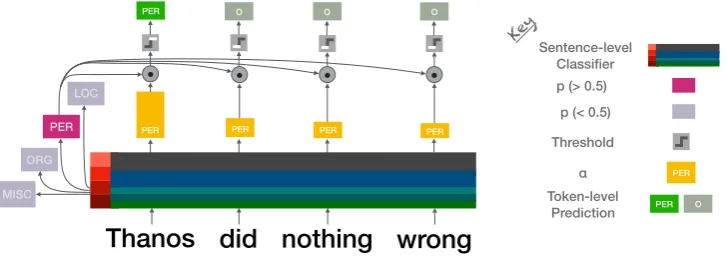
Figure 2: Model Architecture: Token Tagger. The Token Tagger performs tagging using the attention weights. ↵
denotes the attention weights of the predicted tag(s).
Token Representation Module: generates an embedding for each token, representing the word’s meaning and its left and right context. We use
BERT embeddings (Devlin et al.,2018) for
gener-ating a word-level representation. We further use a
Bidirectional GRU (Cho et al.,2014) layer to
bet-ter adapt BERT embeddings to the task to obtain token representations(e1· · ·el).
Attention Module: consists of an attention mechanism for each tag type. Given the token embeddings, a softmax distribution pertaining to the corresponding tag is generated, modelling the conditional probability of a word in a sentence be-ing of that tag, given that the entire sentence
con-tains the tag. We compute attention as in
Bah-danau et al.(2014), using one learned query
vec-tor qt per tag t 2 T . The token embeddings
(e1· · ·el) are passed through a dense layer to
gen-erate keys (k1· · ·kl) in the query space, which
together with query qt, yield a set of attention
weights(↵1,t· · ·↵l,t).
Sentence-level Classifier: generates the prob-ability of the presence of a tag in the sen-tence. For each tag, the token-level
representa-tions(e1· · ·el)are weighed by the attention
distri-bution(↵1,t· · ·↵l,t)corresponding to the tag. The
weighted sum generates a sentence representation
stper tag, which is passed through a sigmoid layer
to generate the probability of the tag being present
(pt), withpt>0.5denoting the presence of a tag.
Token Tagger Module: combines the prob-abilities from the Sentence-level Classifier with the attention weights obtained from the Attention Module to generate BIO tags for each token. Only the attention weights pertaining to the predicted
la-belsT0 are considered (i.e., if no tag is predicted,
the entire sentence is marked ”O”), with the atten-tion weights being scaled by the probability of the
predicted label (i.ept⇤(↵1,t· · ·↵l,t)). A wordxi
is assigned the labelyi = argmaxt2T0(pt⇤↵i,t)
ifpt⇤↵i,yi is greater than a small threshold✏and
it is neither a punctuation symbol nor a stop-word
(Figure2).
4 Experiments
Dataset: To demonstrate the feasibility of our model, we adapt the commonly used CoNLL 2003
dataset (Ratinov and Roth, 2009). The dataset
contains token-level annotations of the Reuter’s
Corpus (Lewis et al.,2004) for 4 entity types:
per-son (PER), location (LOC), organization (ORG) and miscellaneous (MISC), with each token
be-ing tagged in the IOB format (Ramshaw and
Mar-cus, 1999). For training and validation, we strip
out the token-level annotations, instead annotat-ing sentences to merely indicate the presence of entity-types. In order to quantify the quality of the extracted entities, we then measure the span level f-score on the test set using the gold entity spans.
Modelling Choices and Hyperparameters:
We use the BERT-Base Multilingual Cased model for the Token Representation Module, similar to
the NER tagging setup in Devlin et al. (2018).
We experiment both with using the embeddings as is, and fine-tuning the top layers of the atten-tion encoder (we only try fine-tuning the top, top-two and top-three layers due to computational con-straints). For the Token Tagger module, we find that the attention probabilities usually demarcate
the tagged words quite clearly, and that an✏value
of 0.01 performs reasonably well. We use early stopping based on the (averaged) validation accu-racy of the sentence-level predictions. We also observe that fine-tuning the BERT model requires learning rates comparable in order of magnitude to
a learning rate of 2e-7 for fine-tuning the trans-former layers, and 1e-3 for the rest of the network. More details related to the hyperparameters used
are presented in AppendixA. All our models have
been implemented using the AllenNLP framework (Gardner et al.,2017).
5 Results and Analysis
Type Model F-score Acc
S (Lample et al.(Peters et al.,,20182016)) 90.992.2 - -(Devlin et al.,2018) 92.8 -US (Carlson et al.,2009) 55.3
-WS
BERT + PS 65.8 95.5
BERT(FT) + PS 68.4 95.5
BERT + GRU + PS 79.2 95.5
BERT(FT) + GRU 80.7 95.6
[image:4.595.72.291.189.352.2]BERT(FT) + GRU + PS 81.1 95.6
Table 1: Different model performances on the 2003 CoNLL test set. FT denotes fine-tuning, PS denotes probability scaling. S is supervised, US is unsupervised and WS is weakly supervised
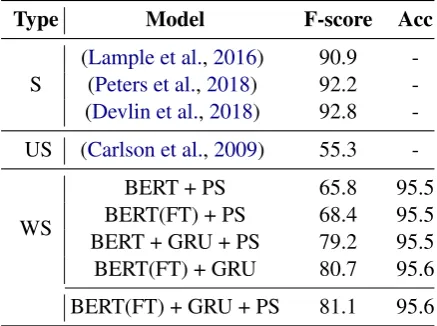
Table 1 shows the performance of our model.
We observe that our proposed approach signif-icantly outperforms the baseline, and performs reasonably well when compared to various state-of-the-art supervised approaches that use signifi-cantly more ground-truth annotation information.
To further investigate the impact of the differ-ent compondiffer-ents of the model, we ablate our model
components (Table1). We observe that having a
contextual GRU layer for adapting to the task has a significant impact on the performance, with the final model performing much better than BERT + PS. Further, fine-tuning and probability scaling also help improve model performance.
5.1 Impact of Stop-Word Removal
We find that the model learns to focus on indica-tor words that frequently occur in sentences where a particular tag is present, and tends to use them to identify the presence of entities at the sentence level. For example, the word ”at” is often indica-tive of the existence of a location in a sentence, the name of the location itself aside, and the model tends to focus on both. This behaviour is unsur-prising, given that the model is trained purely us-ing a signal of whether or not a sentence contains
an entity of that type, with no idea about the entity boundaries themselves. Based on what we com-monly observe, a few of these indicator words in-clude: prepositions such as “at” and “in” when a LOC entity is present; common titles preceding PER names (such as “President” X or “Miss” Y); conjunctions that might separate two or more en-tities (such as X “and” Y).
This results in the model picking out spuri-ous words alongside the actual entity, which ne-cessitates the use of stop-word and symbol re-moval. However, this removal also results in the model not being able to pick out words when they occur within an entity span (for example, ”Re-public of Iceland”). This is particularly prob-lematic for ORG (4.85% spans have stop-words) and MISC (3.15% spans have stop-words), com-pared to LOC(0.6%) and PER(0.76%). This is-sue can potentially be mitigated with either a more sophisticated tagger module or a better stop-word/symbol removal mechanism, which we leave to future work.
5.2 Errors due to Incorrect Entity Boundaries
Model Text Type Micro
(Peters et al.,2018) 95.9 93.8 94.8
BERT(FT) + GRU + PS 84.0 89.0 86.5
Table 2: MUC f-scores for the model
Since our model does not have access to an-notated training data, it has no direct supervision for learning entity boundaries. This particularly hurts the model in the CoNLL task, since preci-sion, recall and f-score are measured based on an exact string match. In order to investigate this, we
use the metric used in MUC events (Grishman and
Sundheim,1996;Chinchor,1998), wherein a sys-tem is scored on two axes: finding the correct text and the correct type. A text is correct if the en-tity boundaries are correct, regardless of their type, while a type is correct if an entity is tagged with a correct type, regardless of the boundaries, as long as there is an overlap with the gold type. The final
score is a micro average f-measure (see Nadeau
and Sekine(2007) for more details).
Table 2 shows the performance of the model
along the two axes, as well as the MUC score. We also report the same metrics for the
MISC
MISC PER
PER
PER
PER PER LOC
LOC LOC
[image:5.595.73.526.63.138.2]ORG ORG
Figure 3: Qualitative Analysis (Best viewed in color)PER,LOC,MISC,ORG. The Gold column shows the gold tags contained in the sentence while the Predictions column contains the tags predicted by the model. Tags in green are correctly predicted, while those in red are incorrect.
see that the model primarily loses out on the text based measure, and performs quite well on the type based one. This is in accordance with our hy-pothesis that the model identifies the correct enti-ties, but fails at finding the exact entity boundaries. A better boundary detection method can conse-quently be used alongside our model to improve the entity retrievals in a downstream task.
5.3 Qualitative Analysis
Fig 3 shows examples of where our proposed
model performs well, and where it fails. Exam-ples 0, 1 and 2 show when the model is correctly able to identify the entity classes persons, loca-tions and miscellaneous. Examples 3, 4 and 5 show some of the shortcomings. As described in
5.1, indicator tokens like President (Example 3)
are usually marked as the PER entity type, which gets penalized when compared to the gold labels. Another common failure case we observe is when outside domain knowledge is necessary to disam-biguate the entity type. For example, in Example 4, the model predicts Philadelphia as LOC, while the correct tag is ORG (referring to the Philadel-phia Eagles). Similarly, in Example 5, the model classifies Hampshire as LOC, while the correct tag is ORG (the cricket club).
6 Conclusion
We present a novel method for entity recognition using a relatively weak supervision signal. Our proposed model, trained on a multi-label classifi-cation task, achieves reasonable entity recognition performance.
While our proposed method is simple, we demonstrate that it works surprisingly well. Var-ious other formulations for this task are possible: for example, one might involve marginalizing over the tags and using this for predicting a label; an-other could perform attention over spans instead of tokens. We plan on investigating these alternate
approaches in future work.
Acknowledgments
We would like to thank the anonymous reviewers for their invaluable feedback, which helped shaped the paper into its current form. We would also like to thank Matthew R. Gormley for the helpful dis-cussions on the topic.
References
Dzmitry Bahdanau, Kyunghyun Cho, and Yoshua Ben-gio. 2014. Neural machine translation by jointly learning to align and translate. arXiv preprint arXiv:1409.0473.
Marcely Zanon Boito, Alexandre B´erard, Aline Villav-icencio, and Laurent Besacier. 2017. Unwritten languages demand attention too! word discovery with encoder-decoder models. InAutomatic Speech Recognition and Understanding Workshop (ASRU), 2017 IEEE, pages 458–465. IEEE.
Andrew Carlson, Scott Gaffney, and Flavian Vasile.
2009. Learning a named entity tagger from
gazetteers with the partial perceptron. In AAAI Spring Symposium: Learning by Reading and Learning to Read, pages 7–13.
Nancy Chinchor. 1998. Overview of muc-7. In
Sev-enth Message Understanding Conference (MUC-7): Proceedings of a Conference Held in Fairfax, Vir-ginia, April 29-May 1, 1998.
Kyunghyun Cho, Bart van Merrienboer, Caglar Gul-cehre, Dzmitry Bahdanau, Fethi Bougares, Holger
Schwenk, and Yoshua Bengio. 2014. Learning
phrase representations using rnn encoder–decoder for statistical machine translation. InProceedings of the 2014 Conference on Empirical Methods in Nat-ural Language Processing (EMNLP), pages 1724– 1734.
Jacob Devlin, Ming-Wei Chang, Kenton Lee, and Kristina Toutanova. 2018. Bert: Pre-training of deep bidirectional transformers for language understand-ing. arXiv preprint arXiv:1810.04805.
Oren Etzioni, Michael Cafarella, Doug Downey, Ana-Maria Popescu, Tal Shaked, Stephen Soderland, Daniel S Weld, and Alexander Yates. 2005. Un-supervised named-entity extraction from the web: An experimental study. Artificial intelligence, 165(1):91–134.
Matt Gardner, Joel Grus, Mark Neumann, Oyvind Tafjord, Pradeep Dasigi, Nelson F. Liu, Matthew Peters, Michael Schmitz, and Luke S. Zettlemoyer. 2017. Allennlp: A deep semantic natural language processing platform.
Omid Ghiasvand and Rohit J Kate. 2015. Biomedical named entity recognition with less supervision. In Healthcare Informatics (ICHI), 2015 International Conference on, pages 495–495. IEEE.
Pierre Godard, Marcely Zanon-Boito, Lucas Ondel, Alexandre Berard, Franc¸ois Yvon, Aline Villavicen-cio, and Laurent Besacier. 2018. Unsupervised word
segmentation from speech with attention. arXiv
preprint arXiv:1806.06734.
Ralph Grishman and Beth Sundheim. 1996. Mes-sage understanding conference-6: A brief history. In COLING 1996 Volume 1: The 16th Interna-tional Conference on ComputaInterna-tional Linguistics, volume 1.
John Lafferty, Andrew McCallum, and Fernando CN Pereira. 2001. Conditional random fields: Prob-abilistic models for segmenting and labeling se-quence data.
Guillaume Lample, Miguel Ballesteros, Sandeep Sub-ramanian, Kazuya Kawakami, and Chris Dyer. 2016. Neural architectures for named entity recognition. InProceedings of NAACL-HLT, pages 260–270. Jihwan Lee, Dongchan Kim, Ruhi Sarikaya, and
Young-Bum Kim. 2018. Coupled representation learning for domains, intents and slots in spoken
lan-guage understanding. In 2018 IEEE Spoken
Lan-guage Technology Workshop (SLT), pages 714–719. IEEE.
David D Lewis, Yiming Yang, Tony G Rose, and Fan Li. 2004. Rcv1: A new benchmark collection for text categorization research. Journal of machine learning research, 5(Apr):361–397.
Chen Liang, Mohammad Norouzi, Jonathan Berant, Quoc V Le, and Ni Lao. 2018. Memory augmented policy optimization for program synthesis and se-mantic parsing. InAdvances in Neural Information Processing Systems, pages 9994–10006.
Thang Luong, Hieu Pham, and Christopher D Man-ning. 2015. Effective approaches to attention-based neural machine translation. In Proceedings of the
2015 Conference on Empirical Methods in Natural Language Processing, pages 1412–1421.
Xuezhe Ma and Eduard Hovy. 2016. End-to-end
sequence labeling via bi-directional LSTM-CNNs-CRF. InProceedings of the 54th Annual Meeting of the Association for Computational Linguistics (Vol-ume 1: Long Papers), pages 1064–1074, Berlin, Germany. Association for Computational Linguis-tics.
David Nadeau and Satoshi Sekine. 2007. A
sur-vey of named entity recognition and classification. Lingvisticae Investigationes, 30(1):3–26.
Matthew E. Peters, Mark Neumann, Mohit Iyyer, Matt Gardner, Christopher Clark, Kenton Lee, and Luke Zettlemoyer. 2018. Deep contextualized word rep-resentations. InProc. of NAACL.
Lance A Ramshaw and Mitchell P Marcus. 1999. Text chunking using transformation-based learning. In Natural language processing using very large cor-pora, pages 157–176. Springer.
Lev Ratinov and Dan Roth. 2009. Design challenges
and misconceptions in named entity recognition. In CoNLL.
Ilya Sutskever, Oriol Vinyals, and Quoc V Le. 2014. Sequence to sequence learning with neural net-works. InAdvances in neural information process-ing systems, pages 3104–3112.
Zhiwen Tang and Grace Hui Yang. 2018. Deeptilebars: Visualizing term distribution for neural information retrieval.arXiv preprint arXiv:1811.00606.
Eu Wern Teh, Mrigank Rochan, and Yang Wang. 2016. Attention networks for weakly supervised object lo-calization. InBMVC, pages 1–11.
Chuan Wang and Nianwen Xue. 2017. Getting the
most out of amr parsing. In Proceedings of the
2017 conference on empirical methods in natural language processing, pages 1257–1268.
Gu Xu, Shuang-Hong Yang, and Hang Li. 2009. Named entity mining from click-through data us-ing weakly supervised latent dirichlet allocation. In Proceedings of the 15th ACM SIGKDD interna-tional conference on Knowledge discovery and data mining, pages 1365–1374. ACM.
Jianming Zhang, Sarah Adel Bargal, Zhe Lin, Jonathan Brandt, Xiaohui Shen, and Stan Sclaroff. 2018. Top-down neural attention by excitation back-prop. International Journal of Computer Vision, 126(10):1084–1102.