Proceedings of the 3rd Workshop on Neural Generation and Translation (WNGT 2019), pages 194–198 194
Big Bidirectional Insertion Representations for Documents
Lala Li
Google Research, Brain Team
William Chan
Google Research, Brain Team
Abstract
The Insertion Transformer is well suited for long form text generation due to its parallel generation capabilities, requiring O(log2n) generation steps to generatentokens. How-ever, modeling long sequences is difficult, as there is more ambiguity captured in the attention mechanism. This work proposes the Big Bidirectional Insertion Representa-tions for Documents (Big BIRD), an insertion-based model for document-level translation tasks. We scale up the insertion-based mod-els to long form documents. Our key contri-bution is introducing sentence alignment via sentence-positional embeddings between the source and target document. We show an im-provement of +4.3 BLEU on the WMT’19 English→German document-level translation task compared with the Insertion Transformer baseline.
1 Introduction
Recently, insertion-based models (Stern et al., 2019;Welleck et al.,2019;Gu et al.,2019;Chan et al., 2019) have been introduced for text gen-eration. Unlike traditional autoregressive left-to-right models (Cho et al., 2014; Sutskever et al., 2014;Vaswani et al.,2017), insertion-based mod-els are not restricted to generating text sequences in a serial left-to-right manner, but these models are endowed with the capabilities of parallel gen-eration. More specifically, Stern et al. (2019); Chan et al.(2019) showed that we can teach neural nets to generate text to follow a balanced binary tree order. An autoregressive left-to-right model would require O(n) generation steps to gener-ate n tokens, whereas the Insertion Transformer (Stern et al., 2019) and KERMIT (Chan et al., 2019) following a balanced binary tree policy re-quires onlyO(log2n)generation steps to generate n tokens. This is especially important for
long-form text generation, for example, Document-Level Machine Translation.
Document-Level Machine Translation is be-coming an increasingly important task. Recent re-search suggests we are nearing human-level parity for sentence-level translation in certain domains (Hassan et al., 2018), however, we lag signifi-cantly behind in document-level translation (Lubli et al., 2018). Various papers have proposed in-corporating context for document-level translation (Junczys-Dowmunt,2019), which has been shown to improve translation quality. There are two pri-mary methods to include context in a document-level machine translation model compared to a sentence-level translation model.
1. Source Contextualization. We can include source context, wherein when we generate the target sentence, we can condition on the corresponding source sentence and its neigh-bours, or even the whole source document. This allows the target sentence to be contex-tualized to the source document.
2. Target Contextualization. We can include target context, wherein when we generate the target sentence, we can condition on all the target tokens generated thus far in the whole document. This allows the target sentence to be contextualized to other target sentences.
this adds complexity and additional runtime cost during inference.
Insertion-based models, for example, the Inser-tion Transformer (Stern et al., 2019) is one po-tential solution. The Insertion Transformer can generate text following a balanced binary tree or-der. It requiresO(log2n)iterations to generaten tokens, offering significant inference time advan-tages over a serial generation model. The source document is naturally fully conditioned on, which provides full source contextualization. Addition-ally, the generation order offers bidirectional con-textualization, permitting target contextualization that is not solely on a left-to-right basis.
In this paper, we present Big Bidirectional Insertion Representations for Documents (Big BIRD). We address the limitations of scaling up the Insertion Transformer to document-level ma-chine translation. We present a model that can model long-form documents with thousands of to-kens in a fully contextualized manner.
2 Big BIRD
In this section, we present Big Bidirectional Representations for Documents (Big BIRD). Big BIRD is an extension of the Insertion Transformer (Stern et al., 2019), scaling up from sentences to documents. The key contributions are 1) extend-ing the context window size to cover a document, and 2) informing the model of sentence positional information, which are aligned between source and target sentences.
Insertion Transformer. In the Insertion Trans-former (Stern et al., 2019), sequences are gener-ated via insertion operations. In the context of Ma-chine Translation, there is a source canvasxand a target canvasy, where the target canvas is updated at each iteration via inserting one token at each plausible location. At timetduring training, a hy-pothesis target canvas yˆt must be a subsequence
of the final output. For example, if the final out-put is [A, B, C, D, E], then yˆt = [B, D] would
be a valid intermediate canvas, in which case the model would be taught to predict[A, C, E]. The model is taught to insert multiple tokens at incom-plete slots, or predict end-of-slot for comincom-pleted slots. The intermediate canvases are uniformly sampled from the ground truth target sequence. During inference, the target canvas starts empty, and tokens will be inserted iteratively until the model predicts to insert empty tokens everywhere,
or the sequence has exceeded the specified maxi-mum length.
Larger Context and Sentence-Positional Em-beddings. Longer sequences lead to more un-certainties for the Insertion Transformer. For ex-ample, if a token in yˆt appears in multiple
sen-tences in the final output, there is ambiguity to the model which sentence it belongs to (and therefore where to attend to on both the source and target canvases). While there is location information en-dowed in the Transformer model, we hypothesize that token level positional information is insuffi-cient (especially since we have limited training data). We believe that endowing the model with sentence-level positional information (i.e., which sentence each token belongs to) may help signifi-cantly disambiguate in such situations and help the model build a more robust attention mechanism.
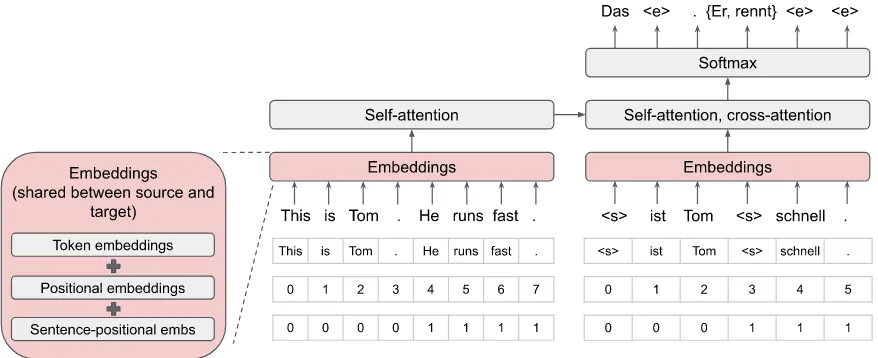
Based on this motivation and assuming that the datasets have not only parallel documents, but also sentence alignment between source and target doc-uments (which is true for WMT’19 document-level translation), we use sentence-positional em-beddings on both the source and target sequences as shown in Figure1. The intention is to endow the model with this prior knowledge on sentence alignment between the source and target, and thus more easily attend to the appropriate sentences based on sentence locality. More specifically, on the source side, we do not use any sentence sepa-rator tokens; on the target side, we start each sen-tence with a sensen-tence separator. During inference we initialize the output hypothesis with empty
hsi sentence separator tokens, where the number ofhsi equals to the number of source sentences, which is equal to the number of target sentences to be generated. These hsi tokens serve as sen-tence anchor points, and have sensen-tence-positional information. Figure1visualizes the model.
In this work we increased the context window size to cover multiple sentences or a short docu-ment. Note that there is only a limit on the max-imum number of tokens in the entire sequence; there is no limit on the length of a single sentence, or the total number of sentences in the sequence.
3 Experiments
(Eu-Figure 1: Big Bidirectional Insertion Representations for Documents
roparl, Rapid, News-Commentary) and parallel sentence-level data (WikiTitles, Common Crawl, Paracrawl). The test set is newstest2019. The document-level portion contains 68.4k parallel documents, or a total of 7.7M parallel sentences; while the sentence-level portion has 19.9M parallel sentences. We generated a vocabulary of 32k subwords from the training data using the SentencePiece tokenizer (Kudo and Richardson, 2018).
The Big BIRD model is as described in Section 2, and the baseline Insertion Transformer model has exactly the same configurations except with-out sentence-positional embeddings. To be ex-plicit, our baseline Insertion Transformer model is also given the prior knowledge of number of source sentences in the document. The target can-vas is initialized target withhsisentence separator tokens, where the number of hsi tokens is equal to the number of sentences in the document. All our models follow the same architecture as the Transformer Base model in (Vaswani et al.,2017), and a context window of 1536 tokens during train-ing (determined based on the longest document in the test set). All models were trained with the SM3 optimizer (Anil et al., 2019) with momen-tum 0.9, learning rate 0.1, and a quadratic learning rate warm-up schedule with 10k warm-up steps. The learning rate were chosen after some prelim-inary comparison runs between Adam and SM3. We opted to use the SM3 optimizer over Adam due to its more memory efficient properties, thus allowing us to use larger minibatches. Training was around 800k steps at batch size 512.
During training, each batch consists of 256
sub-Model BLEU
Insertion Transformer 25.3
Big BIRD 29.6
Table 1: WMT19 English→German Document-Level Translation.
documents and 256 sentences. Sub-documents are continuous sentences dynamically sampled from a document. The lengths of sub-documents are uni-formly sampled in (0, 1536] tokens. The number of sampled sub-documents from each document is 1/10 of the number of sentences in the full doc-ument. Sentences directly come from sentence-level data. This 1:1 mixing of sub-documents and sentences results in training examples of vastly different lengths and therefore many masked po-sitions, and we plan to improve it in the future by packing multiple sentences into one example.
We report sacreBLEU (Post,2018) scores of the two models in Table1. Our Big BIRD model out-performs the Insertion Transformer model by +4.3 BLEU.
[image:3.595.73.512.62.241.2]Source:
(...) Chelsea faces Videoton in the UEFA Europa Leaguge at 3 p.m. on Thursday in London.
Target:
(...) Chelsea trifft in der UEFA Europa League am Donnerstag um 15 Uhr in London auf Videoton.
Insertion Transformer:
(...) Chelsea Gesichter am Donnerstag um 15.00 Uhr in London. Chelsea Gesichter Videoton in der UEFA Europa Leaguge.
Translation:(Google Translate)
Chelsea faces on Thursday at 15.00 in London. Chelsea faces Videoton in UEFA Europa Leaguge.
Big BIRD:
(...) Chelsea sieht am Donnerstag um 15.00 Uhr in London Videoton in der UEFA Europa Leaguge. Translation:(Google Translate)
Chelsea sees Videoton in UEFA Europa League on Thursday at 15.00 in London.
Table 2: An example where the Insertion Transformer gets confused with sentence alignment: it maps one sentence from the source into two sentences in the translation and loses semantic accuracy. When given sentence alignment explicitly, i.e. Big BIRD, it translates the sentence coherently.
better than the Insertion Transformer, and there-fore its translation is more accurate and coherent.
4 Conclusion
In this paper, we presented Big BIRD, an adap-tation of the Insertion Transformer to document-level translation. In addition to a large context window, Big BIRD also uses sentence-positional embeddings to directly capture sentence alignment between source and target documents. We show both quantitatively and qualitatively the promise of Big BIRD, with a +4.3 BLEU improvement over the baseline model and examples where Big BIRD achieves better translation quality via sen-tence alignment. We believe Big BIRD is a promising direction for document level under-standing and generation.
References
Rohan Anil, Vineet Gupta, Tomer Koren, and Yoram Singer. 2019. Memory-Efficient Adaptive Opti-mization for Large-Scale Learning. InarXiv.
Loc Barrault, Ondej Bojar, Marta R. Costa-juss, Chris-tian Federmann, Mark Fishel, Yvette Graham, Barry Haddow, Matthias Huck, Philipp Koehn, Shervin Malmasi, Christof Monz, Mathias Mller, Santanu Pal, Matt Post, and Marcos Zampieri. 2019. Find-ings of the 2019 Conference on Machine Transla-tion. InACL.
William Chan, Nikita Kitaev, Kelvin Guu, Mitchell Stern, and Jakob Uszkoreit. 2019. KERMIT:
Gen-erative Insertion-Based Modeling for Sequences. In
arXiv.
Kyunghyun Cho, Bart van Merrienboer, Caglar Gul-cehre, Dzmitry Bahdanau, Fethi Bougares, Hol-ger Schwenk, and Yoshua Bengio. 2014. Learn-ing Phrase Representations usLearn-ing RNN Encoder-Decoder for Statistical Machine Translation. In
EMNLP.
Jiatao Gu, Qi Liu, and Kyunghyun Cho. 2019. Insertion-based Decoding with Automatically In-ferred Generation Order. InarXiv.
Hany Hassan, Anthony Aue andChang Chen, Vishal Chowdhary, Jonathan Clark, Christian Feder-mann, Xuedong Huang, Marcin Junczys-Dowmunt, William Lewis, Mu Li, Shujie Liu, Tie-Yan Liu, Renqian Luo, Arul Menezes, Tao Qin, Frank Seide, Xu Tan, Fei Tian, Lijun Wu, Shuangzhi Wu, Yingce Xia, Dongdong Zhang, Zhirui Zhang, and Ming Zhou. 2018. Achieving Human Parity on Automatic Chinese to English News Translation. InarXiv.
Marcin Junczys-Dowmunt. 2019. Microsoft Transla-tor at WMT 2019: Towards Large-Scale Document-Level Neural Machine Translation. InWMT.
Taku Kudo and John Richardson. 2018. Sentencepiece: A simple and language independent subword tok-enizer and detoktok-enizer for neural text processing. In
Proceedings of the 2018 Conference on Empirical Methods in Natural Language Processing: System Demonstrations, pages 66–71.
Sameen Maruf and Gholamreza Haffari. 2018. Doc-ument Context Neural Machine Translation with Memory Networks. InACL.
Matt Post. 2018. A Call for Clarity in Reporting BLEU Scores. InWMT.
Mitchell Stern, William Chan, Jamie Kiros, and Jakob Uszkoreit. 2019. Insertion Transformer: Flexible Sequence Generation via Insertion Operations. In
ICML.
Ilya Sutskever, Oriol Vinyals, and Quoc Le. 2014. Sequence to Sequence Learning with Neural Net-works. InNIPS.
Ashish Vaswani, Noam Shazeer, Niki Parmar, Jakob Uszkoreit, Llion Jones, Aidan N. Gomez, Lukasz Kaiser, and Illia Polosukhin. 2017. Attention Is All You Need. InNIPS.