On Amortizing Inference Cost for Structured Prediction
Vivek Srikumar∗ and Gourab Kundu∗ and Dan Roth
University of Illinois, Urbana-Champaign Urbana, IL. 61801
{vsrikum2, kundu2, danr}@illinois.edu
Abstract
This paper deals with the problem of predict-ing structures in the context of NLP. Typically, in structured prediction, an inference proce-dure is applied to each example independently of the others. In this paper, we seek to op-timize the time complexity of inference over entire datasets, rather than individual
exam-ples. By considering the general inference
representation provided by integer linear pro-grams, we propose three exact inference the-orems which allow us to re-use earlier solu-tions for certain instances, thereby completely avoiding possibly expensive calls to the infer-ence procedure. We also identify several ap-proximation schemes which can provide fur-ther speedup. We instantiate these ideas to the structured prediction task of semantic role la-beling and show that we can achieve a speedup of over 2.5 using our approach while retain-ing the guarantees of exactness and a further speedup of over 3 using approximations that do not degrade performance.
1 Introduction
Typically, in structured prediction applications, ev-ery example is treated independently and an infer-ence algorithm is applied to each one of them. For example, consider a dependency parser that uses the maximum spanning tree algorithm (McDonald et al., 2005) or its integer linear program variants (Riedel and Clarke, 2006; Martins et al., 2009) to make pre-dictions. Given a trained model, the parser addresses
* These authors contributed equally to this work.
each sentence separately and runs the inference al-gorithm to predict the parse tree. Thus, the time complexity of inference over the test set is linear in the size of the corpus.
In this paper, we ask the following question: For
a given task, since the inference procedure predicts structures from the same family of structures (depen-dency trees, semantic role structures, etc.), can the fact that we are running inference for a large num-ber of examples help us improve the time complexity of inference? In the dependency parsing example, this question translates to asking whether, having parsed many sentences, we can decrease the parsing time for the next sentence.
Since any combinatorial optimization problem can be phrased as an integer linear program (ILP), we frame inference problems as ILPs for the purpose of analysis. By analyzing the objective functions of integer linear programs, we identify conditions when two ILPs have the same solution. This allows us to reuse solutions of previously solved problems and theoretically guarantee the optimality of the so-lution. Furthermore, in some cases, even when the conditions are not satisfied, we can reuse previous solutions with high probability of being correct.
Given the extensive use of integer linear programs for structured prediction in Natural Language Pro-cessing over the last few years, these ideas can be ap-plied broadly to NLP problems. We instantiate our improved inference approaches in the structured pre-diction task of semantic role labeling, where we use an existing implementation and a previous trained model that is based on the approach of (Punyakanok et al., 2008). We merely modify the inference
cess to show that we can realize the theoretical gains by making fewer calls to the underlying ILP solver.
Algorithm Speedup
Theorem 1 2.44
Theorem 2 2.18
[image:2.612.132.240.96.152.2]Theorem 3 2.50
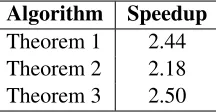
Table 1: The speedup for semantic role labeling cor-responding to the three theorems described in this paper. These theorems guarantee the optimality of the solution, thus ensuring that the speedup is not accompanied by any loss in performance.
Table 1 presents a preview of our results, which are discussed in Section 4. All three approaches in this table improve running time, while guaranteeing optimum solutions. Allowing small violations to the conditions of the theorems provide an even higher improvement in speedup (over 3), without loss of performance.
The primary contributions of this paper are:
1. We pose the problem of optimizing inference costs over entire datasets rather than individ-ual examples. Our approach is agnostic to the underlying models and allows us to use pre-trained scoring functions.
2. We identify equivalence classes of ILP prob-lems and use this notion to prove exact con-ditions under which no inference is required. These conditions lead to algorithms that can speed up inference problem without losing the exactness guarantees. We also use these con-ditions to develop approximate inference algo-rithms that can provide a further speedup.
3. We apply our approach to the structured pre-diction task of semantic role labeling. By not having to perform inference on some of the in-stances, those that are equivalent to previously seen instances, we show significant speed up in terms of the number of times inference needs to be performed. These gains are also realized in terms of wall-clock times.
The rest of this paper is organized as follows: In section 2, we formulate the problem of amortized inference and provide motivation for why amortized
gains can be possible. This leads to the theoretical discussion in section 3, where we present the meta-algorithm for amortized inference along with sev-eral exact and approximate inference schemes. We instantiate these schemes for the task of semantic role labeling (Section 4). Section 5 discusses related work and future research directions.
2 Motivation
Many NLP tasks can be phrased as structured pre-diction problems, where the goal is to jointly assign values to many inference variables while account-ing for possible dependencies among them. This de-cision task is a combinatorial optimization problem and can be solved using a dynamic programming ap-proach if the structure permits. In general, the infer-ence problem can be formulated and solved as inte-ger linear programs (ILPs).
Following (Roth and Yih, 2004) Integer linear programs have been used broadly in NLP. For exam-ple, (Riedel and Clarke, 2006) and (Martins et al., 2009) addressed the problem of dependency pars-ing and (Punyakanok et al., 2005; Punyakanok et al., 2008) dealt with semantic role labeling with this technique.
In this section, we will use the ILP formulation of dependency parsing to introduce notation. The standard approach to framing dependency parsing as an integer linear program was introduced by (Riedel and Clarke, 2006), who converted the MST parser of (McDonald et al., 2005) to use ILP for inference. The key idea is to build a complete graph consist-ing of tokens of the sentence where each edge is weighted by a learned scoring function. The goal of inference is to select the maximum spanning tree of this weighted graph.
2.1 Problem Formulation
In this work, we consider the general inference
prob-lem of solving a0-1integer linear program. To
the structured perceptron of (Collins, 2002), struc-tured SVM (Tsochantaridis et al., 2005) or the con-straints driven learning approach of (Chang et al., 2007).
Since structured prediction assigns values to a collection of inter-related binary decisions, we
de-note theith binary decision byyi ∈ {0,1}and the
entire structure asy, the vector composed of all the
binary decisions. In our running example, each edge in the weighted graph generates a single decision variable (for unlabeled dependency parsing). For
eachyi, letci ∈ <denote the weight associated with
it. We denote the entire collection of weights by the
vectorc, forming theobjectivefor this ILP.
Not all assignments to these variables are valid. Without loss of generality, these constraints can be expressed using linear inequalities over the
infer-ence variables, which we write as MTy ≤ b for
a real valued matrixM and a vectorb. In
depen-dency parsing, for example, these constraints ensure that the final output is a spanning tree.
Now, the overall goal of inference is to find the highest scoring structure. Thus, we can frame
infer-ence as an optimization problempwithninference
variables as follows:
arg max
y∈{0,1}n
cTy (1)
subject to MTy≤b. (2)
For brevity, we denote the space of feasible solutions
that satisfy the constraints for the ILP problempas
Kp ={y∈ {0,1}n|MTy ≤b}. Thus, the goal of
inference is to find
arg max
y∈Kp
cTy.
We refer toKp as the feasible set for the inference
problempandypas its solution.
In the worst case, integer linear programs are known to be NP-hard. Hence, solving large prob-lems, (that is, problems with a large number of con-straints and/or variables) can be infeasible.
For structured prediction problems seen in NLP, we typically solve many instances of inference prob-lems. In this paper, we investigate whether an infer-ence algorithm can use previous predictions to speed
up inference time, thus giving us anamortized gain
in inference time over the lifetime of the program. We refer to inference algorithms that have this
capa-bility asamortized inference algorithms.
In our running example, each sentence corre-sponds to a separate ILP. Over the lifetime of the dependency parser, we create one inference instance (that is, one ILP) per sentence and solve it. An
amor-tized inference algorithm becomesfasterat parsing
as it parses more and more sentences.
2.2 Why can inference costs be amortized over
datasets?
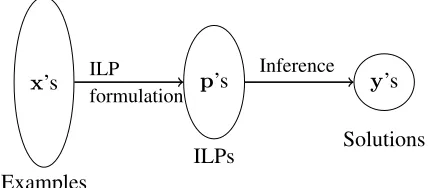
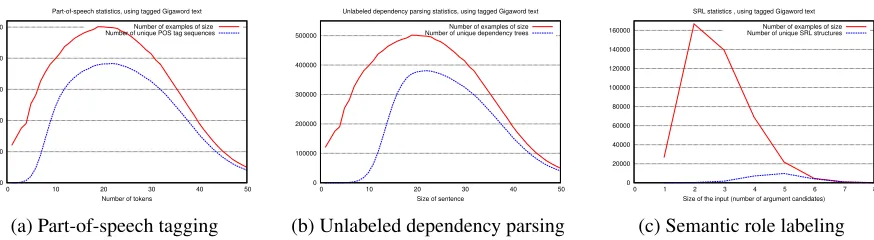
In the rest of this section, we will argue that the time cost of inference can be amortized because of the nature of inference in NLP tasks. Our argument is based on two observations, which are summarized in Figure (1): (1) Though the space of possible struc-tures may be large, only a very small fraction of these occur. (2) The distribution of observed struc-tures is heavily skewed towards a small number of them.
x’s ILP p’s y’s
formulation
Inference
Examples
ILPs Solutions
Figure 1: For a structured prediction task, the
infer-ence problem p for an examplex needs to be
for-mulated before solving it to get the structurey. In
structured prediction problems seen in NLP, while an exponential number of structures is possible for a given instance, in practice, only a small fraction of these ever occur. This figure illustrates the empirical observation that there are fewer inference problems
p’s than the number of examples and the number of
observed structuresy’s is even lesser.
As an illustration, consider the problem of part-of-speech tagging. With the standard Penn Treebank tag set, each token can be assigned one of 45 labels.
Thus, for a sentence of size n, we could have 45n
[image:3.612.320.534.353.447.2]0 100000 200000 300000 400000 500000
0 10 20 30 40 50 Number of tokens
Part-of-speech statistics, using tagged Gigaword text Number of examples of size Number of unique POS tag sequences
(a) Part-of-speech tagging
0 100000 200000 300000 400000 500000
0 10 20 30 40 50 Size of sentence
Unlabeled dependency parsing statistics, using tagged Gigaword text Number of examples of size Number of unique dependency trees
(b) Unlabeled dependency parsing
0 20000 40000 60000 80000 100000 120000 140000 160000
0 1 2 3 4 5 6 7 8 Size of the input (number of argument candidates)
SRL statistics , using tagged Gigaword text Number of examples of size Number of unique SRL structures
[image:4.612.92.529.57.177.2](c) Semantic role labeling
Figure 2: Number of inference instances for different input sizes (red solid lines) and the number of unique structures for each size (blue dotted lines). The x-axis indicates the size of the input (number of tokens for part of speech and dependency, and number of argument candidates for SRL.) Note that the number of instances is not the number of unique examples of a given length, but the number of times an inference procedure is called for an input of a given size.
0 2 4 6 8 10 12
0 5000 10000 15000 20000 Solution Id
Log frequency of solutions for sentences with 5 tokens
(a) Sentence length = 5
-1 0 1 2 3 4 5 6 7 8
0 50000 100000 150000 200000 250000 Solution Id
Log frequency of solutions for sentences with 10 tokens
(b) Sentence length = 10
-1 0 1 2 3 4 5 6 7 8
0 50000 100000 150000 200000 250000 300000 350000 Solution Id
Log frequency of solutions for sentences with 15 tokens
[image:4.612.86.532.267.385.2](c) Sentence length = 15
Figure 3: These plots show the log-frequencies of occurrences of part-of-speech sequences for sentences with five, ten and fifteen tokens. The x-axes list different unique part-of-speech tag sequences for the entire sentence. These plots show that for sentences of a given length, most structures (solutions) that are possible never occur, or occur very infrequently; only a few of the possible structures (solutions) actually occur frequently.
sentence where all the tokens are determiners.
Furthermore, many sentences of the same size
share the same part-of-speech tag sequence. To
quantify the redundancy of structures, we part-of-speech tagged the English Gigaword corpus (Graff and Cieri, 2003). Figure (2a) shows the number of sentences in the corpus for different sentence lengths. In addition, it also shows the number of unique part-of-speech tag sequences (over the en-tire sentence) for each size. We see that the number of structures is much fewer than the number of
in-stances for any sentence size. Note that45nquickly
outgrows the number of sentences as n increases.
The figures (2b) and (2c) show similar statistics for unlabeled dependency parsing and semantic role la-beling. In the former case, the size of the instance is
the number of tokens in a sentence, while in the lat-ter, the size is the number of argument candidates that need to be labeled for a given predicate. In both cases, we see that the number of empirically observed structures is far fewer than the number of instances to be labeled.
Thus, for any given input size, the number of in-stances of that size (over the lifetime of the program) far exceeds the number of observed structures for that size. Moreover, the number of observed struc-tures is significantly smaller than the number of the-oretically possible structures. Thus, we have a small number of structures that form optimum structures for many inference instances of the same size.
shows the log frequencies of part-of-speech tagging sequences for sentences of lengths five, ten and fif-teen. In all cases, we see that a few structures are most frequent. We observed similar distributions of structures for all input sizes for dependency parsing and semantic role labeling as well.
Since the number of structures for a given
exam-ple size is small, many examexam-ples x’s, and hence
many inference problems p’s, are associated with
the same structurey. These observations suggest the
possibility of getting an amortized gain in inference time by characterizing the set of inference problems that produce the same structure. Then, for a new in-ference problem, if we can identify that it belongs to a known set, that is, will yield a solution that we have already seen, we do not have to run inference at all. The second observation also suggests that this char-acterization of sets of problems that have the same solution can be done in a data-driven way because characterizing a small number of structures can give us high coverage.
3 Amortizing inference costs
In this section, we present different schemes for amortized inference leading up to an inference meta-algorithm. The meta-algorithm is both agnostic to the underlying inference algorithm that is used by the problem and maintains the exactness properties of the underlying inference scheme. That is, if we have an exact/approximate inference algorithm with a certain guarantees, the meta-algorithm will have the same guarantees, but with a speedup.
3.1 Notation
For an integer linear programp withnp variables,
we denote its objective coefficients bycpand its
fea-sible set byKp. We denote its solution as asyp. We
represent vectors by boldfaced symbols and theirith
component using subscripts.
We consider many instantiations of the inference problem and use superscripts to denote each indi-vidual instance. Thus, we have a large collection of
inference instances P = {p1,p2,· · · } along with
their respective solutions{y1
p,yp2,· · · }.
Definition 1(Equivalence classes of ILPs). Two
in-teger linear programs are said to be in the same equivalence class if they have the same number of
inference variables and the same feasible set.
We square brackets to denote equivalence classes.
If [P] is an equivalence class of ILPs, we use the
notationK[P] to denote its feasible set and n[P] to
denote the number of variables. Also, for a program
p, we use the notation p ∼ [P]to indicate that it
belongs to the equivalence class[P].
3.2 Exact theorems
Our goal is to characterize the set of objective func-tions which will have the same solution for a given equivalence class of problems.
Suppose we have solved an ILPpto get a solution
yp. For every inference variable that is active in the
solution (i.e., whose value is1), increasing the
corre-sponding objective value will not change the optimal assignment to the variables. Similarly, for all other
variables (whose value in the solution is0),
decreas-ing the objective value will not change the optimal solution. This intuition gives us our first theorem for checking whether two ILPs have the same solution by looking at the difference between their objective coefficients.
Theorem 1. Let p denote an inference problem
posed as an integer linear program belonging to an equivalence class[P]. Letq∼[P]be another infer-ence instance in the same equivalinfer-ence class. Define δc = cq−cp to be the difference of the objective
coefficients of the ILPs. Then,yp is the solution of
the problemqif for eachi∈ {1,· · · , np}, we have
(2yp,i−1)δci ≥0 (3)
The condition in the theorem, that is, inequal-ity (3), requires that the objective coefficients
corre-sponding to valuesyp,ithat are set to1inpincrease,
and those that correspond to values ofyp,iset to 0,
decrease. Under these conditions, ifypis the
max-imizer of the original objective, then it maximizes the new objective too.
Theorem 1 identifies perturbations of an ILP’s ob-jective coefficients that will not change the optimal assignment. Next, we will characterize the sets of objective values that will have the same solution us-ing a criterion that is independent of the actual
so-lution. Suppose we have two ILPs p and q in an
equivalence class[P]whose objective values arecp
both these programs. That is, for every y ∈ K[P],
we havecTpy ≤cTpy∗ andcTqy ≤cTqy∗.
Multiply-ing these inequalities by any two positive real
num-bers x1 and x2 and adding them shows us that y∗
is also the solution for the ILP in[P]which has the
objective coefficientsx1cp+x2cq. Extending this
to an arbitrary number of inference problems gives us our next theorem.
Theorem 2. Let P denote a collection
{p1,p2,· · ·,pm} of m inference problems in the same equivalence class [P] and suppose that all the problems have the same solution, yp. Let
q∼[P]be a new inference program whose optimal solution isy. Theny=ypif there is somex∈ <m
such thatx≥0and
cq=
X
j
xjcjp. (4)
From the geometric perspective, the pre-condition of this theorem implies that if the new coefficients lie in the cone formed by the coefficients of the grams that have the same solution, then the new pro-gram shares the solution.
Theorems 1 and 2 suggest two different ap-proaches for identifying whether a new ILP can use the solution of previously solved inference in-stances. These theorems can be combined to get a single criterion that uses the objective coefficients of
previously solved inference problemsandtheir
com-mon solution to determine whether a new inference problem will have the same solution. Given a collec-tion of solved ILPs that have the same solucollec-tion, from theorem 2, we know that an ILP with the objective
coefficients c = P
jxjcjp will share the solution.
Considering an ILP whose objective vector iscand
applying theorem 1 to it gives us the next theorem.
Theorem 3. Let P denote a collection
{p1,p2,· · ·,pm} of m inference problems belonging to the same equivalence class [P]. Furthermore, suppose all the programs have the same solutionyp. Letq ∼ [P]be a new inference
program in the equivalence class. For anyx∈ <m, define ∆c(x) = cq −Pjxjcjp. The assignment
yp is the optimal solution of the problemqif there
is some x ∈ <m such that x ≥ 0 and for each
i∈ {1, np}, we have
(2yp,i−1)∆ci ≥0 (5)
Theorem Condition
Theorem 1 ∀i∈ {1,· · · , np},
(2yp,i−1)δci ≥0; ∀i.
Theorem 2 ∃x∈ <m, such that
x≥0andcq=Pjxjcjp
Theorem 3 ∃x∈ <m, such that
[image:6.612.312.543.56.158.2]x≥0and(2yp,i−1)∆ci≥0; ∀i.
Table 2: Conditions for checking whetherypis the
solution for an inference problemq∼[P]according
to theorems 1, 2 and 3. Please refer to the statements of the theorems for details about the notation.
3.3 Implementation
Theorems 1, 2 and 3 each specify a condition that checks whether a pre-existing solution is the opti-mal assignment for a new inference problem. These conditions are summarized in Table 2. In all cases, if the condition matches, the theorems guarantee that the two solutions will be the same. That is, applying the theorems will not change the performance of the underlying inference procedure. Only the number of inference calls will be decreased.
In our implementation of the conditions, we used
a database1 to cache ILPs and implemented the
retrieval of equivalence classes and solutions as queries to the database. To implement theorem 1, we iterate over all ILPs in the equivalence class and check if the condition is satisfied for one of them. The conditions of theorems 2 and 3 check whether a collection of linear (in)equalities has a feasible solu-tion using a linear program solver.
We optimize the wall-clock time of theorems 2 and 3 by making two observations. First, we do not need to solve linear programs for all possible ob-served structures. Given an objective vector, we only need consider the highest scoring structures within an equivalence class. (All other structures cannot be the solution to the ILP.) Second, since theorem 2 checks whether an ILP lies within a cone, we can optimize the cache for theorem 2 by only storing the ILPs that form on the boundary of the cone. A sim-ilar optimization can be performed for theorem 3 as well. Our implementation uses the following weaker version of this optimization: while caching ILPs, we
1We used the H2 database engine, which can be downloaded
do not add an instance to the cache if it already satis-fies the theorem. This optimization reduces the size of the linear programs used to check feasibility.
3.4 Approximation schemes
So far, in the above three theorems, we retain the guarantees (in terms of exactness and performance) of the underlying inference procedure. Now, we will look at schemes for approximate inference. Unlike the three theorems listed above, with the following amortized inference schemes, we are not guaranteed an optimal solution.
3.4.1 Most frequent solution
The first scheme for approximation uses the ob-servation that the most frequent solution occurs an overwhelmingly large number of times, compared to the others. (See the discussion in section 2.2 and fig-ures 3a, 3b and 3c for part-of-speech tagging.) Un-der this approximation scheme, given an ILP prob-lem, we simply pick the most frequent solution for that equivalence class as the solution, provided this solution has been seen a sufficient number of times. If the support available in the cache is insufficient, we call the underlying inference procedure.
3.4.2 Top-K approximation
The previous scheme for approximate amortized inference is agnostic to the objective coefficients of integer linear program to be solved and uses only its equivalence class to find a candidate structure.
The top-K approach extends this by scoring theK
most frequent solutions using the objective coeffi-cients and selecting the highest scoring one as the solution to the ILP problem. As with the previous scheme, we only consider solutions that have suffi-cient support.
3.4.3 Approximations to theorems 1 and 3
The next approximate inference schemes relaxes the conditions in theorems 1 and 3 by allowing the
inequalities to be violated by. That is, the
inequal-ity (3) from Theorem 1 now becomes
(2yp,i−1)δci+≥0. (6)
The inequality (5) from Theorem 3 is similarly re-laxed as follows:
(2yp,i−1)∆ci+≥0 (7)
3.5 Amortized inference algorithm
Each exact and approximate inference approach de-scribed above specifies a condition to check whether an inference procedure should be called for a new problem. This gives us the following meta-algorithm for amortized inference, parameterized by
the actual scheme used: If the given input instancep
satisfies the condition specified by the scheme, then use the cached solution. Otherwise, call the infer-ence procedure and cache the solution for future use.
4 Experiments
In this section, we apply the theory from Section 3 to the structure prediction problem of semantic role la-beling. Since the inference schemes presented above are independent of the learning aspects, we use an off-the-shelf implementation and merely modify the inference as discussed in Section 3.5.
The goal of the experiments is to show that us-ing an amortized inference algorithm, we can make fewer calls to the underlying inference procedure. For the exact inference algorithms, doing so will not change the performance as compared to the under-lying system. For the approximations, we can make a trade-off between the inference time and perfor-mance.
4.1 Experimental setup
Our goal is to simulate a long-running NLP process that can use a cache of already solved problems to improve inference time. Given a new input problem, our theorems require us to find all elements in the equivalence class of that problem along with their solutions. Intuitively, we expect a higher probability of finding members of an arbitrary equivalence class if the size of the cache is large. Hence, we processed sentences from the Gigaword corpus and cached the inference problems for our task.
param-eter. LetNBase be the number of times we would
need to call the underlying inference procedure had we not used an amortized algorithm. (This is the
same as the number of inference problems.) LetNA
be the number of times the underlying inference pro-cedure is actually called using an amortized
algo-rithmA. We define thespeedupofAas
Speedup(A) = NBase
NA
. (8)
We also report theclock speedupof our
implemen-tation for all algorithms, which is the ratio of the wall-clock time taken by the baseline algorithm to that of the amortized algorithm. For measuring time, we only measure the time for inference as the other aspects (feature extraction, scoring, etc.) are not changed.
4.2 Semantic Role Labeling
The goal of Semantic Role Labeling (SRL) (Palmer et al., 2010) is to identify and assign semantic roles to arguments of verb predicates in a sentence. For
example, consider the the sentence John gave the
ball to Mary. The verb givetakes three arguments,
John, the ball andto Mary, which are labeled A0, A1 and A2 respectively.
We used the system of (Punyakanok et al., 2008) as our base SRL system. It consists of two classi-fiers trained on the Propbank corpus. The first one, called the argument identifier, filters argument can-didates which are generated using a syntactic parse-based heuristic. The second model scores each can-didate that has not been filtered for all possible argu-ment labels. The scores for all candidates of a pred-icate are combined via inference. As in the system of (Punyakanok et al., 2008), the softmax function is applied to the raw classifier scores to ensure that they are in the same numeric range.
Inference mandates that certain structural and linguistic constraints hold over the full predicate-argument structure for a verb. (Punyakanok et al., 2008) modeled inference via an integer linear pro-gram instance, where each assignment of labels to candidates corresponds to one decision variable. Given a set of argument candidates, the feasible set of decisions is dependent of the number of argument candidates and the verb predicate. Thus, in terms of the notation used in this paper, the equivalence
classes are defined by the pair(predicate, number of
argument candidates).
We ran the semantic role labeler on 225,000 verb predicates from the Gigaword corpus and cached the equivalence classes, objective coefficients and
solutions generated by the SRL system. We
re-port speedup for the various amortized inference schemes on the standard Penn Treebank test set. On this data, the unaltered baseline system, processes 5127 integer linear programs and achieves an F1 of 75.85%.
Table 3 shows the speedup and performance for the various inference schemes. The most frequent and top-K systems are both naive solutions that take advantage of the cache of stored problems. In spite of their simplicity, they attain F1 scores of 62% and 70.06% because few structures occur most fre-quently, as described in section 2.2. We see that all the exact theorems attain a speedup higher than two without losing performance. (The variation in F1 be-tween them is because of the existence of different equivalent solutions in terms of the objective value.) This shows us that we can achieve an amortized gain in inference. Note that a speedup of 2.5 indicates that the solver is called only for 40% of the exam-ples. The approximate versions of theorems 1 and 3
(with = 0.3in both cases, which was not tuned)
attain an even higher gain in speedup over the base-line than the base versions of the theorems. Interest-ingly, the SRL performance in both cases does not decline much even though the conditions of the the-orems may be violated.
5 Related work and Future directions
In recent years, we have seen several approaches to speeding up inference using ideas like using the cut-ting plane approach (Riedel, 2009), dual decompo-sition and Lagrangian relaxation (Rush et al., 2010; Chang and Collins, 2011). The key difference be-tween these and the work in this paper is that all these approaches solve one instance at a time. Since we can use any inference procedure as a underlying system, the speedup reported in this paper is appli-cable to all these algorithms.
Decomposed amortized inference In this paper,
Type Algorithm # instances # solver Speedup Clock F1
calls speedup
Exact Baseline 5127 5217 1.0 1.0 75.85
Exact Theorem 1 5127 2134 2.44 1.54 75.90
Exact Theorem 2 5127 2390 2.18 1.14 75.79
Exact Theorem 3 5127 2089 2.50 1.36 75.77
Approx. Most frequent (Support = 50) 5127 2812 1.86 1.57 62.00
Approx. Top-10 solutions (Support = 50) 5127 2812 1.86 1.58 70.06
Approx. Theorem 1 (approx,= 0.3) 5127 1634 3.19 1.81 75.76
[image:9.612.79.535.57.197.2]Approx. Theorem 3 (approx,= 0.3) 5127 1607 3.25 1.50 75.46
Table 3: Speedup and performance for various inference methods for the task of Semantic Role Labeling. All the exact inference algorithms get a speedup higher than two. The speedup of the approximate version of the theorems is even higher without loss of performance. The clock speedup is defined as the ratio of the inference times of the baseline and the given algorithm. All numbers are averaged over ten trials.
part of speech example, we showed redundancy of structures at the sentence level (Figure 2a). How-ever, for part-of-speech tagging, the decisions are rarely, if at all, dependent on a very large context. One direction of future work is to take advantage of the fact that the inference problem can be split into smaller sub-problems. To support this hypothesis, we counted the number of occurrences of ngrams of tokens (including overlapping and repeated
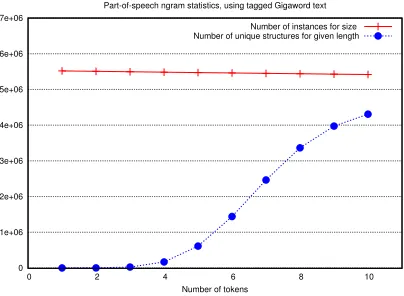
men-tions) forn <= 10and compared this to the number
of unique part-of-speech ngrams of this length. Fig-ure 4 shows these two counts. Following the argu-ment in Section 2.2, this promises a large amortized gain in inference time. We believe that such decom-position can also be applied to other, more complex structured prediction tasks.
The value of approximate inference From the
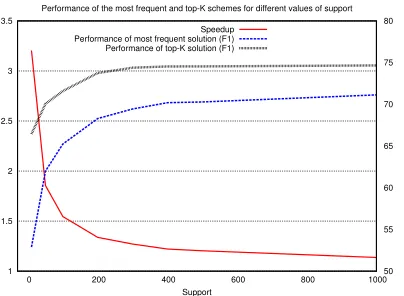
experiments, we see that the first two approximate inference schemes (most frequent solution and the top-K scheme) can speed up inference with the only computational cost being the check for pre-conditions of the exact theorems. Effectively, these algorithms have parameters (i.e., the support param-eter) that allow us to choose between the inference time and performance. Figure 5 shows the perfor-mance of the most frequent and top-K baselines for different values of the support parameter, which in-dicates how often a structure must occur for it to be considered. We see that for lower values of support, we can get a very high speedup but pay with poorer performance.
0 1e+06 2e+06 3e+06 4e+06 5e+06 6e+06 7e+06
0 2 4 6 8 10
Number of tokens
Part-of-speech ngram statistics, using tagged Gigaword text
Number of instances for size Number of unique structures for given length
Figure 4: The red line shows the number of ngrams of tokens (including overlapping and repeated oc-currences) in the Gigaword corpus and the blue line shows the number of unique POS tag sequences.
However, the prediction of the approximate al-gorithms can be used to warm-start any solver that can accept an external initialization. Warm-starting a solver can give a way to get the exact solution and yet take advantage of the frequency of structures that have been observed.
Lifted inference The idea of amortizing inference
[image:9.612.326.528.283.431.2]1 1.5 2 2.5 3 3.5
0 200 400 600 800 1000 50
55 60 65 70 75 80
Support
Performance of the most frequent and top-K schemes for different values of support
[image:10.612.85.287.60.208.2]Speedup Performance of most frequent solution (F1) Performance of top-K solution (F1)
Figure 5: Most frequent solutions and top-K:
Speedup and SRL performance (F1) for different values of the support parameter, using the most-frequent solutions (dashed blue line) and the top-K scheme (thick gray line). Support indicates how many times a structure should be seen for it to be considered. Note that the speedup values for both schemes are identical (red line).
6 Conclusion
In this paper, we addressed structured prediction in the context of NLP and proposed an approach to im-prove inference costs over an entire dataset, rather
than individual instances. By treating inference
problems as instances of integer linear programs, we proposed three exact theorems which identify exam-ples for which the inference procedure need not be called at all and previous solutions can be re-used with the guarantee of optimality. In addition, we also proposed several approximate algorithms. We applied our algorithms, which are agnostic to the actual tasks, to the problem semantic role labeling, showing significant decrease in the number of infer-ence calls without any loss in performance. While the approach suggested in this paper is evaluated in semantic role labeling, it is generally applicable to any NLP task that deals with structured prediction.
Acknowledgements
The authors wish to thank Sariel Har-Peled and the members of the Cognitive Computation Group at the University of
Illi-nois for insightful discussions and the anonymous reviewers for their valuable feedback. This research is sponsored by the Army Research Laboratory (ARL) under agreement
W911NF-09-2-0053. The authors also gratefully acknowledge the support
of the Defense Advanced Research Projects Agency (DARPA) Machine Reading Program under Air Force Research
Labo-ratory (AFRL) prime contract no. FA8750-09-C-0181. This work is also supported by the Intelligence Advanced Research Projects Activity (IARPA) Foresight and Understanding from
Scientific Exposition (FUSE) Program via Department of In-terior National Business Center contract number D11PC2015. Any opinions, findings, and conclusions or recommendations
expressed in this material are those of the author(s) and do not necessarily reflect the view of ARL, DARPA, AFRL, IARPA, or the US government.
References
Y-W. Chang and M. Collins. 2011. Exact decoding
of phrase-based translation models through lagrangian relaxation. EMNLP.
M. Chang, L. Ratinov, and D. Roth. 2007. Guiding
semi-supervision with constraint-driven learning. InACL.
J. Clarke and M. Lapata. 2006. Constraint-based
sentence compression: An integer programming
ap-proach. InACL.
M. Collins. 2002. Discriminative training methods for hidden Markov models: Theory and experiments with
perceptron algorithms. InEMNLP.
R. de Salvo Braz, E. Amir, and D. Roth. 2005. Lifted
first-order probabilistic inference. InIJCAI.
D Graff and C. Cieri. 2003. English gigaword.
A. Martins, N. A. Smith, and E. Xing. 2009. Concise integer linear programming formulations for
depen-dency parsing. InACL.
R. McDonald, F. Pereira, K. Ribarov, and J. Hajic. 2005. Non-projective dependency parsing using spanning
tree algorithms. InEMNLP, pages 523–530,
Vancou-ver, British Columbia, Canada, October. Association for Computational Linguistics.
M. Palmer, D. Gildea, and N. Xue. 2010. Semantic Role
Labeling, volume 3. Morgan & Claypool Publishers. V. Punyakanok, D. Roth, and W. Yih. 2005. The
neces-sity of syntactic parsing for semantic role labeling. In
IJCAI.
V. Punyakanok, D. Roth, and W. Yih. 2008. The impor-tance of syntactic parsing and inference in semantic
role labeling.Computational Linguistics.
S. Riedel and J. Clarke. 2006. Incremental integer linear programming for non-projective dependency parsing. InEMNLP.
S. Riedel. 2009. Cutting Plane MAP Inference for
Markov Logic. Machine Learning.
D. Roth and W. Yih. 2004. A linear programming formu-lation for global inference in natural language tasks. In
D. Roth and W. Yih. 2007. Global inference for entity and relation identification via a linear programming formulation. In Lise Getoor and Ben Taskar, editors,
Introduction to Statistical Relational Learning. A. M. Rush, D. Sontag, M. Collins, and T. Jaakkola.
2010. On dual decomposition and linear
program-ming relaxations for natural language processing. In
EMNLP.
I. Tsochantaridis, T. Joachims, T. Hofmann, and Y. Al-tun. 2005. Large margin methods for structured and
interdependent output variables. Journal of Machine
![Table 2: Conditions for checking whether ypis thesolution for an inference problem q∼[ P] accordingto theorems 1, 2 and 3](https://thumb-us.123doks.com/thumbv2/123dok_us/1301851.659820/6.612.312.543.56.158/table-conditions-checking-thesolution-inference-problem-accordingto-theorems.webp)