Coexisting in the Divided City
The differences made by shared public spaces to cross-community
relations in Jerusalem, Belfast and Brussels.
A thesis submitted for the degree of
Doctor of Philosophy at Trinity College Dublin
2016
Declaration
I declare that this thesis has not been submitted as an exercise for a degree at this or any other university and it is entirely my own work.
i
Summary
This thesis aims to determine whether shared public spaces enhance the level and quality of
cross-community relations in divided cities such as Jerusalem, Belfast and Brussels; and what
differences such spaces can make to intergroup relations in contested cities.
Research therefore consisted of a selection of three different types of shared public spaces – an
open area, a park and a shopping centre – in the three cities of Jerusalem, Belfast and Brussels.
Methodology-wise, a combination of observation, documentary research and semi-structured
interviews was carried out in the three case study cities in order to explore the daily use of
shared public spaces.
As regards the theoretical basis of the thesis, the intergroup contact theory – which posits that
more contact leads to less prejudice – was identified as most relevant for the study of
coexistence and intergroup relations in specific spaces within divided cities. However, certain
weaknesses of the contact hypothesis perspective were revealed, leading to its combination
with notions from Pierre Bourdieu and Michel Foucault drawing more focus on certain key
aspects including society, power relations, discourse and domination – all crucial to study the
use of public space in a contested city.
The selection of the three cities was based on the interest in comparing different contexts of
internal conflict, and how such variations may influence the use of space and intergroup
relations in the city. Cities experiencing different levels of intergroup conflict were thus chosen
– Jerusalem, with an ongoing occasionally violent conflict, Belfast with an ongoing peace
process (post-conflict), and Brussels with an ongoing non-violent conflict. By analysing the
same types of spaces in three different cities, this study hopes to provide further understanding
of the importance of wider contexts but also the particularity of the urban environment when
attempting to implement conflict transformation efforts in divided cities.
Research in Jerusalem revealed that only limited levels of cross-community interaction
occurred in shared public spaces; leading to the conclusion that within the wider context of
the Israeli-Palestinian conflict, shared spaces in the city are not expected to make any
differences or improvements to intergroup relations. Yet research findings also showed that
the selected shared spaces were used on average by both Israelis and Palestinians in a neutral
and non-confrontational manner. Therefore the use of shared public spaces during the period
ii
Research findings in Belfast also revealed minimal levels of intergroup contact between
individuals using shared public spaces in the city centre. However, more cross-community
interaction was observed during specific events taking place within the selected spaces which
were specifically destined towards bringing the Catholic and Protestant communities closer
together. This led to the conclusion that in the specific context of post-conflict Belfast, where
dominant political discourses are increasingly underlining the necessity for shared spaces,
shared public spaces can occasionally make a minimal effect on intergroup relations in the
city.
Research in Brussels showed again that only limited forms of cross-community interaction
occurred within the selected shared spaces. Despite the absence of violence between the
French-speaking and Dutch-speaking communities in the city, Belgium is nevertheless a
deeply divided society where intergroup contact is rare. While the context is void of serious
conflict, the current political situation may be described as one where the two linguistic
communities are drifting further apart, with no interest or desire to come closer. Brussels
remains the only bilingual region, where members of both linguistic communities live in close
proximity. At the very least, the sharing of space in the capital is therefore understood as
important for maintaining intergroup relations in the country.
Following the comparative study and analysis of the research findings in the three cities, the
thesis argues that the presence of shared public spaces in divided cities generally does not
enhance levels of cross-community contact; at least not in a systematic manner. However,
these spaces do offer the possibility for increased interaction between different communities
who may rarely come across each other.
Shared public spaces are therefore not believed to make any notable or short-term differences
to intergroup relations in Jerusalem, Belfast and Brussels. Yet their value in normalising
diversity and exposure to other community should be acknowledged. This thesis therefore
concludes that on a longer term basis, shared spaces may be somewhat beneficial to intergroup
iii
Acknowledgements
First and foremost, I would like to express my immense gratitude and thanks to my supervisor,
Dr. Etain Tannam. Despite having to take over my project at the beginning of my second year
of studies, Etain has provided invaluable support, feedback and encouragement during the
crucial time of field research. Her guidance and suggestions have helped me steer my PhD
project and ultimately produce the following piece of work.
I also wish to thank my first supervisor, Dr. David Tombs, who advised me during the critical
first foundational year of the PhD and therefore helped me produce a strong basis for the rest
of my studies, before moving to New Zealand. His structured approach and recommendations
were greatly appreciated, even his suggestion that ‘it might be better to refer to the summer
term, rather than the summer holidays’.
Special thanks also go to other members of the Irish School of Ecumenics, including Dr. Gladys
Ganiel for offering guidance for field research approaches, Bríd O’ Brian for library-related
advice, but also Caroline Clarke and Karen Nicholson for their availability and support, as well
as David Mitchell and Brendan Browne for their suggestions and tips regarding PhD life and
work. I wish to thank the regular coffee break companions, who always brightened the day,
even in the midst of intense periods of study.
I would also like to express my thanks and immense gratitude to my research interview
participants; Michael Alexander, Marik Shtern, Haim Yacobi, Mandy Turner, Mohamed
Owedah, Jodie Asaraf, Gideon Solimani, Rami Nasrallah, Hillel Bardin, Montaser Amro and
Amneh Badran in Jerusalem; Chris O’Halloran, Milena Komarova, Stephen Pearson, Richard
Dougherty, Ciaran McLaughlin, members of the ForthSpring Youth Club, Martin McMullan,
Louise Mallon, Sheila Morris, Gareth Harper, David Boyd and Joe O’Donnell in Belfast; and
Serge Govaert, Anne Herscovici, Philippe van Parijs, Mark Elchardus, Eric Corijn, Kris
Deschouwer, Philippe Delstanche, Bernard and Conchita Kinoo, Alain Maskens, Alain Joris,
Leen de Spiegelaere, Sophie Alexandre and Miriam Stoffen in Brussels; as well as those
participants who wished to remain anonymous. Without their generous and gracious
participation, the completion of this thesis would not have been possible.
I also wish to thank Frank Gaffikin and Rudi Janssens who provided additional crucial
information after the period of field research; and I wish to express my immense gratitude to
Professor Scott Bollens for his generous contribution during the final stages of my work. I also
convey my gratitude for the help and tips offered by Mick Dumper and Ray Dolphin before and
iv
Finally, I wish to thank my family who has been immensely supportive during these years of
study. In particular, I thank my parents for their encouragement, presence and constant care
for my wellbeing; and my sisters Céline and Anna, whose company helped take some distance
from the occasionally grim aspect of studying ethnic conflict. A special mention goes to the
family cat, Mina, who was constantly by my side during the last few weeks of thesis completion
and submission. I also wish to express a last thanks to my late grandparents Olive and Vince
Murphy; whose first-hand experience of World War Two, as well as their faith and pacifism
v
Table of Contents
Declaration ...2
Summary ... i
Acknowledgements ... iii
List of Tables ... ix
List of Images ...x
Thesis Structure Outline ... xi
Chapter One: Introduction ... 1
1. Aims of the Thesis ... 1
Presentation of the Study Objectives ... 1
Brief Premise to the Study ... 4
2. Research Rationale – Literature Review ... 4
Theoretical Rationale of the Study ... 4
Empirical Justification of the Study ... 10
Conclusion ... 21
Chapter Two: Theoretical and Analytical Framework of the Research ... 22
1. Intergroup Contact Theory ... 23
Intergroup Contact Theory Developments ... 23
Weaknesses and Limitations of the Contact Hypothesis ... 25
Intergroup Contact in Public Spaces and Contested Cities ... 27
2. Pierre Bourdieu and Michel Foucault’s Social Theories ...30
Pierre Bourdieu : Habitus, Field, Doxa and Domination ...30
Michel Foucault: Episteme, Power and Discourse ... 33
Some of Bourdieu and Foucault’s Similar Notions ...36
3. Counter Theory: Consociationalism ...38
Elite Power Sharing as a Solution for Divided Societies ...38
Limitations and Paradoxes of Consociationalism ... 40
Incompatibility of Consociational Theory with the Study of Shared Public Spaces ... 42
4. A Framework for Exploring Shared Public Spaces in Divided Cities ...45
Intergroup Contact Theory Insights: Authority Support, Meaningful Interaction and Negative Contact Effects ...45
Bourdieusian/Foucauldian Notions: Normalised Way of Life, Discourse and Power Struggles ... 46
vi
Conclusion ... 51
Chapter Three: Research Methods ... 52
1. Research Design ... 52
Methodology Literature Review ... 56
Comparative Approach ...58
2. Main Methodology: Observation, Documentation and Interviews ... 62
Observation ... 62
Documentation... 64
Interviews ... 65
3. Methodology in Case Study Cities: Jerusalem, Belfast and Brussels ... 65
Field Research in Jerusalem ... 65
Field Research in Belfast ... 71
Field Research in Brussels ... 75
Theoretical and Comparative Framework ... 80
Conclusion ... 82
Chapter Four: Ethnic Identity and Conflict in Deeply Divided Societies...83
1. Ethnic Identity, Conflict and Culture in Divided Cities ...83
The Social Construction and Reconstruction of Ethnic Identity ...83
Understanding and Identifying the Roots of Ethnic Conflict... 86
The Importance of Culture and Symbolic Landscapes in Contested Cities ... 88
2. The Conflict in Israel and the Palestinian territory ... 91
Historical Background... 91
Jerusalem’s Demographic, Political and Urban Landscape ...93
Defining the Conflict in Jerusalem ... 96
3. The Conflict in Northern Ireland ... 98
Historical Background... 98
Belfast’s Demographic, Political and Urban Landscape ... 100
Defining the Conflict in Belfast ... 102
4. The Conflict in Belgium ... 104
Historical Background... 104
Brussels’ Demographic, Political and Urban Landscape ... 106
Defining the Conflict in Brussels ... 108
Conclusion ... 111
Chapter Five: Exploring Shared Public Spaces in Jerusalem ... 114
vii
Locating the Shared Spaces in Jerusalem ... 115
The Current Context in Jerusalem: No Signs of Peace ... 122
Views on the Future of Jerusalem: Negative Perceptions ...125
Theme 1 Findings: Context of Ongoing Conflict ... 128
2. Theme 2: Describing Daily Life and Intergroup Relations in Shared Public Spaces in Jerusalem ... 128
Demographics and Routines in the Spaces ... 128
Special Events in and around the Spaces ... 131
Interaction and Levels of Intergroup Contact in the Spaces ... 134
Theme 2 Findings: Limited Interaction within Regularly Shared Spaces ... 138
3. Theme 3: Assessing the Interpretation of Shared Public Spaces in Jerusalem ... 139
Perceptions of Shared Space in Jerusalem ... 139
Situating Shared Public Spaces within the City of Jerusalem ... 141
The Role of Shared Public Spaces in Jerusalem ... 143
Theme 3 Findings: Perceived Limited Role of Shared Spaces ... 146
Conclusion ... 148
Chapter Six: Exploring Shared Public Spaces in Belfast ... 150
1. Theme 1: Contextualising Shared Public Spaces in Belfast ... 151
Locating the Shared Spaces in Belfast ... 151
The Current Context in Belfast: Slow Peace Process ... 158
Views of the Future of Belfast: Green Shoots ... 161
Theme 1 Findings: Context of Conflict Transformation Process ... 163
2. Theme 2: Describing Daily Life and Intergroup Relations in Shared Public Spaces in Belfast ... 164
Demographics and Routines in the Spaces ... 164
Special Events in and around the Spaces ... 165
Interaction and Levels of Intergroup Contact in the Spaces ... 169
Theme 2 Findings: Limited Interaction within Regularly Shared Spaces ... 172
3. Theme 3: Assessing the Interpretation of Shared Public Spaces in Belfast ... 173
Perceptions of Shared Space in Belfast ... 173
Situating Shared Public Spaces within the City of Belfast ...175
The Role of Shared Public Spaces in Belfast ... 178
Theme 3 Findings: Perceived Mitigated, but Important Role of Shared Spaces ... 181
Conclusion ... 184
Chapter Seven: Exploring Shared Public Spaces in Brussels ... 186
viii
Locating the Shared Spaces in Brussels ... 187
The Current Context in Brussels: Institutional Separation ... 193
Views of the Future of Brussels: The Cost of Federalisation ... 196
Theme 1 Findings: Context of Ongoing Division ... 199
2. Theme 2: Describing Daily Life and Intergroup Relations in Shared Public Spaces in Brussels ... 200
Demographics and Routines in the Spaces ... 200
Special Events in and around the Spaces ... 201
Interaction and Levels of Intergroup Contact in the Spaces ... 204
Theme 2 Findings: Scarce Interaction within Regularly Shared Spaces ... 208
3. Theme 3: Assessing the Interpretation of Shared Public Spaces in Brussels ... 209
Perceptions of Shared Space in Brussels ... 209
Situating Shared Public Spaces within the City of Brussels... 211
The Role of Shared Public Spaces in Brussels ... 213
Theme 3 Findings: Perceived Limited, but Beneficial Role of Shared Spaces ... 216
Conclusion ... 218
Chapter Eight: Conclusion - The Significance of Shared Public Spaces in Jerusalem, Belfast and Brussels ... 220
1. Acknowledging the Contexts and Understandings of Shared Public Spaces in Jerusalem, Belfast and Brussels ... 220
2. Daily Usage of Shared Public Spaces in Jerusalem, Belfast and Brussels ... 223
3. Assessing the Role of Shared Public Spaces in Jerusalem, Belfast and Brussels ... 229
4. Theoretical and Analytical Conclusions ... 235
Concluding Remarks ... 245
Bibliography ... 249
Secondary Sources Bibliography ... 249
Primary Sources Bibliography ... 262
Annex: Comparative Research Findings Tables ... 280
Theme 1: Contextualising Shared Public Spaces in Jerusalem, Belfast and Brussels ... 280
Theme 2: Describing Daily Life and Intergroup Relations in Jerusalem, Belfast and Brussels ... 282
ix
List of Tables
Table 1: Urban Planning Strategies in Divided Cities ...13
Table 2: Theoretical and Analytical Framework Model ... 49
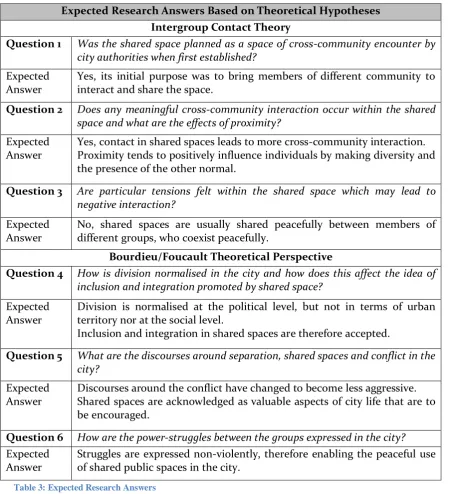
Table 3: Expected Research Answers ... 50
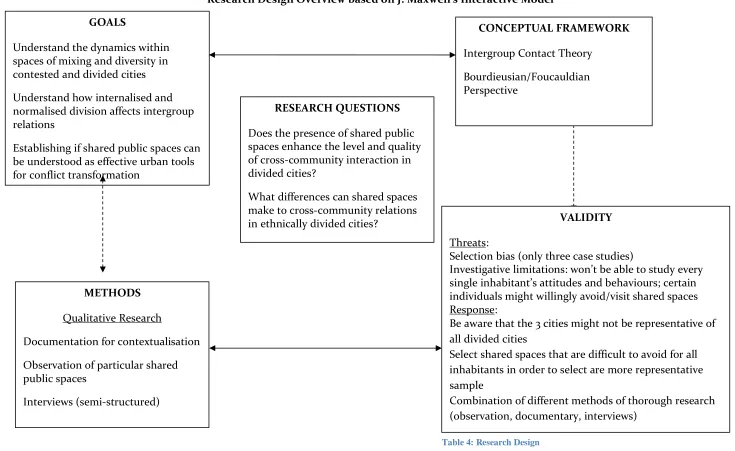
Table 4: Research Design ... 61
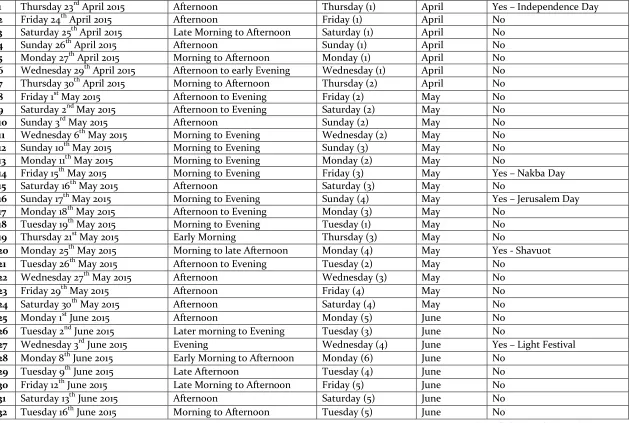
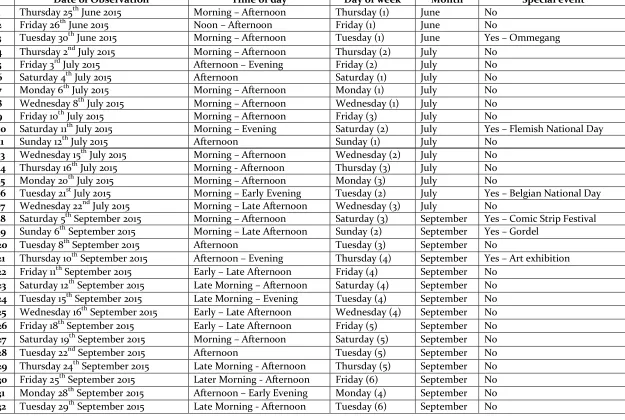
Table 5: Observation Days in Jerusalem ... 68
Table 6: List of Interviews in Jerusalem ... 69
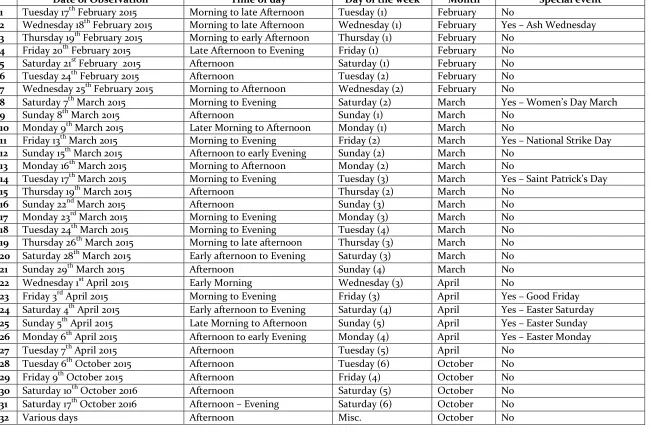
Table 7: Observation Days in Belfast ... 72
Table 8: List of Interviews in Belfast ... 73
Table 9: Observation Days in Brussels ... 77
Table 10: List of Interviews in Brussels ...78
Table 11: List of Ad-hoc Interviews ... 80
Table 12: The Conflict in Jerusalem ... 98
Table 13: The Conflict in Belfast ... 104
Table 14: The Conflict in Brussels ... 111
Table 15: Comparative Table based on the Escalation and De-escalation Model ... 112
Table 16: Comparative Urban Strategy Table ... 112
Table 17: Selected Shared Public Spaces in Jerusalem ... 119
Table 18: Shared Public Spaces in Jerusalem Findings ... 147
Table 19: Selected Shared Spaces in Belfast ... 155
Table 20: Shared Public Spaces in Belfast Findings ... 183
Table 21: Selected Shared Spaces in Brussels ... 190
Table 22: Shared Public Spaces in Brussels Findings ...217
Table 23: Open Public Spaces Comparison... 224
Table 24: Public Parks Comparison ... 224
Table 25: Shopping Centres Comparison ... 225
Table 26: Routines in Open Public Spaces Comparison ... 226
Table 27: Routines in Public Parks Comparison ... 226
Table 28: Routines in Shopping Centres Comparison... 227
Table 29: Levels of Interaction in Open Public Spaces Comparison ... 228
Table 30: Levels of Interaction in Public Parks Comparison ... 228
Table 31: Levels of Interaction in Shopping Centres Comparison ... 228
Table 32: Events leading to Negative Outcomes Comparison ... 230
Table 33: Events leading to Neutral or Positive Outcomes Comparison ... 231
Table 34: Theme 1 - Contextualisation of Shared Spaces Comparison ... 233
Table 35: Theme 2 - Daily Life and Intergroup Relations Comparison ... 234
Table 36: Theme 3 - Interpretation of Shared Space Comparison ... 235
Table 37: Comparative Theoretical Framework and Research Questions Findings ...240
x
List of Images
Figure 1: Map of Israel and the Palestinian Territory (© OpenStreetMap contributors) ... 115
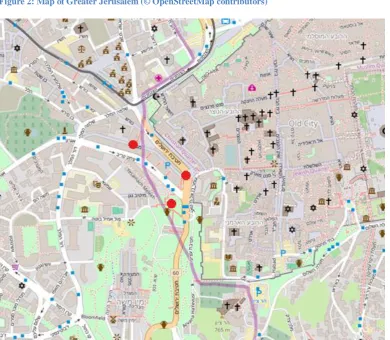
Figure 2: Map of Greater Jerusalem (© OpenStreetMap contributors) ... 120
Figure 3: Map of Jerusalem City Centre with Selected Spaces (© OpenStreetMap contributors) ... 120
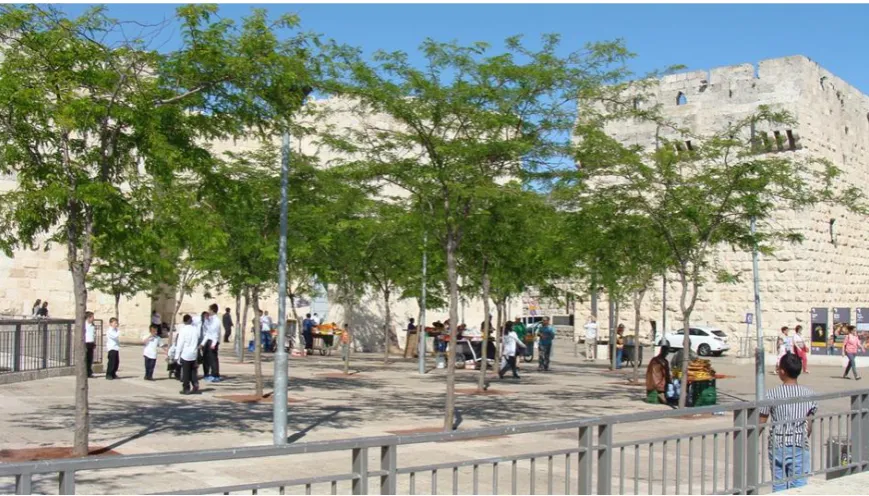
Figure 4: Jaffa Gate Square, view from the entrance into the Old City ... 121
Figure 5: Teddy Park, view on the fountain display ... 121
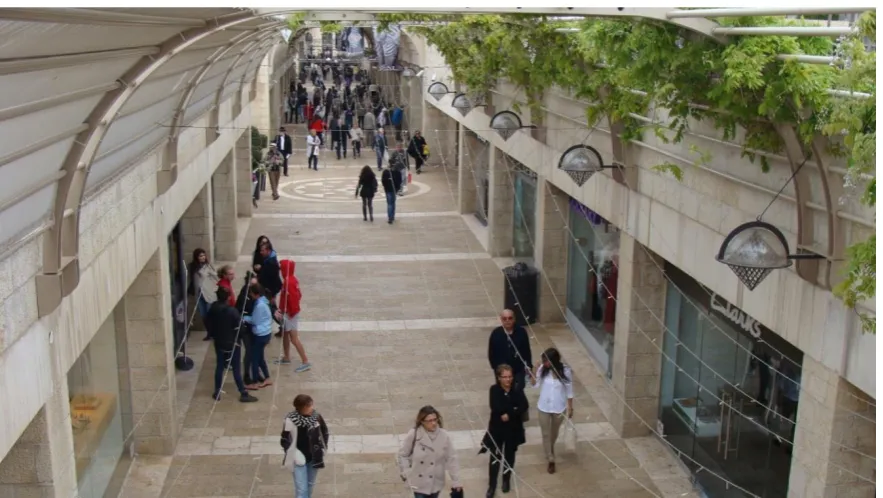
Figure 6: Mamilla mall, view on the main street ...122
Figure 7: Mamilla mall, diversity on the steps ... 130
Figure 8: Mamilla mall on Jerusalem Day ... 132
Figure 9: Map of Northern Ireland (© OpenStreetMap contributors) ... 151
Figure 10: Map of Greater Belfast (© OpenStreetMap contributors) ... 155
Figure 11: Map of Belfast City Centre, Selected Spaces (© OpenStreetMap contributors) ... 156
Figure 12: Victoria Square area, outside the entrance to the shopping centre ... 156
Figure 13: City Hall Gardens ... 157
Figure 14: CastleCourt shopping centre ... 157
Figure 15: Confrontation between flag protestors and youths in Belfast city centre, 17th March 2015 ... 167
Figure 16: Map of Belgium (© OpenStreetMap contributors) ... 187
Figure 17: Map of Greater Brussels (© OpenStreetMap contributors) ... 190
Figure 18: Map of Brussels City Centre with selected Shared Spaces (© OpenStreetMap contributors) ... 191
Figure 19: Dansaert Street Area, little square ... 191
Figure 20: Brussels Royal Park... 192
Figure 21: City 2 Shopping Centre ... 192
xi
Thesis Structure Outline
In order to provide an adequate answer the research question around the differences that
shared public spaces can make to intergroup relations in divided cities, the thesis has been
structured into eight chapters.
Chapter One – Introduction
The first chapter of the thesis presents the aims and research rationale of the study,
underlining the particularity of public spaces in cities that are geographically, socially or
physically divided along ethno-religious, ethno-national or ethno-linguistic lines. While the
term ‘shared space’ remains vague, this thesis understands it as a space – usually public – that
is used on a regular or even daily basis by members of different and often divided
communities. It has been deemed relevant to investigate whether exposure to and interaction
with the ‘other’ that occurs in shared public spaces make a difference to intergroup relations
and ultimately mitigate or exacerbate intergroup conflict in contested cities. As such, two main
research questions have been identified as the common thread structuring the research:
Does the presence of shared public spaces enhance the level and quality of cross-community interaction in divided cities such as Jerusalem, Belfast and Brussels?
What differences can shared public spaces make to cross-community relations in ethnically divided and contested cities?
Chapter Two – Theoretical and Analytical Framework of the Research
A second chapter describes the theoretical and analytical framework, a combination of two
different theories – intergroup contact theory and insights from French social theory. This
particular combination and framework has emanated from the fact that the focus on divided
cities is a relatively recent area of study which is essentially multidisciplinary in nature –
including the fields of conflict analysis, sociology, social psychology, urbanism, architecture,
geography and political science among others.
Intergroup contact theory has been identified as one of the most relevant theories on which to
base the study of coexistence and intergroup relations in specific settings within divided cities.
Indeed, the contact hypothesis posits that the more competing groups come into contact, the
more they will come to like each other and the less prejudice they will have towards one
another. However, a number of limitations have been revealed when applying the theory to the
specific context of urban spaces in deeply divided societies, as the Contact Hypothesis
generally does not acknowledge the wider context within which intergroup contacts occur and
xii
In order to counter these weaknesses, the French social theory notions of Pierre Bourdieu and
Michel Foucault have been added to the study’s theoretical framework, as their understandings
of society, culture, power relations, discourse and domination enable a larger perspective on
the particular contexts of the spaces in Jerusalem, Belfast and Brussels. Through this second
complementary yet necessary theoretical perspective, the study was able to focus on power and
other social dynamics that occur in ethnically divided cities and how these may ultimately
affect intergroup contact and relations in shared public spaces.
Chapter Three – Research Methods
The third chapter introduces in detail the methodology used to carry out research in the field.
In order to provide adequate answers to the main research questions, the methodology has
consisted of selecting three specific types of shared public spaces – an open area, a park and a
shopping centre – and carrying out a comparative analysis of such spaces within three different
contested cities – Jerusalem, Belfast and Brussels. A combination of observation, documentary
research and to a lesser extent interviewing forms the basis of the research which is believed to
enable a thorough investigation and exploration of intergroup coexistence in three different
divided contexts. The comparative element of the study is also underlined, justifying the
selection of Jerusalem, Belfast and Brussels and further describing the methodological
rationale of the research.
Chapter Four – Ethnic Identity and Conflict in Deeply Divided Societies
The fourth chapter of the thesis provides an overview of the three conflicts and the role of
identity. The analytical perspective taken by this study understands ethnic identity as a crucial
aspect of ethnic conflict that is essentially socially constructed – and can therefore potentially
be deconstructed and reconstructed; as suggested by proponents of conflict transformation.
However, the salience of ethnic identity and the importance of cultural landscapes in divided
societies may hinder any efforts towards transformation and better intergroup relations in
certain situations.
Intergroup conflict in Israel and the Palestinian territory, Northern Ireland and Belgium may
all be qualified as types of ethnic conflict with varying degrees of national,
ethno-religious, ethno-linguistic and political competition occurring between the different
communities. The varying degrees and levels of violence and conflict in the cities will provide
an interesting insight in the comparative element of the study of similar types of spaces in
different contexts of division and separation. It is indeed undeniable that the situation in
xiii
from that of Belfast which is described as a post-violent conflict with an agreement and even
more distant from the Brussels situation which is qualified as a non-violent conflict with
recurrent political compromises. The study has established whether these very different
contexts dramatically transform the potential role of shared public spaces as sites of improved
intergroup relations.
Chapter Five –Exploring Shared Public Spaces in Jerusalem
The fifth chapter of the thesis focuses on exploring shared public spaces in Jerusalem. Field
research involved observation in three selected spaces – Jaffa Gate Square, Teddy Park and
Mamilla mall – over a period of over thirty days, as well as interviews with a range of civil
society actors belonging to both the Israeli and Palestinian communities, and further
documentary research through reading primary and secondary sources of information such as
daily news items, reports, and other data.
Research findings revealed that only limited levels of cross-community interaction occurred in
the spaces – albeit in varying degrees, from virtually non-existent in Jaffa Gate Square to more
meaningful in Mamilla mall. It was therefore concluded that shared public spaces make only
limited or even non-existent differences to cross-community relations in the specific context of
Jerusalem, where the conflict is still ongoing and periods of extreme tension are likely to lead
to intergroup violence. However, research findings also revealed that on average, the three
selected spaces were observed as being used by both the Israeli and Palestinian communities
on a regular basis without this causing any tension. In other words, despite the lack of
meaningful interaction, peaceful coexistence was observed as being the norm in the spaces.
The simple fact that these shared public spaces offer the possibility of proximity and shared
experiences with the other community without this leading to heightened tensions on a daily
basis is therefore understood as being significant. While shared spaces are thus not considered
to be the most effective tools for conflict transformation in Jerusalem, they nevertheless
contribute towards creating and normalising a different reality of the city in which both
communities live side by side and coexist.
Chapter Six –Exploring Shared Public Spaces in Belfast
Chapter Six involved observation in the selected spaces of Victoria Square area, City Hall
Gardens and CastleCourt shopping centre in Belfast, over a period of over thirty days. Research
also included interviews with different individuals, mainly within civil society, belonging to
both the Protestant and Catholic communities, as well as documentary research of primary
xiv
Research findings revealed that as in the Jerusalem case, only limited levels of
cross-community interaction occurred within the selected shared spaces in Belfast. Yet more
meaningful contact was observed as occurring in some of the spaces during specific events,
such as deliberately inclusive carnival parades or festivals. It was therefore concluded that
shared public spaces in and of themselves did not provide decisive tools towards conflict
transformation efforts in Belfast, however they can play such a role in certain circumstances.
However, it was also revealed that in the particular context of Belfast, changing discourses
since the peace process have increasingly acknowledged the importance of sharing space as
part of a new will to create a shared future for all of Northern Ireland’s inhabitants. In other
words, shared public spaces are understood and promoted as necessary and positive aspects of
urban life to be cherished and used by all of Belfast’s communities. Therefore, while shared
public spaces in Belfast do no play a decisive role in directly improving intergroup relations in
the city, their very existence and their active promotion can be understood as contributing
towards the transformation of the city into a more functional, plural and open urban entity.
Chapter Seven – Exploring Shared Public Spaces in Brussels
This seventh and last case study chapter explores the role of shared public spaces in Brussels.
As in the previous two chapters, field research involved observation over a period of thirty days
in three selected spaces – Dansaert Street area, Brussels Royal Park and City2 shopping centre.
Field research also included interviews with members of civil society from both the
French-speaking and Dutch-French-speaking communities, as well as additional documentation of primary
and secondary sources such as news items, polls and other data.
As in Jerusalem and Belfast, research findings revealed that only minimal levels of
cross-community interaction occurred within the selected spaces in Brussels. Indeed, despite the
absence of violence or physical division, Belgian society remains deeply divided along linguistic
communitarian lines, leading to very little meaningful contact between Francophones and
Flemings on a daily basis. Unlike the Belfast context, there are currently no concerted efforts at
the elite level towards bringing the two communities closer together or improving intergroup
relations. Therefore, while shared public spaces in Brussels cannot be considered as major
tools towards improving cross-community relations due to the lack of interaction they entail,
these spaces nevertheless remain some of the rare areas within the city where the two
communities come face to face and have the possibility of mixing and reaching out to one
another. In other words, shared public spaces in Brussels provide the rare situations of
xv
Chapter Eight – Conclusion: The Significance of Shared Public Spaces in Jerusalem,
Belfast and Brussels
The eighth and final chapter of the thesis compares the research findings in the three case
studies and draws the theoretical and analytical conclusions. Following the systematic analysis
and comparison of the context, setting of the spaces, types of spaces, routines, levels of
interaction, special events and role of the spaces in the three cities, the main research
questions were answered.
As regards whether the presence of shared public spaces enhanced levels and quality of
cross-community interaction, the research findings revealed that their presence in Jerusalem, Belfast
and Brussels generally does not enhance levels of contact. However, it was also revealed that
such spaces are not barriers to such contact and do offer the possibility or potential for more
meaningful cross-community interaction. Indeed, the study concludes that in all three cities,
shared public spaces tend to provide the opportunity for enhanced levels of interaction,
without this being a systematic outcome.
In terms of the wider question around the differences that shared spaces can make to
cross-community relations in divided cities, the study concludes that such spaces do not make any
major systematic differences in the three cities. However, shared public spaces are believed to
have some value in normalising regular exposure to the other community, which is a crucial
aspect of any healthy modern city, divided or not. It is therefore suggested that the effects –
however minimal – of shared spaces on intergroup relations should be evaluated on a
longer-term basis, with the understanding that transformation processes take time.
Finally, this thesis acknowledges that the comparison of only three cities may not provide
descriptions of the use of shared spaces in a wider range of contested cities in deeply divided
societies. However, it is hoped that this study will at least provide an interesting insight into
the role of public spaces in certain contested cities; as well as a model for social research which
may be applied to a number of comparative studies evaluating or exploring social aspects while
1
Chapter One: Introduction
The first chapter of the thesis is dedicated to presenting the research aims and situating it
within a wider theoretical, empirical and methodological context. The first part of the chapter
will introduce the aims of the thesis by highlighting the main goals of the project, and setting
the premise to the study of shared public spaces in divided cities. The second part will then
present the research rationale, through a literature review focused on the theoretical and
empirical justifications of the study. The third and final part of the chapter will subsequently
describe the research design of the study, by underlining the comparative nature of the thesis
and presenting general methods used as well as briefly describing the field research involved in
the three case studies.
1.
Aims of the Thesis
Presentation of the Study Objectives
This doctoral research in the fields of sociology and conflict transformation explores how
shared public spaces may transform cross-community relations in ethnically divided cities. It
does not aim to examine the causes of ethnic conflicts theoretically, but seeks to reveal:
How inhabitants of divided cities interact in shared public spaces
How the usage of these spaces influences intergroup relations
If shared spaces may be considered as tools contributing towards conflict
transformation efforts in such contexts.
The study will focus on specific shared public spaces – open spaces, parks and shopping
centres – in the three contested cities of Jerusalem, Belfast and Brussels. All three of these
cities are inhabited by different ethno-religious, ethno-national or ethno-linguistic groups that
are competing for control over territory and power; albeit in very different ways. These three
cities are also inhabited by groups and communities whose members feel strongly about their
– generally exclusive – identity; Israelis and Palestinians in Jerusalem, Catholics and
Protestants in Belfast and Francophones and Flemings in Brussels. Specific attention has been
given to public spaces, as they are considered to be the rare areas of cross-community
interaction or at least mixing in cities that usually remain and maintain physical, institutional
or social separation between different resident groups. While it is debatable whether all three
types of urban spaces that have been selected for the study are indeed public spaces (it may be
2
deemed the most appropriate and convenient to qualify central spaces in the city that are
regularly visited by large numbers of individuals from all walks of life.
The Concept of Shared Space
Shared space has been criticised for being a vague term with limited research being carried out
on its supposed positive impact on conflict transformation efforts.1 Four different types of
spaces have been identified by certain urbanism scholars in divided cities such as Belfast –
ethnic space, neutral space, shared space and cosmopolitan space. From this perspective,
shared space can be understood as “a space that facilitates not just contact, but also
engagement across the divide.” Such spaces are considered to be rare in contested cities. Thus
public space is closer to neutral space than shared space, the former identified in Belfast as
being “based largely in the city centre [...] where public funding for expansion, modernisation
and re-imaging has been justified in part on the creation or consolidation of safe space open to
both main traditions for employment, shopping, leisure and residence.”2 Yet the term ‘neutral’
as regards commercial and other activities may be questioned. UN Women has for instance
underlined that “to plan spaces that are safe for everyone, space must be “de-neutralised”. That
is, public spaces cannot be considered to be the same for everyone everywhere.”3
A number of
scholars including Henri Lefebvre argue that public space can never be neutral, as “far from
being merely a neutral medium – or receptacle – of social activities […] space becomes a stake
and a medium for conflicting social representations and strategies […].”4
However, in the
specific context of public spaces in contested cities, the term ‘neutral space’ might be used as
an oversimplification to describe areas of the city that are not as obviously one-sided as other
segregated spaces. Given its ambiguity, the term ‘neutral space’ will not be referred to in this
thesis.
Public space may also be cosmopolitan space, which is “space that is international in character
and has no specific reference in terms of the local division”5, such as most of the spaces in
cities that attract tourist attention. The Conflict in Cities and the Contested State research
project6 has additionally provided a definition of shared space by explaining that “sharing
space may simply mean that people from either side of ethno-national or religious divides get
1
Komarova, Milena. “Shared Space in Belfast and the Limits of A Shared Future.” Conflict in Cities and the Contested State, no. Working Paper 3 (2008).
2
Frank Gaffikin, Frank, and Mike Morrissey. Planning in Divided Cities. John Wiley & Sons, 2011, p. 102
3
UN Women. Safe Women Project. 1998. Plan It Safe Kit. Pluto Press, Annandale, Australia: Section 5. http://www.endvawnow.org/en/articles/380-highlight-the-fact-that-space-is-not-neutral.html?next=381
4
Busquet, Grégory. Political Space in the Work of Henri Lefebvre : Ideology and Utopia. UMR LAVUE (Mosaïques), vol 5 2012-13, Université Paris Ouest Nanterre, p. 3
5
Frank Gaffikin, Frank, and Mike Morrissey. Planning in Divided Cities. John Wiley & Sons, 2011,. 102
6
3
to see others, observe their customs, and hear their languages as they go about their lives.
Slight as such contact may seem, its absence can mean a reduced potential for improving
relations in the future.”7
In this thesis, shared space is defined as an urban area that is shared and used by different
individuals on a regular basis. Space is “a continuous area or expanse which is free, available, or
unoccupied”8; and sharing is defined as having “a portion of (something) with another or
others”, but more precisely to “use, occupy or enjoy (something) jointly with another or
others.”9In the particular context of ethnically divided and contested cities, the term shared
space is often understood as being the opposite and alternative to ‘ethnic space’. At its
simplest, then, shared space may be defined as non-segregated space, where individuals from
different ethno-religious or linguistic communities come for various purposes (leisure,
shopping, work, etc.). This has led to the fact that “those that invest hope in ‘shared space’,
amidst urban conflict, assume that this arena can facilitate a greater pluralism of identity and
belonging [...].”10 Some scholars have identified three different types of shared spaces in which
individuals may encounter people belonging to the other community – naturally shared space,
policy driven shared space and cross-community programmes.11
A theoretical framework combining two different perspectives will be applied in order to
explore if and how shared public spaces make a difference to intergroup relations in the
specific context of three contested cities. The framework is based on the intergroup contact
theory perspective (also known as contact hypothesis) highlighting the importance of
intergroup contact in reducing prejudice; and the French social theory perspectives of Pierre
Bourdieu12 and Michel Foucault13 underlining the relevance of context when studying all
aspects of social life14. The study will ultimately answer the following research questions:
Does the presence of shared public spaces enhance the level and quality of cross-community interaction in divided cities such as Jerusalem, Belfast and Brussels?
7
Conflict in Cities. “Sharing Space in Divided Cities.” Briefing Paper. Conflict in Cities and the Contested State, November 2012.
8
“Space.” Oxford dictionaries 2016. http://www.oxforddictionaries.com/definition/english/space
9
“Share.” Oxford dictionaries 2016. http://www.oxforddictionaries.com/definition/english/share
10
Gaffikin, Frank, Ken Sterrett, Mike Morrissey, and Maeliosa Hardy. “Planning Shared Space for a Shared Future.”
Research Report for Community Relations Council, 2008, p. 36
11
McKeown, Shelly, Ed Cairns, and Maurice Stringer. “Is Shared Space Really Shared?” Shared Space Journal, no. 12 (February 2012).
12
Jourdain, Anne and Sidonie Naulin. Héritage et transmission dans la sociologue de Pierre Bourdieu, Idées économiques et sociales, n° 166, 2011 (4), p. 80
13
Pitsoe, Victor. “Foucault’s Discourse and Power: Implications for Instructionist Classroom Management.” Open Journal of Philosophy 3, no. 1 (2013): 23–28, p. 24
14
4
What differences can shared public spaces make to cross-community relations in ethnically divided cities?
Brief Premise to the Study
Ethnic conflicts often divide whole countries; however they tend to be more visible and
striking in cities and towns where the compact nature of urban space forces inhabitants
belonging to different communities to live in close proximity. Ethnic division becomes even
more important if it occurs in a capital city, where lies the political, economic and cultural
heart of the state. Managing or resolving ethnic strife in cities might therefore have a greater
impact on the overall conflict, facilitating its resolution on a national scale. Although it could
be argued that many modern-day cities are contested in one way or another around issues of
pluralism such as power, class15, ethnicity and status16, there is another kind of divided city
which is much more destructive. Certain cities are contested around both issues of pluralism
and sovereignty, such as state legitimacy and rival claims of national belonging. The study of
divided cities from a conflict resolution perspective is a relatively new phenomenon, and
includes different disciplines such as social sciences, peace studies, architecture and urban
studies.
The importance of well-developed cities for the civic well-being of all their inhabitants and the
state has been underlined by urbanism scholars. A just city is an efficient city, and therefore
justice problems and other issues such as urban poverty need to be dealt with for the city to
remain functional and attractive. 17 It has been further explained that particular attention
should be given to the city – especially the city centre – and that the renewal of civic spirit and
a sense of destiny shared by all residents are crucial.18 However obvious this statement may
seem, creating a sense of shared space and shared destiny can be extremely challenging and
even impossible in situations of ethnic conflict over national sovereignty, as is the case in many
divided cities.
2.
Research Rationale – Literature Review
Theoretical Rationale of the Study
The theoretical rationale for this thesis is that ethnic identity is socially constructed, and not
simply a historical or genetic development. The political relevance of ethnicity and ethnic
identity becomes obvious when more than one ethnic group is present within a given society.
15
Tammaru, Tiit, Maarten van Ham, Szymon Marcińczak, and Sako Musterd. Socio-Economic Segregation in European Capital Cities: East Meets West. Routledge, 2015.
16
Nightingale, Carl H. Segregation: A Global History of Divided Cities. University of Chicago Press, 2012.
17
Fainstein, Susan S. The Just City. Cornell University Press, 2010.
18
5
If such identities are socially constructed, this would imply that they can be deconstructed and
ultimately reconstructed or transformed to become less divisive or confrontational.
Although the research is based within the discipline of sociology, its broader perspective is
situated within the field of conflict transformation. This term, preferred to that of conflict
resolution, was first developed by John Paul Lederach in the 1980s and focuses on the wide
involvement of civil society in peace efforts rather than solely relying on elite and state level
work. Lederach’s concept of ‘moral imagination’ is understood as a crucial tool to find
constructive ways of rising above cycles of violence in divided societies.19
According to Lederach, everything is relational and relationships are therefore central in every
aspect of life. Social life is defined by relationships, and Lederach therefore underlines the
crucial role of relationships in any efforts of change towards ending violence. Relationships are
thus “both the context in which cycles of violence happen and the generative energy from
which transcendence of those same cycles bursts forth.”20 This perspective may be likened to
Bourdieu’s claim that ‘the real is relational’ and that relations are an inherent part of social
constructions. In fact, “the notion of the relational is so central to Bourdieu that he preferred
to speak not of his ‘theory’ but rather of a ‘system of relational concepts’.”21
Lederach’s perception of relationships forms the basis of this thesis on intergroup relations in
deeply divided societies. He claims that “the centrality of relationship provides the context and
potential for breaking violence, for it brings people into the pregnant moments of the moral
imagination: the space of recognition that ultimately the quality of our life is dependent on the
quality of life of others.”22 Indeed, it is believed that conflicts in ethnically divided cities can be
transformed if rival communities come to understand that social and political life in such cities
is not limited to a zero-sum game between different ethnic groups. Lederach is therefore
adamant that transformation and change will happen when deliberate polarization is no longer
seen as the best option in divided societies. In such situations, “cycles of violence are often
driven by tenacious requirements to reduce complex history into dualistic polarities that
attempt to both describe and contain social reality in artificial ways.”23
19
Lederach, John Paul. The Moral Imagination: The Art and Soul of Building Peace. Reprint edition. Oxford; New York: OUP USA, 2010.
20
Lederach, John Paul. The Moral Imagination: The Art and Soul of Building Peace. Reprint edition. Oxford; New York: OUP USA, 2010, p. 34
21
Schinkel, Willem. “Sociological Discourse of the Relational: The Cases of Bourdieu & Latour.” The Sociological Review 55, no. 4 (2007): 707–729, p. 712
22
Lederach, John Paul. The Moral Imagination: The Art and Soul of Building Peace. Reprint edition. Oxford; New York: OUP USA, 2010, p. 35
23
6
Crucially, Lederach states that “genuine constructive change requires engagement of the other.
And this is not just a challenge for the leaders – we must encompass and encourage a wide
public sphere of genuine human engagement.”24 Encouraging increased contact and
engagement between different rival groups within divided societies should therefore help
improve intergroup relations and subsequently decrease the likelihood of violent conflict.
One theoretical perspective that has been identified as particularly relevant for the study of
shared spaces and intergroup relations in divided cities is the intergroup contact theory, first
introduced by Gordon Allport25 and further developed by Thomas Pettigrew26 and other
scholars.27 Unlike many conflict theorists, Allport believed that ethnic conflict was primarily
due to prejudice rather than competition over resources. Although he focused his research on
ethnic relations in the USA, his findings may be applied to other contexts where ethnic groups
have been in conflict. The contact hypothesis posits that increasing contact between rival
groups will lead to more familiarity, which will lead to an increase in liking for ‘the other’ and a
decrease in prejudice; and therefore to the lessening of the intergroup conflict. From this
theoretical perspective, shared public spaces may be understood as crucial contributions
toward conflict transformation efforts in ethnically divided cities, as they enhance intergroup
mixing and therefore increase the chance of intergroup contact. The proponents of the
intergroup contact theory argue that generally speaking, more contact leads to better
intergroup relations, yet there is no mention of the specific contexts in which the interaction
or contact takes place. Are the effects of shared spaces in heavily militarised cities such as
Jerusalem similar to those in peaceful and vibrant cities such as Brussels? These limitations
have led to the combination of the contact hypothesis with the additional perspective of
Bourdieusian and Foucauldian insights in order to form the theoretical framework of the
research (described in Chapter Two). Particular attention needs to be given to the wider
context of such contested cities as Jerusalem, Belfast and Brussels, as “cities are rarely divided
by their own citizens in isolation. They are typically the product of external forces acting on a
24
Op. Cit., p. 49
25
Allport, Gordon Willard. The Nature of Prejudice. Addison-Wesley Publishing Company, 1979.
26
Pettigrew, Thomas F. ‘Intergroup Contact Theory’. Annual Review of Psychology 49, no. 1 (1998): 65–85.; Pettigrew, Thomas F., Linda R. Tropp, Ulrich Wagner, and Oliver Christ. ‘Recent Advances in Intergroup Contact Theory’.
International Journal of Intercultural Relations 35, no. 3 (May 2011): 271–80.
27
7
city with the intent to protect it, save it, claim it, demoralise it, or enlist it in a larger struggle
from which it cannot benefit.”28
Pierre Bourdieu argues that symbolic systems – which are forms of cultural expression that
regulate communication in societies – are instruments of knowledge and dominance. Symbolic
systems therefore form social cohesion by contributing to the moral and cognitive integration
of the members of societies.29 Bourdieu understands culture as what has been defined as such
by the dominant classes, which aligns with the social domination theory perspective. One of
his main aims is to reveal and bring to light “the hidden forms of domination that are
consciously and unconsciously reproduced in everyday life.”30 Culture, like ethnic identity, is
therefore socially constructed. The use of culture by different ethnic groups living on the same
territory can thus be an instrument of domination in an ongoing conflict. According to
Bourdieu, there is an incessantly changing pattern of cultural forms of domination,
competition over power and prestige in any given society.31 The problem in divided cities is
that these cultures are often deemed incompatible, and the celebration of one culture is
sometimes considered a threat to the survival of the other. For Bourdieu, the cultural system of
society is not only a structure of given meanings, but also a field of action, where different
actors and groups struggle for domination.32 While such struggles remain non-violent and
internalised within many societies, this is less the case in contested cities where struggle for
power and domination can become more explicit and lead in certain circumstances to the
engagement of physical forms of violence by different actors. These more perceptible forms of
struggles may in turn influence daily life in these cities, and thus the use of urban space by the
different resident communities.
According to Michel Foucault, every society produces its own truths which help to normalise
and regularise its discourses and therefore its cohesion.33 “It is in discourse that power and
knowledge are joined together”34 asserts Foucault, and this explains why discourse is so
important to understand a given societal or historical context. In the case of divided societies,
ethnic groups often strengthen their social cohesion through the assertion of their exclusive
culture and identity. This also involves the production of truths which can stigmatise other
ethnic groups, and create a victim-aggressor paradigm which can ultimately justify mistrust
28
Calame, Jon, and Esther Ruth Charlesworth. Divided Cities: Belfast, Beirut, Jerusalem, Mostar, and Nicosia. Philadelphia: University of Pennsylvania Press, 2009, p. 8
29
Lardinois, Roland. “Pierre Bourdieu (1930-2002): A Sociologist in Action.” Economic and Political Weekly 37, no. 11 (March 16, 2002): 1019–21, p. 1021
30
Sulkunen, Pekka. ‘Society Made Visible: On the Cultural Sociology of Pierre Bourdieu’. Acta Sociologica 25, no. 2 (1 January 1982): 103–15, p. 107
31
Bourdieu, Pierre. ‘Les Modes de Domination’. Actes de La Recherche En Sciences Sociales 2, no. 2 (1976): 122–32.
32
Bourdieu, Pierre. ‘Sur Le Pouvoir Symbolique’. Annales. Économies, Sociétés, Civilisations 32, no. 3 (1977): 405–11.
33
Foucault, Michel. L’Ordre Du Discours. Paris: Editions Flammarion, 2007.
34
8
and incompatibility with the ‘other’ group. The role of discourse is therefore also important in
the consolidation of ethnic groups in contexts of contested cities. In such situations, the state
usually lacks an inclusive discourse which could bring these different groups together.
Both Pierre Bourdieu and Michel Foucault shed light on the social mechanisms that occur in
all societies, and how these might be intensified in the specific context of ethnically divided
cities. Their understandings of power relations and the creation of truths highlights the fact
that the societal context is critical for analysing how shared spaces may influence intergroup
relations in cities such as Jerusalem, Belfast and Brussels. In other words, power struggles
between different groups within a given divided society and discourses around opposing truths
and histories are very likely to affect how individuals may interact within a given space in a
contested city. Crucially, then, “whether contestation among groups is perceived as good or
bad, individuals’ attitudes toward shared living largely define the urban condition and shape
the experience of public space. Hence, intercommunity exchange and contestation are a form
of negotiation of power, dominance and space that outlasts the duration of the conflict.”35
Other scholars have worked on the concepts of power, domination and hegemony; such as
Antonio Gramsci, who understood institutions of civil society (such as schools, organisations,
and so on) as linking citizens to the state. Crucially, Gramsci’s understanding of the political
role of civil society is underlined as recognising “the importance of civil society as an arena for
political struggle and for transformative politics […].”36
Gramsci’s concept of hegemony may
also help understand and analyse certain social aspects, and it is defined as “the ideological
predominance of the cultural norms, values and ideas of the dominant class over the
dominated.”37
In Jerusalem, Belfast and Brussels, communities are often divided geographically, socially or
institutionally along ethnic lines. Although inhabitants reside together in the city, they
nevertheless also live apart in many if not most of their daily social lives. Experience of ‘the
other’ community is therefore greatly limited. Taking the contact hypothesis perspective,
shared public spaces in such contexts may be seen as useful tools contributing towards
increasing cooperation and reducing intergroup antagonism. However, this view is not shared
by all scholars, and consociational theory advocates (Arend Lijphart, John McGarry and
Brendan O’Leary amongst others) argue that the best way to achieve peace and stability in
ethnically divided societies is to keep conflicting groups apart in order to avoid the outbreak of
35
Abdelmonem, Mohamed Gamal, and Rachel McWhinney. “In Search of Common Grounds: Stitching the Divided Landscape of Urban Parks in Belfast.” Cities 44 (April 2015): 40–49, p. 41
36
MacKenzie, Iain, ed. Political Concepts: A Reader and Guide. Edinburgh: Edinburgh University Press, 2005. p. 146
37
9
violence, and only negotiate at the elite political level. It is indeed believed by some scholars
that in certain circumstances ‘good fences make good neighbours’; hence implying that in
situations of extreme ethnic tension and conflict – where ethnic identity is perceived to be
under direct threat – integration is not the best short-term solution towards achieving peace
and stability.38 Compromise therefore needs to be channelled through politicians and other
agents at the elite level first rather than directly engaging civil society. Taking this last
perspective, shared space would not seem to be a valuable tool for the resolution of conflicts in
divided societies. This thesis aims to explore the implications of such spaces in three divided
cities, all with different contexts and different types of conflicts.
The Choice of Jerusalem, Belfast and Brussels
The broad and overarching way of life in contested cities includes different ethnic groups
usually living separately. In the case of Belfast and Jerusalem, this separation is as much
physical as psychological and social. In North, East, and West Belfast, Catholic and Protestant
neighbourhoods are physically separated by what are known as ‘peacelines’ or ‘peace walls’.
Other separations include the ‘West Link’, a large arterial route that separates West and North
Belfast from the city centre, and the River Lagan separating East Belfast from the city centre.
But the separation is also social, as children do not attend the same schools, youths do not go
to the same leisure centres, and even Catholic and Protestant dead are buried apart in certain
cemeteries (“within Belfast City Cemetery there is an underground wall that purposefully
separates the Catholic and Protestant dead”39).
In Jerusalem, the separation is also physical and social, with West Jerusalem essentially Israeli
and East Jerusalem essentially Palestinian, as agreed through a United Nations resolution in
1947. But since the early 2000s, a physical separation is being built on the outskirts of East
Jerusalem, effectively separating Palestinian neighbourhoods, by what is known as the ‘security
barrier’ in Israel and the ‘separation wall’ or ‘annexation wall’ in the Palestinian territory. East
and West Jerusalem are also separated by a large arterial road that goes through the whole city.
As in Belfast, Israeli and Palestinian children do not attend the same schools, and mixed
neighbourhoods are extremely rare.
The situation is quite different in Brussels, where there is no physical separation, and no
official Flemish or Francophone neighbourhoods, although Dutch-speaking residents are more
38
Lijphart, Arend. Democracy in Plural Societies: A Comparative Exploration. Yale University Press, 1977; Taylor, Rupert. Consociational Theory: McGarry and O’Leary and the Northern Ireland Conflict. 1 edition. London ; New York: Routledge, 2009.
39
10
likely to live in the north of the city. But as in Belfast and Jerusalem, Brussels is surrounded by
a motorway, the ‘Ring’, which serves as a border between the bilingual region of
Brussels-Capital and the mono-lingual region of Flanders. Furthermore schools, universities, most
professional spheres, and most federal institutions are divided along linguistic lines. In all
three cities, division is therefore strongly internalised, and has become an inherent part of city
life in which experience of ‘the other’ is limited to a number of daily activities such as shopping
or visiting a park – in other words, using public urban space.
Although Jerusalem, Belfast and Brussels are obviously very different kinds of cities with very
different historical, social, political, economic and cultural contexts; they can nevertheless be
compared on the basis that their different resident groups – Israelis and Palestinians,
Protestants and Catholics, and French speakers and Dutch speakers respectively – effectively
live together separately.
The interest in studying these three cities is also influenced by their differences in terms of
conflict experiences and situations – ongoing conflict in Jerusalem, post-conflict in Belfast and
non-violent conflict in Brussels. The research will focus on the role that shared spaces have in
each city, and how their effects on intergroup relations may differ – or not – depending on
what policies have been implemented and the different discourses around sharing and
intergroup relations that exist in the Northern Irish, Israeli and Belgian societies.
Empirical Justification of the Study
The term ‘divided city’ can be understood in many different ways, either referring to the fact
that a city is physically divided (for example by walls), or is a border-city between two states,
or even a city divided on a class or social basis (such as gated communities or shanty towns).
But there are a number of cities that are divided because different ethno-national communities
reside within their boundaries and this heterogeneous context can lead to violent or
non-violent conflict. Taking this last perspective, a divided city could be defined as a city where
typically two different ethno-national communities reside, in a state of open or latent conflict.
The urban area is therefore physically or conceptually divided between different communities
who both claim territorial control over the city. Divided cities – also referred to in this thesis as
contested cities – are extremely interesting to study, as they offer an exceptional and unique
perspective into the interaction between communities in conflict within a relatively confined
urban space. They are often the only places where the opposing communities interact and
coexist (albeit not always peacefully), and could therefore also be considered as opportunities
to encourage conflict transformation and peaceful coexistence. Despite their inherent
11
physically (parts of Jerusalem and Belfast), residentially (Jerusalem and Belfast) or
institutionally and socially (Jerusalem, Belfast and Brussels).
Various studies have sought to examine how cities can transform conflicts through urban
planning; the Conflict in Cities and the Contested State Project has for instance examined
“how cities can absorb, resist and potentially play a role in transforming such
conflicts.”40Although the project essentially focused on Belfast and Jerusalem, other cities were
also studied, including Nicosia, Berlin, Beirut, Brussels, and Mostar. The project underlines
that given the very nature of urban areas, the fact that different and opposing communities live
in close proximity can either worsen the conflict or on the contrary encourage cooperation and
peaceful coexistence.
The Conflict in Cities Project also underlines the deep connection between divided cities and
the wider state, therefore underlining that change at the city level can influence the conflict on
a larger, national or even international scale. Other scholars have additionally focused on the
urban aspect of physically divided cities such as Belfast, Jerusalem and Nicosia, underlining
that “in these troubled places, intercommunal rivalry seems inevitably to recommend physical
segregation.”41 Although separation walls in cities might seem like an aberration, they do help
policy makers manage violent conflict in difficult situations. The main problem with urban
partitions is that while they do reduce violent confrontations to some degree, they also
reinforce fear and paranoia. In other words, the short-term effects of physical separation in
violently divided cities might help reduce levels of intergroup violence; but on the long-term
the internalisation of such separations cannot be expected to improve intergroup relations.
Walls and other physical separations are therefore effective obstacles to both conflict
escalation and conflict transformation; thus limiting efforts towards creating a peaceful and
plural urban landscape. Indeed, “the problem arises today when walls are built to embody the
abstract line, in effect making concrete what should remain elastic.”42 Such separation walls
“allow people to see what they want to see on the other side, the image of their enemy”43; they
therefore enhance stereotyping and fear of the other. These arguments thus reinforce the
contact hypothesis claim that more contact between conflicting groups is necessary to reduce
prejudice and intergroup tensions; and also question the relevance of the consociational
assertion that ‘good fences make good neighbours’.
40
Conflict in Cities. “Sharing Space in Divided Cities.” Briefing Paper. Conflict in Cities and the Contested State, November 2012.
41
Calame, Jon, and Esther Ruth Charlesworth. Divided Cities: Belfast, Beirut, Jerusalem, Mostar, and Nicosia. Philadelphia: University of Pennsylvania Press, 2009, p. 1
42
Pullan, Wendy. “A One-Sided Wall.” Index on Censorship 33, no. 3 (January 7, 2004): 78–82, p.81
43
12
The nature of public policy and urban planning perspectives in contested cities are therefore
crucial elements that can greatly influence intergroup conflict on the ground. Scott A. Bollens44
has identified urban polarization as a type of urban conflict which is particularly challenging,