Revisiting Selectional Preferences for Coreference Resolution
Benjamin Heinzerling∗ AIPHES
Heidelberg Institute for Theoretical Studies
Nafise Sadat Moosavi∗
Heidelberg Institute for Theoretical Studies
Michael Strube Heidelberg Institute for
Theoretical Studies
Abstract
Selectional preferences have long been claimed to be essential for coreference res-olution. However, they are mainly mod-eled only implicitly by current corefer-ence resolvers. We propose a dependency-based embedding model of selectional preferences which allows fine-grained compatibility judgments with high cover-age. We show that the incorporation of our model improves coreference resolu-tion performance on the CoNLL dataset, matching the state-of-the-art results of a more complex system. However, it comes with a cost that makes it debatable how worthwhile such improvements are.
1 Introduction
Selectional preferences have long been claimed to be useful for coreference resolution. In his sem-inal work on “Resolving Pronomsem-inal References”
Hobbs(1978) proposed a semantic approach that
requires reasoning about the “demands the pred-icate makes on its arguments.” For example, se-lectional preferences allow resolving the pronoun
it in the text“The Titanic hit an iceberg. It sank quickly.” Here, the predicatesink‘prefers’ certain subject arguments over others: It is plausible that a ship sinks, but implausible that an iceberg does.
Work on the automatic acquisition of selectional preferences has shown considerable progress (
Da-gan and Itai,1990;Resnik,1993;Agirre and
Mar-tinez,2001;Pantel et al.,2007;Erk, 2007;Ritter
et al.,2010; Van de Cruys, 2014). However,
to-day’s coreference resolvers (Martschat and Strube,
2015;Wiseman et al.,2016;Clark and Manning,
2016a, i.a.) capture selectional preferences only
∗These authors contributed equally to this work.
implicitly at best, e.g., via a given mention’s de-pendency governor and other contextual features.
Since negative results do not often get reported, there is no clear evidence in the literature re-garding the non-utility of particular knowledge sources. Consequently, an absence of the explicit modeling of selectional preferences in the recent literature is an indicator that incorporating this knowledge source has not been very successful for coreference resolution.
More than ten years ago, Kehler et al. (2004) declared the “non-utility of predicate-argument structures for pronoun resolution” and observed that minor improvements on a small dataset were due to fortuity rather than selectional preferences having captured meaningful world knowledge re-lations.
The claim by Kehler et al. (2004) is based on selectional preferences extracted from a, by cur-rent standards, small number of 2.8m predicate-argument pairs. Furthermore, they employ a sim-ple (linear) maximum entropy classifier, which re-quires manual definition of feature combinations and is unlikely to fully capture the complex inter-action between selectional preferences and other coreference features. Therefore, it is worth revis-iting how a better selectional preference model af-fects the performance of a more complex corefer-ence resolver.
In this work, we propose a fine-grained, high-coverage model of selectional preferences and study its impact on a state-of-the-art, non-linear coreference resolver. We show that the incorpora-tion of our selecincorpora-tional preference model improves the performance. However, it is debatable whether such small improvements, that cost notable extra time or resources, are advantageous.
Wikilinks
Gigaword
Dependency-based embeddings
EntityType
/product/ship /person/politician /product/ship /person ....
Context
sink@nsubj elect@dobj sank@nsubj steer@nsubj ...
Phrase
ship Titanic sailing_boat airplane ...
Context
sinking@nsubj sank@nsubj steer@dobj fly@dobj ... Parse and
extract term-context
pairs
sank@nsubj /product/ship
[image:2.595.73.526.62.188.2]sink@nsubj iceberg sink@nsubj Titanic
Figure 1: Dependency-based embedding model of selectional preferences.
2 Modeling Selectional Preferences
The main design choice when modeling selec-tional preferences is the selection of a relation in-ventory, i.e. the concepts and entities that can be relation arguments, and the semantic relationships that hold between them.
Prior work has studied many relation invento-ries. Predicate-argument statistics for word-word pairs (eat, food)1 are easy to obtain but do not generalize to unseen pairs (Dagan and Itai,1990). Class-based approaches generalize via word-class pairs (eat, /nutrient/food) (Resnik,1993) or class-class pairs (/ingest, /nutrient/food) (Agirre and
Martinez, 2001), but require disambiguation of
words to classes and are limited by the coverage of the lexical resource providing such classes (e.g. WordNet).
Other possible relation inventories include se-mantic representations such as FrameNet frames and roles, event types and arguments, or abstract meaning representations. While these semantic representations are arguably well-suited to model meaningful world knowledge relationships, auto-matic annotation is limited in speed and accu-racy, making it difficult to obtain a large num-ber of such “more semantic” predicate-argument pairs. In comparison, syntactic parsing is both fast and accurate, making it trivial to obtain a large number of accurate, albeit “less semantic” predicate-argument pairs. The drawback of a syn-tactic model of selectional preferences is suscep-tibility to lexical and syntactic variation. For ex-ample,The Titanic sankandThe ship went under
differ lexically and syntactically, but would have the same or a very similar representation in a se-mantic framework such as FrameNet.
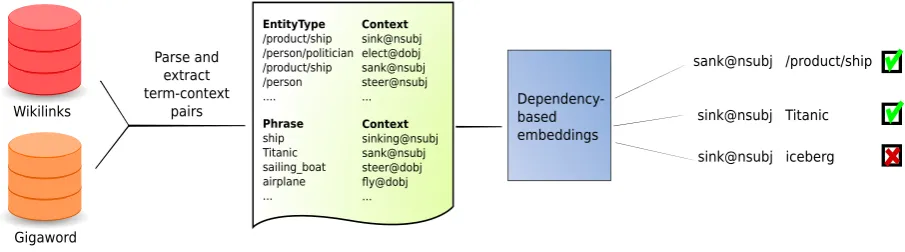
Our model of selectional preferences (Figure1)
1Examples due toAgirre and Martinez(2001).
overcomes this drawback via distributed represen-tation of predicate-argument pairs, using (syntac-tic) dependencies that were specifically designed for semantic downstream tasks, and by resolving named entities to their fine-grained entity types.
Distributed representation.Inspired by Struc-tured Vector Space (Erk and Pad´o, 2008), we embed predicates and arguments into a low-dimensional space in which (representations of) predicate slots are close to (representations of) their plausible arguments, as should be arguments that tend to fill the same slots of similar predi-cates, and predicate slots that have similar argu-ments. For example, captain should be close to
pilot,shiptoairplane, the subject ofsteerclose to bothcaptainandpilot, and also to, e.g., the subject ofdrive. Such a space allows judging the plausi-bility of unseen predicate-argument pairs.2
We construct this space via dependency-based word embeddings (Levy and Goldberg,2014). To see why this choice is better-suited for modeling selectional preferences than alternatives such as word2vec (Mikolov et al., 2013) or GloVe (
Pen-nington et al., 2014), consider the following
ex-ample:
captain ←−−nsubj steers −−→dobj ship
:: ::
pilot ←−−nsubj steers −−→dobj airplane
Here, captain and ship, have high syntagmatic similarity, i.e., these words are semantically re-lated and tend to occur close to each other. This also holds forpilotandairplane. In contrast, cap-tain andpilot, as well as ship and airplane have high paradigmatic similarity, i.e., they are
seman-2Prior work generalizes to unseen predicate-argument
tically similar and occur in similar contexts. A model of selectional preferences requires paradig-matic similarity: The representations of captain
andpilotin such a model should be similar, since they both can plausibly fill the subject slot of the predicate steer. Due to their use of linear con-text windows, word2vec and GloVe capture syn-tagmatic similarity, while dependency-based em-beddings capture paradigmatic similarity (cf.Levy
and Goldberg,2014).
Enhanced++ dependencies.Due to distributed representation, our model generalizes over syn-tactic variation such as active/passive alternations: For example, steer@dobj3 is highly similar to
steer@nsubjpass (see Appendix for more exam-ples). To further mitigate the effect of employ-ing syntax as a proxy for semantics, we use En-hanced++ dependencies (Schuster and Manning,
2016). Enhanced++ dependencies aim to sup-port semantic applications by modifying syntac-tic parse trees to better reflect relations between content words. For example, the plain syntactic parse of the sentence Both of the girls laughed
identifies Both as subject of laughed. The En-hanced++ representation introduces a subject re-lation between girls and laughed, which allows learning more meaningful selectional preferences: Our model should learn that girls (and other hu-mans) laugh, while learning that an unspecified
bothlaughs is not helpful.
Fine-grained entity types. A good model of selectional preferences needs to generalize over named entities. For example, having encountered sentences likeThe Titanic sank, our model should be able to judge the plausibility of an unseen sen-tence likeThe RMS Lusitania sank. For popular named entities, we can expect the learned repre-sentations ofTitanicandRMS Lusitaniato be sim-ilar, allowing our model to generalize, i.e., it can judge the plausibility ofThe RMS Lusitania sank
by virtue of the similarity between Titanic and
RMS Lusitania. However, this will not work for rare or emerging named entities, for which no, or only low-quality, distributed representations have been learned. To address this issue, we incorpo-rate fine-grained entity typing (Ling and Weld). For each named entity encountered during train-ing, we generate an additional training instance by replacing the named entity with its entity type,
3In this work, a predicate’s argument slots are denoted
predicate@slot.
e.g. (Titanic, sank@nsubj)yields (/product/ship, sank@nsubj).
3 Implementation
We train our model by combining term-context pairs from two sources. Noun phrases and their dependency context are extracted from GigaWord
(Parker et al., 2011) and entity types in context
from Wikilinks (Singh et al.,2012). Term-context pairs are obtained by parsing each corpus with the Stanford CoreNLP dependency parser (
Man-ning et al., 2014). After filtering, this yields
ca. 1.4 billion phrase-context pairs such as (Ti-tanic, sank@nsubj) from GigaWord and ca. 12.9 million entity type-context pairs such as (/prod-uct/ship, sank@nsubj) from Wikilinks. Finally, we train dependency-based embeddings using the generalized word2vec version byLevy and Gold-berg(2014), obtaining distributed representations of selectional preferences. To identify fine-grained types of named entities at test time, we first per-form entity linking using the system by
Heinzer-ling et al.(2016), then query Freebase (Bollacker
et al.,2008) for entity types and apply the mapping
to fine-grained types byLing and Weld.
The plausibility of an argument filling a partic-ular predicate slot can now be computed via the cosine similarity of their associated embeddings. For example, in our trained model, the similarity of(Titanic, sank@nsubj)is 0.11 while the similar-ity of(iceberg, sank@nsubj)is -0.005, indicating that an iceberg sinking is less plausible.
4 Do Selectional Preferences Benefit Coreference Resolution?
We now investigate the effect of incorporating se-lectional preferences, implicitly and explicitly, in coreference resolution.
MUC B3 CEAFe CoNLL LEA
R P F1 R P F1 R P F1 Avg. F1 R P F1
baseline 70.09 80.01 74.72 57.64 70.09 63.26 54.47 63.92 58.82 65.60 54.02 66.45 59.59
−gov 70.10 79.96 74.71 57.51 70.31 63.27 54.41 64.08 58.85 65.61 53.93 66.76 59.66
+SP 70.85 79.31 74.85 58.93 69.16 63.64 55.25 63.78 59.21 65.90 55.29 65.53 59.98
[image:4.595.73.525.64.141.2]Reinforce 70.98 78.81 74.69 58.97 69.05 63.61 55.66 63.28 59.23 65.84 55.31 65.32 59.90
Table 1: Results on the CoNLL 2012 test set.
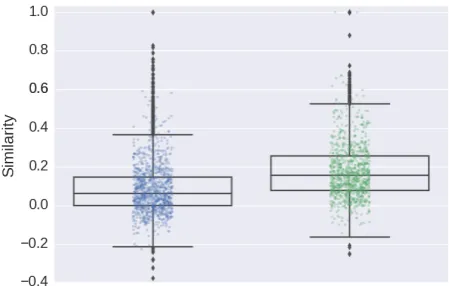
Figure 2: Selectional preference similarities of 10k coreferent and 10k non-coreferent mention pairs. Lines and boxes represent quartiles, di-amonds outliers, points subsamples with jitter. Coreferent mention pairs are more similar than non-coreferent mention pairs with a Matthews cor-relation coefficient of 0.30, indicating weak to moderate correlation.
other knowledge sources in a non-linear way. We select the ranking model of deep-coref
(Clark and Manning, 2016b) as our baseline.
deep-coref is a neural model that combines the in-put features through several hidden layers. Base-linein Table1reports our baseline results on the CoNLL 2012 test set. The results are reported using MUC (Vilain et al., 1995), B3 (Bagga and
Baldwin,1998),CEAFe(Luo,2005), the average
F1score of these three metrics, i.e. CoNLL score,
and LEA (Moosavi and Strube, 2016b).
deep-coref includes the embeddings of the dependency governor of mentions. Combined with the relative position of a mention to its governor, deep-coref may be able to implicitly capture selectional pref-erences to some extent. −gov in Table 1 repre-sents deep-coref performance when governors are not incorporated. As we can see, the exclusion of the governor information does not affect the per-formance. This result shows that the implicit
mod-MUC B3 CEAF
e CoNLL LEA
development
baseline 74.10 63.95 59.73 65.93 60.16 +embedding 74.38 64.42 60.45 66.42 60.65 +binned sim. 74.36 64.54 60.21 66.37 60.77
test
[image:4.595.310.526.179.266.2]baseline 74.72 63.26 58.82 65.60 59.59 +embedding 74.53 63.41 59.03 65.66 59.69 +binned sim. 74.85 63.64 59.21 65.90 59.98
Table 2: Incorporating the selectional preference model as new embeddings (+embedding) vs. as new pairwise features (+binned sim.).
eling of selectional preferences does not provide any additional information to the coreference re-solver.
For each mention, we consider (1) the whole mention string, (2) the whole mention string with-out articles, (3) mention head, (4) context rep-resentation, i.e. governor@dependency-relation, and (5) entity types if the mention is a named en-tity. We obtain an embedding for each of the above properties if they exist in the selectional prefer-ence model, otherwise we set them to unknown.
For each (antecedent, anaphor) pair, we con-sider all the acquired embeddings of anaphor and antecedent. We try two different ways of incor-porating this knowledge into deep-coref includ-ing: (1) incorporating the computed embeddings directly as a new set of inputs, i.e.+embeddingin Table2. We add a new hidden layer on top of the new embeddings and combine its output with out-puts of the hidden layers associated with other sets of inputs; and (2) computing a similarity value be-tween all possible combinations of the antecedent-anaphor acquired embeddings and then binarizing all similarity values, i.e.+binned sim.in Table2.
Providing selectional preference embeddings directly to deep-coref adds more complexity to the baseline coreference resolver. Yet, it performs on-par with+binned sim.on the development set and generalizes worse on the test set. +SP in Table1
[image:4.595.66.291.186.329.2]does [that]antereally impact the case ... [it]anajust shows (impact@nsubj,shows@nsubj)
[it]antewill ask a U.S. bankruptcy court to allow [it]ana (ask@nsubj,allow@dobj)
[image:5.595.94.269.152.202.2][astrainthat has n’t even presented [itself]ana]ante (presented@nsubj,presented@dobj)
Table 3: Examples of +SP correct links on the development set that do not exist in the baseline output.
Error type Proper Mention typeCommon Pronoun
Recall -28 -29 -53
Precision +18 +74 +61
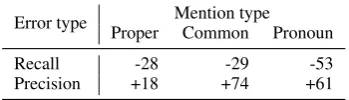
Table 4: Differences in the number of recall and precision errors on the CoNLL’12 test set in com-parison to the baseline.
preferences as binary features improves over the baseline.
Reinforce in Table 1 presents the results of the reward-rescaling model ofClark and Manning
(2016a) that are so far the highest reported results
on the official test set. The reward rescaling model
of Clark and Manning (2016a) casts the ranking
model ofClark and Manning(2016b) in the rein-forcement learning framework which considerably increases the training time, from two days to six days in our experiments.
We analyze how our selectional preference model affects the resolution of various types of mentions. We useMartschat and Strube(2014)’s toolkit4to perform recall and error analyses. The differences in the number of recall and precision errors in +SPcompared tobaselineon the test set are reported in Table4.
By using our selectional preference features, the number of recall errors decreases for all types of mentions. The recall error reduction is more prominent for pronouns. On the other hand, the number of precision errors increases for all types of mentions. The increase in the precision error is the highest for common nouns. Overall, +SP cre-ates about 260 more links thanbaseline.
Table 3 lists a few examples from the de-velopment set in which +SP creates a link that
baseline does not. It also includes the similar-ity that has a high value for the linked mentions and probably is the reason for creating the link. For instance, in the first example, based on our model, similarity(impact@nsubj,shows@nsubj) is known and it is also higher than similar-ity(impact@dobj,shows@nsubj).
4https://github.com/smartschat/cort
In order to estimate a higher bound on the ex-pected performance boost, we run thebaselineand +SPmodels only on anaphoric mentions. By using anaphoric mentions, the performance improves by one percent, based on both the CoNLL score and
LEA. This result indicates that the incorporation of selectional preferences creates many links for non-anaphoric mentions, which in turn decreases pre-cision. Therefore, the overall performance does not improve substantially when system mentions are used. deep-coref incorporates anaphoricity scores at resolution time. One possible way to further improve the results of +SP is to incorpo-rate anaphoricity scores at the input level. In this way, the coreference resolver could learn to use se-lectional preferences mainly for mentions that are more likely to be anaphoric. However, given that the F1 score of current anaphoricity determiners
or singleton detectors is only around 85 percent
(Moosavi and Strube, 2016a,2017), the effect of
using system anaphoricity scores might be small.
5 Conclusions
We introduce a new model of selectional prefer-ences, which combines dependency-based word embeddings and fine-grained entity types. In or-der to be effective, a selectional preference model should (1) have a high coverage so it can be used for large datasets like CoNLL, and (2) be com-bined with other knowledge sources in a non-linear way. Our selectional preference model slightly improves coreference resolution perfor-mance, but considering the extra resources that are required to train the model, it is debatable whether such small improvements are advantageous for solving coreference.
Acknowledgments
References
Eneko Agirre and David Martinez. 2001. Learning class-to-class selectional preferences. In Proceed-ings of the ACL 2001 Workshop on Computational Natural Language Learning (ConLL), pages 15–22.
Amit Bagga and Breck Baldwin. 1998. Algorithms for scoring coreference chains. In Proceedings of the 1st International Conference on Language Resources and Evaluation, Granada, Spain, 28–30 May 1998, pages 563–566.
Kurt Bollacker, Colin Evans, Praveen Paritosh, Tim Sturge, and Jamie Taylor. 2008. Freebase: A collab-oratively created graph database for structuring hu-man knowledge. In Proceedings of the 2008 ACM SIGMOD International Conference on Management of Data,Vancouver, B.C., Canada, 10–12 June 2008, pages 1247–1250.
Kevin Clark and Christopher D. Manning. 2016a. Deep reinforcement learning for mention-ranking coreference models. In Proceedings of the 2016 Conference on Empirical Methods in Natural Lan-guage Processing, Austin, Tex., 1–5 November 2016, pages 2256–2262.
Kevin Clark and Christopher D. Manning. 2016b. Im-proving coreference resolution by learning entity-level distributed representations. InProceedings of the 54th Annual Meeting of the Association for Com-putational Linguistics (Volume 1: Long Papers), Berlin, Germany, 7–12 August 2016.
Tim Van de Cruys. 2010. A non-negative tensor factor-ization model for selectional preference induction. Natural Language Engineering, 16(4):417–437.
Tim Van de Cruys. 2014.A neural network approach to selectional preference acquisition. InProceedings of the 2014 Conference on Empirical Methods in Natural Language Processing (EMNLP), pages 26– 35, Doha, Qatar.
Ido Dagan and Alon Itai. 1990. Automatic processing of large corpora for the resolution of anaphora ref-erences. In Proceedings of the 13th International Conference on Computational Linguistics,Helsinki, Finland, 20–25 August 1990, volume 3, pages 330– 332.
Katrin Erk. 2007. A simple, similarity-based model for selectional preferences. In Proceedings of the 45th Annual Meeting of the Association for Compu-tational Linguistics,Prague, Czech Republic, 23–30 June 2007, pages 216–223.
Katrin Erk and Sebastian Pad´o. 2008. A structured vector space model for word meaning in context. In Proceedings of the 2008 Conference on Empiri-cal Methods in Natural Language Processing, pages 897–906.
Benjamin Heinzerling, Alex Judea, and Michael
Strube. 2016. HITS at TAC KBP 2015:
En-tity discovery and linking, and event nugget detec-tion. In Proceedings of the Text Analysis Confer-ence, National Institute of Standards and Technol-ogy, Gaithersburg, Maryland, USA, 16–17 Novem-ber 2015.
Jerry R. Hobbs. 1978. Resolving pronominal refer-ences. Lingua, 44:311–338.
Andrew Kehler, Douglas Appelt, Lara Taylor, and Aleksandr Simma. 2004. The (non)utility of predicate-argument frequencies for pronoun inter-pretation. In Proceedings of the Human Lan-guage Technology Conference of the North Ameri-can Chapter of the Association for Computational Linguistics, Boston, Mass., 2–7 May 2004, pages 289–296.
Omer Levy and Yoav Goldberg. 2014. Dependency-based word embeddings. InProceedings of the 52nd Annual Meeting of the Association for Computa-tional Linguistics (Volume 2: Short Papers), pages 302–308.
Xiao Ling and Daniel S. Weld. Fine-grained entity recognition. In Proceedings of the 26th Confer-ence on the Advancement of Artificial IntelligConfer-ence, Toronto, Ontario, Canada, 22–26 July 2012, pages 94–100.
Xiaoqiang Luo. 2005. On coreference resolution performance metrics. In Proceedings of the Hu-man Language Technology Conference and the 2005 Conference on Empirical Methods in Natural Lan-guage Processing, Vancouver, B.C., Canada, 6–8 October 2005, pages 25–32.
Christopher D. Manning, Mihai Surdeanu, John Bauer, Jenny Finkel, Steven J. Bethard, and David Mc-Closky. 2014. The Stanford CoreNLP natural lan-guage processing toolkit. In Proceedings of 52nd Annual Meeting of the Association for Computa-tional Linguistics: System Demonstrations, pages 55–60.
Sebastian Martschat and Michael Strube. 2014. Recall error analysis for coreference resolution. In Pro-ceedings of the 2014 Conference on Empirical Meth-ods in Natural Language Processing,Doha, Qatar, 25–29 October 2014, pages 2070–2081.
Sebastian Martschat and Michael Strube. 2015. La-tent structures for coreference resolution. Transac-tions of the Association for Computational Linguis-tics, 3:405–418.
Tomas Mikolov, Kai Chen, Greg Corrado, and Jeffrey Dean. 2013. Efficient estimation of word represen-tations in vector space. InProceedings of the ICLR 2013 Workshop Track.
Nafise Sadat Moosavi and Michael Strube. 2016a.
2016 Conference of the North American Chapter of the Association for Computational Linguistics: Hu-man Language Technologies, San Diego, Cal., 12– 17 June 2016, pages 1005–1011.
Nafise Sadat Moosavi and Michael Strube. 2016b.
Which coreference evaluation metric do you trust? A proposal for a link-based entity aware metric. In Proceedings of the 54th Annual Meeting of the As-sociation for Computational Linguistics (Volume 1: Long Papers),Berlin, Germany, 7–12 August 2016, pages 632–642.
Nafise Sadat Moosavi and Michael Strube. 2017. Use generalized representations, but do not forget sur-face features. In Proceedings of the 2nd Work-shop on Coreference Resolution Beyond OntoNotes (CORBON 2017), pages 1–7, Valencia, Spain.
Patrick Pantel, Rahul Bhagat, Bonaventura Coppola, Timothy Chklovski, and Eduard Hovy. 2007. ISP: Learning inferential selectional preferences. In Hu-man Language Technologies 2007: The Conference of the North American Chapter of the Association for Computational Linguistics; Proceedings of the Main Conference, pages 564–571.
Robert Parker, David Graff, Junbo Kong, Ke Chen, and Kazuaki Maeda. 2011. English Gigaword Fifth Edi-tion. LDC2011T07.
Jeffrey Pennington, Richard Socher, and Christo-pher D. Manning. 2014. GloVe: Global vectors for word representation. In Proceedings of the 2014 Conference on Empirical Methods in Natural Language Processing,Doha, Qatar, 25–29 October 2014, pages 1532–1543.
Philip Resnik. 1993. Selection and Information: A Class-based Approach to Lexical Relationships. Ph.D. thesis, Department of Computer and Informa-tion Science, University of Pennsylvania, Philadel-phia, Penn.
Alan Ritter, Mausam, and Oren Etzioni. 2010. A la-tent dirichlet allocation method for selectional pref-erences. In Proceedings of the 48th Annual Meet-ing of the Association for Computational LMeet-inguis- Linguis-tics, pages 424–434.
Sebastian Schuster and Christopher D. Manning. 2016. Enhanced english universal dependencies: An im-proved representation for natural language under-standing tasks. InProceedings of the Tenth Interna-tional Conference on Language Resources and Eval-uation (LREC 2016).
Sameer Singh, Amarnag Subramanya, Fernando
Pereira, and Andrew McCallum. 2012.
Wik-ilinks: A large-scale cross-document coreference corpus labeled via links to Wikipedia. Techni-cal Report UM-CS-2012-015, University of Mas-sachusetts, Amherst.
Marc Vilain, John Burger, John Aberdeen, Dennis Con-nolly, and Lynette Hirschman. 1995. A model-theoretic coreference scoring scheme. In Proceed-ings of the 6th Message Understanding Conference (MUC-6), pages 45–52, San Mateo, Cal. Morgan Kaufmann.
Appendix
Query Most sim. predicate slots Most sim. entity types Most sim. phrases
sink@nsubj sink@nsubj:xsubj /product/ship Sea Diamond
sink@nsubjpass /event/natural disaster Prestige oil tanker
sinking@nmod:of /finance/stock exchange Samina
slide@nsubj /astral body Estonia ferry
capsizing@nmod:of /person/religious leader k-159
plunge@nsubj /finance/currency Navy gunboat
sink@nmod:along with /military Dona Paz
sinking@nsubj /geography/glacier ferry Estonia
tumble@nsubj /product/airplane add-fisk-independent-nytsf
slip@nsubj /transit Al-Salam Boccaccio
ship capsize@nmod:of /product/ship vessel
some@nmod:aboard /train cargo ship
experience@nmod:aboard /product/airplane cruise ship
afternoon@nmod:aboard /transit boat
pier@nmod:for /product/spacecraft freighter
escort@nmod:including /location/bridge container ship
lift-off@nmod:of /broadcast/tv channel cargo vessel
disassemble@nsubjpass:xsubj /location Navy ship
near-collision@nmod:with /living thing warship
Conger@compound /chemistry tanker
steer@dobj guide@dobj /broadcast/tv channel business way
steer@nsubjpass /product/car newr nbkg nwer ndjn
shepherd@dobj /organization/sports team BahrainDinar
steering@nmod:of /product/ship reynard-honda
nudge@dobj /product/spacecraft zigzag course
pilot@dobj /event/election team home
propel@dobj /medicine/medical treatment U.S. energy policy
maneuver@dobj /building/theater williams-bmw
divert@dobj /education/department interest-rate policy
lurch@nsubj /product/airplane trimaran
/product/ship Repulse@conj:and /product/airplane battleship Bismarck
destroyer@amod /train pt boat
capsize@nmod:of /product/car battleship
experience@nmod:aboard /park USS Nashville
near-collision@nmod:with /military USS Indianapolis
line@cc /event/natural disaster k-159
brig@conj:and /award frigate
-lrb-@nmod:on /geography/island warship
Umberto@conj:and /person/soldier Oriskany
[image:8.595.72.525.191.746.2]rumour@xcomp /location/body of water sister ship