Proceedings of the 2017 Conference on Empirical Methods in Natural Language Processing, pages 2421–2431 Copenhagen, Denmark, September 7–11, 2017. c2017 Association for Computational Linguistics
Investigating Different Syntactic Context Types and Context
Representations for Learning Word Embeddings
Bofang Li1,2
[email protected] Tao Liu
1,2
[email protected] Zhe Zhao
1,2
Buzhou Tang3
[email protected] Aleksandr Drozd
4
Anna Rogers5
[email protected] Xiaoyong Du
1,2
1School of Information, Renmin University of China
2Key Laboratory of Data Engineering and Knowledge Engineering, MOE 3Shenzhen Graduate School, Harbin Institute of Technology
4Global Scientific Information and Computing Center, Tokyo Institute of Technology 5Department of Computer Science, University of Massachusetts Lowell
Abstract
The number of word embedding models is growing every year. Most of them are based on the co-occurrence information of words and their contexts. However, it is still an open question what is the best def-inition of context. We provide a system-atical investigation of 4 different syntactic context types and context representation-s for learning word embeddingrepresentation-s. Com-prehensive experiments are conducted to evaluate their effectiveness on 6 extrinsic and intrinsic tasks. We hope that this pa-per, along with the published code, would be helpful for choosing the best contex-t contex-type and represencontex-tacontex-tion for a given contex-task.
1 Introduction
Recently, there is a growing interest in word em-bedding models, where words are embedded into low-dimensional (dense) real-valued vectors. The trained word embeddings can be directly used for solving intrinsic tasks like word similarity and word analogy. They are also helpful for solv-ing extrinsic tasks, such as part-of-speech taggsolv-ing,
chunking, named entity recognition (Collobert and
Weston,2008;Collobert et al.,2011) and text clas-sification (Socher et al.,2013;Kim,2014).
The training objectives of word embedding models are based on the Distributional
Hypoth-esis (Harris, 1954) that can be stated as follows:
“words that occur in similar contexts tend to have similar meanings”. In most word embedding mod-els, the “context” is defined as the words which precede and follow the target word within some
fixed distance (Bengio et al.,2003;Mnih and
Hin-ton,2007;Mikolov et al.,2013a;Pennington et al.,
2014). Among them, Global Vectors (GloVe)
proposed by Pennington et al. (2014),
Contin-uous Skip-Gram (CSG) 1 and Continuous
Bag-Of-Words (CBOW) proposed by Mikolov et al.
(2013b) achieve state-of-the-art results on a range of linguistic tasks, and scale to corpora with bil-lions of words.
The traditional sparse vector-space models have
explored many different types of context.
Cur-ran(2004);Pad´o and Lapata(2007);Clark(2012) have discussed a set of context definitions beyond simple linear context. For example, a sentence or document could be used as the boundary instead of window size. Contextual words could be associat-ed with their relative sides (left/right) or position-s (+1/-2) to the target word. They could alposition-so be associated with part-of-speech or grammatical re-lation labels. The weight of each contextual word can be explicitly defined. Moreover, words that are connected to target word in dependency parse
1Many researches refer to Continuous Skip-Gram as SG. However, in order to distinguish linear (continuous) context and DEPS (dependency-based) context, we refer it as CSG.
Basic Model Context Representation
Context
Type Linear DEPS
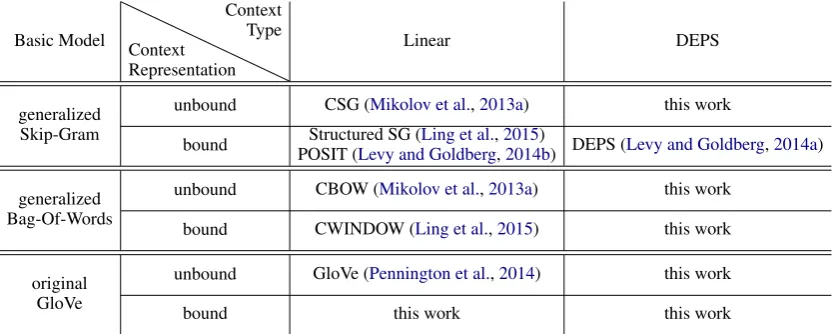
generalized unbound CSG (Mikolov et al.,2013a) this work Skip-Gram bound Structured SG (Ling et al.,2015)
POSIT (Levy and Goldberg,2014b) DEPS (Levy and Goldberg,2014a) generalized unbound CBOW (Mikolov et al.,2013a) this work
Bag-Of-Words bound CWINDOW (Ling et al.,2015) this work
original unbound GloVe (Pennington et al.,2014) this work
[image:2.595.91.511.62.229.2]GloVe bound this work this work
Table 1: Summary of prior research on word embedding models with different syntactic context types
and context representations. For linear context,boundindicates words associated with positional
infor-mation. For DEPS context,boundindicates words associated with dependency relation.
tree can be considered as context.
Recent word embedding models have also
ex-plored some of the above context types. Levy
and Goldberg (2014b); Ling et al. (2015)2
im-prove CSG and CBOW by introducing
position-aware context representation. Levy and Goldberg
(2014a) propose dependency-based context (DEP-S) for CSG.
However, different types of syntactic contex-t have nocontex-t been syscontex-temacontex-tically compared for dif-ferent word embeddings. This paper explores two context types (linear or DEPS) and two context representations (bound or unbound), as shown in
Table 1. Three popular word embedding models
(CBOW, GloVe, and CSG) are compared on word similarity, word analogy, part-of-speech tagging, chunking, named entity recognition, and text clas-sification tasks.
2 Related Work
Several studies directly compare different word
embedding models. Lai et al. (2016) compare
6 word embedding models using different
cor-pora and hyper-parameters. Nayak and
Man-ning (2016) provide a set of evaluations, along
with an online tool, for word embedding models.
Levy and Goldberg (2014c) show the theoretical equivalence of CSG and PPMI matrix
factoriza-tion. Levy et al. (2015) further discuss the
con-nections between 4 word embedding models (PP-MI, SVD, CSG, GloVe) and re-evaluate them with
2In these two papers, the description of position-aware (bound) context are quite different. However, their ideas are actually identical.
the same hyper-parameters. Suzuki and Nagata
(2015) investigate different configurations of
CS-G and CS-GloVe and merge them together. Yin and
Schutze(2016) propose 4 ensemble methods and show their effectiveness over individual ones.
There is also research evaluating different
con-text types in learning word embeddings. Heylen
et al.(2008) compares dependency-based and lin-ear vector space model for finding
semantical-ly related nouns in Dutch. Vulic and Korhonen
(2016) compare CSG and dependency-based
mod-els on various languages. Their results suggest that dependency-based models are better at detecting functional similarity in English, although that does
not necessarily hold for other languages. Bansal
et al.(2014) show that DEPS context is preferable
to linear context on parsing task. Melamud et al.
(2016) investigate the performance of CSG,
DEP-S and a substitute-based word embedding model (Yatbaz et al.,2012)3, which shows that
differen-t differen-types of indifferen-trinsic differen-tasks have clear preference for particular types of contexts. On the other hand, for extrinsic tasks, the optimal context types need to be carefully tuned on specific dataset.
The contribution of this study is that in addition to linear and dependency-based context we also consider bound and unbound context representa-tions, as will be described below. Furthermore, we systematically evaluate three word embedding models: CSG, CBOW and GLoVe.
in the text. The context vocabulary C is thus
identical to the word vocabulary W. However,
this restriction is not required by the model; con-texts need not correspond to words, and the num-ber of context-types can be substantially larger than the number of word-types. We generalize SKIPGRAM by replacing the bag-of-words con-texts with arbitrary concon-texts.
In this paper we experiment with dependency-basedsyntactic contexts. Syntactic contexts cap-ture different information than bag-of-word con-texts, as we demonstrate using the sentence “Aus-tralian scientist discovers star with telescope”.
Linear Bag-of-Words Contexts This is the context used byword2vecand many other neu-ral embeddings. Using a window of sizekaround
the target wordw, 2k contexts are produced: the k words before and the k words after w. For k = 2, the contexts of the target word w are w−2, w−1, w+1, w+2. In our example, the contexts
ofdiscoversareAustralian,scientist,star,with.2 Note that a context window of size2may miss some important contexts (telescope is not a con-text ofdiscovers), while including some acciden-tal ones (Australianis a contextdiscovers). More-over, the contexts are unmarked, resulting in dis-coversbeing a context of bothstarsandscientist, which may result in stars and scientists ending up as neighbours in the embedded space. A win-dow size of5is commonly used to capture broad topical content, whereas smaller windows contain more focused information about the target word.
Dependency-Based Contexts An alternative to the bag-of-words approach is to derive contexts based on the syntactic relations the word partic-ipates in. This is facilitated by recent advances in parsing technology (Goldberg and Nivre, 2012; Goldberg and Nivre, 2013) that allow parsing to syntactic dependencies with very high speed and near state-of-the-art accuracy.
After parsing each sentence, we derive word contexts as follows: for a target word w with
modifiersm1, . . . , mk and a headh, we consider the contexts(m1, lbl1), . . . ,(mk, lblk),(h, lblh−1),
2word2vec’s implementation is slightly more compli-cated. The software defaults to prune rare words based on their frequency, and has an option for sub-sampling the fre-quent words. These pruning and sub-sampling happenbefore the context extraction, leading to a dynamic window size. In addition, the window size is not fixed to k but is sampled uniformly in the range[1, k]for each word.
Australian scientist discovers star with telescope
amod nsubj dobj prep pobj
Australian scientist discovers star telescope
amod nsubj dobj prep with
WORD CONTEXTS australian scientist/amod−1
scientist australian/amod, discovers/nsubj−1
discovers scientist/nsubj, star/dobj, telescope/prep with star discovers/dobj−1
telescope discovers/prep with−1
Figure 1: Dependency-based context extraction example.
Top: preposition relations are collapsed into single arcs, makingtelescopea direct modifier ofdiscovers.Bottom:the contexts extracted for each word in the sentence.
wherelblis the type of the dependency relation
be-tween the head and the modifier (e.g. nsubj,dobj, prep with, amod) and lbl−1 is used to mark the
inverse-relation. Relations that include a preposi-tion are “collapsed” prior to context extracpreposi-tion, by directly connecting the head and the object of the preposition, and subsuming the preposition itself into the dependency label. An example of the de-pendency context extraction is given in Figure 1.
Notice that syntactic dependencies are both more inclusive and more focused than bag-of-words. They capture relations to words that are far apart and thus “out-of-reach” with small win-dow bag-of-words (e.g. the instrument ofdiscover istelescope/prep with), and also filter out “coinci-dental” contexts which are within the window but not directly related to the target word (e.g. Aus-tralianis not used as the context fordiscovers). In addition, the contexts are typed, indicating, for ex-ample, thatstarsare objects of discovery and sci-entists are subjects. We thus expect the syntactic contexts to yield more focused embeddings, cap-turing more functional and less topical similarity.
4 Experiments and Evaluation
[image:3.595.310.521.61.163.2]We experiment with 3 training conditions: BOW5 (bag-of-words contexts with k = 5), BOW2 (same, withk = 2) and DEPS(dependency-based syntactic contexts). We modified word2vec to support arbitrary contexts, and to output the con-text embeddings in addition to the word embed-dings. For bag-of-words contexts we used the originalword2vecimplementation, and for syn-tactic contexts, we used our modified version. The negative-sampling parameter (how many negative contexts to sample for every correct one) was 15.
Figure 1: Illustration of dependency parse tree.
3 Word Embeddings Models
In this section, we first introduce different contexts in detail, and discuss their strengths and weakness-es. We then show how CSG, CBOW and GloVe can be generalized to use these contexts.
3.1 Context Types
There are many different types of context, both on document and sentence level. For syntactic contexts, the current literature discusses mainly the linear (used in most word embedding models)
and dependency-based contexts (DEPS (Levy and
Goldberg, 2014a)). Linear context is defined as the positional neighbors of the target word in texts. DEPS context is defined as the syntactic neighbors of the target word based on dependency parse tree,
as shown in Figure14.
Compared to the linear context, DEPS context can capture more relevant words that are further away from the target word in the text. For
ex-ample in Figure1, linear context does not include
the word-context pair “discovers telescope”, while DEPS context contains this information. DEP-S context can also exclude some uninformative word-context pairs like “with star” and “telescope with”.
Note that dependency parsing is
time-consuming. Despite its parallelizability, our
implementation still takes nearly a month to finish dependency parsing for the Wikipedia corpus on a 32-core machine. it is only fair to compare linear and DEPS context if we ignore the time com-plexity. it is also worth noting that part-of-speech labels are required when performing dependency parsing.
3.2 Context Representations
In the original CSG, CBOW and GloVe model-s, contexts are represented by words without any
additional information. Ling et al.(2015) modify
4This example is fromLevy and Goldberg(2014a)
Context Representation
Context
Type Linear DEPS
unbound australian,scientist, star, with
scientist, star, telescope bound australian/-2,scientist/-1,
star/+1, with/+2
scientist/nsubj, star/dobj,
telescope/prep with
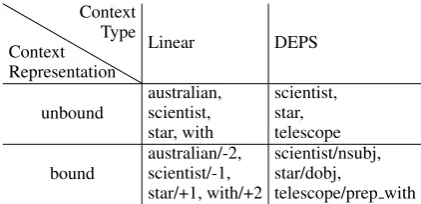
Table 2: Illustration of bound and unbound rep-resentations under linear and DEPS context types.
This example is based on Figure1, and the target
word is “discovers”.
CSG and CBOW by introducing position-bound words, where each contextual word is associated with their relative position to the target word. This allows CSG and CBOW to distinguish different sequential positions and capture the structural in-formation from the context. We refer to methods that bind positional information with the contextu-al word as bound (context) representation, as op-posed to unbound (context) representation where contextual words are treated the same irrespective of their positions with regards to the target word.
The original DEPS uses “bound” representation by default: each word is associated with its depen-dency relation to the target word. In this paper, we also investigate the simpler context representation where no dependency relation is associated with a word. This enables a fair comparison with conven-tional models like CSG, CBOW and GloVe, since they do not use bound representation either. An example of different syntactic context types and
context representations is shown in Table2.
Intuitively, bound representation should work better than unbound representation, since it uses information about relative word positions. How-ever, this is not always the case in practice. An obvious drawback is that bound representation is more sparse than unbound representation, espe-cially for DEPS context type. In our data, there
were47dependency relations in dependency parse
tree. Although not every combination of depen-dency relations and words appear in the word-context pair collection, in practice it still enlarges the contextual words’ vocabulary about 5 times.
Both syntactic context types (linear and DEPS) and the choice of context representations (bound and unbound) have a dramatic effect on the word embeddings. Bound linear representation transfer-s each contextual word into a new one, and the
[image:3.595.77.285.66.139.2]Linear (window size1) DEPS
P
(australian, scientist) (scientist, australian) (scientist, discovers) (discovers, scientist) (discovers, star) . . .
(australian, scientist) (scientist, australian) (scientist, discovers) (discovers, scientist) (discovers, star) (discovers, telescope) . . .
M
(australian, scientist) (scientist, australian, discovers)
(discovers, scientist, star)
. . .
(australian, scientist) (scientist, australian, discovers)
(discovers, scientist, star, telescope) . . .
M
(australian, scientist,1) (scientist, australian,1) (scientist, discovers,1) (discovers, scientist,1) (discovers, star,1) . . .
[image:4.595.79.285.59.272.2](australian, scientist,1) (scientist, australian,1) (scientist, discovers,1) (discovers, scientist,1) (discovers, star,1) (discovers, telescope,1) . . .
Table 3: Illustration of collectionP,MandMfor
sentence “australian scientist discovers star with telescope”. Unbound representation is used in this
example. Words in the collections areBold. .
word-context pairs are changed completely. DEP-S, as compared to the linear contexts, increases the likelihood that the contextual words are in a mean-ingful relation with the target word, although some words captured by DEPS would also be found in the linear contexts if the window is wide enough.
For example, in Table2, “scientist” and “star” are
considered as the contextual words of “discovers” in both linear and DEPS context types.
3.3 Generalization
LetP be a collection of word-context pairs.P can
be merged based on the words to form a collection
M with size of |V|, where V is the vocabulary.
Each element (w, c1, c2, .., cnw) ∈ M is wordw
and its contexts, wherenw is the number of word
w’s contexts. Pcan also be merged based on both
words and contexts to form a collectionM. Each
element(w, c,#(w, c))∈M is the wordw,
con-text c, and the times they appear in collectionP.
An example of these collections is shown in Ta-ble3.
3.3.1 Generalized Bag-Of-Words
The objective function of Generalized Bag-Of-Words (GBOW) is defined as:
X
(w,c1,..,cnw)∈M
logp w
nw X
i=1
~ci
!
(1)
With negative sampling technique, the log prob-ability is calculated by:
logσ ~w·Xnw
i=1
~ci
! −XK
k=1
logσ w~Nk·
nw X
1=i
~ci
! (2)
whereσis the sigmoid function,Kis the negative
sampling size, ~w and~c is the vector for word w
andcrespectively. The negatively sampled word
wNk is randomly selected on the basis of its
uni-gram distribution(P#(w)
w#(w))
ds, where#(w)is the
number of times that wordw appears in the
cor-pus, and ds is the distribution smoothing
hyper-parameter which is usually defined as0.75.
Note that with negative sampling technique,
both GBOW and original CBOW (Mikolov et al.,
2013a) will learn two sets of embeddings (word embeddings and context embeddings). In the o-riginal CBOW, the context embeddings can also be considered as word embeddings, since the vo-cabulary set of words and contexts are the same. However, for bound context, the words (i.e. scien-tist) and contexts (i.e. scientist/nsubj) are quite d-ifferent. It is necessary to distinguish conditioned and conditioning variables. For example, in
Fig-ure 1, the context “scientist/nsubj” can only be
predicted by word “discovers”. However, most of the word is connected to several contextual word-s. Due to this, the sum of contextual word em-beddings should be used for predicting the target word.
3.3.2 Generalized Skip-Gram
For generalized Skip-Gram (GSG), the definition is more straightforward and the objective function
actually needs no specification (Levy and
Gold-berg, 2014b). Nonetheless, in order to make it consistent with our GBOW, we also specify the conditioned and conditioning variables in the ob-jective function:
X
(w,c)∈P
logp(w|~c)
= X
(w,c)∈P
"
logσ(~w·~c)−XK
k=1
logσ(w~Nk·~c) # (3)
25 50 100 250 500 0.50
0.55 0.60 0.65 0.70 0.75
WordSim353 similarity
correlation
Skip-Gram
25 50 100 250 500 0.50
0.55 0.60 0.65 0.70 0.75
CBOW
25 50 100 250 500 0.50
0.55 0.60 0.65 0.70 0.75
GloVe
25 50 100 250 500 dimension 0.25
0.30 0.35 0.40 0.45 0.50 0.55
WordSim353 relatedness
correlation
25 50 100 250 500 dimension 0.25
0.30 0.35 0.40 0.45 0.50 0.55
25 50 100 250 500 dimension 0.25
0.30 0.35 0.40 0.45 0.50 0.55
[image:5.595.118.480.62.212.2]unbound linear context bound linear context unbound DEPS context bound DEPS context
Figure 2: Correlation results for similarity and relatedness categories on WordSim353 (word similarity) dataset.
3.3.3 GloVe
Unlike GSG and GBOW, GloVe explicitly opti-mizes a log-bilinear regression model based on word co-occurrence matrix. Since GloVe is al-ready a very generalized model, with the previous
defined collectionM, the final objective function
is written as:
X
(w,c)∈M
f(#(w, c))(~w·~c+b~w+~bc−log #(w, c)) (4)
whereb~w and ~bc are biases for word and
contex-t. f is a non-decreasing weighting function and
ensures that large#(w, c)is not over-weighted.
Note that the inputs of GSG, GBOW and Glove
are the collections P, M and M respectively.
Once the corpus and hyper-parameters are fixed, these collections (and thus the learned word em-beddings) are determined only by the choice of context types and representations.
4 Experiments
We evaluate the effectiveness of different syntactic context types and context representations on word similarity, word analogy, part-of-speech tagging, chunking, named entity recognition, and text clas-sification tasks. In this section we describe our models, and then report and discuss the experi-mental results on each task.
4.1 Word Embeddings
Previously, theword2vecftoolkit5(Levy et al.,
2015) extended theword2vectoolkit6(Mikolov
et al., 2013b) to accept the input of collection P
5https://bitbucket.org/yoavgo/ word2vecf
6http://code.google.com/p/word2vec/
rather than raw corpus. This makes CSG mod-el accept arbitrary contexts (e.g. DEPS context). However, CBOW and GloVe are not considered in
that toolkit. We implementword2vecPMtoolkit,
a further extension of word2vecf, which
sup-ports generalized CSG, CBOW and GloVe with
the input of collectionP,M andM respectively.
For fair comparison, as suggested by Levy et al.
(2015), we use the same hyper-parameters7for
al-l embedding modeal-ls. Engal-lish Wikipedia (August 2013 dump) is used as the training corpus. The
Stanford CoreNLP (Manning et al.,2014) is used
for dependency parsing. After parsing, tokens are converted to lowercase. Words and contexts that
appear fewer than 100times in the collection P
are ignored.
4.2 Word Similarity Task
Word similarity task aims at producing semantic similarity scores of word pairs, which are com-pared with the human scores using Spearman’s correlation. The cosine distance is used for gener-ating similarity scores between two word vectors.
We use the WordSim353 (Finkelstein et al.,2001)
dataset, divided into similarity and relatedness cat-egories (Zesch et al.,2008;Agirre et al.,2009).
Previous research (Levy and Goldberg, 2014a;
Melamud et al., 2016) concluded that compared to linear context, DEPS context can capture more functional similarity (e.g. tiger/cat) rather than topical similarity (relatedness) (e.g. tiger/jungle). However, their experiments do not distinguish the
7Negative sampling size is set to 5 for SG and 2 for CBOW. Distribution smoothing is set to0.75. No dynamic context or “dirty” sub-sampling is used. The window size is fixed to2. The number of iterations is set to2,5and30for SG, CBOW and GloVe respectively.
Model ContextType RepresentationContext WS353 Rare Words SimLex-999Similarity Relatedness Similarity+RelatednessWS353 MEN Mech Turk
GSG linear
unbound .757 .414 .417 .563 .732 .632
bound .762 .421 .434 .543 .695 .608
dep unboundbound .776.792 .422.413 .418.421 .531.483 .728.674 .644.643
GBOW linear
unbound .747 .436 .439 .503 .718 .644
bound .689 .403 .428 .427 .659 .512
dep boundword .669.799 .412.434 .386.403 .395.502 .667.640 .541.587
GloVe linear
unbound .645 .354 .323 .545 .662 .587
bound .670 .400 .363 .481 .563 .587
[image:6.595.85.510.61.206.2]dep unboundbound .696.734 .371.409 .342.406 .539.468 .692.541 .603.557
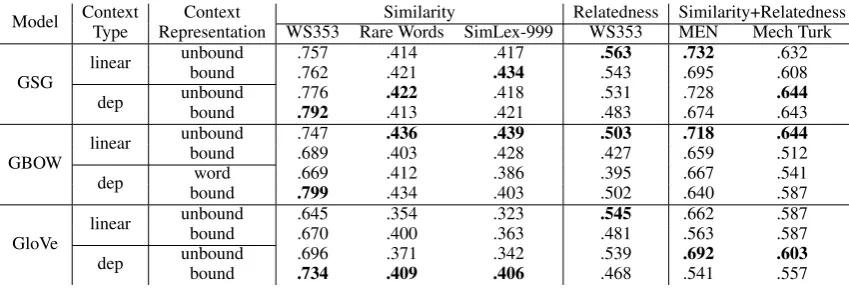
Table 4: Numerical results on word similarity datasets. Best results in group are markedBold.
Model ContextType Representation SemContext Google Google MSR Inflectional Derivational Encyclopedia LexicographySyn morphology morphology
GSG linear
unbound .708 .639 .642 .678 .110 .242 .083
bound .702 .454 .653 .668 .111 .208 .099
dep unboundbound .716.600 .661.307 .644.600 .691.668 .122.112 .170.253 .095.099
GBOW linear
unbound .628 .566 .601 .618 .096 .201 .074
bound .602 .376 .569 .572 .091 .157 .081
dep unboundbound .573.495 .553.248 .520.516 .496.563 .094.086 .126.216 .076.078
GloVe linear
unbound .471 .719 .454 .425 .033 .226 .054
bound .502 .218 .542 .559 .044 .129 .095
[image:6.595.85.513.240.385.2]dep unboundbound .513.402 .700.121 .525.525 .491.446 .043.033 .093.227 .063.083
Table 5: Numerical results on word analogy datasets. Best results in group are markedBold.
effect of different context representations: un-bound representation is used for linear contex-t (Mikolov et al., 2013b), while bound
represen-tation is used for dependency-based context (Levy
and Goldberg,2014a). Moreover, only CSG mod-el is considered.
We revisit those claims with more systematical experiments. As shown in the top-left sub-figure
of Figure2, DEPS does outperform the linear
con-textin GSG and GloVe in the similarity section of WordSim353, confirming its ability to capture functional similarity. However, the advantage of DEPS does not fully transfer to GBOW. Although bound DEPS context for GBOW is still the best performer, unbound DEPS context performs the worst, which shows the importance of bound vs unbound representation.
Note that the results are also reversed on Word-Sim353 relatedness section (the right subfigure of
Figure2), which shows that linear context is more
suitable for capturing topical similarity.
Overall, DEPS context type does not get all the credit for capturing functional similarity. Contex-t represenContex-taContex-tions play an imporContex-tanContex-t role for word
similarity task. it is only safe to say that DEP-S context captures functional similarity with the “help” of bound representation. In contrast, lin-ear context type captures topical similarity with the “help” of unbound representation.
However, the above findings come with a ma-jor caveat: a lot seems to depend on the particular dataset, in addition to the model and context type.
We experimented with MEN dataset (Bruni et al.,
2012), Mechanical Turk dataset (Radinsky et al.,
2011), Rare Words dataset (Luong et al., 2013),
and SimLex-999 dataset (Hill et al., 2016)
(Ta-ble 4), and we were not able to observe uniform
trends even for datasets that are supposed to cap-ture the same relation - like the similarity part of WordSim353, Rare Words and SimLex.
25 50 100 250 500 0.2
0.3 0.4 0.5 0.6 0.7
Inflections (LRCos)
accuracy (%)
Skip-Gram
25 50 100 250 500 0.2
0.3 0.4 0.5 0.6 0.7
CBOW
25 50 100 250 500 0.2
0.3 0.4 0.5 0.6 0.7
GloVe
25 50 100 250 500 0.05
0.10 0.15 0.20 0.25 0.30
Derivation (LRCos)
accuracy (%)
25 50 100 250 500 0.05
0.10 0.15 0.20 0.25 0.30
25 50 100 250 500 0.05
0.10 0.15 0.20 0.25 0.30
25 50 100 250 500 0.05
0.10 0.15 0.20 0.25 0.30 0.35 0.40
Encyclopedia (LRCos)
accuracy (%)
25 50 100 250 500 0.05
0.10 0.15 0.20 0.25 0.30 0.35 0.40
25 50 100 250 500 0.05
0.10 0.15 0.20 0.25 0.30 0.35 0.40
25 50 100 250 500 dimension 0.04
0.06 0.08 0.10 0.12
Lexicography (LRCos)
accuracy (%)
25 50 100 250 500 dimension 0.04
0.06 0.08 0.10 0.12
25 50 100 250 500 dimension 0.04
0.06 0.08 0.10 0.12
[image:7.595.116.478.64.320.2]unbound linear context bound linear context unbound DEPS context bound DEPS context
Figure 3: Averaged accuracy results for all Inflections, Derivation, Encyclopedia and Lexicography cat-egories on BATS word analogy dataset.
4.3 Word Analogy Task
Word analogy task aims at answering the
question-s like “a iquestion-s to a’ aquestion-s b iquestion-s to ?”, such as
“Lon-don is to Britain as Tokyo is to Japan”. We
fol-low the evaluation protocol inLevy and Goldberg
(2014b), which answers the questions using
LR-Cos method (Drozd et al., 2016). LRCos shows
significant improvement over the traditional vec-tor offset method. We use BATS analogy dataset (Gladkova et al.,2016) in our experiments.
As shown in Figure 3, context representation
plays an important role in word analogy task. The choice of context representation (bound or un-bound) actually has much larger impact than the choice of context type (linear or DEPS). The re-sults on Encyclopedia category are perhaps the most evident. The performance of unbound lin-ear context and unbound DEPS context is similar. However, for most models and categories, bound representation seems to outperform unbound rep-resentation. When bound representation is used,
the performance drops around5−15percent for
DEPS context in terms of accuracy. This is
con-sistent with the findings of Levy and Goldberg
(2014a), who report that DEPS context did not work well for the analogy task.
As shown in Table5, we have also
experiment-ed on two much smaller datasets: MSR analogy
dataset (Mikolov et al.,2013c), and Google
analo-gy dataset (Mikolov et al.,2013a) (with semantic
and syntactic questions). They also show that the choice of context representation has more impact than the choice of context type.
4.4 POS, Chunking and NER Tasks
Although intrinsic evaluations like word similar-ity and word analogy tasks could provide direc-t insighdirec-ts aboudirec-t differendirec-t condirec-texdirec-t direc-types and repre-sentations, they have certain methodological
prob-lems (Gladkova and Drozd,2016), and the
exper-imental results above cannot be directly translated to the typical uses of word embeddings in down-stream tasks (Schnabel et al.,2015;Linzen,2016;
Chiu et al.,2016). Thus extrinsic tasks should also be considered.
In this subsection, we evaluate the effective-ness of different word embedding models with dif-ferent contexts on Part-of-Speech Tagging (POS),
Chunking8 and Named Entity Recognition (NER)
tasks9. For these tasks, a NLP system assigns
la-bels to elements of texts. Note that in practice, one should NOT use DEPS context for POS-tagging and chunking tasks, since their labels are used in
8CoNLL 2000 shared task http://www.cnts.ua. ac.be/conll2000/chunking
9CoNLL 2003 shared task http://www.cnts.ua. ac.be/conll2003/ner
25 50 100 250 500 82
84 86 88 90 92 94 96
Part-of-Speech Tagging
accuracy (%)
Skip-Gram
25 50 100 250 500 82
84 86 88 90 92 94
96 CBOW
25 50 100 250 500 82
84 86 88 90 92 94
96 GloVe
25 50 100 250 500 65
70 75 80 85
Chunking
F1-score (%)
25 50 100 250 500 65
70 75 80 85
25 50 100 250 500 65
70 75 80 85
25 50 100 250 500 dimension 62
64 66 68 70 72 74 76
Named Entity Recognition
F1-score (%)
25 50 100 250 500 dimension 62
64 66 68 70 72 74 76
25 50 100 250 500 dimension 62
64 66 68 70 72 74 76
[image:8.595.117.478.63.267.2]unbound linear context bound linear context unbound DEPS context bound DEPS context
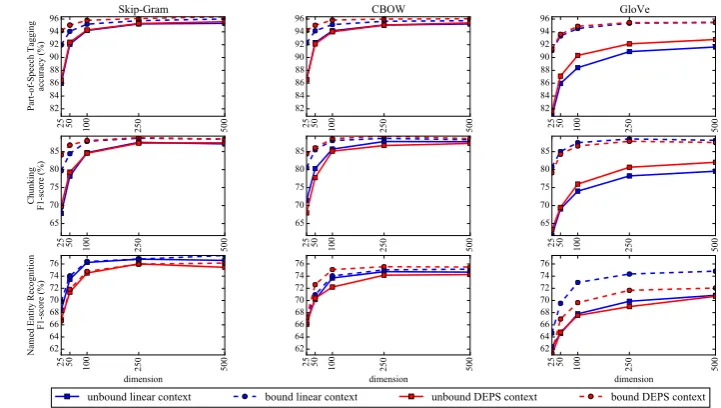
Figure 4: Accuracy orF1-score results on Part-of-Speech Tagging, Chunking and Named Entity
Recog-nition tasks.
parsing the source corpus.
Following the evaluation protocol used inKiros
et al.(2015), we restrict the predicting model to
Logistic Regression Classifier10. The classifier’s
input for predicting the label of word wi is
sim-ply the concatenation of word vectorsw~i−2,w~i−1, ~
wi, w~i+1, w~i+2. This ensures that the quality of embedding models is directly evaluated, and their strengths and weaknesses are easily observed.
Model ContextType RepresentationContext POS Chunking NER
GSG linear
unbound 95.3 87.2 76.6 bound 96.0 88.5 77.4
dep unboundbound 95.696.3 87.588.5 75.576.2
GBOW linear
unbound 95.2 87.7 74.7 bound 95.7 88.3 75.2 dep unboundbound 95.496.0 87.388.6 74.375.5
GloVe linear
unbound 91.6 79.6 70.8 bound 95.5 88.2 74.8
dep unboundbound 92.895.5 82.087.5 70.772.0
Table 6: Numerical results on Part-of-Speech Tag-ging, Chunking and Named Entity Recognition
tasks. Best results in group are markedBold.
As shown in Figure4and Table6, GSG, GBOW
and GloVe exhibit overall similar trends. When the same context type is used, bound represen-tation outperforms unbound represenrepresen-tation on all tasks. Sequence labeling tasks are not sensitive to
10The implementation by scikit is used http:// scikit-learn.org/
syntax. For bound representation, the ignorance of syntax becomes beneficial, since it decreases the amount of noise and sparsity.
Moreover, DEPS context type works slight-ly better than linear context type in most cases. These results suggest that unbound linear contex-t (as in contex-tradicontex-tional CSG and CBOW) may nocontex-t be the best choice of input word vectors for sequence labeling. Bound representations should always be used and DEPS context type is also worth consid-ering. Again, similar to the word analogy task, GloVe is more sensitive to different context repre-sentations than Skip-Gram and CBOW.
4.5 Text Classification Task
Finally, we evaluate the effectiveness of differen-t word embedding models widifferen-th differendifferen-t syndifferen-tacdifferen-tic contexts on text classification task. Text classifi-cation is one of the most popular and well-studied tasks in natural language processing. Recently, deep neural networks achieve state-of-the-art re-sults on this task (Socher et al.,2013;Kim,2014;
Dai and Le, 2015). They often need pre-trained word embeddings as inputs to improve their per-formances. Similarly to the previous evaluation of sequence labeling tasks, instead of building com-plex deep neural networks, we use a simpler
clas-sification method called Neural Bag-of-Words (Li
[image:8.595.74.288.464.606.2]Model Context Context Sentence-level Document-levelType Rep. MR CR Subj RT-2k IMDB
GSG linear unbound
76.1 78.3 90.9 83.5 85.2
bound 75.3 79.0 90.4 82.2 85.2
dep unbound 76.0 77.7 90.7bound 75.0 77.5 90.0 84.784.8 85.184.5
GBOW linear unbound 74.9 77.9
90.4 82.0 85.0
bound 74.1 77.8 90.3 80.7 84.1 dep unboundbound 73.575.0 77.6 90.178.2 89.9 80.782.4 84.983.4
GloVe linear unbound 73.4 76.7 89.6 79.2
83.5
[image:9.595.73.291.63.214.2]bound 73.2 77.5 90.0 79.8 83.4 dep unboundbound 72.5 76.7 88.8 79.274.0 77.7 89.5 81.3 83.583.5 random word embeddings 63.9 72.8 79.9 72.2 77.2
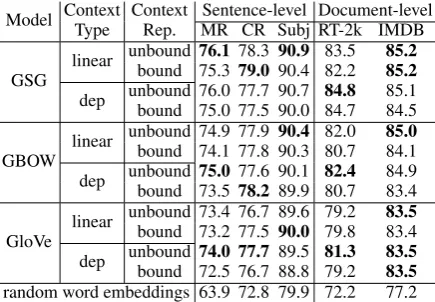
Table 7: Accuracy results on 5 text classification
datasets. Best results in group areBold
is built upon these text representations for classifi-cation.
Different word embedding models are evaluated on 5 text classification datasets. The first 3 dataset-s are dataset-sentence-level: dataset-short movie review dataset-sentiment
(MR) (Pang and Lee,2005), customer product
re-views (CR) (Nakagawa et al.,2010), and
subjec-tivity/objectivity classification (SUBJ) (Pang and
Lee, 2004). The other 2 datasets are
document-level with multiple sentences: full-length movie
review (RT-2k) (Pang and Lee,2004), and IMDB
movie review (IMDB) (Maas et al.,2011)11.
As shown in Table 7, pre-trained word
embed-dings outperform random word embedembed-dings by a large margin. This strengthens the previous claim that pre-trained word embeddings are highly use-ful for text classification (Iyyer et al., 2015; Li et al.,2017). Unlike in the other tasks, in text clas-sification all models exhibit similar performance. Text classification has less focus on syntax and function similarity. Because of that, models with bound representation perform worse than those with unbound representation on almost all dataset-s except CR. Modeldataset-s with DEPS context type and linear context type are comparable. These obser-vations suggest that simple unbound linear context type (as in traditional CSG and CBOW) is still the best choice of pre-training word embeddings for text classification, which is already used in most studies.
5 Conclusion
This paper provides a first systematical investiga-tion of different syntactic context types (linear vs
11Please seeWang and Manning(2012) for more detailed introduction and pre-processing of these datasets.
dependency-based) and different context represen-tations (bound vs unbound) for learning word em-beddings. We evaluate GSG, GBOW and GloVe models on intrinsic property analysis tasks (word similarity and word analogy), sequence labeling tasks (POS, Chunking and NER) and text classi-fication task.
We find that most tasks have clear preference for different context types and representations. Context representation plays a more importan-t role importan-than conimportan-teximportan-t importan-type for learning word embed-dings. Only with the “help” of bound representa-tion does DEPS context capture funcrepresenta-tional similar-ity. Word analogies seem to prefer unbound rep-resentation, although performance varies by ques-tion type No matter which syntactic context type is used, bound representation is essential for se-quence labeling tasks, which benefits from its a-bility of capturing functional similarity. GSG with unbound linear context is still the best choice for text classification task. Linear context is sufficient for capturing topical similarity compared to more labor-intensive DEPS context. Words’ position in-formation is generally useless for text classifica-tion, which makes bound representation contribute less to this task.
In the spirit of transparent and reproducible
ex-periments, the word2vecPM toolkit 12 is
pub-lished along with this paper. We hope researcher-s will take advantage of the code for further im-provements and applications to other tasks.
Acknowledgments
We thank the authors of the word2vecf
toolk-it and the accompanied evaluation scripts (Levy
et al., 2015). Their work systematically investi-gated the effects of different hyper-parameters on various word embedding models, which directly influenced us a lot.
This work is supported by National Natu-ral Science Foundation of China with grant No. 61472428, the Fundamental Research Funds for the Central Universities, the Research Funds of Renmin University of China No. 14XNLQ06. This work is partially supported by ECNU-RUC-InfoSys Joint Data Science Lab and CCF-Tencent Open Research Fund (RAGR20160102).
12The current version can be found at https:// github.com/libofang/word2vecPM. The entire code is also planned to be re-written in Python and integrated into VSMlib (http://vsm.blackbird.pw/) for easier use.
References
Eneko Agirre, Enrique Alfonseca, Keith Hall, Jana Kravalova, Marius Pas¸ca, and Aitor Soroa. 2009. A study on similarity and relatedness using distribu-tional and wordnet-based approaches. In NAACL, pages 19–27. Association for Computational Lin-guistics.
Mohit Bansal, Kevin Gimpel, and Karen Livescu. 2014. Tailoring continuous word representations for dependency parsing. InACL, pages 809–815.
Yoshua Bengio, R´ejean Ducharme, Pascal Vincent, and Christian Janvin. 2003. A neural probabilistic lan-guage model. The Journal of Machine Learning Re-search, 3:1137–1155.
Elia Bruni, Gemma Boleda, Marco Baroni, and Nam-Khanh Tran. 2012. Distributional semantics in tech-nicolor. In ACL, pages 136–145. Association for Computational Linguistics.
Billy Chiu, Anna Korhonen, and Sampo Pyysalo. 2016. Intrinsic evaluation of word vectors fails to predict extrinsic performance. InACL, pages 406–414.
Stephen Clark. 2012. Vector space models of lexical meaning. InHandbook ofContemporary Semantics second edition.Wiley-Blackwell.
Ronan Collobert and Jason Weston. 2008. A unified architecture for natural language processing: Deep neural networks with multitask learning. InICML, pages 160–167. ACM.
Ronan Collobert, Jason Weston, L´eon Bottou, Michael Karlen, Koray Kavukcuoglu, and Pavel Kuksa. 2011. Natural language processing (almost) from scratch. The Journal of Machine Learning Re-search, 12:2493–2537.
James Richard Curran. 2004. From distributional to semantic similarity. Ph.D. thesis, University of Ed-inburgh, UK.
Andrew M. Dai and Quoc V. Le. 2015. Semi-supervised sequence learning. InNIPS, pages 3079– 3087.
Aleksandr Drozd, Anna Gladkova, and Satoshi Mat-suoka. 2016. Word embeddings, analogies, and ma-chine learning: Beyond king - man + woman = queen. InCOLING.
Lev Finkelstein, Evgeniy Gabrilovich, Yossi Matias, E-hud Rivlin, Zach Solan, Gadi Wolfman, and Eytan Ruppin. 2001. Placing search in context: The con-cept revisited. InWWW, pages 406–414. ACM. Anna Gladkova and Aleksandr Drozd. 2016.
Intrin-sic evaluations of word embeddings: What can we do better? InProceedings of The 1st Workshop on Evaluating Vector Space Representations for NLP, pages 36–42, Berlin, Germany. ACL.
Anna Gladkova, Aleksandr Drozd, and Satoshi Mat-suoka. 2016. Analogy-based detection of morpho-logical and semantic relations with word embed-dings: What works and what doesnt. InProceedings of naacl-hlt, pages 8–15.
Zellig Harris. 1954. Distributional structure. Word, 10(23):146–162.
Kris Heylen, Yves Peirsman, Dirk Geeraerts, and Dirk Speelman. 2008. Modelling word similarity: an e-valuation of automatic synonymy extraction algo-rithms. InLREC.
Felix Hill, Roi Reichart, and Anna Korhonen. 2016. Simlex-999: Evaluating semantic models with (gen-uine) similarity estimation. Computational Linguis-tics.
Mohit Iyyer, Varun Manjunatha, Jordan Boyd-Graber, and Hal Daum´e III. 2015. Deep unordered compo-sition rivals syntactic methods for text classification. InACL, pages 1681–1691.
Yoon Kim. 2014. Convolutional neural networks for sentence classification. In EMNLP, pages 1746– 1751.
Ryan Kiros, Yukun Zhu, Ruslan Salakhutdinov, Richard S Zemel, Antonio Torralba, Raquel Urta-sun, and Sanja Fidler. 2015. Skip-thought vectors. InNIPS, pages 3294–3302.
Siwei Lai, Kang Liu, Shizhu He, and Jun Zhao. 2016. How to generate a good word embedding. IEEE In-telligent Systems, 31:5–14.
Omer Levy and Yoav Goldberg. 2014a. Dependency-based word embeddings. InACL, pages 302–308. Omer Levy and Yoav Goldberg. 2014b. Linguistic
reg-ularities in sparse and explicit word representations. InCoNLL, pages 171–180.
Omer Levy and Yoav Goldberg. 2014c. Neural word embedding as implicit matrix factorization. InNIPS, pages 2177–2185.
Omer Levy, Yoav Goldberg, and Ido Dagan. 2015. Im-proving distributional similarity with lessons learned from word embeddings. TACL, 3:211–225.
Bofang Li, Tao Liu, Zhe Zhao, Puwei Wang, and Xi-aoyong Du. 2017. Neural bag-of-n-grams. InAAAI, pages 3067–3074.
Wang Ling, Chris Dyer, Alan W. Black, and Isabel Trancoso. 2015. Two/too simple adaptations of word2vec for syntax problems. In HLT-NAACL, pages 1299–1304.
Tal Linzen. 2016. Issues in evaluating semantic spaces using word analogies.CoRR, abs/1606.07736. Thang Luong, Richard Socher, and Christopher D
Andrew L. Maas, Raymond E. Daly, Peter T. Pham, Dan Huang, Andrew Y. Ng, and Christopher Potts. 2011. Learning word vectors for sentiment analysis. InACL, pages 142–150.
Christopher D. Manning, Mihai Surdeanu, John Bauer, Jenny Finkel, Steven J. Bethard, and David Mc-Closky. 2014. The Stanford CoreNLP natural lan-guage processing toolkit. In ACL System Demon-strations, pages 55–60.
Oren Melamud, David McClosky, Siddharth Patward-han, and Mohit Bansal. 2016. The role of context types and dimensionality in learning word embed-dings. InHLT-NAACL, pages 1030–1040.
Tomas Mikolov, Kai Chen, Gregory S. Corrado, and Jeffrey Dean. 2013a. Efficient estimation of word representations in vector space. CoRR, ab-s/1301.3781.
Tomas Mikolov, Ilya Sutskever, Kai Chen, Gregory S. Corrado, and Jeffrey Dean. 2013b. Distributed rep-resentations of words and phrases and their compo-sitionality. InNIPS, pages 3111–3119.
Tomas Mikolov, Wen-tau Yih, and Geoffrey Zweig. 2013c. Linguistic regularities in continuous space word representations. In HLT-NAACL, volume 13, pages 746–751.
Andriy Mnih and Geoffrey E. Hinton. 2007. Three new graphical models for statistical language modelling. InICML, pages 641–648.
Tetsuji Nakagawa, Kentaro Inui, and Sadao Kurohashi. 2010. Dependency tree-based sentiment classifica-tion using crfs with hidden variables. In NAACL, pages 786–794. Association for Computational Lin-guistics.
Neha Nayak and Christopher D. Manning. 2016. Eval-uating word embeddings using a representative suite of practical tasks. InACL workshop.
Sebastian Pad´o and Mirella Lapata. 2007. Dependency-based construction of semantic space models. Computational Linguistics, 33:161–199.
Bo Pang and Lillian Lee. 2004. A sentimental edu-cation: Sentiment analysis using subjectivity sum-marization based on minimum cuts. InACL, pages 271–278. Association for Computational Linguistic-s.
Bo Pang and Lillian Lee. 2005. Seeing stars: Exploit-ing class relationships for sentiment categorization with respect to rating scales. In ACL, pages 115– 124. Association for Computational Linguistics.
Jeffrey Pennington, Richard Socher, and Christo-pher D. Manning. 2014. Glove: Global vectors for word representation. InEMNLP, pages 1532–1543.
Kira Radinsky, Eugene Agichtein, Evgeniy Gabrilovich, and Shaul Markovitch. 2011. A word at a time: computing word relatedness using temporal semantic analysis. In Proceedings of the 20th international conference on World wide web, pages 337–346. ACM.
Tobias Schnabel, Igor Labutov, David M. Mimno, and Thorsten Joachims. 2015. Evaluation methods for unsupervised word embeddings. InEMNLP, pages 649–657.
Richard Socher, Alex Perelygin, Jean Y Wu, Jason Chuang, Christopher D Manning, Andrew Y Ng, and Christopher Potts. 2013. Recursive deep mod-els for semantic compositionality over a sentimen-t sentimen-treebank. In EMNLP, volume 1631, page 1642. Citeseer.
Jun Suzuki and Masaaki Nagata. 2015. A unified learn-ing framework of skip-grams and global vectors. In
ACL, page 186.
Ivan Vulic and Anna Korhonen. 2016. Is ”universal syntax” universally useful for learning distributed word representations? InACL, page 518.
Sida I. Wang and Christopher D. Manning. 2012. Base-lines and bigrams: Simple, good sentiment and topic classification. InACL, pages 90–94.
Mehmet Ali Yatbaz, Enis Sert, and Deniz Yuret. 2012. Learning syntactic categories using paradig-matic representations of word context. In EMNLP-CoNLL, pages 940–951.
Wenpeng Yin and Hinrich Schutze. 2016. Learning word meta-embeddings. InACL, pages 327–332. Torsten Zesch, Christof M¨uller, and Iryna Gurevych.
2008. Using wiktionary for computing semantic re-latedness. InAAAI, volume 8, pages 861–866.