LEGO MINDSTORMS AS A TEACHING TOOL IN ENGINEERING EDUCATION
A. Nic Chraith1, K. Kelly2
1. Department of Mechanical and Manufacturing Engineering, School of Engineering, Trinity College Dublin, Dublin 2. Ireland
2. Department of Mechanical and Manufacturing Engineering, School of Engineering, Trinity College Dublin, Dublin 2. Ireland
ABSTRACT
The primary purpose of this paper is the development of an active-learning, constructivist coursework plan, adhering to the Conceive Design Implement Operate (CDIO) initiative, for integration with the standard second level school syllabus.
Initial investigation was executed through questionnaire research within multiple environments, and with students of varying ages from numerous educational backgrounds. Based on the results, the initial plans for a Transition Year coursework syllabus were developed. The potential assignment designs were initially tested within a classroom environment of twenty students of the Centre for Talented Youth in Ireland (CTYI). The finalized coursework was then executed within a Transition Year class of Santa Sabina, Sutton, and the functionality of the course plan continuously monitored in order to refine the syllabus.
The secondary objective of the development of a demonstration model suitable for use at college open days and presentations for primary and secondary level institutions was also included in this study. Development of the demonstration model was executed through the investigation of the characteristics and functions of a mechanism which students would find attractive. These findings were incorporated alongside the considered technical and educational requirements of an engineering presentation, for the development of presentation model design.
KEYWORDS: education, robotics, CDIO
1. INTRODUCTION
economy’s need for design engineers, students are encouraged to choose the field for their education and career.
With the increasing importance of engineering design throughout the world, a greater emphasis is being placed on the creative and interpersonal skills required for achievements in the field. The primary purpose of this study is the development of an active-learning constructivist coursework plan, adhering to the Conceive Design Implement Operate (CDIO) initiative, for integration with the standard second level school syllabus. Investigation is to be executed through questionnaire research within multiple environments, and with students of varying ages from numerous educational backgrounds. Questions are to be posed as to the students’ opinion on which factors attract people to the field of engineering, and also as to which are the dissuading characteristics of the field. The students are also to be investigated as to how they were originally approached with the concept of engineering, with a view to improving this experience – within a controlled environment which can be standardized and therefore updated and improved on a regular basis.
Based on these results, the primary influencing factors which affect students’ opinion of the engineering field are to be identified. Subsequently, standardized methods are to be designed for the promotion of engineering design within these areas, with a view to increasing the number of students choosing engineering for their 3rd level education and, ultimately, their career.
The primary objective of the project was the development of a 2nd level coursework plan, incorporating the LEGO Mindstorms kits, for integration with the transition year period of the second level school syllabus. To be designed to promote the creative and practical aspects of engineering, therefore redefining the manner in which concepts of science and engineering are presented to prospective 3rd level students.
2. PREVIOUS INITIATIVES
2.1 Review of Work Done
The potential of the LEGO Mindstorms for use as educational toolkits within third level institutions has been a concept extensively reviewed both in previous publications, organizations, and even within the LEGO group itself. LEGO Mindstorms is inherently designed as an educational tool. The LEGO Mindstorms Education package comes with an accompanying activity series complete with education theory and construction tasks designed by the Robotics Institute at Carnegie Mellon University [2].
engineers and robotics enthusiasts throughout the world, no notable attempt has been made as of yet to research the development of one of these models for use within the environment of career talks and demonstrations promoting the field of engineering.
Within the Departments of Mechanical and Manufacturing Engineering and MEMS courses at Trinity College Dublin, four previous reports have been completed investigating the use of LEGO Mindstorms within the third level syllabus for the courses. The conceptualization of these labs was first addressed by Ryan (2007)[3]. Ryan initially proposed the development of an introduction lab, within which the students are provided step-by-step instructions for the construction and programming of a functional wheeled mechanism. The purpose of this lab was to introduce the student to the basic functions of the incorporated sound sensor, motors and also the concept of data acquisition and analysis through the sound sensor. This design was re-evaluated and expanded upon by Killeen (2008)[4], through the generalization of the laboratory task list. Instead of being provided with a single sensor with the requirement of data acquisition, the students were instead provided with the simple task of constructing a wheeled, moving vehicle which reacts to input on a sensor of the students’ choosing. Basic information is provided to the students as regards the programming aspect of the lab, but the development of a mechanism design is a required aspect of the exercise.
Within the initial lab layout, the instructional, step-by-step styled instructions remove the aspect of creativity and design from the lab – allowing the possibility of the students blindly following instructions without absorbing the desired theories from the lab. The redefined approach to the lab concurs with the Conceive-Design-Implement-Operate (CDIO) approach to engineering and design education – incorporating constructivism and active learning into the assignment. Killeen also identified the need for an increase in the background theory in both the concepts introduced within the labs and the programming of the brick itself.
The final use of LEGO Mindstorms investigated is that of their use as potential demonstrational models [6] for presentations or talks promoting the field of engineering. Kennedy’s report focuses on the use of the Tilted Twister Rubik’s Cube Solver [4] directly as a presentation model. It is considered that, while the demonstration model itself is highly impressive, a number of measures should be taken within the development of the demonstration model in order for the design to fulfil specific requirements of an educational demonstration model, as discussed.
Various external reports have also been examined with a view to investigating the use of LEGO in education. An integrated program at Wichita State University presents a Mindstorms Robotics challenge as an accompaniment to the courses in order to promote the study of robotics. The system adheres strongly to the CDIO initiative, emphasising the skills necessary for the engineering field.
Ireland, Maynooth. Important factors of the implementation of such labs were investigated such as level of accompanying theory and assessment of the coursework executed. The text highlights the deficiency of design-based courses throughout 3rd level institutions in Ireland, and presents information on the benefits of the integrated design module in the existing technology and engineering courses available.
3. CURRENT APPROACH TO ENGINEERING EDUCATION AT
SECOND LEVEL
The current, or traditional, approach to education in sciences is that of direct absorption of knowledge by the student. While constructivism proposes that knowledge must be „constructed within the mind of the student through active learning, this passive education method relies on the direct transfer of information from teacher to student.
Laboratory exercises are also conducted through a series of step-by-step instructions provided either by instructors or manuals. This didactic educational method is primarily designed to maximize the level of knowledge conveyed to the student within the limited amount of time available. What is neglected within this approach is the introduction of analytical and research skills which become extremely valuable to the student as they progress through the levels of education. Also – more specifically within second level courses – the fact that the concept of “investigation and discovery”, the essence of any scientific career, is omitted denies the student an opportunity to experience the true nature of science before deciding upon a college course or career path.
4. LEGO MINDSTORMS
LEGO Mindstorms has its origins in research on the development of a constructionist approach to science education. Swiss psychologist, Dr. Jean Piaget, coined the term “constructivist epistemology”. This concept describes the meaning of knowledge as rooted in human understanding – “constructed”, as such, through the mental activity of the student. It was through this theory that Piaget first highlighted his emphasis on the importance of active learning in the cognitive development of the student mind.
The hardware contained within the LEGO Mindstorms NXT 2.0 package is comprised of the programmable computer component (the “brick”), motors and sensors capable of interacting with the brick. The sensors consist of touch, sound, light and ultrasonic sensors – including the capability for utilizing the motors as rotation sensors. The NXT package also contains a variety of LEGO pieces which may be interconnected during construction, as well as a number of RJ12/6P6C type modular connector cables for use in linking motors and sensors with the brick.
5. CONCEPTUALISATION OF SECOND LEVEL COURSEWORK
Briefly, the presented exercises must serve to:
• Link theoretical concepts introduced to the students within the course to comprehendible applications, constructed by the students
• Provide a multi-tiered program of activities, allowing every student
some level of project completion (and therefore motivation), regardless of ability
• Engage an interest in engineering design through providing students
with the basis to construct practical devices, visible in the everyday world
• Emphasize the importance of teamwork and role completion within a
functioning group
Evaluation of potential designs for both the coursework plan and assignments provided throughout the plan was executed primarily within two separate environments:
1. A class of twenty students, from varying schools, between the ages of 9 to 13
This class consisted of twenty male students, participating in the Centre for Talented Youth in Ireland (CTYI) [5]. The weekend classes are provided for students between the ages of 9-13, who possess an IQ level of the top one percentile of the country. The majority of the students, therefore, possessed both an extremely high level of understanding and comprehension of theory presented. The course I was teaching, Planes, Trains & Automobiles, was described as the study of practical applications of mechanical engineering. Due to the fact that the twenty students selected the course, a large number of the participants had strong prior knowledge and interest in the field. It was considered, therefore, that even though the students were of a younger age group than the target range, that they were to be considered suitable for preliminary testing for a Transition Year coursework plan.
The extended time frame available while working with the CTYI students was utilized to investigate the efficiency of potential tasks for the coursework plan. In addition to those activities selected for development, refinement and implementation within the second level course, numerous others were introduced to the students, as outlined in section 15.1.
2. A class of twenty Transition Year students, within the same school. Four eighty-minute class sessions were carried out with a class of twenty Transition Year students of St. Dominic’s High School, Santa Sabina, Sutton. Throughout these four sessions, the sample Transition Year coursework plan was executed, complete with all outlined preparation work and teaching processes described. In order to investigate the functionality of this potential coursework plan, surveying of the students’ thought processes and mindsets was executed continuously throughout the four classes.
general knowledge learned within the class, or if only the specific theory utilized in construction of the mechanisms was affected.
6. SECOND-LEVEL COURSEWORK DESIGN
In order to maintain the level of fundamental principles and information presented, and also to maintain a high level of motivation among the students, the structure of each lesson is separated into two distinct sections:
1. A theory-based introductory section where the fundamental concepts are introduced. This section also incorporates activities using arbitrary (non-LEGO) objects, and discussion or question and answer sessions upon topics introduced. Any demonstration models considered appropriate are also presented within this section of the lesson.
2. A practical section in which the students call upon the principles learned in the previous section in order to design and construct functioning mechanisms. Brief theory directly relating to the constructions may be introduced in this section.
For each class, the students were required to work in teams on each task list presented. The objectives for each activity were designed in a multi-levelled fashion, allowing for each group to achieve some level of completion for each task – regardless of previous experience or level of knowledge. Each team member was also assigned a role within the group, with specific duties and responsibilities assigned to each for the completion of the task – therefore highlighting the importance of roles within a project and teamwork.
Brief Q&A sessions were organized for the students in review of information introduced during the course of the lesson; as such an awards system was introduced. Theory presented in all lessons up to that point was questioned within these sessions, with an emphasis on the application of this theory to the sensors and constructions created by the team.
When the students are presented with a question, only the team coordinators were to provide an answer, and the coordinator may only provide that answer once they have confirmed that each team member both understands and agrees with the answer. De-merits may be applied in cases of failure to do so.
This method further develops interpersonal skills within the team environment, as well as reinforcing the validity of the opinion of each team member. A major advantage of this process, in terms of the CDIO aspect, is that it requires extroverted students to consult on the opinion of otherwise subdued team members, vastly increasing the participation rate and engagement in the teams’ dynamic.
7. RESULTS
[image:7.612.173.443.182.295.2]Survey results provided a strong indication of the sources which had the most influence on the students’ opinion of engineering as a career field with the production of highly surprising results, as shown in fig. 1. It seems that while teachers and guidance counselors are considered to have the least influence upon the students’ career choice, that activity based teaching in the Transition year syllabus, as well as external influences seem to have the strongest – therefore reinforcing the need for an active learning coursework plan during this time.
Figure 7 : Sources of influence upon students' opinion of the engineering field
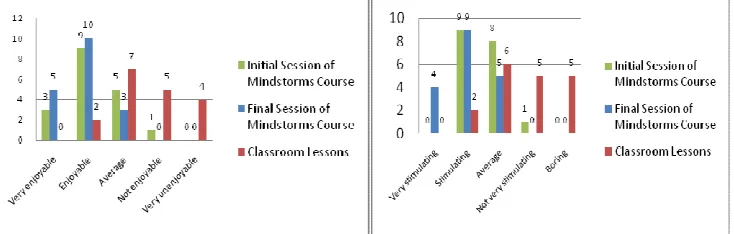
Surveys were also executed throughout the course period, in order to gauge the students’ opinion of the lessons.
Figure 2: Survey results for the students’ level of enjoyment (Left) and the level of intellectual stimulation (Right) during the course
It was clearly seen that the students found the LEGO Mindstorms coursework far more enjoyable and intellectually stimulating than the standard ‘classroom’ lessons in which absorption learning is conducted.
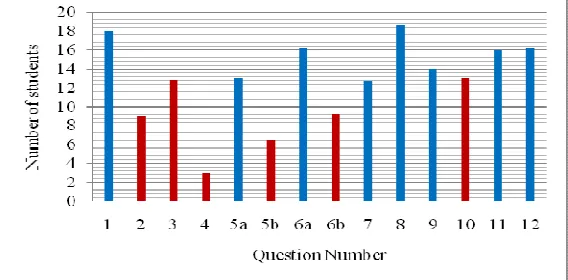
[image:7.612.125.492.366.483.2]Figure 3: Number of students providing a correct answer for each question of the assessment test
Figure 3 illustrates the number of students, out of 19 who completed the assessment test, who answered correctly for each question. Questions not reinforced through active learning are shown in red, with the remaining questions shown in blue. It is clear that the students answered with greater accuracy upon subjects which had been reinforced through active learning with the LEGO Mindstorms.
8. DISCUSSION AND CONCLUSIONS
A detailed survey analysis of second level students from various educational backgrounds provided statistical evidence of for conclusions;
• Career counsellors appear to have the least influence when presenting
engineering as a career option to the students, while Transition Year activities appear to have the most (within a school setting).
• College open days are not appropriately utilized, given that students have
already chosen Leaving Cert subjects and course fields.
• The principal reason that Engineering is considered by the sample section of students due to the creative design aspect of the field.
• Students are dissuaded from the study of engineering primarily because it is considered too difficult.
The interesting association between each of these concepts is that they can each be addressed through the medium of an engineering course introduced to the students prior to the choice of their Leaving Cert subjects. These results, therefore, serve to underline the necessity for a Transition Year coursework plan, during which the creative aspect of engineering can be underlined to the students in conjunction with developing the students intuitive skills, with which they may break down the barrier of “difficulty” created through the process of transmittal education.
exceptionally high average for the evaluation test results also indicates the strength of the educational aspect of the course.
The primary objective of the course design was the introduction of students to engineering concepts through physics and design processes, and therefore the promotion of engineering as a career. The increase in students considering the field for their 3rd level education from 5 students at the commencement of the course, to 9 after course completion (an 80% increase), the coursework design and execution can be considered an overall success
9. REFERENCES
[1] Ringwood J.V. et al Teaching Engineering Design Through LEGO Mindstorms, European Journal of Engineering Education, Vol. 30 (2003), 91-104
[2] The Robotics Institute, available at : http://www.ri.cmu.edu, last retrieved February 10th 2010.
[3] Ryan E., LEGO Mindstorms Testbed, 2007
[4] Killeen E., LEGO Mindstorms as a Teaching Tool for Engineering Education, 2008
[5] Lahiff D., LEGO Mindstorms Lab and Demonstrative Tool Design, 2006 [6] Tilted Twister by H. Andersson, available at: http://www.tiltedtwister.com, last retrieved January 5th 2010.