World Library and Information Congress:
69th IFLA General Conference and Council
1-9 August 2003, Berlin
Code Number: 105-E
Meeting: 125. Reference Work
Simultaneous Interpretation: Yes
Designing and delivering information services to postgraduate students:
Experiences of one librarian at the University of Melbourne
Sabina Robertson
University of Melbourne AustraliaAbstract
Working with academics, developing web based programs, partnerships and
development and evaluation of information literacy programs are hot topics in the field of librarianship and information science. The paper discusses the experiences of a
librarian based in a faculty and the changing information needs of postgraduates. In addition the paper outlines the progress of an online course, “Ready, Set, Go! Skills and tools for effective researchers”. The online course is an interactive tutorial targeted to postgraduate students based in country campuses and teaching hospitals.
Introduction
Academic partnerships, web based instructional programs and the pervasiveness of the Web and its effect on library services are hot topics in the field of librarianship and information science. Searching the literature reveals a rich source of case studies of libraries seeking new ways of delivering service and resources to their constituencies (Brown & Krumholz, 2002; Hughes, Soderdahl, & Zimmerman, 1999; Kotter, 1999; Nimon, 2002; Orr, Appleton, & Wallin, 2001; Tompkins, Perry, & Lippincott, 1998; Walter, 2000). The latest articles on faculty liaison, in particular, are instructive as librarians are collaborating with academics in delivering information skills programs (Asher, 2003; Asselin & Lee, 2002; Carlson, 2003; Mozenter, Sanders, & Welch, 2000; Rader, 2001; Yang, 2000). For too long, librarians have designed services and
programs on their understanding of what is needed rather than working with academics and students in determining their information and skill needs.
The following paper is another example of a case study. The paper will concentrate on the experiences of a librarian based outside the library, observations of changing information needs of postgraduate students and the ways in which the web is
transforming services and information program delivery at the University of Melbourne.
Background
Inspired by articles and reports of new service models developed by some of the large American academic libraries (Lipow, 1993) the University Librarian was determined to initiate such developments at the University of Melbourne. The Vice Chancellor’s
Strategic Plan, however, was a catalyst that changed the Library’s direction in delivering services to the research community. It is within this environment that the University Librarian sought out the Dean of the School of Graduate Studies (the School) and put forward a proposition that an experienced librarian based in the School may benefit the postgraduate community. From the Library's perspective, creating the position of Research Consultant signalled to the university community that the Library was supporting key strategic directions. The creation of the position, then, was part of the Library's mission to ensure that its resources and services were strategically placed to meet the emerging research and information needs of the university community. The position was advertised as a two year secondment but within twelve months it became permanent.
The School, co-located with the University of Melbourne Postgraduate Association (UMPA) in the Graduate Centre, is a focal point for over 10,000 postgraduate students. The School is responsible for administering research higher degrees for PhD and Research Masters in Science, administrative support for the Office for Environmental Programs and the Australian New Zealand School of Government. In addition the School plays a lead role in policy development, provides advice and information for supervisors and postgraduate coordinators and provides academic support skills programs including the Advanced Leadership and Professional Skills Program for postgraduate students.
Facilities in the historic 1888 building include individual study carrels for postgraduates in their last stage of writing up their thesis, computer labs, study rooms, meeting rooms, printing and publishing centre. The Centre is gradually being transformed into a
wireless environment including the well patronised café/bistro. The Centre is a dynamic place, or, as one former senior manager observed, it has a "buzz".
Postgraduate Student Profile
In 2000, UMPA and the School jointly commissioned a research report,
First year postgraduate students at the University of Melbourne: a preliminary
investigation. Set against the changes in the Australian higher education sector, the report provides an insight into the postgraduate experience at a large Australian research university. According to Ross
undergraduate study, to be of mature age and to pay fees. In fact, the 'typical' postgraduate is more likely to be woman aged over 30 enrolled in a postgraduate diploma in the Faculty of Education (Ross, 2001 p.22)
The report highlighted the diversity of the postgraduate community at the University of Melbourne and exploded the stereotype of "the young male elite research student" (Ross, 2001 p.23). While the report was written three years ago, observations made then are appear to hold true for the current cohort of postgraduate students.
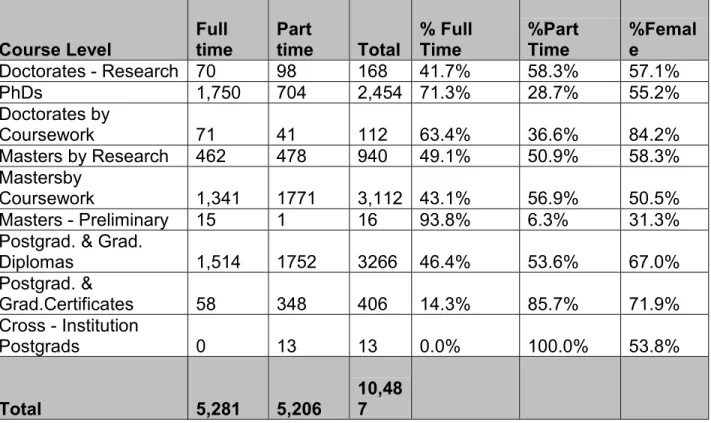
Tables 1 and 2 provide a detailed view of the postgraduate community in 2002. Table 1 illustrates the diversity of students, the range of courses that postgraduates are enrolled and the high percentage of postgraduate undertaking part time study across most levels of study. Table 2 provides trend data on the international postgraduate cohort. While the majority of international students are from Asia, an increasing number of students are coming from Middle East, Europe and North America.
Table 1: Enrolments by Course Level, Attendance Type & Gender, March 2002
Course Level Fulltime Parttime Total % FullTime %PartTime %Female
Doctorates - Research 70 98 168 41.7% 58.3% 57.1% PhDs 1,750 704 2,454 71.3% 28.7% 55.2% Doctorates by Coursework 71 41 112 63.4% 36.6% 84.2% Masters by Research 462 478 940 49.1% 50.9% 58.3% Mastersby Coursework 1,341 1771 3,112 43.1% 56.9% 50.5% Masters - Preliminary 15 1 16 93.8% 6.3% 31.3%
Postgrad. & Grad.
Diplomas 1,514 1752 3266 46.4% 53.6% 67.0% Postgrad. & Grad.Certificates 58 348 406 14.3% 85.7% 71.9% Cross - Institution Postgrads 0 13 13 0.0% 100.0% 53.8% Total 5,281 5,206 10,48 7
Table 2 International Postgraduate Student Enrolment by Country of Origin: 2000 – 2002 2000 2001 2002 %of Internat. %of Internat. %of Internat. Country Enrol. enrol. Enrol. enrol. Enrol. enrol.
Africa & Middle East 36 3.7% 54 4.4% 94 6.1%
North America 61 6.2% 62 5.1% 92 6.0%
Central America 2 0.2% 3 0.2% 6 0.4%
South America 13 1.3% 25 2.1% 33 2.2%
Asia 727 74.1% 895 73.5% 1131 74.0%
Europe 89 9.1% 126 10.4% 139 9.1%
Pacific & Indian
Ocean Is. 17 1.7% 17 1.4% 17 1.1%
Other Countries 36 3.7% 35 2.9% 17 1.1%
Total 981 100% 1217 100.0% 1529 100.0%
Figures supplied by the Academic Planning Support Unit, University of Melbourne, April 2003
Experiences of Working in the School
Working in the School provides many opportunities. Onsite access to School staff and UMPA has fostered a better understanding of how the Library may support the School and has enabled contact with a wide range of postgraduate groups across the
University. Such ease of access would not have been possible if I were based in the Library.
Attending the School’s Executive Management Team meetings is a vital “insider opportunity”. The Dean, Associate Deans and senior School managers discuss such issues as supervision, benchmarking, impact of new postgraduate courses on existing University facilities, research funding, expanding the academic support programs to country campuses and grappling with increased international enrolment targets. The School’s annual planning days are another opportunity to learn more about the School’s operational goals. Working alongside School colleagues ensures that the services and information skills program that I co-ordinate are aligned with the School’s goals.
Basing “my operations” in the School has helped me gain a different perspective on the issues that are of greatest concern to many postgraduate students. Over the years I have developed a better understanding of students' research interests, changes in postgraduate courses, the pressures on students to submit their thesis within stated timeline and the constant juggling of family work and study commitments. I am also more aware of the pressures on departments to be more research active and to attract international research postgraduate students while at the same time sustaining a heavy
This not only makes my working life interesting but it provides a depth of experience that could not be gained if I were based in a library.
Since my appointment at the School in 1998 several hundred postgraduate students have visited my office for individual library consultations. Initially, many of the
postgraduates who sought my help were mature age postgraduate students returning to study. This trend was confirmed in the Ross report (2001). Some of these
postgraduates were not used to researching for information or writing up reports as their secretaries would take care of these duties. Their information needs covered setting up email accounts, selecting an Internet Service Provider (ISP), computer skills training, presentation skills, managing information, manipulating data, navigating the web, searching databases and making sense of the complex world of libraries.
While I continue to see mature aged students, the mix is slightly different and the information needs have changed. The increased international postgraduate student enrolment (see Table 2) has created additional demands on student support services. Living away from their families for a long period of time, and, adjusting to a different climate and culture, add to the pressures of studying at an Australian academic institution. In addition, some students have poor English language skills and have difficulties coping in a different learning environment. While the focus of the
consultations is on selecting relevant databases, constructing effective search
strategies, locating sources and related skills, some students take the opportunity seek advice on supervision concerns and, at times, family problems.
The School recognised there was a need to provide a program to assist international students in adjusting to a different cultural environment and in mid 1999 established an Academic Orientation Program for International Students (AOPIPS). The program has become an integral part of the academic support skills programs and is designed to assist students with their studies, improve their communication skills and their transition to learning at an Australian university. Library staff play a role in supporting the
program.
The Australian, or “onshore” postgraduate students, may not have the language or cultural hurdles, but they have doubts about their skill levels in word processing,
knowledge of application software packages and they are overwhelmed with the range of databases, e-prints, e-text and e-journals, print and microform collections. As a result of the changes in scholarly communication, the individual consultation sessions include strategies on keeping up-to-date with new services and instruction in the use of
bibliographic software packages. The information skills programs have also evolved to meet the changing skills requirements.
Information Skills Programs
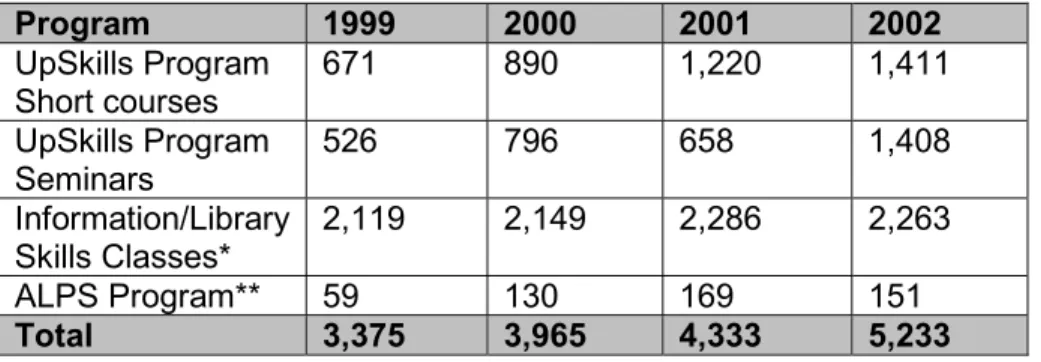
Since 1998 over 9,000 postgraduate students have attended information skills classes (Table 3). The Library’s information skills program is now an important component of the School of Graduate Studies Skills Program. In semester one 1998, twenty one classes, covering internet searching, effective search strategies and EndNote, were
offered through the Program booklet. The Library contributions accounted for ten per cent of the program. Five years later, semester one 2003, the contribution has grown to fifty four per cent. The program has expanded to 119 information skills classes which now include software application packages.
Table 3: School of Graduate Studies Support Skills Programs Enrolments for 1999 – 2002 Program 1999 2000 2001 2002 UpSkills Program Short courses 671 890 1,220 1,411 UpSkills Program Seminars 526 796 658 1,408 Information/Library Skills Classes* 2,119 2,149 2,286 2,263 ALPS Program** 59 130 169 151 Total 3,375 3,965 4,333 5,233
Note:* Includes Research Consultant individual consultations, modules, lectures outside UpSkills (947); UpSkills Information Skills (1135) ** ALPS Advanced Leadership Professional Skills Program
New Programs: web based learning.
While an increasing number of postgraduate students are participating in the School’s academic support skills programs, students who are based in country campuses do not have the same opportunities to attend the programs as the metropolitan based
postgraduates. Although presenters, including library colleagues, deliver classes off campus, there is a feeling among this cohort of postgraduates that they are “missing out” on the School’s academic support skills programs and on individual consultations. The School is concerned about the continued sense of inequity expressed by country and off campus students and has listed the development of ongoing support programs as one of the six key objectives for 2003 (2002 p.2). One of the ways in which the School believes it can ameliorate the “town country” divide is to offer web based academic support programs.
In early 2003 the School successfully applied for a grant to develop an online course. The program, “Ready, Set, Go! Skills and tools for effective researchers”, aims to equip research postgraduates with the research skills and management tools essential for the first six months of candidature. The twelve week program will be offered to research postgraduates enrolled in the faculties of Medicine, Science, Institute of Food and Land Resources and Veterinary Science who are based in country campuses and hospitals. By the end of the program, the Project Team hope that the students will have:
· An understanding of the key stages and distinct challenges involved in postgraduate research.
· Knowledge of the time and task management issues, tools and resources. · Reflected on and clarified the roles and responsibilities of supervisors and
students at the postgraduate level.
· Explored the main browsers, search engines, bibliographic software, online databases, indexes and catalogues that they will use for conducting and recording literature searches.
· An understanding of the requirements and elements of a literature review and a confirmation report.
· Considered factors that contribute to the effective presentation of academic research.
Each topic within the online course will take between two and three hours for students to complete. The following six topics, each to be offered over a 2-week, are: getting
started, managing research, working with your supervisor, searching and critically analysing the literature in the field, early writing tasks period and presenting your research. Students will have the option of “attending” for selected topics only or
completing the entire course. They will also be able to return to the information at times of need throughout their candidature.
Developing an online course is a new experience for most of the Project Team. Members are drawn from the School (Academic Programs Manager and Programs Officer), Learning Skills Unit Advisor, Courseware Designer and myself. Initial project meetings have covered a wide range of issues covering intellectual property rights, web design, structure of the site, navigation, learning management systems, content, ease of maintaining site and pedagogical issues. Underlying the wide ranging discussions is the Team’s concern that the online course will engage and maintain the interest of the postgraduates. This concern is upper most in my mind as I determine how best I should present the topic, “searching and critically analysing the literature in the field. On one level it may seem a straightforward task to map out a framework that will support and guide the student’s search for relevant literature. Yet, at another level, the web based module is being designed without any cues from the students. That is, when I meet with students I rely on a whole range of cues – words, gestures and body language to
determine if I am interpreting their queries and meeting their information needs. While I have read articles on designing web based courses and the necessity for understanding student demographics, learning styles and supplying support material at the ”right time” (Jensen Lee & Falahey, 2002; Karuppen, 2001; Karuppen & Karuppen, 1999) I am unsure as to how the students will react to the module and the long term benefits they will gain from enrolling in a web based tutorial.
Conclusion
Working in the School has given me many opportunities to explore new ways of
delivering services and programs. The placement of a librarian in the School has helped change some perceptions. On the one hand, the Dean and School of Graduate Studies staff regard librarians as invaluable partners in supporting postgraduate students and supervisors. Conducting Individual consultations with postgraduate students has been rewarding. From my perspective I have learned a great deal. I have a better
understanding of the changes in postgraduate study, the time constraints under which postgraduates operate and an appreciation of the diverse information needs of the postgraduate community. While On the other hand, library staff members are more aware of the diverse backgrounds of postgraduate students and the need to design and deliver services and programs that fit in with the needs and time constraints of
postgraduates.
As observed by Rader (Rader, 2001) the evolving information and technology environment is creating many changes and opportunities in higher education. The cumulative effects of changes in information technology demand that librarians be flexible in assessing how technology may enhance service delivery. The development of web based technology has made it possible for librarians to work outside the library. The uptake of publishers to use the web for product delivery has made it possible for students and researchers to access information at their time of need. Library web sites are constantly evolving to better match user needs. While web based technology is exciting and a liberating force, we must not lose sight of our academic community
needs. It is important that librarians assess the information needs of their student cohort and determine if their library web sites, online services and online delivery of programs will add value to the students’ learning experiences. Our role, is to support, enrich and provide superb services – in person and online.
Bibliography
Asher, C. (2003). Separate but equal: Librarians, academics and information literacy. AARL: Australian Academic & Research Libraries, 34(1), 52 - 55.
Asselin, M. M., & Lee, E. A. (2002). I wish someone had taught me: Information literacy in a teacher education program. Teacher Librarian, 30(2), 10 -18.
Brown, C., & Krumholz, L. R. (2002). Integrating information literacy into the science curriculum.
College & Research Libraries, 63(2), 111-123.
Carlson, S. (2003). New allies in the fight against research by googling. Retrieved April 16, 2003, from http://chronical.com/free/v49/i28/28a03301.htm
Hughes, C. A., Soderdahl, P., & Zimmerman, K. (1999, 19 - 21 January). Creating academic web space for academic staff: Research and teaching initiatives at the university of iowa libraries. Paper presented at the Information online & on disc 99 : Strategies for the next millennium. Proceedings of the Ninth Australasian Information Online & On Disc
Conference and Exhibition, Sydney Convention and Exhibition Centre.
Jensen Lee, C., & Falahey, A. (2002). Using the web: A discussion of some of the non-technical factors to be taken into account when designing web sites intended to support courses taught primarily in face-to-face mode. Journal of Sociology, 38(3), 291 - 301.
Karuppen, C., & Karuppen, M. (1999). Empirically based guidelines for develping teaching materials on the web. Business Communication Quarterly, 62(3), 37 - 45.
Kotter, W. R. (1999). Bridging the great divide: Improving relations between librarians and classroom faculty. The Journal of Academic Librarianship, 25(4), 294 - 303.
Lipow, A. G. (Ed.). (1993). Rethinking reference in academic libraries: The proceedings and process of library solutions institute no.2, university of California, Berkeley, march 12 -14, 1993, duke university, June 4 - 6,1993. Berkeley: Library Solutions Press.
Mozenter, F., Sanders, B. T., & Welch, J. M. (2000). Restructuring a liaison program in an academic library. College & Research Libraries, 61(4), 432 - 440.
Nimon, M. (2002). Preparing to teach 'the literature review': Staff and student views of the value of a compulsory course in research education. AARL: Australian Academic & Research Libraries, 33(3), 168 - 169.
Orr, D., Appleton, M., & Wallin, M. W. (2001). Information literacy and flexible delivery: Creating a conceptual framework and model. Journal of Academic Librarianship, 27(6), 457-463. Rader, H. B. (2001, August 16 - 25). Managing academic and research library partnerships.
Paper presented at the 67th IFLA Council and General Conference, Boston, USA. Ross, K. (2001). First year postgraduate students at the university of melbourne: A preliminary
investigation. Melbourne: University of Melbourne Postgraduate Association and The School of Graduate Studies, University of Melbourne.
School of Graduate Studies University of Melbourne. (2002). The schol of graduate studies strategic & operational plan. Melbourne: University of Melbourne.
Tompkins, P., Perry, S., & Lippincott, J. K. (1998). New learning communities: Collaboration, networking, and information literacy. Information Technology and Libraries, 17(2), 100-106.
Walter, S. (2000). Engelmond: A model for faculty - librarian collaboration in the information age.
Information Technology and Libraries, 19(1), 34 - 41.
Yang, Z. Y. L. (2000). University faculty's perception of a library liaison program: A case study.