Otolaryngology, Shanghai Sixth People’s Hospital Affiliated to Shanghai Jiao Tong University, Shanghai 200233, China; 3Department of Otorhinolaryngology, Affiliated Eye and ENT Hospital, Fudan University, Shanghai 200031,
China; 4Key Laboratory of Hearing Medicine of National Health and Family Planning Commission, Shanghai, China; 5Key Laboratory for Developmental Genes and Human Disease, Ministry of Education, Institute of Life Sciences, Southeast University, Nanjing 210096, China; 6Co-Innovation Center of Neuroregeneration, Nantong
University, Nantong 226001, China. *Equal contributors.
Received September 4, 2016; Accepted October 16, 2016; Epub January 15, 2017; Published January 30, 2017
Abstract: Bmi1 is a member of the Polycomb protein family and has been reported to play important roles in
regu-lating the survival of auditory hair cells. However, the detailed expression profile of Bmi1 during mouse cochlear
development has not yet been fully investigated. Here, we used C56BL/6J mice to examine the spatiotemporal
expression of Bmi1 in the cochlear duct during embryonic and postnatal development. Bmi1 expression was first
observed throughout the nuclei of the otocyst at embryonic day 11 (E11). At E14.5 and E15.5, Bmi1 was expressed in the nuclei of differentiating cochlear epithelia from the apical to the basal turns. At E15.5, Bmi1 also began to be expressed in the spiral ganglion. From E18 to postnatal day 0 (P0), the expression of Bmi1 was located in the nuclei of the cochlear epithelium in all three turns and could be distinctly seen in the outer hair cells, inner hair cells, supporting cells (inner phalangeal cells, Deiters’ cells, pillar cells, and Hensen’s cells), Kölliker’s organ, the striae vascularis, and tympanic border cells. Bmi1 continued to be expressed in spiral ganglion cells from E18 to P0. Our results provide the basic expression pattern of Bmi1 and might be helpful for future investigations of the detailed role of Bmi1 during the development of the cochlea.
Keywords: Polycomb protein, Bmi1, inner ear, cochlea, development
Introduction
The mammalian cochlea is a complex sensory organ that is responsible for sound detection, and it contains two types of auditory hair cells (outer hair cells and inner hair cells) and at least four types of supporting cells (Hensen’s cells, pillar cells, inner phalangeal cells, and Deiters’ cells). Development of the mouse co- chlea begins with a thickening of the ectoderm adjacent to the hindbrain-known as the otic placode-on embryonic day 8.5 (E8.5) [1]. The otic placode then invaginates to form the cyst from E9.5 to E11.5. At this time, the oto-cyst is already regionalized into different devel-opmental compartments [2]. The progenitors of the hair cells and supporting cells of the pro-sensory epithelium are still dividing at E12.5 and E13.5 [3, 4]. At E14.5, all progenitor cells of the inner ear have exited the cell cycle [5]. On
day E14.5, the cristae medialis and the cristae lateralis in the basal turn of the cochlea form the primordia that develop into Kölliker’s organ and the organ of Corti, respectively. Both organs are fully developed by E15.5, and cell differen-tiation in the organ of Corti into outer hair cells, inner hair cells, and supporting cells is complet-ed between E17 and E18 [2].
complex-es, including PRC1 (Polycomb repressive plex 1) and PRC2 (Polycomb repressive com-plex 2). PRC2 methylates H3K27 of the chro- matin containing the target gene, and this at- tracts PRC1, which maintains the silencing effect of H3K27me3 [9].
Bmi1 is a key protein in PRC1 and plays an im- portant role in cell cycle regulation, cell immor-talization, and cell senescence [10, 11]. Bmi1 is also involved in the regulation of self-renewal and differentiation of stem cells and in the development of several organs [12]. Our recent findings show that Bmi1 is expressed in the cochlea and plays an important role in hair cell survival by controlling redox balance and ROS level [13]. However, the detailed expression profile of Bmi1 has not yet been fully investi-gated during mouse inner ear development. In this study, we performed immunohistochem-istry in C56BL/6J mice to characterize the detailed spatiotemporal expression of Bmi1 in the embryonic and postnatal mammalian co- chlear duct.
Materials and methods
Animals
Timed pregnancies were established for C57- BL/6J wild type mice, and the morning of plug identification was defined as E0.5. P0 was defined as the day of birth. E11, E14.5, E15.5, E18, and P0 mice were used in this experiment. Mice were housed with open access to food and water at the Experimental Animal Center, Shanghai Medical College of Fudan University, China. All experiments were approved by the Shanghai Medical Experimental Animal Admi- nistrative Committee (Permit Number: 2009-0082), and all efforts were made to minimize
suffering and reduce the number of animals used.
Tissue and frozen section preparation
Pregnant mice were anesthetized by subcuta-neous injection of xylazine and ketamine and were coeliotomized to remove the embryos. Embryos were decapitated, and the heads were fixed overnight in 4% paraformaldehyde (PFA) in PBS, pH 7.2. P0 mice were decapitated to dissect out the inner ear, and the cochleae were fixed overnight in 4% PFA in PBS, pH 7.2. P0 cochleae were decalcified in 10% EDTA. Sp- ecimens were embedded in sucrose at 4% and cut into 10-μm-thick sections and mounted onto glass slides.
Immunohistochemistry
Epitopes were unmasked by microwave heating (1000 W) in retrieval buffer (Maixin Biotech) for 15 min. Sections were permeated with 0.1% Triton X-100, blocked with 10% donkey serum in 10 mM PBS (pH 7.4) for 30 min at room tem-perature, and then incubated with the primary anti-Bmi1 antibody overnight at 4°C in a humid-ified chamber. The following day, the sections were rinsed with PBS and then incubated with secondary antibody (DAKO) for 30 min at room temperature. After washing with PBS, the sec-tions were stained with 3,3’-diaminobenzidine and counterstained with hematoxylin.
Results
Bmi1 was expressed in the otocyst
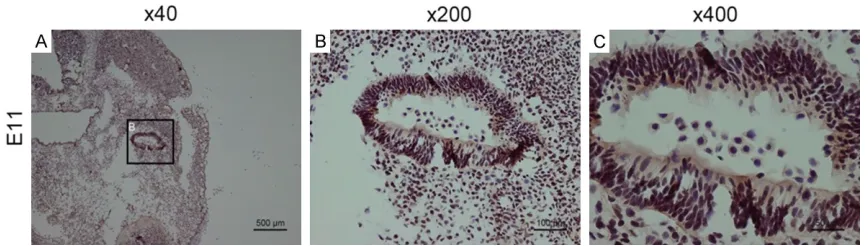
[image:2.612.92.526.73.196.2]the cochlea. Our data showed that Bmi1 was expressed in the dorsal and ventral part of the otocyst (Figure 1), indicating that Bmi1 might play important roles in the proliferation and specification of the prosensory domain.
Bmi1 was expressed in the embryonic co-chlear duct
[image:3.612.94.524.76.227.2]Between E13.5 and E14.5, the cells in the pri-mordial organ of Corti stop proliferating due to
Figure 2. Bmi1 expression was seen in all turns of the cochlear epithelium on E14.5 shown at three magnifications.
The red star indicates the apical turn and the red hollow arrowhead and arrow indicate Kölliker primordium and Corti’s primordium, respectively.
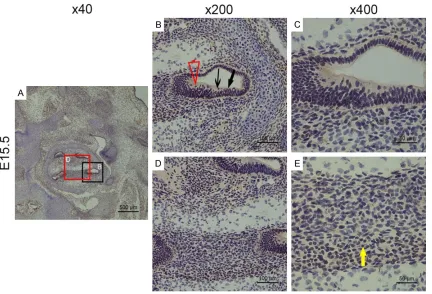
[image:3.612.96.528.289.583.2]the expression of the cyclin-dependent kinase inhibitors p27Kip1 and p19Ink4d in the cochle-ar duct. These nonproliferating cells then dif-ferentiate within the sensory primordium to form a precise mosaic of hair cells and support-ing cells [1]. Hair cell differentiation starts ar- ound E14.5 in the cochlea as indicated by the expression of Math1 [14], and at E14.5 we found that Bmi1 was broadly expressed in the nuclei of the cochlear epithelium (Figure 2). Starting at E15.5, myosin 7a, one of the hair cell-specific markers, is expressed at the base of the organ of Corti [15]. As Figure 3 shows, Bmi1 was clearly observed in auditory hair cells in all three turns at E15.5, indicating that Bmi1 might participate in the differentiation process of inner ear progenitor cells. By E15.5, the spi-ral ganglion neuron had reached to the cochle-ar modiolus, and Bmi1 was also expressed in the spiral ganglion (Figure 3).
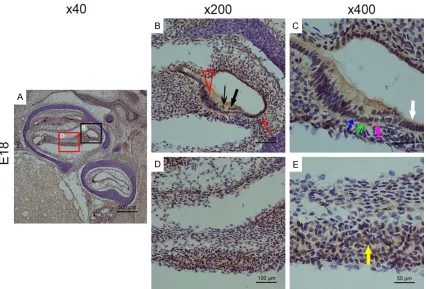
Hair cells complete their differentiation bet- ween E17 and E18. We examined the E18 co- chlear duct and found that Bmi1 was expressed in the nuclei of the cochlear epithelium in the apical, middle, and basal turns and could be distinctly seen in outer hair cells, inner hair cells, surrounding supporting cells (inner pha-langeal cells, Deiters’ cells, pillar cells, and Hensen’s cell), and Kölliker’s organ. Bmi1 was also expressed in the whole cochlear duct, including the striae vascularis and tympanic border cells (Figure 4).
Bmi1 was expressed in the postnatal cochlea
Like the E18.5 cochlear duct, Bmi1 was widely expressed in auditory hair cells, supporting cells, Kölliker’s organ, the striae vascularis, and tympanic border cells in all three turns of the cochlea at P0 (Figure 5). At P0, the spiral
[image:4.612.98.524.73.362.2]glion neurons were chiefly within Rosenthal’s canal. The spiral ganglion neurons developed from the base to the apex, and Bmi1 continued to be expressed in spiral ganglion neurons sim-ilar to its expression in the organ of Corti and the striae vascularis (Figure 5).
Discussion
The inner ear is one of the most complex and delicate organs, and it functions to convert sound waves into nerve impulses-which it transmits to the brain-and to maintain body balance. The cochlea is an anatomical struc-ture of the inner ear, and it conducts and sens-es sound as part of the peripheral auditory sys-tem. The organ of Corti is the core part of the cochlea and is the auditory transduction organ that physically transforms signals from the mid-dle ear into nerve impulses. The organ of Corti is located throughout the full length of the basi-lar membrane and contains two types of hair cells and at least four types of supporting cells,
all of which are terminally differentiated cells that are derived from the same precursor cells during embryonic development [16].
[image:5.612.95.523.71.361.2]The otic placode invaginates to form the oto-cyst by E11, and at this time the otooto-cyst is already regionalized into the sensory epitheli-um that will generate hair cells and supporting cells and the non-sensory epithelium that will generate the endolymphatic duct, the endolym-phatic sac, and the vestibular membrane [2]. In this study, we showed that Bmi1 protein was expressed in all of the nuclei throughout the entire otocyst, and this indicates that Bmi1 might be involved in the development of the otocyst. From E12.5 to E14.5, the prosensory area differentiates into hair cells and support-ing cells. Bmi1 was expressed in the cochlear duct on E14.5, and this implies that Bmi1 might take part in the differentiation of hair cells and supporting cells. From E18 to P0, Bmi1 was located in the hair cells and supporting cells, which suggests that Bmi1 might play important
it from the endolymph and perilymph. The K ions of the striae vascularis are transferred to the endolymph through the KCNQ1/KCNE1 K+ channels of the marginal cells, thus the genera-tion of the endocochlear potential is dependent on both the electrical insulation of the intrastria space and K+ ion transfer. The striae vascularis of the basal turn of the cochlear duct begins to differentiate on E16.5 and is markedly thick-ened on P0. The striae vascularis and the cochlea develop gradually from the basal turn to the apical turn, and by P14 the cochlea has fully developed and the striae vascularis is mature [17]. We found that Bmi1 was expressed in the striae vascularis of the basal turn on E18, and by P0 the expression of Bmi1 was located in the striae vascularis of the cochlear duct except in the apical turn because the stri-ae vascularis of the apical turn is not yet devel-oped at that age. These results indicated that Bmi1 might be involved in the development of the striae vascularis and the generation of the endocochlear potential.
The spiral ganglion of the cochlea is located in Rosenthal’s tube of the modiolus, and spiral ganglion neurons include both bipolar neurons and afferent nerves. The peripheral processes of the spiral ganglion radiate out and are dis-tributed in the organ of Corti, and its central processes form the cochlear nerve. The ventro-medial part of the otocyst gradually develops into the cochleovestibular ganglion on E9. The cochleovestibular ganglion and geniculate ga- nglion from the first gill plate form the facial-acoustic ganglion primordia. The cochleoves-tibular ganglion neurons gradually separate and enter into their respective regions on E12.5 and form the cochlear ganglion primordium and vestibular ganglion primordium on E13.5. The cochlear neurons gradually emit projections
indicates that Bmi1 might cooperate with dif-ferent genes to play difdif-ferent roles in difdif-ferent cell types during different developmental stag-es. In support of this, it has been reported that Bmi-1 cooperates with Foxg1 to maintain neu-ral stem cell self-renewal in the forebrain [18]. Our results provide the basic expression pat-tern of Bmi1 and might be helpful for future investigations of the detailed role of Bmi1 dur-ing the development of the cochlea.
Acknowledgements
This work was supported by grants from the Major State Basic Research Development Program of China (973 Program) (2015CB96- 5000), the National Natural Science Foundation of China (Nos. 81570911, 81470692, 81371- 094, 81500790, 81570921, 31500852, 3150- 1194 and 81230019), the Jiangsu Province Natural Science Foundation (BK20150022, BK20140620, BK20150598), the Program of Leading Medical Personnel in Shanghai, the Fundamental Research Funds for the Central Universities (2242014R30022, 0214143800- 37), and the Construction Program of Shanghai Committee of Science and Technology (12DZ- 2251700).
Disclosure of conflict of interest
None.
Authors’ contribution
Conceived and designed the experiments: YC and RC. Performed the experiments: LL, YZ, WL, and WN. Wrote the paper: LL, RC, and YC.
Address correspondence to: Dr. Yan Chen, ENT
Institute, Affiliated Eye and ENT Hospital of Fudan
[1] Radde-Gallwitz K, Pan L, Gan L, Lin X, Segil N and Chen P. Expression of Islet1 marks the sensory and neuronal lineages in the mamma-lian inner ear. J Comp Neurol 2004; 477: 412-421.
[2] Morsli H, Choo D, Ryan A, Johnson R and Wu DK. Development of the mouse inner ear and origin of its sensory organs. J Neurosci 1998; 18: 3327-3335.
[3] Kanaya E, Yamahara K, Okano T, Yoshida A, Katsuno T, Takebayashi H, Ito J and Yamamoto N. Expression of the olig gene family in the de-veloping mouse inner ear. Gene Expr Patterns 2015; 17: 79-86.
[4] Ruben RJ. Development of the inner ear of the mouse: a radioautographic study of terminal mitoses. Acta Otolaryngol 1967; Suppl 220: 221-244.
[5] Lee YS, Liu F and Segil N. A morphogenetic wave of p27Kip1 transcription directs cell cy-cle exit during organ of Corti development. De-velopment 2006; 133: 2817-2826.
[6] Layman WS and Zuo J. Epigenetic regulation in the inner ear and its potential roles in develop-ment, protection, and regeneration. Front Cell Neurosci 2014; 8: 446.
[7] Stojanova ZP, Kwan T and Segil N. Epigenetic regulation of Atoh1 guides hair cell develop-ment in the mammalian cochlea. Developdevelop-ment 2015; 142: 3529-3536.
[8] Brunk BP, Martin EC and Adler PN. Drosophila genes posterior sex combs and suppressor two of zeste encode proteins with homology to the murine bmi-1 oncogene. Nature 1991; 353: 351-353.
cells in a concentration-dependent manner. J Biol Chem 2006; 281: 34696-34704.
[12] Jiang L, Li J and Song L. Bmi-1, stem cells and cancer. Acta Biochim Biophys Sin (Shanghai) 2009; 41: 527-534.
[13] Chen Y, Li L, Ni W, Zhang Y, Sun S, Miao D, Chai R and Li H. Bmi1 regulates auditory hair cell survival by maintaining redox balance. Cell Death Dis 2015; 6: e1605.
[14] Chen P, Johnson JE, Zoghbi HY and Segil N. The role of Math1 in inner ear development: uncoupling the establishment of the sensory primordium from hair cell fate determination. Development 2002; 129: 2495-2505. [15] Zhang Y, Chen Y, Ni W, Guo L, Lu X, Liu L, Li W,
Sun S, Wang L and Li H. Dynamic expression of Lgr6 in the developing and mature mouse co-chlea. Front Cell Neurosci 2015; 9: 165. [16] Fekete DM, Muthukumar S and Karagogeos D.
Hair cells and supporting cells share a com-mon progenitor in the avian inner ear. J Neuro-sci 1998; 18: 7811-7821.
[17] Hibino H, Nin F, Tsuzuki C and Kurachi Y. How is the highly positive endocochlear potential
formed? The specific architecture of the stria
vascularis and the roles of the ion-transport
apparatus. Pflugers Arch 2010; 459: 521-533.