4231
Open Domain Question Answering Using
Early Fusion of Knowledge Bases and Text
Haitian Sun∗ Bhuwan Dhingra∗ Manzil Zaheer Kathryn Mazaitis
Ruslan Salakhutdinov William W. Cohen
School of Computer Science Carnegie Mellon University
{haitians,bdhingra,manzilz,krivard,rsalakhu,wcohen}@cs.cmu.edu
Abstract
Open Domain Question Answering (QA) is evolving from complex pipelined systems to end-to-end deep neural networks. Specialized neural models have been developed for ex-tracting answers from either text alone or Knowledge Bases (KBs) alone. In this paper we look at a more practical setting, namely QA over the combination of a KB and entity-linked text, which is appropriate when an
in-complete KB is available with a large text
corpus. Building on recent advances in graph representation learning we propose a novel model, GRAFT-Net, for extracting answers from a question-specific subgraph containing text and KB entities and relations. We con-struct a suite of benchmark tasks for this prob-lem, varying the difficulty of questions, the amount of training data, and KB complete-ness. We show that GRAFT-Net is competitive with the state-of-the-art when tested using ei-ther KBs or text alone, and vastly outperforms existing methods in the combined setting.
1 Introduction
Open domain Question Answering (QA) is the task of finding answers to questions posed in nat-ural language. Historically, this required a spe-cialized pipeline consisting of multiple machine-learned and hand-crafted modules (Ferrucci et al.,
2010). Recently, the paradigm has shifted towards training end-to-end deep neural network models for the task (Chen et al.,2017;Liang et al.,2017;
Raison et al., 2018; Talmor and Berant, 2018;
Iyyer et al., 2017). Most existing models,
how-ever, answer questions using asingleinformation source, usually either text from an encyclopedia, or a single knowledge base (KB).
Intuitively, the suitability of an information source for QA depends on both its coverage and
∗
Haitian Sun and Bhuwan Dhingra contributed equally to this work.
Q. Who voiced Meg in Family Guy?
Family Guy Meg Griffin
CVT1
CVT2 Lacey Chabert
Mila Kunis
Megatron "Meg" Griffin is a character from the animated television series
Family Guy.
Originally voiced by Lacey Chabert during the first season, she has been
voiced by Mila Kunis since season 2
actor actor character
character-played-by
KB Entity Text Document KB Relation Entity Mention
Question Subgraph
[image:1.595.318.521.223.373.2]from to
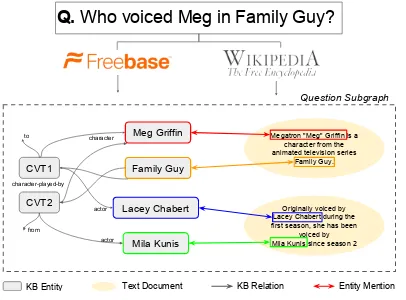
Figure 1: To answer a question posed in natural language, GRAFT-Net considers a heterogeneous graph constructed from text and KB facts, and thus can leverage the rich relational structure between the two information sources.
thedifficultyof extracting answers from it. A large text corpus has high coverage, but the information is expressed using many different text patterns. As a result, models which operate on these patterns (e.g. BiDAF (Seo et al.,2017)) do not generalize beyond their training domains (Wiese et al.,2017;
Dhingra et al.,2018) or to novel types of
reason-ing (Welbl et al.,2018;Talmor and Berant,2018). KBs, on the other hand, suffer from low cover-age due to their inevitable incompleteness and re-stricted schema (Min et al., 2013), but are easier to extract answers from, since they are constructed precisely for the purpose of being queried.
In practice, some questions are best answered using text, while others are best answered using KBs. A natural question, then, is how to effec-tively combine both types of information. Surpris-ingly little prior work has looked at this problem. In this paper we focus on a scenario in which a large-scale KB (Bollacker et al.,2008;Auer et al.,
A na¨ıve option, in such a setting, is to take state-of-the-art QA systems developed for each source, and aggregate their predictions using some heuris-tic (Ferrucci et al., 2010; Baudiˇs, 2015). We call this approach late fusion, and show that it can be sub-optimal, as models have limited ability to aggregate evidence across the different sources (§5.4). Instead, we focus on anearly fusion strat-egy, where a single model is trained to extract an-swers from aquestion subgraph(Fig1) containing relevant KB facts as well as text sentences. Early fusion allows more flexibility in combining infor-mation from multiple sources.
To enable early fusion, in this paper we propose a novel graph convolution based neural network, called GRAFT-Net (Graphs of Relations Among Facts and Text Networks), specifically designed to operate over heterogeneous graphs of KB facts and text sentences. We build upon recent work on graph representation learning (Kipf and Welling,
2016;Schlichtkrull et al.,2017), but propose two
key modifications to adopt them for the task of QA. First, we proposeheterogeneous update rules that handle KB nodes differently from the text nodes: for instance, LSTM-based updates are used to propagate information into and out of text nodes (§3.2). Second, we introduce adirected propaga-tion method, inspired by personalized Pagerank in
IR (Haveliwala,2002), which constrains the
prop-agation of embeddings in the graph to follow paths starting from seed nodes linked to the question (§ 3.3). Empirically, we show that both these ex-tensions are crucial for the task of QA.
We evaluate these methods on a new suite of benchmark tasks for testing QA models when both KB and text are present. Using WikiMovies
(Miller et al., 2016) and WebQuestionsSP (Yih
et al.,2016), we construct datasets with a varying
amount of training supervision and KB complete-ness, and with a varying degree of question com-plexity. We report baselines for future comparison, including Key Value Memory Networks (Miller
et al.,2016;Das et al.,2017c), and show that our
proposed GRAFT-Nets have superior performance across a wide range of conditions (§ 5). We also show that GRAFT-Nets are competitive with the state-of-the-art methods developed specifically for text-only QA, and state-of-the art methods devel-oped for KB-only QA (§5.4)1.
1Source code and data are available at https://
github.com/OceanskySun/GraftNet
2 Task Setup
2.1 Description
A knowledge base is denoted asK = (V,E,R), where V is the set of entities in the KB, and the edgesE are triplets(s, r, o) which denote that re-lation r ∈ R holds between the subject s ∈ V
and objecto∈ V. A text corpusDis a set of doc-uments {d1, . . . , d|D|} where each document is a
sequence of wordsdi = (w1, . . . , w|di|). We
fur-ther assume that an (imperfect) entity linking sys-tem has been run on the collection of documents whose output is a set L of links(v, dp)
connect-ing an entity v ∈ V with a word at position p in document d, and we denote withLdthe set of
all entity links in documentd. For entity mentions spanning multiple words ind, we include links to all the words in the mention inL.
The task is, given a natural language question q = (w1, . . . , w|q|), extract its answers{a}q from G= (K,D,L). There may be multiple correct an-swers for a question. In this paper, we assume that the answers are entities from either the documents or the KB. We are interested in a wide range of set-tings, where the KBK varies from highly incom-plete to comincom-plete for answering the questions, and we will introduce datasets for testing our models under these settings.
To solve this task we proceed in two steps. First, we extract a subgraphGq ⊂ G which contains the
answer to the question with high probability. The goal for this step is to ensure high recall for an-swers while producing a graph small enough to fit into GPU memory for gradient-based learning. Next, we use our proposed model GRAFT-Net to learn node representations inGq, conditioned onq,
which are used to classify each node as being an answer or not. Training data for the second step is generated using distant supervision. The entire process mimics the search-and-read paradigm for text-based QA (Dhingra et al.,2017).
2.2 Question Subgraph Retrieval
We retrieve the subgraph Gq using two parallel pipelines – one over the KBKwhich returns a set of entities, and the other over the corpusDwhich returns a set of documents. The retrieved entities and documents are then combined with entity links to produce a fully-connected graph.
KB Retrieval. To retrieve relevant entities from
ques-tion q, producing a set of seed entities, denoted Sq. Next we run the Personalized PageRank (PPR)
method (Haveliwala,2002) around these seeds to identify other entities which might be an answer to the question. The edge-weights around Sq are
distributed equally among all edges of the same type, and they are weighted such that edges rel-evant to the question receive a higher weight than those which are not. Specifically, we average word vectors to compute a relation vectorv(r)from the surface form of the relation, and a question vector v(q)from the words in the question, and use co-sine similarity between these as the edge weights. After running PPR we retain the top E entities v1, . . . , vEby PPR score, along with any edges
be-tween them, and add them toGq.
Text Retrieval. We use Wikipedia as the corpus
and retrieve text at the sentence level, i.e. docu-ments in D are defined along sentences bound-aries2. We perform text retrieval in two steps: first we retrieve the top 5 most relevant Wikipedia articles, using the weighted bag-of-words model from DrQA (Chen et al.,2017); then we populate a Lucene3 index with sentences from these
arti-cles, and retrieve the top ranking onesd1, . . . , dD,
based on the words in the question. For the sentence-retrieval step, we found it beneficial to include the title of the article as an additional field in the Lucene index. As most sentences in an arti-cle talk about the title entity, this helps in retriev-ing relevant sentences that do not explicitly men-tion the entity in the quesmen-tion. We add the retrieved documents, along with any entities linked to them, to the subgraphGq.
The final question subgraph is Gq =
(Vq,Eq,R+), where the vertices V
q consist
of all the retrieved entities and documents, i.e.
Vq={v1, . . . , vE} ∪{d1, . . . , dD}. The edges are
all relations fromKamong these entities, plus the entity-links between documents and entities, i.e.
Eq={(s, o, r)∈ E :s, o∈ Vq, r∈ R}
∪ {(v, dp, rL) : (v, dp)∈ Ld, d∈ Vq},
where rL denotes a special “linking” relation.
R+ = R ∪ {r
L} is the set of all edge types in
the subgraph.
2
The termdocumentwill always refer to a sentence in the rest of this paper.
3https://lucene.apache.org/
3 GRAFT-Nets
The question q and its answers {a}q induce a labeling of the nodes in Vq: we let yv = 1 if
v ∈ {a}q and yv = 0 otherwise for all v ∈ Vq . The task of QA then reduces to perform-ing binary classification over the nodes of the graph Gq. Several graph-propagation based
mod-els have been proposed in the literature which learn node representations and then perform clas-sification of the nodes (Kipf and Welling, 2016;
Schlichtkrull et al.,2017). Such models follow the
standard gather-apply-scatter paradigm to learn the node representation with homogeneous up-dates, i.e. treating all neighbors equally.
The basic recipe for these models is as follows:
1. Initialize node representationsh(0)v .
2. Forl= 1, . . . , Lupdate node representations
h(vl)=φ
h(vl−1), X
v0∈N
r(v)
h(vl0−1)
,
where Nr(v) denotes the neighbours of v
along incoming edges of type r, andφ is a neural network layer.
HereLis the number of layersin the model and corresponds to the maximum length of the paths along which information should be propagated in the graph. Once the propagation is complete the final layer representations h(vL) are used to
per-form the desired task, for example link prediction in knowledge bases (Schlichtkrull et al.,2017).
However, there are two differences in our set-ting from previously studied graph-based clas-sification tasks. The first difference is that, in our case, the graph Gq consists of heterogeneous
nodes. Some nodes in the graph correspond to KB entities which represent symbolic objects, whereas other nodes represent textual documents which are variable length sequences of words. The second difference is that we want to condition the repre-sentation of nodes in the graph on the natural lan-guage questionq. In§3.2 we introduce heteroge-neous updates to address the first difference, and in§3.3we introduce mechanisms for conditioning on the question (and its entities) for the second.
3.1 Node Initialization
xv can be pre-trained KB embeddings or random,
andnis the embedding size. Document nodes in the graph describe a variable length sequence of text. Since multiple entities might link to differ-ent positions in the documdiffer-ent, we maintain a vari-able length representation of the document in each layer. This is denoted byHd(l)∈R|d|×n. Given the
words in the document(w1, . . . , w|d|), we initial-ize its hidden representation as:
Hd(0) =LSTM(w1, w2, . . .),
where LSTM refers to a long short-term memory unit. We denote thep-th row ofHd(l), correspond-ing to the embeddcorrespond-ing ofp-th word in the document dat layerl, asHd,p(l).
3.2 Heterogeneous Updates
Figure 2 shows the update rules for entities and documents, which we describe in detail here.
Entities. LetM(v) = {(d, p)}be the set of po-sitions p in documents d which correspond to a mention of entityv. The update for entity nodes in-volves a single-layer feed-forward network (FFN) over the concatenation of four states:
h(vl) =FFN
h(vl−1)
h(ql−1)
P
r
P
v0∈N
r(v)α
v0
rψr(h(l
−1)
v0 )
P
(d,p)∈M(v)H (l−1) d,p . (1) The first two terms correspond to the entity repre-sentation and question reprerepre-sentation (details be-low), respectively, from the previous layer.
The third term aggregates the states from the entity neighbours of the current node,Nr(v),
af-ter scaling with an attention weightαvr0(described in the next section), and applying relation specific transformationsψr. Previous work on
Relational-Graph Convolution Networks (Schlichtkrull et al.,
2017) used a linear projection for ψr. For a
batched implementation, this results in matrices of size O(B|Rq||Eq|n), where B is the batch size, which can be prohibitively large for large sub-graphs4. Hence in this work we use relation vec-torsxr forr ∈ Rqinstead of matrices, and
com-pute the update along an edge as:
ψr(h(l
−1)
v0 ) =pr
(l−1)
v0 FFN
xr, h(l
−1) v0
. (2)
4This is because we have to use adjacency matrices of size
|Rq| × |Eq| × |Eq|to aggregate embeddings from neighbours
of all nodes simultaneously.
Hereprv(l0−1) is a PageRank score used to control
the propagation of embeddings along paths start-ing from the seed nodes, which we describe in de-tail in the next section. The memory complexity of the above isO(B(|Fq|+|Eq|)n), where|Fq|is the
number of facts in the subgraphGq.
The last term aggregates the states of all tokens that correspond to mentions of the entityvamong the documents in the subgraph. Note that the up-date depends on the positions of entities in their containing document.
Documents. LetL(d, p)be the set of all entities
linked to the word at position p in document d. The document update proceeds in two steps. First we aggregate over the entity states coming in at each position separately:
˜
Hd,p(l) =FFN
Hd,p(l−1), X
v∈L(d,p)
h(vl−1)
. (3a)
Hereh(vl−1) are normalized by the number of
out-going edges atv. Next we aggregate states within the document using an LSTM:
Hd(l)=LSTM( ˜Hd(l)). (3b)
3.3 Conditioning on the Question
For the parts described thus far, the graph learner is largely agnostic of the question. We introduce dependence on question in two ways: by attention over relations, and by personalized propagation.
To represent q, let wq1, . . . , wq|q| be the words in the question. The initial representation is com-puted as:
h(0)q =LSTM(w1q, . . . , w|qq|)|q|∈Rn, (4)
where we extract the final state from the out-put of the LSTM. In subsequent layers the question representation is updated as h(ql) =
FFN
P
v∈Sqh (l) v
, whereSqdenotes the seed
en-tities mentioned in the question.
Attention over Relations. The attention weight
in the third term of Eq. (1) is computed using the question and relation embeddings:
αrv0 =softmax(xrTh(ql−1)),
where the softmax normalization is over all outgo-ing edges fromv0, andxris the relation vector for
Chabert voiced by Lacey during ...
LSTM -- layer l-1 LSTM -- layer l
Lacey Chabert
... FFN
... Chabert
Lacey Chabert
Q. Who voiced Meg in Family Guy?
voiced
... by Lacey during ...
LSTM CVT1
Entity Update Text Update
Figure 2: Illustration of the heterogeneous update rules for entities (left) and text documents (right)
Directed Propagation. Many questions require
multi-hop reasoning, which follows a path from a seed node mentioned in the question to the tar-get answer node. To encourage such a behaviour when propagating embeddings, we develop a tech-nique inspired from personalized PageRank in IR
(Haveliwala, 2002). The propagation starts at the
seed entitiesSq mentioned in the question. In
ad-dition to the vector embeddingsh(vl) at the nodes,
we also maintain scalar “PageRank” scores prv(l)
which measure the total weight of paths from a seed entity to the current node, as follows:
pr(0)v = ( 1
|Sq| if v∈Sq
0 o.w. ,
pr(vl) = (1−λ)pr(vl−1)+λX
r
X
v0∈N
r(v)
αvr0pr(vl0−1).
Notice that we reuse the attention weights αvr0 when propagating PageRank, to ensure that nodes along paths relevant to the question receive a high weight. The PageRank score is used as a scal-ing factor when propagatscal-ing embeddscal-ings along the edges in Eq. (2). For l = 1, the PageRank score will be 0 for all entities except the seed entities, and hence propagation will only happen outward from these nodes. Forl = 2, it will be non-zero for the seed entities and their 1-hop neighbors, and propagation will only happen along these edges. Figure3illustrates this process.
3.4 Answer Selection
The final representationsh(vL) ∈ Rn, are used for
binary classification to select the answers:
[image:5.595.123.479.61.216.2] [image:5.595.345.490.265.331.2]Pr (v∈ {a}q|Gq, q) =σ(wTh(vL)+b), (5)
Figure 3: Directed propagation of embeddings in
GRAFT-Net. A scalar PageRank score pr(vl) is
maintained for each node v across layers, which spreads out from the seed node. Embeddings are only propagated from nodes withpr(vl)>0.
whereσis the sigmoid function. Training uses bi-nary cross-entropy loss over these probabilities.
3.5 Regularization via Fact Dropout
To encourage the model to learn a robust classi-fier, which exploits all available sources of infor-mation, we randomly drop edges from the graph during training with probability p0. We call this
fact-dropout. It is usually easier to extract an-swers from the KB than from the documents, so the model tends to rely on the former, especially when the KB is complete. This method is similar to DropConnect (Wan et al.,2013).
4 Related Work
The work ofDas et al.(2017c) attempts an early fusion strategy for QA over KB facts and text. Their approach is based on Key-Value Memory Networks (KV-MemNNs) (Miller et al., 2016) coupled with a universal schema (Riedel et al.,
facts and text snippets. Our graph-based method, on the other hand, explicitly uses this structure for the propagation of embeddings. We compare the two approaches in our experiments (§5), and show that GRAFT-Nets outperform KV-MemNNs over all tasks.
Non-deep learning approaches have been also attempted for QA over both text assertions and KB facts.Gardner and Krishnamurthy(2017) use traditional feature extraction methods of open-vocabulary semantic parsing for the task. Ryu
et al. (2014) use a pipelined system
aggregat-ing evidence from both unstructured and semi-structured sources for open-domain QA.
Another line of work has looked at learning combined representations of KBs and text for re-lation extraction and Knowledge Base Comple-tion (KBC) (Lao et al.,2012;Riedel et al.,2013;
Toutanova et al., 2015; Verga et al., 2016; Das
et al., 2017b; Han et al., 2016). The key
differ-ence in QA compared to KBC is that in QA the inference process on the knowledge source has to be conditioned on the question, so different ques-tions induce different representaques-tions of the KB and warrant a different inference process. Further-more, KBC operates under the fixed schema de-fined by the KB before-hand, whereas natural lan-guage questions might not adhere to this schema.
The GRAFT-Net model itself is motivated from the large body of work on graph representation learning (Scarselli et al., 2009; Li et al., 2016;
Kipf and Welling, 2016; Atwood and Towsley,
2016;Schlichtkrull et al.,2017). Like most other
graph-based models, GRAFT-Nets can also be viewed as an instantiation of the Message Passing Neural Network (MPNN) framework of Gilmer
et al.(2017). GRAFT-Nets are alsoinductive
rep-resentation learners like GraphSAGE (Hamilton
et al.,2017), but operate on a heterogeneous
mix-ture of nodes and use retrieval for getting a sub-graph instead of random sampling. The recently proposed Walk-Steered Convolution model uses random walks for learning graph representations
(Jiang et al.,2018). Our personalization technique
also borrows from such random walk literature, but uses it to localize propagation of embeddings.
Tremendous progress on QA over KB has been made with deep learning based approaches like memory networks (Bordes et al.,2015;Jain,2016) and reinforcement learning (Liang et al., 2017;
Das et al.,2017a). But extending them with text,
which is our main focus, is non-trivial. In another direction, there is also work on producing parsi-monious graphical representations of textual data
(Krause et al.,2016;Lu et al.,2017); however in
this paper we use a simple sequential representa-tion augmented with entity links to the KB which works well.
For QA over text only, a major focus has been on the task of reading comprehension (Seo et al.,
2017;Gong and Bowman,2017;Hu et al.,2017;
Shen et al.,2017;Yu et al.,2018) since the
intro-duction of SQuAD (Rajpurkar et al.,2016). These systems assume that the answer-containing pas-sage is known apriori, but there has been progress when this assumption is relaxed (Chen et al.,2017;
Raison et al., 2018; Dhingra et al., 2017; Wang
et al.,2018,2017;Watanabe et al.,2017). We work
in the latter setting, where relevant information must be retrieved from large information sources, but we also incorporate KBs into this process.
5 Experiments & Results
5.1 Datasets
WikiMovies-10Kconsists of10Krandomly
sam-pled training questions from the WikiMovies dataset (Miller et al.,2016), along with the origi-nal test and validation sets. We sample the training questions to create a more difficult setting, since the original dataset has100Kquestions over only 8 different relation types, which is unrealistic in our opinion. In§5.4we also compare to the exist-ing state-of-the-art usexist-ing the full trainexist-ing set.
We use the KB and text corpus constructed from Wikipedia released byMiller et al.(2016). For en-tity linking we use simple surface level matches, and retrieve the top 50 entities around the seeds to create the question subgraph. We further add the top 50 sentences (along with their article ti-tles) to the subgraph using Lucene search over the text corpus. The overall answer recall in our con-structed subgraphs is99.6%.
WebQuestionsSP (Yih et al., 2016) consists of
4737natural language questions posed over Free-base entities, split up into3098training and1639 test questions. We reserve250training questions for model development and early stopping. We use the entity linking outputs from S-MART5 and re-trieve500entities from the neighbourhood around the question seeds in Freebase to populate the
question subgraphs6. We further retrieve the top50 sentences from Wikipedia with the two-stage pro-cess described in§2. The overall recall of answers among the subgraphs is94.0%.
Table 1 shows the combined statistics of all the retreived subgraphs for the questions in each dataset. These two datasets present varying levels of difficulty. While all questions in WikiMovies correspond to a single KB relation, for WebQues-tionsSP the model needs to aggregate over two KB facts for∼30%of the questions, and also requires reasoning over constraints for ∼7%of the ques-tions (Liang et al.,2017). For maximum portabil-ity, QA systems need to be robust across several degrees of KB availability since different domains might contain different amounts of structured data; and KB completeness may also vary over time. Hence, we construct an additional3datasets each from the above two, with the number of KB facts downsampled to10%, 30%and50%of the orig-inal to simulate settings where the KB is incom-plete. We repeat the retrieval process for each sam-pled KB.
5.2 Compared Models
KV-KB is the Key Value Memory Networks
model fromMiller et al.(2016);Das et al.(2017c) but using only KB and ignoring the text. KV-EF
(early fusion) is the same model with access to both KB and text as memories. For text we use a BiLSTM over the entire sentence as keys, and entity mentions as values. This re-implementation shows better performance on the text-only and KB-only WikiMovies tasks than the results re-ported previously7 (see Table 4). GN-KB is the GRAFT-Net model ignoring the text.GN-LFis a late fusion version of the GRAFT-Net model: we train two separate models, one using text only and the other using KB only, and then ensemble the
two8.GN-EFis our main GRAFT-Net model with
early fusion.GN-EF+LFis an ensemble over the GN-EF and GN-LF models, with the same ensem-bling method as GN-LF. We report Hits@1, which
6A total of13questions had no detected entities. These
were ignored during training and considered as incorrect dur-ing evaluation.
7For all KV models we tuned the number of layers
{1,2,3}, batch size{10,30,50}, model dimension{50,80}. We also use fact dropout regularization in the KB+Text set-ting tuned between{0,0.2,0.4}.
8For ensembles we take a weighted combination of the
an-swer probabilities produced by the models, with the weights tuned on the dev set. For answers only in text or only in KB, we use the probability as is.
is the accuracy of the top-predicted answer from the model, and the F1 score. To compute the F1 score we tune a threshold on the development set to select answers based on binary probabilities for each node in the subgraph.
5.3 Main Results
Table2presents a comparison of the above models across all datasets. GRAFT-Nets (GN) shows con-sistent improvement over KV-MemNNs on both datasets in all settings, including KB only (-KB), text only (-EF, Text Only column), and early fu-sion (-EF). Interestingly, we observe a larger rel-ative gap between the Hits and F1 scores for the KV models than we do for our GN models. We believe this is because the attention for KV is nor-malized over the memories, which are KB facts (or text sentences): hence the model is unable to assign high probabilities to multiple facts at the same time. On the other hand, in GN, we normal-ize the attention over types of relations outgoing from a node, and hence can assign high weights to all the correct answers.
We also see a consistent improvement of early fusion over late fusion (-LF), and by ensembling them together we see the best performance across all the models. In Table2(right), we further show the improvement for KV-EF over KV-KB, and GN-LF and GN-EF over GN-KB, as the amount of KB is increased. This measures how effective these approaches are in utilizing text plus a KB. For KV-EF we see improvements when the KB is highly incomplete, but in the full KB setting, the performance of the fused approach is worse. A similar trend holds for GN-LF. On the other hand, GN-EF with text improves over the KB-only ap-proach in all settings. As we would expect, though, the benefit of adding text decreases as the KB be-comes more and more complete.
5.4 Comparison to Specialized Methods
ei-Dataset # train / dev / test # entity nodes # edge types # document nodes # question vocab
WikiMovies-10K 10K / 10K / 10K 43,233 9 79,728 1759
[image:8.595.74.491.144.319.2]WebQuestionsSP 2848 / 250 / 1639 528,617 513 235,567 3781
Table 1: Statistics of all the retrieved subgraphs∪qGqfor WikiMovies-10K and WebQuestionsSP.
Model Text Only KB + Text
10 % 30% 50% 100% WikiMovies-10K
KV-KB – 15.8 / 9.8 44.7 / 30.4 63.8 / 46.4 94.3 / 76.1 KV-EF 50.4 / 40.9 53.6 / 44.0 60.6 / 48.1 75.3 / 59.1 93.8 / 81.4 GN-KB – 19.7 / 17.3 48.4 / 37.1 67.7 / 58.1 97.0 / 97.6 GN-LF
73.2 / 64.0
74.5 / 65.4 78.7 / 68.5 83.3 / 74.2 96.5 / 92.0 GN-EF 75.4 / 66.3 82.6 / 71.3 87.6 / 76.2 96.9 / 94.1 GN-EF+LF 79.0 / 66.7 84.6 / 74.2 88.4 / 78.6 96.8 / 97.3
WebQuestionsSP
KV-KB – 12.5 / 4.3 25.8 / 13.8 33.3 / 21.3 46.7 / 38.6 KV-EF 23.2 / 13.0 24.6 / 14.4 27.0 / 17.7 32.5 / 23.6 40.5 / 30.9 GN-KB – 15.5 / 6.5 34.9 / 20.4 47.7 / 34.3 66.7 / 62.4 GN-LF
25.3 / 15.3
29.8 / 17.0 39.1 / 25.9 46.2 / 35.6 65.4 / 56.8 GN-EF 31.5 / 17.7 40.7 / 25.2 49.9 / 34.7 67.8 / 60.4 GN-EF+LF 33.3 / 19.3 42.5 / 26.7 52.3 / 37.4 68.7 / 62.3
5 0 5 10 15
Hits@1
10.1
3.9
2.3
-6.2
10.5
4.2
-1.5 -1.3
11.2
5.8
2.2 1.1
WikiMovies-10K KV-EF KV-KB GN-LF GN-KB GN-EF GN-KB
0.1 0.3 0.5 1.0
KB fraction 0
20 40 60
Hits@1
37.8
15.9 11.5
-0.5
54.8
30.3
15.6
-0.5
55.7
34.2
19.9
-0.1
WebQuestionsSP KV-EF KV-KB GN-LF GN-KB GN-EF GN-KB
Table 2: Left:Hits@1 / F1 scores of GRAFT-Nets (GN) compared to KV-MemNN (KV) in KB only (-KB), early fusion (-EF), and late fusion (-LF) settings.Right:Improvement of early fusion (-EF) and late fusion (-LF) over KB only (-KB) settings as KB completeness increases.
ther match or outperform the existing state-of-the-art models. We emphasize that the latter have no mechanism for dealing with the fused setting.
The one exception is the KB-only case for WebQuestionsSP where GRAFT-Net does 6.2% F1 points worse than Neural Symbolic Machines
(Liang et al.,2017). Analysis suggested three
ex-planations: (1) In the KB-only setting, the recall of subgraph retrieval is only 90.2%, which lim-its overall performance. In an oracle setting where we ensure the answers are part of the subgraph, the F1 score increases by 4.8%. (2) We use the same probability threshold for all questions, even though the number of answers may vary signifi-cantly. Models which parse the query into a sym-bolic form do not suffer from this problem since answers are retrieved in a deterministic fashion. If we tune separate thresholds for each question the F1 score improves by7.6%. (3) GRAFT-Nets per-form poorly in the few cases where there is a con-straint involved in picking out the answer (for ex-ample, “whofirstvoiced Meg in Family Guy”). If we ignore such constraints, and consider all enti-ties with the same sequence of relations to the seed as correct, the performance improves by3.8%F1. Heuristics such as those used byYu et al. (2017) can be used to improve these cases. Figure3shows
examples where GRAFT-Net fails to predict the correct answer set exactly.
5.5 Effect of Model Components
Heterogeneous Updates. We tested a
non-heterogeneous version of our model, where in-stead of using fine-grained entity linking informa-tion for updating the node representainforma-tions (M(v) andL(d, p)in Eqs.1,3a), we aggregate the docu-ment states across all its positions asP
pH
(l)
d,pand
use this combined state for all updates. Without the heterogeneous update, all entitiesv ∈L(d,·)will receive the same update from documentd. There-fore, the model cannot disambiguate different en-tities mentioned in the same document. The result in Table 5 shows that this version is consistently worse than the heterogeneous model.
Conditioning on the Question. We performed
an ablation test on the directed propagation method and attention over relations. We observe that both components lead to better performance. Such effects are observed in both complete and in-complete KB scenarios, e.g. on WebQuestionsSP dataset, as shown in Figure4(left).
Fact Dropout. Figure 4 (right) compares the
Question Correct Answers Predicted Answers
what language do most people speak in afghanistan Pashto language,
Farsi (Eastern Language) Pashto language
what college did john stockton go to Gonzaga University Gonzaga University,
[image:9.595.73.294.187.296.2]Gonzaga Preparatory School
Table 3: Examples from WebQuestionsSP dataset.Top:The modelmissesa correct answer.Bottom:The model predicts an extraincorrectanswer.
Method WikiMovies (full) WebQuestionsSP
kb doc kb doc
MINERVA 97.0 / – – – –
R2-AsV – 85.8 / – – –
NSM – – – / 69.0 –
DrQA* – – – 21.5 / –
R-GCN# 96.5 / 97.4 – 37.2 / 30.5 –
KV 93.9 / – 76.2 / – – / – – / –
KV# 95.6 / 88.0 80.3 / 72.1 46.7 / 38.6 23.2 / 13.0
GN 96.8 / 97.2 86.6 / 80.8 67.8 / 62.8 25.3 / 15.3
Table 4: Hits@1 / F1 scores compared to SOTA models using only KB or text: MINERVA
(Das et al., 2017a), R2-AsV (Watanabe et al.,
2017), Neural Symbolic Machines (NSM) (Liang
et al., 2017), DrQA (Chen et al., 2017),
R-GCN (Schlichtkrull et al.,2017) and KV-MemNN
(Miller et al., 2016). *DrQA is pretrained on
SQuAD.#Re-implemented.
0 KB 0.1 KB 0.3 KB 0.5 KB 1.0 KB
NH 22.7 / 13.6 28.7 / 15.8 35.6 / 23.2 47.2 / 33.3 66.5 / 59.8
H 25.3 / 15.3 31.5 / 17.7 40.7 / 25.2 49.9 / 34.7 67.8 / 60.4
Table 5: Non-Heterogeneous (NH) vs. Heteroge-neous (H) updates on WebQuestionsSP
the rate of fact dropout. Moderate levels of fact dropout improve performance on both datasets. The performance increases as the fact dropout rate increases until the model is unable to learn the in-ference chain from KB.
6 Conclusion
In this paper we investigate QA using text com-bined with an incomplete KB, a task which has received limited attention in the past. We intro-duce several benchmark problems for this task by modifying existing question-answering datasets, and discuss two broad approaches to solving this problem—“late fusion” and “early fusion”. We show that early fusion approaches perform better.
We also introduce a novel early-fusion model, called GRAFT-Net, for classifying nodes in sub-graph consisting of both KB entities and text
doc-0 20 40 60 80 100 Epoch
0 10 20 30 40 50 60 70
Hits@1
100% KB + Directed + Attention 100% KB + Attention 100% KB
30% KB + Directed + Attention 30% KB + Attention 30% KB
75 80 85 90
Hits@1
WikiMovies-10K (50% KB)
0.0 0.2 0.4 0.6 0.8 1.0
Fact dropout
25 30 35 40
Hits@1
WebQuestionsSP (30% KB)
Figure 4:Left:Effect of directed propagation and query-based attention over relations for the We-bQuestionsSP dataset with 30% KB and 100%
KB. Right: Hits@1 with different rates of
fact-dropout on and WikiMovies and WebQuestionsSP.
uments. GRAFT-Net builds on recent advances in graph representation learning but includes sev-eral innovations which improve performance on this task. GRAFT-Nets are a single model which achieve performance competitive to state-of-the-art methods in both text-only and KB-only set-tings, and outperform baseline models when us-ing text combined with an incomplete KB. Cur-rent directions for future work include – (1) ex-tending GRAFT-Nets to pick spans of text as an-swers, rather than only entities and (2) improving the subgraph retrieval process.
Acknowledgments
Bhuwan Dhingra is supported by NSF under grants CCF-1414030 and IIS-1250956 and by grants from Google. Ruslan Salakhutdinov is sup-ported in part by ONR grant N000141812861, Ap-ple, and Nvidia NVAIL Award.
References
[image:9.595.314.520.190.341.2]Neu-ral Information Processing Systems, pages 1993– 2001.
S¨oren Auer, Christian Bizer, Georgi Kobilarov, Jens Lehmann, Richard Cyganiak, and Zachary Ives. 2007. Dbpedia: A nucleus for a web of open data.
InThe semantic web, pages 722–735. Springer.
Petr Baudiˇs. 2015. Yodaqa: a modular question an-swering system pipeline. InPOSTER 2015-19th In-ternational Student Conference on Electrical
Engi-neering, pages 1156–1165.
Kurt Bollacker, Colin Evans, Praveen Paritosh, Tim Sturge, and Jamie Taylor. 2008. Freebase: a collab-oratively created graph database for structuring hu-man knowledge. In Proceedings of the 2008 ACM SIGMOD international conference on Management
of data, pages 1247–1250. AcM.
Antoine Bordes, Nicolas Usunier, Sumit Chopra, and Jason Weston. 2015. Large-scale simple question answering with memory networks. arXiv preprint
arXiv:1506.02075.
Danqi Chen, Adam Fisch, Jason Weston, and Antoine Bordes. 2017. Reading Wikipedia to answer open-domain questions. In Association for
Computa-tional Linguistics (ACL).
Rajarshi Das, Shehzaad Dhuliawala, Manzil Zaheer, Luke Vilnis, Ishan Durugkar, Akshay Krishna-murthy, Alex Smola, and Andrew McCallum. 2017a. Go for a walk and arrive at the answer: Reasoning over paths in knowledge bases using reinforcement learning.arXiv preprint arXiv:1711.05851.
Rajarshi Das, Arvind Neelakantan, David Belanger, and Andrew McCallum. 2017b. Chains of reason-ing over entities, relations, and text usreason-ing recurrent neural networks. EACL.
Rajarshi Das, Manzil Zaheer, Siva Reddy, and An-drew McCallum. 2017c. Question answering on knowledge bases and text using universal schema and memory networks. ACL.
Bhuwan Dhingra, Kathryn Mazaitis, and William W Cohen. 2017. Quasar: Datasets for question an-swering by search and reading. arXiv preprint
arXiv:1707.03904.
Bhuwan Dhingra, Danish Pruthi, and Dheeraj Ra-jagopal. 2018. Simple and effective semi-supervised question answering.NAACL.
David Ferrucci, Eric Brown, Jennifer Chu-Carroll, James Fan, David Gondek, Aditya A Kalyanpur, Adam Lally, J William Murdock, Eric Nyberg, John Prager, et al. 2010. Building watson: An overview of the deepqa project. AI magazine, 31(3):59–79.
Matt Gardner and Jayant Krishnamurthy. 2017. Open-vocabulary semantic parsing with both distributional statistics and formal knowledge. In AAAI, pages 3195–3201.
Justin Gilmer, Samuel S Schoenholz, Patrick F Riley, Oriol Vinyals, and George E Dahl. 2017. Neural message passing for quantum chemistry.ICML.
Yichen Gong and Samuel R Bowman. 2017. Ruminat-ing reader: ReasonRuminat-ing with gated multi-hop atten-tion. arXiv preprint arXiv:1704.07415.
William L. Hamilton, Rex Ying, and Jure Leskovec. 2017. Inductive representation learning on large graphs.CoRR, abs/1706.02216.
Xu Han, Zhiyuan Liu, and Maosong Sun. 2016. Joint representation learning of text and knowledge for knowledge graph completion. arXiv preprint
arXiv:1611.04125.
Taher H Haveliwala. 2002. Topic-sensitive pagerank.
InProceedings of the 11th international conference
on World Wide Web, pages 517–526. ACM.
Minghao Hu, Yuxing Peng, and Xipeng Qiu. 2017. Mnemonic reader for machine comprehension.
arXiv preprint arXiv:1705.02798.
Mohit Iyyer, Wen-tau Yih, and Ming-Wei Chang. 2017. Search-based neural structured learning for sequen-tial question answering. InProceedings of the 55th Annual Meeting of the Association for
Computa-tional Linguistics (Volume 1: Long Papers),
vol-ume 1, pages 1821–1831.
Sarthak Jain. 2016. Question answering over knowl-edge base using factual memory networks. In
Pro-ceedings of the NAACL Student Research Workshop,
pages 109–115.
Jiatao Jiang, Zhen Cui, Chunyan Xu, Chengzheng Li, and Jian Yang. 2018. Walk-steered convo-lution for graph classification. arXiv preprint
arXiv:1804.05837.
Thomas N Kipf and Max Welling. 2016. Semi-supervised classification with graph convolutional networks. arXiv preprint arXiv:1609.02907.
Sebastian Krause, Leonhard Hennig, Andrea Moro, Dirk Weissenborn, Feiyu Xu, Hans Uszkoreit, and Roberto Navigli. 2016. Sar-graphs: A language re-source connecting linguistic knowledge with seman-tic relations from knowledge graphs. Web Seman-tics: Science, Services and Agents on the World Wide Web, 37:112–131.
Ni Lao, Amarnag Subramanya, Fernando Pereira, and William W Cohen. 2012. Reading the web with learned syntactic-semantic inference rules. In Pro-ceedings of the 2012 Joint Conference on Empiri-cal Methods in Natural Language Processing and
Computational Natural Language Learning, pages
1017–1026. Association for Computational Linguis-tics.
Chen Liang, Jonathan Berant, Quoc Le, Kenneth D Forbus, and Ni Lao. 2017. Neural symbolic ma-chines: Learning semantic parsers on freebase with weak supervision. ACL.
Zhengdong Lu, Haotian Cui, Xianggen Liu, Yukun Yan, and Daqi Zheng. 2017. Object-oriented neu-ral programming (oonp) for document
understand-ing. arXiv preprint arXiv:1709.08853.
Alexander Miller, Adam Fisch, Jesse Dodge, Amir-Hossein Karimi, Antoine Bordes, and Jason We-ston. 2016. Key-value memory networks for directly reading documents. EMNLP.
Bonan Min, Ralph Grishman, Li Wan, Chang Wang, and David Gondek. 2013. Distant supervision for relation extraction with an incomplete knowledge base. In Proceedings of the 2013 Conference of the North American Chapter of the Association for Computational Linguistics: Human Language
Tech-nologies, pages 777–782.
Martin Raison, Pierre-Emmanuel Mazar´e, Rajarshi Das, and Antoine Bordes. 2018. Weaver: Deep co-encoding of questions and documents for machine reading.arXiv preprint arXiv:1804.10490.
Pranav Rajpurkar, Jian Zhang, Konstantin Lopyrev, and Percy Liang. 2016. Squad: 100,000+ questions for machine comprehension of text. arXiv preprint
arXiv:1606.05250.
Sebastian Riedel, Limin Yao, Andrew McCallum, and Benjamin M Marlin. 2013. Relation extraction with matrix factorization and universal schemas. In Pro-ceedings of the 2013 Conference of the North Amer-ican Chapter of the Association for Computational
Linguistics: Human Language Technologies, pages
74–84.
Pum-Mo Ryu, Myung-Gil Jang, and Hyun-Ki Kim. 2014. Open domain question answering using wikipedia-based knowledge model. Information
Processing and Management, 50(5):683 – 692.
Franco Scarselli, Marco Gori, Ah Chung Tsoi, Markus Hagenbuchner, and Gabriele Monfardini. 2009. The graph neural network model. IEEE Transactions on
Neural Networks, 20(1):61–80.
Michael Schlichtkrull, Thomas N Kipf, Peter Bloem, Rianne van den Berg, Ivan Titov, and Max Welling. 2017. Modeling relational data with graph convolu-tional networks. arXiv preprint arXiv:1703.06103.
Minjoon Seo, Aniruddha Kembhavi, Ali Farhadi, and Hannaneh Hajishirzi. 2017. Bidirectional attention flow for machine comprehension.ICLR.
Yelong Shen, Po-Sen Huang, Jianfeng Gao, and Weizhu Chen. 2017. Reasonet: Learning to stop reading in machine comprehension. InProceedings of the 23rd ACM SIGKDD International Conference
on Knowledge Discovery and Data Mining, pages
1047–1055. ACM.
A. Talmor and J. Berant. 2018. The web as a knowledge-base for answering complex questions.
In North American Association for Computational
Linguistics (NAACL).
Kristina Toutanova, Danqi Chen, Patrick Pantel, Hoi-fung Poon, Pallavi Choudhury, and Michael Gamon. 2015. Representing text for joint embedding of text and knowledge bases. In Proceedings of the 2015 Conference on Empirical Methods in Natural
Lan-guage Processing, pages 1499–1509.
Patrick Verga, David Belanger, Emma Strubell, Ben-jamin Roth, and Andrew McCallum. 2016. Multi-lingual relation extraction using compositional uni-versal schema.NAACL.
Li Wan, Matthew Zeiler, Sixin Zhang, Yann Le Cun, and Rob Fergus. 2013. Regularization of neural net-works using dropconnect. InInternational
Confer-ence on Machine Learning, pages 1058–1066.
Shuohang Wang, Mo Yu, Xiaoxiao Guo, Zhiguo Wang, Tim Klinger, Wei Zhang, Shiyu Chang, Gerald Tesauro, Bowen Zhou, and Jing Jiang. 2018. R3: Reinforced reader-ranker for open-domain question answering. AAAI.
Shuohang Wang, Mo Yu, Jing Jiang, Wei Zhang, Xiaoxiao Guo, Shiyu Chang, Zhiguo Wang, Tim Klinger, Gerald Tesauro, and Murray Campbell. 2017. Evidence aggregation for answer re-ranking in open-domain question answering. arXiv preprint
arXiv:1711.05116.
Yusuke Watanabe, Bhuwan Dhingra, and Ruslan Salakhutdinov. 2017. Question answering from unstructured text by retrieval and comprehension.
arXiv preprint arXiv:1703.08885.
Johannes Welbl, Pontus Stenetorp, and Sebastian Riedel. 2018. Constructing datasets for multi-hop reading comprehension across documents. TACL.
Georg Wiese, Dirk Weissenborn, and Mariana Neves. 2017. Neural domain adaptation for biomedical question answering. In Proceedings of the 21st Conference on Computational Natural Language
Learning (CoNLL 2017), pages 281–289,
Vancou-ver, Canada. Association for Computational Lin-guistics.
Wen-tau Yih, Matthew Richardson, Chris Meek, Ming-Wei Chang, and Jina Suh. 2016. The value of se-mantic parse labeling for knowledge base question answering. InProceedings of the 54th Annual Meet-ing of the Association for Computational LMeet-inguistics
(Volume 2: Short Papers), volume 2, pages 201–206.