Exploring the new constructs of
exercising
How exercise related obsessive-compulsiveness,
compensatory health beliefs (CHB’s) and outcome
expectations are related to exercise addiction and
normal exercise
Ann-Christin Klein
s1590146
Bachelor of Science Thesis
June 2017
Supervisors: Marcel Pieterse Peter ten Klooster
Department of Health Psychology and Technology University of Twente
Table of Contents
Abstract ... 3
Introduction ... 5
Methods ... 13
Participants ... 13
Materials ... 13
Compensatory Health Belief Scale ... 14
Commitment to Exercise Scale ... 15
Questions measuring a persons’ obsessive-compulsiveness and outcome expectations . 16 Demographic questions ... 17
Design and Procedure ... 17
Ethical Considerations ... 18
Data-analyse ... 18
Results ... 19
Descriptive statistics ... 19
Results correlational analyses ... 21
Results moderation analyses ... 22
Discussion ... 24
Strengths and Limitations ... 29
Future research ... 31
Practical implications ... 32
References ... 34
Appendix ... 38
Abstract
Objectives: The purpose of this study was to gain knowledge about how exercise related obsessive-compulsiveness, compensatory health beliefs (CHB’s) and an individuals’ outcome expectations are related to addictive and normal exercise.
Method: 331 young adults aged between 18 and 35 years (M= 21; SD= 2.5) participated in an online cross-sectional survey study where they had to fill in a battery of questionnaires such as the ‘Compensatory Health Belief Scale’ (Rabia et al., 2006), the ‘Commitment to Exercise Scale’ (Derakhshanpoor, 2006) as well as self-developed scales which measured constructs like exercise related obsessive-compulsiveness and outcome expectations.
Data-analyses: In order to answer the above mentioned research question, five hypotheses were formulated which were tested by means of Pearson correlational and moderation analyses.
Results: The results showed that there are generally univariate associations between the constructs in question. More specifically, the analyses revealed that the relationship between the weekly amount of exercising and being affected by exercise related
obsessive-compulsiveness is not influenced by the frequency and intensity with which a person engages in physical activity. Other findings indicated that the more exercise self-efficacy a person has, the weaker is the relationship between the weekly amount of exercising and using CHB’s. Additionally, weekly exercising significantly predicts being affected by exercise related obsessive-compulsiveness and there is a positive relationship between the weekly amount of exercising and a persons’ outcome expectations. A final result was that CHB’S are associated with exercise related obsessive-compulsiveness.
prevent this type of dependency and therefore also its’ psychological as well as physical consequences. Furthermore, many opportunities for future research open op such as studying how the constructs in question form a larger picture of causality, how
obsessive-compulsiveness can be prevented, which role cognition and behaviour plays, if there are any differences in gender or culture and how outcome expectations can be increased without increasing the risk for becoming addicted by exercise.
Keywords: exercise (addiction), obsessive-compulsiveness, CHB’s, outcome
Introduction
In todays’ society, many people engage in physical activity to stay healthy and to improve their psychological well-being. Most of them engage in an appropriate amount of physical activity, others are addicted to exercise or at risk to develop exercise addiction. As Cockerill (2002) mentioned „Healthy exercisers organize their exercise around their lives, whereas dependents (excessive exercisers or exercise addicted people) organize their lives around their exercise.” Furthermore he states that excessive exercisers often feel an extreme need for control in their lives. These addicted exercisers are at risk for developing adverse effects on their physical and psychological health due to their engagement in an excessive amount of physical activity. Additionally, being an addicted exerciser or to be at least at risk to become one, does not go without consequences. Too much exercise can lead to different kinds of negative results such as depression, injuries or physical harm, exhaustion and in the worst case also suicide (Terry, Szabo & Griffiths, 2004). Furthermore, exercise addiction can go hand in hand with withdrawal symptoms, detrimental social consequences, disturbed psychological functioning and the interference with relationship and work (Morgan, 1979).
Literature has shown that the prevalence of exercise addiction is strongly dependent on the sample in which the study is conducted and how exercise addiction is defined. Research with 50% sport science students and 50% psychology students who filled in the ‘Exercise Addiction Inventory’ has shown that around 3% of the overall sample were diagnosed as being at risk to develop exercise addiction whereas 2.5% already were
questionnaires, Guidi et al. (2009) revealed that almost 18.1 % of them are diagnosed as compulsive exercisers.
Moreover, the development of exercise addiction and its related consequences often go unnoticed. Also the trend towards a heightened amount of addicted exercisers, especially among students, shows that the negative consequences and risks of developing a dependence on exercise are often underestimated and have to be prevented. Therefore, more attention has to be paid to this kind of health topic.
The question which arises out of the previous information is how exercise addiction is defined. Goodman (1990) defined general addiction in terms of a “behavioural process that can provide pleasure or relief from internal discomfort such as stress and anxiety and is
characterized by repeated failure to control the behaviour and maintenance of the behaviour in spite of negative consequences.” Therefore exercise addiction can be defined as “an abnormal reliance on exercise behaviour to cope with chronic stress or hassles, [to provide a sense of pleasure in case of negative internal states] and [to cope with] the challenges of everyday life and featuring the core components of addiction found in more traditional addiction” (Berczik, Szabó, Griffiths, Kurimay, Kun, Urbán & Demetrovics, 2012) such as the compulsion as well as dependence on activity that can have harmful consequences for the individuals’ well-being as well as their social life. An important distinction between normal and addictive exercisers has been made by Landolfi (2013). He states that addictive exercisers do not stop exercising regardless of physical injury, personal inconvenience or disruption in different life areas such as social conflicts or the interference with work. In addition, exercise addicted people are more likely to exercise for intrinsic rewards (e.g. feeling better) and experience disturbing deprivation sensations when they are unable to engage in their physical activity.
that there are physiological as well as psychological explanations for engaging in excessive exercise. Regarding the physiological explanations, the ‘Runners’ high hypotheses’ and the ‘Thermogenic regulation hypotheses’ are often mentioned in connection with exercise
dependence. The first refers to the state that after an intensive workout, an intensive feeling of euphoria will take place due to the endorphin production in the human body. These
endorphins in turn can cause dependence (Berczik et al., 2012). The latter hypotheses
describes the process where intense physical activity increases the body temperature which in turn leads to a reduction in anxiety and negative feelings. De Vries (1981) found out that physical exercise reduces anxiety. Therefore it could be assumed that higher levels of anxiety result in higher levels of and more intense exercise. It is important to mention that focussing on this paper, athletes and professionals do not belong to the group of addicted exercisers because they mostly have other motives for why to engage in physical activity. Furthermore, this paper concentrates on a sample with normal as well as addicted exercisers instead of only one of the two groups.
Two of the most common psychological explanations are the ‘Cognitive appraisal theory’ (Szabo, 1995) and the ‘Affect regulation theory’ (Hamer & Karageorghis, 2007). The first describes that many people use exercise as a means of coping with stress. More
responsibility for daily activities. This rationalization can also be described as using a type of cognitive dissonance reduction by using ‘Compensatory Health Beliefs (CHB’s)’. CHB’s “are beliefs that the negative effects of an unhealthy [but pleasurable] behaviour can be
compensated or neutralised by carrying out a healthy behaviour” (Knäuper, Rabiau, Cohen & Patriciu, 2004). Compensatory Health Beliefs can be applied not only to physical activity but to other behaviours as well. An example is the use of CHB’s to compensate for unhealthy eating patterns, where individuals may make use of CHB’s such as ‘eating nothing the rest of the day can compensate for eating unhealthy’or in relationship to physical activity ‘doing sport can compensate for eating unhealthy’(Wilde, 2013). This process becomes more
extreme when the individual experiences low self-efficacy beliefs or a loss of control over the experience of stress which leads to an increased vulnerability to stress and the resulting negative feelings. These feelings then urge the individual to engage in the activity more frequently even at the expense of other important obligations such as social responsibilities which cannot be met anymore. As these arising conflicts are a new stressor for the addicted person, the person again has to engage in an increasing amount of exercise to be able to deal with the increasing amount of stress. This whole process ends up in the exercise being the problem itself (Szabo, 1995).
The ‘Affect regulation hypotheses’ (Hamer & Karageorghis, 2007) describes the process where the engagement in physical activity increases positive affect and decreases negative affect and therefore contributes to an improved general mood state. The decrease in negative affect can be explained with the relief motive whereas the increase in positive affect is also known as the enhancement motive where the person already feels good but wants more and therefore engages in the physical activity to gain a reward. Nevertheless, the affect
becoming dependent on exercise.
This assumption also highlights the obsessive component in exercise addiction where the individual experiences increased levels of anxiety before engaging in the physical activity and a decreased anxiety as well as a sense of freedom and satisfaction after the fulfilment of the exercise (Berczik et al., 2012). Another study has shown that exercise addiction often also can lead to obsessive-compulsiveness (Blachno et al., 2016) where obsessive-compulsiveness can be defined as having “unwanted and repeated thoughts, feelings, images, and sensations (obsessions) [which are alleviated by] engaging in behaviours [in this case physical activity] or mental acts in response to these thoughts or obsessions” ("Obsessive-Compulsive Disorder | Psychology Today," 2017). Because of the fact, that the respondents in this study are young adults who are still in the process of becoming exercise addicted, the model that exercising results in exercise related obsessive-compulsiveness (the two variables influence each other reciprocally) will be expected. Therefore hypotheses 1 states There is a positive relationship between the weekly amount of exercising and exercise related obsessive-compulsiveness. A second hypotheses focusses on the relationship between the above described construct of CHB’s and exercise related obsessive-compulsiveness. CHB’s are associated with exercise related obsessive-compulsiveness.
activity positively moderates the relationship between the weekly amount of exercising and
exercise related obsessive-compulsiveness.
+
+
However, in this study frequency and intensity is more an attitude rather than a
quantitative measure of the amount of physical activity a person engages in. Nevertheless, the expected moderation can also be explained by the tolerance-effect which is often found in alcohol addicted people. The tolerance effect describes the occurrence of a “greater
insensitivity to an initial dose than to the same dose repeated later.” To reach the initial effect, the individual then has to increase the amount of consumed alcohol (Chen, 1968, p.1) or in this case the amount of physical activity.
Another psychological explanation for the development of exercise addiction lies in the construct of exercise self-efficacy. Neupert et al. (2013) stated that exercise self-efficacy beliefs are beliefs that one is able to engage in physical activity, even if there are some constraints such as a lack of time or energy, and that these beliefs lead to a greater likelihood of actually engaging in physical activity. Furthermore, their study also showed that exercise self-efficacy has an “influential role in the adoption and maintenance of exercise behaviour” which in turn can result in becoming dependent on exercise. Focussing on the relationship between exercise self-efficacy and using CHB’s it can be said that people who have high exercise self-efficacy do not use CHB’s because they do not have to rationalize their
exercising behaviour. This because they have the control over their behaviour and belief in the
Frequency and Intensity
Weekly amount of Exercising
goodness of their behaviour. By contrast, people with low exercise self-efficacy actually make use of CHB’s because by using CHB’s they can compensate for their lack of control they experience which again is representative for having low exercise self-efficacy beliefs (Bandura, 1991). Based on these results, it was in this study expected that exercise self-efficacy functions as a moderator variable regarding the reciprocal relationship between the weekly amount of exercising and the already above mentioned construct of CHB’s. More specifically, it was expected that exercise self-efficacy negatively influences this relationship because literature has shown that people with high exercise self-efficacy beliefs do not use CHB’s. This lead to the fourth hypotheses which states The positive relationship between the weekly amount of exercising and using CHB’s is negatively moderated by a persons’ exercise
self-efficacy.
-
+
A final psychological explanation for developing exercise addiction lies in the outcome expectations which people have when engaging in physical activity. As Neupert et al. (2013) found out is behaviour often the result of outcome expectations, that is “whether one expects one’s actions [especially one’s engagement in physical activity] to lead to desirable outcomes”. However, outcome expectations can be positive as well as negative. Focussing on positive ones, these outcome expectations lead to motivation to in engage in the
Exercise self-efficacy
Weekly amount of
activity in question – in this case exercising. Because of these findings, it is expected that the weekly amount of exercising and outcome expectations are positively correlated. What Neupert et al. (2013) also mentioned was that because the direction of the relationship between exercising and outcome expectations is reciprocal, it does not matter which variable causes the other. Out of this, hypotheses 5 was formulated. There is a positive relationship between the weekly amount of exercising and a persons’ outcome expectations.
Next to the physiological and psychological explanations, research has also been conducted in the field of personality traits which are common in people who are addicted to exercise. Lichtenstein et al. (2014) showed that addicted exercisers can be best described by a high level of excitement-seeking and achievement striving as well as lower scores on
straightforwardness and compliance. Especially the first and second personality trait can result in pain and overuse from exercise.
In the past, research has often focused on the consequences and causes of addicted exercise. Nevertheless, there is a gap in research which focusses on the cognitive strategies as a predictor to study how exercise related obsessive-compulsiveness, CHB’s and outcome expectations are related to exercise. Therefore a sample was chosen which consists of normal as well as addicted exercisers. Additionally, to answer the research question, this paper will use the ‘Fascination to Exercise’and the ‘Frequency and Intensity’items of the ‘Commitment to Exercise Scale’ (Derakhshanpoor, Vaez Mousavi & Taheri, 2017) as well as the
times per week. Next, research will be conducted regarding how exercise related obsessive compulsiveness, CHB’s and outcome expectations are related to normal and addicted exercise.
Methods
Participants
The target population for this study were young adults between 18-35 years old. Everyone in this age category was allowed to participate regardless their gender, ethnicity and cultural background. Another inclusion criteria for participating was that the participant had to agree with the informed consent at the beginning of the survey.
This study was based on a correlational survey design. The participants were reached through convenience sampling which means that those respondents were part of the study who were easy to reach and wanted to participate. This study recruited 417 participants from whom 331 (79%) respondents completed the full survey. 92 of them were male (27.8%) and 238 were female (71.9%). From the 331 respondents, 298 were students (90.0%). The remaining participants were employed (6.3%) or unemployed (3.3%). Furthermore, the respondents were aged between 17 and 33 years old, with a mean age of M = 21 years (SD = 2.25).
Materials
Compensatory Health Belief Scale
The Compensatory Health Belief Scale (CHB Scale) developed by Rabia et al. (2006) consists of 17 items which all measure compensatory health beliefs. CHB’s are used for the purpose that “the negative effects of an unhealthy behaviour can be compensated for, or ‘neutralized’, by engaging in a healthy behaviour” (Knäuper et al., 2014). The overall scale is divided up into 4 subscales, namely ‘substance use, eating/sleeping habits, stress and weight regulation’. However, for the purpose of this study only the ‘eating/sleeping habits’ items and the items belonging to the subscale ‘weight regulation’ were used. This because CHB’s are in this study used for physical activity as compensating behaviour. Because of this, the
‘substance use’ subscale and the ‘stress’ subscale will not be described in more detail.
Eating/Sleeping habits. The second subscale consists of 4 items which were reported with a reliability coefficient of .66. This alpha value indicated a moderate internal consistency (Knäuper et al., 2004). One item of this scale is ‘Eating whatever one wants in the evening is ok if one did not eat during the entire day’. Items out of this category also have to be
answered on a 5-point Likert scale with options 1= totally disagree; 2= somewhat disagree; 3= neither agree nor disagree; 4= somewhat agree; 5= totally agree. The alpha coefficient of the subscale used in this survey was α= .62.
Weight regulation. The last subscale consists of 3 items with a reported reliability of α= .57 (Knäuper et al., 2004). This reliability indicated that the results which are based on this scale are not really replicable by other researchers. ‘Breaking a diet today may be
compensated for by starting a new diet tomorrow’is one item of the fourth subscale. As the first three subscales, also these questions have to be answered on a 5-point Likert scale which ranged from 1= totally disagree to 5= totally agree. In this survey, the reliability was α= .60.
the scale in European research is somewhat lower than in the Canadian original version. The total scale had an alpha value of .80 which indicated a good internal consistency (Knäuper et al., 2004). The reliability of the subscales used in this research was α= .78.
Commitment to Exercise Scale
To evaluate and measure the individuals’ commitment to exercise, the ‘Commitment to Exercise Scale’ (CES scale) which was developed by Derakhshanpoor (2006) was used. The CES is made up out of 25 items which belong to 4 subscales, namely ‘Fascination to exercise items; reinforce items; frequency and intensity items; and disturber factor items’. Because this study only uses the ‘fascination to exercise’ items and the ‘frequency and intensity items’, the other two subscales (‘reinforce items’ and ‘disturber factor items’) will not be described in more detail.
Fascination to exercise. This subscale consists of 8 items whereof ‘I believe whenever I planned for exercising, I succeeded in doing that’is one. Items which belong to this subscale have to be answered on a 5-point Likert scale which ranges from 1= totally disagree to 5=
totally agree. The reliability of this scale was .77.In this paper, the items of this category were used - based on face validity1 - as items which belong to the construct of exercise
self-efficacy.
Frequency and intensity items. The third subscale is represented by 4 items which describe an attitude which people can have regarding the amount of physical activity they engage in. One question is ‘If I miss one day of my exercise schedule, I try to make it up on another day’.As is the case with the first two subscales of the CES, the items which belong to the frequency and intensity category have to be answered by choosing the best fitting option on a 5-point Likert scale which ranges from 1= totally disagree to 5= totally agree. This
1 Based on face validity, the decision was made to use the fascination to exercise items from the CES to represent the
exercise self‐efficacy construct. Face validity means making a subjective assessment of the extent to which a test or
subscale had a reliability of .74.
Thereliability of the total scale which was reported in other research was good with an internal consistency coefficient of α= .87 (Derakhshanpoor, 2006). The alpha coefficient of the subscales used in this survey (without the last subscale) was α= .85.
Questions measuring a persons’ obsessive-compulsiveness and outcome expectations
The questions about physical activity regarding a persons’ obsessive-compulsiveness and outcome expectations, consist of a scale with 21 items. 3 of these questions measure physical activity and are questions like ‘How often do you engage in physical activity (fitness, tennis, soccer, etc.)per week’. To answer questions of this sort, the participant has to choose between the options 1= 0-3 times and 2= more than 3 times. These questions represent the construct ‘weekly amount of exercising’.
Outcome expectations. The first subscale consists of 11 items. Example questions out of this subscale are ‘I engage in physical activity because I would like to reward myself’; ‘I engage in physical activity to feel good about myself’ and ‘I engage in physical activity because I like to see how my body shape changes’.These questions have to be answered on a 5-point Likert scale which ranges from 1= strongly disagree to 5= strongly agree. The
internal consistency coefficient of this scale was α = .78 which indicates a good reliability.
Obsessive-compulsiveness. The second subscale contains 6 items which all measure the obsessive-compulsive side in physical activity. On a 5-point Likert scale which ranges from 1= strongly disagree to 5= strongly agree questions such as ‘When the positive feeling goes away, I directly want to engage in the activity again’; ‘Being physically active is like a circle which I cannot quit’ and ‘When I quit a session earlier than planned, next time I engage in the activity longer to compensate for the missed time’have to be answered by the
Demographic questions
The demographic questions at the beginning of the survey referred to the age, gender, employment status, height and weight of the participants.
Design and Procedure
The study had a cross-sectional survey design. All participants received the same questionnaire which was made in Qualtrics, an online survey software that makes it
elementary to design and administer questionnaires. The participants were asked to honestly fill in the questionnaire, consisting of 94 items. The period of data collection was from
06.04.2017 until 24.04.2017. The estimated time maximum to complete the questionnaire was 30 minutes. In practice it took the participants an average of 15 minutes (Median= 14.85) to complete.
The participants were recruited mainly via Sona Systems, a subjects pool from the University of Twente, where students of the studies psychology and communication sciences can sign up to participate in other student’s research. By participating in surveys, first- and second year students received points which they need to proceed to the third year.
Furthermore, social media like Facebook and WhatsApp and sometimes personal face-to-face contact were used to ask acquaintances of the researchers to participate in the study.
Participants were given background information about the goal of the study as well as instructions how to answer the questions. After receiving explanation, information and
instructions about the study, the participant had to give informed consent to make sure that the decision to participate in the study was on an informed basis and autonomously made.
Furthermore by giving informed consent, the participant showed that he/she understood the goal of the study. Thereafter, the respondent started filling in the questionnaire. The
Ethical Considerations
As mentioned earlier participants had to give informed consent approved by the ethics
committee of BMS in order to make sure the respondents’ autonomous decision to participate in the survey and to be able to start it. At the end of the survey they were also given the right to exclude their data from the study. They could do so by contacting the researcher. All data was handled anonymously so there were no privacy violations. Participants did not have to give their name, and only had to fill in a standard number in order to receive test-person credits.
Data-analyse
In order to answer the presented research questions which are formulated in six hypotheses, several statistical analyses were conducted with SPSS. Before starting with the analyses, respondents who did not fill in those parts of the survey which were relevant for answering the above mentioned hypotheses, were excluded from the data set. After exclusion, the remaining number of respondents was N= 331. Also before starting analysing, the gathered data had to be screened regarding the scales’ reliability. Furthermore, it was explored if negatively formulated items have to be recoded so that they do not disturb the outcomes of the later conducted analyses. Thereafter, the total scores of all subscales were calculated in order to be able to run the Pearson correlational and moderation analyses.
changes as a function of the moderator. By means of moderation analyses, hypotheses 3 and 4 were tested. A moderation analyses consists of 3 steps. First, the independent- and the
moderator variable were mean centred to avoid multicollinearity. Second, a new predictor, which is the product of the in step 1 mean centred variables, was computed. This new variable functions as moderator variable. Finally, a linear regression analyses with the mean centred variables and the new predictor (moderator variable) as independent variables on the
dependent variable has to be carried out in order to find out if moderation took place. It can be said that moderation took place in case of a significant interaction term (Baron &Kenny, 1986).
Results
[image:19.595.74.529.452.719.2]Descriptive statistics
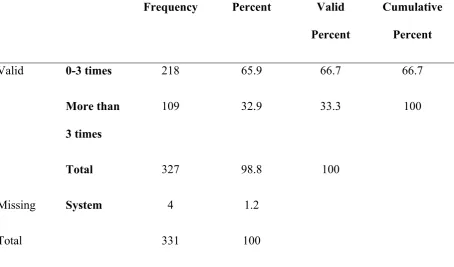
Table 1. Prevalence of people who are at risk for developing exercise addiction.
Frequency Percent Valid
Percent
Cumulative Percent
Valid 0-3 times 218 65.9 66.7 66.7
More than 3 times
109 32.9 33.3 100
Total 327 98.8 100
Missing System 4 1.2
Total 331 100
activity more than 3 times per week. As can be seen in table 1, 33% of the participants met the criteria for being at risk for developing exercise addiction.
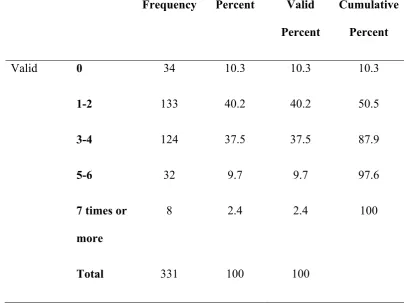
Table 2. Prevalence of addicted as well as normal exercisers.
Frequency Percent Valid Percent
Cumulative Percent
Valid 0 34 10.3 10.3 10.3
1-2 133 40.2 40.2 50.5
3-4 124 37.5 37.5 87.9
5-6 32 9.7 9.7 97.6
7 times or more
8 2.4 2.4 100
Total 331 100 100
Table 2 represents the percentage of people who engage in a normal as well an excessive amount of exercise. A person can be classified as being addicted to exercise when engaging in physical activity 5 times or more per week. Therefore, it can be said that 12% of the
Results correlational analyses
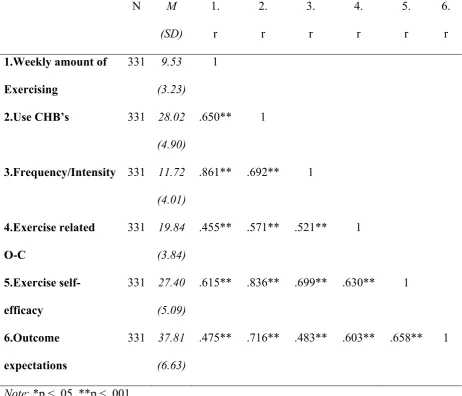
Table 3. Results correlational analyses with the variables: weekly amount of exercising, use CHB’s, frequency/intensity, exercise related obsessive-compulsiveness (O-C), exercise
self-efficacy and outcome expectations.
N M
(SD) 1. r 2. r 3. r 4. r 5. r 6. r 1.Weekly amount of
Exercising
331 9.53 (3.23)
1
2.Use CHB’s 331 28.02
(4.90)
.650** 1
3.Frequency/Intensity 331 11.72 (4.01)
.861** .692** 1
4.Exercise related O-C
331 19.84 (3.84)
.455** .571** .521** 1
5.Exercise self-efficacy
331 27.40 (5.09)
.615** .836** .699** .630** 1
6.Outcome expectations
331 37.81 (6.63)
.475** .716** .483** .603** .658** 1
Note: *p < .05, **p < .001
By means of Pearson correlational analyses, hypotheses 1, 2 and 5 were tested. In table 3, the correlations between all constructs can be seen. Focussing on hypotheses 1 There is a positive relationship between the weekly amount of exercising and being affected by exercise related
obsessive-compulsiveness it can be said that exercising is significantly associated with
also significantly predicts exercise related obsessive-compulsiveness (r= .33, p= .04). However, this correlation is lower than the one with normal as well as addicted exercisers.
Regarding hypotheses 2 CHB’s are associated with exercise related
obsessive-compulsiveness the results revealed that the two constructs are significantly correlated with each other (r= .57; p= <.001). Using CHB’s is therefore associated with exercise related obsessive-compulsiveness. Hypotheses 2 can be accepted. Finally, hypotheses 5 There is a positive relationship between the weekly amount of exercising and outcome expectations was tested by correlating the constructs ‘weekly amount of exercising’ and ‘outcome
expectations’.Table 3 shows that there is a positive correlation between the constructs which shows that weekly exercising is actually positively related to the outcome expectations of the individual (r= .48, p= <.001). Therefore, also the fifth hypotheses can be accepted.
[image:22.595.68.530.521.743.2]Results moderation analyses
Table 4. Results moderation analyses to test if frequency and intensity influences the
relationship between the weekly amount of exercising and being affected by exercise related
obsessive-compulsiveness.
Model Unstandardized
Coefficients
Standardized Coefficients
B Std.
Error
Beta t Sig.
Constant 19.736 .242 81.640 < .001
Exercising(Centr) .020 .109 .017 .184 .854
FrequencyIntensity(Centr) .485 .089 .508 5.424 < .001 Exercising*FrequencyIntensity .009 .014 .032 .663 .508
The third hypotheses Frequency and intensity of physical activity positively moderates the relationship between the weekly amount of exercising and exercise related
obsessive-compulsiveness was tested by means of a moderation analyses with being affected by exercise related obsessive-compulsiveness as dependent variable, the weekly amount of exercising as independent variable and frequency and intensity (CES) of physical activity as moderator variable. The results in table 4 show that the relationship between the weekly amount of exercising and exercise related obsessive-compulsiveness is not influenced by the frequency and intensity of the individuals’ physical activity sessions because the interaction term Exercising*FrequencyIntensity is not significant (t= 0.66; p= .51). However, whereas the weekly amount of exercising does not significantly predict exercise related
[image:23.595.69.532.487.711.2]obsessive-compulsiveness (t= .18; p= .85), the moderator variable does (t= 5.42; p= <.001). Therefore, the first hypotheses has to be rejected.
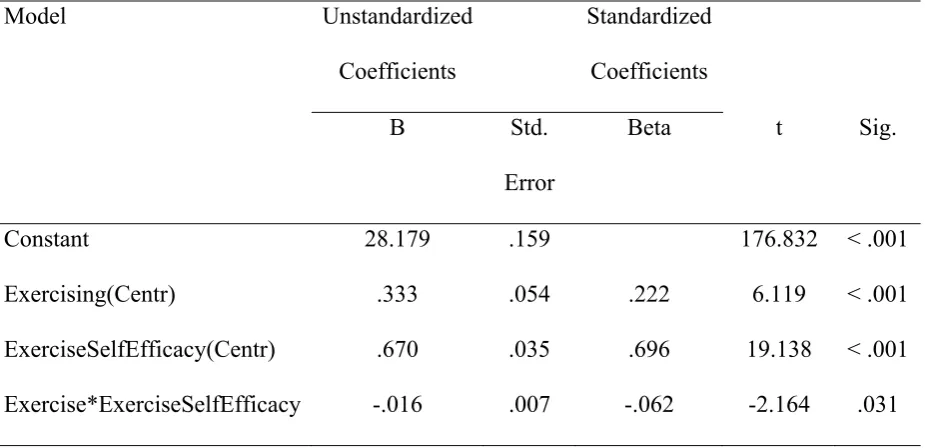
Table 5. Results moderation analyses to see if exercise self-efficacy influences the relationship between the weekly amount of exercising and the use of CHB’s.
Model Unstandardized
Coefficients
Standardized Coefficients
B Std.
Error
Beta t Sig.
Constant 28.179 .159 176.832 < .001
Exercising(Centr) .333 .054 .222 6.119 < .001
ExerciseSelfEfficacy(Centr) .670 .035 .696 19.138 < .001 Exercise*ExerciseSelfEfficacy -.016 .007 -.062 -2.164 .031
Another moderation analyses with making use of CHB’s as dependent, the weekly amount of exercising as independent and exercise self-efficacy as moderator variable was executed to test the fourth hypotheses which states The relationship between the weekly amount of exercising and the use of CHB’s is moderated by a persons’ exercise self-efficacy. Table 5 shows that there is a positive relationship between the weekly amount of exercising and making use of CHB’s which is negatively influenced by an individuals’ exercise self-efficacy (t= -2.16; p= .03). More specifically, this result shows that the relationship between the weekly amount of exercising and making use of CHB’s is weaker as people have more exercise self-efficacy. Moreover, the weekly amount of exercising as well as the moderator variable both predict significantly the use of CHB’s (p <.001). Therefore, the fourth
hypotheses can be accepted and it can be concluded that moderation takes place.
Discussion
A final result was that CHB’S are associated with exercise related obsessive-compulsiveness. In order to completely understand the following interpretation of the results, it will first be specified under which circumstance people are called addicted exercisers and under which normal ones. It is important to mention that this classification is not based on previous literature, but is data-driven. Based on these findings, a person has to be classified on the one hand as addicted when he/she engages in physical activity 5 times or more per week and on the other hand as normal exerciser when the person does engage in physical activity not more than 4 times a week. In this paper, 12 % of the respondents were classified as addicted exercisers whereas 88 % were not. However, in this paper performance athletes do not fall in the range of addicted exercisers because they engage in physical activity more than 5 times per week out of other reasons than addicted exercisers who engage in physical activity 5 times or more per week because of some psychological reason which leads to addiction.
Another result which also studied the relationship between a persons’ weekly amount of exercising and exercise related obsessive-compulsiveness also took the frequency and intensity (as moderator) with which a person exercises into account. The findings revealed that the relationship between the weekly amount of exercising and exercise related obsessive-compulsiveness is not moderated by the frequency or intensity with which people engage in physical activity. A possible explanation lies in the fact that frequency which is in this case based on the ‘frequency and intensity items’ from the CES (Derakhshanpoor, 2006) measures more an attitude instead of an amount. Besides that, because of the strong correlation between the constructs frequency and intensity and the weekly amount of exercising which leads to redundancy, the moderation is not that relevant anymore. However, the result showed that it is the frequency and intensity itself which predicts the development of exercise related
Furthermore, the second moderation analyses revealed that there is a positive
relationship between the weekly amount of exercise in general and the use of CHB’ and that this relationship is negatively influenced by a persons’ exercise self-efficacy. In other words, the more exercise self-efficacy a person has, the weaker is the relationship between weekly exercising and making use of CHB’s. CHB’s are “beliefs that the negative effects of an unhealthy behaviour can be compensated or neutralized by carrying out a healthy behaviour” (Knäuper et al., 2004) The reciprocal positive relationship between weekly exercising and CHB’s therefore may be explained by the fact that people who engage in physical activity too often and who have low exercise self-efficacy beliefs, try to rationalize their behaviour which results in making use of CHB’s. The fact that a persons’ exercise self-efficacy negatively influences the relationship between the two other variables can be explained by having a more detailed look at what exercise self-efficacy is.
Bandura (1994) defined self-efficacy as “people’s beliefs about their capabilities to produce designated levels of performance that exercise influence over events that affect their lives. Self-efficacy beliefs determine how people feel, think, motivate themselves and
behave”. Besides that, exercise self-efficacy beliefs are characterized by believing in the own capabilities of engaging in physical activity even if there are barriers. These beliefs in turn result in a great motivation to actually engage in physical activity (Neupert et al., 2013).
efficacy beliefs. By contrast, people make use of CHB’s when having low exercise self-efficacy because they try to rationalize their lack of control over their behaviour. This may explain why exercise self-efficacy negatively influences the relationship between the weekly amount of exercising and making use of CHB’s.
CHB’s also played an important role by testing if they are associated with exercise related obsessive-compulsiveness. The found relationship can be explained by saying that people use CHB’s to rationalize the engagement in an unhealthy behaviour (Knäuper et al., 2004). If a person rationalizes the behaviour each time when engaging in physical activity, this is a repeated process which can lead the CHB’s becoming obsessive ("Obsessive-Compulsive Disorder | Psychology Today," 2017). Nevertheless, it can be assumed that the person engages in the same amount of physical activity as before to get rid of the other obsessions and thoughts which results in the compulsive side.
to outcome expectations. More specifically, this is the case because positive affect represents high energy which in turn leads to euphoria.
Strengths and Limitations
Although this study revealed several significant results, some methodological limitations exist which will be explained in the following. First, the sample size of addicted exercisers was with only 40 respondents relatively small. Because of this, the findings represented by only this group do not have the same variance as the findings represented by both groups together. One explanation for the limitation of only 40 addicted exercisers can be that it was difficult to get access to addicted exercisers and that there were only two questions which were aimed at finding out the level of physical activity a person engages in. More specifically, in this paper, addicted exercise was characterized by engaging in physical activity 5 times or more per week, whereas normal exercise was characterized by engaging in physical activity not more than 4 times per week. Nevertheless, the overall sample size with 331 respondents had great power. This also is a strength of the current study.
A limitation which is very important to mention is the great overlap between the constructs ‘frequency/intensity’ and ‘weekly amount of exercising’. In table 3 it can be seen that these two constructs are highly correlated with each other with a correlation coefficient of
r = .86. This indicates that the two constructs are often overlapping regarding what they exactly measure. Therefore, it can be assumed that they measure the same construct and not two different ones which in turn leads to redundancy. Because of this, it can be said that the importance of the first moderation analyses is reduced based on the overlap between the constructs. However, this limitation can be explained by another one, namely that the labels of the constructs used sometimes represented other constructs than the ones expected at the beginning. Therefore, some constructs were changed during the working process which finally resulted in using the constructs of CHB’s, exercise related obsessive-compulsiveness, outcome expectations and exercise self-efficacy. However, these constructs were clear and manageable which leads to valid and reliable results.
Future research
Although this study gave interesting insights in how exercise related obsessive-compulsiveness, CHB’s and outcome expectations are related to normal and addicted exercisers, there are many interesting topics for future research regarding physical activity. First, it could be very interesting to look at cultural or gender differences regarding physical activity and the amount of dependence which can result from excessive exercising. Gender differences could be especially interesting because in this study 72% of the respondents were female. Second, it also could be worth the effort to explore how obsessive-compulsiveness in exercising can be prevented or which CHB’s are most often combined with exercise addiction and how to prevent them. Furthermore, a study in clinical settings with addicted exercisers and other addicted people could be interesting to conduct to see if there are similarities as well as differences in their cognitions, CHB’s and behaviours. In addition, studying how to
increase positive outcome expectations and exercise self-efficacy but without causing obsessive-compulsiveness could be interesting as well as important to prevent negative consequences.
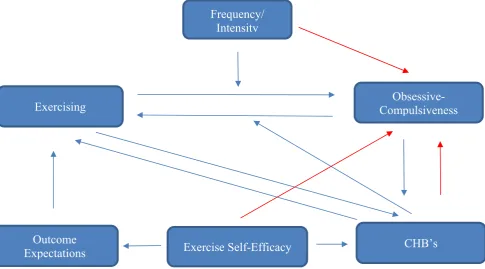
Finally, something which is interesting to mention regarding the constructs used in this study is that they may form a larger whole by influencing each other reciprocally. In this study, some causal relationships were explored whereas other were not. However, it is important to mention that all the constructs contribute to an explanation of the (problem) behaviour in question – (normal or addicted) exercising. Because of this reason, it would be worth the effort to do research where all the constructs with some of their possible
Figure 1. Possible relationships to study in future research to see if the constructs form a bigger picture of causality.
Practical implications
The results of the study show that it is important to pay more attention to the topic of exercise addiction and its’ prevention. Even though 12% of the respondents were classified as addicted to exercise, 33% of the sample lies within a range of being at risk for developing exercise addiction which means exercising more than 3 times a week. Furthermore, although physical activity itself is a healthy behaviour, it is important to not underestimate the risk for
dependency and its resulting negative consequences for the body as well as the mind of the addicted person. To prevent exercise addiction, it could be helpful to inform people before starting eg. Going to the gym, what the negative health consequences of too much exercising could be and what for healthy alternatives exist in case of weight regulation, eating disorder, stress regulation, etc. Furthermore, it is not only important to inform the person who wants to engage in physical activity, but also to inform parents or peers so that people can pay
attention to the level of physical activity others are engaging in and if necessary, remind them
Frequency/ Intensity
Outcome
References
Bandura, A. (1991). Social cognitive theory of self-regulation. Organizational Behavior and Human Decision Processes, 50(2), 248-287. doi:10.1016/0749-5978(91)90022-l Bandura, A. (1994). Self-Efficacy. Encyclopedia of human behavior, 4, 71-81.
doi:10.4135/9780857025753.n178
Baron, R. M., & Kenny, D. A. (1986). The moderator-mediator variable distinction in social psychological research: Conceptual, strategic, and statistical considerations. Journal of Personality and Social Psychology, 51(6), 1173-1182.
doi:10.1037//0022-3514.51.6.1173
Berczik, K., Szabó, A., Griffiths, M. D., Kurimay, T., Kun, B., Urbán, R., & Demetrovics, Z. (2012). Exercise Addiction: Symptoms, Diagnosis, Epidemiology, and Etiology.
Substance Use & Misuse, 47(4), 403-417. doi:10.3109/10826084.2011.639120 Błachno, M., Bryńska, A., Tomaszewicz-Libudzic, C., Jagielska, G., Srebnicki, T.,
Wiśniewski, A., & Wolańczyk, T. (2016). Obsessive-compulsive symptoms and physical activity in patients with anorexia nervosa: possible relationships. Psychiatria Polska, 50(1), 55-64. doi:10.12740/pp/34810
Boscarino, J. A. (1994). Book Reviews : Measuring Functioning and Well-Being: The
Medical Outcomes Study Approach Edited by Anita L. Stewart and John E. Ware, Jr., with a foreword by Alvin R. Tarlow. Durham, NC: Duke University Press, 1992. 449 pages. Medical Care Research and Review, 51(1), 114-117.
doi:10.1177/107755879405100107
Chen, C. (1968). A study of the alcohol-tolerance effect and an introduction of a new behavioural technique. Psychopharmacologia, 12(5), 433-440.
doi:10.1007/bf00401349
Derakhshanpoor, A., Vaez Mousavi, M., & Taheri, H. R. (2016). Introducing the
Questionnaire of Commitment to Exercise. Global Journal of Health Science, 9(6), 151. doi:10.5539/gjhs.v9n6p151
De Vries, H. A. (1981). Tranquilizer effect of exercise: A critical review. The Physician and Sports Medicine, 9(11), 47-53
Goodman, A. (1990). Addiction: Definition and Implications. British Journal of Addictions, 85(11), 1403-1408.
Guidi, J., Pender, M., Hollon, S. D., Zisook, S., Schwartz, F. H., Pedrelli, P., … Petersen, T. J. (2009). The prevalence of compulsive eating and exercise among college students: An exploratory study. Psychiatry Research, 165(1-2), 154-162.
doi:10.1016/j.psychres.2007.10.005
Hamer, M., & Karageorghis, C. I. (2007). Psychobiological mechanisms of exercise dependence. Sports Medicine, 37(6), 477-484.
Knäuper, B., Rabiau, M., Cohen, O., & Patriciu, N. (2004). Compensatory health beliefs: theory and measurement. Psychology & Health, 19(5), 607-624.
doi:10.1080/0887044042000196737
Landolfi, E. (2013). Exercise Addiction. Sports Medicine, 43(2), 111-119. doi:10.1007/s40279-012-0013-x
Lejoyeux, M., Avril, M., Richoux, C., Embouazza, H., & Nivoli, F. (2008). Prevalence of exercise dependence and other behavioral addictions among clients of a Parisian fitness room. ComprehensivePsychiatry, 49, 353 – 358.
Lichtenstein, M. B., Christiansen, E., Elklit, A., Bilenberg, N., & Støving, R. K. (2014). Exercise addiction: A study of eating disorder symptoms, quality of life, personality traits and attachment styles. Psychiatry Research, 215(2), 410-416.
Morgan, W.P. (1979). Negative addiction in runners. The Physician and Sports Medicine, 7, 57-70.
Neupert, S. D., Lachman, M. E., & Whitbourne, S. B. (2013). Exercise Self-Efficacy and Control Beliefs: Effects on Exercise Behavior after an Exercise Intervention for Older Adults. Journal of Aging and Physical Activity, 17(1), 1-16. doi:10.1123/japa.17.1.1 Obsessive-Compulsive Disorder | Psychology Today. (2017, March 23). Retrieved from
https://www.psychologytoday.com/conditions/obsessive-compulsive-disorder Stewart, J., & Badiani, A. (1993). Tolerance and sensitization to the behavioral effects of
drugs. Behavioural Pharmacology, 4(4), 289???312. doi:10.1097/00008877-199308000-00003
Sussman, S., & Sussman, A. N. (2011). Considering the Definition of Addiction. International Journal of Environmental Research and Public Health, 8(12), 4025-4038.
doi:10.3390/ijerph8104025
Szabo, A. (1995). The impact of exercise deprivation on well-being of habitual exercisers.
Australian Journal of Science and Medicine in Sport, 27, 68-75.
Terry, A., Szabo, A., & Griffiths, M. (2004). The exercise addiction inventory: a new brief screening tool. Addiction Research and Theory, 12(5), 489-499.
doi:10.1080/16066350310001637363
Watson, D., Clark, L. A., & Tellegen, A. (1988). Development and validation of brief measures of positive and negative affect: The PANAS scales. Journal of Personality and Social Psychology, 54(6), 1063-1070. doi:10.1037//0022-3514.54.6.1063 Webster, M. (1828). Fascination | Definition of Fascination by Merriam-Webster. Retrieved
Wilde, Elena te (2013). Compensatory Health Beliefs: The Development of an Eating-Specific
Appendix Appendix A: Questionnaire
Bachelorthesis CHB
Q66 Dear participant,
This questionnaire is carried out in the context of our bachelor thesis. It is drafted to measure the effects of binge-watching and excessive exercise on health outcomes. The details and results of the research will only be anonymous and confidential announced to third parties. There are no right or wrong answers and you reserve the right to terminate from participating in this study at any time without giving reasons. By taking part in this survey, you automatically agree with the abovementioned (informed consent). Thank you very much for your time and honest answers. Ann-Christin Klein, Kira Oberschmidt and Marieke Prinsen.
Q1 What is your age?
Q2 What is your gender? Male (1)
Female (2)
Q3 Employment status Student (1)
Employed (2) Unemployed (3) Other (4)
Q4 What is your height in cm? Example answer: 165
Q77 In the following part, please state how much you agree with the statements.
Not at all (1) A little (2) Somewhat (3)
Quite a bit (4)
Very much (5)
The effects of regularly
drinking alcohol can be made up for by eating
healthy (1)
It is alright to drink a lot of
alcohol as long as one drinks lots of water to flush
it (2)
Smoking from time to time is OK if
one eats healthy (3)
The effects of drinking coffee can be
balanced by drinking equal amounts of water (4)
The effects of drinking too much alcohol
during the weekend can
be made up for by not
Q78 In the following part, please state how much you agree with the statements.
Not at all (1) A little (2) Somewhat (3)
Quite a bit (4)
Very much (5)
Too little sleep during the week can
be compensated
for by sleeping in on
the weekends (1)
It is OK to go to bed late if one can sleep
longer the next morning (only the number of hours counts) (2)
It is OK to skip breakfast
if one eats more during lunch or dinner (3) Eating whatever one
wants in the evening is OK if one did not eat during the entire day
(4)
Q79 In the following part, please state how much you agree with the statements.
Not at all (1) A little (3) Somewhat (4)
Quite a bit (5)
Very much (6)
Stress during the week can be made up
for by relaxing on the weekend
(1)
A stressful day can be compensated
for by relaxing in front of the
TV (2)
The bad effects of stress can be
made up for by exercising
(3)
Sleep compensates for stress (4)
Q80 In the following part, please state how much you agree with the statements.
Not at all (1) A little (2) Somewhat (3)
Quite a bit (4)
Very much (5)
Eating dessert can be made
up for by skipping the main dish (1)
Using artificial sweeteners compensates for extra calories (2) Breaking a diet today may be compensated for by starting a new
diet tomorrow (3)
Not at all (1) A little (2) Somewhat (3)
Quite a bit (4)
Very much (5)
It’s okay to watch multiple episodes of a
series if I worked hard
that day (1)
A night/evening
of watching multiple episodes of a series can be compensated by not watching television another night (2) I can
night of watching
multiple episodes of a
series if I study extra
hard tomorrow (3)
After a good work-out I
deserve to watch multiple episodes of a
series (4)
If I eat healthy it’s okay to watch
multiple episodes of a
series (5)
After I studied for a long while I
can treat myself by
watching multiple episodes of a
series (6)
A day of much television watching can
be made up for by exercising more the next
day (7)
A day of much television watching can
be made up for eating less
unhealthy food (8)
Q86 The following questions are about television watching as well as on-demand streaming websites. An example of such a website is Netflix. Please answer the questions with regards to watching series online.
Q66 In the past 7 days, on how many days did you watch more than two episodes of the same TV series in the same sitting (one immediately after the other)?
0 days (1) 1 day (2) 2 days (3) 3 days (4) 4 days (5) 5 days (6) 6 days (7) 7 days (8)
Q84 Thinking of the last time you watched more than two consecutive episodes of the same TV show in the same sitting, how many consecutive episodes of the same TV show(one after the other) did you watch?
Q85 Thinking of the last time your watched more than two consecutive episodes of the same TV show in the same sitting, how many hours did you spend watching the TV show? (in hours, rounded to nearest half hour)
Q68 How do you usually watch series? Always alone (1)
Mostly alone (2)
Equally often alone as with others (3) Mostly with others (4)
Always with others (5)
Q87 Who do you usually watch series with I watch alone (1)
Q70 What genre of series do you watch most Action, Adventure, Western (1)
Animation, Family (2)
Biography, Documentary, News, Talk-show (3) Comedy (4)
Crime, Thriller, Horror (5) Drama (6)
Game-show, Reality-TV (7) History, War (8)
Music, Musical (9)
Fantasy, Mystery, Sci-Fi (10) Romance (11)
Short (12) Sport (13)
Q72 When do you usually watch series? During daytime (1)
Equally often during daytime and nighttime (2) During nighttime (between 12 and 8am) (3)
Q74 How many different series do you watch regularly?
Q83 The following questions will give you an opportunity to tell us more about your physical activity.
Q6 When I do not exercise, I feel regret and guilty. totally disagree (1)
disagree (2) neutral (3) agree (4) totally agree (5)
Q7 I feel so energetic and happy after one set of exercising. totally disagree (1)
Q9 If I quit exercising, it will have some negative effects on my health. totally disagree (1)
disagree (2) neutral (3) agree (4) totally agree (5)
Q10 I believe whenever I planned for exercising, I succeeded in doing that. totally disagree (1)
disagree (2) neutral (3) agree (4) totally agree (5)
Q11 I exercise because of my inner desire, not anyone else’s motivations. totally disagree (1)
disagree (2) neutral (3) agree (4) totally agree (5)
Q12 I feel proud of myself because I have regular exercising compared to my peers. totally disagree (1)
disagree (2) neutral (3) agree (4) totally agree (5)
Q13 I daydream about my fitness which is the fruit of my exercise. totally disagree (1)
Q14 I ponder about my exercise schedule. totally disagree (1)
disagree (2) neutral (3) agree (4) totally agree (5)
Q15 My best friend likes exercising. Strongly disagree (1)
Somewhat disagree (2) Neither agree nor disagree (3) Somewhat agree (4)
Strongly agree (5)
Q16 Whenever I have been recommended to exercise by my doctor, friend and etc. I tried to do so.
Strongly disagree (1) Somewhat disagree (2) Neither agree nor disagree (3) Somewhat agree (4)
Strongly agree (5)
Q17 I encourage my friends to exercise. Strongly disagree (1)
Somewhat disagree (2) Neither agree nor disagree (3) Somewhat agree (4)
Strongly agree (5)
Q18 I have important people (spouse, child and friends) in my life who believe I should exercise.
Strongly disagree (1) Somewhat disagree (2) Neither agree nor disagree (3) Somewhat agree (4)
Q19 Important people in my life (spouse, child and friends) manage their schedule in a way that matches my exercise schedule.
Strongly disagree (1) Somewhat disagree (2) Neither agree nor disagree (3) Somewhat agree (4)
Strongly agree (5)
Q20 Exercising is an opportunity to hang out with my friends. Strongly disagree (1)
Somewhat disagree (2) Neither agree nor disagree (3) Somewhat agree (4)
Strongly agree (5)
Q21 I try to find a friend or a companion in sports venues. Strongly disagree (1)
Somewhat disagree (2) Neither agree nor disagree (3) Somewhat agree (4)
Strongly agree (5)
Q22 I exercise every day. Strongly disagree (1) Somewhat disagree (2) Neither agree nor disagree (3) Somewhat agree (4)
Strongly agree (5)
Q23 I exercise at least three days a week. Strongly disagree (1)
Somewhat disagree (2) Neither agree nor disagree (3) Somewhat agree (4)
Q24 If I miss one day of my exercise schedule, I try to make it up on other day. Strongly disagree (1)
Somewhat disagree (2) Neither agree nor disagree (3) Somewhat agree (4)
Strongly agree (5)
Q25 I have specified a particular time for exercising. Strongly disagree (1)
Somewhat disagree (2) Neither agree nor disagree (3) Somewhat agree (4)
Strongly agree (5)
Q26 Sometimes I miss my exercise due to the lack of energy or time. Strongly disagree (1)
Somewhat disagree (2) Neither agree nor disagree (3) Somewhat agree (4)
Strongly agree (5)
Q27 I quit exercising because of different reasons (lack of time, having a career, family issues, bad weather and insecurities).
Strongly disagree (1) Somewhat disagree (2) Neither agree nor disagree (3) Somewhat agree (4)
Strongly agree (5)
Q28 I miss my exercise sessions due to the daily life issues. Strongly disagree (1)
Somewhat disagree (2) Neither agree nor disagree (3) Somewhat agree (4)
Q29 I believe whenever I miss some of my exercise sessions, I experience some troubles starting a new schedule.
Strongly disagree (1) Somewhat disagree (2) Neither agree nor disagree (3) Somewhat agree (4)
Strongly agree (5)
Q89 How often do you engage in physical activity (fitness, soccer, tennis, etc.) per week? 0-3 times (1)
More than 3 times (2)
Q30 Think about your level of physical activity from the last 7 days. How many times during the last weeek did you engage in physical activity?
0 (1) 1-2 (2) 3-4 (3) 5-6 (4)
7 times or more (5)
Q31 How many hours did you engage in physical activity per session? 1 (1)
2 (2) 3 (3) 4 (4)
5 or more hours (5)
Q33 I engage in physical activity to feel good about myself. Strongly disagree (1)
Somewhat disagree (2) Neither agree nor disagree (3) Somewhat agree (4)
Q34 I engage in physical activity because I would like to reward myself. Strongly disagree (1)
Somewhat disagree (2) Neither agree nor disagree (3) Somewhat agree (4)
Strongly agree (5)
Q35 When I engage in sport then because I would like to reduce negative feelings. Strongly disagree (1)
Somewhat disagree (2) Neither agree nor disagree (3) Somewhat agree (4)
Strongly agree (5)
Q37 I engage in physical activity because I like to see how my body shape changes. Strongly disagree (1)
Somewhat disagree (2) Neither agree nor disagree (3) Somewhat agree (4)
Strongly agree (5)
Q38 The feeling after having engaged in physical activity is a good one. Strongly disagree (1)
Somewhat disagree (2) Neither agree nor disagree (3) Somewhat agree (4)
Strongly agree (5)
Q39 When the positive feeling goes away, I directly want to engage in the activity again, Strongly disagree (1)
Somewhat disagree (2) Neither agree nor disagree (3) Somewhat agree (4)
Q40 I engage in physical activity because I like to socialize with others. Strongly disagree (1)
Somewhat disagree (2) Neither agree nor disagree (3) Somewhat agree (4)
Strongly agree (5)
Q41 I simply engage in physical activity because it’s a hobby of mine. Strongly disagree (1)
Somewhat disagree (2) Neither agree nor disagree (3) Somewhat agree (4)
Strongly agree (5)
Q42 I really like the feeling of having muscle ache. Strongly disagree (1)
Somewhat disagree (2) Neither agree nor disagree (3) Somewhat agree (4)
Strongly agree (5)
Q43 When I quit a sport session earlier than planned, next time I engage in the activity longer to compensate for the missed time.
Strongly disagree (1) Somewhat disagree (2) Neither agree nor disagree (3) Somewhat agree (4)
Strongly agree (5)
Q44 When I planned a session, but cannot realize it, I feel bad. Strongly disagree (1)
Somewhat disagree (2) Neither agree nor disagree (3) Somewhat agree (4)
Q45 When I planned a session, but I cannot realize it, I will plan the session in for another day.
Strongly disagree (1) Somewhat disagree (2) Neither agree nor disagree (3) Somewhat agree (4)
Strongly agree (5)
Q46 When I planned a session, but I cannot realize it, that does not matter to me. Strongly disagree (1)
Somewhat disagree (2) Neither agree nor disagree (3) Somewhat agree (4)
Strongly agree (5)
Q47 Being physically active is like a cycle which I cannot quit. Strongly disagree (1)
Somewhat disagree (2) Neither agree nor disagree (3) Somewhat agree (4)
Strongly agree (5)
Q48 I engage in physical activity because it increased my discipline. Strongly disagree (1)
Somewhat disagree (2) Neither agree nor disagree (3) Somewhat agree (4)
Strongly agree (5)
Q49 Physical activity is relaxation for my mind. Strongly disagree (1)
Somewhat disagree (2) Neither agree nor disagree (3) Somewhat agree (4)
Q50 When I am in the gym, most of the time I talk to others instead of being physically active.
Strongly disagree (1) Somewhat disagree (2) Neither agree nor disagree (3) Somewhat agree (4)
Strongly agree (5)
Q51 When I see others doing sport, I am jealous and want to do the same. Strongly disagree (1)
Somewhat disagree (2) Neither agree nor disagree (3) Somewhat agree (4)
Strongly agree (5)
Q88 The following questions are about your sleeping habits.
Q54 How long did it usually take for you to fall asleep during the past 4 weeks?
Q55 On the average, how many hours did you sleep each night during the past 4 weeks?
Q56 How often during the past 4 weeks did you feel that your sleep was not quiet (moving restlessly, feeling tense, speaking, etc.) while sleeping?
Q57 How often during the past 4 weeks did you get enough sleep to feel rested upon waking in the morning?
Q58 How often during the past 4 weeks did you awaken short of breath or with a headache?
Q59 How often during the past 4 weeks did you feel drowsy or sleepy during the day?
Q61 How often during the past 4 weeks did you awaken during your sleep time and have trouble falling asleep again?
Q62 How often during the past 4 weeks did you have trouble staying awaken during the day?
Q63 How often during the past 4 weeks did you snore during your sleep?
Q64 How often during the past 4 weeks did you take naps (5 minutes or longer) during the day?
Q65 How often during the past 4 weeks did you get the amount of sleep you needed?
Q62 You've reached the end of this study. Thank you for your participation. Beneath you can enter your SONA number if you wish to receive credits for this study (University of Twente students only). You can also submit your e-mail adress if you want to be informed about the outcomes of this study. If you wish to be excluded form the study you can contact the researcher via [email protected]
Q63 NOTE: Students of University of Twente only! Enter your SONA number here to receive credits