72
Zero-shot Relation Classification as Textual Entailment
Abiola Obamuyide Department of Computer Science
University of Sheffield
Andreas Vlachos
Department of Computer Science University of Sheffield
Abstract
We consider the task of relation classification, and pose this task as one of textual entailment. We show that this formulation leads to several advantages, including the ability to (i) perform zero-shot relation classification by exploiting relation descriptions, (ii) utilize existing tex-tual entailment models, and (iii) leverage read-ily available textual entailment datasets, to enhance the performance of relation classifi-cation systems. Our experiments show that the proposed approach achieves 20.16% and 61.32% in F1 zero-shot classification perfor-mance on two datasets, which further im-proved to 22.80% and 64.78% respectively with the use of conditional encoding.
1 Introduction
The task of determining the relation between vari-ous entities from text is an important one for many natural language understanding systems, includ-ing question answerinclud-ing, knowledge base construc-tion and web search. Relaconstruc-tion classificaconstruc-tion is an essential part of many high-performing relation extraction systems in the NIST-organised TAC Knowledge Base Population (TAC-KBP) track (Ji and Grishman,2011;Adel et al.,2016). As a re-sult of its wide application, many approaches and systems have been proposed for this task (Zelenko et al., 2003; Surdeanu et al., 2012;Riedel et al., 2013;Zhang et al.,2017).
A shortcoming common to previous proposed approaches, however, is that they identify only re-lations observed at training time, and are unable to generalize to new (unobserved) relations at test time. To address this challenge, we propose to for-mulate relation classification as follows: Given a unit of text T which mentions a subject X and a candidate object Y of a knowledge base rela-tionR(X, Y), and a natural language description dofR, we wish to evaluate whetherT expresses
R(X, Y). We formulate this task as a textual en-tailment problem in which the unit of text and the relation description can be considered as the premise P and hypothesis H respectively. The challenge then becomes that of determining the truthfulness of the hypothesis given the premise. Table 1 gives examples of knowledge base rela-tions and their natural language descriprela-tions.
This formulation brings a number of advan-tages. First, we are able to perform zero-shot clas-sification of new relations by generalizing from the descriptions of seen training relations to those of unseen relations at test time. Given a collec-tion of relacollec-tions, for instance, spouse(X,Y) and
city of birth(X,Y) together with their natural lan-guage descriptions and training examples, we can learn a model that can classify other instances of these relations, as well as instances of other rela-tions that were not observed at training time, for instance child(X,Y), given their descriptions. In addition to being able to utilize existing state-of-the-art textual entailment models for relation clas-sification, our approach can use distant supervi-sion data together with data from textual entail-ment as additional supervision for relation classi-fication.
Relation Subject (X) Object (Y) Text (Premise) Description (Hypothesis)
religious order Lorenzo Ricci Society of Jesus X(August 1, 1703 – November 24, 1775) was an Italian Jesuit, elected the 18th Superior General of theY.
X was a member of the groupY
director Kispus Erik Balling Xis a 1956 Danish romantic com-edy written and directed byY.
The director ofXisY
designer Red Baron II Dynamix Xis a computer game for the PC, developed by Yand published by Sierra Entertainment.
Yis the designer ofX
Table 1: Examples of relations, entities, sample text instances, and relation descriptions.
2 Related Work
Most recent work, includingAdel et al.(2016) and Zhang et al.(2017), proposed models that assume the availability of supervised data for the task of relation classification. Rockt¨aschel et al. (2015) andDemeester et al.(2016) inject prior knowledge in the form of propositional logic rules to improve relation extraction for new relations with zero and few training labels, in the context of theuniversal schemaapproach (Riedel et al.,2013). They con-sidered the use of propositional logic rules, which for instance, can be mined from external knowl-edge bases (such as Freebase (Bollacker et al., 2008)) or obtained from ontologies such as Word-Net (Miller,1995). However, the use of proposi-tional logic rules assumes prior knowledge of the possible relations between entities, and is thus of limited application in extracting new relations.
Levy et al. (2017) showed that a related and complementary task, that of entity/attribute rela-tion extracrela-tion, can be reduced to a quesrela-tion an-swering problem. The task we address in this work is that of zero-shot relation classification, which determines if a given relation exists between two given entities in text. As a result the output of our approach is a binary classification decision indi-cating whether a given relation exists between two given entities in text. The task performed byLevy et al. (2017) is that of zero-shot entity/attribute
relation extraction, since their approach returns the span corresponding to the relation arguments (”answers”) from the text.1 In addition, our ap-proach for zero-shot relation classification utilizes relation descriptions, which is typically available in relation ontologies, and is thus not reliant on crowd-sourcing.
Our approach also takes inspiration from
var-1Note that for this reason, a direct comparison between
the two approaches is not straightforward, as this would be akin to comparing a text classification model and a question answering model.
ious approaches for leveraging knowledge from a set of source tasks to target tasks, such as re-cent transfer learning methods in natural language processing (Peters et al., 2018; McCann et al., 2017). Closest to our work is that of Conneau et al. (2017), who showed that representations learned from natural language inference data can enhance performance when transferred to a num-ber of other natural language tasks. In this work, we consider the task of zero-shot relation classifi-cation by utilizing relation descriptions.
3 Model
Our approach takes as input two pieces of text, a sentence containing the subject and object entities of a candidate relation, and the relation’s descrip-tion, and returns as output a binary response in-dicating whether the meaning of the description can be inferred between the two entities in the sen-tence. See Table1for some examples. The prob-lem of determining whether the meaning of a text fragment can be inferred from another is that of natural language inference/textual entailment (Da-gan et al.,2005;Bowman et al.,2015).
We take as our base model the Enhanced Se-quential Inference Model (ESIM) introduced by Chen et al. (2017), one of the commonly used models for text pair tasks (?). ESIMutilizes Bidi-rectional Long Short-Term Memory (Hochreiter and Schmidhuber, 1997; Graves and Schmidhu-ber, 2005) (BiLSTM) units as a building block and accepts two sequences of text as input. It then passes the two sequences through three model stages - input encoding, local inference modelling and inference composition, and returns the class cwith the highest classification score, wherecin textual entailment is one ofentailment, contradic-tionorneutral. In our experiments, for each (sen-tence, relation description) pair we return a 2-way classification prediction instead.
en-coding and inference composition stages, which we adapt using conditional encoding as described in the following subsection. The input encoding
and inference composition stages operate analo-gously, and each receives as input two sequences of vectors, {pi} and {hj}, or more compactly
two matrices P ∈ RI×d for the premise and
H ∈RJ×dfor the hypothesis, whereI andJ are
respectively the number of words in the premise and hypothesis, and d is the dimensionality of each vector representation. In the case of the in-put encoding layer, P and H are word embed-dings of words in the premise and hypothesis re-spectively, while in the case ofinference composi-tion, P andH are internal model representations derived from the preceding local inference mod-elling stage. Then the input sequences are pro-cessed with BiLSTM units to yield new sequences
¯
P ∈ RI×2d for the premise andH¯ ∈
RJ×2dfor
the hypothesis:
¯
P ,−→cp,←−cp =BiLST M(P) (1)
¯
H,−→ch,←−ch =BiLST M(H) (2)
where−→cp,←−cp ∈Rdare respectively the last cell
states in the forward and reverse directions of the BiLSTM that reads the premise. −→ch,←−ch ∈ Rd
are similarly defined for the hypothesis.
3.1 Conditional encoding for ESIM
When used for zero-shot relation classification,
ESIM encodes the sentence independently of the relation description. Given a new target relation’s description, it is desirable for representations com-puted for the sentence to take into account the representations for the target relation description. Therefore we explicitly condition the representa-tions of the sentence on that of the relation de-scription using a conditional BiLSTM (cBiLSTM) (Rockt¨aschel et al.,2016) unit. Thus, Equation1 is replaced with:
¯
P =cBiLST M(P,−→ch,←−ch) (3)
where −→ch and ←−ch respectively denote the last
memory cell states in the forward and reverse di-rections of the BiLSTM that reads the relation de-scription. This adaptation is made to both input encoding and inference composition stages. We refer to the adaptedESIM as the Conditioned In-ference Model (CIM) in subsequent sections.
4 Datasets
We evaluate our approach using the datasets of Adel et al. (2016) and (Levy et al., 2017). The dataset ofAdel et al.(2016) (LMU-RC) is split into training, development and evaluation sets. The training set was generated by distant supervision, and the development and test data were obtained from manually annotated TAC-KBP system out-puts. We obtained the descriptions for the relations from the TAC-KBP relation ontology guidelines.2 This resulted in a dataset of about 6 million pos-itive and negative instances, each consisting of a relation, its subject and object entities, a sentence containing both entities and a relation description. We applied a similar process to the relation ex-traction dataset of (Levy et al., 2017) (UW-RE). It consists of 120 relations and a set of question templates for each relation, containing both posi-tive and negaposi-tive relation instances, with each in-stance consisting of a subject entity, a knowledge base relation, a question template for the relation, and a sentence retrieved from the subject entity’s Wikipedia page. We wrote descriptions for each of the 120 relations in the dataset, with each rela-tion’s question templates serving as a guide. Thus all instances in the dataset (30 million positive and 2 million negative ones) now include the corre-sponding relation description, making them suit-able for relation classification using our approach. In addition to the two datasets, we also utilize the MultiNLI natural language inference corpus (Williams et al., 2018) in our experiments as a source of supervision. We map itsentailmentand
contradictionclass instances to positive and nega-tive relation instances respecnega-tively.
5 Experiments and Results
We conduct two sets of experiments. The first set of experiments tests the performance of our approach in the zero-shot setting, where no su-pervision instances are available for new relations (Section 5.1). The second set of experiments measures the performance of our approach in the limited supervision regime, where varying levels of supervision is available (Section5.2).
Implementation Details Our model is im-plemented in Tensorflow (Abadi et al., 2016).
2https://tac.nist.gov/2015/KBP/
Dataset Model F1 (%)
LMU-RC ESIM 20.16
CIM 22.80
UW-RE ESIM 61.32
[image:4.595.314.526.66.202.2]CIM 64.78
Table 2: Zero-shot relation learning results for
ESIMandCIM.
Dataset Supervision F1 (%)
LMU-RC
TE 25.54
TE+DS 26.28
UW-RE
TE 44.38
TE+DS 62.33
Table 3: Zero-shot relation learning results for model CIM pre-trained on two sources of data: Textual Entailment (TE), or both Distant Supervi-sion and Textual Entailment (TE+DS). The results in Table 2 correspond to DS only supervision.
We initialize word embeddings with 300D Glove (Pennington et al., 2014) vectors. We found a few epochs of training (generally less than 5) to be sufficient for convergence. We apply Dropout with a keep probability of 0.9 to all layers. The result reported for each experiment is the average taken over five runs with independent random initializations. In order to prevent overfitting to specific entities, we mask out the subject and object entities with the tokensSUBJECT ENTITY
andOBJECT ENTITYrespectively.
5.1 Zero-shot Relation Learning
For this experiment we created ten folds of each dataset, with each fold partitioned into train/dev/test splits along relations. In each fold, a relation belongs exclusively to either the train, dev or test split.
Table2shows averaged F1 across the folds for the models on theLMU-RCandUW-RE datasets. We observe that using only distant supervision for the training relations and without supervision for the test relations, the models were still able to make predictions for them, though at different performance levels. CIM obtained better perfor-mance compared toESIM, as a result of its use of conditional encoding.
Table 3 shows F1 scores of model CIM pre-trained on only MultiNLI (referred to as TE) or a combination of MultiNLI and distant supervision (referred to as TE+DS) data in the zero-shot
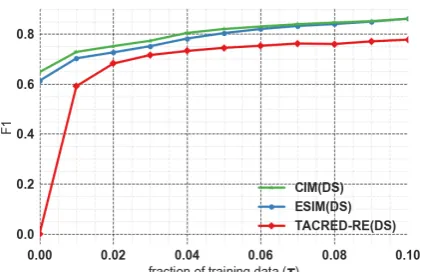
set-Figure 1: Limited supervision results: F1 scores on
UW-RE as fraction of training data (τ) is varied. Whenτ=0, we get the zero-shot results in Table2
ting. We find that CIM pre-trained on only tex-tual entailment data is already able to make pre-dictions for unseen test relations, while using a combination of distant supervision and textual en-tailment data achieved improved F1 scores across both datasets, demonstrating the validity of our ap-proach in this setting. We also note that using TE+DS data performs worse than DS data alone in the case of theUW-RE dataset, unlike in the case ofLMU-RC. We hypothesize that this is because DS data performs much better for the former.
5.2 Few-shot Relation Learning
Figure 2: F1 scores on LMU-RC as fraction of training data (τ) is varied.
performance, with CIM outperforming ESIM in the 0-6% interval. However, beyond this interval, we do not observe any major difference in per-formance between ESIM andCIM, demonstrating that CIM performs well in both the zero-shot and limited supervision settings. For context, when given full supervision on theUW-REdataset,CIM
andTACRED-REobtain F1 scores of 94.82% and 87.73% respectively. A similar trend is observed for theLMU-RCdataset, whose plot can be found in Figure2.
In general, all models obtain better results on
UW-RE than on LMU-RC. We hypothesize that the performance difference is due toUW-REbeing derived from Wikipedia documents (which typi-cally have well-written text), while LMU-RC was obtained from different genres and sources (such as discussion forum posts and web documents), which tend to be noisier.
5.3 Qualitative Results
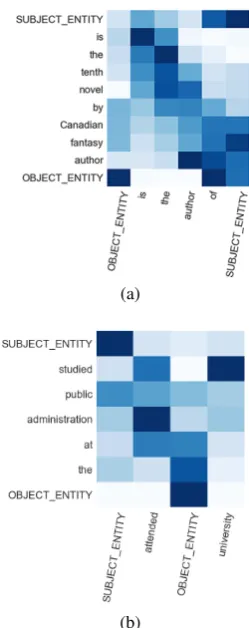
Figure3depicts a visualization of the normalized attention weights assigned by model CIM on in-stances drawn from the development set. We ob-serve that it is able to attend to words that are se-mantically coherent with the premise (”novel” and ”author”, Figure 3a), (”studied” and ”university”, Figure 3b).
6 Conclusions
We show that the task of relation classification can be achieved through the use of relation descrip-tions, by formulating the task as one of textual en-tailment between the relation description and the piece of text. This leads to several advantages, in-cluding the ability to perform zero-shot relation
(a)
(b)
Figure 3: Attention visualization
classification and use textual entailment models and datasets to improve performance.
Acknowledgments
We are grateful to Pasquale Minervini and Jeff Mitchell for helpful conversations and sugges-tions, and the Sheffield NLP group and anony-mous reviewers for valuable feedback. This re-search is supported by the EU H2020 SUMMA project (grant agreement number 688139).
References
Martin Abadi, Paul Barham, Jianmin Chen, Zhifeng Chen, Andy Davis, Jeffrey Dean, Matthieu Devin, Sanjay Ghemawat, Geoffrey Irving, Michael Isard, and Others. 2016. TensorFlow: A System for Large-Scale Machine Learning. In OSDI, volume 16, pages 265–283.
[image:5.595.76.290.68.204.2]Kurt Bollacker, Colin Evans, Praveen Paritosh, Tim Sturge, and Jamie Taylor. 2008. Freebase: a col-laboratively created graph database for structuring human knowledge. SIGMOD 08 Proceedings of the 2008 ACM SIGMOD international conference on Management of data, pages 1247–1250.
Samuel R. Bowman, Gabor Angeli, Christopher Potts, and Christopher D. Manning. 2015. A large anno-tated corpus for learning natural language inference. InEMNLP.
Qian Chen, Xiaodan Zhu, Zhen-Hua Ling, Si Wei, Hui Jiang, and Diana Inkpen. 2017. Enhanced lstm for natural language inference. In Proceedings of the 55th Annual Meeting of the Association for Compu-tational Linguistics (Volume 1: Long Papers), pages 1657–1668. Association for Computational Linguis-tics.
Alexis Conneau, Douwe Kiela, Holger Schwenk, Lo¨ıc Barrault, and Antoine Bordes. 2017. Supervised Learning of Universal Sentence Representations from Natural Language Inference Data. In Proceed-ings of the 2017 Conference on Empirical Methods in Natural Language Processing, pages 670–680. Association for Computational Linguistics.
Ido Dagan, Oren Glickman, and Bernardo Magnini. 2005. The PASCAL Recognising Textual Entail-ment Challenge. InMachine Learning Challenges, Evaluating Predictive Uncertainty, Visual Object Classification and Recognizing Textual Entailment, First PASCAL Machine Learning Challenges Work-shop, MLCW 2005, Southampton, UK, April 11-13, 2005, Revised Selected Papers, pages 177–190.
Thomas Demeester, Tim Rockt¨aschel, and Sebastian Riedel. 2016. Lifted Rule Injection for Relation Em-beddings. Proceedings of the 2016 Conference on Empirical Methods in Natural Language Processing (EMNLP-16), pages 1389–1399.
Alex Graves and J¨urgen Schmidhuber. 2005. Frame-wise phoneme classification with bidirectional LSTM networks. In Proceedings of the Interna-tional Joint Conference on Neural Networks, vol-ume 4, pages 2047–2052.
Sepp Hochreiter and J¨urgen Schmidhuber. 1997. Long Short-Term Memory. Neural Computation, 9(8):1735–1780.
Heng Ji and Ralph Grishman. 2011. Knowledge base population: Successful approaches and challenges. In Proceedings of the 49th Annual Meeting of the Association for Computational Linguistics: Human Language Technologies, pages 1148–1158. Associ-ation for ComputAssoci-ational Linguistics.
Omer Levy, Minjoon Seo, Eunsol Choi, and Luke Zettlemoyer. 2017. Zero-Shot Relation Extraction via Reading Comprehension.
Bryan McCann, James Bradbury, Caiming Xiong, and Richard Socher. 2017. Learned in translation: Con-textualized word vectors. InAdvances in Neural In-formation Processing Systems, pages 6297–6308.
George A. Miller. 1995. WordNet: a lexical database for English. Communications of the ACM, 38(11):39–41.
Jeffrey Pennington, Richard Socher, and Christopher D Manning. 2014. GloVe: Global Vectors for Word Representation. In Empirical Methods in Natural Language Processing (EMNLP), pages 1532–1543.
Matthew E Peters, Mark Neumann, Mohit Iyyer, Matt Gardner, Christopher Clark, Kenton Lee, and Luke Zettlemoyer. 2018. Deep contextualized word rep-resentations. InProc. of NAACL.
Sebastian Riedel, Limin Yao, Andrew McCallum, and Benjamin M. Marlin. 2013. Relation Extraction with Matrix Factorization and Universal Schemas.
Proceedings of the 2013 Conference of the North American Chapter of the Association for Computa-tional Linguistics: Human Language Technologies, (June):74–84.
Tim Rockt¨aschel, Edward Grefenstette, Karl Moritz Hermann, Tomas Kocisky, and Phil Blunsom. 2016. Reasoning about entailment with neural attention. InInternational Conference on Learning Represen-tations (ICLR).
Tim Rockt¨aschel, Sameer Singh, and Sebastian Riedel. 2015. Injecting logical background knowledge into embeddings for relation extraction. InNAACL HLT 2015, The 2015 Conference of the North American Chapter of the Association for Computational Lin-guistics: Human Language Technologies, Denver, Colorado, USA, May 31 - June 5, 2015, pages 1119– 1129.
Mihai Surdeanu, Julie Tibshirani, Ramesh Nallapati, and Christopher D Manning. 2012. Multi-instance Multi-label Learning for Relation Extraction. Pro-ceedings of the 2012 Joint Conference on Empirical Methods in Natural Language Processing and Com-putational Natural Language Learning, EMNLP ’12, (July):455–465.
Adina Williams, Nikita Nangia, and Samuel Bowman. 2018. A broad-coverage challenge corpus for sen-tence understanding through inference. In Proceed-ings of the 2018 Conference of the North American Chapter of the Association for Computational Lin-guistics: Human Language Technologies, Volume 1 (Long Papers), pages 1112–1122, New Orleans, Louisiana. Association for Computational Linguis-tics.