Improved Decipherment of Homophonic Ciphers
Malte Nuhn and Julian Schamper and Hermann Ney
Human Language Technology and Pattern Recognition
Computer Science Department, RWTH Aachen University, Aachen, Germany
<surname>@cs.rwth-aachen.de
Abstract
In this paper, we present two improve-ments to the beam search approach for solving homophonic substitution ciphers presented in Nuhn et al. (2013): An im-proved rest cost estimation together with an optimized strategy for obtaining the or-der in which the symbols of the cipher are deciphered reduces the beam size needed to successfully decipher the Zodiac-408 cipher from several million down to less than one hundred: The search effort is re-duced from several hours of computation time to just a few seconds on a single CPU. These improvements allow us to success-fully decipher the second part of the fa-mous Beale cipher (see (Ward et al., 1885) and e.g. (King, 1993)): Having182 differ-ent cipher symbols while having a length of just 762symbols, the decipherment is way more challenging than the decipher-ment of the previously deciphered Zodiac-408cipher (length 408, 54different sym-bols). To the best of our knowledge, this cipher has not been deciphered automati-cally before.
1 Introduction
State-of-the-art statistical machine translation sys-tems use large amounts of parallel data to estimate translation models. However, parallel corpora are expensive and not available for every domain.
Decipherment uses only monolingual data to train a translation model: Improving the core deci-pherment algorithms is an important step for mak-ing decipherment techniques useful for trainmak-ing practical machine translation systems.
In this paper we present improvements to the beam search algorithm for deciphering homo-phonic substitution ciphers as presented in Nuhn
et al. (2013). We show significant improvements in computation time on the Zodiac-408cipher and show the first decipherment of part two of the Beale ciphers.
2 Related Work
Regarding the decipherment of 1:1 substitution ci-phers, various works have been published: Most older papers do not use a statistical approach and instead define some heuristic measures for scoring candidate decipherments. Approaches like Hart (1994) and Olson (2007) use a dictionary to check if a decipherment is useful. Clark (1998) defines other suitability measures based on n-gram counts and presents a variety of optimization techniques like simulated annealing, genetic algorithms and tabu search. On the other hand, statistical ap-proaches for 1:1 substitution ciphers are published in the natural language processing community: Ravi and Knight (2008) solve 1:1 substitution ci-phers optimally by formulating the decipherment problem as an integer linear program (ILP) while Corlett and Penn (2010) solve the problem using A∗ search. Ravi and Knight (2011) report the
first automatic decipherment of the Zodiac-408 ci-pher. They use a combination of a 3-gram lan-guage model and a word dictionary. As stated in the previous section, this work can be seen as an extension of Nuhn et al. (2013). We will there-fore make heavy use of their definitions and ap-proaches, which we will summarize in Section 3.
3 General Framework
In this Section we recap the beam search frame-work introduced in Nuhn et al. (2013).
3.1 Notation
We denote the ciphertext with fN
1 =
f1. . . fj. . . fN which consists of cipher
tokens fj ∈ Vf. We denote the plain-text with eN
1 = e1. . . ei. . . eN (and its vocabulary Ve respectively). We define e0 = f0 = eN+1 = fN+1 = $ with “$” being a special sentence boundary token. Homo-phonic substitutions are formalized with a general function φ : Vf → Ve. Following (Corlett and Penn, 2010), cipher functionsφ, for which not all φ(f)’s are fixed, are called partial cipher func-tions. Further, φ0 is said to extend φ, if for all
f ∈ Vf that are fixed in φ, it holds thatf is also fixed in φ0 with φ0(f) = φ(f). The cardinality
ofφcounts the number of fixed f’s inφ. When talking about partial cipher functions we use the notation for relations, in whichφ⊆Vf ×Ve.
3.2 Beam Search
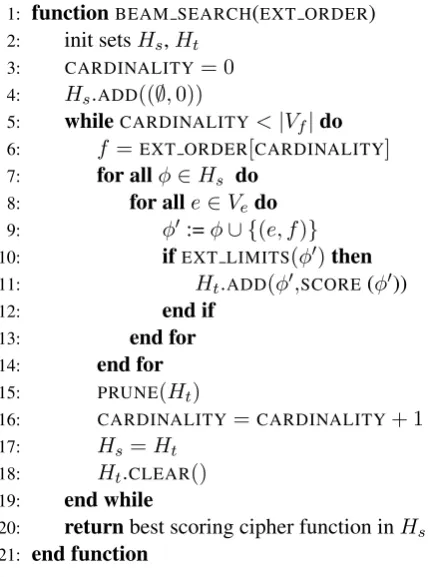
The main idea of (Nuhn et al., 2013) is to struc-ture all partial φ’s into a search tree: If a cipher containsN unique symbols, then the search tree is of heightN. At each level a decision about then -th symbol is made. The leaves of -the tree form full hypotheses. Instead of traversing the whole search tree, beam search descents the tree top to bottom and only keeps the most promising candidates at each level. Practically, this is done by keeping track of all partial hypotheses in two arraysHsand Ht. During search all allowed extensions of the partial hypotheses inHsare generated, scored and put into Ht. Here, the functionEXT ORDER (see Section 5) chooses which cipher symbol is used next for extension,EXT LIMITSdecides which ex-tensions are allowed, and SCORE (see Section 4) scores the new partial hypotheses. PRUNE then selects a subset of these hypotheses. Afterwards the array Ht is copied to Hs and the search pro-cess continues with the updated arrayHs. Figure 1 shows the general algorithm.
4 Score Estimation
The score estimation function is crucial to the search procedure: It predicts how good or bad a partial cipher functionφmight become, and there-fore, whether it’s worth to keep it or not.
To illustrate how we can calculate these scores, we will use the following example with vocabular-iesVf = {A, B, C, D}, Ve = {a, b, c, d}, exten-sion order(B, C, A, D), and cipher text1
φ(fN
1 )=$ ABDD CABC DADC ABDC $
1We include blanks only for clarity reasons.
1: functionBEAM SEARCH(EXT ORDER) 2: init setsHs,Ht
3: CARDINALITY= 0 4: Hs.ADD((∅,0))
5: whileCARDINALITY<|Vf|do 6: f =EXT ORDER[CARDINALITY] 7: for allφ∈Hs do
8: for alle∈Vedo 9: φ0:=φ∪ {(e, f)} 10: ifEXT LIMITS(φ0)then 11: Ht.ADD(φ0,SCORE(φ0))
12: end if
13: end for
14: end for
15: PRUNE(Ht)
16: CARDINALITY=CARDINALITY+ 1 17: Hs =Ht
18: Ht.CLEAR() 19: end while
[image:2.595.310.527.68.357.2]20: returnbest scoring cipher function inHs 21: end function
Figure 1: The general structure of the beam search algorithm for decipherment of substitution ciphers as presented in Nuhn et al. (2013). This paper im-proves the functionsSCOREandEXT ORDER.
and partial hypothesisφ= {(A, a),(B, b)}. This yields the following partial decipherment
φ(fN
1 )=$ ab.. .ab. .a.. ab.. $
The score estimation function can only use this partial decipherment to calculate the hypothesis’ score, since there are not yet any decisions made about the other positions.
4.1 Baseline
the score at all. In practical decipherment, like e.g. the Zodiac-408cipher, this forms a real problem: While making the first decisions—i.e. traversing the first levels of the search tree—only very few terms actually contribute to the score estimation, and thus only give a very coarse score. This makes the beam search ”blind” when not many symbols are deciphered yet. This is the reason, why Nuhn et al. (2013) need a large beam size of several mil-lion hypotheses in order to not lose the right hy-pothesis during the first steps of the search.
4.2 Improved Rest Cost Estimation
The rest cost estimator we present in this paper solves the problem mentioned in the previous sec-tion by also including lower ordern-grams: In the example mentioned before, we would also include unigram scores into the rest cost estimate, yielding a score ofp(a|$)·p(b|a)·13·p(a)·p(b|a)·12·p(a)12· p(a)·p(b|a)·12. Note that this is not a simple lin-ear interpolation of differentn-gram trivial scores: Each symbol is scored only using the maximum amount of context available. This heuristic is non-admissible, since an increased amount of context can always lower the probabilty of some symbols. However, experiments show that this score estima-tion funcestima-tion works great.
5 Extension Order
Besides having a generally good scoring function, also the order in which decisions about the cipher symbols are made is important for obtaining reli-able cost estimates. Generally speaking we want an extension order that produces partial decipher-ments that contain useful information to decide whether a hypothesis is worth being kept or not as early as possible.
It is also clear that the choice of a good ex-tension order is dependent on the score estima-tion funcestima-tion SCORE. After presenting the previ-ous state of the art, we introduce a new extension order optimized to work together with our previ-ously introduced rest cost estimator.
5.1 Baseline
In (Nuhn et al., 2013), two strategies are pre-sented: One which at each step chooses the most frequent remaining cipher symbol, and another, which greedily chooses the next symbol to max-imize the number of contiguously fixed n-grams in the ciphertext.
LM order Zodiac-Perplexity408 Beale Pt. 2
1 19.49 18.35
2 14.09 13.96
3 12.62 11.81
4 11.38 10.76
5 11.19 9.33
6 10.13 8.49
7 10.15 8.27
[image:3.595.326.502.62.208.2]8 9.98 8.27
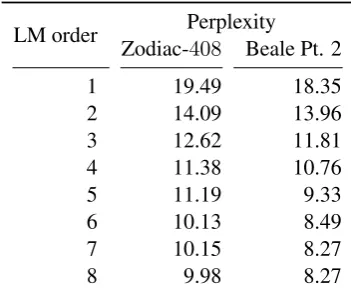
Table 1: Perplexities of the correct decipherment of Zodiac-408 and part two of the Beale ciphers using the character based language model used in beam search. The language model was trained on the English Gigaword corpus.
5.2 Improved Extension Order
Each partial mappingφdefines a partial decipher-ment. We want to choose an extension order such that all possible partial decipherments following this extension order are as informative as possible: Due to that, we can only use information about whichsymbols will be deciphered, not their actual decipherment. Since our heuristic is based onn -grams of different orders, it seems natural to evalu-ate an extension order by counting how many con-tiguously deciphered n-grams are available: Our new strategy tries to find an extension order op-timizing the weighted sum of contiguously deci-pheredn-gram counts2
N
X
n=1
wn·#n.
Herenis then-gram order,wnthe weight for or-dern, and#nthe number of positions whose max-imum context is of sizen.
We perform a beam search over all possible enumerations of the cipher vocabulary: We start with fixing only the first symbol to decipher. We then continue with the second symbol and evalu-ate all resulting extension orders of length 2. In our experiments, we prune these candidates to the 100best ones and continue with length3, and so on.
Suitable values for the weights wn have to be chosen. We try different weights for the different
2If two partial extension orders have the same score after
i02 h08 a03 v01 e05 d09 e07 p03 o07 s10 i11 t03 e14 d03 i03 n05 t06 h01 e13 c04 o10u01n01 t04 y01 o12 f04 b04 e15 d09f03 o04 r06 d04 a07 b07 o09 u03 t13 f01 o01 u08 r05 m03 i08 l09 e14 s06 f01 r05 o07m04 b06 u02f04 o10 r07 d01 s11 i03 n02a06n03e05 x01 c03 a01 v01 a03 t10 i13 o03n05 o08 r06 v01 a08 u03 l01 t11 s12 i04 x01 f01 e01 e03 t02 b06 e07 l02 o11 w06 t08 h08 e15 s06u04 r06 f04a10
...
p04 a14 p01 e07 r05 n02u02m02 b01 e14 r05 o03 n05e15 d10 e01 s01 c01 r01 i03 b05 e06 s08 t01 h08 c04 e10 x01 a14 c07 t02 l09 o12 c02 a04 l09 i13 t02 y01 o02 f03 t07 h02 e11 v01a10 r07 l07 t11 s09 o04 t01 h03 a06 t04 n03 o06 d05 i13 f02f03 i03 c04 u07 l09 t02 y01 w04 i12 l01 l02 b03 e01 h02a09 d10 i07 n06f01 i13 n01 d10 i03 n05g04 i03 t05
Table 2: Beginning and end of part two of the Beale cipher. Here we show a relabeled version of the ci-pher, which encodes knowledge of the gold decipherment to assign reasonable names to all homophones. The original cipher just consists of numbers.
orders on the Zodiac-408cipher with just a beam size of26. With such a small beam size, the exten-sion order plays a crucial role for a successful de-cipherment: Depending on the choice of the differ-ent weightswnwe can observe decipherment runs with 3 out of 54 correct mappings, up to 52 out of54 mappings correct. Even though the choice of weights is somewhat arbitrary, we can see that generally giving higher weights to highern-gram orders yields better results.
We use the weights w8
1 =
(0.0,1.0,1.0,1.0,1.0,1.0,2.0,3.0) for the following experiments. It is interesting to com-pare these weights to the perplexities of the correct decipherment measured using different n-gram orders (Table 5). However, at this point we do not see any obvious connection between perplexities and weights wn, and leave this as a further research direction.
6 Experimental Evaluation
6.1 Zodiac Cipher
Using our new algorithm we are able to decipher the Zodiac-408with just a beam size of26and a language model order of size8. By keeping track of the gold hypothesis while performing the beam search, we can see that the gold decipherment in-deed always remains within the top26scoring hy-potheses. Our new algorithm is able to decipher the Zodiac-408 cipher in less than10s on a sin-gle CPU, as compared to48h of CPU time using the previously published heuristic, which required a beam size of several million. Solving a cipher with such a small beam size can be seen as “read-ing off the solution”.
6.2 Beale Cipher
We apply our algorithm to the second part of the Beale ciphers with a8-gram language model.
Compared to the Zodiac-408, which has length 408while having 54 different symbols (7.55 ob-servations per symbol), part two of the Beale ci-phers has length 762 while having 182different symbols (4.18 observations per symbol). Com-pared to the Zodiac-408, this is both, in terms of redundancy, as well as in size of search space, a way more difficult cipher to break.
Here we run our algorithm with a beam size of 10M and achieve a decipherment accuracy of157 out of185symbols correct yielding a symbol error rate of less than5.4%. The gold decipherment is pruned out of the beam after35symbols have been fixed.
We also ran our algorithm on the other parts of the Beale ciphers: The first part has a length 520 and contains 299 different cipher symbols (1.74 observations per symbol), while part three has length 618 and has 264 symbols which is 2.34observations per mapping. However, our al-gorithm does not yield any reasonable decipher-ments. Since length and number of symbols indi-cate that deciphering these ciphers is again more difficult than for part two, it is not clear whether the other parts are not a homophonic substitution cipher at all, or whether our algorithm is still not good enough to find the correct decipherment.
7 Conclusion
done before. This algorithm might prove useful when applied to word substitution ciphers and to learning translations from monolingual data. Acknowledgements
The authors thank Mark Kozek from the Depart-ment of Mathematics at Whittier College for chal-lenging us with a homophonic cipher he created. Working on his cipher led to developing the meth-ods presented in this paper.
References
Andrew J. Clark. 1998. Optimisation heuristics for cryptology. Ph.D. thesis, Faculty of Information Technology, Queensland University of Technology. Eric Corlett and Gerald Penn. 2010. An exact A*
method for deciphering letter-substitution ciphers. In Proceedings of the 48th Annual Meeting of the Association for Computational Linguistics (ACL), pages 1040–1047, Uppsala, Sweden, July. The As-sociation for Computer Linguistics.
George W. Hart. 1994. To decode short cryptograms. Communications of the Association for Computing Machinery (CACM), 37(9):102–108, September. John C. King. 1993. A reconstruction of the key to
beale cipher number two. Cryptologia, 17(3):305– 317.
Malte Nuhn, Arne Mauser, and Hermann Ney. 2012. Deciphering foreign language by combining lan-guage models and context vectors. InProceedings of the 50th Annual Meeting of the Association for Computational Linguistics (ACL), pages 156–164, Jeju, Republic of Korea, July. Association for Com-putational Linguistics.
Malte Nuhn, Julian Schamper, and Hermann Ney. 2013. Beam search for solving substitution ciphers. InAnnual Meeting of the Assoc. for Computational Linguistics, pages 1569–1576, Sofia, Bulgaria, Au-gust.
Edwin Olson. 2007. Robust dictionary attack of short simple substitution ciphers. Cryptologia, 31(4):332–342, October.
Sujith Ravi and Kevin Knight. 2008. Attacking de-cipherment problems optimally with low-order n-gram models. InProceedings of the Conference on Empirical Methods in Natural Language Processing (EMNLP), pages 812–819, Honolulu, Hawaii. Asso-ciation for Computational Linguistics.
Sujith Ravi and Kevin Knight. 2011. Bayesian infer-ence for Zodiac and other homophonic ciphers. In Proceedings of the 49th Annual Meeting of the Asso-ciation for Computational Linguistics (ACL), pages 239–247, Portland, Oregon, June. Association for Computational Linguistics.