Re-embedding Words
Igor Labutov
Cornell University
Hod Lipson
Cornell University
Abstract
We present a fast method for re-purposing existing semantic word vectors to improve performance in a supervised task. Re-cently, with an increase in computing re-sources, it became possible to learn rich word embeddings from massive amounts of unlabeled data. However, some meth-ods take days or weeks to learn good em-beddings, and some are notoriously dif-ficult to train. We propose a method that takes as input an existing embedding, some labeled data, and produces an em-bedding in the same space, but with a bet-ter predictive performance in the super-vised task. We show improvement on the task of sentiment classification with re-spect to several baselines, and observe that the approach is most useful when the train-ing set is sufficiently small.
1 Introduction
Incorporating the vector representation of a word as a feature, has recently been shown to benefit performance in several standard NLP tasks such as language modeling (Bengio et al., 2003; Mnih and Hinton, 2009), POS-tagging and NER (Col-lobert et al., 2011), parsing (Socher et al., 2010), as well as in sentiment and subjectivity analysis tasks (Maas et al., 2011; Yessenalina and Cardie, 2011). Real-valued word vectors mitigate sparsity by “smoothing” relevant semantic insight gained during the unsupervised training over the rare and unseen terms in the training data. To be effective, these word-representations — and the process by which they are assigned to the words (i.e. embed-ding) — should capture the semantics relevant to the task. We might, for example, consider dra-matic(term X) andpleasant (termY) to correlate with a review of a good movie (taskA), while find-ing them of opposite polarity in the context of a
dating profile (taskB). Consequently, good vectors forXandYshould yield an inner product close to 1in the context of task A, and −1 in the context of taskB. Moreover, we may already have on our hands embeddings forXandY obtained from yet another (possibly unsupervised) task (C), in which
X andY are, for example, orthogonal. If the em-beddings for task Chappen to be learned from a much larger dataset, it would make sense to re-use task C embeddings, but adapt them for task
A and/or task B. We will refer to task C and its embeddings as thesource taskand thesource em-beddings, and taskA/B, and its embeddings as the
target taskand thetarget embeddings.
Traditionally, we would learn the embeddings for the target task jointly with whatever unla-beled data we may have, in an instance of semi-supervised learning, and/or we may leverage la-bels from multiple other related tasks in a multi-task approach. Both methods have been applied successfully (Collobert and Weston, 2008) to learn task-specific embeddings. But while joint train-ing is highly effective, a downside is that a large amount of data (and processing time) is required a-priori. In the case of deep neural embeddings, for example, training time can number in days. On the other hand, learned embeddings are becoming more abundant, as much research and computing effort is being invested in learning word represen-tations using large-scale deep architectures trained on web-scale corpora. Many of said embeddings are published and can be harnessed in their raw form as additional features in a number of super-vised tasks (Turian et al., 2010). It would, thus, be advantageous to learn a task-specific embedding directly from another (source) embedding.
In this paper we propose a fast method for re-embedding words from a source re-embeddingSto a target embeddingT by performing unconstrained optimization of a convex objective. Our objec-tive is a linear combination of the dataset’s
likelihood under the target embedding and the Frobenius norm of the distortion matrix — a ma-trix of component-wise differences between the target and the source embeddings. The latter acts as a regularizer that penalizes the Euclidean dis-tance between the source and target embeddings. The method is much faster than joint training and yields competitive results with several baselines.
2 Related Work
The most relevant to our contribution is the work by Maas et.al (2011), where word vectors are learned specifically for sentiment classification. Embeddings are learned in a semi-supervised fashion, and the components of the embedding are given an explicit probabilistic interpretation. Their method produces state-of-the-art results, however, optimization is non-convex and takes approxi-mately 10 hours on 10 machines1. Naturally, our method is significantly faster because it operates in the space of an existing embedding, and does not require a large amount of training data a-priori.
Collobert and Weston (2008), in their seminal paper on deep architectures for NLP, propose a multilayer neural network for learning word em-beddings. Training of the model, depending on the task, is reported to be between an hour and three days. While the obtained embeddings can be “fine-tuned” using backpropogation for a su-pervised task, like all multilayer neural network training, optimization is non-convex, and is sensi-tive to the dimensionality of the hidden layers.
In machine learning literature, joint semi-supervised embedding takes form in methods such as the LaplacianSVM (LapSVM) (Belkin et al., 2006) and Label Propogation (Zhu and Ghahra-mani, 2002), to which our approach is related. These methods combine a discriminative learner with a non-linear manifold learning technique in a joint objective, and apply it to a combined set of labeled and unlabeled examples to improve per-formance in a supervised task. (Weston et al., 2012) take it further by applying this idea to deep-learning architectures. Our method is different in that the (potentially) massive amount of unlabeled data is not required a-priori, but only the resultant embedding.
1as reported by author in private correspondence. The
runtime can be improved using recently introduced tech-niques, see (Collobert et al., 2011)
3 Approach
Let ΦS,ΦT ∈ R|V|×K be the source and target embedding matrices respectively, whereK is the dimension of the word vector space, identical in the source and target embeddings, andV is the set of embedded words, given byVS∩VT. Following this notation,φi– theithrow inΦ– is the respec-tive vector representation of wordwi∈V. In what follows, we first introduce our supervised objec-tive, then combine it with the proposed regularizer and learn the target embeddingΦT by optimizing the resulting joint convex objective.
3.1 Supervised model
We model each document dj ∈ D (a movie re-view, for example) as a collection of words wij (i.i.d samples). We assign a sentiment labelsj ∈
{0,1}to each document (converting the star rating to a binary label), and seek to optimize the con-ditional likelihood of the labels (sj)j∈{1,...,|D|}, given the embeddings and the documents:
p(s1, ..., s|D||D; ΦT) =
Y
dj∈D Y
wi∈dj
p(sj|wi; ΦT)
wherep(sj = 1|wi,ΦT) is the probability of as-signing a positive label to documentj, given that wi∈dj. As in (Maas et al., 2011), we use logistic regression to model the conditional likelihood:
p(sj = 1|wi; ΦT) =
1 1 + exp(−ψTφ
i)
whereψ∈RK+1is a regression parameter vector
with an included bias component. Maximizing the log-likelihood directly (forψandΦT), especially on small datasets, will result in severe overfitting, as learning will tend to commit neutral words to either polarity. Classical regularization will mit-igate this effect, but can be improved further by introducing an external embedding in the regular-izer. In what follows, we describere-embedding regularization— employing existing (source) em-beddings to bias word vector learning.
3.2 Re-embedding regularization
regular-ization loss. Combined with the supervised objec-tive, the resulting log-likelihood becomes:
argmax ψ,ΦT
X
dj∈D X
wi∈dj
logp(sj|wi; ΦT)−λ||∆Φ||2F (1)
where∆Φ = ΦT−ΦS,||·||F is a Frobenius norm, andλis a trade-off parameter. There are almost no restrictions on ΦS, except that it must match the desired target vector space dimensionK. The objective is convex inψandΦT, thus, yielding a unique target re-embedding. We employ L-BFGS algorithm (Liu and Nocedal, 1989) to find the op-timal target embedding.
3.3 Classification with word vectors
To classify documents, re-embedded word vectors can now be used to construct a document-level feature vector for a supervised learning algorithm of choice. Perhaps the most direct approach is to compute a weighted linear combination of the em-beddings for words that appear in the document to be classified, as done in (Maas et al., 2011) and (Blacoe and Lapata, 2012). We use the docu-ment’s binary bag-of-words vector vj, and com-pute the document’s vector space representation through the matrix-vector productΦTvj. The re-sultingK+ 1-dimensional vector is then cosine-normalized and used as a feature vector to repre-sent the documentdj.
4 Experiments
Data: For our experiments, we employ a large, recently introduced IMDB movie review dataset (Maas et al., 2011), in place of the smaller dataset introduced in (Pang and Lee, 2004) more com-monly used for sentiment analysis. The dataset (50,000 reviews) is split evenly between training and testing sets, each containing a balanced set of highly polar (≥7and≤4stars out of10) reviews.
Source embeddings: We employ three external embeddings (obtained from (Turian et al., 2010)) induced using the following models: 1) hierarchi-cal log-bilinear model (HLBL) (Mnih and Hinton, 2009) and two neural network-based models – 2) Collobert and Weston’s (C&W) deep-learning ar-chitecture, and 3) Huanget.al’s polysemous neural language model (HUANG) (Huang et al., 2012). C&W and HLBL were induced using a 37M-word newswire text (Reuters Corpus 1). We also induce a Latent Semantic Analysis (LSA) based embed-ding from the subset of the English project Guten-berg collection of approximately 100M words. No
pre-processing (stemming or stopword removal), beyond case-normalization is performed in either the external or LSA-based embedding. For HLBL, C&W and LSA embeddings, we use two variants of different dimensionality: 50 and 200. In total, we obtain seven source embeddings: HLBL-50, HLBL-200, C&W-50, C&W-200, HUANG-50, LSA-HUANG-50, LSA-200.
Baselines: We generate two baseline embeddings – NULL and RANDOM. NULL is a set of zero vectors, and RANDOM is a set of uniformly distributed random vectors with a unit L2-norm. NULL and RANDOM are treated as source vec-tors and re-embedded in the same way. The NULL baseline is equivalent to regularizing on the target embedding without the source embed-ding. As additional baselines, we use each of the 7 source embeddings directly as a target without re-embedding.
Training:For each source embedding matrixΦS, we compute the optimal target embedding matrix ΦT by maximizing Equation 1 using the L-BFGS algorithm. 20 % of the training set (5,000 docu-ments) is withheld for parameter (λ) tuning. We use LIBLINEAR (Fan et al., 2008) logistic re-gression module to classify document-level em-beddings (computed from theΦTvjmatrix-vector product). Training (re-embedding and document classification) on 20,000 documents and a 16,000 word vocabulary takes approximately 5 seconds on a 3.0 GHz quad-core machine.
5 Results and Discussion
Features Number of training examples
+ Bag-of-words features .5K 5K 20K .5K 5K 20K
A. Re-embeddings (our method)
HLBL-50 74.01 79.89 80.94 78.90 84.88 85.42 HLBL-200 74.33 80.14 81.05 79.22 85.05 85.95 C&W-50 74.52 79.81 80.48 78.92 84.89 85.87
C&W-200 74.80 80.25 81.15 79.34 85.28 86.15
HUANG-50 74.29 79.90 79.91 79.03 84.89 85.61 LSA-50 72.83 79.67 80.67 78.71 83.44 84.73 LSA-200 73.70 80.03 80.91 79.12 84.83 85.31
B. Baselines
RANDOM-50 w/ re-embedding 72.90 79.12 80.21 78.29 84.01 84.87 RANDOM-200 w/ re-embedding 72.93 79.20 80.29 78.31 84.08 84.91 NULL w/ re-embedding 72.92 79.18 80.24 78.29 84.10 84.98 HLBL-200 w/o re-embedding 67.88 72.60 73.10 79.02 83.83 85.83
C&W-200 w/o re-embedding 68.17 72.72 73.38 79.30 85.15 86.15
HUANG-50 w/o re-embedding 67.89 72.63 73.12 79.13 84.94 85.99
C. Related methods
[image:4.595.72.305.62.233.2]Joint training (Maas, 2011) — — 84.65 — — 88.90 Bag of Words SVM — — — 79.17 84.97 86.14
Table 1: Classification accuracy for the sentiment task (IMDB movie review dataset (Maas et al., 2011)). Subtable A compares performance of the re-embedded vocabulary, induced from a given source embedding. Subtable B contains a set of base-lines:X-w/o re-embeddingindicates using a source embedding X directly without re-embedding.
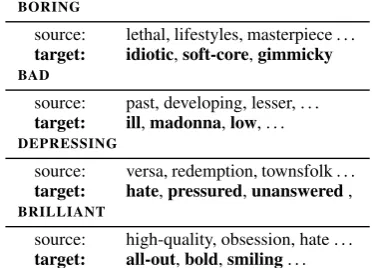
BORING
source: lethal, lifestyles, masterpiece . . . target: idiotic,soft-core,gimmicky BAD
source: past, developing, lesser, . . . target: ill,madonna,low, . . . DEPRESSING
source: versa, redemption, townsfolk . . . target: hate,pressured,unanswered, BRILLIANT
[image:4.595.325.512.72.206.2]source: high-quality, obsession, hate . . . target: all-out,bold,smiling. . .
Table 2: A representative set of words from the 20 closest-ranked (cosine-distance) words to (boring,bad,depressing, brilliant) extracted from thesourceandtarget(C&W-200) embeddings. Source embeddings give higher rank to words that are related, but not necessarily indicative of sentiment, e.g. brilliantandobsession. Target words tend to be tuned and ranked higher based on movie-sentiment-based rela-tions.
Training set size: We note that with a sufficient number of training instances for each word in the test set, additional knowledge from an external embedding does little to improve performance.
Source embeddings: We find C&W embeddings to perform best for the task of sentiment classi-fication. These embeddings were found to per-form well in other NLP tasks as well (Turian et al., 2010).
Embedding dimensionality: We observe that for HLBL, C&W and LSA source embeddings (for all training set sizes), 200 dimensions outperform 50. While a smaller number of dimensions has been shown to work better in other tasks (Turian et al., 2010), re-embedding words may benefit from a larger initial dimension of the word vector space. We leave the testing of this hypothesis for future work.
Additional features: Across all embeddings, ap-pending the document’s binary bag-of-words rep-resentation increases classification accuracy.
6 Future Work
While “semantic smoothing” obtained from intro-ducing an external embedding helps to improve performance in the sentiment classification task, the method does not help to re-embed words that do not appear in the training set to begin with. Re-turning to our example, if we founddramaticand
pleasant to be “far” in the original (source) em-bedding space, but re-embed them such that they are “near” (for the task of movie review sentiment
classification, for example), then we might ex-pect words such asmelodramatic,powerful, strik-ing,enjoyableto be re-embedded nearby as well, even if they did not appear in the training set. The objective for this optimization problem can be posed by requiring that the distance between ev-ery pair of words in the source and target embed-dings is preserved as much as possible, i.e. min ( ˆφiφˆj−φiφj)2 ∀i, j(where, with some abuse of notation, φ and φˆ are the source and target em-beddings respectively). However, this objective is no longer convex in the embeddings. Global re-embedding constitutes our ongoing work and may pose an interesting challenge to the community.
7 Conclusion
8 Acknowledgements
This work was supported in part by the NSF CDI Grant ECCS 0941561 and the NSF Graduate fel-lowship. The content of this paper is solely the responsibility of the authors and does not neces-sarily represent the official views of the sponsor-ing organizations. The authors would like to thank Thorsten Joachims and Bishan Yang for helpful and insightful discussions.
References
Mikhail Belkin, Partha Niyogi, and Vikas Sindhwani. 2006. Manifold regularization: A geometric frame-work for learning from labeled and unlabeled exam-ples. The Journal of Machine Learning Research, 7:2399–2434.
Yoshua Bengio, R´ejean Ducharme, Pascal Vincent, and Christian Janvin. 2003. A neural probabilistic lan-guage model. The Journal of Machine Learning Re-search, 3:1137–1155.
William Blacoe and Mirella Lapata. 2012. A com-parison of vector-based representations for semantic composition. InProceedings of the 2012 Joint Con-ference on Empirical Methods in Natural Language Processing and Computational Natural Language Learning, pages 546–556. Association for Compu-tational Linguistics.
Ronan Collobert and Jason Weston. 2008. A unified architecture for natural language processing: deep neural networks with multitask learning. In Pro-ceedings of the 25th international conference on Machine learning, pages 160–167. ACM.
Ronan Collobert, Jason Weston, L´eon Bottou, Michael Karlen, Koray Kavukcuoglu, and Pavel Kuksa. 2011. Natural language processing (almost) from scratch. The Journal of Machine Learning Re-search, 12:2493–2537.
Rong-En Fan, Kai-Wei Chang, Cho-Jui Hsieh, Xiang-Rui Wang, and Chih-Jen Lin. 2008. Liblinear: A library for large linear classification. The Journal of Machine Learning Research, 9:1871–1874.
Eric H Huang, Richard Socher, Christopher D Man-ning, and Andrew Y Ng. 2012. Improving word representations via global context and multiple word prototypes. InProceedings of the 50th Annual Meet-ing of the Association for Computational LMeet-inguis- Linguis-tics: Long Papers-Volume 1, pages 873–882. Asso-ciation for Computational Linguistics.
Dong C Liu and Jorge Nocedal. 1989. On the limited memory bfgs method for large scale optimization. Mathematical programming, 45(1-3):503–528.
Andrew L Maas, Raymond E Daly, Peter T Pham, Dan Huang, Andrew Y Ng, and Christopher Potts. 2011. Learning word vectors for sentiment analysis. In Proceedings of the 49th Annual Meeting of the Asso-ciation for Computational Linguistics: Human Lan-guage Technologies-Volume 1, pages 142–150. As-sociation for Computational Linguistics.
Andriy Mnih and Geoffrey E Hinton. 2009. A scalable hierarchical distributed language model. Advances in neural information processing systems, 21:1081– 1088.
Bo Pang and Lillian Lee. 2004. A sentimental educa-tion: Sentiment analysis using subjectivity summa-rization based on minimum cuts. InProceedings of the 42nd annual meeting on Association for Compu-tational Linguistics, page 271. Association for Com-putational Linguistics.
Richard Socher, Christopher D Manning, and An-drew Y Ng. 2010. Learning continuous phrase representations and syntactic parsing with recursive neural networks. InProceedings of the NIPS-2010 Deep Learning and Unsupervised Feature Learning Workshop.
Joseph Turian, Lev Ratinov, and Yoshua Bengio. 2010. Word representations: a simple and general method for semi-supervised learning. InProceedings of the 48th Annual Meeting of the Association for Compu-tational Linguistics, pages 384–394. Association for Computational Linguistics.
Jason Weston, Fr´ed´eric Ratle, Hossein Mobahi, and Ronan Collobert. 2012. Deep learning via semi-supervised embedding. InNeural Networks: Tricks of the Trade, pages 639–655. Springer.
Ainur Yessenalina and Claire Cardie. 2011. Com-positional matrix-space models for sentiment anal-ysis. InProceedings of the Conference on Empiri-cal Methods in Natural Language Processing, pages 172–182. Association for Computational Linguis-tics.