Decoding Running Key Ciphers
Sravana Reddy∗
Department of Computer Science The University of Chicago
1100 E. 58th Street Chicago, IL 60637, USA
Kevin Knight
Information Sciences Institute University of Southern California
4676 Admiralty Way Marina del Rey, CA 90292, USA
Abstract
There has been recent interest in the problem of decoding letter substitution ciphers using techniques inspired by natural language pro-cessing. We consider a different type of classi-cal encoding scheme known as therunning key cipher, and propose a search solution using Gibbs sampling with a word language model. We evaluate our method on synthetic cipher-texts of different lengths, and find that it out-performs previous work that employs Viterbi decoding with character-based models.
1 Introduction
The running key cipher is an encoding scheme that uses a secret keyRthat is typically a string of words, usually taken from a book or other text that is agreed upon by the sender and receiver. When sending a plaintext messageP, the sender truncates R to the length of the plaintext. The scheme also relies on a substitution functionf, which is usually publicly known, that maps a plaintext letterp and key letter rto a unique ciphertext letterc. The most common choice forf is thetabula recta, wherec = (p+r) mod 26for letters in the English alphabet, with A
= 0, B= 1, and so on.
To encode a plaintext with a running key, the spaces in the plaintext and the key are removed, and for every0 ≤i < |P|, the ciphertext letter at posi-tioniis computed to beCi ← f(Pi, Ri). Figure 1 shows an example encoding using thetabula recta.
For a given ciphertext and knownf, the plaintext uniquely determines the running key and vice versa.
∗
Research conducted while the author was visiting ISI.
Since we know that the plaintext and running key are both drawn from natural language, our objective function for the solution plaintext under some lan-guage model is:
ˆ
P = arg max
P
log Pr(P) Pr(RP,C) (1)
where the running key RP,C is the key that corre-sponds to plaintextP and ciphertextC.
Note that ifRP,C is a perfectly random sequence of letters, this scheme is effectively a ‘one-time pad’, which is provably unbreakable (Shannon, 1949). The knowledge that both the plaintext and the key are natural language strings is important in breaking a running key cipher.
The letter-frequency distribution of running key ciphertexts is notably flatter than than the plaintext distribution, unlike substitution ciphers where the frequency profile remains unchanged, modulo letter substitutions. However, the ciphertext letter distri-bution is not uniform; there are peaks corresponding to letters (like I) that are formed by high-frequency plaintext/key pairs (like E and E).
2 Related Work
2.1 Running Key Ciphers
Bauer and Tate (2002) use letter n-grams (without smoothing) up to order 6 to find the most probable plaintext/key character pair at each position in the ci-phertext. They test their method on 1000-character ciphertexts produced from plaintexts and keys ex-tracted from Project Gutenberg. Their accuracies range from 28.9% to 33.5%, where accuracy is mea-sured as the percentage of correctly decoded
Figure 1: Example of a running key cipher. Note that key is truncated to the length of the plaintext. Plaintext– linguistics is fun,Running Key– colorless green ideas,tabula rectasubstitution whereCi←(Pi+Ri) mod 26
Plaintext: L I N G U I S T I C S I S F U N
Running Key: C O L O R L E S S G R E E N I D
Ciphertext: N W Y U L T W L A I J M W S C Q
acters. Such figures are too low to produce read-able plaintexts, especially if the decoded regions are not contiguous. Griffing (2006) uses Viterbi decod-ing and letter 6-grams to improve on the above re-sult, achieving a median 87% accuracy over several 1000-character ciphertexts. A key shortcoming of this work is that it requires searching through about
265states at each position in the ciphertext.
2.2 Letter Substitution Ciphers
Previous work in decipherment of classical ciphers has mainly focused on letter substitution. These ci-phers use a substitution table as the secret key. The ciphertext is generated by substituting each letter of the plaintext according to the substitution table. The table may be homophonic; that is, a single plaintext letter could map to more than one possible cipher-text letter. Just as in running key ciphers, spaces in the plaintext are usually removed before encoding.
Proposed decipherment solutions for letter substi-tution ciphers include techniques that use expecta-tion maximizaexpecta-tion (Ravi and Knight, 2008), genetic algorithms (Oranchak, 2008), integer programming (Ravi and Knight, 2009), A* decoding (Corlett and Penn, 2010), and Bayesian learning with Dirichlet processes (Ravi and Knight, 2011).
2.3 Vigen`ere Ciphers
A scheme similar to the running key cipher is the Vi-gen`ere cipher, also known as the periodic key cipher. Instead of a single long string spanning the length of the plaintext, the key is a short string – usually but not always a single word or phrase – repeated to the length of the plaintext. Figure 2 shows an example Vigen`ere cipher encoding. This cipher is less secure than the running key, since the short length of the key vastly reduces the size of the search space, and the periodic repetition of the key leaks information.
Recent work on decoding periodic key ciphers perform Viterbi search on the key using letter n-gram models (Olsen et al., 2011), with the
assump-tion that the length of the key is known. If unknown, the key length can be inferred using the Kasiski Test (Kasiski, 1863) which takes advantage of repeated plaintext/key character pairs.
3 Solution with Gibbs Sampling
In this paper, we describe a search algorithm that uses Gibbs Sampling to break a running key cipher.
3.1 Choice of Language Model
The main advantage of a sampling-based approach over Viterbi decoding is that it allows us to seam-lessly use word-based language models. Lower or-der letter n-grams may fail to decipher most cipher-texts even with perfect search, since an incorrect plaintext and key could have higher likelihood un-der a weak language model than the actual message.
3.2 Blocked Sampling
One possible approach is to sample a plaintext letter at each position in the ciphertext. The limitation of such a sampler for the running key problem is that is extremely slow to mix, especially for longer ci-phertexts: we found that in practice, it does not usu-ally converge to the optimal solution in a reasonable number of iterations even with simulated annealing. We therefore propose a blocked sampling algorithm that samples wordsrather than letters in the plain-text, as follows:
1. Initialize randomlyP :=p1p2. . . p|C|, fixRas the key that corresponds toP, C
2. Repeat for some number of iterations
(a) Sample spaces (word boundaries) inP ac-cording toPr(P)
(b) Sample spaces inRaccording toPr(R)
(c) Sample each word in P according to
Pr(P) Pr(R), updatingRalong withP (d) Sample each word in R according to
Figure 2: Example of a Vigen`ere cipher cipher, with a5-letter periodic key, repeated to the length of the plaintext. Plaintext– linguistics is fun,Periodic Key– green,tabula rectasubstitution.
Plaintext: L I N G U I S T I C S I S F U N
Running Key: G R E E N G R E E N G R E E N G
Ciphertext: R Z R K H O J X M P Y Z W J H T
3. Remove spaces and returnP, R
Note that every time a word inP is sampled, it induces a change inRthat may not be a word or a sequence of words, and vice versa. Sampling word boundaries will also produce hypotheses contain-ing non-words. For this reason, we use a word tri-gram model linearly interpolated with letter tritri-grams (including the space character).1 The interpolation mainly serves to smooth the search space, with the added benefit of accounting for out-of-vocabulary, misspelled, or truncated words in the actual plaintext or key. Table 1 shows an example of one sampling iteration on the ciphertext shown in Figure 1.
Table 1: First sampling iteration on the ciphertext NWYULTWLAIJMWSCQ
GenerateP, R P: WERGATERYBVIEDOW with letter trigrams R: RSHOLASUCHOESPOU Sample spaces inP P: WERGAT ER YB VIEDOW Sample spaces inR R: RS HOLASUCHOES POU
Sample words inP P: ADJUST AN MY WILLOW
R: NT PATAWYOKNEL HOU Sample words inR P: NEWNXI ST HE SYLACT
R: AS CHOLESTEROL SAX
4 Experiments
4.1 Data
We randomly select passages from the Project Gutenberg and Wall Street Journal Corpus extracts that are included in the NLTK toolkit (Bird et al., 2009). The passages are used as plaintext and key pairs, and combined to generate synthetic ciphertext data. Unlike previous works which used constant-length ciphertexts, we study the effect of message length on decipherment by varying the ciphertext length (10, 100, and 1000 characters).
Our language model is an interpolation of word trigrams and letter trigrams trained on the Brown
1Pr(P) =λPr(P|
word LM) + (1−λ) Pr(P|letter LM), and similarly forPr(R).
Corpus (Nelson and Kucera, 1979), with Kneser-Ney smoothing. We fixed the word language model interpolation weight toλ= 0.7.
4.2 Baseline and Evaluation
For comparison with the previous work, we re-implement Viterbi decoding over letter 6-grams (Griffing, 2006) trained on the Brown Corpus. In addition to decipherment accuracy, we compare the running time in seconds of the two algorithms. Both decipherment programs were implemented in Python and run on the same machines. The Gibbs Sampler was run for10000iterations.
As in the Griffing (2006) paper, since the plaintext and running key are interchangeable, we measure the accuracy of a hypothesized solution against the reference as the max of the accuracy between the hy-pothesized plaintext and the reference plaintext, and the hypothesized plaintext and the reference key.
4.3 Results
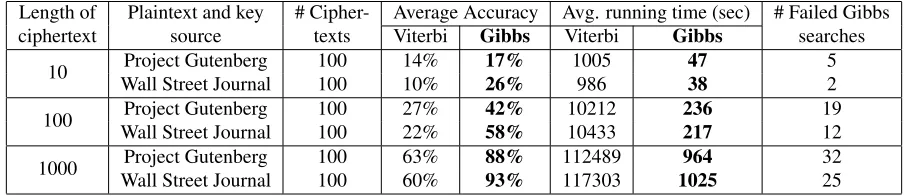
Table 2: Decipherment accuracy (proportion of correctly deciphered characters). Plaintext and key sources for the ciphertext test data were extracted by starting at random points in the corpora, and selecting the followingncharacters.
Length of Plaintext and key # Cipher- Average Accuracy Avg. running time (sec) # Failed Gibbs ciphertext source texts Viterbi Gibbs Viterbi Gibbs searches
10 Project Gutenberg 100 14% 17% 1005 47 5
Wall Street Journal 100 10% 26% 986 38 2
100 Project Gutenberg 100 27% 42% 10212 236 19
Wall Street Journal 100 22% 58% 10433 217 12
1000 Project Gutenberg 100 63% 88% 112489 964 32
Wall Street Journal 100 60% 93% 117303 1025 25
Table 3:Substitution function parameterized by the keyword, CIPHER.f(p, r)is the entry in the row corresponding topand the column corresponding tor.
A B C D E F G H I J K L M N O P Q R S T U V W X Y Z A C I P H E R A B D F G J K L M N O Q S T U V W X Y Z
B I P H E R A B D F G J K L M N O Q S T U V W X Y Z C
C P H E R A B D F G J K L M N O Q S T U V W X Y Z C I
. . .
However, on the long ciphertexts, our algorithm gets close to perfect decipherment, surpassing the Viterbi algorithm by a large margin.2Accuracies on the Wall Street Journal ciphertexts are higher than on the Gutenberg ciphertexts for our algorithm, which may be because the latter is more divergent from the Brown Corpus language model.
5 Future Work
5.1 Unknown substitution functions
Some running key ciphers also use a secret substi-tution functionf rather than thetabula rectaor an-other known function. In typical cases, these func-tions are not arbitrary, but are parameterized by a se-cret keyword that mutates thetabula rectatable. For example, the function with the keyword CIPHER would be the substitution table shown in Table 3. Decoding a running key ciphertext under a latent substitution function is an open line of research. One possibility is to extend our approach by sampling the keyword or function in addition to the plaintext.
5.2 Exact search
Since some the errors in Gibbs Sampling decipher-ment are due to search failures, a natural exten-sion of this work would be to adapt Viterbi search
2The accuracies that we found for Viterbi decoding are
lower than those reported by Griffing (2006), which might be because they use an in-domain language model.
or other exact decoding algorithms like A* to use word-level language models. A naive implementa-tion of Viterbi word-based decoding results in com-putationally inefficient search spaces for large vo-cabularies, so more sophisticated methods or heuris-tics will be required.
5.3 Analysis of Running Key Decipherment
While there has been theoretical and empirical anal-ysis of the security of letter substitution ciphers of various lengths under different language models (Shannon, 1949; Ravi and Knight, 2008), there has been no similar exposition of running key ciphers, which we reserve for future work.
6 Conclusion
We propose a decipherment algorithm for running key ciphers that uses Blocked Gibbs Sampling and word-based language models, which shows signifi-cant speed and accuracy improvements over previ-ous research into this problem.
Acknowledgments
References
Craig Bauer and Christian Tate. 2002. A statistical attack on the running key cipher.Cryptologia, 26(4). Steven Bird, Edward Loper, and Ewan Klein. 2009.
Nat-ural Language Processing with Python. O’Reilly Me-dia Inc.
Eric Corlett and Gerald Penn. 2010. An exact A* method of deciphering letter-substitution ciphers. In Proceed-ings of ACL.
Alexander Griffing. 2006. Solving the running key ci-pher with the Viterbi algorithm.Cryptologia, 30(4). Friedrich Kasiski. 1863. Die Geheimschriften und die
Dechiffrir-Kunst. E. S. Mittler und Sohn.
Francis Nelson and Henry Kucera. 1979. The Brown Corpus: A Standard Corpus of Present-Day Edited American English. Brown University.
Peder Olsen, John Hershey, Steven Rennie, and Vaib-hava Goel. 2011. A speech recognition solution to an ancient cryptography problem. Technical Report RC25109 (W1102-005), IBM Research.
David Oranchak. 2008. Evolutionary algorithm for de-cryption of monoalphabetic homophonic substitution ciphers encoded as constraint satisfaction problems. In
Proceedings of the Conference on Genetic and Evolu-tionary Computation.
Sujith Ravi and Kevin Knight. 2008. Attacking deci-pherment problems optimally with low-order n-gram models. InProceedings of EMNLP.
Sujith Ravi and Kevin Knight. 2009. Attacking letter substitution ciphers with integer programming. Cryp-tologia, 33(4).
Sujith Ravi and Kevin Knight. 2011. Bayesian inference for Zodiac and other homophonic ciphers. In Proceed-ings of ACL.