A p p l i e d Text Generation*
O w e n R a m b o w U n i v e r s i t y o f P e n n s y l v a n i a
D e p a r t m e n t . o f C I S P h i l a d e l p h i a , P A 1 9 1 0 4 r a m b o w @ l i n c . c i s . u p e n n , e d u
T a n y a K o r e l s k y C o G e n T e x , I n c . 105 L e n o x R o a d I t h a c a , N Y 1 4 8 5 0 t a n y a © c o g e n t ex. c o m
1 I n t r o d u c t i o n
This paper presents the Joyce system as an example of a fully-implemented, application-oriented text generation system. Joyce covers the whole range of tasks associated with text generation, from content selection to morpho- logical processing. It was developped as part of the in- terface of the software design environment Ulysses. T h e following design goals were set for it:
• T h e generated text must be of sufficiently high qual- ity so t h a t the user community of the underlying application accepts it as part of the documentation of software designs.
• T h e generation must be fast enough so t h a t the sys- tem can be used as a tool during the design process. • T h e system must be adaptable to new needs as they arise during further development of the underlying system, and it must be portable to completely new applications.
While we were able to exploit existing research for many of the design issues, it turned out that we needed to develop our own approach to text planning (Rambow 1990).
This paper will present the system and a t t e m p t to show how these design objectives led to particular design decisions. T h e structure of the paper is as follows. In Section 2, we will present the underlying application and give examples of the o u t p u t of the System. In Section 3, we will discuss the overall structure of Joyce. We then discuss the three main components in turn: the text planner in Section 4, the sentence planner in Section 5 and the realizer in Section 6. We will discuss the text planner in some detail since it represents a new approach to the problem. Section 7 traces the generation of a short text. In Section 8, we address the problem of portability, and wind up by discussing some shortcomings of Joyce in the conclusion.
"Research on the original Joyce system (described in this paper) was supported by the AFSC at Rome Laboratory un- der grant no. F30602-85-C-0098 to Odyssey Research As- sociates. A successor system to Joyce has been under de- velopment at CoGenTex since early 1991. We would like to thank Richard Kittredge, Robert Rubinoff and two anony- mous reviewers for helpful comments on earlier versions of this paper.
2 T h e J o y c e S y s t e m i n t h e U l y s s e s U s e r I n t e r f a c e
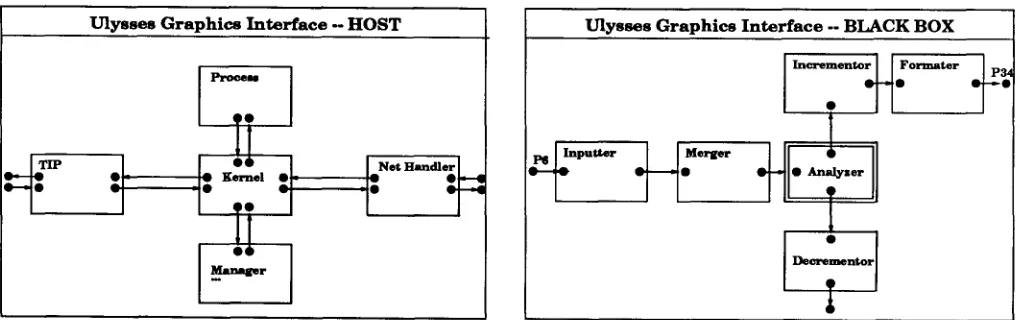
T h e Joyce text generation system was developped a~ part of the software design environment Ulysses (Ko- relsky and Ulysses Staff 1988; Rosenthal et al 1988) Ulysses includes a graphical environment for the de. sign of secure, distributed software systems. T h e useJ manipulates icons t h a t symbolize components (boxes) d a t a ports of components (circles) and d a t a flow be- tween ports (arrows). Additional information, princi pally about the security level of the components ant ports, is entered through menus. T h e design proceed, hierarchically by top-down structural decomposition.
As a tool in the user interface, Joyce generates two different types of texts a b o u t software designs:
• It generates annotations of the design which are in tended to serve as part of the system documentatior during and after the design process. A short and long version of these texts are available. T h e lon~ version can be several paragraphs long. T h e text~ usefully complement the graphical representation~ since the graphical representation can show only om level in the structural decomposition, and since th, additional information t h a t is available about eacl component (in particular, security level) cannot b, displayed graphically.
• It is used to explain the result of the application o a heuristic security design tool, the "flow analyzer" T h e texts Joyce generates are specifically conceived c as written texts. T h e text o u t p u t is integrated into t h graphical environment in such a way t h a t much of t h same interactive functionality is available either throug] the text o u t p u t window or through the graphical inter face window. For example, if a designer reads the desig] annotation generated by Joyce and notices t h a t the secu rity level of a component has been entered wrong, the1 the error can be corrected by clicking at the name of th component in the text window and accessing the apprc priate menu.
U l y s s e s G r a p h i c s I n t e r f a c e -- H O S T
!i
TIP Net Handler
Qq)
Figure 1: T h e H O S T Graphical Representation
its security characteristics. T h e text in Figure 4 is gen- erated by 3oyce in order to report the results of the flow analyzer; the graphical representation of the underlying s y s t e m can be seen in Figure 3. Note t h a t the structures of the two texts are quite different: while the Host text is structured according to more a b s t r a c t categories such as design s t r u c t u r e and functionality, the Black Box text follows the p a t h of the insecure flow through the compo- nent.
Joyce has been fully i m p l e m e n t e d in C o m m o n Lisp, and runs on the Symbolics Lisp Machine and on Sun workstations. A successor version has been ported to the Apple Macintosh.
H O S T : G e n e r a l S t r u c t u r e a n d S e c u r i t y F e a - t u r e s
The multilevel Host is a complex component of the Station. It contains a Kernel, a TIP, a Process, a Net Handler and a group of Managers. The Pro- cess, the TIP, the Managers and the Net Handler communicate only through the Kernel. The man- ifestly secure Process and the Managers perform auxiliary functions. The Process is low-level. The T I P serves as interface to a User; the Net Handler handles communication with a Net. The security statuses of the TIP, the Managers and the Net Han- dler have not yet been specified.
The Kernel is a complex component. Its secu- rity status has not yet been specified. The Ker- nel contains a Message Switch, an Address Register and a Locator. The Address Register, the Locator and the Message Switch communicate directly with each other. The low-level Address Register and the multilevel Locator are data-bases. The Message Switch handles communication with the TIP, the Process, the Managers and the Net Handler. The security status of the Message Switch has not yet b e e n s p e c i f i e d ,
Figure 2: T h e H O S T Text
U l y s s e s G r a p h i c s I n t e r f a c e -- B L A C K B O X
1
t
Figure 3: T h e B L A C K BOX Graphical Representation
BLACK BOX: INSECURE FLOW
In the Black Box an insecure flow occurs. Classified information enters the Black Box through P6. It is passed through the Inputter to the Merger, which may upgrade it to top-secret. The Merger passes it to the Analyzer, which has been assumed secure. The Analyzer downgrades it to secret. It passes it through the Incrementor to the Formater, which downgrades it when a classified corrected reading leaves through P34.
Figure 4: T h e B L A C K BOX Text
3 T h e S t r u c t u r e o f J o y c e
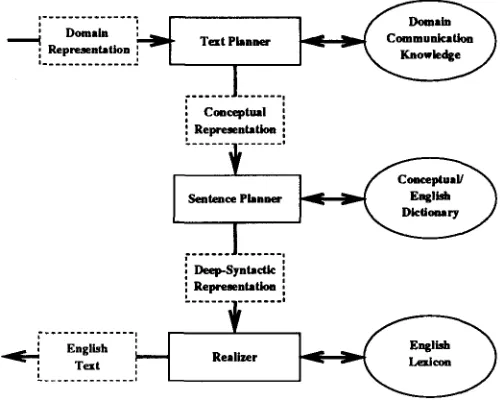
Joyce consists of three separate modules, which p e r f o r m distinct tasks and access their own knowledge bases (Fig- ure 5).
1. T h e text planner accesses the domain representation and produces a list of propositions, which represents b o t h the content and the s t r u c t u r e of the intended text. Each proposition is expressed in a language- independent, conceptual frame-like formalism. It encodes a minimal a m o u n t of information, but can be realized as an independent sentence if neces- sary. T h e text planner draws on domain communi- cation knowledge expressed in a high-level schema language (see Section 4).
2. T h e sentence planner takes the list of propositions and determines how to express t h e m in n a t u r a l lan- guage. This task includes choosing lexicalizations and a syntactic s t r u c t u r e for each proposition, and assembling these lexico-syntactic structures, called Deep Syntactic Representation or D S y n t R , into larger sentences. It draws on knowledge captured in the conceptual/English dictionary.
3. T h e linguistic realizer takes the syntactic structures and produces surface sentences. It draws on syntac- tic and morphological knowledge, expressed in the English lexicon.
[image:2.612.59.569.59.219.2]: E n g l i s h "
Text
'.. ... , ,
T a t Planner
. . . . . . i i
Conceptual Representation i
Sentence Plannes"
. . . J . . . i
v ~ - s r . , - ~ !
Representation i
Realizer
- j
Figure 5: T h e Structure of Joyce
rather t h a n three. However, there is a certain amount of disagreement about where the line between the two is to be drawn. For example, MeKeown's T E X T (McK- eown 1985) performs the tasks t h a t Joyce classifies as sentence planning as part of the realization process, whereas Meteer's S P O K E S M A N (Meteer 1989) clas- sifies t h e m as part of text planning. (See (Meteer 1990, p.23sq) for a useful s u m m a r y of the terminolog- ical issues 1.) In this paper, "text planning" will always be used in the narrow sense of "content selection and organization". T h e architecture of Joyce is directly in- fluenced by t h a t of the SEMSYN system (RSsner 1987; RSsner 1988). RSsner divides the realization component into two parts, the "generator kernel" and the "generator front end". This distinction is mirrored exactly by the distinction between sentence planning and realization in Joyce.
There are two main advantages to such a tripartite ar- chitecture, one conceptual and the other practical. Con- ceptually, the advantage is that linguistic planning tasks are clearly separated from the actual grammar, which comprises word order and morphological rules. These rules can be stated independently of the formulation of purely semantic rules that determine lexical and syn- tactic choices. This modularity makes the system more maintainable. T h e linguistic planning tasks should, how- ever, be clearly separated from the textual planning tasks: while the linguistic planning tasks are language- dependent, the textual planning tasks appear not to be 2.
1 Note that the tasks Meteer groups together as "Syntax" - choosing the syntactic structure and linearization - are in- separable only in certain syntactic representations. In Joyce, the Deep-Syntactic Representation encodes syntactic struc- ture but not linear order (see Section 6 for details).
2We are not aware of any example in which different text plans (as defined here) are needed for different languages. The fact that functionally similar texts may display different structures in different cultures should not be confused with language-specific constraints on text structure.
Thus, if multi-lingual generation is desired, text planning and sentence planning ought to be performed by distinct components.
On a more practical level, modularity in design and implementation can be exploited by parallel process- ing of independent modules. While the current im- plementations of Joyce do not allow for parallel exe- cution, the incremental processing of parallel comput- ing tasks on a serial machine is also advantageous, as is argued in the W I P project (Wahlster et al 1991; Harbusch et al 1991) 3. Incrementality reduces the ini- tial response time of the system (though not the overall processing time). This can be crucial if multi-paragraph text is to be generated by an interface tool. In the Joyce system, the text planner cedes control to the sentence planner as soon as the text planner has defined a propo- sition. Once the sentence planner has constructed the D S y n t R of a complete sentence, it sends it to the re- alizer which generates the English sentence. Thus, the first sentence is o u t p u t by Joyce shortly after the text generator is invoked; text continues to be o u t p u t approx- imately at reading speed. T h e effect is t h a t a user of the text generator has the impression t h a t he or she never has to wait for the system to respond, even when it is generating lengthy texts.
T h r o u g h o u t the system, processing is message-driven in the sense of (McDonald et al 1987): control lies in the input, which is used t o construct the next level of repre- sentation. T h e r e is no need for backtracking or feedback from one level of processing to an earlier one. As is argued by McDonald el al., such an architecture con- tributes to processing efficiency.
We will now discuss the three modules of Joyce in more detail.
4 T h e T e x t P l a n n e r
Prior to the design of the text planning component of Joyce, several existing approaches were studied. Since the structure of the descriptive text (Figure 2) does not mirror the structure of the domain, Paris's "pro-
cedural strategy" (Paris and McKeown 1987) cannot be used in general. Hovy's RST-based planner (Hovy 1988) assumes t h a t content selection has Mready been per- formed, contrary to the situation in the Ulysses applica- tion; furthermore, there are efficiency problems in a pure STRIPS-like planning paradigm. We therefore found McKeown's schema-based approach (McKeown 1985) to be the most promising. However, it t u r n e d out t h a t gen- eral rhetorical schemas cannot adequately capture the structure of the intended texts. In (Kittredge et al 1991), we argue that planning certain types of texts - such as re- ports and descriptions - requires domain-specific knowl- edge about how to communicate in t h a t domain. T h a t knowledge we call "domain communication knowledge" (DCK). For example, in describing secure system designs
[image:3.612.84.334.64.264.2]you must relate the security level of each component, but not, say, the number of ports or their security levels. Furthermore, the connectivity of components should be stated before their functionality. In the flow analyzer text, the security levels of the components need not be communicated at all, but if a component (other than the final component of the path) downgrades information, it must be stated whether and why the component is se- cure. This very precise knowledge about which domain information needs to communicated and in what order cannot simply be derived from general principles. We have also argued t h a t in many existing text planning systems, such DCK has been encoded implicitly. In the interest of efficiency, modularity and portability we have decided to represent DCK explicitly in Joyce.
We have developed a "schema language" for easy rep- resentation of DCK, called DICKENS (Domain Commu- nication Knowledge ENcoding Schemas). T h e schemas are similar in form to those used by McKeown. Basically, schemas can be seen as a description of text structure. The system, however, interprets each schema as a list of instructions. T h e instructions can be calls to other schemas, recursive calls to the same schema, or they can be one of a set of special commands provided by the schema language. One special command produces a specific proposition and sends it to the sentence planner. Other special commands support conditional branching and iteration. During execution, each schema is associ- ated with a particular subset of the domain representa- tion, which is called the focus (in the sense of McKeown's "global focus"). In the Ulysses application, the focus always corresponds to one component. There are spe- cial commands to shift the focus. In addition to the fo- cus, which limits the domain representation from which information can be communicated, a theme can be set which determines information structure within individ- ual propositions. T h e theme corresponds to McKeown's "local focus". As has been widely recognized, thematic structure affects issues such as grammatical voice at the linguistic level.
In addition, two further special commands were found to be necessary in order to perform text planning:
• A portion of the text plan can be edited. To do this, a schema is called, but any propositions that are cre- ated (by the schema or by any schema it calls) are not sent to the sentence planner. T h e y are kept on a separate list in the order they are created. When the execution of the schema terminates, an editing function is applied to the list. T h e editing function can delete propositions, change their order, change their contents or create new ones. T h e choice of an editing function depends on the domain and on the particular requirements of the text. Further s t u d y is needed in order to determine the types of editing op- erations that can be made and to devise a high-level language to express them; the goal is to eventually establish a library of editing operations. Typical editing operations we have used include juxtapos- ing similar propositions or juxtaposing propositions with certain similar slots (typically, the agent slot). An example is given in Section 7.
This type of revision is different from the revision discussed in (Gabriel 1988) and (Meteer 1991). In these systems, the linguistic specification of the tar- get texts is revised. In Joyce, it is the text plan itself, i.e. the pre-linguistic representation of text content and structure, that is subject to revision. • Schemas can post to a "blackboard", and check this
blackboard for messages. This allows for additional control and communication between schemas which are called at different times during the text planning process and cannot communicate with each other directly.
Instead of being templates t h a t limit the structure of the text to certain preconceived types, the schemas are now an explicit and compact representation of domain communication knowledge.
5 T h e S e n t e n c e P l a n n e r
T h e sentence planner combines all those planning tasks t h a t are specific to the target language. It receives propositions from the text planner and sends the DSyntR of complete sentences to the realizer for pro- cessing. It has two main tasks: first, it chooses lexi- cal and syntactic realizations by consulting the Concep- tual/English dictionary; second, it determines sentence scope by merging the D S y n t R of individual propositions. We will discuss each of these steps in turn.
T h e Conceptual/English dictionary is implemented as a set of procedures that operate on the propositions. Each proposition is mapped into the D S y n t R of a clause (i.e., its root is a verb). Lexicalization can take prag- matic factors into account. It can also refer to a history of lexicalizations if lexical variation is desired. After a D S y n t R has been constructed, certain syntactic para- phrase operations are performed if necessary, for exam- ple passivization if a grammatical object is the theme of the sentence, or if the subject is absent.
The second task of the sentence planner is to deter- mine the scope of sentences. Combining the linguistic realization of propositions into larger sentences is a cru- cial issue because it increases the quality of the gener- ated text. For example, The low-level Address Register and the multilevel Locator are data-bases (from the Host text in Figure 2) is significantly better than the four clauses from which it was formed: The Address Reg- ister is a data-base. It is low-level. The Locator is a data-base. It is multilevel. An informal study in which subjects were asked to revise a (grammatical) text con- taining only single-proposition sentences supported the claim t h a t longer sentences are preferred over shorter ones whenever possible and reasonable.
planner 4. Joyce performs the following syntactic clause- combining operations: Relative clause formation, adjec- tival attachment (the process by which an adjective from a copula-construction is embedded in an NP), and con- junction. Conjunction includes multiple conjunctions of more than one clause, and m a y lead to elision of repeated sentence elements ("conjunction reduction"). For exam- ple, in the example quoted above, the lexeme data base occurs only once in the conjoined sentence.
T h e second question t h a t arises is how clause combi- nation should be restricted. We have identified stylistic and discourse constraints. T h e stylistic constraints are constraints against the sentence becoming too long (an upper bound on the number of clauses t h a t can be com- bined into one sentence), and a constraint on recursive embedding of relative clauses. Discourse constraints are imposed by the structure of the text: clauses belonging to conceptually distinct text units should not be com- bined. T h e text planner can send a special message, called c o n c e p t u a l - b r e a k , to the sentence planner. It signals the beginning of a new textual unit. These spe- cial messages are triggered by appropriate indications in the DICKENS specifcation of the DCK.
T h e algorithm is as follows. T h e sentence planner maintains a "current" DSyntR. Each incoming propo- sition is translated into a DSyntR, which the sen- tence planner then a t t e m p t s to merge with the current DSyntR. If none of the clause combination strategies work, or if stylistic heuristics interfere, or if the incoming proposition is a c o n c e p t u a l - b r e a k , the current D S y n t R is sent to the realizer and the new D S y n t R becomes the current one. T h e process of clause combination can be very easily modeled at the D S y n t R level: relative clause formation and conjunction reduce to simple tree compo- sition operations. (In the case of adjectival a t t a c h m e n t only the adjective node is attached.) Issues such as word order in relative clauses, the morphological form of the complementizer, and conjunction reduction can be dealt with at further stages of processing.
6
The Linguistic Realizer
T h e linguistic component is based on Meaning-Text The- ory ( M T T ) (Mel'~uk 1988), and is a reimplementa- tion (in Lisp) of Polgu~re's Prolog implementation of a Meaning-Text model for English (Iordanskaja et al 1988; Iordanskaja et al 1991).
M T T defines three successive levels of representation. With each level of representation is associated a compo- nent which transforms the representation into the next higher level. Each component is implemented as a sepa- rate module in Joyce.
• T h e Deep-Syntactic Representation (DSyntR) is a dependency g r a m m a r tree representing the syn- tactic relationships between the meaning-bearing
4In Section 7, we discuss an example in which two propo- sitions are merged by the text planner. The crucial point is that in that example, the two propositions are merged into a single proposition. Here, we are discussing cases in which two
distinct propositions are linguistically realized in the same sentence.
~
s c ~ t progressiveMerger
information Analyzer
definite indefinite definite
Figure 6: D S y n t R of sentence The Merger is passing
information to the Analyzer
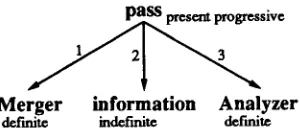
words of a sentence. Sister nodes are unordered with respect to each other. T h e nodes are labelled with lexemes which are a n n o t a t e d with features. Numer- ical arc labels represent the syntactic arguments of the governing lexeme, while ATTR represents the at- tributive relation. An example is shown in Figure 6. Note t h a t the function words the, is, to are not yet represented.
• T h e Surface-Syntactic Representation (SSyntR) is also a dependency grammar representation, but it includes all lexemes of the final sentence. T h e tran- sition between D S y n t R and S S y n t R is achieved by looking up function words in the English lexicon. and by expanding grammatical features such as verb tenses.
• T h e Deep Morphological Representation (DMor- phR) is a linearization of the nodes of the SSyntR. • T h e Surface Morphological Representation is in fac!
the written form of the English sentence. Morpho- logical processing is done by a component closel~ based on SUTRA-S (Emele and M o m m a 1985). While linguistic realizers based on other theories coulc have been used, this M T T - b a s e d approach offers the fol- lowing advantages:
• T h e approach is based on an independently moti. vated linguistic theory. Much linguistic work ha., already been done in the M T T framework (for ex. ample (Mel'6uk and Pertsov 1987)).
• T h e modularization of different types of linguisti~ knowledge makes the grammar easier to maintain Parallelism in computation could be exploited. • T h e dependency g r a m m a r used to express the tw(
syntactic levels of representation permits the sepa ration of the semantically relevant issue of g r a m m a t ical relations (e.g., subjecthood) from pragmaticall] relevant issues of surface word order (e.g., topical ization).
7 A n E x a m p l e
As an example, consider the sample text in Figure 4. I describes the occurrence of an insecure flow in compo nent Black Box. T h e texts t h a t explain insecure flow; are generated by a set of eight schemas, one of which i shown in Figure 7. It is the first t h a t is invoked.
[image:5.612.397.547.62.130.2](defschema flow-analysis-error :title "Insecure flow" : theme "information"
:make-proposition (insecure-flow :location focus)
:make-proposition (enter :agent (get-infornation)
:object focus
:location (entry-port focus)) :make-proposition (id-security :agent (get-information)
:value (get-level (entry-port focus))) conceptual-break
:shift-focus-and-edit (next-component initial-follow-path #'merge-send-data))
Figure 7: T h e F L O W ANALYZER schema
The arguments to special commands immediately fol- low the command. T h e : t i t l e special command gen- erates a title. C o m m a n d :theme sets the initial theme of the paragraph, influencing issues such as passiviza- tion. T h e n follow three : m a k e - p r o p o s i t i o n commands, which each produce one proposition. T h e first argu- ment to : m a k e - p r o p o s i t i o n is the class of the propo- sition. T h e slots are typically filled with pointers into the domain representation of the application program.
f o c u s is a pointer maintained by the text planner which refers to the global focus (currently the component Black Box, represented by pointer #<COMPONENT B l a c k Box>), while g e t - i n f o r m a t i o n and e n t r y - p o r t are functions provided by the underlying application program. Not all arguments must be filled by a : m a k e - p r o p o s i t i o n com- mand; the sentence planner will choose lexical and syn- tactic realizations accordingly. T h e text planner sends an i n s e c u r e - f l o w proposition to the sentence planner, which translates it into a D S y n t R tree (which repre- sents the clause In the Black Box an insecure flow oc- curs) and returns control to the text planner. T h e text planner then proceeds to the next : m a k e - p r o p o s i t i o n command, and sends the proposition shown in Figure 8 to the sentence planner. When the sentence planner re-
ENTER
AGENT #<information>
OBJECT #<COMPONENT Black Box> LOCATION #<PORT P9>
Figure 8: T h e E N T E R proposition
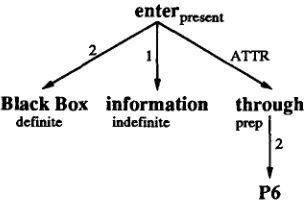
ceives the e n t e r proposition, it translates it into the D S y n t R tree shown in Figure 9, which could be ex- pressed as the clause information enters the Black Box through P6. Note that the choice of enter as verb is due to the fact t h a t information is currently the theme; if
Black Box were the theme, the choice would have been
receives. T h e sentence planner then tries to combine the new D S y n t R with the current one (which was de- rived from the previous proposition). This fails (since the two clauses have different verbs and different ac- tants), so the current D S y n t R is sent to the realizer, which prints out the first sentence. T h e new D S y n t R
Black Box information through
definite indefinite prep [ 2
Y
P6
Figure 9: D S y n t R of sentence information enters the Black Box through P6
becomes the current one. Control is returned to the text planner, which processes the third : m a k e - p r o p o s i t i o n command and sends the appropriate proposition to the sentence planner. T h e sentence planner generates the clausal DSyntR tree shown in Figure 10 (the informa- tion is classified). It then a t t e m p t s to combine the new
information classified
def'mite adjective
Figure 10: DSyntR of sentence The information is clas- sified
clause with the "current D S y n t R " , first using the adjec- tival a t t a c h m e n t strategy. This succeeds, yielding the tree shown in Figure 11. It then returns control to the text planner, since another clause could be merged with the current DSyntR. T h e text planner then calls schema conceptual-break. T h e only effect of this schema is to send a c o n c e p t u a l - b r e a k message to the sentence plan- ner, which thereupon sends its current D S y n t R to the re- alizer. T h e realizer prints out the surface sentence Clas- sified information enters the Black Box through P6.
[image:6.612.61.401.66.162.2] [image:6.612.364.516.227.327.2] [image:6.612.386.503.457.524.2]Black Box Information through
del'mite indefinite prep
classified P6
adjective
Figure 11: D S y n t R of sentence Classified information enters the Black Box through P6
mand also initiates the editing process. All proposi- tions that are generated as a result of this command are kept on a list rather than sent to the sentence plan- ner. When the command has been executed, the list is edited by the function given as the third argument, # ' m e r g e - s e n d - d a t a . T h e effect of this function is to combine two successive s e n d propositions into a single, new one, so t h a t two clauses such as the Analyzer sends the information to the Incrementor and the Incrementor sends the information to the Formater yield the Ana- lyzer sends the information to the Formater through the Incrementor. Note t h a t this combination is not a lin- guistic one but a conceptual one, since it relies on facts about sending d a t a in this domain, rather than on the syntax or lexical semantics about the verb send. It must therefore be performed by the text planner, and not the sentence planner.
8 P o r t i n g t h e S y s t e m
Porting is an i m p o r t a n t way to evaluate complete applied text generation systems, since there is no canonical set of tasks that such a system must be able to perform and on which it can be tested. (Realization components, on the other hand, can be tested for their syntactic and perhaps lexical coverage.) Joyce was originally designed to generate only component descriptions (as in Figure 2). T h e "flow analyzer" heuristic tool was added later to the system, and the completely different type of text it required was a first successful test of Joyce and its text planner in particular.
T h e modular design of Joyce proved beneficial dur- ing the porting to the new application. T h e following conceptually well-defined tasks were required during the development of the "flow analyzer" application:
1. Since the flow analyzer is a new type of tool, no corpus of texts was available for study. Instead, sample texts were written by hand and critiqued by domain experts. T h e texts were then revised and resubmitted to the experts. T h e "ideal text" that emerged was then analyzed and the DCK needed to generate it expressed in terms of schemas. We interpret the cycle of writing, critiquing and revising as a process of DCK acquisition.
2. New classes of proposition were defined. These in- clude e n t e r , u p g r a d e and downgrade. Some of the
proposition classes from the earlier descriptive ap- plication could be reused, such as s e n d .
3. T h e Conceptual/English dictionary was extended to account for the new proposition classes.
4. Several new lexical items were entered into the English lexicon. For example, the English lex- eme downgrade subcategorizes for two nouns and a propositional phrase obligatorily headed by to.
Note that those parts of Joyce t h a t deal with facts of English (including clause combination) needed no atten- tion (other than updating the lexicon).
We are currently working on porting a successor of Joyce to several new applications, including the genera- tion of project management reports. Initial results, in- cluding a prototype, are encouraging.
9 C o n c l u s i o n
We are aware of several shortcomings of Joyce, which we will address in future versions of the system.
• While we have argued in (Kittredge et al 1991) t h a t rhetoric cannot be the central guiding princi- ple in text planning, it appears to play an impor- tant role as a constraint on possible text structures. Furthermore, it helps determine the use of connec- tives between rhetorically related clauses. Finally, it may determine when conceptual breaks occur in text structure which affect sentence scoping (Scott and de Souza 1990). We are currently investigating the option of augmenting the DCK schemas with rhetorical annotations.
• T h e current form of the Conceptual/English dictio- nary is not satisfactory, since the dictionary writer is too free in writing dictionary entries. For example, the dictionary could be used as a back door for the introduction of new content which the text planner was (for whatever reasons) unable to plan. Meteer discusses the same problem in McKeown's original T E X T system (Meteer 1990, p.35). An interface to the dictionary t h a t is more restrictive is needed. • While it is possible to set a theme in the text
plan, thematic structure has not received suffi- cient attention. Rules of thematic progression (as implemented, for instance, in McKeown's T E X T ) are not taken into consideration. Furthermore. clause combination is also sensitive to thematic structure (Kuno 1976; Derr and McKeown 1986: Iordanskaja 1989), which is currently not taken intc account.
[image:7.612.138.282.63.162.2]B i b l i o g r a p h y
Carcagno, Denis and Iordanskaja, Lidija, 1989. Con- tent Determination and Text Structuring in Gossip. In Proceedings of the Second European Workshop on
Text Generation. Edinburgh.
Dale, Robert, 1988. Generating Referring Expressions in a Domain of Objects and Processes. PhD thesis, University of Edinburgh.
Derr, Marcia A. and McKeown, Kathleen R., 1986. Us- ing Focus to Generate Complex and Simple Sentences. In 24 th Meeting of the Association for Computational Linguistics (ACL'86), ACL, pages 319-326.
Emele, Martin and Momma, Stefan, 1985. SUTRA- S: Erweiternngen eines Generator-Front-End fiir das SEMSYN-Projekt. Technical Report, Universit~t Stuttgart.
Gabriel, Richard P., 1988. Deliberate Writing. In Mc- Donald, David D. and Bolc, Leonard (editors), Natural Language Generation Systems, pages 1-46. Springer Verlag.
Harbusch, Karin; Finkler, Wolfgang; and Schauder, Anne, 1991. Incremental Syntax Generation with Tree Adjoining Grammars. In Proceedings 4.Int. GI- Kongress Wissensbasiertc Systeme, GWAI. Miinchen. Hovy, Eduard H., 1988. Planning coherent multisenten- tim text. In Proceedings of the 26th Annual Meeting,
ACL, pages 163-169. Buffalo.
Iordanskaja, Lidija, 1989. Communicative Structure and Its Use During Text Generation. Technical Re- port TR 15-10, Odyssey Research Associates, Ithaca, NY/Montr~al, PQ.
Iordanskaja, Lidija; Kittredge, Richard; and Polgu~re, Alain, 1988. Implementing the Meaning-Text Model for Language Generation. Paper presented at COLING-88.
Iordanskaja, Lidija; Kittredge, Richard; and Polgu~re, Alain, 1991. Lexical Selection and Paraphrase in a Meaning-Text Generation Model. In Paris, Cecile; Swartout, William; and Mann, William (editors), Nat- ural Language Generation in Artifical Intelligence and Computational Linguistics, pages 293-312. Kluwer Academic Publishers.
Kittredge, Richard; Korelsky, Tanya; and Rambow, Owen, 1991. On the Need for Domain Communica- tion Knowledge. Computational Intelligence 7(4). Kuno, S., 1976. Subject, theme and the speaker's empa-
thy - a reexamination of relativization phenomena. In Li, Charles N. (editor), Subject and Topic, pages 417- 444. Academic Press.
McDonald, David D.; Meteer (Vaughan), Marie W.; and Pustejovsky, James D., 1987. Factors contributing to efficiency in Natural Language Generation. In Kern- pen, Gerard (editor), Natural Language Generation,
pages 159-181. Martinus Nijhoff Publishers.
McKeown, Kathleen, 1985. Text Generation. Cam-
bridge University Press, Cambridge.
Mel'Suk, Igor A., 1988. Dependency Syntax: Theory and Practice. State University of New York Press, New York.
Mel'Suk, Igor A. and Pertsov, Nikolaj V., 1987. Sur- face Syntax of English. John Benjamins, Amster- dam/Philadelphia.
Meteer, Marie W., 1989. The SPOKESMAN Natural Language Generation System. Technical Report, BBN Systems and Technologies Corporation.
Meteer, Marie W., 1990. The 'Generation Gap': The Problem of Expressibility in Text Planning. Technical Report 7347, BBN Systems and Technologies Corpo- ration.
Meteer, Marie W., 1991. The Implication of Revisions for Natural Language Generation. In Paris, Cecile; Swartout, William; and Mann, William (editors), Nat- ural Language Generation in Artificai Intelligence and Computational Linguistics, pages 155-177. Kluwer Academic Publishers.
Paris, Cecile L. and McKeown, Kathleen R., 1987. Dis- course Strategies for Describing Complex Physical Ob- jects. In Kempen, Gerard (editor), Natural Language Generation, pages 97-115. Martinus Nijhoff Publish- ers.
Rambow, Owen, 1990. Domain Communication Knowl- edge. In Proceedings of the Fifth International Work- shop on Natural Language Generation. Dawson, PA. RSsner, Dietmar, 1987. The Automated News Agency
SEMTEX - a Text Generator for German. In Kem- pen, G. (editor), Natural Language Generation: New Results in Artificial Intelligence, Psychology and Lin- guistics, pages 138-148. Kluwer Academic Publishers, Boston.
RSsner, Dietmar, 1988. The SEMSYN Generation Sys- tem: Ingredients, Applications, Prospects. In Pro- ceedings of the Second Conference on Applied Natural Language Processing, ACL. Austin.
Scott, Donia R. and de Souza, Clarisse Sieckenius, 1990. Getting the message across in RST-based Text Gen- eration. In Dale, Robert; Mellish, Chris; and Zock, Michael (editors), Current Research in Natural Lan- gugae Generation. Academic Press, London.