Proceedings of the 45th Annual Meeting of the Association of Computational Linguistics, pages 904–911, Prague, Czech Republic, June 2007. c2007 Association for Computational Linguistics
Words and Echoes: Assessing and Mitigating
the Non-Randomness Problem in Word Frequency Distribution Modeling
Marco Baroni
CIMeC (University of Trento) C.so Bettini 31
38068 Rovereto, Italy
Stefan Evert
IKW (University of Osnabr¨uck) Albrechtstr. 28
49069 Osnabr¨uck, Germany
Abstract
Frequency distribution models tuned to words and other linguistic events can pre-dict the number of distinct types and their frequency distribution in samples of arbi-trary sizes. We conduct, for the first time, a rigorous evaluation of these models based on cross-validation and separation of train-ing and test data. Our experiments reveal that the prediction accuracy of the models is marred by serious overfitting problems, due to violations of the random sampling as-sumption in corpus data. We then propose a simple pre-processing method to allevi-ate such non-randomness problems. Further evaluation confirms the effectiveness of the method, which compares favourably to more complex correction techniques.
1 Introduction
Large-Number-of-Rare-Events (LNRE) models (Baayen, 2001) are a class of specialized statistical models that allow us to estimate the characteristics of the distribution of type probabilities in type-rich linguistic populations (such as words) from limited samples (our corpora). They also allow us to extrapolate quantities such as vocabulary size (the number of distinct types) and the number of hapaxes (types occurring just once) beyond a given corpus or make predictions for completely unseen data from the same underlying population.
LNRE models have applications in theoretical lin-guistics, e.g. for comparing the type richness of mor-phological or syntactic processes that are attested to
different degrees in the data (Baayen, 1992). Con-sider for example a very common prefix such as
re-and a rather rare prefix such asmeta-. With LNRE models we can answer questions such as: If we could obtain as many tokens of meta- as we have of re-, would we also see as many distinct types? In other words, is the prefixmeta-as productive as the prefix re-? Practical NLP applications, on the other hand, include estimating how many out-of-vocabulary words we will encounter given a lexicon of a certain size, or making informed guesses about type counts in very large data sets (e.g.,how many
typos are there on the Internet?)
pointing out directions for future work.
2 LNRE models
Baayen (2001) introduces a family of models for Zipf-like frequency distributions of linguistic pop-ulations, referred to as LNRE models. Such a lin-guistic population is formally described by a finite or countably infinite set of typesωiand their
occur-rence probabilitiesπi. Word frequency models are
not concerned with the probabilities (i.e., relative frequencies) of specific individual types, but rather the overall distribution of these probabilities.
Numbering the types in order of decreasing prob-ability (π1 ≥ π2 ≥ π3 ≥ . . ., called a
popula-tion Zipf ranking), we can specify a LNRE model
for their distribution as a function that computesπi
from the Zipf rank iofωi. For instance, the
Zipf-Mandelbrot law1is defined by the equation
πi = C
(i+b)a (1)
with parametersa > 1andb >0. It is mathemati-cally more convenient to formulate LNRE models in terms of a type density functiong(π)on the interval
π∈[0,1], such that
Z B
A
g(π)dπ (2)
is the (approximate) number of types ωi withA ≤ πi ≤ B. Evert (2004) shows that Zipf-Mandelbrot corresponds to a type density of the form
g(π) :=
(
C·π−α−1 A≤π ≤B
0 otherwise (3)
with parameters 0 < α < 1 and 0 ≤ A < B.2 Models that are formulated in terms of such a type densityghave many direct applications (e.g. usingg
as a Bayesian prior), and we refer to them asproper
LNRE models.
Assuming that a corpus of N tokens is a random sample from such a population, we can make pre-dictions about lexical statistics such as the number
1The Zipf-Mandelbrot law is an extension of Zipf’s law (which hasa= 1andb= 0). While the latter originally refers to type frequencies in a given sample, the Zipf-Mandelbrot law is formulated for type probabilities in a population.
2
In this equation, Cis a normalizing constant required in order to ensureR1
0 πg(π)dπ= 1, the equivalent of
P
iπi= 1.
V(N) of different types in the corpus (the
vocab-ulary size), the number V1(N) ofhapax legomena
(types occurring just once), as well as the further dis-tribution of type frequenciesVm(N). Since the
pre-cise values would be different from sample to sam-ple, the model predictions are given by expectations
E[V(N)] andE[Vm(N)], which can be computed
with relative ease from the type density functiong. By comparing expected and observed values ofV
andVm (for the lowest frequency ranks, usually up
tom = 15), the parameters of a LNRE model can be estimated (we refer to this astrainingthe model), allowing inferences about the population (such as the total number of types in the population) as well as further applications of the estimated type density (e.g. for Good-Turing smoothing). Since we can cal-culate expected values for samples of arbitrary size
N, we can use the trained model to predict how many new types would be seen in a larger corpus, how many hapaxes there would be, etc. This kind of vocabulary growthextrapolationhas become one of the most important applications of LNRE models in linguistics and NLP.
A detailed account of the mathematics of LNRE models can be found in Baayen (2001, Ch. 2). Baayen describes two LNRE models, lognormal
andGIGP, as well as several other approaches (in-cluding a version ofZipf ’s lawand theYule-Simon
model) that are not based on a type density and hence do not qualify as proper LNRE models. Two LNRE models based on Zipf’s law,ZMandfZM, are introduced by Evert (2004).
In the following, we will only consider proper LNRE models because of their considerably greater utility, and because their performance in extrapo-lation tasks appears to be better than, or at least comparable to, the other models (Evert and Baroni, 2006). In addition, we exclude the lognormal model because of its computational complexity and numer-ical instability.3 In initial evaluation experiments, the performance of lognormal was also inferior to the remaining three models (ZM, fZM and GIGP). Note that ZM is the most simplistic model, with only 2 parameters and assuming an infinite population vocabulary, while fZM and GIGP have 3 parameters
3
and can model populations of different sizes.
3 Evaluation of LNRE models
LNRE models are traditionally evaluated by look-ing at how well expected values generated by them fit empirical counts extracted from the same data-set used for parameter estimation, often by visual inspection of differences between observed and pre-dicted data in plots. More rigorously, Baayen (2001) and Evert (2004) compare the frequency distribu-tion observed in the training set to the one predicted by the model with a multivariate chi-squared test. As we will show below, evaluating standard LNRE models on the same data that were used to estimate their parameters favours overfitting, which results in poor performance on unseen data.
Evert and Baroni (2006) attempt, for the first time, to evaluate LNRE models on unseen data. However, rather than splitting the data into separate training and test sets, they evaluate the models in an extra-polation setting, where the parameters of the model are estimated on asubsetof the data used for testing. Evert and Baroni do not attempt to cross-validate the results, and they do not provide a quantitative evalu-ation, relying instead on visual inspection of empir-ical and observed vocabulary growth curves.
3.1 Data and procedure
We ran our experiments with three corpora in differ-ent languages and represdiffer-enting differdiffer-ent textual ty-pologies: the British National Corpus (BNC), a “bal-anced” corpus of British English of about 100 mil-lion tokens illustrating different communicative set-tings, genres and topics; the deWaC corpus, a Web-crawled corpus of about 1.5 billion German words; and the la Repubblica corpus, an Italian newspaper corpus of about 380 million words.4
From each corpus, we extracted 20 non-overlapping samples of randomly selected docu-ments, amounting to a total of 4 million tokens each (punctuation marks and entirely non-alphabetical to-kens were removed before sampling, and all words were converted to lowercase). Each of these sam-ples was then split into a training set of 1 million to-kens (thetraining sizeN0) and a test set of 3 million
4
See www.natcorp.ox.ac.uk, http://wacky.
sslmit.unibo.it and http://sslmit.unibo.it/
repubblica
tokens. The documents in the la Repubblica sam-ples were ordered chronologically before splitting, to simulate a typical scenario arising when working with newspaper data, where the data available for training precede, chronologically, the data one wants to generalize to.
We estimate parameters of the ZM, fZM and GIGP models on each training set, using the zipfR toolkit.5 The models are then used to predict the expected number of distinct types, i.e., vocabulary sizeV, at sample sizes of 1, 2 and 3 million tokens, equivalent to 1, 2 and 3 times the size of the training set (we refer to these as theprediction sizesN0,2N0 and 3N0, respectively). Finally, the expected vo-cabulary sizeE[V(N)]is compared to the observed valueV(N)in the test set for N =N0,N = 2N0 andN = 3N0. We also look atV1(N), the number of hapax legomena, in the same way.
Our main focus is V prediction, since this is by far the most useful measure in practical applica-tions, where we are typically interested in knowing how many types (or how many types belonging to a certain category) we will see as our sample size increases (How many typos are there on the Web? How many types with prefix meta- would we see if we had as many types of meta- as we have of
re-?) Hapax legomena counts, on the other hand, play a central role in quantifying morphological pro-ductivity (Baayen, 1992) and they give us a first in-sight into how good the models are at predicting fre-quency distributions, besides vocabulary size (as we will see, a model’s success in predictingV does not necessary imply that the model is also capturing the right frequency distribution).
For all models, corpora and prediction sizes, goodness-of-fit of the model on the training set is measured with a multivariate chi-squared test (Baayen, 2001, 118-122). Performance of the mod-els in prediction ofV is assessed viarelative error, computed for each of the 20 samples from a corpus and the 3 prediction sizes as follows:
e= E[V(N)]−V(N)
V(N)
whereN = k·N0 is the prediction size (for k =
1,2,3),V(N)is the observedV in the relevant test
5
http://purl.org/stefan.evert/zipfR
set at sizeN, andE[V(N)]is the corresponding ex-pectedV predicted by a model.6
For each corpus and prediction size we obtain 20 valuesei(viz.,e1, . . . , e20). As a summary measure, we report the square root of the mean square relative error (rMSE) calculated according to
√
rMSE=
v u u t
1 20 ·
20 X
i=1
(ei)2
This gives us an overall assessment of prediction ac-curacy (we take the square root to obtain values on the same scale as relative errors, and thus easier to interpret). We complement rMSEs with reports on the average relative error (indicating whether there is a systematic under- or overestimation bias) and its asymptotic 95% confidence intervals, based on the empirical standard deviation of theei across the 20
trials (the confidence intervals are usually somewhat larger than the actual range of values found in the experiments, so they should be seen as “pessimistic estimates” of the actual variance).
3.2 Results
The panels of Figure 1 report rMSE values for the 3 corpora and for each prediction size. For now, we focus on the first 3 histograms of each panel, that present rMSEs for the 3 LNRE models intro-duced above: ZM, fZM and GIGP (the remaining histograms will be discussed later).7
For all corpora and all extrapolation sizes beyond
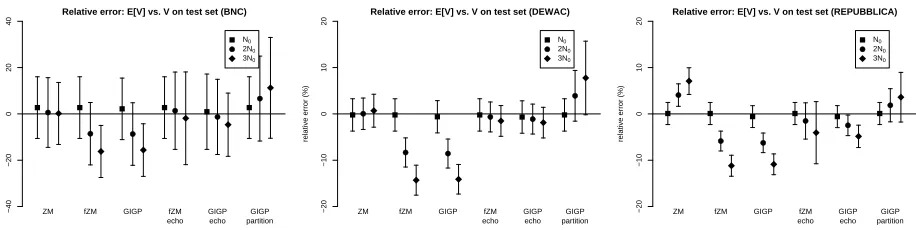
N0, the simple ZM model outperforms the more so-phisticated fZM and GIGP models (which seem to be very similar to each other). Even at the largest prediction size of 3N0, ZM’s rMSE is well below 10%, whereas the other models have, in the worst case (BNC 3N0), a rMSE above 15%. Figure 2 presents plots of average relative error and its em-pirical confidence intervals (again, focus for now on the ZM, fZM and GIGP results; the rest of the figure is discussed later). We see that the poor performance
6
We normalize by V(N) rather than (a function of) E[V(N)]because in the latter case we would favour models that overestimateV, compared to ones that are equally “close” to the correct value but underestimateV.
7
A table with the full numerical results is available upon request; we find, however, that graphical summaries such as those presented in this paper make the results easier to interpret.
of fZM and GIGP is due to their tendency to under-estimate the true vocabulary sizeV, while variance is comparable across models.
The rMSEs ofV1 prediction are reported in Fig-ure 3. V1 prediction performance is poorer across the board, and ZM is no longer outperforming the other models. For space reasons, we do not present relative error and variance plots forV1, but the gen-eral trends are the same observed forV, except that the bias of ZM towardsV1 overestimation is much clearer than forV.
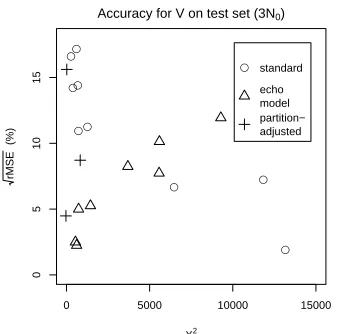
Interestingly, goodness-of-fit on the training data is not a good predictor ofV andV1 prediction per-formance on unseen data. This is shown in Figure 4, which plots rMSE for prediction of V against goodness-of-fit (quantified by multivariate X2 on the training set, as discussed above) for all corpora and LNRE models at the3N0prediction size (but the same patterns emerge at other prediction sizes and withV1). The largerX2, the poorer the training set fit; the larger rMSE, the worse the prediction. Thus, ideally, we should see a positive correlation between
X2and rMSE. Focusing for now on the circles (pin-pointing the ZM, fZM and GIGP models), we see that there is instead anegativecorrelation between goodness of fit on the training set and quality of pre-diction on unseen data.8
First, these results indicate that, if we take good-ness of fit on the training set as a criterion for choos-ing the best model (as done by Baayen and Evert), we end up selecting theworstmodel for actual pre-diction tasks. This is, we believe, a very strong case for applying the split train-test cross-validation method used in other areas of statistical NLP to fre-quency distribution modeling. Second, the data sug-gest that the more sophisticated models are overfit-tingthe training set, leading to poorer performance than the simpler ZM on unseen data. We turn now to what we think is the main cause for this overfitting.
4 Non-randomness and echoes
The results in the previous section indicate that the
Vs predicted by LNRE models are at best “ballpark estimates” (andV1 predictions, with a relative error that is often above 20%, do not even qualify as
plau-8
With correlation coefficients ofr <−.8, significant at the
ZM fZM GIGP fZM echo GIGP echo GIGP partition N0 2N0 3N0
rMSE for E[V] vs. V on test set (BNC)
rMSE (%) 0 5 10 15 20
ZM fZM GIGP fZM
echo GIGP echo GIGP partition N0 2N0 3N0
rMSE for E[V] vs. V on test set (DEWAC)
rMSE (%) 0 5 10 15 20
ZM fZM GIGP fZM
echo GIGP echo GIGP partition N0 2N0 3N0
rMSE for E[V] vs. V on test set (REPUBBLICA)
[image:5.612.78.537.104.218.2]rMSE (%) 0 5 10 15 20
Figure 1: rMSEs of predictedV on the BNC, deWaC and la Repubblica data-sets
ZM fZM GIGP fZM
echo GIGP echo
GIGP partition
Relative error: E[V] vs. V on test set (BNC)
relative error (%)
−40 −20 0 20 40 ● ● ● ● ● ● ● N0 2N0 3N0
ZM fZM GIGP fZM
echo GIGP echo
GIGP partition
Relative error: E[V] vs. V on test set (DEWAC)
relative error (%)
−20 −10 0 10 20 ● ● ● ● ● ● ● N0 2N0 3N0
ZM fZM GIGP fZM
echo GIGP echo
GIGP partition
Relative error: E[V] vs. V on test set (REPUBBLICA)
relative error (%)
[image:5.612.80.538.317.432.2]−20 −10 0 10 20 ● ● ● ● ● ● ● N0 2N0 3N0
Figure 2: Average relative errors and asymptotic 95% confidence intervals ofV prediction on BNC, deWaC and la Repubblica data-sets
ZM fZM GIGP fZM
echo GIGP echo GIGP partition N0 2N0 3N0
rMSE for E[V1] vs. V1 on test set (BNC)
rMSE (%) 0 10 20 30 40 50
ZM fZM GIGP fZM
echo GIGP echo GIGP partition N0 2N0 3N0
rMSE for E[V1] vs. V1 on test set (DEWAC)
rMSE (%) 0 10 20 30 40 50
ZM fZM GIGP fZM
echo GIGP echo GIGP partition N0 2N0 3N0
rMSE for E[V1] vs. V1 on test set (REPUBBLICA)
rMSE (%) 0 10 20 30 40 50
Figure 3: rMSEs of predictedV1on the BNC, deWaC and la Repubblica data-sets
[image:5.612.78.537.542.660.2]0 5000 10000 15000
0
5
10
15
Accuracy for V on test set (3N0)
X2
rMSE
(%)
● ●
●
● ●
●
● ●
●
● standard
[image:6.612.100.269.72.239.2]echo model partition− adjusted
Figure 4: Correlation betweenX2 andV prediction rMSE across corpora and models
sible ballpark estimates). Although such rough esti-mates might be more than adequate for many practi-cal applications, is it possible to further improve the quality of LNRE predictions?
A major factor hampering prediction quality is that real texts massively violate therandomness
as-sumption made in LNRE modeling: words, rather
obviously, are not picked at random on the basis of their population probability (Evert and Baroni, 2006; Baayen, 2001). The topic-driven “clumpi-ness” of low frequency content words reduces the number of hapax legomena and other rare events used to estimate the parameters of LNRE models, leading the models to underestimate the type rich-ness of the population. Interestingly (but unsurpris-ingly), ZM with its assumption of an infinite pop-ulation, is less prone to this effect, and thus it has a better prediction performance than the more so-phisticated fZM and GIGP models, despite its poor goodness-of-fit.
The effect of non-randomness is illustrated very clearly for the BNC (but the same could be shown for the other corpora) by Figure 5, a comparison of rMSE for prediction ofV from our experiments above to results obtained on versions of the BNC samples with words scrambled in random order, thus forcibly removing non-randomness effects. We see from this figure that the performance of both fZM and GIGP improves dramatically when they are trained and tested on randomized sequences of
words. Interestingly, randomization has instead a
negativeeffect on ZM performance.
ZM fZM GIGP ZM
random fZM random
GIGP random
N0 2N0 3N0
rMSE for E[V] vs. V on test set (BNC)
rMSE
(%)
0
5
10
15
20
Figure 5: rMSEs of predicted V on unmodified vs. randomized versions of the BNC sets
4.1 Previous approaches to non-randomness
While non-randomness is widely acknowledged as a serious problem for the statistical analysis of cor-pus data, very few authors have suggested correc-tion strategies. The key problem of non-random data seems to be that the occurrence frequencies of a type in different documents do not follow the binomial distribution assumed by random sampling models. One approach is therefore to model this distribu-tion explicitly, replacing the binomial with its sin-gle parameterπby a more complex distribution that has additional parameters (Church and Gale, 1995; Katz, 1996). However, these distributions are cur-rently not applicable to LNRE modeling, which is based on the overall frequencies of types in a cor-pus rather than their frequencies in individual doc-uments. The overall frequencies can only be calcu-lated by summation over all documents in the cor-pus, resulting in a mathematically and numerically intractable model. In addition, the type densityg(π) would have to be extended to a multi-dimensional function, requiring a large number of parameters to be estimated from the data.
[image:6.612.315.532.114.273.2]single “burst”. Using a standard LNRE model for the normal part of the population and a simple lin-ear growth model for the underdispersed part, ad-justed values forE[V]andE[Vm]can easily be
cal-culated. These so-calledpartition-adjusted models (which introduce one additional parameter) are thus the only viable models for non-randomness correc-tion in LNRE modeling and have to be considered the state of the art.
4.2 Echoadjustment
Rather than making more complex assumptions about the population distribution or the sampling model, we propose that non-randomness should be tackled as apre-processingproblem. The issue, we argue, is really with the way we count occurrences of types. The fact that a rare topic-specific word oc-curs, say, four times in a single document does not make it any less a hapax legomenon for our purposes than if the word occurred once (this is the case, for example, of the wordchondriticin the BNC, which occurs 4 times, all in the same scientific document). We operationalize our intuition by proposing that, for our purposes, each content word (at least each rare, topic-specific content word) occurs maximally once in a document, and all other instances of that word in the document are really instances of a spe-cial “anaphoric” type, whose function is that of “echoing” the content words in the document. Thus, in the BNC document mentioned above, the word
chondritic is counted only once, whereas the other
three occurrences are considered as tokens of the
echo type. Thus, we are counting what in the in-formation retrieval literature is known as document
frequencies. Intuitively, these are less susceptible to
topical clumpiness effects than plain token frequen-cies. However, by replacing repeated words with echo tokens, we can stick to a sampling model based on random word token sampling (rather than docu-ment sampling), so that the LNRE models can be applied “as is” to echo-adjusted corpora.
Echo-adjustment does not affect the sample size
N nor the vocabulary size V, making the interpre-tation of results obtained with echo-adjusted mod-els entirely straightforward. N does not change be-cause repeated types are replaced with echo tokens, not deleted. V does not change because only re-peated types are replaced. Thus, no type present in
the original corpus disappears (more precisely,V in-creases by 1 because of the addition of the echo type, but given the large size ofV this can be ignored for all practical purposes). Thus, the expectedV com-puted for a specified sample size N with a model trained on an echo-adjusted corpus can be directly compared to observed values at N, and to predic-tions made for the sameN by models trained on an unprocessed corpus. The same is not true for the pre-diction of the frequency distribution, where, for the sameN, echo-based models predict the distribution
ofdocumentfrequencies.
We are proposing echoes as a model for the us-age of (rare) content words. It would be diffi-cult to decide where the boundary is between top-ical words that are inserted once in a discourse and then anaphorically modulated and “general-purpose” words that constitute the frame of the dis-course and can occur multiple times. Luckily, we do not have to make this decision when estimating a LNRE model, since model fitting is based on the distribution of the lowest frequencies. For example, with the default zipfR model fitting setting, only the lowest 15 spectrum elements are used to fit the mod-els. For any reasonably sized corpus, it is unlikely that function words and common content words will occur in less than 16 documents, and thus their dis-tribution will be irrelevant for model fitting. Thus, we can ignore the issue of what is the boundary be-tween topical words to be echo-adjusted and general words, as long as we can be confident that the set of lowest frequency words used for model fitting be-long to the topical set.9 This makes practical echo-adjustment extremely simple, since all we have to do is to replace all repetitions of a word in the same document with echo tokens, and estimate the param-eters of a plain LNRE model with the resulting ver-sion of the training corpus.
4.3 Experiments with echo adjustment
Using the same training and test sets as in Sec-tion 3.1, we train the partiSec-tion-adjusted GIGP model
9The issue becomes more delicate if we want to predict the frequency spectrum rather thanV, since a model trained on echo-adjusted data will predict echo-adjusted frequencies across the board. However, in many theoretical and practical settings only the lowest frequency spectrum elements are of in-terest, where, again, it is safe to assume that words are highly topic-dependent, and echo-adjustment is appropriate.
implemented in the LEXSTATS toolkit (Baayen, 2001). We estimate the parameters of echo-adjusted ZM, fZM and GIGP models on versions of the train-ing corpora that have been pre-processed as de-scribed above. The performance of the models is evaluated with the same measures as in Section 3.1 (for prediction ofV1, echo-adjusted versions of the test data are used).
Figure 1 reports the performance of the echo-adjusted fZM and GIGP models and of partition-adjusted GIGP (echo-partition-adjusted ZM performed sys-tematically much worse than the other echo-adjusted models and typically worse than uncorrected ZM, and it is not reported in the figure). Both correction methods lead to a dramatic improvement, bringing the prediction performance of fZM and GIGP to lev-els comparable to ZM (with the latter outperforming the corrected models on the BNC, but being outper-formed on la Repubblica). Moreover, echo-adjusted GIGP is as good as partitioned GIGP on la Repub-blica, and better on both BNC and deWaC, suggest-ing that the much simpler echo-adjustment method is at least as good and probably better than Baayen’s partitioning. The mean error and confidence interval plots in Figure 2 show that the echo-adjusted models have a much weaker underestimation bias than the corresponding unadjusted models, and are compara-ble to, if not better than, ZM (although they might have a tendency to display more variance, as clearly illustrated by the performance of echo-adjusted fZM on la Repubblica at 3N0 prediction size). Finally, the echo-adjusted models clearly stand out with re-spect to ZM when it comes to V1 prediction (Fig-ure 3), indicating that echo-adjusted versions of the more sophisticated fZM and GIGP models should be the focus of future work on improving predic-tion of the full frequency distribupredic-tion, rather than plain ZM. Moreover, echo-adjusted GIGP is outper-forming partitioned GIGP, and emerging as the best model overall.10 Reassuringly, for the echoed mod-els there is a very strongpositivecorrelation between goodness-of-fit on the training set and quality of pre-diction, as illustrated for V prediction at 3N0 by the triangles in Figure 4 (again, the patterns in this
10
In looking at theV1 data, it must be kept in mind,
how-ever, thatV1 has a different interpretation when predicted by
echo-adjusted models, i.e., it is the number ofdocument-based
hapaxes, the number of types that occur in one document only.
figure represent the general trend for echo-adjusted models found in all settings).11 This indicates that the over-fitting problem has been resolved, and for echo-adjusted models goodness-of-fit on the train-ing set is a reliable indicator of prediction accuracy.
5 Conclusion
Despite the encouraging results we reported, much work, of course, remains to be done. Even with the echo-adjusted models, prediction of V1 suffers from large errors and prediction ofV quickly deteri-orates with increasing prediction sizeN. If the mod-els’ estimates for 3 times the size of the training set have acceptable errors of around 5%, for many ap-plications we might want to extrapolate to100N0or more (recall the example of estimating type counts for the entire Web). Moreover, echo-adjusted mod-els make predictions pertaining to the distribution of document frequencies, rather than plain token fre-quencies. The full implications of this remain to be investigated. Finally, future work should system-atically explore to what extent different textual ty-pologies are affected by the non-randomness prob-lem (notice, e.g., that non-randomness seems to be a greater problem for the BNC than for the more uni-form la Repubblica corpus).
References
Baayen, Harald. 1992. Quantitative aspects of
morpho-logical productivity. Yearbook of Morphology 1991,
109-150.
Baayen, Harald. 2001. Word frequency distributions.
Dordrecht: Kluwer.
Church, Kenneth W. and William A. Gale. 1995. Poisson
mixtures. Journal of Natural Language Engineering
1, 163-190.
Evert, Stefan. 2004. A simple LNRE model for random
character sequences.Proceedings of JADT 2004,
411-422.
Evert, Stefan and Marco Baroni. 2006. Testing the
ex-trapolation quality of word frequency models.
Pro-ceedings of Corpus Linguistics 2005.
Katz, Slava M. 1996. Distribution of content words and
phrases in text and language modeling. Natural
Lan-guage Engineering,2(2) 15-59.
11
With significant correlation coefficients ofr=.76for2N0