Yasuyuki Kitano
1;3, Tetsuya Ozaki
1, Manabu Kanemoto
2, Masao Komatsu
3,
Shigeo Tanase
1and Tetsuo Sakai
11National Institute of Advanced Industrial Science and Technology, Ikeda 563-8577, Japan 2GS Yuasa Co., Kyoto 601-8520, Japan
3Hiroshima Institute of Technology, Hiroshima 731-5193, Japan
In order to improve the hydrogen absorption properties of the layer structure appearing at the nickel rich side of La-Mg-Ni alloy, appropriate amounts of Ni were replaced by some elemental atoms, Mn, Co and Al. The La0:8Mg0:2Ni3:4xCo0:3(MnAl)x(0<x<0:4) alloy
system was synthesized and crystal structures were investigated by electron microscopy. The atomic concentration ratio of (LaMg) to the other atoms was 3.7 in this system. The Pr5Co19-type structure (5:19H-structure) and the Ce5Co19-type structure (5:19R-structure) were found in this
alloy system. Electron micrographs of these structures are presented in this paper. Structure analysis of the complex layer structure is demonstrated by careful observation of the electron diffraction pattern. [doi:10.2320/matertrans.MBW200631]
(Received December 8, 2006; Accepted May 10, 2007; Published July 11, 2007)
Keywords: crystal structure, nickel rich side of lantern-magnesium-nickel-cobalt-manganese-aluminum alloys, electron microscopy, hydrogen absorption
1. Introduction
Various layer structures were reported in the nickel rich side of La-Ni alloy system, such as LaNi2(meta-stable),
LaNi3, La2Ni7, La5Ni19 and LaNi5.1–3) Crystal structures
homologous to these alloys were originally studied in the R-T alloy systems (R = Rare earth metals or Yttrium and T = Iron, Cobalt or Nickel) by Kahn.4–6)Kahn pointed out that the
structures could be regarded as a mixture of two structures, the Laves phase and the CaCu5 structure. Eelectron
micro-scopic studies were performed by Komuraet al.for the Sm-Co and Sm-Ni alloys.7–11)They reported that several complex
structures coexisted in the same grain. The microstructures were interpreted by using the term ‘intergrowth’. They also established by high resolution electron microscopy the attribution of the images in the crystal structures.
Recently, it has been reported that an appropriate amount of Mg addition to the La-Ni alloy not only maintains the crystal structures but also gives an enhanced hydrogen storage capacity.12–17)In order to improve farther the hydro-gen properties of the La-Mg-Ni alloys, appropriate amounts of Ni were replaced by some elemental atoms, Mn, Co and Al. Then alloys of La0:8Mg0:2Ni3:4xCo0:3(MnAl)x(0<x< 0:4) were synthesized and studied. X-ray crystallographic analysis as well as electron microscopic analysis were carried out and reported partially in the previous papers.18,19)In this
paper, we present electron micrographs for the Pr5Co19-type
structure (5:19H-structure) and the Ce5Co19-type structure
(5:19R-structure) which were found in the alloy system, and also demonstrate that a complex layer structure can be analyzed by careful observation of the electron diffraction pattern.
2. Experimental
Alloy ingots were synthesized by induction-melting and were appropriately annealed in the same way as reported in
the previous papers.18,19) Specimens suitable for electron
microscopy were prepared using a mechanical polishing machine and an ion thinning instrument. Two electron microscopes were employed, JEM2010 in Hiroshima Insti-tute of Technology, and H9000 at the Research Center for Ultrahigh Voltage Electron Microscopy, Osaka University. The former was used for precise observation of the electron diffraction pattern and the latter was used for the high resolution imaging. Both were performed with the [010] incidence of the hexagonal indices of the crystal. In this direction, the structural information could be effectively collected.
3. Results and Discussion
3.1 Layer structures in the La0:8Mg0:2Ni3:4 xCo0:3
-(MnAl)x (0<x<0:4) alloys and description of the
crystal structure
As mentioned in the previous section, several intermetallic compounds, have been reported in the La-Ni or La-Mg-Ni alloy system, such as LaNi2(meta-stable, cF24-MgCu2, cubic
Laves phase:1,2,16)), LaMgNi4(cF24-MgSnCu4, cubic ordered
Laves phase14,15)), LaNi
3 (hR36-PuNi3, 1:3R-structure1)),
LaMg2Ni9 (hR36-PuNi3, 1:3R-structure13)), La2Ni7
(hP36-Ce2Ni7, 2:7H-structure1)), La5Ni19 (hR72-Ce5Co19,
5:19R-structure3)), La
0:7Mg0:3Ni:2:5Co0:5 (hR72-Ce5Co19,
5:19R-structure17)), La
0:7Mg0:25Ni3:0Co0:5 (hP48-Pr5Co19,
5:19H-structure17)), and LaNi
5 (hP6-CaCu51)).
In the La-Mg-Ni alloy system studied here, the existence of 1:3R-, 2:7H-, 5:19R-, 5:19H- and 1:4R-structures has been confirmed by X-ray diffraction analysis, and it has also been confirmed that La or Mg atoms occupy the site for large atoms and the Ni atoms occupy the site for small atoms.18,19) The crystal structure of the Laves phase or the CaCu5
(LaNi5) structure are known as closed pack structures of
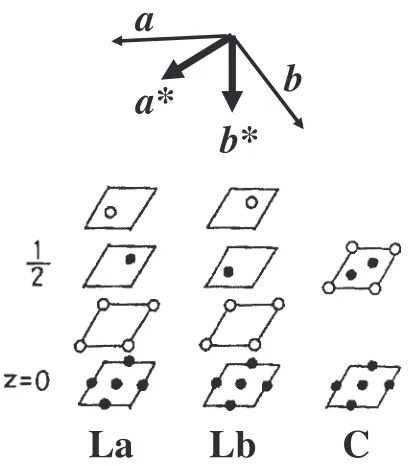
assumed in this paper is also included. Here La orLb is a layer-unit of the Laves phase and C is a layer-unit of the CaCu5 (LaNi5) structure. As seen in Fig. 1, the layer-unit
La/Lb is composed of four atomic layers and contains 2 large and 4 small atoms, while the layer-unitCis composed of two atomic layers and contains 1 large and 5 small atoms. The total number of atoms included in a layer-unit is 6 for both Laves phase and CaCu5. The thickness of the layer-unit
is almost the same for both structures. In this paper we will use the value 0.404 nm for the thickness, which was obtained by X-ray analysis.18,19)
In Fig. 2, an example of the TEM image is presented for the 5:19H structure together with a projection of the crystal structure. The incidence of the electron beam is [010]. A part of the image is magnified and inserted at the top right corner of Fig. 2. Attribution of the image in relation to the structure has been already established.7–11)Horizontal arrays of clear white dots correspond to one C-type layer-unit, and hori-zontal arrays of dull white dots in a dark line correspond to oneLa/Lb-type layer-unit. ThreeC-type layer-units and one La/Lb-type layer-unit form a repeat-block in the 5:19H structure. Positional correspondence of the image to the projection is indicated by three arrows. The relative shift between two repeat-blocks can be recognized negative or positive in the [2/3 1/3 0] direction. In order to show the shift, a vertical line is drawn in the magnified image.
The crystal structure is built up by stacking repeat-blocks, each of which is formed by m C-type layer-units together with one La/Lb-type layer-unit at the top. A repeat-block stacks on the top of the La-type layer-unit with a shift of [2=31=30], while a repeat-block stacks on the top of the Lb-type layer-unit with a shift of [2/3 1/3 0]. The crystal
structures discussed in this paper are summarized in Table 1. In the second column is presented the number ofLa/Lb-type layer-units in a repeat-block, the numerals being singular for all cases. In the third column is presented the number of C-type layer-units in a repeat-block and the numeral increases regularly depending on the crystal structure. This number will be denoted bymin this paper. The numbers ratio of large and small atoms is presented in the 4th and 5th column. Type of the structure is given in the 6th column using an appropriate designation. Here, the symbol H means the hexagonal structure and R the rhombohedral one described by Ramsdell.20)At the bottom of Table 1, the general form
for the structure is presented using the parameterm. Here we note that in large-scale analysis the value of m is not necessarily restricted to integers for complex crystal struc-tures.
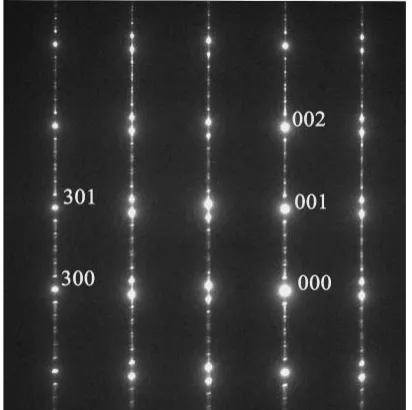
The electron diffraction pattern of the [010] zone axis is characterized by the distance between two spots along the c direction. Electron diffraction patterns for the alloys studied here are given in Fig. 3(a) and Fig. 3(b) for 5:19H and 5:19R structures, respectively. Indices in the reciprocal space are given in the hexagonal system. The distance between two reciprocal points, 000 and 001 corresponds to the inverse of the thickness of one La/Lb- or C-type layer-unit in Fig. 1, being approximately equal to 2.5 nm1. A repeat-block for
the 5:19H structure is made of four layer-units in total, such as three C-type layer-units and one La/Lb-type layer-unit, and is the same as that for the 5:19R structure. Since repeat-blocks for both consist of four layer-units, diffraction spots appear at a fourth of the distance from 000 to 001. The stacking of repeat-blocks is different between the two structures. The unit cell size in the c direction for the hexagonal structure is twice of the repeat-block for the 5:19R structure, and therefore twice as many diffraction spots appear.
La
Lb
C
a
b
b*
a*
Fig. 1 Hexagonal setting assumed in this paper at the top, and drawings of the layer-units: the Laves phase,La/Lb, and the CaCu5(LaNi5) structure, C. The thickness of the layer-unit is assumed to be equal for both, 0.404 nm. When the layer-unitLais followed by the layer-unitC(above), there is a shift [2=31=30]. When the layer-unitLbis followed by the layer-unitC(above), there is a shift [2/3 1/3 0]. When the layer-unitCis followed by one of the layer-units,La,LbandC, there is no shift.
2 nm
Fig. 2 TEM image of the 5:19H structure found in the La0:8Mg0:2
-Ni3:4xCo0:3(MnAl)x(0<x<0:4) alloy compounds, and the
[image:2.595.305.548.72.253.2] [image:2.595.67.272.76.309.2]In this paper, we define a parameter t as a normalized distance between two diffraction spots along the cdirection. In the last column of Table 1, thet-value is summarized for the respective structures. At the lower right-hand corner cell, relations between two parameters, m and t, are presented. The equations are as follows:
t¼1=2ð1þmÞ; and thenm¼1=2t1;
for hexagonal; ð1Þ
and
t¼1=ð1þmÞ; and thenm¼1=t1;
for rhomohedral; ð2Þ
where the parametertis the distance between two spots in c direction in the diffraction pattern of the [010] zone axis, and
the parameter mis the number ofC-type layer-units in one repeat-block. In this equation, the value ofmis not restricted to integers. It should be noted that in the diffraction pattern, as seen in Fig. 3, diffraction spots 100 and 200 appear for the hexagonal structure, but not for the rhombohedral structure.
3.2 Electron crystallography for unknown layer struc-ture
An electron diffraction pattern of unknown structure is presented in Fig. 4. The diffraction spots align along the c direction not with a constant spacing, that is, the spots are
Type Laves CaCu5-type Structure observed Diffraction
Atoms Large Small Large Small Large Small Type pattern in c
Number
2 4 1 5
Space between
of atom two spots (t)
1 0 2þ0¼2 4þ0¼4 Laves H 1/2
Laves C,R 1
0 1 0þ1¼1 0þ5¼5 CaCu5H 1
1 1 2þ1¼3 4þ5¼9 1:3 H 1/4
1:3 R 1/2
Number 1 2 2þ2¼4 4þ10¼14 2:7 H 1/6
of layer-unit 2:7 R 1/3
1 3 2þ3¼5 4þ15¼19 5:19 H 1/8
5:19 R 1/4
1 4 2þ4¼6 4þ20¼24 1:4 H 1/10
1:4 R 1/5
1 m 2þm 4þ5m H ð1=ð1þmÞÞ=2
R 1=ð1þmÞ
Fig. 3 Electron diffraction patterns found in the La0:8Mg0:2Ni3:4xCo0:3
-(MnAl)x (0<x<0:4) alloy compounds, (a) Pr5Co19 type (5:19H
structure), (b) Ce5Co19 type (5:19R structure). Indices in the reciprocal
space are given in the hexagonal system. Distance between two reciprocal points, 000 and 001 corresponds to the inverse of the thickness of one layer-unit,La/LborCof Fig. 1, being approximately equal to 2.5 nm1.
Diffraction spots, 100 and 200, are visible for the hexagonal structure, but not for the rhombohedral structure.
Fig. 4 Electron diffraction pattern of unknown structure. Zone axis is [010] in the hexagonal system. The diffraction spots align along the cdirection
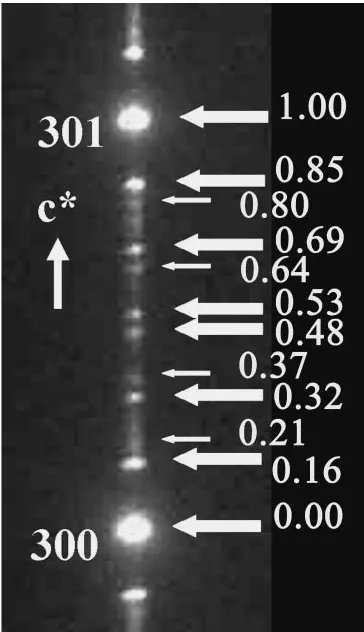
[image:3.595.44.553.124.358.2] [image:3.595.324.530.385.590.2]incommensurate. Diffuse streaks are also observed along the cdirection. In the adirection, diffraction spots, 100 and 200 do not appear. These experimental facts suggest that the crystal structure of this area is rhombohedral, and the number of the C-type layer-units might be different in each repeat-block. In that case, the parametermwould not be an integer. An enlargement between 300 and 301 of Fig. 4 is presented in Fig. 5. In order to find out the precise value t
for the unknown structure, we measured the position of the diffraction spots between 300 and 301. The resulting positions of the diffraction spots are revealed in Fig. 5, and the period in the c direction is found to bet¼0:16. Using the equation (2), the parameterm becomes 5.25. This does not correspond to any structure in Table 1.
It might be suggested that the structure is a mixture of two or more structures where the average value of the parameter
mwould become 5.25. As the simplest model, structure could be assumed to be a mixture of the two layer structures of m¼5 and m¼6. with a volume ratio 3 to 1. Here the average value of the parameter m would be equal to ð5 3þ61Þ=4¼5:25.
A corresponding high resolution image is given in Fig. 6. The electron diffraction pattern Fig. 4 was made from a region approximately ten times larger than the area of Fig. 6. Since each layer-unit is resolved in each repeat-block in the image, we can see the layer structure directly. As mentioned in the previous section, the horizontal array of clear dots are attributed to theC-type layer-unit and the horizontal arrays of
dull dots are attributed to theLa/Lb-type layer-units. Several types of repeat-blocks are found in the image.
Numerals inserted with an arrow in Fig. 6, present the number of theC-type layer-units in each repeat-block in the central section of the image. Numerals other than 5 and 6 appeared above and below. The totally non-periodic struc-tures can be observed in the image. Making an average for
m at the main part of the image, we obtain that m is approximately equal to 5.25. This value is consistent with the
m-value obtained in the simplest model assumed from the electron diffraction pattern.
We have demonstrated that the parameter m (5.25) obtained from the high resolution images and the parameter
t (0.16) measured in the electron diffraction pattern satisfy the equation (2) for the rhombohedral structure. In this way the complex crystal structure is plausibly analyzed from careful observation of the electron diffraction pattern.
Acknowledgements
A part of this work was supported by ‘‘Nanotechnology Support Project of the Ministry of Education, Culture, Sports, Science and Technology (MEXT), Japan’’ at the Research Center for Ultrahigh Voltage Electron Microscopy, Osaka University. Thanks to Professor H. Mori and Doctor K. Sakata of this center for the high resolution imaging by the H9000 electron microscope. The authors thank R&D Support Project of Transmission Electron Microscopy in the Kansai centre of the National Institute of Advanced Industrial Science and Technology, for TEM specimen preparations of the alloys.
REFERENCES
1) P. Villars and L. D. Calvert: Pearson’s Handbook of Crystallographic Data for Intermetallic Phases, vol. 4, second ed., ASM International, Materials Prak, Ohio, 1991.
Fig. 5 Enlargement of Figure 4 between 300 and 301. The position of the diffraction spots is measured along the c direction and spacing of the
spots is found to be incommensurate, that is,t¼0:16.
Fig. 6 High resolution image obtained from the area roughly correspond-ing to the diffraction pattern of Fig. 4 in the La0:8Mg0:2Ni3:4xCo0:3
[image:4.595.322.533.71.281.2] [image:4.595.77.259.72.388.2]6) Y. Kahn: Phys. Stat. Sol. (a)23(1974) 425.
7) Y. Komura, S. Takeda and Y. Kitano: Science Report, RITUA29, Suppl. 1 (1981) 13–18.
8) S. Takeda, Y. Kitano and Y. Komura: J. Less-Common Metals84
(1982) 317–325.
9) S. Takeda and Y. Komura: Crystal research and technology17(1982) 1145–1150.
10) S. Takeda, H. Horikoshi and Y. Komura: J. Microscopy129(1983) 347–352.
11) H. Horikoshi, S. Takeda and Y. Komura: Jpn. J. Appl. Phys.24(1985) L210–L212.
(2003) 129–137.
16) S. De Negri, M. Giovannini and A. Saccone: J. Alloys and Compounds
397(2005) 126–134.
17) H. Hayakawa, E. Akiba, M. Gotoh and T. Kohno: Mater. Trans.46
(2005) 1393.
18) T. Ozaki, Y. Kitano, S. Tanase, T. Sakai, M. Kanemoto, T. Kakeya, M. Kuzuhara and M. Watada: ECS 208th Meeting, Abstract number 861, Los Angeles (2005).