
&
Nanomaterials
Dynamic Covalent Nanoparticle Building Blocks
Abstract: Rational and generalisable methods for engi-neering surface functionality will be crucial to realising the technological potential of nanomaterials. Nanoparticle-bound dynamic covalent exchange combines the error-correcting and environment-responsive features of equi-librium processes with the stability, structural precision, and vast diversity of covalent chemistry, defining a new and powerful approach for manipulating structure, func-tion and properties at nanomaterial surfaces. Dynamic co-valent nanoparticle (DCNP) building blocks thus present a whole host of possibilities for constructing adaptive sys-tems, devices and materials that incorporate both nano-scale and molecular functional components. At the same time, DCNPs have the potential to reveal fundamental in-sights regarding dynamic and complex chemical systems confined to nanoscale interfaces.
The Importance of Nanoparticle Surface
Func-tionality
Tremendous synthetic and analytical advances over more than two decades have opened up a new region of chemical space on the nanoscale, leading to excitement on account of the ex-traordinary properties observed for myriad types of nanoparti-cles (NPs) and other materials in this size regime.[1] Virtually
any potential application of nanomaterials will require careful control over a wide range of features, as well as integration with any number of other components.[1d,e, 2] However,
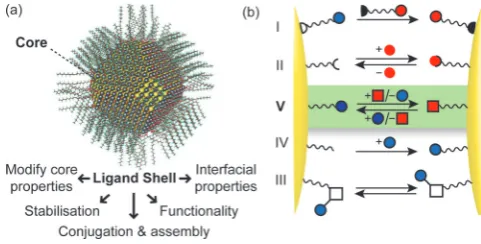
strat-egies for functionalising and assembling these new chemical entities have not kept pace with advances in their synthesis and there is now a pressing need to bridge this capability gap if the technological potential of nanomaterials is to be realised. The chemical nature of nanoscale surfaces is inherently criti-cal to the behaviour of all nanomaterials. The canonicriti-cal exam-ple is a monolayer-stabilised nanoparticle (NP), in which an in-organic core is stabilised by a surface-bound layer of molecular ligands. The properties of these multicomponent systems are defined both by the material, size and shape of the inorganic core and by the characteristics of the surface-bound species (Figure 1 a).[3] Furthermore, the ligand shell provides a handle
for attaching other components—be they molecules, surfaces or other nanomaterials. Despite a long history,[4]the controlled
synthesis of NPs of any sort remains challenging and the range of compatible surface functionalities restricted.[5] ‘Ligand
ex-change’, whereby temporary surface-bound molecules are re-placed in their entirety (Figure 1 b, I) has been widely exploited for some systems,[6]yet still presents several practical
challeng-es, has limited scope for linking to complex functionalities or non-molecular components, and is not applicable to all core materials. Consequently, robust and predictable methods for modifying NP-bound surface species in a postsynthetic fashion will be critical for manipulating NPs, tuning their properties, and assembling devices and materials from these nanoscale building blocks.[7]Ideally these methodologies should be
inde-pendent of the underlying nanomaterial and therefore general-isable across a wide array of nanostructures that can have mol-ecules attached to the surface.
The current strategies for in situ modification of NP-bound molecules (Figure 1 b, II–IV) have considerable drawbacks that prevent them offering universal solutions. Exploiting noncova-lent interactions between biomolecules—and, in particular, hy-bridisation to single-stranded oligonucleotides—has proven particularly successful, leading to myriad NP-based devices and materials.[9] However, the structural and chemical stability of
biomolecules is only maintained within tightly defined condi-tions; complex high molecular weight architectures limit the scope for structural and chemical variation; and molecular-level characterisation can be extremely challenging. Nonbio-molecular approaches have the potential to draw upon the full diversity of synthetic chemistry for optimising structure, func-tion and properties.[7]Innovative designs that exploit
noncova-lent interactions for NP functionalisation,[10]aggregation,[11]and
surface immobilisation,[12]have recently been explored, but still
cannot match the stability, specificity, and selectivity of DNA. Stimuli-responsive molecular switches incorporated within NP ligand shells have recently produced a number of impressive dynamic NP systems, in particular for control of NP aggrega-tion.[13] The challenges for this relatively unexplored strategy
include avoiding degradation processes that lead to switch fa-tigue, and extending the switching phenomena to properties beyond the aggregation state.[14]
Covalent modification of NP surface functionality is an obvi-ous attractive alternative and has indeed been intensively
ex-Figure 1.a) Calculated structure of a monolayer-stabilised NP (5 nm PbS core capped with oleic acid ligands) and the crucial features that are deter-mined by the ligand shell; b) cartoon representation of strategies for post-synthetic NP surface engineering: I. Ligand exchange; II. host–guest com-plexation; III. stimuli-responsive molecular switches; IV. kinetically controlled covalent reactions; V. dynamic covalent reactions (highlighted). Panel (a) adapted from ref. [8] with permission from AAAS.
[a]Dr. E. R. Kay
EaStCHEM School of Chemistry, University of St Andrews North Haugh, St Andrews, Fife, KY16 9ST (UK) E-mail: [email protected]
Homepage: http://kaylab.wp.st-andrews.ac.uk
ORCID from the author for this article is available on the WWW under http://dx.doi.org/10.1002/chem.201601394.
[image:2.595.304.545.65.187.2]plored. However, typical examples rely on kinetically controlled reactions, often inspired by mild, robust and high-yielding pro-tocols developed for bioconjugation applications.[15]These only
offer one-shot transformations and fail to match the pro-grammability of oligonucleotide approaches. Dynamic covalent bonds—which, under appropriate conditions, can form and break many times over, while under alternative conditions can be kinetically inert—offer a unique solution to these issues (Figure 1 b, V), and the concept of dynamic covalent nanoparti-cle (DCNP) building blocks opens up a host of possibilities for repeatedly switching—and subtly tuning—NP functionalisation and properties, and for controlling NP self-assembly.
Dynamic Covalent Chemistry: Towards
Adap-tive Chemical Systems, Materials and Surfaces
Processes in which covalent bonds are formed reversibly under conditions of thermodynamic control have for decades been recognised as important in certain branches of chemistry, in-cluding carbohydrate stereochemistry[16] and polymer
synthe-sis.[17] Inspired by the prospect of extending the newly
estab-lished principles of supramolecular chemistry into the molecu-lar world—and enabled by advances in analytical technology that made feasible the characterisation of mixtures—in the late 1990s, pioneering groups developed dynamic covalent chemistry as a means of combining the strength, directionality and potential for kinetic stability of covalent bonds, with the benefits of error-correcting self-assembly, product stability con-trol, and stimuli-responsiveness.[18] Creating equilibrating
mix-tures of molecular species that could adapt in response to mo-lecular recognition interactions or environmental changes af-forded a new strategy for template-induced selection of opti-mised supramolecular hosts, guests and catalysts, or for high-yield assembly of complex molecular architectures.[18e, 19]The
in-tervening years have seen rapid progress, leading to several re-markable achievements, including selection of unforeseen macrocyclic receptors from dynamic combinatorial libraries,[20]
construction of three-dimensional molecular cages and capsu-les,[21] preparation of hitherto inaccessible interlocked
molecu-lar architectures,[22] crystallisation of infinite covalent organic
frameworks,[23]self-replication from a dynamic mixture of
com-peting molecules,[24] and operation of sophisticated artificial
molecular nanomachines.[25] Logical extensions of these
con-cepts have led to the self-assembly of responsive and adaptive materials,[26] including dynamic covalent polymers[27] and
self-selecting small molecule ‘dynablocks’.[28]
Characterisation of inherently dynamic and multicomponent chemical systems is a formidable challenge in any setting,[29]
even more so when moving away from the familiar solution-state environment into condensed phases or on to surfaces.[19b]
Dynamic covalent processes occurring at interfaces have been correspondingly demanding to establish. Pioneering studies exploited emerging characterisation techniques including atomic force microscopy and confocal fluorescence microscopy to visualise erasable molecular patterns[30]and directed surface
diffusion of covalently attached macromolecules,[31] operating
by reversible condensation and hydrolysis of imines on
self-as-sembled monolayers (SAMs). More recently, pH-controlled pat-terning of imine SAMs was achieved through dynamic covalent selection from a mixture of small-molecule amines or amine-containing proteins.[32] Multiple orthogonal dynamic covalent
processes have since been combined to construct an impres-sive series of chemically responimpres-sive multicomponent surface architectures in which several coaxially aligned photoconduc-tive channels can be grown normal to the surface with control over patterning parallel to the substrate.[33]
Enabled by developments in scanning probe microscopy, potentially reversible covalent reactions have also been investi-gated for the construction of extended noncovalent and cova-lent atomically thin 2D networks at solid surfaces under vacuum,[34] at the solid/liquid interface[35] and at the liquid/air
interface.[36]Recently, dynamic covalent exchange was
demon-strated in one such system, where the free energy of surface physisorption can act as a driving force for constituent selec-tion and amplificaselec-tion from a dynamic library of imines.[37]
The emergence of surface-confined dynamic covalent sys-tems now suggests several compelling possibilities, including spatiotemporal control over the exchange process, leading to the prospect of creating surface patterns or achieving com-partmentalised chemical behaviour spanning several length scales. These studies have helped to reveal the often consider-able influence of the unique surface microenvironment when chemical processes are confined to interfaces.
Dynamic Covalent Nanoparticle Building
Blocks
These contemporaneous developments for both nanomaterials and dynamic molecular systems now set the stage for extend-ing dynamic covalent reactions onto nanosurfaces. Intermedi-ate in size between macromolecules and extended surfaces, applying reversible covalent reactions to nanosurfaces allows the principles of equilibrium control to be applied to achieve responsive and adaptive behaviour on the nanoscale, while ex-ploiting the precision and diversity of synthetic molecular structures. Working with nanosized chemical entities introdu-ces several new challenges, but also opens up exciting possi-bilities for elucidating fundamental features of chemical pro-cesses taking place at interfaces that are just not available for extended substrates.
In a handful of cases, cargoes have been attached to and then released from nanomaterials through formation and cleavage of the same covalent bond. For example, inspired by stationary phases developed for affinity chromatography, bor-onic acids have been associated with magnetic NPs and used to isolate and enrich polyhydroxylated biomolecules from bio-logical samples followed by release for analysis by mass spec-trometry.[38] Boronic acid functionalised gold nanoparticles
(AuNPs) have also been used to reversibly trap molecular car-goes in the pores of silica solids that display polyhydroxyl sur-face functionality; cargo release being achieved by lowering pH, consistent with a mechanism involving pH-switched boro-nate ester condensation/hydrolysis.[39] A similar approach has
nano-particles (MSNPs), where the silica surface was functionalised with boronic acids and the capping unit was the polyhydroxyl-ated glycoprotein insulin.[40] Moreover, imine linkages have
been used to attach and detach hydrophobic dendrons on the surface of silica-coated superparamagnetic microspheres[41]and
both hydrazones[42] and oximes[43]have been used for loading
and release of simple carbonyl-containing units on MSNPs. Taking place on sparsely-functionalised irregular surfaces, direct characterisation of the molecular processes in such sys-tems is a formidable challenge. These examples all exploit effi-cient interconversion of functional groups through high-yield-ing condensation and hydrolysis reactions. Under each set of conditions, formation or cleavage of a covalent bond is essen-tially irreversible and is therefore conceptually similar to other covalent surface modifications.[15] However, dynamic covalent
exchange processes would allow subtle and responsive tuning of the NP surface functionality, controlled by thermodynamic differences between a number of exchanging species, and ex-hibiting constitutional adaptation in response to myriad pa-rameters and interactions. Dynamic covalent nanoparticle (DCNP) building blocks therefore introduce a powerful new ap-proach to nanomaterial surface engineering, and the construc-tion of responsive NP-based devices, assemblies and materials.
Dynamic covalent exchange on phospholipid nanosurfaces
Myriad dynamic biomolecular reaction and recognition pro-cesses take place on phospholipid bilayers; for example, disul-fide exchange with exofacial thiols on membrane-associated proteins can mediate signalling pathways, viral entry and non-endosomal cellular uptake processes.[44]In addition to the
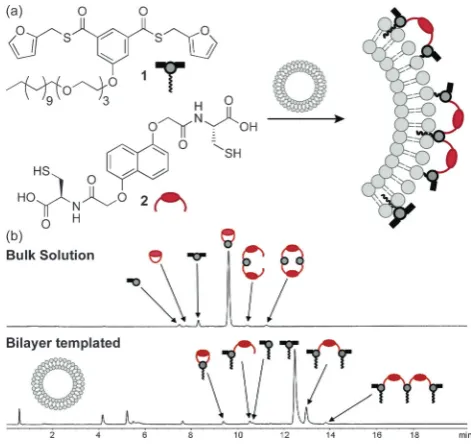
con-siderable analytical challenges, achieving dynamic covalent re-actions on artificial nanoscale membranes must also overcome the often limited stability of self-assembled amphiphile struc-tures. Nevertheless, Otto and co-workers successfully demon-strated dynamic covalent thioester exchange on the surface of large (d200 nm) unilamellar vesicles assembled from egg phosphatidyl choline and 10 mol % of a membrane-anchored thioester derivative 1 (Figure 2).[45] Surface confinement was
found to retard the dynamic covalent thioester exchange reac-tions only to a modest extent and equilibrium control was maintained. Significantly, thioester libraries equilibrated on these liposome surfaces exhibited markedly different composi-tions compared to bulk solution. For example, when amphi-philic bis-thioester 1 was equilibrated with dithiol 2, a high proportion of linear compounds (formed by cross-linking sev-eral membrane-anchored units) was observed, in contrast to the small monomeric and dimeric products formed in solution (Figure 2 b). This can be attributed to the higher local concen-tration of 1 at the interface, compared to when at the same overall concentration in bulk solution.
Dynamic covalent exchange on monolayer-stabilised inorganic nanosurfaces
Our group first explored the DCNP concept by using AuNPs (d
3.0 nm) bearing a hydrazone-terminated surface monolayer
(AuNP-3; Figure 3).[46] On introducing an aldehyde exchange
unit, such as4, together with an acid catalyst, the monolayer composition could be reliably and reversibly modified through dynamic covalent hydrazone exchange. The single-component monolayer achieves extremely high surface densities of ex-changeable units, which could be quantitatively modified; or alternatively, mixed monolayers could be accessed with com-positions defined by the thermodynamic stability of each hy-drazone and the reaction conditions. Simply removing the acid catalyst afforded kinetically stable products that could be iso-lated, purified, characterised, and stored without further changes to the monolayer.
In contrast to larger and sparsely functionalised nanosurfa-ces—which behave in many respects as curved analogues of 2D extended SAMs—these small colloidal NPs, stabilised by a dense, single-component monolayer, are perhaps better con-sidered as a unique category of 3D SAMs, with many features akin to large macromolecules.[47] This pseudomolecular nature
allows analytical tools such as NMR spectroscopy to be exploit-ed for in situ characterisation of surface-bound structures and processes ; opportunities that are not applicable to analogous 2D systems or sparsely functionalised larger NPs. Monitoring DCNP hydrazone exchange by 19F NMR spectroscopy allowed
both NP-bound and unbound species to be quantified in real time (Figure 3 b,c). As might be intuitively expected, the sur-face-confined process proceeded more slowly than analogous solution-phase reactions.[46] However, the retardation was
[image:4.595.307.543.64.286.2]rela-tively modest and dynamic covalent exchange was found to be significantly faster than analogous ligand exchange process-es at the Au S bond, which of course also first require each
Figure 2.a) Schematic representation of a bilayer-templated dynamic combi-natorial library formed by thioester exchange between surface-active bis-thioester1and dithiol2in the presence of lipid bilayer vesicles ; b) HPLC traces comparing library compositions produced in bulk aqueous solution (top trace) and at the lipid bilayer interface (bottom trace, 10 mmegg
phos-phatidyl choline, 1.0 mm1and 1.0 mm2).[45]Adapted from ref. [45] under
new ligand to be synthetically prepared. The ability to charac-terise molecular-level details promises a quantitative under-standing of NP-bound dynamic covalent reactions that will un-derpin rational synthetic methods for manipulating DCNPs with predictability and precision.
One of the advantages of the DCNP concept is the ability to exploit the vast toolbox of synthetic organic chemistry to tune virtually any aspect of the surface-bound molecular structure, properties or reactivity. Whereas hydrazone-exchange reactions tend to reach equilibrium on a timescale of minutes to hours under acid- or nucleophile-catalysed conditions, the reaction between a boronic acid and various dihydroxy compounds to yield boronate esters occurs extremely rapidly in the presence of Lewis bases. Hydrazones and boronate esters therefore rep-resent two chemically orthogonal dynamic covalent functional groups with an attractive contrast in kinetic characteristics. We recently developed AuNP-7(d3.4 nm; Figure 4), stabilised by a homogenous monolayer of structurally simple boronic acids, which reacts with 1,2-diols in the presence of a Lewis base to provide NP-bound boronate esters.[48] In situ analysis by 19F NMR spectroscopy revealed that boronate ester formation
and dynamic covalent exchange (when more than one diol-containing exchange unit is introduced) occurs rapidly and re-versibly, achieving high surface-saturation concentrations. Mixed boronate ester monolayers display pathway-independ-ent compositions that adapt to changes in the mixture of
exo-genously introduced diols, confirming that dynamic covalent exchange on the NP surface remains an equilibrium process under thermodynamic control (Figure 4).[48]
Independently, Otto and co-workers have exploited kinetical-ly facile imine exchange to achieve template-driven dynamic covalent NP functionalisation (Figure 5).[49] On treating
AuNP-12/13(d11.7 nm), which is stabilised by a mixed monolayer incorporating approximately 10 mol % aldehyde ligand12, with mixtures of simple primary amines, negligible NP-bound imine formation was observed. However, on introducing short (16-mer) oligonucleotides, selective uptake of amines from solu-tion was observed. This could be explained by thermodynamic stabilisation of NP-bound imines as a result of multivalent in-teractions between the imine-functionalised NP surface and the oligonucleotide template. Significantly, the degree of func-tionalisation, and the composition of NP-bound imine libraries, depended on the oligonucleotide sequence employed (Fig-ure 5 b): the dynamic covalent ligand shell can adapt to opti-mise binding to each specific DNA template.[49] Very recently,
the same approach was extended to the formation of bound hydrazones, whereby mixtures of two different NP-bound hydrazones were obtained depending on the DNA tem-plate sequence.[50] This second-generation system also has the
advantage of employing a neutral surface monolayer, which minimises nonspecific binding to the anionic oligonucleotide templates.
Together, these studies establish that dynamic molecular ex-change chemistry can be used to selectively control NP func-tionalisation through adaptive surface monolayers, as well as pointing to the potential insights—and considerable
chal-Figure 4.NP-bound boronate ester formation and dynamic covalent ex-change on sequential reaction of AuNP-7with catechols8(blue) and9
(red). In situ analysis by19
F NMR spectroscopy reveals identical mixed mono-layer equilibria are reached via two different routes (R=N -methylmorpholini-um).[48]
[image:5.595.311.538.61.297.2]Adapted from ref. [48] with permission from The Royal Society of Chemistry.
Figure 3.a) Dynamically reconfigurable AuNP-bound hydrazone monolayers; b) in situ characterisation by19
F NMR spectroscopy allows molecular-level characterisation of monolayer composition; c) real-time tracking of dynamic covalent exchange reactions.[46]
[image:5.595.60.281.61.353.2]lenges—associated with characterising dynamic covalent pro-cesses in this unconventional environment. The diversity of abiotic synthetic chemistry may now be exploited to develop a whole series of DCNP building blocks that would constitute a universal set of environment-responsive ‘nanoparticle syn-thons’ with optimised reactivity and properties for a wide range of applications.
Reversible Control of DCNP Properties
Mild methods for postsynthetic NP property control are highly desirable and would have significant benefits for nanomaterial handling and processing. We reported how hydrazone ex-change can be used to achieve reversible and stimuli-respon-sive control over DCNP physicochemical properties by appro-priate choice of molecular exchange unit (Figure 6).[46]AuNP-3
was colloidally stable only in polar aprotic solvents, yet
hydra-zone exchange with hydrophobic aldehyde 14 produced
AuNP-15, which exhibited colloidal stability in less polar organ-ic solvents. Likewise, exchange with charged aldehyde16 pro-duced AuNP-17, which was colloidally stable in water. In con-trast to alternative approaches such as ligand exchange or noncovalent encapsulation, DCNPs combine excellent stability in each state with complete reversibility; any one state can be accessed from any of the others, and each state corresponds to a single, covalently bound entity, with no requirement for weakly associated stabilisers or surfactants.
In a recent study, Takahara, Otsuka and co-workers prepared large silica NPs (d100 nm) functionalised with polymer brushes bearing approximately 10 mol % alkoxyamine side chains (NP-18, Figure 7).[51]The dynamic covalent radical
cross-over reaction of alkoxyamines was then exploited to graft on appropriately functionalised polymer exchange units, such as poly(4-vinylpyridine) derivativeP19. Although the extent of ex-change was very limited (ca. 2.2 % as quantified by XPS analy-sis), subsequent quaternisation of the pyridine units rendered silica NP-18 P19Me+ dispersible in water. Reaction with the
small-molecule alkoxyamine20recovered both the XPS signa-ture and solvent compatibility properties of the initial sample, consistent with a fully reversible dynamic covalent exchange process.[51]
Molecule-Directed Assembly of DCNP Building
Blocks
Structural control over nanoparticle assemblies is important for defining a number of emergent and collective properties when several NPs are brought together, and is therefore of crucial importance to many innovative NP applications, from sensing to catalysis; optoelectronics to thermoelectrics.[1d,e]
Further-more, integrating nanostructures with components from exist-ing technologies, such as microelectronics or optics, requires the controlled assembly and patterning of NPs across several size scales.[2] Although NP ‘superlattices’ may be assembled,
driven by nonspecific dispersion forces on controlled solvent evaporation, these tend to form close-packed structures with arrangements that are specified by the size and shape of the NP building blocks.[52] Independent control over NP building
[image:6.595.56.284.64.336.2]block characteristics and assembly structure through chemis-try-led design of interparticle linkers has been exemplified by
Figure 5.a) DNA-templated dynamic covalent AuNP-bound imine monolay-ers; negligible imine formation occurs in the absence of DNA ; b) monolayer composition depends on the specific base pair sequence of the double-stranded DNA template.[49]Panel (b) adapted with permission from ref. [49],
copyright Wiley-VCH Verlag GmbH & Co. KGa, Weinheim.
Figure 6.Reversible control of DCNP solvent compatibility by dynamic cova-lent hydrazone exchange; solvents: A=hexane, B=chloroform, C= tetrahy-drofuran, D=methanol, E=N,N-dimethylformamide, F=water.[46]Adapted
[image:6.595.317.537.67.270.2]the emergence of ordered, non-close-packed NP arrays con-nected by oligonucleotide hybridisation.[9g]However, all of the
attendant issues with regards to DNA stability and customisa-bility remain, and assembly at surfaces is still very much in its infancy.[53]Despite several notable advances exploiting
nonbio-molecular linkers,[11, 54]all-covalent strategies tend to encounter
kinetic traps, whereas noncovalent approaches can require very specific conditions or complex molecular designs to pro-duce well-defined kinetically stable structures.
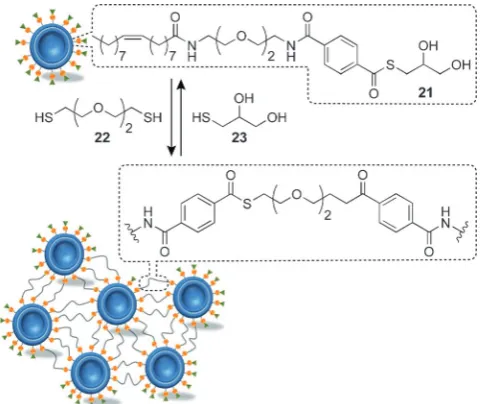
DCNP building blocks have the exciting potential to self-as-semble under error-correcting, thermodynamically controlled conditions, yet be connected by structurally unambiguous, stable and diverse covalent linkers. Exploiting dynamic cova-lent exchange of bilayer-confined thioesters, Ravoo and co-workers reported the reversible assembly of liposome aggre-gates.[55] Liposomes (d100 nm) constructed from soy bean
lecithin and 25 mol % thioester21were treated with dithiol22,
[image:7.595.150.446.65.303.2]resulting in covalent cross-links between the vesicles
(Figure 8). Although the assembly morphology has not been determined, dynamic light scattering indicated the formation of polydisperse aggregates over a period of several hours, which could subsequently be disrupted by addition of an excess of monofunctional thiol23to drive the dynamic cova-lent exchange process back towards the starting thioester.
An optical sensor for assessing enantiomeric excess of chiral diols has been demonstrated, based on enantioselective dis-ruption of colloidally stable aggregates produced from saccha-ride-functionalised AuNPs in the presence of inorganic borate anions.[56]Aggregation, which produces an easily detectible
op-tical signature on account of changes to the AuNP-localised surface plasmon resonance, was attributed to the formation of dynamic covalent spiroborate cross-links between NP-bound
vicinal diols. These linkages are subsequently disrupted on in-troduction of the small-molecule diol analytes.
Combining organic molecule linkers with monolayer-stabi-lised DCNPs, we recently demonstrated the dynamic covalent assembly of extended and responsive NP aggregates by using boronic acid-functionalised AuNP-7(Figure 4 and 9) in combi-nation with ditopic linkers that can themselves be varied to tune the aggregate morphology in a modular fashion.[48]In the
presence of a bifunctional diol linker, dynamic covalent boro-nate ester cross-links are formed between the DCNPs. The
re-Figure 8.Reversible liposome cross-linking by dynamic covalent thioester exchange.[55]Adapted from ref. [55] with permission from The Royal Society
[image:7.595.308.550.365.567.2]of Chemistry.
sulting extended aggregates eventually precipitate from solu-tion, producing low-density open networks that are consistent with a diffusion-limited aggregation process. Assembly is quan-titative and switchable : the DNCP building block and molecu-lar linker do not interact until addition of a Lewis base to stabi-lise the NP-bound boronate esters, thus initiating assembly. Re-markably, despite being linked by covalent bonds, the result-ing solid-state aggregates can then be completely disassem-bled by introducing a competitive monofunctional diol (Figure 9).[48]
Interestingly, DCNP aggregate morphology was found to vary depending on the nature of the bifunctional linker, sug-gesting that morphology can be tuned through structural modification of a small-molecule component. With the ability to characterise NP-bound dynamic covalent processes in situ (vide supra), this offers a straightforward and rational approach to varying morphological parameters over a wider range than is possible using biomolecular systems. This modular strategy might also be extended to incorporate additional chemical, physical or structural features within the molecular linker design. The diversity of complementary and orthogonal dy-namic covalent exchange processes points the way to yet-more sophisticated assemblies and devices that incorporate several different DCNP building blocks, designed to be selec-tively reactive with each other and/or with specific species. The DCNP building block concept thus suggests several intri-guing avenues towards responsive, reconfigurable and truly multifunctional hybrid nanomaterials in which both molecular and nanoscale components are precisely arranged, and com-bine to define emergent system properties.
Conclusion and Outlook
One only has to look to biology to understand the potential for producing remarkable functional materials or complex chemical networks by nanoscale confinement of dynamic mo-lecular systems on interfaces or within compartments.
Advan-ces in both synthetic and analytical technology are now allow-ing chemists to consider emulatallow-ing some of these extraordina-ry systems, even if only at a comparatively rudimentaextraordina-ry level. Dynamic covalent reactions offer unique advantages in their combination of specific and selective thermodynamically con-trolled reactivity, within structurally robust and unambiguous small-molecule covalent structures that are synthetically and analytically tractable. Conferring dynamic covalent reactivity on the vast array of nanomaterials that can now be generated with increasingly precise control over chemical composition, size, shape and dispersity, will therefore establish a versatile
new category of nanochemical synthon: the DCNP building
block.
Whether on soft or hard nanosurfaces, combining the error-correcting and environment-responsive features of equilibrium processes with the stability and structural diversity of covalent chemistry amounts to a ‘best of both worlds’ solution to the problem of engineering surface functionality. The basic con-cept is largely independent of the nanomaterial itself, and so can ultimately be generalised across a range of materials, shapes and sizes. This is in stark contrast to ligand-exchange strategies, which by definition must be specific for each differ-ent nanomaterial–molecule interaction; dynamic covaldiffer-ent ex-change of simple units on the periphery of a stabilising mono-layer can occur significantly faster under milder conditions and avoids the necessity for multistep synthesis of each ligand from scratch. The advantages of a nonbiomolecular approach include the ability to readily vary structural and chemical pa-rameters, and operate under a wide range of conditions. The ever-increasing number of well-characterised dynamic covalent reactions[19c, 57] affords a diversity of complementary and
or-thogonal reactivities, spanning a huge range of kinetic behav-iours and operating conditions. Furthermore, with the full gamut of synthetic small-molecule chemistry at our disposal, the possibilities for augmenting both structure and properties through the supporting molecular scaffold are almost limitless. For all these reasons, DCNPs can provide a toolbox of universal
nanoscale building blocks that can be predictably modified, combined, and assembled to suit numerous of applications.
The pseudomolecular nature of colloidally stable NPs—at least at the lower end of the size-scale—means that although the analytical challenges are significant, they are not insur-mountable. Several studies discussed herein have demonstrat-ed that these systems can reveal direct insight into chemical processes occurring at interfaces, something that has proven extremely challenging in other settings. Consequently, DCNPs constitute a unique platform on which to study surface-bound molecular behaviour. Understanding the subtle and complex network of interactions governing reactivity within NP-bound monolayers will be crucial to arriving at rational and predicta-ble synthetic methodologies for working with DCNPs, for ex-ample by quantifying and understanding the influence of sur-face confinement on reaction kinetics.[46] At the same time,
such fundamental questions are equally relevant to better un-derstanding a variety of other surface-confined molecular pro-cesses, from heterogeneous catalysis to cell-surface recogni-tion. The profound influence of the surface-bound microenvir-onment on the thermodynamics of equilibrating dynamic co-valent systems has already been demonstrated,[45, 49]and points
the way towards templated nanosurfaces that array numerous copies of several functionalities across a nanoscale surface area, thus providing synthetic analogues for modelling or per-turbing large-area multivalent interactions that are at the heart of numerous natural processes.[58]
The essential role that surface-bound species play in defin-ing a range of nanomaterial properties means that dynamic covalent modification heralds a powerful, environment-respon-sive route to controlling system-level behaviours, including physicochemical properties or microscopic and mesoscopic as-sembly structures. We have shown that this approach can be used to reversibly switch and tune NP solvent compatibility using very simple molecular exchange units,[46] or else to
as-semble covalently linked NP aggregates that are responsive to specific chemical stimuli.[48]There is rich potential for creating
adaptive and reconfigurable devices and materials in which structural features and physicochemical properties can be tuned in a modular fashion by rational selection of molecular and NP components that are assembled in thermodynamically controlled error-correcting processes and may be perturbed by external stimuli.
Mastering complex systems that arise through the interac-tion of dynamic chemical processes, reacinterac-tion networks and structures is one of the next grand challenges facing synthetic, analytical and theoretical chemists in the coming decades;[59]
dynamic covalent chemistry and nanomaterial building blocks will undoubtedly play significant roles in realising this. Al-though the concept of a rational ‘heterosupramolecular chemistry’ whereby supramolecular chemistry principles could be applied to achieve molecular-level control over nanoparti-cles was proposed at least two decades ago,[60]it is only now
that synthetic and analytical capabilities have reached a level of maturity that allows such aspirations to be met. Dynamic covalent reactions are being exploited in all sorts of original ways,[20–37] including in systems that are coupled to external
energy sources, such as out-of-equilibrium chemical
reaction-s,[24a] transmembrane concentration gradients[61] or repeatedly
applied external stimuli.[62] We can expect that
cross-fertilisa-tion between each of these themes will serve as inspiracross-fertilisa-tion for ever more innovative designs and complex behaviours on the nanoscale. With the ability to reveal fundamental insights, and transformative potential as an enabling technology, DCNPs will contribute to this future chemical synthetic science, whereby molecular, nanoscale and macroscopic building blocks may be combined with equal precision, to create complex, responsive and adaptive systems operating across several size scales.
Acknowledgements
I thank the Royal Society of Edinburgh and the Scottish Gov-ernment for a personal research fellowship and gratefully ac-knowledge the EPSRC (EP/K016342/1) and Leverhulme Trust (RPG-2015-042) for funding our work on dynamic nanomateri-als. I also thank all members of my research group, both past and present, who have contributed to our work in this area.
Keywords: dynamic covalent chemistry · nanoparticles ·
nanostructures· supramolecular chemistry · surface chemistry
[1] a) G. A. Ozin, A. C. Arsenault,Nanochemistry. A Chemical Approach to
Nanomaterials, The Royal Society of Chemistry, Cambridge,2005; b) C.
Burda, X. B. Chen, R. Narayanan, M. A. El-Sayed, Chem. Rev.2005,105, 1025 – 1102; c) H. Goesmann, C. Feldmann,Angew. Chem. Int. Ed.2010,
49, 1362 – 1395 ;Angew. Chem.2010,122, 1402 – 1437; d) D. V. Talapin, J.-S. Lee, M. V. Kovalenko, E. V. Shevchenko, Chem. Rev.2010, 110, 389 – 458; e) P. D. Howes, R. Chandrawati, M. M. Stevens,Science2014,346, 1247390.
[2] a) Z. H. Nie, A. Petukhova, E. Kumacheva,Nat. Nanotechnol.2010,5, 15 – 25; b) L. Xu, W. Ma, L. Wang, C. Xu, H. Kuang, N. A. Kotov,Chem. Soc. Rev.2013,42, 3114 – 3126.
[3] a) R. A. Sperling, W. J. Parak,Philos. Trans. R. Soc. London Ser. A2010,
368, 1333 – 1383; b) M. A. Boles, D. Ling, T. Hyeon, D. V. Talapin, Nat.
Mater.2016,15, 141 – 153.
[4] M. Faraday,Philos. Trans. R. Soc. London1857, 147, 145 – 181.
[5] a) J. Park, J. Joo, S. G. Kwon, Y. Jang, T. Hyeon,Angew. Chem. Int. Ed. 2007,46, 4630 – 4660;Angew. Chem.2007,119, 4714 – 4745; b) Y. Xia, Y. Xiong, B. Lim, S. E. Skrabalak,Angew. Chem. Int. Ed.2009,48, 60 – 103;
Angew. Chem.2009,121, 62 – 108; c) N. T. K. Thanh, N. Maclean, S.
Ma-hiddine,Chem. Rev.2014,114, 7610 – 7630.
[6] a) M. J. Hostetler, S. J. Green, J. J. Stokes, R. W. Murray,J. Am. Chem. Soc. 1996,118, 4212 – 4213 ; b) R. S. Ingram, M. J. Hostetler, R. W. Murray,J.
Am. Chem. Soc.1997,119, 9175 – 9178 ; c) A. Caragheorgheopol, V.
Che-chik,Phys. Chem. Chem. Phys.2008,10, 5029 – 5041. [7] W. Edwards, E. R. Kay,ChemNanoMat2016,2, 87 – 98.
[8] D. Zherebetskyy, M. Scheele, Y. Zhang, N. Bronstein, C. Thompson, D. Britt, M. Salmeron, P. Alivisatos, L.-W. Wang,Science 2014,344, 1380 – 1384.
[9] a) E. Katz, I. Willner,Angew. Chem. Int. Ed.2004,43, 6042 – 6108;Angew.
Chem.2004,116, 6166 – 6235 ; b) S. Mann, W. Shenton, M. Li, S. Connolly,
D. Fitzmaurice,Adv. Mater.2000,12, 147 – 150; c) S. S. Behrens,J. Mater.
Chem. 2008, 18, 3788 – 3798; d) C. L. Choi, A. P. Alivisatos, Annu. Rev.
Phys. Chem.2010,61, 369 – 389; e) C.-L. Chen, N. L. Rosi,Angew. Chem.
Int. Ed. 2010, 49, 1924 – 1942 ; Angew. Chem. 2010, 122, 1968 – 1986;
f) J. I. Cutler, E. Auyeung, C. A. Mirkin, J. Am. Chem. Soc. 2012, 134, 1376 – 1391; g) R. J. Macfarlane, M. N. O’Brien, S. H. Petrosko, C. A. Mirkin,Angew. Chem. Int. Ed.2013,52, 5688 – 5698;Angew. Chem.2013,
125, 5798 – 5809.
Liz-Marzn,Chem. Eur. J.2014,20, 10874 – 10883; c) Y.-W. Yang, Y.-L. Sun, N. Song,Acc. Chem. Res. 2014, 47, 1950 – 1960; d) L. J. Prins,Acc. Chem. Res.2015,48, 1920 – 1928.
[11] a) A. K. Boal, F. Ilhan, J. E. DeRouchey, T. Thurn-Albrecht, T. P. Russell, V. M. Rotello,Nature2000,404, 746 – 748; b) R. Klajn, M. A. Olson, P. J. Wesson, L. Fang, A. Coskun, A. Trabolsi, S. Soh, J. F. Stoddart, B. A. Grzy-bowski,Nat. Chem.2009,1, 733 – 738; c) T. Shirman, T. Arad, M. E. van der Boom, Angew. Chem. Int. Ed. 2010, 49, 926 – 929; Angew. Chem. 2010, 122, 938 – 941; d) J. Zhang, R. J. Coulston, S. T. Jones, J. Geng, O. A. Scherman, C. Abell,Science2012,335, 690 – 694.
[12] a) D. Dorokhin, S.-H. Hsu, N. Tomczak, D. N. Reinhoudt, J. Huskens, A. H. Velders, G. J. Vancso,ACS Nano2010,4, 137 – 142; b) T. Shirman, R. Ka-minker, D. Freeman, M. E. van der Boom,ACS Nano2011,5, 6553 – 6563. [13] a) R. Klajn, J. F. Stoddart, B. A. Grzybowski, Chem. Soc. Rev.2010, 39, 2203 – 2237; b) A. C. Fahrenbach, S. C. Warren, J. T. Incorvati, A.-J. Aves-tro, J. C. Barnes, J. F. Stoddart, B. A. Grzybowski,Adv. Mater.2013,25, 331 – 348; c) H. Zhao, S. Sen, T. Udayabhaskararao, M. Sawczyk, K. Kucˇan-da, D. Manna, P. K. Kundu, J.-W. Lee, P. Krl, R. Klajn,Nat. Nanotechnol. 2015,11, 82 – 88.
[14] E. R. Kay, J. Lee, D. G. Nocera, M. G. Bawendi, Angew. Chem. Int. Ed. 2013,52, 1165 – 1169;Angew. Chem.2013,125, 1203 – 1207.
[15] K. E. Sapsford, W. R. Algar, L. Berti, K. B. Gemmill, B. J. Casey, E. Oh, M. H. Stewart, I. L. Medintz,Chem. Rev.2013,113, 1904 – 2074.
[16] E. L. Eliel, S. H. Wilen,Stereochemistry of Organic Compounds, Wiley-In-terscience, New York,1994.
[17] F. S. Dainton, K. J. Ivin,Nature1948,162, 705 – 707.
[18] a) P. A. Brady, J. K. M. Sanders, Chem. Soc. Rev. 1997, 26, 327 – 336; b) J. M. Lehn,Chem. Eur. J.1999,5, 2455 – 2463; c) G. R. L. Cousins, S.-A. Poulsen, J. K. M. Sanders,Curr. Opin. Chem. Biol. 2000, 4, 270 – 279; d) J. M. Lehn, A. V. Eliseev,Science2001,291, 2331 – 2332; e) S. J. Rowan, S. J. Cantrill, G. R. L. Cousins, J. K. M. Sanders, J. F. Stoddart, Angew.
Chem. Int. Ed.2002,41, 898 – 952;Angew. Chem.2002,114, 938 – 993.
[19] a) P. T. Corbett, J. Leclaire, L. Vial, K. R. West, J.-L. Wietor, J. K. M. Sanders, S. Otto,Chem. Rev.2006,106, 3652 – 3711; b) J. Li, P. Nowak, S. Otto,J.
Am. Chem. Soc.2013,135, 9222 – 9239; c) Y. Jin, C. Yu, R. J. Denman, W.
Zhang,Chem. Soc. Rev.2013,42, 6634 – 6654.
[20] S. Otto, R. L. E. Furlan, J. K. M. Sanders,Science2002,297, 590 – 593. [21] P. Mal, B. Breiner, K. Rissanen, J. R. Nitschke,Science2009,324, 1697 –
1699.
[22] a) K. S. Chichak, S. J. Cantrill, A. R. Pease, S.-H. Chiu, G. W. V. Cave, J. L. Atwood, J. F. Stoddart,Science 2004, 304, 1308 – 1312; b) D. A. Leigh, R. G. Pritchard, A. J. Stephens,Nat. Chem.2014,6, 978 – 982.
[23] a) H. M. El-Kaderi, J. R. Hunt, J. L. Mendoza-Corts, A. P. Ct, R. E. Taylor, M. O’Keeffe, O. M. Yaghi,Science2007,316, 268 – 272; b) J. W. Colson, A. R. Woll, A. Mukherjee, M. P. Levendorf, E. L. Spitler, V. B. Shields, M. G. Spencer, J. Park, W. R. Dichtel,Science 2011,332, 228 – 231; c) Y. Liu, Y. Ma, Y. Zhao, X. Sun, F. Gndara, H. Furukawa, Z. Liu, H. Zhu, C. Zhu, K. Suenaga, P. Oleynikov, A. S. Alshammari, X. Zhang, O. Terasaki, O. M. Yaghi,Science2016,351, 365 – 369.
[24] a) J. W. Sadownik, D. Philp,Angew. Chem. Int. Ed.2008,47, 9965 – 9970;
Angew. Chem.2008, 120, 10113 – 10118; b) R. Nguyen, L. Allouche, E.
Buhler, N. Giuseppone, Angew. Chem. Int. Ed. 2009, 48, 1093 – 1096;
Angew. Chem.2009, 121, 1113 – 1116; c) J. M. A. Carnall, C. A. Waudby,
A. M. Belenguer, M. C. A. Stuart, J. J.-P. Peyralans, S. Otto,Science2010,
327, 1502 – 1506.
[25] a) M. von Delius, E. M. Geertsema, D. A. Leigh,Nat. Chem.2010,2, 96 – 101; b) S. Kassem, A. T. L. Lee, D. A. Leigh, A. Markevicius, J. Sol,Nat.
Chem.2016,8, 138 – 143.
[26] E. Moulin, G. Cormos, N. Giuseppone,Chem. Soc. Rev.2012,41, 1031 – 1049.
[27] a) J. M. Lehn, Prog. Polym. Sci. 2005, 30, 814 – 831; b) T. Maeda, H. Otsuka, A. Takahara,Prog. Polym. Sci.2009, 34, 581 – 604; c) R. J. Woj-tecki, M. A. Meador, S. J. Rowan,Nat. Mater.2011, 10, 14 – 27; d) C. J. Kloxin, C. N. Bowman, Chem. Soc. Rev. 2013, 42, 7161 – 7173 ; e) C. S. Mahon, D. A. Fulton,Nat. Chem.2014,6, 665 – 672.
[28] N. Giuseppone,Acc. Chem. Res.2012,45, 2178 – 2188.
[29] M. C. Misuraca, E. Moulin, Y. Ruff, N. Giuseppone,New J. Chem.2014,38, 3336 – 3349.
[30] D. I. Rozkiewicz, B. J. Ravoo, D. N. Reinhoudt,Langmuir2005,21, 6337 – 6343.
[31] T. Chang, D. I. Rozkiewicz, B. J. Ravoo, E. W. Meijer, D. N. Reinhoudt,
Nano Lett.2007,7, 978 – 980.
[32] L. Tauk, A. P. Schrçder, G. Decher, N. Giuseppone,Nat. Chem.2009,1, 649 – 656.
[33] a) N. Sakai, S. Matile,J. Am. Chem. Soc.2011,133, 18542 – 18545; b) H. Hayashi, A. Sobczuk, A. Bolag, N. Sakai, S. Matile,Chem. Sci.2014, 5, 4610 – 4614; c) K.-D. Zhang, S. Matile, Angew. Chem. Int. Ed.2015,54, 8980 – 8983;Angew. Chem.2015,127, 9108 – 9111.
[34] a) S. Weigelt, C. Busse, C. Bombis, M. M. Knudsen, K. V. Gothelf, T. Strun-skus, C. Wçll, M. Dahlbom, B. Hammer, E. Lægsgaard, F. Besenbacher, T. R. Linderoth, Angew. Chem. Int. Ed. 2007, 46, 9227 – 9230; Angew.
Chem.2007,119, 9387 – 9390; b) S. Weigelt, C. Busse, C. Bombis, M. M.
Knudsen, K. V. Gothelf, E. Lægsgaard, F. Besenbacher, T. R. Linderoth,
Angew. Chem. Int. Ed.2008,47, 4406 – 4410;Angew. Chem.2008,120,
4478 – 4482; c) N. A. A. Zwaneveld, R. Pawlak, M. Abel, D. Catalin, D. Gigmes, D. Bertin, L. Porte,J. Am. Chem. Soc.2008,130, 6678 – 6679. [35] R. Tanoue, R. Higuchi, N. Enoki, Y. Miyasato, S. Uemura, N. Kimizuka,
A. Z. Stieg, J. K. Gimzewski, M. Kunitake,ACS Nano2011,5, 3923 – 3929. [36] W. Dai, F. Shao, J. Szczerbin´ski, R. McCaffrey, R. Zenobi, Y. Jin, A. D.
Schlter, W. Zhang,Angew. Chem. Int. Ed.2016,55, 213 – 217.
[37] A. Ciesielski, M. El Garah, S. Haar, P. Kovarˇcˇek, J.-M. Lehn, P. Samor ,Nat.
Chem.2014,6, 1017 – 1023.
[38] a) W. Zhou, N. Yao, G. Yao, C. Deng, X. Zhang, P. Yang,Chem. Commun. 2008, 5577 – 5579 ; b) L. Liang, Z. Liu,Chem. Commun.2011,47, 2255 – 2257; c) Z.-A. Lin, J.-N. Zheng, F. Lin, L. Zhang, Z. Cai, G.-N. Chen, J.
Mater. Chem.2011,21, 518 – 524; d) H. Wang, Z. Bie, C. L, Z. Liu,Chem.
Sci.2013,4, 4298 – 4303.
[39] E. Aznar, M. Dolores Marcos, R. Martnez-MÇez, F. Sancenn, J. Soto, P. Amors, C. Guillem,J. Am. Chem. Soc.2009,131, 6833 – 6843.
[40] Y. Zhao, B. G. Trewyn, I. I. Slowing, V. S.-Y. Lin,J. Am. Chem. Soc.2009,
131, 8398 – 8400.
[41] K. C.-F. Leung, S. Xuan, C.-M. Lo,ACS Appl. Mater. Interfaces 2009, 1, 2005 – 2012.
[42] C.-H. Lee, S.-H. Cheng, I.-P. Huang, J. S. Souris, C.-S. Yang, C.-Y. Mou, L.-W. Lo,Angew. Chem. Int. Ed.2010,49, 8214 – 8219 ;Angew. Chem.2010,
122, 8390 – 8395.
[43] D. P. Ferris, P. R. McGonigal, L. S. Witus, T. Kawaji, M. M. Algaradah, A. R. Alnajadah, M. S. Nassar, J. F. Stoddart,Org. Lett.2015,17, 2146 – 2149. [44] a) A. G. Torres, M. J. Gait, Trends Biotechnol.2012, 30, 185 – 190; b) G. Gasparini, G. Sargsyan, E.-K. Bang, N. Sakai, S. Matile,Angew. Chem. Int. Ed.2015,54, 7328 – 7331;Angew. Chem.2015,127, 7436 – 7439. [45] F. M. Mansfeld, H. Y. Au-Yeung, J. K. M. Sanders, S. Otto,J. Syst. Chem.
2010,1, 12.
[46] F. della Sala, E. R. Kay, Angew. Chem. Int. Ed. 2015, 54, 4187 – 4191;
Angew. Chem.2015,127, 4261 – 4265.
[47] a) A. C. Templeton, M. P. Wuelfing, R. W. Murray,Acc. Chem. Res.2000,
33, 27 – 36; b) X.-M. Li, J. Huskens, D. N. Reinhoudt, J. Mater. Chem. 2004,14, 2954 – 2971.
[48] S. Borsley, E. R. Kay,Chem. Commun.2016, DOI: 10.1039/C6CC00135A. [49] P. Nowak, V. Saggiomo, F. Salehian, M. Colomb-Delsuc, Y. Han, S. Otto,
Angew. Chem. Int. Ed.2015,54, 4192 – 4197;Angew. Chem.2015,127,
4266 – 4271.
[50] Y. Han, P. Nowak, M. Colomb-Delsuc, M. P. Leal, S. Otto,Langmuir2015,
31, 12658 – 12663.
[51] T. Sato, T. Ohishi, Y. Higaki, A. Takahara, H. Otsuka,Polym. J.2016,48, 147 – 155.
[52] a) C. B. Murray, C. R. Kagan, M. G. Bawendi,Science 1995,270, 1335 – 1338; b) C. J. Kiely, J. Fink, M. Brust, D. Bethell, D. J. Schiffrin, Nature 1998, 396, 444 – 446; c) B. L. V. Prasad, C. M. Sorensen, K. J. Klabunde,
Chem. Soc. Rev.2008,37, 1871 – 1883 ; d) C. R. Kagan, C. B. Murray,Nat.
Nanotechnol.2015,10, 1013 – 1026.
[53] E. Auyeung, R. J. Macfarlane, C. H. J. Choi, J. I. Cutler, C. A. Mirkin,Adv.
Mater.2012,24, 5181 – 5186.
[54] a) A. M. Kalsin, M. Fialkowski, M. Paszewski, S. K. Smoukov, K. J. M. Bishop, B. A. Grzybowski, Science2006,312, 420 – 424; b) I. Hussain, Z. Wang, A. I. Cooper, M. Brust,Langmuir2006,22, 2938 – 2941; c) R. Klajn, K. J. M. Bishop, M. Fialkowski, M. Paszewski, C. J. Campbell, T. P. Gray, B. A. Grzybowski, Science2007,316, 261 – 264; d) S. I. Lim, C.-J. Zhong,
Acc. Chem. Res.2009,42, 798 – 808.
[55] S. A. Berg, B. J. Ravoo,Soft Matter2014,10, 69 – 74.
[57] a) Y. Yi, H. Xu, L. Wang, W. Cao, X. Zhang,Chem. Eur. J.2013,19, 9506 – 9510; b) H. Ying, Y. Zhang, J. Cheng,Nat. Commun.2014,5, 3218 ; c) S. Ji, W. Cao, Y. Yu, H. Xu,Angew. Chem. Int. Ed. 2014, 53, 6781 – 6785;
Angew. Chem. 2014, 126, 6899 – 6903; d) S. Billiet, K. De Bruycker, F.
Driessen, H. Goossens, V. Van Speybroeck, J. M. Winne, F. E. Du Prez,Nat.
Chem.2014,6, 815 – 821; e) A. Sanchez-Sanchez, D. A. Fulton, J. A.
Pom-poso,Chem. Commun.2014,50, 1871 – 1874 ; f) B. Rasmussen, A. Søren-sen, H. GotfredSøren-sen, M. Pittelkow,Chem. Commun.2014,50, 3716 – 3718; g) R.-C. Brachvogel, M. von Delius,Chem. Sci.2015,6, 1399 – 1403 ; h) S. Gao, T. Stopka, M. Niggemann,Org. Lett.2015,17, 5080 – 5083; i) S. Kul-chat, J.-M. Lehn,Chem. Asian J.2015,10, 2484 – 2496.
[58] a) M. Mammen, S.-K. Choi, G. M. Whitesides,Angew. Chem. Int. Ed.1998,
37, 2754 – 2794;Angew. Chem.1998,110, 2908 – 2953; b) L. L. Kiessling, J. E. Gestwicki, L. E. Strong,Angew. Chem. Int. Ed.2006,45, 2348 – 2368;
Angew. Chem.2006,118, 2408 – 2429.
[59] a) J.-M. Lehn,Angew. Chem. Int. Ed.2013,52, 2836 – 2850;Angew. Chem. 2013, 125, 2906 – 2921; b) B. Grzybowski, S. Otto, D. Philp, Chem.
Commun. 2014,50, 14924 – 14925 ; c) J.-M. Lehn,Angew. Chem. Int. Ed.
2015, 54, 3276 – 3289 ; Angew. Chem. 2015, 127, 3326 – 3340; d) E. Mattia, S. Otto,Nat. Nanotechnol.2015,10, 111 – 119.
[60] a) L. Cusack, R. Rizza, A. Gorelov, D. Fitzmaurice,Angew. Chem. Int. Ed.
Engl. 1997, 36, 848 – 851; Angew. Chem. 1997, 109, 887 – 890; b) L.
Cusack, S. N. Rao, D. Fitzmaurice,Chem. Eur. J.1997,3, 202 – 207. [61] a) V. Saggiomo, U. Luening, Chem. Commun. 2009, 3711 – 3713; b) V.
Saggiomo, C. Goeschen, R. Herges, R. Quesada, U. Luening,Eur. J. Org.
Chem.2010, 2337 – 2343 ; c) X. Wu, N. Busschaert, N. J. Wells, Y.-B. Jiang,
P. A. Gale,J. Am. Chem. Soc.2015,137, 1476 – 1484.
[62] M. J. Barrell, A. G. CampaÇa, M. von Delius, E. M. Geertsema, D. A. Leigh,
Angew. Chem. Int. Ed. 2011, 50, 285 – 290; Angew. Chem. 2011, 123,
299 – 304.
CONCEPT
&
NanomaterialsE. R. Kay*
&&–&&
Dynamic Covalent Nanoparticle Building Blocks
Dynamic covalent reactionsof nano-particle-bound species present a host of possibilities for reversibly modifying nanoparticle functionalization, repeated-ly switching nanoparticle properties, and controlling nanoparticle self-assem-bly. The potential applications and fun-damental insights that this approach can bring to nanoparticle surface engi-neering are explored through recent early examples on a variety of nanoma-terial surfaces.Concept from @euanrkay @univofstandrews on Dynamic Covalent #Nanoparticle Building Blocks
Nanoparticle Building Blocks
Engineering surface functionality is crucial to realizing the technological potential of nanomaterials. Nanoparticle-bound dynamic covalent exchange combines the error-correcting and environment-responsive features of
equilibrium processes with the stability, structural precision, and diversity of covalent chemistry. As discussed by E. R. Kay in his Concept on page&&ff., dynamic covalent
![Figure 3. a) Dynamically reconfigurable AuNP-bound hydrazone monolayers;b) in situ characterisation by 19F NMR spectroscopy allows molecular-levelcharacterisation of monolayer composition; c) real-time tracking of dynamiccovalent exchange reactions.[46] Ad](https://thumb-us.123doks.com/thumbv2/123dok_us/8690138.379720/5.595.311.538.61.297/dynamically-reconfigurable-monolayers-characterisation-spectroscopy-levelcharacterisation-composition-dynamiccovalent.webp)
![Figure 6. Reversible control of DCNP solvent compatibility by dynamic cova-drofuran, Dlent hydrazone exchange; solvents: A=hexane, B=chloroform, C=tetrahy-=methanol, E=N,N-dimethylformamide, F=water.[46] Adaptedwith permission from ref](https://thumb-us.123doks.com/thumbv2/123dok_us/8690138.379720/6.595.56.284.64.336/reversible-compatibility-hydrazone-solvents-chloroform-dimethylformamide-adaptedwith-permission.webp)
![Figure 9. Boronate ester-driven DCNP assembly and disassembly on sequential addition of a bifunctional linker (blue), followed by a monofunctional cappingunit (pink).[48] Adapted from ref](https://thumb-us.123doks.com/thumbv2/123dok_us/8690138.379720/8.595.67.528.62.257/boronate-disassembly-sequential-bifunctional-followed-monofunctional-cappingunit-adapted.webp)
