Relation Classification via Multi-Level Attention CNNs
Linlin Wang1∗, Zhu Cao1∗, Gerard de Melo2, Zhiyuan Liu3†
1Institute for Interdisciplinary Information Sciences, Tsinghua University, Beijing, China 2 Department of Computer Science, Rutgers University, Piscataway, NJ, USA
3State Key Laboratory of Intelligent Technology and Systems, Tsinghua National Laboratory for Information Science and Technology,
Department of Computer Science and Technology, Tsinghua University, Beijing, China
{ll-wang13,cao-z13}@mails.tsinghua.edu.cn, [email protected]
Abstract
Relation classification is a crucial ingredi-ent in numerous information extraction sys-tems seeking to mine structured facts from text. We propose a novel convolutional neural network architecture for this task, relying on two levels of attention in order to better discern patterns in heterogeneous contexts. This architecture enables end-to-end learning from task-specific labeled data, forgoing the need for external knowl-edge such as explicit dependency structures. Experiments show that our model outper-forms previous state-of-the-art methods, in-cluding those relying on much richer forms of prior knowledge.
1 Introduction
Relation classification is the task of identifying the semantic relation holding between two nominal en-tities in text. It is a crucial component in natural language processing systems that need to mine ex-plicit facts from text, e.g. for various information extraction applications as well as for question an-swering and knowledge base completion (Tandon et al., 2011; Chen et al., 2015). For instance, given the example input
“Fizzy [drinks] and meat cause heart disease and [diabetes].”
with annotated target entity mentionse1 =“drinks”
ande2 =“diabetes”, the goal would be to
automati-cally recognize that this sentence expresses a
cause-effect relationship betweene1 ande2, for which
we use the notation Cause-Effect(e1,e2). Accurate
relation classification facilitates precise sentence interpretations, discourse processing, and higher-level NLP tasks (Hendrickx et al., 2010). Thus,
∗ Equal contribution.
† Corresponding author. Email: [email protected]
relation classification has attracted considerable at-tention from researchers over the course of the past decades (Zhang, 2004; Qian et al., 2009; Rink and Harabagiu, 2010).
In the example given above, the verb corre-sponds quite closely to the desired target relation. However, in the wild, we encounter a multitude of different ways of expressing the same kind of relationship. This challenging variability can be lexical, syntactic, or even pragmatic in nature. An effective solution needs to be able to account for useful semantic and syntactic features not only for the meanings of the target entities at the lexical level, but also for their immediate context and for the overall sentence structure.
Thus, it is not surprising that numerous feature-and kernel-based approaches have been proposed, many of which rely on a full-fledged NLP stack, including POS tagging, morphological analysis, de-pendency parsing, and occasionally semantic anal-ysis, as well as on knowledge resources to capture lexical and semantic features (Kambhatla, 2004; Zhou et al., 2005; Suchanek et al., 2006; Qian et al., 2008; Mooney and Bunescu, 2005; Bunescu and Mooney, 2005). In recent years, we have seen a move towards deep architectures that are capable of learning relevant representations and features with-out extensive manual feature engineering or use of external resources. A number of convolutional neural network (CNN), recurrent neural network (RNN), and other neural architectures have been proposed for relation classification (Zeng et al., 2014; dos Santos et al., 2015; Xu et al., 2015b). Still, these models often fail to identify critical cues, and many of them still require an external dependency parser.
We propose a novel CNN architecture that ad-dresses some of the shortcomings of previous ap-proaches. Our key contributions are as follows:
1. Our CNN architecture relies on a novel
level attention mechanism to capture both entity-specific attention (primary attention at the input level, with respect to the target en-tities) and relation-specific pooling attention (secondary attention with respect to the target relations). This allows it to detect more subtle cues despite the heterogeneous structure of the input sentences, enabling it to automati-cally learn which parts are relevant for a given classification.
2. We introduce a novel pair-wise margin-based objective function that proves superior to stan-dard loss functions.
3. We obtain the new state-of-the-art results for relation classification with an F1 score of 88.0%on the SemEval 2010 Task 8 dataset, outperforming methods relying on signifi-cantly richer prior knowledge.
2 Related Work
Apart from a few unsupervised clustering meth-ods (Hasegawa et al., 2004; Chen et al., 2005), the majority of work on relation classification has been supervised, typically cast as a standard multi-class or multi-label multi-classification task. Traditional feature-based methods rely on a set of features computed from the output of an explicit linguis-tic preprocessing step (Kambhatla, 2004; Zhou et al., 2005; Boschee et al., 2005; Suchanek et al., 2006; Chan and Roth, 2010; Nguyen and Grish-man, 2014), while kernel-based methods make use of convolution tree kernels (Qian et al., 2008), sub-sequence kernels (Mooney and Bunescu, 2005), or dependency tree kernels (Bunescu and Mooney, 2005). These methods thus all depend either on carefully handcrafted features, often chosen on a trial-and-error basis, or on elaborately designed kernels, which in turn are often derived from other ptrained NLP tools or lexical and semantic re-sources. Although such approaches can benefit from the external NLP tools to discover the dis-crete structure of a sentence, syntactic parsing is error-prone and relying on its success may also impede performance (Bach and Badaskar, 2007). Further downsides include their limited lexical gen-eralization abilities for unseen words and their lack of robustness when applied to new domains, genres, or languages.
In recent years, deep neural networks have shown promising results. The Recursive Matrix-Vector Model (MV-RNN) by Socher et al. (2012)
sought to capture the compositional aspects of the sentence semantics by exploiting syntactic trees. Zeng et al. (2014) proposed a deep convolutional neural network with softmax classification, extract-ing lexical and sentence level features. However, these approaches still depend on additional features from lexical resources and NLP toolkits. Yu et al. (2014) proposed the Factor-based Compositional Embedding Model, which uses syntactic depen-dency trees together with sentence-level embed-dings. In addition to dos Santos et al. (2015), who proposed the Ranking CNN (CR-CNN) model with a class embedding matrix, Miwa and Bansal (2016) similarly observed that LSTM-based RNNs are out-performed by models using CNNs, due to limited linguistic structure captured in the network archi-tecture. Some more elaborate variants have been proposed to address this, including bidirectional LSTMs (Zhang et al., 2015), deep recurrent neural networks (Xu et al., 2016), and bidirectional tree-structured LSTM-RNNs (Miwa and Bansal, 2016). Several recent works also reintroduce a dependency tree-based design, e.g., RNNs operating on syntac-tic trees (Hashimoto et al., 2013), shortest depen-dency path-based CNNs (Xu et al., 2015a), and the SDP-LSTM model (Xu et al., 2015b). Finally, Nguyen and Grishman (2015) train both CNNs and RNNs and variously aggregate their outputs using voting, stacking, or log-linear modeling (Nguyen and Grishman, 2015). Although these recent mod-els achieve solid results, ideally, we would want a simple yet effective architecture that does not re-quire dependency parsing or training multiple mod-els. Our experiments in Section 4 demonstrate that we can indeed achieve this, while also obtaining substantial improvements in terms of the obtained F1 scores.
3 The Proposed Model
Given a sentenceS with a labeled pair of entity
mentionse1 ande2(as in our example from
Sec-tion 1), relaSec-tion classificaSec-tion is the task of
identify-ing the semantic relation holdidentify-ing betweene1ande2
among a set of candidate relation types (Hendrickx et al., 2010). Since the only input is a raw sen-tence with two marked mentions, it is non-trivial to obtain all the lexical, semantic and syntactic cues necessary to make an accurate prediction.
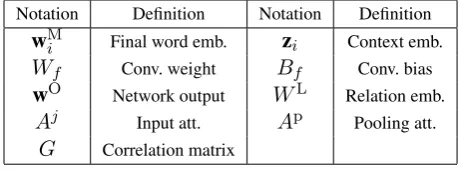
Notation Definition Notation Definition
wM
i Final word emb. zi Context emb. Wf Conv. weight Bf Conv. bias
wO Network output WL Relation emb.
Aj Input att. Ap Pooling att.
G Correlation matrix
Table 1: Overview of main notation.
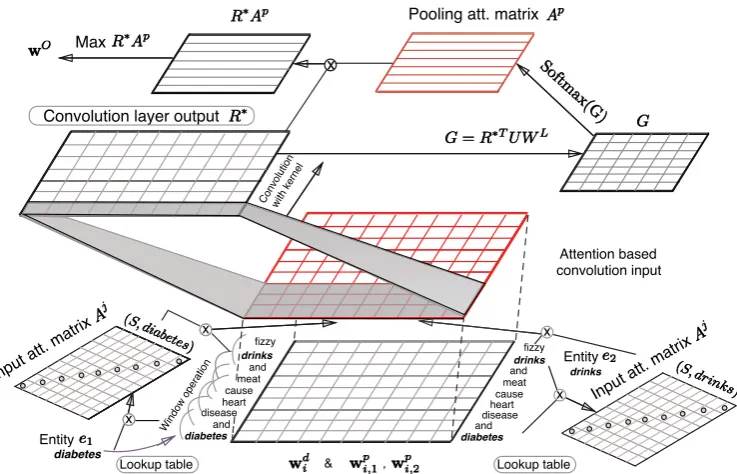
in Figure 1. The input sentence is first encoded using word vector representations, exploiting the context and a positional encoding to better capture the word order. A primary attention mechanism, based on diagonal matrices is used to capture the relevance of words with respect to the target en-tities. To the resulting output matrix, one then applies a convolution operation in order to capture contextual information such as relevant n-grams, followed by max-pooling. A secondary attention pooling layer is used to determine the most useful convolved features for relation classification from the output based on an attention pooling matrix. The remainder of this section will provide further details about this architecture. Table 1 provides an overview of the notation we will use for this. The final output is given by a new objective function, described below.
3.1 Classification Objective
We begin with top-down design considerations for the relation classification architecture. For a given
sentence S, our network will ultimately output
some wO. For every output relation y ∈ Y, we
assume there is a corresponding output embedding
WL
y, which will automatically be learnt by the
net-work (dos Santos et al., 2015).
We propose a novel distance functionδθ(S)that
measures the proximity of the predicted network
outputwOto a candidate relationyas follows.
δθ(S, y) = w
O
|wO|−WyL
(1)
using theL2norm (note thatWyLare already
nor-malized). Based on this distance function, we
de-sign a margin-based pairwise loss functionLas
L=δθ(S, y) + (1−δθ(S,yˆ−))+βkθk2
=
1 +|wwOO|−WyL−|wwOO|−WyˆL−
+βkθk2, (2)
where1is the margin, β is a parameter,δθ(S, y)
is the distance between the predicted label
embed-dingWLand the ground truth labelyandδ
θ(S,yˆ−)
refers to the distance betweenwO and a selected
incorrect relation label yˆ−. The latter is chosen
as the one with the highest score among all incor-rect classes (Weston et al., 2011; dos Santos et al., 2015), i.e.
ˆ
y−= argmax
y0∈Y,y06=yδ(S, y
0). (3)
This margin-based objective has the advantage of a strong interpretability and effectiveness com-pared with empirical loss functions such as the ranking loss function in the CR-CNN approach by dos Santos et al. (2015). Based on a distance func-tion motived by word analogies (Mikolov et al., 2013b), we minimize the gap between predicted outputs and ground-truth labels, while maximizing the distance with the selected incorrect class. By minimizing this pairwise loss function iteratively
(see Section 3.5), δθ(S, y) are encouraged to
de-crease, whileδθ(S,yˆ−)increase.
3.2 Input Representation
Given a sentence S = (w1, w2, ..., wn) with
marked entity mentions e1(=wp) and e2(=wt),
(p, t ∈ [1, n], p 6= t), we first transform every word into a real-valued vector to provide lexical-semantic features. Given a word embedding matrix
WV of dimensionalitydw× |V|, whereV is the
input vocabulary anddwis the word vector
dimen-sionality (a hyper-parameter), we map everywi to
a column vectorwd
i ∈Rdw.
To additionally capture information about the relationship to the target entities, we incorporate word position embeddings (WPE) to reflect the
rel-ative distances between thei-th word to the two
[image:3.595.70.300.63.148.2]marked entity mentions (Zeng et al., 2014; dos Santos et al., 2015). For the given sentence in Fig. 1, the relative distances of word “and” to
en-tity e1 “drinks” and e2 “diabetes” are −1and 6,
respectively. Every relative distance is mapped
to a randomly initialized position vector inRdp,
wheredp is a hyper-parameter. For a given word
i, we obtain two position vectors wpi,1 and wpi,2,
with regard to entities e1 and e2, respectively.
The overall word embedding for thei-th word is
wM
i = [(wdi)|,(wpi,1)|,(wpi,2)|]|.
Using a sliding window of size k centered
Pooling att. matrix
fizzy
Input S with marked entities: Fizzy [drinks] and meat cause heart disease and [diabetes] . Input
att. ma trix
Input att. ma
trix
drinks and meat cause heart disease
and diabetes
fizzy drinks and meat cause heart disease and diabetes
Entity diabetes
Lookup table & , Lookup table x
x Convolution layer output
Con volu
tion
with ke
rnel
Win dow
ope ratio
n
Max
x
x x
Entity
drinks
[image:4.595.117.486.63.300.2]Attention based convolution input
Figure 1: Schematic overview of our Multi-Level Attention Convolutional Neural Networks
words into a vector zi ∈ R(dw+2dp)k to
incorpo-rate contextual information as
zi = [(wMi−(k−1)/2)|, ...,(wMi+(k−1)/2)|]| (4)
An extra padding token is repeated multiple times for well-definedness at the beginning and end of the input.
3.3 Input Attention Mechanism
While position-based encodings are useful, we con-jecture that they do not suffice to fully capture the relationships of specific words with the target en-tities and the influence that they may bear on the target relations of interest. We design our model so as to automatically identify the parts of the input sentence that are relevant for relation classification.
Attention mechanisms have successfully been applied to sequence-to-sequence learning tasks such as machine translation (Bahdanau et al., 2015; Meng et al., 2015) and abstractive sentence sum-marization (Rush et al., 2015), as well as to tasks such as modeling sentence pairs (Yin et al., 2015) and question answering (Santos et al., 2016). To date, these mechanisms have generally been used to allow for an alignment of the input and output sequence, e.g. the source and target sentence in ma-chine translation, or for an alignment between two input sentences as in sentence similarity scoring and question answering.
fizzy drinks and meat cause heart disease and diabetes
Entity 1: drinks Entity 2: diabetes Lookup
table Given Text S:
... ... ... ... ... ... ... ... ...
W
o
rd
&
Po
si
tio
n
e
mb
e
d
d
in
g
Window operation
Diagonal Input att. matrix (S,drinks)
Diagonal
Input att. matrix (S,diabetes)
... ...
Figure 2: Input and Primary Attention
In our work, we apply the idea of modeling atten-tion to a rather different kind of scenario involving heterogeneous objects, namely a sentence and two entities. With this, we seek to give our model the capability to determine which parts of the sentence are most influential with respect to the two enti-ties of interest. Consider that in a long sentence with multiple clauses, perhaps only a single verb or noun might stand in a relevant relationship with a given target entity.
As depicted in Fig. 2, the input representation layer is used in conjunction with diagonal attention matrices and convolutional input composition.
Contextual Relevance Matrices. Consider the
[image:4.595.307.532.362.476.2]that there is a salient connection between the words “cause” and “diabetes” also in terms of corpus
cooc-currences. We introduce two diagonal attention
matricesAj with valuesAj
i,i =f(ej, wi)to
char-acterize the strength of contextual correlations and
connections between entity mentionej and word
wi. The scoring functionf is computed as the
in-ner product between the respective embeddings of
wordwiand entityej, and is parametrized into the
network and updated during the training process.
Given theAjmatrices, we define
αij = exp(A j i,i)
Pn
i0=1exp(Aji0,i0)
, (5)
to quantify the relative degree of relevance of thei
-th word wi-th respect to -thej-th entity (j∈ {1,2}).
Input Attention Composition. Next, we take
the two relevance factors α1
i and α2i and model
their joint impact for recognizing the relation via simple averaging as
ri=ziα
1
i +α2i
2 . (6)
Apart from this default choice, we also evaluate two additional variants. The first (Variant-1) con-catenates the word vectors as
ri = [(ziα1i)|,(ziα2i)|]|, (7)
to obtain an information-enriched input attention component for this specific word, which contains the relation relevance to both entity 1 and entity 2. The second variant (Variant-2) interprets rela-tions as mappings between two entities, and com-bines the two entity-specific weights as
ri=ziα
1
i −α2i
2 , (8)
to capture the relation between them.
Based on these ri, the final output of the
input attention component is the matrix R =
[r1,r2, . . . ,rn], wherenis the sentence length.
3.4 Convolutional Max-Pooling with Secondary Attention
After this operation, we apply convolutional max-pooling with another secondary attention model to extract more abstract higher-level features from the
previous layer’s output matrixR.
Convolution Layer. A convolutional layer may,
for instance, learn to recognize short phrases such as trigrams. Given our newly generated input
attention-based representationR, we accordingly
apply a filter of sizedcas a weight matrixWf of
sizedc×k(dw+ 2dp). Then we add a linear bias
Bf, followed by a non-linear hyperbolic tangent
transformation to represent features as follows:
R∗= tanh(W
fR+Bf). (9)
Attention-Based Pooling. Instead of regular
pooling, we rely on an attention-based pooling strategy to determine the importance of individual
windows inR∗, as encoded by the convolutional
kernel. Some of these windows could represent meaningful n-grams in the input. The goal here is
to select those parts ofR∗ that are relevant with
respect to our objective from Section 3.1, which essentially calls for a relation encoding process, while neglecting sentence parts that are irrelevant for this process.
We proceed by first creating a correlation
mod-eling matrixGthat captures pertinent connections
between the convolved context windows from the
sentence and the relation class embeddingWL
in-troduced earlier in Section 3.1:
G=R∗|U WL, (10)
whereU is a weighting matrix learnt by the
net-work.
Then we adopt a softmax function to deal with
this correlation modeling matrixG to obtain an
attention pooling matrixApas
Api,j = Pnexp(Gi,j)
i0=1exp(Gi0,j), (11)
whereGi,jis the(i, j)-th entry ofGandApi,jis the
(i, j)-th entry ofAp.
Finally, we multiply this attention pooling matrix
with the convolved outputR∗ to highlight
impor-tant individual phrase-level components, and apply a max operation to select the most salient one (Yin et al., 2015; Santos et al., 2016) for a given dimen-sion of the output. More precisely, we obtain the
output representationwOas follows in Eq. (12):
wOi = max
j (R
∗Ap)
i,j, (12)
wherewO
i is thei-th entry ofwOand(R∗Ap)i,jis
3.5 Training Procedure
We rely on stochastic gradient descent (SGD) to up-date the parameters with respect to the loss function in Eq. (2) as follows:
θ0 =θ+λd(
P|S|
i=1[δθ(Si, y) + (1−δθ(Si,yˆi−))]) dθ
+λ1d(β||θ|| 2)
dθ
(13)
whereλandλ1are learning rates, and
incorporat-ing theβparameter from Eq. (2).
4 Experiments
4.1 Experimental Setup
Dataset and Metric. We conduct our
exper-iments on the commonly used SemEval-2010 Task 8 dataset (Hendrickx et al., 2010), which contains 10,717 sentences for nine types of an-notated relations, together with an additional “Other” type. The nine types are: Cause-Effect,
Component-Whole, Content-Container, Entity-Destination, Entity-Origin, Instrument-Agency, Member-Collection, Message-Topic, and Product-Producer, while the relation type “Other” indicates that the relation expressed in the sentence is not among the nine types. However, for each of the aforementioned relation types, the two entities can also appear in inverse order, which implies that the sentence needs to be regarded as expressing a different relation, namely the respective inverse
one. For example, Cause-Effect(e1,e2) and
Cause-Effect(e2,e1) can be considered two distinct
rela-tions, so the total number|Y|of relation types is
19. The SemEval-2010 Task 8 dataset consists of a training set of 8,000 examples, and a test set with the remaining examples. We evaluate the models using the official scorer in terms of the Macro-F1 score over the nine relation pairs (excluding Other).
Settings. We use the word2vec skip-gram model
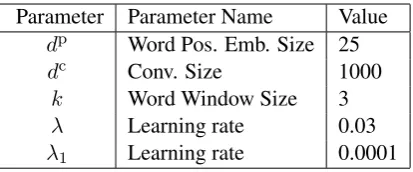
(Mikolov et al., 2013a) to learn initial word rep-resentations on Wikipedia. Other matrices are ini-tialized with random values following a Gaussian distribution. We apply a cross-validation procedure on the training data to select suitable hyperparam-eters. The choices generated by this process are given in Table 2.
4.2 Experimental Results
Table 3 provides a detailed comparison of our Multi-Level Attention CNN model with previous
Parameter Parameter Name Value
dp Word Pos. Emb. Size 25
dc Conv. Size 1000
k Word Window Size 3
λ Learning rate 0.03
[image:6.595.314.521.61.147.2]λ1 Learning rate 0.0001
Table 2: Hyperparameters.
approaches. We observe that our novel attention-based architecture achieves new state-of-the-art re-sults on this relation classification dataset. Att-Input-CNN relies only on the primal attention at the input level, performing standard max-pooling after the convolution layer to generate the network
outputwO, in which the new objective function
is utilized. With Att-Input-CNN, we achieve an F1-score of 87.5%, thus already outperforming not only the original winner of the SemEval task, an SVM-based approach (82.2%), but also the well-known CR-CNN model (84.1%) with a relative
improvement of 4.04%, and the newly released
DRNNs (85.8%) with a relative improvement of
2.0%, although the latter approach depends on the
Stanford parser to obtain dependency parse infor-mation. Our full dual attention model Att-Pooling-CNN achieves an even more favorable F1-score of 88%.
Table 4 provides the experimental results for the two variants of the model given by Eqs. (7) and (8) in Section 3.3. Our main model outperforms the other variants on this dataset, although the variants may still prove useful when applied to other tasks. To better quantify the contribution of the different components of our model, we also conduct an ab-lation study evaluating several simplified models. The first simplification is to use our model without the input attention mechanism but with the pooling attention layer. The second removes both atten-tion mechanisms. The third removes both forms of attention and additionally uses a regular
objec-tive function based on the inner products=r·w
for a sentence representationrand relation class
embedding w. We observe that all three of our
components lead to noticeable improvements over these baselines.
4.3 Detailed Analysis
Primary Attention. To inspect the inner
Classifier F1 Manually Engineered Methods
SVM (Rink and Harabagiu, 2010) 82.2
Dependency Methods
RNN (Socher et al., 2012) 77.6
MVRNN (Socher et al., 2012) 82.4
FCM (Yu et al., 2014) 83.0
Hybrid FCM (Yu et al., 2014) 83.4
SDP-LSTM (Xu et al., 2015b) 83.7
DRNNs (Xu et al., 2016) 85.8
SPTree (Miwa and Bansal, 2016) 84.5
End-To-End Methods
CNN+ Softmax (Zeng et al., 2014) 82.7
CR-CNN (dos Santos et al., 2015) 84.1
DepNN (Liu et al., 2015) 83.6
depLCNN+NS (Xu et al., 2015a) 85.6
STACK-FORWARD∗ 83.4
VOTE-BIDIRECT∗ 84.1
VOTE-BACKWARD∗ 84.1
Our Architectures
Att-Input-CNN 87.5
[image:7.595.81.283.62.390.2]Att-Pooling-CNN 88.0
Table 3: Comparison with results published in the
literature, where ‘∗’ refers to models from Nguyen
and Grishman (2015).
for the following randomly selected sentence from the test set:
The disgusting scene was retaliation against her brother Philip who rents the [room]e1inside
this apartment [house]e2on Lombard street.
Fig. 3 plots the word-level attention values for the input attention layer to act as an example, us-ing the calculated attention values for every indi-vidual word in the sentence. We find the word “inside” was assigned the highest attention value, while words such as “room” and “house” also are deemed important. This appears sensible in light of the ground-truth labeling as a
Component-Whole(e1,e2) relationship. Additionally, we
ob-serve that words such as “this”, which are rather irrelevant with respect to the target relationship, indeed have significantly lower attention scores.
Most Significant Features for Relations.
Ta-ble 5 lists the top-ranked trigrams for each relation
classyin terms of their contribution to the score
for determining the relation classification. Recall
the definition ofδθ(x, y)in Eq. (1). In the network,
we trace back the trigram that contributed most to
Classifier F1
Att-Input-CNN (Main) 87.5
Att-Input-CNN (Variant-1) 87.2
Att-Input-CNN (Variant-2) 87.3
Att-Pooling-CNN (regular) 88.0
– w/o input attention 86.6
– w/o any attention 86.1
[image:7.595.316.520.64.186.2]– w/o any attention, w/oδ-objective 84.1
Table 4: Comparison between the main model and variants as well as simplified models.
the
disgustingscene was retaliationagainst her
brotherphilipwho rents the roominside this apartmenthouse
on lombardstreet
0.0 0.1 0.2 0.3 0.4 0.5 0.6 0.7
Figure 3: Input Attention Visualization. The value
of the y-coordinate is computed as100∗(At
i − mini∈{1,...,n}Ati), whereAtistands for the overall
attention weight assigned to the word i.
the correct classification in terms ofδθ(Si, y)for
each sentenceSi. We then rank all such trigrams in
the sentences in the test set according to their total
contribution and list the top-ranked trigrams.∗ In
Table 5, we see that these are indeed very informa-tive for deducing the relation. For example, the top
trigram for Cause-Effect(e2,e1) is “are caused by”,
which strongly implies that the first entity is an ef-fect caused by the latter. Similarly, the top trigram
for Entity-Origin(e1,e2) is “from the e2”, which
suggests thate2 could be an original location, at
which entitye1 may have been located.
Error Analysis. Further, we examined some of
the misclassifications produced by our model. The following is a typical example of a wrongly classi-fied sentence:
∗For Entity-Destination(e
2,e1), there was only one
[image:7.595.308.523.242.414.2]Relation (e1,e2) (e2,e1)
e1caused a, caused ae2, e2caused by,e2frome1,
Cause-Effect e1resulted in, the cause of, is caused by, are caused by,
had caused the, poverty causee2 was caused by, been caused by
Component-Whole e1of the, of ae2, of thee2, with itse2,e1consists of,
in thee2, part of the e1has a,e1comprisese2
Content-Container in ae2, was hidden in, e1withe2, filled withe2,
inside ae2, was contained in e1contained a, full ofe2,
Entity-Destination e1into the,e1into a, had thrown into
was put inside, in ae2
Entity-Origin from thise2, is derived from, e1e2is, thee1e2,
from thee2, away from the fore1e2, the source of
Instrument-Agency for thee2, is used by, by ae2, e1usee2, with ae2,
with thee2, ae1e2 by usinge2
Member-Collection of thee2, in thee2, ae1of,e1of various,
a member of, from thee2 e1ofe2, thee1of
Message-Topic on thee2,e1asserts the, thee1of, described in the,
e1points out,e1is the the topic for, in thee2
Product-Producer e1made by, made bye2, has constructed a, came up with,
[image:8.595.128.469.61.268.2]from thee2, by thee2 has drawn up,e1who created Table 5: Most representative trigrams for different relations.
A [film]e1 revolves around a [cadaver]e2 who
seems to bring misfortune on those who come in contact with it.
This sentence is wrongly classified as belonging to the “Other” category, while the ground-truth
la-bel is Message-Topic(e1,e2). The phrase “revolves
around” does not appear in the training data, and moreover is used metaphorically, rather than in its original sense of turning around, making it difficult for the model to recognize the semantic connection.
Another common issue stems from sentences of
the form “. . .e1e2. . . ”, such as the following ones:
The size of a [tree]e1[crown]e2is strongly . . .
Organic [sesame]e1[oil]e2has an . . .
Before heading down the [phone]e1[operator]e2
career . . .
These belong to three different relation classes,
Component-Whole(e2,e1), Entity-Origin(e2,e1),
and Instrument-Agency(e1,e2), respectively, which
are only implicit in the text, and the context is not particularly helpful. More informative word em-beddings could conceivably help in such cases.
Convergence. Finally, we examine the
conver-gence behavior of our two main methods. We plot the performance of each iteration in the Att-Input-CNN and Att-Pooling-Att-Input-CNN models in Fig. 4. It can be seen that Att-Input-CNN quite smoothly converges to its final F1 score, while for the Att-Pooling-CNN model, which includes an additional attention layer, the joint effect of these two atten-tion layer induces stronger back-propagaatten-tion ef-fects. On the one hand, this leads to a seesaw phenomenon in the result curve, but on the other
hand it enables us to obtain better-suited models with slightly higher F1 scores.
0 5 10 15 20 25 30
0.4 0.45 0.5 0.55 0.6 0.65 0.7 0.75 0.8 0.85 0.9
Iteration
F1 score
Att−Pooling−CNN Att−Input−CNN
Figure 4: Training Progress of Att-Input-CNN and Att-Pooling-CNN across iterations.
5 Conclusion
[image:8.595.318.516.360.518.2]Acknowledgments
The research at IIIS is supported by China 973 Program Grants 2011CBA00300, 2011CBA00301, and NSFC Grants 61033001, 61361136003, 61550110504. Prof. Liu is supported by the China 973 Program Grant 2014CB340501 and NSFC Grants 61572273 and 61532010.
References
Nguyen Bach and Sameer Badaskar. 2007.
A review of relation extraction. Online at
http://www.cs.cmu.edu/%7Enbach/papers/
A-survey-on-Relation-Extraction.pdf.
Dzmitry Bahdanau, Kyunghyun Cho, and Yoshua Ben-gio. 2015. Neural machine translation by jointly
learning to align and translate. In Proceedings of
the International Conference on Learning Represen-tations (ICLR).
Elizabeth Boschee, Ralph Weischedel, and Alex Zama-nian. 2005. Automatic information extraction. In
Proceedings of the 2005 International Conference on Intelligence Analysis, McLean, VA, pages 2–4. Razvan C Bunescu and Raymond J Mooney. 2005.
A shortest path dependency kernel for relation
ex-traction. InProceedings of the Conference on
Hu-man Language Technology and Empirical Methods in Natural Language Processing, pages 724–731. Association for Computational Linguistics.
Yee Seng Chan and Dan Roth. 2010. Exploiting
back-ground knowledge for relation extraction. In
Pro-ceedings of the 23rd International Conference on Computational Linguistics, pages 152–160. Associ-ation for ComputAssoci-ational Linguistics.
Jinxiu Chen, Donghong Ji, Chew Lim Tan, and Zhengyu Niu. 2005. Unsupervised feature selection
for relation extraction. InProceedings of IJCNLP.
Jiaqiang Chen, Niket Tandon, and Gerard de Melo. 2015. Neural word representations from large-scale
commonsense knowledge. In Proceedings of WI
2015.
Cıcero Nogueira dos Santos, Bing Xiang, and Bowen Zhou. 2015. Classifying relations by ranking with
convolutional neural networks. In Proceedings of
the 53rd Annual Meeting of the Association for Computational Linguistics and the 7th International Joint Conference on Natural Language Processing, volume 1, pages 626–634.
Takaaki Hasegawa, Satoshi Sekine, and Ralph Grish-man. 2004. Discovering relations among named
entities from large corpora. In Proceedings of the
42nd Annual Meeting of the Association for Compu-tational Linguistics, page 415. Association for Com-putational Linguistics.
Kazuma Hashimoto, Makoto Miwa, Yoshimasa Tsu-ruoka, and Takashi Chikayama. 2013. Simple cus-tomization of recursive neural networks for
seman-tic relation classification. In Proceedings of the
2013 Conference on Empirical Methods in Natu-ral Language Processing, pages 1372–1376, Seattle, Washington, USA, October. Association for Compu-tational Linguistics.
Iris Hendrickx, Su Nam Kim, Zornitsa Kozareva, Preslav Nakov, Diarmuid ´O S´eaghdha, Sebastian Pad´o, Marco Pennacchiotti, Lorenza Romano, and Stan Szpakowicz. 2010. SemEval-2010 task 8: Multi-way classification of semantic relations
be-tween pairs of nominals. In Proceedings of the
5th International Workshop on Semantic Evaluation, pages 33–38. Association for Computational Lin-guistics.
Nanda Kambhatla. 2004. Combining lexical, syntactic, and semantic features with maximum entropy
mod-els for extracting relations. In Proceedings of the
42nd Annual Meeting of the Association for Compu-tation Linguistics, page 22. Association for Compu-tational Linguistics.
Yang Liu, Furu Wei, Sujian Li, Heng Ji, Ming Zhou, and Houfeng Wang. 2015. A dependency-based
neural network for relation classification. In
Pro-ceedings of the 53rd Annual Meeting of the Associ-ation for ComputAssoci-ational Linguistics and the 7th In-ternational Joint Conference on Natural Language Processing, pages 285–290.
Fandong Meng, Zhengdong Lu, Mingxuan Wang, Hang Li, Wenbin Jiang, and Qun Liu. 2015. Encod-ing source language with convolutional neural
net-work for machine translation. InProceedings of the
53rd Annual Meeting of the Association for Compu-tational Linguistics and the 7the International Joint Conference on Natural Language Processing, pages 20–30.
Tomas Mikolov, Kai Chen, Greg Corrado, and Jeffrey Dean. 2013a. Efficient estimation of word
represen-tations in vector space. InICLR Workshop.
Tomas Mikolov, Wen-tau Yih, and Geoffrey Zweig. 2013b. Linguistic regularities in continuous space
word representations. InHLT-NAACL, pages 746–
751.
Makoto Miwa and Mohit Bansal. 2016. End-to-end relation extraction using LSTMs on sequences and
tree structures. arXiv preprint arXiv:1601.00770.
Raymond J Mooney and Razvan C Bunescu. 2005.
Subsequence kernels for relation extraction. In
Ad-vances in Neural Information Processing Systems, pages 171–178.
Thien Huu Nguyen and Ralph Grishman. 2014. Em-ploying word representations and regularization for
domain adaptation of relation extraction. In
Thien Huu Nguyen and Ralph Grishman. 2015. Combining neural networks and log-linear
mod-els to improve relation extraction. arXiv preprint
arXiv:1511.05926.
Longhua Qian, Guodong Zhou, Fang Kong, Qiaoming Zhu, and Peide Qian. 2008. Exploiting constituent dependencies for tree kernel-based semantic relation
extraction. InProceedings of the 22nd International
Conference on Computational Linguistics, volume 1, pages 697–704. Association for Computational Lin-guistics.
Longhua Qian, Guodong Zhou, Fang Kong, and Qiaoming Zhu. 2009. Semi-supervised learning for semantic relation classification using stratified
sampling strategy. InProceedings of the 2009
Con-ference on Empirical Methods in Natural Language Processing.
Bryan Rink and Sanda Harabagiu. 2010. Utd: Clas-sifying semantic relations by combining lexical and
semantic resources. InProceedings of the 5th
Inter-national Workshop on Semantic Evaluation, pages 256–259. Association for Computational Linguis-tics.
Alexander M Rush, Sumit Chopra, and Jason Weston. 2015. A neural attention model for abstractive
sen-tence summarization. In Proceedings of EMNLP
2015.
Cicero dos Santos, Ming Tan, Bing Xiang, and Bowen
Zhou. 2016. Attentive pooling networks. arXiv
preprint arXiv:1602.03609.
Richard Socher, Brody Huval, Christopher D. Man-ning, and Andrew Y. Ng. 2012. Semantic composi-tionality through recursive matrix-vector spaces. In
Proceedings of the 2012 Joint Conference on Empir-ical Methods in Natural Language Processing and Computational Natural Language Learning, pages 1201–1211.
Fabian M Suchanek, Georgiana Ifrim, and Gerhard Weikum. 2006. Combining linguistic and statis-tical analysis to extract relations from web
docu-ments. InProceedings of the 12th ACM SIGKDD
International Conference on Knowledge Discovery and Data Mining, pages 712–717. ACM.
Niket Tandon, Gerard de Melo, and Gerhard Weikum. 2011. Deriving a Web-scale common sense fact
database. In Proceedings of the Twenty-fifth AAAI
Conference on Artificial Intelligence (AAAI 2011), pages 152–157, Palo Alto, CA, USA. AAAI Press. Jason Weston, Samy Bengio, and Nicolas Usunier.
2011. Wsabie: Scaling up to large vocabulary
im-age annotation. InProceedings of IJCAI, volume 11,
pages 2764–2770.
Kun Xu, Yansong Feng, Songfang Huang, and Dongyan Zhao. 2015a. Semantic relation classifica-tion via convoluclassifica-tional neural networks with simple
negative sampling. Proceedings of EMNLP 2015.
Yan Xu, Lili Mou, Ge Li, Yunchuan Chen, Hao Peng, and Zhi Jin. 2015b. Classifying relations via long short term memory networks along shortest
depen-dency paths. InProceedings of Conference on
Em-pirical Methods in Natural Language Processing (to appear).
Yan Xu, Ran Jia, Lili Mou, Ge Li, Yunchuan Chen, Yangyang Lu, and Zhi Jin. 2016. Improved re-lation classification by deep recurrent neural
net-works with data augmentation. arXiv preprint
arXiv:1601.03651.
Wenpeng Yin, Hinrich Sch¨utze, Bing Xiang, and Bowen Zhou. 2015. ABCNN: attention-based convolutional neural network for modeling sentence
pairs.arXiv preprint arXiv:1512.05193.
Mo Yu, Matthew Gormley, and Mark Dredze. 2014. Factor-based compositional embedding models. In
NIPS Workshop on Learning Semantics.
Daojian Zeng, Kang Liu, Siwei Lai, Guangyou Zhou, Jun Zhao, et al. 2014. Relation classification via
convolutional deep neural network. In COLING,
pages 2335–2344.
Shu Zhang, Dequan Zheng, Xinchen Hu, and Ming Yang. 2015. Bidirectional long short-term memory
networks for relation classification. InProceedings
of the 29th Pacific Asia Conference on Language, In-formation and Computation pages, pages 73–78. Zhu Zhang. 2004. Weakly-supervised relation
classifi-cation for information extraction. InIn Proceedings
of the Thirteenth ACM International Conference on Information and Knowledge Management.
Guodong Zhou, Su Jian, Zhang Jie, and Zhang Min. 2005. Exploring various knowledge in relation
ex-traction. In Proceedings of the 43rd Annual