Choice Function based Hyper-heuristics for
Multi-objective Optimization
Mashael Maashi1a, Graham Kendall2, Ender ¨Ozcan3
Automated Scheduling, Optimisation and Planning Research Group,
University of Nottingham, School of Computer Science, Jubilee Campus,Wollaton Road, Nottingham, NG8 1BB ,UK.
1email: [email protected] 2The University of Nottingham Malaysia Campus
email:[email protected] 3email: [email protected]
Abstract
A selection hyper-heuristic is a high level search methodology which op-erates over a fixed set of low level heuristics. During the iterative search process, a heuristic is selected and applied to a candidate solution in hand, producing a new solution which is then accepted or rejected at each step. Selection hyper-heuristics have been increasingly, and successfully, ap-plied to single-objective optimization problems, while work on multi-objective selection hyper-heuristics is limited. This work presents one of the initial studies on selection hyper-heuristics combining a choice function heuris-tic selection methodology with great deluge and late acceptance as non-deterministic move acceptance methods for multi-objective optimization. A well known hypervolume metric is integrated into the move accep-tance methods to enable the approaches to deal with multi-objective prob-lems. The performance of the proposed hyper-heuristics is investigated on the Walking Fish Group test suite which is a common benchmark for multi-objective optimization. Additionally, they are applied to the vehi-cle crashworthiness design problem as a real-world multi-objective prob-lem. The experimental results demonstrate the effectiveness of the
non-aDr Maashi ([email protected]) works as an Assistant Professor at the
deterministic move acceptance, particularly great deluge when used as a component of a choice function based selection hyper-heuristic.
Keywords: Hyper-heuristic, metaheuristic, great deluge, late acceptance, multi-objective optimization
1. Introduction
Hyper-heuristics perform a search over the space of heuristics when solving problems. In a hyper-heuristic approach, different heuristics or heuristic components can be selected, generated or combined to solve a given computationally difficult optimization problem in an efficient and effective way. A selection hyper-heuristic, which is the focus of this study, manages a predetermined set of low level heuristics with the goal of choos-ing the best one at any given time uschoos-ing a performance measure main-tained for each low level heuristic. This type of hyper-heuristic comprises
two main stages: heuristic selection and move acceptance strategy. A
selec-tion hyper-heuristic is often described asheuristic selection-move acceptance.
Hyper-heuristics are sufficiently general and modular search methods en-abling reuse of their components for solving problems from different
do-mains [1]. The task of heuristic selection, also referred to as the high level
strategy, is to guide the search intelligently and adapt taking into account the success/failure of the low level heuristics or combinations of heuristic components during the search process.
need to be supplied. The barrier allows only problem domain indepen-dent information to flow from the low level to the high level, such as the fitness/cost/penalty value measured by an evaluation function, indicat-ing the quality of a solution [3]. Low level heuristics, or heuristic com-ponents, are the problem domain specific elements of a hyper-heuristic framework. Hence they have access to any relevant information, such as candidate solution(s).
Many real-world optimization problems are multi-objective requiring improvement of more than one objective, simultaneously. Often, there is some trade-off between multiple conflicting objectives [4, 5, 6, 7]. Hence, the multi-objective approaches provide a set of improved solutions (not a single solution as in single objective optimization) capturing the trade-off between those objectives for a given problem at the end of the search pro-cess. There is a variety of population based approaches for multi-objective optimization in the scientific literature, such as NSGAII [8], SPEA2 [9], and MOGA [10]. However, there are a few studies on multi-objective se-lection hyper-heuristics. To the best of the authors’ knowledge, this paper is one of the first studies that investigate the influence of the move ac-ceptance component on the performance of a selection hyper-heuristic for multi-objective optimization. In this study, we extend our previous work in [11] which describes a HHMO CF AM multi-objective hyper-heuristic controlling a set of low level (meta-)heuristics (NSGAII [8], SPEA2 [9], and MOGA [10]). We have adopted the great deluge algorithm (GDA) and late acceptance (LA) separately as a non-deterministic move acceptance com-ponent of a selection hyper-heuristic for multi-objective optimization and we have tested the performance of the overall algorithm using the same set of low level heuristics as in our previous study on the well-known Walking Fish Group (WFG) benchmark instances [12]. Moreover, we have applied the proposed selection hyper-heuristics with embedded GDA and
LA, on a multi-objective real-world problem ofvehicle crashworthiness[13]
multi-objective hyper-heuristic, embedding GDA, turns out to be an effec-tive, reusable and general approach for multi-objective optimization. The empirical results show that it is the best option as a multi-objective selec-tion hyper-heuristic move acceptance component, outperforming each in-dividual low level (meta-)heuristic run on their own for the WFG instances and NSGA II for the vehicle crashworthiness design problem.
The rest of the paper is organized as follows. In Section 2, a broad overview of the scientific literature on move acceptance methods, in par-ticular the great deluge and late acceptance algorithms, is provided. An overview of existing studies on multi-objective selection hyper-heuristics and a selection hyper-heuristic framework supporting the use of great deluge and late acceptance move acceptance methods for multi-objective optimization are covered in Section 3. The experimental results for the proposed hyper-heuristics to the WFG benchmark and vehicle crashwor-thiness problem instances are provided in Section 4 and 5, respectively. Finally, the conclusions are presented in Section 6.
2. Move Acceptance Methods
The choice of heuristic selection and move acceptance methods in se-lection hyper-heuristics influences the performance of a hyper-heuristic
[14]. A move acceptance criterion can bedeterministicornon-deterministic.
The choice function (CF) is introduced as a heuristic selection method as part of a selection hyper-heuristic in Cowling et al. [18]. The choice function maintains a score for each low level heuristic and chooses the one with the highest score at each decision point during the search pro-cess. A low level heuristic’s score depends on whether or not the heuristic generates improvement when used individually, when used in coopera-tion with another heuristic and how much time has been passed since its last invocation. This initial study has been followed by many other studies indicating the success of choice function based hyper-heuristics using different move acceptance methods on different problems. Cowling et al. [19] developed an approach using several proposed hyper-heuristic components in order to solve a real-world scheduling problem; namely project presentations. The approach employed deterministic move
ac-ceptance strategies{All-Moves, Only-Improvements}and seven heuristic
selection methods{Simple Random, Random Gradient, Random
Permu-tation, Random Permutation-Gradient, Greedy, Reinforcement Learning,
Choice Function}. The experimental results show that choice function
all-moves performs better than simple random all-moves over the given prob-lems, and produced better solutions than those produced by humans.
There are a few comparative studies which evaluate the performances of different heuristic selection and move acceptance methods. A set of seven different heuristic selection strategies (Simple Random, Random Descent, Random Permutation, Random Permutation Descent, Greedy, Choice Function, Tabu Search) are combined with a set of five acceptance
strategies {All-Moves, Only-Improving, Improving & Equal, Exponential
Monte Carlo with Counter, GDA}. The combination set is tested on
four-teen benchmark functions against genetic and memetic algorithms. Choice Function-Improving & Equal performs the best [14]. Another study was conducted by Bilgin et al. [20] using a set of eight heuristic selection
strate-gies{Simple Random, Random Gradient, Random Permutation, Random
Permutation Gradient, Greedy, Choice Function, Reinforcement
Learn-ing, Tabu Search}and five move acceptance strategies {All-Moves,
Only-Improving, Improving &Equal, GDA, EMCQ}which were tested on
scheduling, planning and shelf space allocation (see [21]). The choice func-tion simulated annealing hyper-heuristic performed better than a simple random great deluge hyper-heuristic over a set of examination timetabling problems as presented in [20]. In [22] different heuristic selection
meth-ods {Simple Random, Greedy, Reinforcement Learning, Reinforcement,
Tabu Search, Choice Function} were combined with a Late Acceptance
methodology. The results show that the random heuristic selection with late acceptance obtained the best results on the examination timetabling problem.
All these previous studies focus on single-objective optimization prob-lems. To the best of the authors’ knowledge, this paper is one of the first studies that investigates the influence of the move acceptance component of selection hyper-heuristics for multi-objective optimization. In the fol-lowing subsections we describe the move acceptance methods that we have used in our experiments, as well as related work.
2.1. Great Deluge
The great deluge algorithm (GDA) is a metaheuristic proposed by Dueck [15] using a threshold move acceptance criterion as illustrated in Algo-rithm 1. This algoAlgo-rithm is adopted from [15], assuming a maximization problem. GDA always accepts improving moves, while a worsening move
is accepted only if it is better than athreshold(target improvement denoted
asLEV EL) at a given step. The algorithm starts with an initial water level, which is often taken as the quality of the initial solution (step 4). At each
step, a solution in hand (s) is modified and a new solutions (s∗) is obtained
from its neighbourhood using a move operator (step 6). The water level is increased gradually (usually linearly) at each iteration, during the search,
according to a predefined rate referred to as Rain Speed (U P). A
worsen-ing solution (s∗) is accepted if the quality of the solution (measured by
(f(s∗)) is greater than or equal to the water level (steps 7 and 8) and then
the water level is updated (step 9). The algorithm terminates when there is no change in the solution quality within a predefined time or when the maximum number of iterations is exceeded.
Algorithm 1Great Deluge Algorithm
1: procedureGDA
2: Produce an initial solutions
3: Choose an initial rain speedU P >0
4: Choose an initial water levelLEV EL >0 ◃ LEV EL=f(s)
5: repeat
6: Obtain a new solutions∗ ∈N(s, Q)fromsusing a move operatorQ 7: if(f(s∗)> LEV EL)then
8: s=s∗
9: LEV EL=LEV EL+U P 10: end if
11: until(termination criteria are satisfied) 12: end procedure
[25]. The value ofU P is usually a small value greater than 0, and less than
0.03 [26]. Dueck [15] provided various recommendations regarding U P.
For example, a suggestion is that U P should be on average smaller than
1%of the average distance between the quality of the current solution and
the water level. So the water level can be calculated for a solutions∗using:
LEV EL=LEV EL+U P(LEV EL+f(s∗)) (1)
The value of UP can also be calculated based on the time allocated for the search and by defining upper/lower bounds of an estimated quality of solution [27]. However, both of those parameters depend on the problem dimensions and can affect the quality of final solution for a given problem [28]. An extended GDA with reheating was proposed by McMullan and McCollum [29]. The idea is similar to the reheating scheme utilized in simulated annealing. The reheating (re-levelling in the GDA context) aims to widen the boundary condition, via improving the rain speed, in order to allow a worsening move to be accepted and avoid becoming trapped in a local optimum. If there is no improvement, water level is reset and re-levelling strategy is applied using a new rain speed value based on the number of total moves in the process.
GDA has been used in many hyper-heuristic approaches as an
accep-tance move strategy. ¨Ozcan et al. [30] proposed a reinforcement learning
in the literature. Kendall and Mohamad [31] presented a variant of a GDA based hyper-heuristic. It was applied to channel assignment bench-marks. The experimental results show that a Simple Random GDA hyper-heuristic produced good results when compared to a constructive heuris-tic and a geneheuris-tic algorithm. In addition, a variant of the GDA hyper-heuristic approach including flex deluge, non-linear and extended great deluge is proposed in [32]. These approaches were applied to large scale and highly constrained timetabling problems and tested on exam timetabling benchmark problems. The experimental analysis demonstrates that non-linear great deluge produced the best results compared to other approaches.
In the scientific literature, there are many other studies that investigate GDA and its variants in tackling various optimization problems. How-ever, the majority of them are applied to optimization problems with a single-objective. In fact, there is only one study that proposed the GDA for multi-objective optimization [33] in which weighted sum of the objectives is used for multi-criteria examination timetabling. GDA guides the search process via a trajectory, determined by adaptively changing weights. In this study, we employ a different method rather than reducing the multi-ple objectives into a single objective.
2.2. Late Acceptance
Late acceptance local search (LALS) is an iterative method, proposed recently by Burke and Bykov [34]. This approach won an international competition to automatically solve the Magic Square problem which was later beaten by a selection hyper-heuristic [35]. It is based on a hill-climbing framework as illustrated in Algorithm 2 (adopted from [34]) which em-beds a new move acceptance strategy. The idea is to delay the comparison between the cost of the current solution and the previous solution, hence the move acceptance method is referred to as late acceptance (LA) at the core of the local search algorithm. LA is simple and easy to implement,
requiring implementation of a list C of size L. Each item Cl (0 ≤ l < L)
in the list contains the cost (fitness/objective) value of a solution visited in
thelth previous iteration. At the beginning of the search,C list is filled by
the initial cost value. During the search process, a new solution s∗is
ob-tained by applying the move operator to the current solutions. The cost of
the new solutionf(s∗)is compared to the cost of a previously visited
solu-tion. This is done via the use of the listC. The last element indicating the
atCl. Hence,Cl is compared to the cost of the new solutionf(s∗)for the
accept/reject decision. If this cost is better than or equal to the cost of the
last element, then the new solution is accepted (sis set tos∗). The cost ofs
is inserted into the beginning of the list, while the last element is removed from the list. This process is repeated until a set of stopping criteria is met. In order to avoid shifting the whole list at each iteration and reduce the
processing time of LA, a circular queue is employed as suggested andlis
calculated using the following formula:
l =i mod L (2)
where modrepresents the remainder of integer division, ith is the current
iteration,Lis the length of the cost listC.
Algorithm 2Late Acceptance Local Search Algorithm
1: procedureLALS 2: Begin
3: Produce an initial solutions 4: Calculate cost ofsusingf(s)
5: for∀l∈ {0, ..., L−1}do 6: Cl=f(s)
7: end for
8: Initialize the iteration counter,i= 0
9: repeat
10: Create a new solutions∗fromsusing a move operator 11: Calculate its cost byf(s∗)
12: l=i mod L
13: if(f(s∗)≤Clorf(s∗)≤f(s))then
14: Accept candidate(s=s∗)
15: end if 16: Cl=f(s)
17: i=i+ 1
18: until(a chosen stopping condition) 19: end procedure
Intuitively, in order to be able to exploit the unique features of LA,L
should be set to a value less than the number of iterations and greater than
or equal to two. IfLis equal to one, LALS becomes a greedy hill-climber
random walk depending on the move operator. Since LA is a fairly new methodology, there is only a limited number of studies in the scientific lit-erature and none of those previous studies has dealt with a multi-objective optimization problem. In [22], the late acceptance strategy was combined with different heuristic selection methods (Simple Random, Greedy, Re-inforcement Learning, Tabu Search and Choice Function) and applied to examination timetabling problems. The experiments show that the ran-dom heuristic selection with late acceptance performs well among other combination methods. In [36], an experimental comparison of LALS with well-known search methods (simulated annealing (SA), threshold accept-ing (TA) and GDA were carried out on the travelaccept-ing salesman and exam timetabling problems. The results show the success of LALS when its per-formance is compared to the others.
3. Proposed Multi-objective Selection Hyper-heuristic Approach
The interest in selection hyper-heuristics has been growing in recent years. However, the majority of research in this area has been limited to single-objective optimization. To date, only a limited number of studies have been identified that address/deal with selection hyper-heuristics for multi-objective problems. Section 3.1 discusses some of those selection hyper-heuristics. Section 3.2 describes the proposed choice function based hyper-heuristic which embeds non-deterministic acceptance methods.
3.1. Related Work
future work is still needed to improve the methodology. A Markov chain based selection hyper-heuristic (MCHH) has been investigated in [39]. The Markov chain guides the selection of heuristics and applies online rein-forcement leaning to adapt transition weights between heuristics. MCHH was applied to the DTLZ test problems [40] and compared to a (1+1) evo-lution strategy, a random hyper-heuristic and a hyper-heuristic presented in [37]. The comparison shows the efficacy of the proposed approach in terms of Pareto convergence and its ability to select good heuristic com-binations. MCHH was applied to the Walking Fish Group (WFG) test problems [12]. The experiments show the efficacy of the method but fu-ture work is still needed in terms of acceptance strategies to improve the search [39]. MCHH has also been applied to real-world water distribution network design problems and has produced competitive results [41]. In [42], a new hyper-heuristic based on the multi-objective evolutionary algo-rithm NSGAII [8] is proposed. The main idea of this method is in produc-ing the final Pareto-optimal set, through a learnproduc-ing process that evolves combinations of condition-action rules based on NSGAII. The proposed method was tested on many instances of irregular 2D cutting stock bench-mark problems and produced promising results. In [43],[44], a hyper-heuristic-based encoding was proposed for solving strip packing and cut-ting stock problems with two objectives that maximize the total profit and minimize the total number of cuts. Experimental results show that the hyper-heuristic outperforms individual heuristics. In [45] a multi-objective hyper-heuristic for the design and optimization of a stacked neu-ral network is proposed. The proposed approach is based on NSGAII com-bined with a local search algorithm (Quasi-Newton algorithm). In [46] a multi-objective hyper-heuristic optimization scheme for engineering sys-tem design problems is presented. A genetic algorithm, simulated anneal-ing and particle swarm optimization are used as low-level heuristics.
uti-lized as low-level heuristics. A hypervolume-based hyper-heuristic for a dynamic-mapped multi-objective island-based model is proposed in [51]. The proposed method is superior when compared to the contribution-based hyper-heuristic and other standard parallel models over the WFG test problems [12].
Different frameworks have been proposed for mixing a set of existing algorithms. As an example, adaptive multi-method search called AMAL-GAM is proposed in [52, 53, 54]. This approach employs multiple search algorithms; (NSGAII [8], particle swarm optimization [55], adaptive Metropo-lis algorithm [56], and differential evolution [57]), simultaneously, based on adaptive offspring creation. AMALGAM is applied to a set of well known multi-objective test problems, and its performance was reported to be superior to other methods [52]. It was also applied to solve a num-ber of water resource problems, yielding high quality solutions [53],[54]. A multi-strategy ensemble multi-objective evolutionary algorithm called MS-MOEA for dynamic optimization is proposed in [58]. It combines dif-ferent strategies including a memory strategy and genetic and differen-tial operators to adaptively create offspring and achieve fast convergence speed. The experimental results show that MS-MOEA is able to obtain promising results.
hyper-heuristic [11]. This study extends our previous work in [11] by introducing a metric enabling the use of non-deterministic move acceptance methods within a selection hyper-heuristic framework.
3.2. Choice Function Multi-objective Hyper-heuristic based on Non-deterministic Move Acceptance
Previous studies show that the use of a different move acceptance method could improve the overall performance of a selection hyper-heuristic in the context of single objective optimization [14]. In this study, we inves-tigate the behavior of the great deluge algorithm (GDA) [15] and late ac-ceptance (LA) [5] as non-deterministic move acac-ceptance strategies within the choice function based hyper-heuristic framework, designed for solving multi-objective optimization problems. We attempt to improve the per-formance of the original approach (HHMO CF AM) [11] by using GDA and LA as an acceptance method instead of All-moves and adopting those methods for multiobjective optimization, allowing acceptance of “worsen-ing” moves at a given step.
The motivation for choosing GDA and LA as an acceptance method is that both are simple and do not require many parameters, requiring less effort in parameter tuning. More importantly, encouraging results have been reported in the literature for single-objective optimization, but there are only a few studies on their application to multi-objective optimization (e.g., [33]). However, GDA and LA are different in the way that they ac-cept worse solutions. GDA uses a time (iteration) varying threshold while accepting a worse solution, while LA uses a delayed acceptance strategy comparing the quality of a current candidate solution to that of a solution visited a number of iterations earlier. Both move acceptance methods re-quire computation of the change in the value of a single-objective at each
step and so theDperformance metric [4] is proposed for their applicability
to the multi-objective optimization problems.
3.2.1. D metric
TheDmetric [4] is an extended version of the hypervolume, and is also
known as thesize of space covered metric (SSC) [4]. The SSC metric
evalu-ates how much of the objective space is covered by a given front. Hence, SSC cannot be directly used to decide whether a given front dominates
an-other one or not. However, the Dmetric can compute the space (surface)
f2
f1
front 1 – set A
front 2 – set B
space
(surface)
covered by
A and B:
D(A, B)
D(B, A)
[image:14.595.221.392.127.277.2]SSC(A + B)
Figure 1: Ilustration of how D metric works for two given fronts 1 (set A) and 2 (set B) [61].
non-dominated set) A and (e.g., new non-dominated set) B with respect
to the objective space as illustrated in Fig. 1. (A+B) denotes the union of
surfaces covered byAandB. D(A, B)denotes the size of the space
domi-nated byAand not dominated byB whileD(B, A)denotes the size of the
space dominated byB and not dominated byA:
D(A, B) = SSC(A+B)−SSC(B) (3)
D(B, A) =SSC(A+B)−SSC(A) (4)
If D(A, B) < D(B, A) then B dominates A. In other words, the
non-dominated set B (front 2) is better than the non-dominated set A (front
1) with respect to theDmetric.
In the context of move acceptance criterion, in particular GDA and LA, the quality measure of the current solution and the candidate solution is essential in order to make a decision regarding an acceptance decision. For the single-objective optimization problem, fitness can be used. However, this is not applicable in a multi-objective optimization. In multi-objective problems, the output is a set of solutions (a non-dominated set). We
pro-pose the use of the Dmetric as a way of comparing two non-dominated
sets with respect to the objective space. The D metric is usually used in
ob-tained from multi-objective optimizers. In this study, for the first time, we
integrate the D metric into a move acceptance criterion in order to
con-vert multi-objective optimization to single optimization without having to define weights for each criteria.
3.2.2. Great Deluge and D Metric
GDA is modified based on the D metric to enable its use in
multi-objective optimization and comparison of a new front (B) to the current
front in hand (A) for acceptance as shown in Algorithm 3. A is a
non-dominated front which represents an initial or current solution andB is a
front which represents a new solution potentially obtained from the
neigh-borhood. The water level is assigned initially to the value of D(A, B).
D(A, B) value will always be less than or equal to LEV EL at any point
during the search process. Hence, any improvement (non-dominated front)
will be accepted after checking with respect to the inequality ofD(B, A)>
LEV EL. This also allows acceptance of a new front which is worse than
(dominated by)Ain terms of the D measure. WhenB is accepted and the
water level is increased linearly using a predefined speed rate (U P). This
rate is usually fixed as a small positive value in single objective optimiza-tion and the same strategy is used for multi-objective optimizaoptimiza-tion.
Algorithm 3Great Deluge Algorithm withDmetric
1: procedureGDA(A,B)
2: if(D(B, A)> LEV EL)then 3: A=B
4: LEV EL=LEV EL+U P 5: end if
6: end procedure
3.2.3. Late Acceptance and D Metric
LA is modified to employ theDmetric and its pseudo-code is shown
in Algorithm 4. LA utilizes a list of lengthLand this listCcontains values
obtained using theDmetric at each entryCl, where0 ≤l < L. Given two
fronts (sets of solutions) Aand B representing the current front and new
front, respectively, D(A, B) and D(B, A) are measured. The new front is
accepted if D(B, A) > D(A, B) (see subsection 3.2.1), since this situation
value of D(B, A) is better than or equal to the value of Cl which is the
D measure of two fronts fromL step prior to the current stepi (see step
2); D(B, A) ≥ Cl. After B gets accepted (step 4), the value of D(B, A)
is inserted into Cl (step 7) and the old value is removed. If a move is
rejected, then Cl is set to the D value of the pair of fronts when A was
accepted previously. Clvalues are initialized toD(X, Y)when a new front
Y is obtained from the first frontXat the beginning of the search process.
Algorithm 4The Late Acceptance withDmetric
1: procedureLA(A, B) ◃Given thatdvalholds the D value of previous two fronts when A was accepted
2: l=i mod L;i=i+ 1; ◃ iis the current iteration 3: if(D(B, A)≥ClorD(B, A)> D(A, B))then
4: Accept candidateA=B 5: dval=D(B, A)
6: end if
7: Insert D value into the list,Cl=dval
8: end procedure
3.2.4. Choice Function great deluge/late acceptance based Hyper-heuristic Frame-work
Maashi et al. [11] introduced a selection hyper-heuristic framework based on a choice function which is modified to deal with multi-objective optimization problems and a mechanism to rank low level heuristics for heuristic selection using equation 5.
CF(h) =αf1(h) +f2(h) (5)
Equation 5 reflects the overall performance of low level heuristics with respect to the performance metrics (AE, RNI, SSC and UD). This
mea-sures the resulting non-dominated set in the objective space.f1 represents
the performance of an individual heuristichbased on the highest ranking
among the other heuristics. f1 is used for intensification. f2 is the number
of CPU seconds elapsed since the heuristic was last called. This provides an element of diversification, by favoring those low level heuristics that
have not been called recently. α is a large positive value (e.g. 100). It is
important to strike a balance betweenf1 andf2values, so that they are in
The pseudo code of the two proposed hyper-heuristics for multi-objective
optimization; choice function great deluge based hyper-heuristic (HHMO CF GDA) and choice function late acceptance based hyper-heuristic (HHMO CF LA)
shown in Algorithm 5. Initially, a greedy algorithm is applied to determine
the best low level heuristichto be selected for the first iteration (steps 2-6).
All low level heuristicsHare executed (step 3). Then, the low level
heuris-tics are ranked based on the ranking scheme (step 4) and their choice func-tion values are computed using equafunc-tion 5 (step 5). The low level heuristic
hwith the largest choice function valueCF(h)is selected to be applied at
the next iteration and it produces the non-dominated front A (a current
solution) (steps 6 and 7). Then, for all low level heuristics H, the
rank-ing mechanism is updated (step 9). The choice function values are also computed and updated (step 10). According to the updated choice
func-tion values, the low level heuristichwith the largest choice function value
CF(h) is executed and it produces the non-dominated front B (a
candi-date solution) (steps 11 and 12). In step 14, the acceptance procedure, whether GDA(A,B) or LA(A,B) depends on the hyper-heuristic that we used, is called and applied using the parameters that were obtained from the search (see Sections 3.2.2 and 3.2.3). This process is repeated until the stopping condition is met which is a fixed number of iterations (steps 8-16). Please note the acceptance procedure is applied on the indicator value of the whole candidate population not on the single solution of the pop-ulation. And note that the greedy algorithm is applied only once at the beginning of the search, in order to determine which low level heuristic to apply first. Then, only one low level heuristic is selected at each iteration.
4. Computational Experiments on the Walking Fish Group (WFG) Test Problems
Algorithm 5Multi-Objective Hyper-heuristic based on Acceptance Proce-dure
1: procedureHH CF(H) whereHis a set of the low level heuristics. 2: Initialization
3: Runh, ∀h∈H
4: Rankh, ∀h∈Hbased on the ranking scheme 5: GetCF(h), ∀h∈H
6: Selecthwith the largestCF(h)as an initial heuristic 7: Execute the selectedhand produce a frontA
8: repeat
9: Update the rank ofh, ∀h∈Hbased on the ranking scheme 10: UpdateCF(h), ∀h∈H
11: Selecthwith the largestCF(h), ∀h∈H
12: Execute the selectedhand produce a new frontB 13: Call the acceptance procedure GDA(A,B)/LA(A,B) 14: until(termination criteria are satisfied)
15: end procedure
4.1. WFG Test Problems
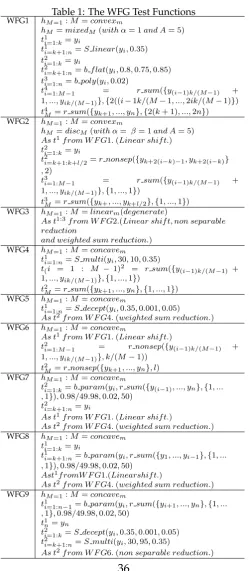
The WFG test suit was introduced by Huband et al. [12]. It consists of nine continuous benchmark functions as shown in Table 1. The WFG test suite is designed for real valued optimization with no side constraints which makes it easier to analyze and implement. Due to the distinct fea-tures of the problems in the WFG dataset, it is a common choice for most MO/EA researchers [12] for assessing new algorithms.
to offer a more comprehensive set of challenges when compared to DTLZ using NSGAII [12].
4.2. Performance Evaluation Criteria
The comparison of the quality of solutions for multi-objective opti-mization is more complex than single-objective problems. The number of non-dominated individuals should be maximized, the distance of the non-dominated front should minimized, i.e. the resulting non-dominated set should be distributed uniformly as much as possible and converge to-ward the Pareto optimal front (POF). We use five performance metrics to assess the quality of approximation sets from different aspects: (i) ra-tio of non-dominated individuals (RNI) [59], (ii) hypervolume (SSC) [4], (iii) uniform distribution of a non-dominated population (UD) [60], (iv) generational distance (GD) [62] and (v) the inverted generational distance (IGD) [7] . A higher value considering one of those performance met-rics indicates that non-dominated solutions are of good quality, except for GD and IGD, where a lower value indicates that the approximation non-dominated front is closer to the POF.
We have compared the mean performance of three choice function based multi-objective hyper-heuristics; HHMO CF AM, HHMO CF GDA and HHMO CF LA across multiple trials with respect to the metrics across
multiple trials. Moreover, t-tests are used as a statistical test for pairwise
mean performance comparison. The following notation is used when re-porting the results. Given a pair of algorithms, A and B (denoted as A-B),
The + (−) indicates that algorithm A performs better (worse) than B on
average with respect to the given metric and this performance difference
is statistically significant within a confidence interval of 95%. ±(∓)
indi-cates that A performs slightly better (worse) than B without any statistical
significance. ≈ indicates that mean performances of both algorithms are
equal.
4.3. Experimental Settings
including four position parameters, 20 distance parameters and two objec-tives. We concur with findings in the literature [6] that two objectives are enough to represent the essential features of multi-objective optimization problems to demonstrate the significance of the proposed approach.
Following the recommendation in [63] and [64], a hyper-heuristic is terminated after 6,250 generations. All hyper-heuristics are run for a total of 25 stages. In each stage, a low level heuristic is chosen and executed for 250 generations with a population size of 100. The secondary popu-lation of SPEA2 is set to 100. The execution time takes 10 to 30 minutes depending on a given problem. For the WFG problems, 30 independent trials were run for each method with different random seeds. For all three low level heuristics, the simulated binary crossover (SBX) operator is used for recombination and a polynomial distribution for mutation [65]. The crossover and mutation probability were set to 0.9 and 1/24 respectively. The distribution indices for crossover and mutation were set to 10 and 20 respectively. In the measure of SSC and D metric for GDA and LA, the
reference points for WFG problems withkobjectives was setri = (0, i∗2),
i = 1, ..., k [12] . The distance sharing σ for the UD metric and MOGA was set to 0.01 in the normalized space. These settings were used for SSC and UD as a feedback indicator in the ranking scheme of the hyper-heuristic framework and as a performance measure for the comparison.
As for HHMO CF GDA, the rain speed (U P) is set to 0.0003 based on the
empirical experiments that are presented in the supplementary files. The
length of the fitness array (LF a) in HHMO CF LA is set to 5.00 as
recom-mended in [36]. All methods are implemented using Microsoft Visual C++
2008 on an Intel Core2 Duo 3GHz\2G\250G computer.
4.4. Results
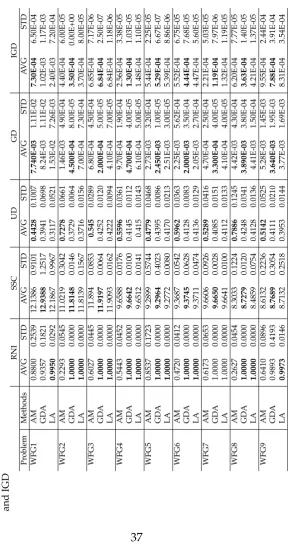
The average values associated with their standard deviations consid-ering the performance metrics, including RNI, SSC, UD, GD and IGD for each WFG problem generated by each hyper-heuristic across 30 trials are
provided in Table 2. The pairwise (t-test) mean performance comparison
to by its move acceptance method utilized within each hyper-heuristic. The pairwise performance differences of GDA and LA from AM are sta-tistically significant with respect to the measure of RNI for all benchmark functions, except WFG1. GDA and LA perform relatively similar with re-spect to RNI. With rere-spect to the measure of the hypervolume (SSC), GDA has the best overall mean performance when compared to AM and LA, and this performance difference is statistically significant across all WFG problems, except WFG2. For this instance, GDA performs slightly better than LA. In addition, LA delivers a significantly better performance than AM for all WFG problems, except WFG5. Similarly, GDA delivers a signif-icantly better mean performance when compared to AM and LA with re-spect to the measure of generational distance (GD) for all benchmark func-tions, except WFG1 and WFG9. For WFG1, AM performs slightly better than GDA and significantly better than LA, while for WFG9, LA performs significantly better than AM and GDA performs slightly better than AM. With respect to the measure of inverted generational distance (IGD), GDA performs significantly better than AM in all instances except in WFG1. In addition, GDA performs significantly better than LA in four instances of WFG2, WFG4, WFG8 and WFG9 while it performs significantly similar to LA in the rest.
Although non-deterministic move acceptance methods improve the over-all mean performance of the hyper-heuristic with respect to RNI, SSC, GD and IGD, AM performs the best with respect to the measure of the uni-form distribution of non-dominated solutions (UD). The peruni-formance dif-ferences from GDA and LA are statistically significant for all problems, ex-cept WFG4, for which AM still performs slightly better than LA. GDA and LA have relatively similar performance across all WFG problems except WFG5, WFG8 and WFG9. The success of AM with respect to UD might be
due to the use of theD metric within the acceptance procedure. SinceD
metric is a binary hypervolume measure that is designed to compare two sets of non-dominated solutions with respect of their convergence towards the POF, there is no consideration regarding how uniformly these solu-tions are distributed along the POF. This might also be a reason why non-deterministic move acceptance produces high quality solutions in terms of the convergence towards the POF.
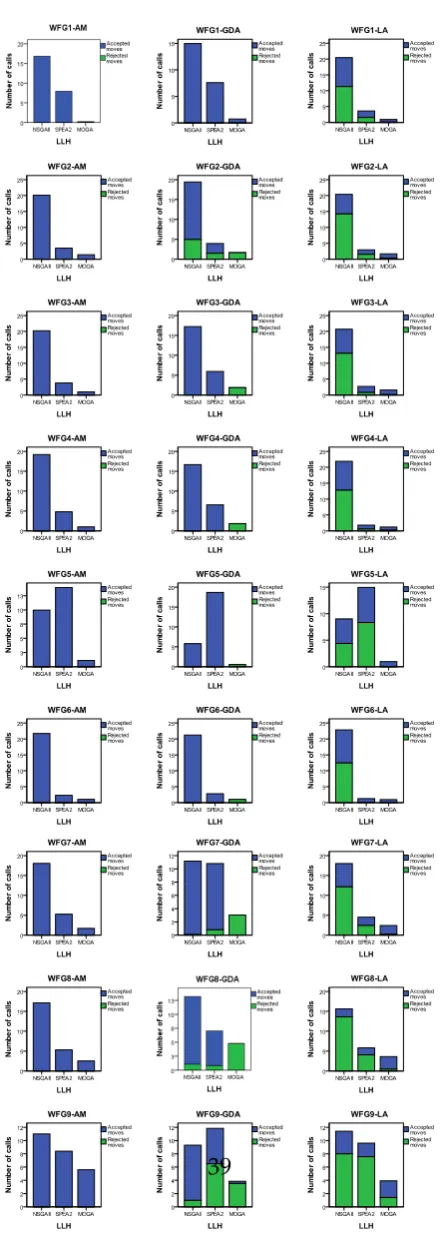
invo-cations of each low level heuristic selected and applied at 25 consecutive decision points during the whole search process over all runs. Each bar in the plot also indicates the average number of accepted and rejected Pareto fronts. A similar pattern for the choice of low level heuristics during the search process has been observed in Fig. 2 on almost all WFG problems considering the three hyper-heuristics. This is highly likely due to the use of the same heuristic selection mechanism (choice function). However, the pattern in the plots for accepted or rejected Pareto fronts produced by the chosen low level heuristic varies for a given problem depending on the move acceptance strategy that the hyper-heuristic employed. NSGAII is always selected more than the other low level heuristics regardless of the move acceptance method, except for WFG5 and WFG9. For WFG5, SPEA2 is the most frequently chosen algorithm regardless of the move acceptance component of the hyper-heuristic during the search process. On the other hand, SPEA2 is frequently chosen when GDA is used as the move accep-tance on WFG9. The performance of MOGA is the worst among the three hyper-heuristics on the WFG problems; thus it is invoked relatively less frequently during the search process in all test problems for all methods. NSGAII appears to be a good choice for solving the WFG problems. Our observations are consistent with the result obtained in [66] showing that the best performance is achieved by NSGAII on the WFG test problems with two objectives. As discussed in [11], mixing different metaheuristics under a selection hyper-heuristic framework yields an improved perfor-mance.
function based hyper-heuristic when used as the move acceptance strat-egy over the WFG test problems.
5. Computational Experiments on the Multi-objective Design of Vehi-cle Crashworthiness
More experiments are conducted over a multi-objective real-world prob-lem, namely the design of vehicle crashworthiness problem [13], to evalu-ate the performance of selection hyper-heuristics. The same performance evaluation criteria and algorithms are used as described in the previous section. In this study, the performances of HHMO CF AM, HHMO CF GDA and HHMO CF LA is compared to the NSGAII [8].
5.1. Problem Formulation
In the automotive industry, crashworthiness is a very important issue when designing a vehicle. Crashworthiness design of real-world vehicles involves the optimization of a number of objectives including the head, injury criterion, chest acceleration, chest deflection, etc. However, some of these objectives may be, and usually are, in conflict with each other, i.e. an improvement in one objective value leads to the deterioration in the values of the other objectives.
Liao et al. [13] presented a multi-objective design for the vehicle crash-worthiness problem with five real-value parameters and no constraints. The vehicle crashworthiness problem was constructed using the surro-gate modelling techniques with latin hypercube sampling and stepwise re-gression considering the weight, acceleration characteristics and toe-board intrusion as the design objectives. The mass of the vehicle is tackled as the first design objective, while an integration of collision acceleration
be-tween t1 = 0.05s and t2 = 0.07s in the full frontal crash is considered as
Mass = 1640.2823 + 2.3573285t1+ 2.3220035t2
+ 4.5688768t3+ 7.7213633t4+ 4.4559504t5
(6)
Ain = 6.5856 + 1.15t1−1.0427t2+ 0.9738t3+ 0.8364t4
−0.3695t1t4+ 0.0861t1t5+ 0.3628t2t4−0.1106t21
−0.3437t23+ 0.1764t24
(7)
Intrusion=−0.0551 + 0.0181t1 + 0.1024t2+ 0.0421t3
−0.0073t1t2+ 0.024t2t3−0.0118t2t4−0.0204t3t4
−0.008t3t5−0.0241t22+ 0.0109t 2 4
(8) So, the multi-objective design of vehicle crashworthiness problem is for-mulated as:
min F(x)=[M ass, Ain, Intrusion]
s.t.
1mm≤x≤3mm
where x=(t1, t2, t3, t4, t5)T
(9)
5.2. Performance Evaluation Criteria and Experimental Settings
We used five performance metrics to assess the quality of approxima-tion sets from different aspects: (i) ratio of non-dominated individuals (RNI) [59], (ii) hypervolume (SSC) [4], (iii) uniform distribution of a non-dominated population (UD) [60], (iv) generational distance (GD) [62] and
(v) the inverted generational distance (IGD) [7]. t-tests are used as a
sta-tistical test for pairwise mean performance comparison of methods using the same notations as those used in Section 4.2.
We performed 30 independent runs for each comparison method using the same parameter settings as provided in [13] with a population size of 30 and running for 50 generations in each iteration. All hyper-heuristic methodologies were run for a total of 75 iterations based on the empiri-cal experiments that are presented in the supplementary files. In order to make a fair comparison, we repeated NSGAII experiments conducted in [13] under our termination conditions over the additional instances. So,
all methods terminated after 3,750 generations. The distance sharing σ
for the UD metric and MOGA was arbitrarily set to 0.09 in the normal-ized space. These settings were used for UD as a feedback indicator in the ranking scheme of the hyper-heuristic framework and as a performance measure for the comparison. As the true Pareto front is unknown, we con-sider the best approximation found by means of combining results of all considered methods and used it instead of a true Pareto front for the met-rics of GD and IGD. In the measure of SSC and the D metric for GDA and
LA, the reference points in our experiments for k objectives can be set as
ri =znadiri+ 0.5(znadiri−zideali)(0, i∗2),i= 1, ..., k[67]. Other experimental
settings are the same as those used in Section 4.3. All algorithms were im-plemented with the same common sub-functions using Microsoft Visual C++ 2008 on an Intel Core2 Duo 3GHz/2G/250G computer.
5.3. Performance Comparison of Selection Hyper-heuristics and NSGAII
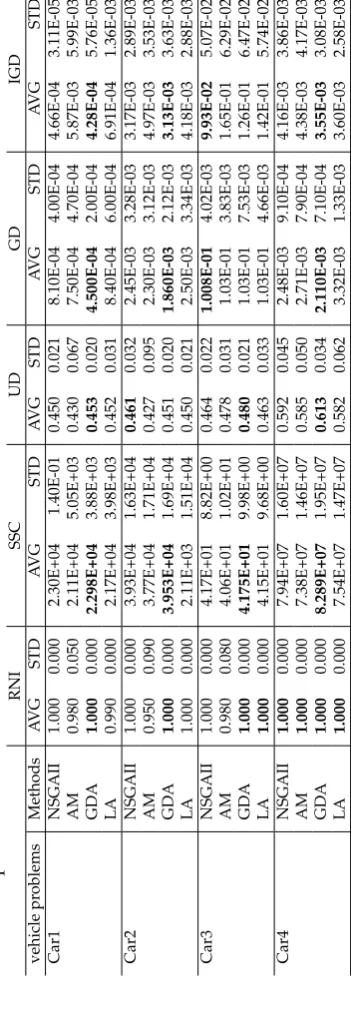
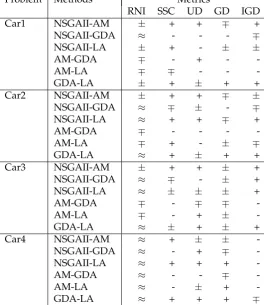
The mean performance comparison of AM, GDA, LA and NSGAII based on the performance metrics (RNI, SSC, UD, GD and IGD) for solving the vehicle crashworthiness problems is provided in Table 5. Table 5 and the
result of the t-test in Table 6 show that GDA, LA and NSGAII produce
with respect to RNI on Car4, but not for other problem instances. With respect to the hypervolume (SSC), GDA has the highest average value among the other methods for all problem instances. The performance dif-ference of GDA from the other hyper-heuristics is statistically significant for Car1, Car3 and Car4. With respect to the measures of GD and IGD, GDA is superior to the other methods for all problem instances, except Car3, where NSGAII performs the best. This performance difference is statistically significant for Car1, Car2 and Car4. Considering UD, GDA produces solutions that are distributed uniformly along the POF for all problem instances, except Car2, where NSGAII performs the best.
In summary, GDA performs the best considering convergence and di-versity, producing solutions that converge towards the POF and that are distributed uniformly along the POF.
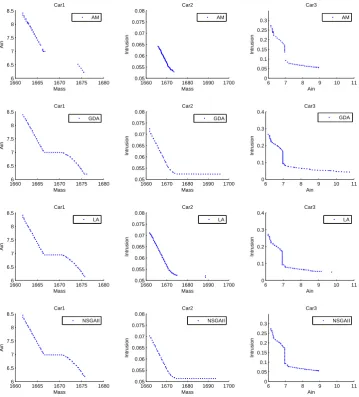
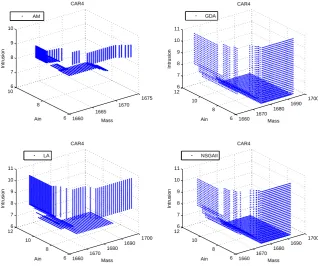
Figs. 3 and 4 illustrates the 50% attainment surfaces from the 30 fronts after 3,750 generations produced by each method for each problem stance. GDA appears to generate good convergence for all problem in-stances. This can be clearly observed for Car2 and Car3, where GDA con-verges to the best POF with a well spread optimal Pareto front as com-pared to the other approaches. In contrast, AM generates the poorest solu-tions in almost all cases. NSGAII and LA have similar convergence for all problem instances, except Car2, where NSGAII has covered a larger pro-portion of objective space compared to LA. From the above observations, we conclude that GDA outperforms NSGAII and other methods in the majority of cases. The hyper-heuristics for even real world multi-objective problems benefits from the use of a learning heuristic selection method as well as GDA.
6. Conclusion
Studies on selection hyper-heuristics for multi-objective optimization are limited. This is one of the first studies which investigates the influ-ence of the move acceptance component of a selection hyper-heuristic for multi-objective optimization. Two choice function based online learning selection hyper-heuristics are introduced, each embedding a different non-deterministic move acceptance criteria; great deluge algorithm (GDA) and late acceptance (LA) which are adopted for multi-objective optimization
framework is highly flexible and its components are reusable. It is built on an interface which allows other researchers to write their own hyper-heuristic components easily. If new and better performing components are found in the future, the software can be easily modified to include those components for testing.
The performance of the two proposed hyper-heuristics, namely HHMO CF GDA and HHMO CF LA are compared to a previous approach HHMO CF AM
[11] on the Walking Fish Group test problems (WFG) which is a common benchmark for multi-objective optimization. Additionally, their perfor-mance is compared to the well-known multi-objective algorithm, NSGAII on the real-world vehicle crashworthiness multi-objective design problem instances. The experimental results demonstrate the effectiveness of non-deterministic move acceptance strategy based methodology. HHMO CF GDA
and HHMO CF LA outperforms the previously proposed approach of HHMO CF AM [11] over the WFG test problems, indicating that the non-deterministic
ac-ceptance strategies improve the performance of the multi-objective choice function based selection hyper-heuristic. Moreover, this observation is supported further by empirical evidence obtained from testing those
hyper-heuristics against NSGAII over the vehicle crashworthiness problems. HHMO CF GDA turns out to be the best choice for solving this problem.
The results from both benchmark test problems (WFG) and the real-world problems (vehicle crashworthiness design) demonstrate the ability and potential of the multi-objective selection hyper-heuristic approaches in solving continuous multi-objective optimization problems. Investigat-ing the performance of selection hyper-heuristics utilizInvestigat-ing other heuristic selection or move acceptance which are adopted for multi-objective opti-mization is a trivial future work. Applying the proposed selection hyper-heuristics on other types of multi-objective problems, such as discrete or dynamic environment problems is also left as future work for testing the level of generality of the proposed approaches further.
Acknowledgement. The authors thank the University of Tabuk and
Min-istry of Higher Education in Saudi Arabia for funding this work.
References
the Operational Research Society 2009;60:1273–1285.
[2] Burke, E., Kendall, G., Newall, J., Hart, E., Ross, P., Schulen-burg, S.. Handbook of Meta-Heuristics; chap. Hyper-Heuristics: An Emerging Direction in Modern Search Technology. Kluwer Academic Publishers; 2003, p. 457–474.
[3] Hussin, N.. Tabu Search Based Hyper-heuristic Approaches for Ex-amination Timetabling. Ph.D. thesis; The University of Nottingham, Nottingham, UK; 2005.
[4] Zitzler, E.. Evolutionary Algorithms for Multiobjective Optimiza-tion: Methods and Applications. Ph.D. thesis; ETH Zurich, Switzer-land; 1999.
[5] Zitzler, E., Deb, K., Thiele, L.. Comparison of multiobjective evo-lutionary algorithms: Empirical results. Evoevo-lutionary Computation 2000;8(2):173–195.
[6] Zitzler, E., Deb, K., Thiele, L.. Comparison of multiobjective evo-lutionary algorithms: Empirical results. Evoevo-lutionary Computation 1995;8(2):173195.
[7] Coello Coello, C.A., Cruz Cort`es, N.. Solving multiobjective opti-mization problems using an artificial immune system. Genetic Pro-gramming and Evolvable Machines 2005;6(2):163–190.
[8] Deb, K., Goel, T.. Controlled elitist non-dominated sorting genetic algorithms for better convergence. In: Proceedings of Evolutionary Multi Criterion Optimization Conference. 2001, p. 67–81.
[9] Zitzler, E., Laumanns, M., Thiele, L.. Spea2: Improving the
strength pareto evolutionary algorithm for multiobjective optimiza-tion. In: EUROGEN 2001 Evolutionary Methods for Design, Opti-mization and Control with Applications to Industrial Problems. 2001, p. 951–100.
[11] Maashi, M., ¨Ozcan, E., Kendall, G.. A multi-objective hyper-heuristic based on choice function. Expert Systems with Applications 2014;41(9):4475–4493.
[12] Huband, S., Hingston, P., Barone, L., While, L.. A review of mul-tiobjective test problems and a scalable test problem toolkit. IEEE Transactions on Evolutionary Computation 2006;10(5).
[13] Liao, X., Li, Q., Yang, X., Zhang, W., Li, W..
Multiobjec-tive optimization for crash safety design of vehicles using stepwise
regression model. Structural and Multidisciplinary Optimization
2008;35:561569.
[14] ¨Ozcan, E., Bilgin, B., Korkmaz, E.. A comprehensive analysis of
hyper-heuristics. Intelligent Data Analysis 2008;12(1):3–23.
[15] Dueck, G.. New optimization heuristics: The great deluge algorithm and the record to record travel. Journal of Computational Physics 1993;104:86–92.
[16] Kirkpatrick, S., Gelatt, C.D., Vecchi, M.P.. Optimization by simu-lated annealing. Science 1983;220:671–680.
[17] Glover, F., Laguna, M.. Modern heuristic techniques for combinato-rial problems; chap. Tabu search. 1995, p. 70–150.
[18] Cowling, P.I., Kendall, G., Soubeiga, E.. A hyperheuristic ap-proach to scheduling a sales summit. In: Selected Papers from the Third International Conference on Practice and Theory of Automated Timetabling III. PATAT ’00; London, UK, UK: Springer-Verlag. ISBN 3-540-42421-0; 2001, p. 176–190.
[19] Cowling, P., Kendall, G., Soubeiga, E.. Hyperheuristics: A tool for rapid prototyping in scheduling and optimisation. Applications of Evolutionary Computing 2002;2279:1–10.
[20] Bilgin, B., ¨Ozcan, E., Korkmaz, E.. An experimental study on
hyper-heuristics and exam timetabling. In: Burke, E., Rudov, H., editors.
Practice and Theory of Automated Timetabling VI; vol. 3867 ofLecture
[21] Burke, E.K., Gendreau, M., Hyde, M., Kendall, G., Ochoa, G., ¨
Ozcan, E., et al. Hyper-heuristics: A survey of the state of the art. Journal of the Operational Research Society 2013;64(12):1695–1724.
[22] ¨Ozcan, E., Bykov, Y., Birben, M., Burke, E.K.. Examination
timetabling using late acceptance hyper-heuristics. In: the IEEE
Congress on Evolutionary Computation. 2009, p. 997–1004.
[23] Glover, F.. Future paths for integer programming and links to arti-ficial intelligence. Computers & Operations Research 1986;13(5):533– 549.
[24] Burke, E., Bykov, Y., Newall, J., Petrovic, S.. A time-predefined local search approach to exam timetabling problems. IIE Transactions 2004;36(6):509–528.
[25] Petrovic, S., Yang, Y., Dror, M.. Case-based selection of initialisation heuristics for metaheuristic examination timetabling. Expert Systems with Applications 2007;33(3):772 – 785.
[26] Scott, E., Geldenhuysys, G.. A comparison of the tabu search and great deluge methods for graph colouring. In: Proceedings of the 16th IMACS World Congress Scientific Computation Applied Math-ematics and Simulation (IMACS 2000). 2000, p. 363.
[27] Sanja Petrovic Yong Yang, M.D.. Case-based selection of initialisation heuristics for metaheuristic examination timetabling. Evolutionary Computation 2000;8(2):173–195.
[28] Telfar, G.. Generally applicable heuristicsfor global optimisation: An investigation of algorithm performance for the euclidean traveling salesman problem. Master’s thesis; Institute of Statistics and Opera-tions Research, Victoria University Of Wellington; 1995.
[29] McMullan, P., McCollum, B.. Dynamic job scheduling on the grid environment using the great deluge algorithm. In: Malyshkin, V.,
editor. Parallel Computing Technologies; vol. 4671 of Lecture Notes
[30] ¨Ozcan, E., Misir, M., Ochoa, G., Burke, E.K.. A reinforcement learn-ing - great-deluge hyper-heuristic for examination timetabllearn-ing. Inter-national Journal of Applied Metaheuristic Computing 2010;1(1):39– 59.
[31] Kendall, G., Mohamad, M.. Channel assignment in cellular commu-nication using a great deluge hyperheuristic. In: IEEE International Conference on Network. 2004, p. 769–773.
[32] Sin, E.S., Kham, N.S.M.. Hyper heuristic based on great deluge and its variants for exam timetabling problem. CoRR 2012;abs/1202.1891.
[33] Petrovic, S., Bykov, Y.. A multiobjective optimisation technique for exam timetabling based on trajectories. In: Burke, E., De Caus-maecker, P., editors. Practice and Theory of Automated Timetabling
IV; vol. 2740 of Lecture Notes in Computer Science. Springer Berlin /
Heidelberg; 2003, p. 181–194.
[34] Burke, E.K., Bykov, Y.. A late acceptance strategy in hill-climbing for exam timetabling problems. In: Proceeding of the 7th International Conference on the Practice and Theory of Automated Timetabling. 2008, p. 1–7.
[35] Kheiri, A., ¨Ozcan, E.. Constructing constrained-version of magic
squares using selection hyper-heuristics. The Computer Journal
2014;57(3):469–479.
[36] Burke, E., Bykov, Y.. The late acceptance hill-climbing heuristic. Tech. Rep. Technical Report CSM-192; Computing Science and Math-ematics, University of Stirling; Stirling, UK; 2012.
[37] Burke, E.K., Landa-Silva, J.D., Soubeiga, E.. Multi-objective hyper-heuristic approaches for space allocation and timetabling. In: Ibaraki, T., Nonobe, K., Yagiura, M., editors. Meta-heuristics: Progress as Real Problem Solvers. The 5th Metaheuristics International Confer-ence (MIC 2003); Springer; 2005, p. 129–158.
Algorithms (SLS-DS 2009). Bruxelles, Belgium; 2009,Technical Report TR/IRIDIA/2009-024, IRIDIA, Universite Libre de Bruxelles, Brus-sels, Belgium.
[39] McClymont, K., Keedwell, E.C.. Markov chain hyper-heuristic (mchh): An online selective hyper-heuristic for multi-objective con-tinuous problems. In: Proceedings of the 13th Annual Conference on Genetic and Evolutionary Computation. GECCO ’11; ACM. ISBN 978-1-4503-0557-0; 2011, p. 2003–2010.
[40] Deb, K., Thiele, L., Laumanns, M., Zitzler, E.. Scalable multiob-jective optimization test problems. In: Proceedings of Congress on Evolutionary Computation. 2002, p. 825–830.
[41] McClymont, K., Keedwell, E., Savic, D., Randall-Smith, M.. A general multi-objective hyper-heuristic for water distribution net-work design with discolouration risk. Journal of Hydroinformatics 2013;15(3):700–716.
[42] Gomez, J., Terashima-Mar´ın, H.. Approximating multi-objective hyper-heuristics for solving 2d irregular cutting stock problems. In: Advances in Soft Computing. Lecture Notes in Computer Science; 2010, p. 349–360.
[43] Miranda, G., de Armas, J., Segura, C., Le ´on, C.. Hyperheuristic codification for the multi-objective 2d guillotine strip packing prob-lem. In: Proceedings of IEEE Congress on Evolutionary Computa-tion. 2010, p. 1–8.
[44] de Armas, J., Miranda, G., Le ´on, C.. Hyperheuristic encoding scheme for multi-objective guillotine cutting problems. In: Proceed-ings of the 13th Annual Genetic and Evolutionary Computation Con-ference. 2011, p. 1683–1690.
[45] Furtuna, R., Curteanu, S., Leon, F.. Multi-objective optimization of a stacked neural network using an evolutionary hyper-heuristic. Applied Soft Computing 2012;12(1).
Con-ference on Mathematical Problems in Engineering, Aerospace and Science, AIP Conference; vol. 1493. 2012, p. 764–769.
[47] V´azquez-Rodr´ıguez, J., Petrovic, S.. A mixture experiments multi-objective hyper-heuristics. Journal of the Operational Research Soci-ety 2013;64(11):1664–1675.
[48] Zitzler, E., K ¨unzli, S.. Indicator-based selection in multiobjective search. In: Lecture Notes in Computer Science. Parallel Problem Solv-ing from Nature (PPSN VIII); SprSolv-inger; 2004, p. 832842.
[49] Bai, R., van Woensel, T., Kendall, G., Burke, E.K.. A new model and a hyper-heuristic approach for two-dimensional shelf space allo-cation. Journal Operational Research 2013;11:31–55.
[50] Kumari, A., Srinivas, K., Gupta, M.. Software module clustering us-ing a hyper-heuristic based multi-objective genetic algorithm. In: Ad-vance Computing Conference (IACC), 2013 IEEE 3rd International. 2013, p. 813–818.
[51] Len, C., Miranda, G., Segura, C.. Hyperheuristics for a dynamic-mapped multi-objective island-based model. In: Distributed Com-puting, Artificial Intelligence, Bioinformatics, Soft ComCom-puting, and
Ambient Assisted Living; vol. 5518 of Lecture Notes in Computer
Sci-ence. Springer Berlin Heidelberg; 2009, p. 41–49.
[52] Vrugt, J., Robinson, B.. Improved evolutionary optimization from genetically adaptive multimethod search. Proceedings of the Na-tional Academy of Sciences 2007;104(3):708–711.
[53] Raad, D., Sinkse, A., Vuuren, J.. Multiobjective optimization for water distribution systemdesign using a hyperheuristic. Journal of Water Resources Management 2000;136(5):592–596.
[54] Zhang, X., Srinivasan, R., Liew, M.V.. On the use of multi-algorithm, genetically adaptive multi-objective method for multi-site calibration of the swat model. Hydrological Processes 2010;24(8):955–1094.
[56] Haario, H., Saksman, E., Tamminen, J.. An adaptive metropolis algorithm. Bernoulli 2001;7:223–242.
[57] Storn, R., Price, K.. Differential evolution: A simple and efficient heuristic for global optimization over continuous. Journal of Global Optimization 1997;11:341–359.
[58] Wang, Y., Li, B.. Multi-strategy ensemble evolutionary optimiza-tion for dynamic multi-objective optimizaoptimiza-tion. Memetic Computing 2010;2:3–24.
[59] Tan, K.C., Lee, T.H., Khor, E.F.. Evolutionary algorithms for multi-objective optimization: Performance assessments and comparisons. Artificial Intelligence Review 2002;17:253–290.
[60] Srinivas, N., Deb, K.. Multiobjective optimization using
non-dominated sorting in genetic algorithms. Evolutionary Computation 1994;2(3):221–248.
[61] Grosan, C., Oltean, M., Dumitrescu, D.. Performance metrics for multiobjective optimization evolutionary algorithms. In: Proceed-ings of Conference on Applied and Industrial Mathematics. 2003,.
[62] Van Veldhuizen, D.A., Lamont, G.B.. Evolutionary computation and convergence to a pareto front. In: In Late Breaking Papers at the Genetic Programming 1998 Conference. 1998, p. 221–228.
[63] Chow, J., Regan, A.. A surrogate-based multiobjective metaheuristic and network degradation simulation model for for robust toll pricing. 2012. Civil Engineering Working Papers.
[64] Voutchkov, I., Keane, A.. Computational Intelligence in Optimiza-tion: Adaptation, Learning, and Optimization; chap. Multi-objective optimization using surrogates. 2010, p. 155–175.
[65] Deb, K., Agrawal, R.B.. Simulated binary crossover for continuous search space. Complex Systems 1995;9:115–148.
Compu-tational Intelligence in Multi-criteria Decision-making. 2007, p. 382– 389.
Table 1: The WFG Test Functions
WFG1 hM=1:M=convexm
hM=mixedM(with α= 1and A= 5) t1
i=1:k=yi t1
i=k+1:n=S linear(yi,0.35) t2
i=1:k=yi t2
i=k+1:n=b f lat(yi,0.8,0.75,0.85) t3
i=1:n=b poly(yi,0.02) t4
i=1:M−1 = r sum({y(i−1)k/(M−1) +
1, ..., yik/(M−1)},{2((i−1k/(M−1, ...,2ik/(M−1)})
t4
M=r sum({yk+1, ..., yn},{2(k+ 1), ...,2n})
WFG2 hM=1:M=convexm
hM=discM(with α= β= 1and A= 5) As t1f rom W F G1.(Linear shif t.) t2
i=1:k=yi t2
i=k+1:k+l/2=r nonsep({yk+2(i−k)−1, yk+2(i−k)}
,2)
t3i=1:M−1 = r sum({y(i−1)k/(M−1) +
1, ..., yik/(M−1)},{1, ...,1})
t3M=r sum({yk+, ..., yk+l/2},{1, ...,1})
WFG3 hM=1:M=linearm(degenerate)
As t1:3f rom W F G2.(Linear shif t, non separable
reduction
and weighted sum reduction.)
WFG4 hM=1:M=concavem
t1i=1:n=S multi(yi,30,10,0.35)
t(i = 1 : M −1)2 = r sum({y(i−1)k/(M−1) +
1, ..., yik/(M−1)},{1, ...,1})
t2
M=r sum({yk+1, ..., yn},{1, ...,1})
WFG5 hM=1:M=concavem t1
i=1:n=S decept(yi,0.35,0.001,0.05)
As t2f rom W F G4.(weighted sum reduction.)
WFG6 hM=1:M=concavem
As t1f rom W F G1.(Linear shif t.) t2
i=1:M−1 = r nonsep({y(i−1)k/(M−1) +
1, ..., yik/(M−1)}, k/(M−1))
t2
M=r nonsep({yk+1, ..., yn}, l)
WFG7 hM=1:M=concavem t2
i=1:k=b param(yi, r sum({y(i−1), ..., yn},{1, ... ,1}),0.98/49.98,0.02,50)
t2
i=k+1:n=yi
As t1f rom W F G1.(Linear shif t.)
As t2f rom W F G4.(weighted sum reduction.)
WFG8 hM=1:M=concavem t1
i=1:k=yi t1
i=k+1:n=b param(yi, r sum({y1, ..., yi−1},{1, ... ,1}),0.98/49.98,0.02,50)
Ast1f romW F G1.(Linearshif t.)
As t2f rom W F G4.(weighted sum reduction.)
WFG9 hM=1:M=concavem t1
i=1:n−1=b param(yi, r sum({yi+1, ..., yn},{1, ... ,1},0.98/49.98,0.02,50)
t1
n=yn t2
i=1:k=S decept(yi,0.35,0.001,0.05) t2i=k+1:n=S multi(yi,30,95,0.35)
Table 3: Pairwise t-test results for the choice function based multi-objective hyper-heuristics using AM, GDA and LA as the move acceptance component on each WFG test problem instance with respect to different metrics; the ratio of non-dominated indi-viduals (RNI), the hypervolume (SSC), the uniform distribution (UD), the generational distance (GD) and the inverted generational distance (IGD).
Problem Methods Metrics
RNI SSC UD GD IGD
WFG1 AM-GDA ∓ - + ± +
AM-LA - - + + +
GDA-LA ∓ + ± + +
WFG2 AM-GDA - - + -
-AM-LA - - + -
-GDA-LA ≈ ± ± + +
WFG3 AM-GDA - - + - ∓
AM-LA - - + - ∓
GDA-LA ≈ + ± + ±
WFG4 AM-GDA - - + -
-AM-LA - - ± -
-GDA-LA ≈ + ∓ + +
WFG5 AM-GDA - - + -
-AM-LA - ± + - ∓
GDA-LA ≈ + + + ±
WFG6 AM-GDA - - + -
-AM-LA - - + -
-GDA-LA ≈ + ∓ + ±
WFG7 AM-GDA - - + -
-AM-LA - - + -
-GDA-LA ≈ + ∓ + ±
WFG8 AM-GDA - - + -
-AM-LA - - + -
-GDA-LA ≈ + + + +
WFG9 AM-GDA - - + -
-AM-LA - - + -
-GDA-LA ∓ + + ± +
Table 4: The vehicle crashworthiness problems
Figure 2: The average number of low level metaheuristic invocations (NSGAII, SPEA2 and MOGA) and accepted/rejected moves produced by selection hyper-heuristics using AM, GDA and LA over the WFG test problems.
![Figure 1: Ilustration of how D metric works for two given fronts 1 (set A) and 2 (set B)[61].](https://thumb-us.123doks.com/thumbv2/123dok_us/8684403.378814/14.595.221.392.127.277/figure-ilustration-metric-works-given-fronts-set-set.webp)