doi:10.4236/jsea.2010.31006 Published Online January 2010 (http://www.SciRP.org/journal/jsea)
Cryptanalysis of TEA Using Quantum-Inspired
Genetic Algorithms
Wei Hu
Department of Computer Science, Houghton College, One Willard Avenue, Houghton, NY, USA. Email: [email protected]
Received September 10th, 2009; revised October 9th, 2009; accepted October 16th, 2009.
ABSTRACT
The Tiny Encryption Algorithm (TEA) is a Feistel block cipher well known for its simple implementation, small memory footprint, and fast execution speed. In two previous studies, genetic algorithms (GAs) were employed to investigate the randomness of TEA output, based on which distinguishers for TEA could be designed. In this study, we used quan-tum-inspired genetic algorithms (QGAs) in the cryptanalysis of TEA. Quantum chromosomes in QGAs have the advan-tage of containing more information than the binary counterpart of the same length in GAs, and therefore generate a more diverse solution pool. We showed that QGAs could discover distinguishers for reduced cycle TEA that are more efficient than those found by classical GAs in two earlier studies. Furthermore, we applied QGAs to break four-cycle and five-cycle TEAs, a considerably harder problem, which the prior GA approach failed to solve.
Keywords: Cryptanalysis, Distinguisher, Feistel Block Cipher, Genetic Algorithms, Optimization, Quantum Computing, TEA
1. Introduction
The Tiny Encryption Algorithm (TEA), a Feistel block cipher notable for its simplicity of description and im-plementation, was developed by David Wheeler and Roger Needham at the Computer Laboratory of Cam-bridge University and was first presented at the Fast Software Encryption workshop at Cambridge in 1994 [1]. Its design goal was to minimize the memory footprint and maximize the speed. There is an excellent article on TEA by Shepherd [2].
The following code presents the TEA encode routine in C language:
void code(long* v, long* k) {
unsigned long y = v[0], z = v[1], sum = 0, /* set up */ delta = 0x9e3779b9, n = 32 ;
while (n-->0) { /* basic cycle start */ sum += delta ;
y += (z<<4)+k[0] ^ z+sum ^ (z>>5)+k[1] ; z += (y<<4)+k[2] ^ y+sum ^ (y>>5)+k[3] ; }
v[0] = y ; v[1] = z ; }
where the 128-bit key is stored in four 32-bit blocks k = (k[0], k[1], k[2], k[3]) and data of 64 bits are stored in v = (v[0] ,v[1]).
The quantity delta in the C code is used to ensure that encryption/decryption in each cycle is different. A cycle
in TEA is defined as two Feistel rounds. The SHIFT, ADD, and XOR operations in TEA provide the necessary diffusion of the statistics of the plaintext in the ciphertext and confusion between the ciphertext and key value for a secure encryption algorithm.
The simplicity of TEA’s key schedule algorithm made itself susceptible to the related-key attacks; in [3] three such attacks were suggested. Soon after this discovery, the original authors of TEA created a revised version of TEA called XTEA to address this weakness [4].
The impossible differential cryptanalysis proposed in [10] is a special case of differential cryptanalysis. Dif-ferential cryptanalysis seeks out the difDif-ferential charac-teristics of a cipher with greater than expected probabil-ity, but the impossible differential cryptanalysis looks for differential characteristics with probability zero (impos-sible). In [11] authors conducted the impossible differen-tial cryptanalysis of 12-cycle TEA and 14-cycle XTEA. It is interesting to note that XTEA is more vulnerable to this kind of attacks than TEA, although the original im-provement was aimed at the key-related attacks.
In the study of the block cipher RC6 [12], a candidate for the Advanced Encryption Standard (AES), authors noticed that block ciphers such as TEA and XTEA that use shifting tended to display some non-random distribu-tions in the least significant bits of their output words. For a secure encryption algorithm, the bits patterns of the out-put are expected to be uniform, i.e., truly random. They employed the chi-square statistic x2 to measure the
devia-tion of the observed distribudevia-tions in the least significant bits of the output from a uniform distribution. Their results showed that RC6 with 128-bit blocks could be distin-guished from a random permutation with up to 15 rounds, and for some weak keys up to 17 rounds.
In [13] authors were the first to make use of a genetic algorithm (GA) withx2 statistic and two customized
fit-ness functions to study the same issue with TEA. More specifically, they studied the bit patterns of the least sig-nificant eight bits of the first output word of TEA, i.e., v[0] & 255. Their goal was to search bitmasks for the input, both the input data blocks and the input key, which produces a chi-square statistic value as far as possible from the expected ones. They were successful with one- cycle, two-cycle, and three cycle TEAs, but not with the four-cycle TEA, which is a much harder problem.
In [14] authors corrected one of the two fitness func-tions in [13] and used a meta-GA [15] to optimize the parameters in each GA, including population size and mutation rate, to improve the results in [13], but were unable to tackle the four-cycle TEA. Consequently, to find a means to attack TEA of greater than three-cycles remains challenging. Solving this problem calls for a different approach such as designing more effective fit-ness functions since the performance of GAs heavily depends on the structure of its fitness function or using other evolutionary computation techniques.
2. Quantum-Inspired Genetic Algorithms
2.1 Some Basic Concepts in Quantum MechanicsIn quantum mechanics, particles move from one point to another as if they are waves, reflecting the dual nature of both waves and particles. The shape of these waves de-pends on the particle’s angular momentum and energy level. Particles are in a low energy state on one observa-tion, and in a high energy state on the next. There is no
transition at all. The location of quantum particles, such as electrons and photons, can be described by a quantum state vector , a weighted sum which in the case of two possible locations equals 0 1 , where
and are two weights influencing the particle being in locations 0 or 1 , respectively. represents a linear superposition of the particle given individual quantum state vectors. However, in the act of observing a quantum state, it collapses to a single state [16]. This fact will be important when we introduce the quantum-inspired genetic algorithms in Subsection 2.5.
2.2 Quantum Bit
The basic unit of information in quantum computing is not a traditional bit but a quantum system with two states such as a photon that has two polarized directions. This quantum system is called qubit. A qubit, quantum bit, is represented as
0 1
where and are complex numbers and | |2+| |2=1. | |2
defines the probability that the qubit will be found in state “0” and | |2 defines the probability that the qubit
will be found in state “1”. A qubit may be in the state “0”, state “1”, or a linear superposition of the two.
2.3 Quantum Chromosome
Like the other evolutionary algorithms, the quantum- inspired genetic algorithms have a representation of indi-vidual or chromosome. An m-qubit chromosome is de-fined as:
1 2
1 2
...
...
m
m
where | |2+| |2=1, =1,2,…, . This expression has the
capability to represent a linear superposition of states, from which all possible combinations of different values can be derived. Let us look at one such example of 3- qubit chromosome:
1 3 1
2
2 2
1 1 1 2
2 2
The states of this chromosome can be represented as
3 3 1 1 3
000 001 010 011 100
4 4 4 4 4
3 1 1
101 110 111
4 4 4
The above expression induces a probability distribu-tion such that the probabilities that the chromosome is seen to be in the 8 states 000 , 000 , 001 , 010 ,
011 , 100 , 101 , 110 and 111 are the squares of the weights. This 3-qubit chromosome is capable of rep-resenting 8 states, and 8 3-bit classical binary chromo-somes are required to represent 8 states (000), (001), (010), (011), (100), (101), (110), and (111). A qubit represents probabilities of being in state “0”, “1”, or a superposition of both, whereas a classical bit must be in either state “0” or “1”. It is evident that a qubit contains more information than a classical bit.
2.4 Quantum Mutation and Crossover
The mutation operation of a bit in a binary chromosome is flipping that bit. We made use of two types of muta-tions, rotational mutation and point mutation, in the quantum genetic algorithms used in this work. The rota-tional mutation operation of a qubit proposed in [17] is defined by a quantum rotation matrix which satisfies = = I, where is the Hermitian adjoint matrix of matrix and I is an identity matrix. In this paper, we only used the following real-valued quantum rotation matrix:
cos sinsin cos
U
where represents the angle of counterclockwise rota-tion.
The point mutation is to switch the values of
and
in a qubit, and the crossover operation of a quantum chromosome is defined similarly to that of a binary chromosome. The original version of quantum- inspired evolutionary algorithm proposed in [17] did not contain such operations. We observed in our experiments that our solutions tended to be trapped at local maxima, so we introduced these two operations to increase the diversity of our solution pool. Other similar definitions of mutation and crossover could be found in the literature.
2.5 Quantum Genetic Algorithms
Encouraged by the excellent performance of the quan-tum-inspired evolutionary algorithm in [17], we adapted the following quantum-inspired genetic algorithm (QGA) for our current study. The structure of QGA is described in the following pseudo code:
QGA: Begin t←0
1) initialize quantum population Q(t) of N qubit chromosomes
2) make binary population P(t) by observing the states of Q(t)
3) evaluate P(t)
4) store the best solutions among P(t) into b
while( t < T) t←t+1
1) evaluate P(t-1)
2) select the top 50% of Q(t-1) to undergo rotational mutation, point mutation, and crossover to produce N/2 new qubit chromosomes
3) Q(t)= (the top 50% of Q(t-1)) + (N/2 new qubit chromosomes)
4) make P(t) by observing the states of Q(t) 5) store the best solutions among P(t) into b
end while End
In our implementation of QGA, we chose 1
2
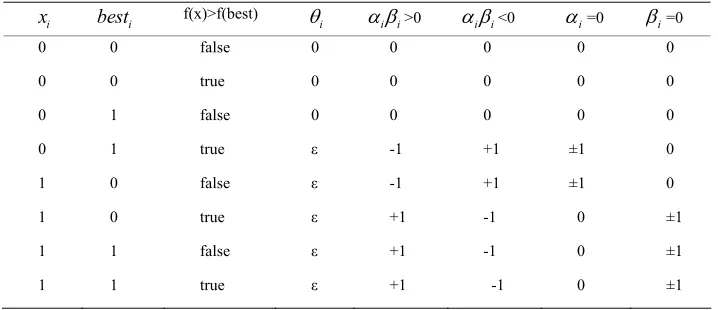
for all qubits in each chromosome when t = 0, so that each qubit had equal probability to be in state “0” or “1”. The quantum rotation angle was chosen according to Table 1 as in [18], where 0.001 .
3. Results
The input of TEA is 128 bits long, which is made of 64 bit blocks of data and a 128 bit key, and the output of TEA is the encrypted 64 bit data stored in v[0] and v[1], where v[0] and v[1] are defined in the C code introduced at the beginning of this paper.
We used a qubit chromosome to represent a bitmask. To evaluate each bitmask in a QGA, a logical AND op-eration between the bitmask and a randomly generated input pair, data-key, of 128 bits was performed. The re-sultant values were then passed to TEA to yield the out-put. There were 211 such randomly generated data-key pairs for each bitmask.
The focus of our work is studying the distribution of the bit patterns of v[0] & 255 in the output of TEA. We recorded the counts of different values of v[0] & 255 from the outputs of TEA. The important question is whether the observed counts were significantly different from the expected ones. There are a variety of ways to assess this difference including Pearson’s chi-square, G test, and Fisher’s exact test. We utilized the chi-square statistic in this work as in [13] and [14]. The Pearson’s chi-square is
X2
1i
In this equation, N is the number of observations, is the observed counts and is the expected counts. In the current study, the expected counts follow a uniform dis-tribution, which implies the bit patterns are truly random.
N
i i
i
O E E
There are 256 possible values from v[0] & 255, therefore the maximum value of the chi-square is 522,240 with 255 degrees of freedom and 211 observations (See [14]
Table 1. Rotation angle updating rules
i
x besti f(x)>f(best)
i
i i>0 i i<0 i=0 i=0
0 0 false 0 0 0 0 0 0 0 true 0 0 0 0 0 0 1 false 0 0 0 0 0 0 1 true ε -1 +1 ±1 0 1 0 false ε -1 +1 ±1 0 1 0 true ε +1 -1 0 ±1 1 1 false ε +1 -1 0 ±1 1 1 true ε +1 -1 0 ±1
3.2 Two-Cycle TEA
where f is the fitness function, x and best are a solution and the best solution respectively, xiand bestiare the i-th bit
com-ponent of x and best. Since the two-cycle TEA is more difficult than one-cycle
TEA, no bitmasks of heavy enough weights can produce the maximal deviation of 522,240. In [13] and [14], authors
In this section, we will compare different bitmasks found in each cycle of TEA using QGAs in our study and
using GAs in [13] and [14]. modified the fitness function in Equation (1) to create the following fitness function to break the two-cycle TEA,
3.1 One-Cycle TEA
4 2
3
3
1
, 403.4579
1 ,
w if x w
fitness
otherwise w
(2) We used the following fitness function as in [13] and
[14],
4 2
2
, 522, 240
, w if x fitness
x otherwise
(1) The idea behind this fitness function is to divide
the-search process of GA into two steps. The first step is to find bitmasks with weights above the thresholdvalue 403.4579, which is about 0.5 percentile of all x2 values
where w represents the weight, the number of 1’s, of the bitmask. This fitness function was first introduced in [6], but incorrectly used 522,480 in place of 522,240. This piece-wisely defined fitness function aims to find bit-masks that have maximal deviation from a uniform probability distribution.
and has a P-value of 5*10-9. The second is to in-
crease the weights of those bitmasks. For one-cycle TEA, we found bitmasks that had max-
imal deviation from the random distribution with x2 =
522.240. In [13], the authors found their best solution at weight 153, and [14] found their best solutions to be at weights 154 and 155.
Table 2. Our results of QGA on one-cycle TEA
Bitmask x2 Weight
{0xFFFFFF00,0xFFFFE000, 0xFFFFFF00,0xFFFFFF00, 0xFFFFFFFF, 0xFFFFFFFF}
522,240 155
{0xFFFFFF00,0xFFFFE000, 0xFFFFFF00,0xFFFEFF00,
0xFFFFFFFF, 0xFFFFFFFF} 522,240 154 {0xFFFFFF00,0xDFFFE000,
0xFFFFFF00,0xFFFEFF00, 0xFFFFFFFF, 0xFFFFFFFF}
522,240 153
{0xFFFFFF00,0xDFFFE000, 0xFFFFFF00,0xFFFEFF00, 0xFFFFFFFE, 0xFFFFFFFF}
522,240 152
{0xFFFFFF00,0xDFFFE000, 0xFFFFFF00,0xFFFEFF00, 0xFFFFFFFF, 0xFF7FFFDF}
522,240 151
The bitmasks of higher weight are preferred since they permit a bigger set of inputs to be used for the test. In [13] authors used a GA with a population size of 100 to find the best bitmask of weight 153 and in [14] authors used a GA with a population size of 185 to find the best bit-masks of weights 154 and 155. To provide a baseline for comparison of different GA techniques, we ran our QGA with a population size of 100 to find the best bitmasks of weights ranging from 151 to 155, which are listed in Ta-ble 2. The two bitmasks of weights 151 and 152 in TaTa-ble 2 were not reported in [13] and [14]. Because one-cycle TEA is relatively easier to break, all the bitmasks in Ta-ble 2 have their x2= 522.240, which is the maximal value
[image:4.595.309.537.522.711.2]Table 3. Results of GA on two-cycle TEA in [14]
Weight x2
[image:5.595.57.286.286.525.2]157 459.6417 155 483.6 158 474.8167 145 486.2333 159 451.3917 158 415.8583 160 422.475 157 435.6833 162 488.3333 159 413.8417
Table 4. Our results of QGA on two-cycle TEA
Bitmask x2 Weight
{0xFFFFD7FF,0xFFDFFBFF,0xFFFCADF9,
0xFFFFFBCF, 0xFFFFFF5E, 0xFFFFFB8B} 611.925 170 {0xFFFFD7FF, xFFDFFBFF,0xFFFCAC75,
0xFFFFDFCF, 0xFFFFFF5E, 0xFFFFFFCB} 606.725 170 {0xFFFFD7F7, 0xFF9FFBFF, 0xFFFEAFF1,
0xFFFFFFCF, 0xFFFFFF5E, 0xFFFFFF8B} 588.875 171 {0xFFFFD7F7,0xFF9FFBFF,0xFFFCBD7B,
0xFFFFFFCF, 0xFFFFFF5E, 0xFFFFFB8F} 572.375 171 {0xFFFFD7FF,0xFF9FFBFF, 0xFFFCAD75,
0xFFFFFBEF, 0xFFFFFF5E, 0xFFFFFF9B} 538.5 171 {0xFFFFD7F7, 0xFF9FFBFF, 0xFFFFAC77,
0xFFFFDFCF, 0xFFFFFF7E, 0xFFFFFF8B} 578.4 171 {0xFFFFD7FF,0xFF9FFBFF, 0xFFFEBDF1,
0xFFFFFBCF, 0xFFFFFF5E, 0xFFFFFB9B} 662.075 171 {0xFFFFD7FF,0xFF9FFBFF, 0xFFFCAD75,
0xFFFFFBEF, 0xFFFFFF5E, 0xFFFFFF9B} 628.125 172 {0xFFFFF7FF,0xFF9FFBFF, 0xFFFCAD73,
0xFFFFFBCF, 0xFFFFF5DE, 0xFFFFFFBF} 635.725 172 {0xFFFFF7F7,0xFFDFFBFF,0xFFFCADF7,
0xFFFFFBCF,0xFFFFFFDF, 0xFFFFFB8B} 598.075 173
In [13], authors employed the fitness function defined in Equation (2) to find the following best bitmask with a weight of 155 and an averagex2 statistic of 508.15 on 30
random input-key datasets:
{0xBFFFF0FA, 0xFFFE7388, 0xFFFFF7F8, 0xFFFFF3F8, 0xFFFFEF85, 0xFFFFEF8C} In [14] authors found ten bitmasks using the fitness function in Equation (2) and calculated the average x2
statistic across 30 different random input-key datasets, each having 211 input-key pairs. Their results are
summa-rized in Table 3.
In [13] and [14], both authors used the same threshold in the fitness function as in Equation (2) for two-cycle, three-cycle, and four-cycle TEAs, and the bitmasks found for four-cycle TEA were not usable due to their
low weights. We suspected that using a different thresh-old in the fitness function for each cycle might be more appropriate since the average x2 values of various cycles
are different. Based on this belief, we selected different thresholds in the fitness function for each different cycle. We used the following fitness function for two-cycle TEA,
4 2
2
, >1100 ,
w if x fitness
x otherwise
(3)
The idea behind this fitness function is to ensure the minimum value for x2 first, then find a bitmask of large
weight.
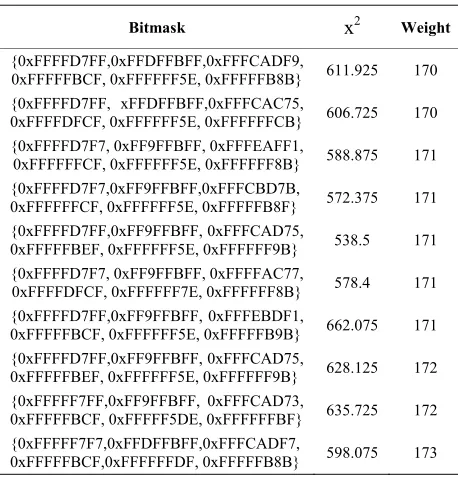
Our QGA discovered ten bitmasks whose average x2
statistic across 30 different random input-key datasets and weight are included in Table 4.
In Table 4, the averagex2 statistic was 602 and the
av-erage bitmask weight was 171, whereas the results from [14] in Table 3 had corresponding values of 453.3875 and 157 respectively.
Our results in Table 4 demonstrated a big improve-ment over those in [13] and [14]. As the cycles of TEA increase, our QGAs show their apparent advantage over GAs as illustrated in the following sections. In all the subsequent experiments below, we used a QGA with population size of 100, generation number of 200, and
0.001
in rotational mutation.
3.3 Three-Cycle TEA
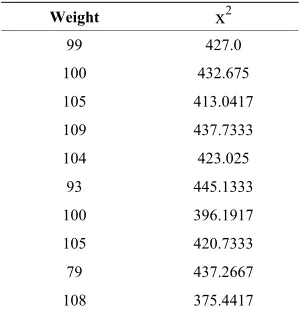
For three-cycle TEA, authors in [14] used the same fit-ness function defined in Equation (2) as for the two-cycle TEA to find ten bitmasks. Their average x2 statistic
across 30 different random input-key datasets and weight are presented in Table 5.
In [13], authors used fitness function defined in Equa-tion (2) to get the following best bitmask with a weight of 116 and an average x2 statistic of 466.5 on 30 random
input-key datasets:
{0xFFE1F040, 0x FCE70446, 0x FFEFF06E, 0x FFE7F42A, 0x FFBF1825, 0x FFFA0064} We identified ten bitmasks using the following fitness function for three-cycle TEA,
4 2
2
, >90 ,
w if x
fitness 0
x otherwise
(4)
The only difference between this function and that in Equation (3) is the threshold employed in the function definition. The information about these bitmasks is summarized in Table 6. The average X2 statistic was
Table 5. Results of GA on three-cycle TEA in [14]
Weight x2
99 427.0 100 432.675 105 413.0417 109 437.7333 104 423.025 93 445.1333 100 396.1917 105 420.7333 79 437.2667 108 375.4417
For two-cycle and three-cycle TEAs, we obtained bet-ter bitmasks than those found in [13] and [14] in bet-terms of both chi-square statistic and weight.
3.4 Four-Cycle TEA
The task of finding efficient bitmasks becomes more complicated as the cycles of TEA increase. The ap-proaches in [13] and [14] were sufficient to find efficient bitmasks for TEA of cycles less than four, but failed to attack TEA of cycles greater than or equal to four.
In [13], using the fitness function in Equation (2) au-thors found bitmasks of relatively low weights, less than 47. They then took up a different approach. Instead of using chi-square statistic, they used Strict Avalanche Criterion (SAC), a more sensitive measure, to assess the deviation of the output of TEA from randomness. The best bitmask they found was
{0x96922A0C, 0x42C06402, 0x35B11001, 0x97000000, 0xF0000001, 0xBEB00001} with a weight of 50 and an average x2 statistic of 673.40
on 30 random input-key datasets. Since TEA takes input data of 64 bits, any bitmask of weight less than 64 cannot be useful for different cryptanalysis of TEA.
In [14], authors were unable to find any useful bit-masks for four-cycle TEA. They suspected that with more rounds of calculations in their GA, it might be pos-sible to discover some adequate bitmasks.
Based on the principle that we should approach each cycle differently, the following fitness function was ap-plied to four-cycle TEA,
4 2
2
, >80 ,
w if x
fitness 0
x otherwise
(5)
Our QGA uncovered five bitmasks. For each of these bitmask, we computed the average x2 statistic across 30
[image:6.595.97.251.103.260.2]random input-key datasets. The results are listed in Table 7. All thesex2 statistic values have a P-value less than 5*10-9.
Table 6. Our results of QGA on three-cycle TEA
Bitmask x2 Weight
{0xF7D65CE6, 0x10FCA894,0xF2ABBFDD,
0xFF0557BB, 0xFF867C02, 0xFFD7E73D} 554.3 120 {0x77D65CE6, 0x10FCA894, 0xF2ABBFDD,
0xFF0557BB, 0xFF867C02, 0xFFD7E73D} 518.74 119 {0x77D65CE6, 0x10FCA894, 0xF2ABBFDD,
0xDF0557BB, 0xFF867C02, 0xFFD7E73D} 536.51 118 {0x77D65CE6, 0x10FCA894, 0xE2ABBFDD,
0xFF0557BB, 0xFF867C02, 0xFBD7E73D} 540.11 117 {0x77D65CE6, 0x10FCA894, 0xE2ABBFDD,
0xDF0557BB, 0xFF867C02, 0xFBD7E73D} 547.80 116 {0xF1729F86, 0x97B6EC6F, 0xFB5A1EE0,
0xFFD328F4, 0xFFE4408C, 0xFFB1FDEA} 542.23 117 {0xF1729F86, 0x97B6EC6F, 0xFB5A1EE0,
0xFFD328F4, 0xFDE4408C, 0xFFB1FDEA} 540.65 116 {0xF38FA5FB, 0xF7E44E4B, 0xF483FB22,
0xF23FE071, 0xFFE1C64D, 0xFFCF5074} 559.45 116 {0xF77C99E2, 0xD157C8BC, 0x7C79BF35,
0x9555D5F2, 0xFFFECA55, 0xCDDDABE5} 482.56 120 {0x773C98EF, 0xD92FCEBC, 0x5C79BF15,
0x955D55F2, 0xFFFECA45, 0xCDDDABC5} 485.21 119
Table 7. Our results of QGA on four-cycle TEA
Bitmask x2 Weight
{0x504007C7, 0xB03C5091, 0x84AE8212,
0x026029C7, 0x411BA198, 0xC81074B8} 740.22 69 {0xF407DC1C, 0x7A123211, 0x8F1042AE,
0x8040A0BE, 0x90017A89, 0x20C204C0} 749.12 69 { 0x4520B630, 0x0A36E920, 0x0D051868,
0x0AEC3868, 0x2312C768, 0x2460F804} 721.33 69 {0x54D3A2C4, 0x901722EC, 0xE02B0591,
0x21D00283, 0x57848409, 0x49114082} 735.26 67 {0x3E2C642A, 0x80443210, 0xB446B064,
0x87250417, 0x0C93E181, 0x12040508} 767.23 64
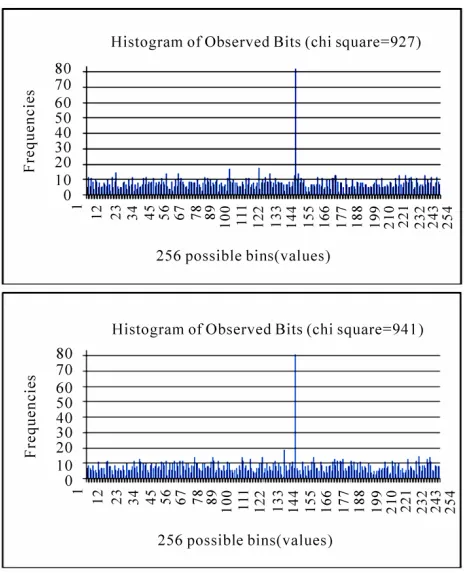
The output v[0] & 255 of the first bitmask in Table 7, from two separate sample runs of TEA on one random input-key dataset of 211 pairs, is displayed in the form of
histograms in Figure 1. As illustrated in Figure 1, there is a clear peak or bias at the same position 152 for both runs although the frequencies at all other positions are relatively the same. Thex2 statistic values produced by
these two sample runs of TEA were 927 and 941 respec-tively. The significance of these x2 statistic values, which
measure the deviation of TEA output from randomness, can be evaluated by their P-value. We thought it is more helpful if the plots like those in Figure 1 can be exhib-ited.
3.5 Five-Cycle TEA
[image:6.595.303.539.366.494.2]Figure 1. The two plots show the histograms of the output of the first bitmask in Table 7. The x-axis represents the possible 256 positions, and the y-axis represents the fre-quencies of the bit patterns of TEA output at various positions
4 2
2
, >70 ,
w if x
fitness 0
x otherwise
(6)
We found the following bitmask:
{0xE4822346, 0x830CA317, 0xCE9522DC, 0x3E13C130, 0x33C18B0A, 0x128A11A0} This bitmask has a weight of 76, an averagex2 statistic
of 631.74 on 30 random input-key datasets, and a P-value less than 5*10-9.
For five-cycle TEA, we only reported one bitmask that has a high chi-square statistic and a high weight. It was not the intent of our current study to conduct an exhaus-tive search of all bitmasks of interest, but rather to dem-onstrate the effectiveness of QGAs in the cryptanalysis of TEA.
4. Conclusions
In this paper, QGAs were utilized in the cryptanalysis of TEA. We not only significantly improved the results in [13] and [14] in terms of both bitmask chi-square statistic and weight, but also were able to break TEA of cycles greater than or equal to four, a challenge previous studies
could not resolve. With these improved bitmasks, effi-cient distinguishers for TEA can be constructed. These distinguishers require few inputs to get high distinguish-ing probability [13]. Our success, we believed, was based on designing new fitness functions and the fact that the qubit chromosomes in QGAs are more informative than the bit chromosomes of same length in traditional GAs.
5. Acknowledgments
We thank Houghton College for its financial support and Dr. Aaron Garrett of Jacksonville State University for helpful discussion.
REFERENCES
[1] D. Wheeler, and R. Needham, “TEA, a tiny encryption algorithm,” Proceedings of the 1995 Fast Software En-cryption Workshop, Springer-Verlag, pp. 97–110, 1995. [2] S. J. Shepherd, “The tiny encryption algorithm,” Journal
of Cryptologia, Vol. 31, No. 3, pp. 233–245, July 2007. [3] D. Wagner, J. Kelsey, and B. Schneier, “Related-key
cryptoanalysis of 3-WAY, Biham-DES, CAST, DES-X, NewDES, RC2 and TEA,” Proceedings of the IClCS’97 Conference, Springer-Verlag, pp. 233–246, 1997. [4] F. Yang, J. Song, and H. Zhang, “Quantitative
cryptana-lysis of six-round DES using evolutionary algorithms,” Proceedings of the 3rd International Symposium on Ad-vances in Computation and Intelligence, LNCS Vol. 5370, Springer-Verlag, pp. 134–141, 2008.
[5] E. Biham and A. Shamir, “Differential cryptanalysis of DES-like cryptosystems,” CRYPTO’90, LNCS 537, Springer-Verlag, pp. 2–21, 1991.
[6] J. Song, H. Zhang, Q. Meng, and Z. Wang, “Cryptanaly-sis of two-round DES using genetic algorithms,” ISICA’07: International Symposium on Intelligence Computation and Applications, LNCS, Springer-Verlag, Vol. 4683, pp. 583–590, 2007.
[7] J. Song, H. Zhang, Q. Meng, and Z. Wang, “Cryptanalysis of four-round DES based on genetic algorithms,” Pro-ceedings of the International Conference on Wireless Communications, Networking and Mobile Computing, Springer-Verlag, LNCS, Vol. 4683, pp. 583–590, 2007. [8] J. Holland, “Adaptation in natural and artificial systems,”
Ann Arbor, MI: University of Michigan Press, 1975. [9] S. Hong, D. Hong, Y. Ko, D. Chang, W. Lee, and S. Lee,
“Differential cryptanalysis of TEA and XTEA,” ICISC 2003, LNCS 2971, Springer-Verlag, pp. 402–417, 2004. [10] E. Biham, A. Biryukov, and A. Shamir, “Cryptanalysis of
skipjack reduced to 31 rounds using impossible differen-tials,” Advances in Cryptology – EUROCRYT’99, LNCS, Springer-Verlag, Vol. 1592, pp. 12–23, 1994.
[12] L. Knudsen and W. Meier, “Correlations in RC6 with a reduced number of rounds,” Proceedings of the Seventh Fast Software Encryption Workshop, Springer-Verlag, 2000. [13] J. C. Hernandez and P. Isasi, “Finding efficient distin-guishers for cryptographic mappings, with an application to the block cipher TEA,” Proceedings of the 2003 Con-gress on Evolutionary Computation CEC2003, pp. 341–348, IEEE Press, 2003.
[14] A. Garrett, J. Hamilton, and G. Dozier, “Genetic algorithm techniques for the cryptanalysis of TEA,” International Journal on Intelligent Control and Systems Special Session on Information Assurance. Vol. 12, pp. 325–330, 2007. [15] J. J. Grefenstette, “Optimization of control parameters for
genetic algorithms,” IEEE Transactions on Systems, Man ,
and Cybernetics, Vol. 16, No. 1, pp. 122–128, 1986. [16] R. Penrose, “Shadows of the mind,” Oxford University
Press, 1994.
[17] K. H. Han and J. H. Kim, “Introduction of quantum-inspired evolutionary algorithm,” in Proceedings of the 2002 FIRA Robot World Congress, pp. 243–248, May 2002.
[18] S. Y. Yang and L. C. Jiao, “The quantum evolutionary programming,” Proceedings of the 5th International Con-ference on Computational Intelligence and Multimedia Applications (ICCIMA’03), pp. 362–367, 2003.