for Subgraph Algorithms
?Blair Archibald1[0000−0003−3699−6658], Fraser Dunlop2[0000−0002−4485−4871], Ruth Hoffmann2[0000−0002−1011−5894], Ciaran McCreesh1[0000−0002−6106−4871], Patrick Prosser1[0000−0003−4460−6912], and James Trimble1[0000−0001−7282−8745]
1 University of Glasgow, Glasgow, Scotland 2
University of St Andrews, St Andrews, Scotland
Abstract. The current state of the art in subgraph isomorphism solving involves using degree as a value-ordering heuristic to direct backtracking search. Such a search makes a heavy commitment to the first branching choice, which is often incorrect. To mitigate this, we introduce and eval-uate a new approach, which we call “solution-biased search”. By combin-ing a slightly-random value-ordercombin-ing heuristic, rapid restarts, and nogood recording, we design an algorithm which instead uses degree to direct the proportion of search effort spent in different subproblems. This increases performance by two orders of magnitude on satisfiable instances, whilst not affecting performance on unsatisfiable instances. This algorithm can also be parallelised in a very simple but effective way: across both satis-fiable and unsatissatis-fiable instances, we get a further speedup of over thirty from thirty-six cores, and over one hundred from ten distributed-memory hosts. Finally, we show that solution-biased search is also suitable for optimisation problems, by using it to improve two maximum common induced subgraph algorithms.
1
Introduction
The subgraph isomorphism problem is to decide whether a copy of a small “pat-tern” graph occurs inside a larger “target” graph. The problem is broadly ap-plicable, arising in areas including bioinformatics [2], chemistry [46], computer vision [11, 49], law enforcement [8], model checking [47], malware detection [4], compilers [43, 1], pattern recognition [12], program similarity comparison [10], the design of mechanical locks [50], and graph databases [37].
Although the problem isNP-complete, by combining design techniques from
artificial intelligence with careful algorithm engineering, modern subgraph iso-morphism solvers can often produce exact solutions quickly even on graphs with thousands of vertices. The current single strongest subgraph isomorphism solver
?
uses “highest degree first” as a value-ordering heuristic to direct a constraint pro-gramming style search [35, 25, 37]. This heuristic is much better than branching randomly, but is still far from perfect. To offset mistakes made by this heuristic, this paper proposes a new perspective on value-ordering: rather than defining a
search order, we use degree to direct whatproportion of the search effort should
be spent in each subproblem. By combining rapid restarts and nogood recording, and introducing a small amount of randomness into the value-ordering heuristic, we make a state-of-the-art subgraph algorithm perform two orders of magnitude better on a large number of satisfiable instances, whilst performing worse only rarely on satisfiable instances, and never on unsatisfiable instances. This strategy is also effective in an optimisation setting, producing benefits in two maximum common induced subgraph algorithms.
This new form of search can also be parallelised, with amuch simpler
im-plementation than conventional work-stealing. By running many threads with different random seeds but the same restart schedule, and sharing nogoods only following restarts, we can achieve aggregate speedups [20] of thirty-one from a thirty-six core machine, or over one hundred by using ten such machines.
1.1 Background
Thenon-induced subgraph isomorphism problem is to find an injective mapping
from the vertices of apattern graphP to the vertices of atarget graphT, such
that adjacent vertices inP are mapped to adjacent vertices inT (including that
vertices with loops inP may only be mapped to vertices with loops inT). The
induced problem additionally requires that non-adjacent vertices are mapped to
non-adjacent vertices. Thedegree of a vertex is the number of other vertices to
which it is adjacent.
This paper looks at improving the Glasgow Subgraph Solver3, which can
solve both the non-induced and the induced subgraph isomorphism problems.
The solver is very closely based upon the k↓ algorithm of Hoffmann et al. [21]
with k = 0, and we refer the reader to that paper for full technical details;
that algorithm, in turn, is a simplification and re-engineering of an older Glas-gow algorithm [35, 25]. Essentially, the solver is a dedicated forward-checking constraint programming implementation specifically for subgraph problems. It works with a model having a variable per pattern graph vertex, with domains ranging over the target graph vertices, and performs a backtracking search to map each pattern vertex to a target vertex whilst propagating adjacency and injectivity constraints (together with further implied constraints based upon de-grees and paths). However, it uses specialised bit-parallel data structures and algorithms, and propagates constraints in a fixed order rather than using a queue.
1.2 Experimental Setup
Our experiments are performed on the EPCC Cirrus HPC facility, on systems with dual Intel Xeon E5-2695 v4 CPUs and 256GBytes RAM, running Centos
3
7.3.1611. We use GCC 7.2.0 as the compiler. For parallelism, we use C++ native threads, and for distributed parallelism we also use the SGI MPT implementation of MPI. All timing measurements are steady-clock, and we use a deterministic pseudo-random number generator for reproducibility.
We use the dataset introduced by Kotthoff et al. [25] for evaluation. This dataset brings together a range of randomly-generated and application instance families from earlier papers:
BVG(r), M4D(r), and Rand are families of randomly generated graphs
us-ing different models (bounded degree, regular mesh, and uniform), where each pattern is a permuted random connected subgraph of the target (and so each instance is satisfiable) [9]. These benchmark instances are widely used, but have unusual properties and so broad conclusions should not be drawn based solely upon behaviour of these instances [37].
SF contains randomly generated scale-free graphs using a similar method [52].
LV consists of various kinds of graph gathered by Larrosa and Valiente [27] from
the Stanford Graph Database. We include both the 50 small graphs, and the 50 large graphs.
Phase contains hand crafted instances that lie near the satisfiable / unsatisfi-able phase transition [37].
PR contains graphs generated from segmented images, corresponding to a
com-puter vision problem [49].
Images and Meshes contain graphs representing 2D segmented images and
3D object models, again representing a computer vision problem [11].
Other studies use a random selection of 200 of each of the instances from the “meshes” and “images” families because some earlier solvers find many of these instances extremely hard. We would like to have a larger number of satisfiable instances in our test set, and so we include all pattern / target pairs. This gives a total of 14,621 instances (rather than the original 5,725). At least 2,150 of these instances are known to be satisfiable for the non-induced problem, and at least 12,348 are unsatisfiable.
2
Improving Sequential Search
We begin with a set of baseline performance measurements. In the top two plots of Figure 1 we show the cumulative number of instances solved over time for the non-induced and induced problems respectively. We compare the Glasgow Sub-graph Solver using depth-first search (DFS) and with the modifications described in the remainder of this paper (solution-biased search, SBS), the PathLAD vari-ation of the LAD algorithm [48, 25], VF2 [9], RI [2], and VF3 [5] (which only supports the induced problem), in each case using the original implementation provided by the algorithm’s authors. The plots show that our starting point comfortably beats PathLAD, VF2, VF3 and RI, except for very low choices of
timeout. For each algorithm, the y value gives the cumulative number of
14621 0 2000 4000 6000 8000 10000 12000
100 101 102 103 104 105 106
Instances Solv ed Runtime (ms) Glasgow: SBS DFS PathLAD VF2 RI 14621 0 2000 4000 6000 8000 10000 12000
100 101 102 103 104 105 106
Induced Instances Solv ed Runtime (ms) Glasgow: SBS DFS PathLAD VF2 VF3 RI 1200 1300 1400 1500 1600 1700 1800 1900 2000 2100
102 103 104 105 106
Sat Instances Solv ed Runtime (ms) 1100 1150 1200 1250 1300 1350 1400 1450 1500
102 103 104 105 106
[image:4.612.138.476.94.436.2]Induced Sat Instances Solv ed Runtime (ms)
Fig. 1.On the top row, the cumulative number of instances solved over time, comparing the Glasgow Subgraph Solver (both in its basic form, and with the improvements introduced in the remainder of the paper) to other solvers, for the non-induced and induced problems. On the bottom row, the same, considering only satisfiable instances.
vertical distance between two lines therefore shows how many more instances can be solved by one solver than another, if every instance is run separately with
the chosen x timeout. The horizontal distance shows how many times longer
the per-instance timeout would need to be to allow the rightmost algorithm to
succeed ony out of the 14,621 instances (bearing in mind that the two sets ofy
instances could be different), and gives a measure calledaggregate speedup [20].
14621
7000 8000 9000 10000 11000 12000 13000 14000
102 103 104 105 106
Instances
Solv
ed
Runtime (ms) DFS DDS
100 101
102 103
104
105
106
100 101 102 103 104 105 106
DDS
Search
Time
(ms)
DFS Search Time (ms)
[image:5.612.136.480.118.259.2]SF LV BVG(r) M4D(r) Rand PR Phase Meshes Images Any unsat
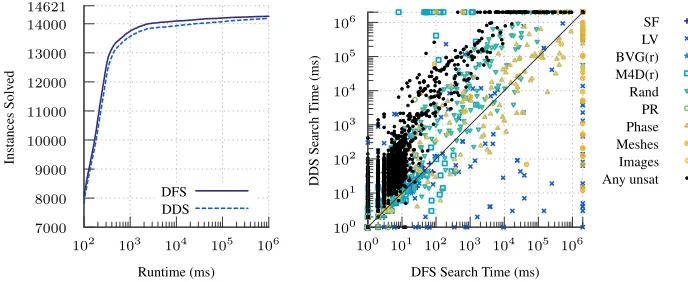
Fig. 2.Comparing depth-bounded discrepancy search (DDS) to depth-first backtrack-ing search (DFS), both usbacktrack-ing degree as the value-orderbacktrack-ing heuristic.
of this paper, we show only the non-induced problem, which tends to be harder; results with the induced variant are similar.
2.1 Discrepancy Searches
Adiscrepancyis where search goes against the advice of a value-ordering heuris-tic. Discrepancy searches [19, 24, 51, 23] are alternatives to backtracking search that initially search disallowing all discrepancies, and then retry search allowing an increasing number of discrepancies at each iteration until either a solution is found or unsatisfiability is proven. These schemes assume that value-ordering heuristics are usually reliable, and that most solutions can be found with only a small number of discrepancies. In such cases, the heavy commitment to early branching choices made by backtracking search can be extremely costly.
Figure 2 shows the effects of adding Walsh’s [51] depth-bounded discrep-ancy search (DDS) to the solver (results with other discrepdiscrep-ancy search variants are similar). On the scatter plot, each point represents the solving time for one instance—to avoid noise for easier instances, we measure only time spent dur-ing search, and exclude time spent in preprocessdur-ing and initialisation. Points
below the x−y diagonal are speedups, whilst points on the top and right axes
1400 1500 1600 1700 1800 1900 2000
102 103 104 105 106
Sat
Instances
Solv
ed
Runtime (ms) Degree Biased Random Anti
100
101 102
103 104
105
106
100 101 102 103 104 105 106
Biased
Search
Time
(ms)
Degree Search Time (ms)
[image:6.612.136.484.92.259.2]SF LV BVG(r) M4D(r) Rand PR Phase Meshes Images Any unsat
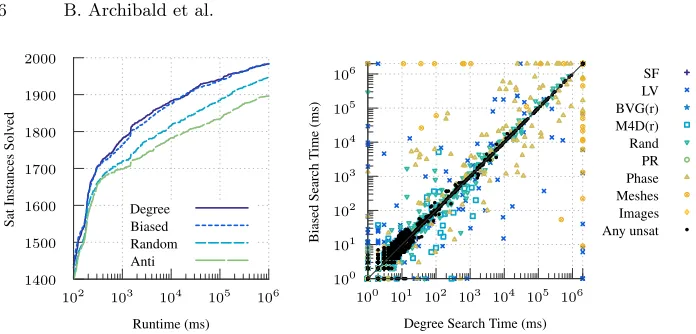
Fig. 3. On the left, the cumulative number of satisfiable instances solved over time, using four different value-ordering heuristics. On the right, an instance by instance comparison of the degree and biased heuristics on all instances. Points on the outer axes are timeouts, and point style shows instance family.
a proof of optimality to be a realistic prospect, and they are not well-suited for unsatisfiable decision problems. Despite this, the extremely large gains on some satisfiable instances confirm our suspicions that we should find an alternative to heavy-commitment backtracking search.
2.2 Value-Ordering Heuristics
Traditionally, value-ordering heuristics are designed to drive search towards the most promising region of the search space [14], or the most constrained [15], or the region with the highest solution density [44]. In subgraph isomorphism, this is done by selecting vertices from highest degree to lowest [37]. The left-hand plot
of Figure 3 demonstrates that this is indeed a good choice: theDegreeheuristic’s
line shows much better performance on satisfiable instances than theRandom
(branch randomly) or Anti (branch from lowest degree to highest) heuristic
lines. Meanwhile, on unsatisfiable instances, the value-ordering heuristic has no effect on performance, because a complete search must be performed.
But what happens if our value-ordering heuristic has to choose between map-ping a pattern vertex to one of, for example, three target vertices of degree ten, two vertices of degree nine, or five of degree two? When driving conventional backtracking search, the degree heuristic would pick one of the vertices of degree ten, and we would commit all of our search effort to the exponentially large search tree underneath it, not considering any other choice until this tree has been fully explored and eliminated. We will show that this is not a wise choice,
and that instead, we shouldcommit equal search effort to each of the three
degree ten subproblems have been explored? Or might it be better to commit, say, twice as much effort to each degree ten subproblems as to each degree nine subproblems, and only a very small amount of effort to the degree two sub-problems? To test this hypothesis, we will now introduce a new alternative to
backtracking search, which we call solution-biased search. This search is made
up of three components: a new slightly-random value-ordering heuristic, rapid restarts, and nogood recording. The aim is to perform a complete search, but spending proportionally more time in parts of the search tree that are preferred by the value-ordering heuristic.
2.3 Biased Value-Ordering
We first define a newBiasedvalue-ordering heuristic, as follows. When
branch-ing, we select a vertexv0 from the chosen domainDv with probability
p(v0) = 2 deg(v0)
P w∈Dv2
deg(w).
This heuristic is now equally likely to pick between vertices of equal degree, is
twice as likely to pick a vertex of degreedas one of degreed−1, and is over a
thousand times more likely to pick a vertex of degreedthan degreed−10.
Figure 3 confirms that this heuristic, when used with backtracking search, will solve close to the same number of instances as the degree heuristic would for any given choice of timeout. In other words, we can introduce an element of randomness into the degree value-ordering heuristic without adversely affecting
its performance in aggregate. The right-hand plot gives a detailed comparison.
It shows that despite the aggregate performance being similar, on a case by case basis, the two heuristics can make a large difference to the performance for individual satisfiable instances. This justifies our belief that although degree is a good heuristic, we should perhaps not commit heavily to a single vertex of highest degree, but also consider vertices of the same or similar degree.
2.4 Restarting Search and Nogood Recording
Having introduced a new value-ordering heuristic, we must now also move away
from depth-first backtracking search. We do this by using restarts and nogood
recording. The general idea is to perform a certain amount of search, and then if no solution has been found (and unsatisfiability has not been proven), to abandon search and restart from the beginning. Such an approach can only be beneficial if something changes after restarting—in a constraint programming setting, this is usually the variable-ordering heuristic [28, 13, 29, 16]. In this paper, we
in-stead rely upon randomness in our new value-ordering heuristic, and continue
to use smallest domain first with static tiebreaking for variable-ordering.4Using
4
restarts on value-ordering heuristics is uncommon (although Razgon et al. [45] look at learning value-ordering heuristics from restarts, Chu et al. [6] use a sim-ilar scheme in the context of parallel search, and an early approach by Gomes et al. [17] does so in an optimisation context).
Preliminary experiments directed us to use the Luby scheme [33] to deter-mine when to restart. Following convention, we multiply each item in the Luby sequence by a constant—we used the SMAC automatic parameter tuner [22] to select the value 660.
To avoid exploring portions of the search space that we have already visited, every time we restart, we add new constraints to the problem which eliminate
already-explored subtrees—such a constraint is called anogood. We generate
sim-ple decision nogoods. That is, upon backtracking due to a decision to restart,
we post a nogood of the form (v 7→v0)∧(w7→w0)∧(x7→x0)⇒ ⊥ for every
branch to the left of the current (incomplete) branch at every level of the search tree, and when we first make a decision to restart before backtracking, we post a similar nogood eliminating the entire subtree explored. We use the two watched literals technique [42] to propagate stored nogoods. This has two benefits: the propagation complexity does not particularly depend upon the number of stored nogoods, and it does not require any work upon backtracking. Other more so-phisticated nogood generation and propagation schemes exist [29, 16], but these are not helpful in this setting (our solver does not maintain arc consistency or use a propagation queue).
2.5 Solution-Biased Search in Practice
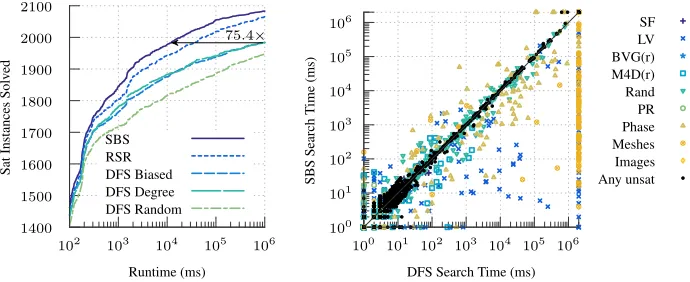
In Figure 4 we show the effects of adding restarts and nogood recording to the algorithm. With restarts and nogood recording (random search with restarts, RSR), the random value-ordering heuristic comfortably beats the degree strategy with depth-first search. In other words, although having a good value-ordering heuristic is beneficial, introducing randomness into the search is better, if it is done alongside a mechanism to avoid heavy commitment to any particular random choice. However, the biased heuristic together with restarts (solution-biased search, SBS) is better still—that is, if we are introducing restarts, then it is better to add a small amount of randomness to a tailored heuristic than it is to throw away the heuristic altogether. Indeed, the original algorithm can solve 1983 satisfiable instances by 909 seconds, whilst the biased and random restarting algorithms require only 12 seconds and 35 seconds respectively to solve the same number.
In the more detailed view in the right-hand plot of Figure 4, comparing the original algorithm to solution-biased search, all of the unsatisfiable instances
are very close to the x−y diagonal, showing that their performance is nearly
unchanged. On the other hand, there are large numbers of satisfiable instances
1400 1500 1600 1700 1800 1900 2000 2100
102 103 104 105 106
75.4×
Sat
Instances
Solv
ed
Runtime (ms) SBS
RSR DFS Biased DFS Degree DFS Random
100 101
102 103
104
105
106
100 101 102 103 104 105 106
SBS
Search
Time
(ms)
DFS Search Time (ms)
[image:9.612.138.483.118.259.2]SF LV BVG(r) M4D(r) Rand PR Phase Meshes Images Any unsat
Fig. 4. On the left, the number of satisfiable instances solved over time, comparing solution-biased search (SBS), random search with restarts (RSR), and the three value-ordering heuristics with conventional depth-first search. To the right, a comparison between the original algorithm and solution-biased search.
well below the diagonal line, indicating large speedups. Better yet, there are only a handful of satisfiable instances that are more than a factor of ten times worse. In other words, as well as improving performance, we have made up most of the consistency we lost by introducing randomness.
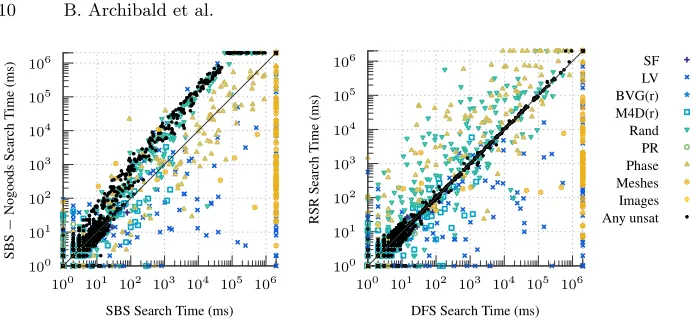
As we might expect, these properties do not hold if any of the combination of changes are disabled. In the left-hand plot of Figure 5, we see large slowdowns on unsatisfiable instances when disabling nogood recording, and on the right-hand
plot we see many more satisfiable instances above thex−ydiagonal when using
the random value-ordering heuristic as opposed to the degree-biased heuristic.
2.6 Solution-Biased Search in Theory
Although we have shown that it provides good results, we have yet to justify where the biased formula comes from, or indeed why we call this approach “solution-biased”. Our goal is to use biased randomness in a value-ordering heuristic to spend time in subproblems proportional to an estimate of their so-lution density [44]. Such an approach is better than committing entirely to the area of maximum solution density because estimators only give a probability— although we may estimate that one subtree has twice the solution density of another, in reality the “better” subtree may contain no solutions at all.
To estimate solution density, we need an estimate of how big different sub-problems are likely to be, and of how many solutions each subproblem is likely to contain. Of course, obtaining exact (or even approximate) values for these figures is at least as hard as solving the problem in its entirety, but we may obtain
us-able approximations. For pairs of Erd˝os-R´enyi random graphs with large solution
100 101
102
103 104
105
106
100 101 102 103 104 105 106
SBS
−
Nogoods
Search
Time
(ms)
SBS Search Time (ms)
100 101
102 103
104
105
106
100 101 102 103 104 105 106
RSR
Search
Time
(ms)
DFS Search Time (ms)
[image:10.612.136.483.92.255.2]SF LV BVG(r) M4D(r) Rand PR Phase Meshes Images Any unsat
Fig. 5.On the left, not using nogood recording introduces slowdowns, particularly on unsatisfiable instances. On the right, using a random value-ordering gives much worse performance on many satisfiable instances.
for graphs from this distribution, we need only an estimator of subproblem size.
Measurements also suggest that, for pairs of Erd˝os-R´enyi graphs, subproblems
under a target vertex of degree dtend to contain a small constant times more
search nodes than those under a target vertex of degree d−1. This empirical
analysis suggests that an estimator that is exponential indwill give our method
the desired behaviour, at least for Erd˝os-R´enyi graphs. We expect it may be
possible to derive better estimators for particular input classes, although over the full range of problem instances, we have verified that exponential estimators substantially outperform polynomial and factorial weightings.
3
Parallel Search
14200 14250 14300 14350 14400 14450
103 104 105 106 107
12.7×
31.4×,57.1×,95.5×,94.5×
2.2×,3.5×,7.9×
24.2×,82.6×,103.2×,144.9×
11.7×
Instances
Solv
ed
Runtime (ms)
SBS (Luby) SBS (Timer) 32 Threads (Luby) 32 Threads (Timer) 5 Hosts (Timer) 10 Hosts (Timer) 20 Hosts (Timer)
100
101
102
103
104 105
106
100 101 102 103 104 105 106
32
Threads
(T
imer)
Search
Time
(ms)
SDS (Timer) Search Time (ms)
100
101 102
103
104
105
106
100 101 102 103 104 105 106
10
Host
Runtime
(ms)
SDS (Timer) Runtime (ms)
[image:11.612.136.482.115.423.2]SF LV BVG(r) M4D(r) Rand PR Phase Meshes Images Any unsat
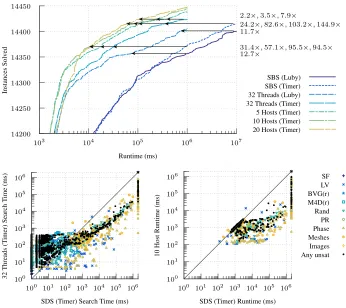
Fig. 6. Above, the cumulative number of instances solved over time, comparing the sequential algorithm to results using 32 threads on a single machine, and using five, ten or twenty distributed memory hosts. Below, instance by instance comparisons.
3.1 Shared Memory Parallelism
Solution-biased search allows for a much simpler parallel implementation. We create a number of threads, and give each thread its own random seed; other-wise each thread performs the same sequential search. Threads synchronise on restarts, a simple barrier causing each thread to wait for every other thread to also restart. Nogoods from all threads are then gathered and combined before search resumes, now with a larger set of nogoods than in a sequential run. Finally, whenever any single thread terminates, either due to having found a solution or proved unsatisfiability, then every other thread may immediately terminate.
– Each thread will be run with the same restart schedule, and so will spend approximately the same amount of time between restarts. Because the only synchronisation between threads is at a restart, we expect threads to be busy doing search. (This is in contrast to an alternative method for paralellising restarting search [7], which packs together successive sequence values to pro-duce a balanced workload.) This approach therefore avoids the irregular task size issues which usually arise in parallel combinatorial search.
– Sequentially, on non-trivial instances the algorithm will restart often (many
tens of thousands, for instances that reach the thousand second timeout).
– Because the search trees we explore are exponentially large, the randomness
in the value-ordering heuristic is sufficient to ensure that most of the time, threads are exploring different parts of the search tree.
– The gathering of nogoods to describe the work done so far provides an
alter-native to requiring either a specific mechanism to allocate work, or expensive synchronisation between threads. Notably, this completely bypasses the typ-ical difficulties of sharing all learned nogoods in learning solvers [18].
– If sometimes threads do happen to explore part of the same subproblems,
this is not a problem: if the instance is satisfiable, either thread might find a solution first, and if the instance is unsatisfiable, we merely introduce some
redundancy into the proof.5 The combination of rapid restarts and nogood
recording is enough to ensure that this is only a small overhead.
Figure 6 shows how this scheme performs in practice. Sequentially, we can solve 14,357 instances within the thousand second timeout, with the last instance being solved at 939.0 seconds. Using thirty-six threads on machines with two eighteen core processors, we can solve 14,357 instances with a timeout of only 74.2 seconds, giving an aggregate speedup [20] of 12.7.
Closer inspection of the results reveals that with this many threads, a con-siderable proportion of the overall search time is spent with threads waiting at the barrier for synchronisation. This is because the time taken to carry out
search until 660 backtracks are encountered is onlyroughly a constant (in
prac-tice it usually varies by around a factor of two). Furthermore, the Luby sequence includes occasional large multipliers, and if unsatisfiability is proved during to-wards the end of one of these runs, each thread will end up duplicating a large amount of work.
Because we are using nogood recording, an alternative approach is possible. Rather than using the Luby sequence for restarts, we could restart after either a constant number of backtracks, or simply after a certain time interval has passed—this bounds the maximum possible idle time that threads could spend at a barrier. Figure 6 also shows the effects of restarting every 100ms. Sequentially, this approach is slightly better than using the Luby sequence, being able to solve 14,370 instances, with the last at 996.4 seconds. With thirty-six threads, solving this many instances takes 31.8 seconds, giving an aggregate speedup of 31.4.
5
It is important to emphasise that there is no expectation of a linear speedup from this approach [30, 31, 3], particularly for satisfiable instances. Due to the bi-ased random nature of the value-ordering heuristic, one of our extra threads may “get lucky” and find a solution much quicker than we would sequentially, leading to a superlinear speedup. Conversely, our extra threads may contribute nothing to finding a solution—or worse, due to new nogoods altering the choice made by the random branching heuristic, we could even get an absolute slowdown. We can see both of these effects in the bottom left plot of Figure 6: although we achieve roughly a linear speedup on unsatisfiable instances, satisfiable instances show much greater variability. However, this approach does at least mirror our intuition of allocating search effort in proportion to where the value-ordering heuristic believes it will be most fruitful, and so we should not be too surprised that we see roughly a linear speedup on average on harder instances.
Additionally, for easy instances, most of the algorithm’s execution time is spent in a preprocessing phase. We have not parallelised this, which is why our results are poor below the one second mark.
3.2 Distributed Memory Parallelism
To further test the scalability of this technique, we also used MPI to implement a distributed-memory parallelism layer on top of the threaded layer. In contrast to the huge difficulties of implementing work-stealing in a distributed memory setting, this required only the addition of two MPI calls: an “all gather” operation to communicate nogoods, and a “gather” to collect and combine the results of each host. Termination, meanwhile, was handled by posting an empty nogood (and so termination can only occur on a restart).
0 500 1000 1500 2000 2500 3000 3500
102 103 104 105 106
5.3×
1.8×
Instances
Solv
ed
Runtime (ms)
DFS SBS k↓:
DFS SBS McSplit↓:
100
101
102 103
104
105 106
100 101 102 103 104 105 106
SBS
k
↓
Runtime
(ms)
DFS k↓Runtime (ms)
100
101
102
103
104
105 106
100 101 102 103 104 105 106
SBS
McSplit
↓
Runtime
(ms)
DFS McSplit↓Runtime (ms)
[image:14.612.137.483.90.415.2]SF LV BVG(r) M4D(r) Rand PR Phase Meshes Images
Fig. 7. Above, the cumulative number of maximum common induced subgraph in-stances solved by k↓ and McSplit↓ over time, with the two forms of search. Below, comparing k↓(left) and McSplit↓(right) on an instance by instance basis.
4
Maximum Common Subgraph Algorithms
Having looked at subgraph isomorphism in detail, we now briefly discuss the maximum common induced subgraph problem, to see whether our new approach to search has more general applicability. Two recent algorithms for this problem also make use of backtracking search with degree as a value-ordering heuristic.
The k↓algorithm [21] attempts to solve the problem by first trying to solve the
induced subgraph isomorphism problem, and then if that fails, retries allowing a single unmatched vertex (and thus using weaker invariants), and so on. Due to its similarity to the Glasgow Subgraph Solver, we can introduce the same bias and restart strategy.
Meanwhile, the McSplit↓algorithm [38] uses a constraint programming style
search, but with special propagators and backtrackable data structures that ex-ploit special properties of the problem. The unconventional domain store used
in-troducing restarts, we cannot propagate using nogoods. Instead, we can only detect when we are inside an already-visited branch. We must therefore use the one watched literal scheme instead, and we also introduce a basic subsumption scheme to prune redundant clauses.
Performance results from these two modified algorithms, using the same fam-ilies of instances as in the previous section, are shown in Figure 7. Although we have moved from a decision problem to an optimisation problem, the same
changes remain clearly beneficial. For thek↓algorithm, the change has a minimal
effect on many instances (typically, where thek= 0 subproblem is unsatisfiable
and hard, and the k = 1 subproblem is satisfiable and easy), but gives large
benefits on many more instances than it penalises: it is over an order of magni-tude better on over three hundred instances, whilst being an order of magnimagni-tude worse on only seven.
With McSplit↓, the inability to use two watched literals means that in many
cases we introduce a small slowdown. However, the overall pattern is the same: when introducing restarts and a biased value ordering heuristic, it is much more common to see a large speedup than a large slowdown.
5
Conclusion and Future Work
The conventional view of value-ordering heuristics is that they define a search order. We have proposed an alternative perspective, where value-orderings de-fine a weighting specifying how much search effort should be put into different subproblems, based upon a rough estimate of solution densities. We have also shown how to turn this perspective into an algorithm, by combining a biased random value-ordering heuristic with rapid restarts and nogood recording. This combination of techniques gives us, for the first time, a practical alternative to
backtracking search where we have a strongvalue-ordering heuristic, and where
we care both about satisfiableand unsatisfiable instances.
A further benefit is the ease with which such a search can be parallelised. By having each thread carry out the same search with a different random seed, and sharing nogoods only on restarts, we remove the need for intrusive changes to the core search algorithm, eliminate the irregularity problem, and still respect the advice of the value-ordering heuristic.
We believe that these technique are broadly applicable, beyond subgraph algorithms, and we intend to implement them in a full constraint programming solver. We are also interested in making better use of statistical knowledge (either
a priori or learned during search) to further refine the biased randomisation process. And finally, we are trying hard to work out whether our new perspective
also has some relevance tovariable ordering heuristics.
Acknowledgements
The authors would like to thank ¨Ozg¨ur Akg¨un, Chris Jefferson, Sonja Kraiczy,
References
1. Blindell, G.H., Lozano, R.C., Carlsson, M., Schulte, C.: Modeling universal in-struction selection. In: Principles and Practice of Constraint Programming - 21st International Conference, CP 2015, Cork, Ireland, August 31 - September 4, 2015, Proceedings. pp. 609–626 (2015). https://doi.org/10.1007/978-3-319-23219-5 42 2. Bonnici, V., Giugno, R., Pulvirenti, A., Shasha, D.E., Ferro, A.: A subgraph
iso-morphism algorithm and its application to biochemical data. BMC Bioinformatics
14(S-7), S13 (2013)
3. de Bruin, A., Kindervater, G.A.P., Trienekens, H.W.J.M.: Asynchronous parallel branch and bound and anomalies. In: Parallel Algorithms for Irregularly Struc-tured Problems, Second International Workshop, IRREGULAR ’95, Lyon, France, September 4-6, 1995, Proceedings. pp. 363–377 (1995). https://doi.org/10.1007/3-540-60321-2 29
4. Bruschi, D., Martignoni, L., Monga, M.: Detecting self-mutating malware using control-flow graph matching. In: Detection of Intrusions and Mal-ware & Vulnerability Assessment, Third International Conference, DIMVA 2006, Berlin, Germany, July 13-14, 2006, Proceedings. pp. 129–143 (2006). https://doi.org/10.1007/11790754 8
5. Carletti, V., Foggia, P., Saggese, A., Vento, M.: Introducing VF3: A new algorithm for subgraph isomorphism. In: Graph-Based Representations in Pattern Recogni-tion - 11th IAPR-TC-15 InternaRecogni-tional Workshop, GbRPR 2017, Anacapri, Italy, May 16-18, 2017, Proceedings. pp. 128–139 (2017)
6. Chu, G., Schulte, C., Stuckey, P.J.: Confidence-based work stealing in parallel constraint programming. In: Principles and Practice of Constraint Programming - CP 2009, 15th International Conference, CP 2009, Lisbon, Portugal, September 20-24, 2009, Proceedings. pp. 226–241 (2009)
7. Cir´e, A.A., Kadioglu, S., Sellmann, M.: Parallel restarted search. In: Proceedings of the Twenty-Eighth AAAI Conference on Artificial Intelligence, July 27 -31, 2014, Qu´ebec City, Qu´ebec, Canada. pp. 842–848 (2014)
8. Coffman, T., Greenblatt, S., Marcus, S.: Graph-based
technolo-gies for intelligence analysis. Commun. ACM 47(3), 45–47 (2004). https://doi.org/10.1145/971617.971643
9. Cordella, L.P., Foggia, P., Sansone, C., Vento, M.: A (sub)graph isomorphism algo-rithm for matching large graphs. IEEE Trans. Pattern Anal. Mach. Intell.26(10), 1367–1372 (2004)
10. Dalla Preda, M., Vidali, V.: Abstract similarity analysis. Elec-tronic Notes in Theoretical Computer Science 331, 87 – 99 (2017). https://doi.org/10.1016/j.entcs.2017.02.006, proceedings of the Sixth Work-shop on Numerical and Symbolic Abstract Domains (NSAD 2016)
11. Damiand, G., Solnon, C., de la Higuera, C., Janodet, J., Samuel, ´E.: Polynomial algorithms for subisomorphism of nd open combinatorial maps. Computer Vision and Image Understanding115(7), 996–1010 (2011)
12. Foggia, P., Percannella, G., Vento, M.: Graph matching and learn-ing in pattern recognition in the last 10 years. IJPRAI 28(1) (2014). https://doi.org/10.1142/S0218001414500013
14. Geelen, P.A.: Dual viewpoint heuristics for binary constraint satisfaction problems. In: ECAI. pp. 31–35 (1992)
15. Gent, I.P., MacIntyre, E., Prosser, P., Walsh, T.: The constrainedness of search. In: Proceedings of the Thirteenth National Conference on Artificial Intelligence and Eighth Innovative Applications of Artificial Intelligence Conference, AAAI 96, IAAI 96, Portland, Oregon, USA, August 4-8, 1996, Volume 1. pp. 246–252 (1996) 16. Glorian, G., Boussemart, F., Lagniez, J., Lecoutre, C., Mazure, B.: Combining nogoods in restart-based search. In: Principles and Practice of Constraint Pro-gramming - 23rd International Conference, CP 2017, Melbourne, VIC, Australia, August 28 - September 1, 2017, Proceedings. pp. 129–138 (2017)
17. Gomes, C.P., Selman, B., Kautz, H.A.: Boosting combinatorial search through randomization. In: Proceedings of the Fifteenth National Conference on Artificial Intelligence and Tenth Innovative Applications of Artificial Intelligence Conference, AAAI 98, IAAI 98, July 26-30, 1998, Madison, Wisconsin, USA. pp. 431–437 (1998) 18. Hamadi, Y., Jabbour, S., Sais, L.: Control-based clause sharing in parallel SAT solving. In: Hamadi, Y., Monfroy, E., Saubion, F. (eds.) Autonomous Search, pp. 245–267. Springer (2012). https://doi.org/10.1007/978-3-642-21434-9 10, https://doi.org/10.1007/https://doi.org/10.1007/978-3-642-21434-978-3-642-21434-https://doi.org/10.1007/978-3-642-21434-9 10
19. Harvey, W.D., Ginsberg, M.L.: Limited discrepancy search. In: Proceedings of the Fourteenth International Joint Conference on Artificial Intelligence, IJCAI 95, Montr´eal Qu´ebec, Canada, August 20-25 1995, 2 Volumes. pp. 607–615 (1995) 20. Hoffmann, R., McCreesh, C., Ndiaye, S.N., Prosser, P., Reilly, C., Solnon, C.,
Trimble, J.: Observations from parallelising three maximum common (connected) subgraph algorithms. In: Integration of Constraint Programming, Artificial In-telligence, and Operations Research - 15th International Conference, CPAIOR 2018, Delft, The Netherlands, June 26-29, 2018, Proceedings. pp. 298–315 (2018). https://doi.org/10.1007/978-3-319-93031-2 22
21. Hoffmann, R., McCreesh, C., Reilly, C.: Between subgraph isomorphism and max-imum common subgraph. In: Proceedings of the Thirty-First AAAI Conference on Artificial Intelligence, February 4-9, 2017, San Francisco, California, USA. pp. 3907–3914 (2017)
22. Hutter, F., Hoos, H.H., Leyton-Brown, K.: Sequential model-based optimization for general algorithm configuration. In: Learning and Intelligent Optimization -5th International Conference, LION 5, Rome, Italy, January 17-21, 2011. Selected Papers. pp. 507–523 (2011)
23. Karoui, W., Huguet, M., Lopez, P., Naanaa, W.: YIELDS: A yet improved limited discrepancy search for csps. In: Integration of AI and OR Techniques in Constraint Programming for Combinatorial Optimization Problems, 4th International Confer-ence, CPAIOR 2007, Brussels, Belgium, May 23-26, 2007, Proceedings. pp. 99–111 (2007)
24. Korf, R.E.: Improved limited discrepancy search. In: Proceedings of the Thirteenth National Conference on Artificial Intelligence and Eighth Innovative Applications of Artificial Intelligence Conference, AAAI 96, IAAI 96, Portland, Oregon, August 4-8, 1996, Volume 1. pp. 286–291 (1996)
25. Kotthoff, L., McCreesh, C., Solnon, C.: Portfolios of subgraph isomorphism algo-rithms. In: Learning and Intelligent Optimization - 10th International Conference, LION 10, Ischia, Italy, May 29 - June 1, 2016, Revised Selected Papers. pp. 107–122 (2016)
26. Kotthoff, L., Moore, N.C.A.: Distributed solving through model splitting. CoRR
27. Larrosa, J., Valiente, G.: Constraint satisfaction algorithms for graph pattern matching. Mathematical Structures in Computer Science12(4), 403–422 (2002) 28. Lecoutre, C., Sais, L., Tabary, S., Vidal, V.: Recording and minimizing nogoods
from restarts. JSAT1(3-4), 147–167 (2007)
29. Lee, J.H.M., Schulte, C., Zhu, Z.: Increasing nogoods in restart-based search. In: Proceedings of the Thirtieth AAAI Conference on Artificial Intelligence, February 12-17, 2016, Phoenix, Arizona, USA. pp. 3426–3433 (2016)
30. Li, G., Wah, B.W.: How to cope with anomalies in parallel approximate branch-and-bound algorithms. In: Proceedings of the National Conference on Artificial Intelligence. Austin, TX, August 6-10, 1984. pp. 212–215 (1984)
31. Li, G., Wah, B.W.: Coping with anomalies in parallel
branch-and-bound algorithms. IEEE Trans. Computers 35(6), 568–573 (1986).
https://doi.org/10.1109/TC.1986.5009434
32. Lindauer, M.T., Hoos, H.H., Hutter, F.: From sequential algorithm selection to parallel portfolio selection. In: Learning and Intelligent Optimization - 9th Inter-national Conference, LION 9, Lille, France, January 12-15, 2015. Revised Selected Papers. pp. 1–16 (2015). https://doi.org/10.1007/978-3-319-19084-6 1
33. Luby, M., Sinclair, A., Zuckerman, D.: Optimal speedup of Las Vegas algorithms. Inf. Process. Lett.47(4), 173–180 (1993)
34. Malapert, A., R´egin, J., Rezgui, M.: Embarrassingly parallel search in constraint programming. J. Artif. Intell. Res. 57, 421–464 (2016). https://doi.org/10.1613/jair.5247
35. McCreesh, C., Prosser, P.: A parallel, backjumping subgraph isomorphism algo-rithm using supplemental graphs. In: Principles and Practice of Constraint Programming 21st International Conference, CP 2015, Cork, Ireland, August 31 -September 4, 2015, Proceedings. pp. 295–312 (2015)
36. McCreesh, C., Prosser, P.: The shape of the search tree for the maximum clique problem and the implications for parallel branch and bound. TOPC2(1), 8:1–8:27 (2015). https://doi.org/10.1145/2742359
37. McCreesh, C., Prosser, P., Solnon, C., Trimble, J.: When subgraph isomorphism is really hard, and why this matters for graph databases. J. Artif. Intell. Res.61, 723–759 (2018)
38. McCreesh, C., Prosser, P., Trimble, J.: A partitioning algorithm for maximum com-mon subgraph problems. In: Proceedings of the Twenty-Sixth International Joint Conference on Artificial Intelligence, IJCAI 2017, Melbourne, Australia, August 19-25, 2017. pp. 712–719 (2017)
39. Michel, L., See, A., Van Hentenryck, P.: Parallelizing constraint programs trans-parently. In: Principles and Practice of Constraint Programming - CP 2007, 13th International Conference, CP 2007, Providence, RI, USA, September 23-27, 2007, Proceedings. pp. 514–528 (2007). https://doi.org/10.1007/978-3-540-74970-7 37 40. Moisan, T., Gaudreault, J., Quimper, C.: Parallel discrepancy-based search. In:
Principles and Practice of Constraint Programming - 19th International Confer-ence, CP 2013, Uppsala, Sweden, September 16-20, 2013. Proceedings. pp. 30–46 (2013). https://doi.org/10.1007/978-3-642-40627-0 6
41. Moisan, T., Quimper, C., Gaudreault, J.: Parallel depth-bounded discrepancy search. In: Integration of AI and OR Techniques in Constraint Programming -11th International Conference, CPAIOR 2014, Cork, Ireland, May 19-23, 2014. Proceedings. pp. 377–393 (2014). https://doi.org/10.1007/978-3-319-07046-9 27 42. Moskewicz, M.W., Madigan, C.F., Zhao, Y., Zhang, L., Malik, S.: Chaff:
43. Murray, A.C., Franke, B.: Compiling for automatically generated instruction set extensions. In: 10th Annual IEEE/ACM International Symposium on Code Gen-eration and Optimization, CGO 2012, San Jose, CA, USA, March 31 - April 04, 2012. pp. 13–22 (2012). https://doi.org/10.1145/2259016.2259019
44. Pesant, G., Quimper, C., Zanarini, A.: Counting-based search: Branching heuris-tics for constraint satisfaction problems. J. Artif. Intell. Res.43, 173–210 (2012). https://doi.org/10.1613/jair.3463
45. Razgon, M., O’Sullivan, B., Provan, G.M.: Search ordering heuristics for restarts-based constraint solving. In: Proceedings of the Twentieth International Florida Ar-tificial Intelligence Research Society Conference, May 7-9, 2007, Key West, Florida, USA. pp. 182–183 (2007)
46. R´egin, J.: D´eveloppement d’outils algorithmiques pour l’Intelligence Artificielle. Application `a la chimie organique. Ph.D. thesis, Universit´e Montpellier 2 (1995) 47. Sevegnani, M., Calder, M.: Bigraphs with sharing. Theor. Comput. Sci.577, 43–73
(2015). https://doi.org/10.1016/j.tcs.2015.02.011
48. Solnon, C.: Alldifferent-based filtering for subgraph isomorphism. Artif. Intell.
174(12-13), 850–864 (2010)
49. Solnon, C., Damiand, G., de la Higuera, C., Janodet, J.: On the complexity of submap isomorphism and maximum common submap problems. Pattern Recogni-tion48(2), 302–316 (2015)
50. V¨omel, C., de Lorenzi, F., Beer, S., Fuchs, E.: The secret life of keys: On the calculation of mechanical lock systems. SIAM Review 59(2), 393–422 (2017). https://doi.org/10.1137/15M1030054
51. Walsh, T.: Depth-bounded discrepancy search. In: Proceedings of the Fifteenth International Joint Conference on Artificial Intelligence, IJCAI 97, Nagoya, Japan, August 23-29, 1997, 2 Volumes. pp. 1388–1395 (1997)