Optimal Quality Certification
Optimal Quality Certification
By Andriy Zapechelnyuk∗
Quality certification not only informs consumers, but also stim-ulates producers to supply better quality products. We study a problem of quality certification in a moral hazard setting. We show that, under standard assumptions, simple certification sys-tems, such as quality assurance rule and pass-fail rule, are optimal. Our solution method involves interpreting the certification problem as a delegation problem.
JEL: D82, D86, D45
Keywords: Certification, Bayesian persuasion, information dis-closure, information design, delegation, moral hazard, career con-cerns
Consumers often do not observe the true quality of products, thus relying on indirect methods of ascertaining their worth. One of such methods is certifica-tion, where an independent certifier verifies conformity of a product to specified standards. Certification is often mandatory and regulated by the government, especially when it concerns health, safety, and wellbeing. For example, car manu-facturers must disclose conformity to crash safety standards. Childcare and educa-tional organizations obtain accreditation from an office on standards in education. Restaurants and catering businesses obtain food hygiene certificates from a food standards agency. Food manufacturers must conform to disclosure requirements of nutritional and allergy information on their products.
We are interested in the power of certification in motivating producers to im-prove the quality of their products. As in the persuasion literature set in motion by Kamenica and Gentzkow (2011), we focus on the role of information disclos-ure through certification, and shut down all other channels of influence, such as certification fees, warranty requirements, consumer rights protection laws, and product marketing regulations.
We consider a simple, stylized model of quality certification that features a monopoly producer, a representative consumer, and a regulator. The producer chooses a quality and a price of an indivisible good. The price is freely chosen and observable, whereas the quality is costly and unobservable to the consumer. Information about the quality is only available through a certification rule that assigns a rating to each quality. The consumer observes the price and the
certi-∗ Date: 10th October 2019. Address: School of Economics and Finance, University of St Andrews,
2 ANDRIY ZAPECHELNYUK
fication rating, and buys the good whenever its expected net value exceeds the consumer’s private outside option.
The regulator’s task is to choose a certification rule that maximizes the expected consumer surplus.1 The regulator commits to a certification rule ex-ante. Thus, the producer’s quality and price decisions depend on both the certification rule and the producer’s private cost of quality. Through certification, the regulator balances the tradeoff between flexibility and control. A finer certification gives the producer more flexibility to use her private information efficiently, whereas a coarser certification gives the regulator more control to limit the producer’s monopoly power and to redistribute the surplus to the consumer.
Suppose that the probability density of the producer’s type is single-peaked. This is a standard assumption, and it includes increasing and decreasing density as special cases. Then optimal certification takes a simple form ofquality assurance. A quality assurance rule reveals the quality if and only if it meets or exceeds a specified threshold, in effect, preventing sales of products whose quality is below the threshold.
In addition, suppose that the producer’s cost variation, which is unobservable to the regulator, is not too big.2 This can be realistic in many applications: The regulator is more likely to be unable to observe (and condition upon) small cost differences. For example, a food standards agency may be uncertain about costs of hygiene among fast-food outlets. However, it will be aware of the cost difference between fast-food and sushi restaurants, thus being able to impose different qual-ity standards. Where this assumption is met,pass-fail certification is optimal. A pass-fail rule is a widespread certification method in practice. It certifies whether or not the product satisfies a specified quality standard. Intuitively, the regulator sets a quality standard strictly above what any type of the profit-maximizing producer would prefer. Most producer types choose to meet this standard, at the expense of some low types in the tail of the distribution, who prefer to shut down. An optimal quality standard balances the tradeoff between a better quality by participating producers and a better participation rate.
We tackle the problem of optimal certification as follows. First, we show that it can be expressed as a delegation problem with a producer’s participation con-straint. Then, using the equivalence between delegation and persuasion (Kolotilin and Zapechelnyuk 2019), we recast it as a monotone persuasion problem. Finally, we apply standard tools in the persuasion literature to solve it.
Note the standard method from the delegation literature (Amador and Bagwell 2013) does not address delegation problems with participation constraint, so using the method of Kolotilin and Zapechelnyuk (2019) is justified here and, moreover, it is easy to apply and brings additional insights by connecting the problem to the persuasion literature. Kolotilin and Zapechelnyuk (2019, Section 4) apply this
1Our analysis can be easily adapted to the model with a welfare-maximizing regulator. This is further
discussed in Section VI.
OPTIMAL QUALITY CERTIFICATION 3
method to solve the monopoly regulation problem. Although the intuition behind this method is similar, the certification problem is structurally different from the monopoly regulation problem, e.g., it features a two-dimensional decision (quality and price) and requires more stringent assumptions on the demand and cost functions to ensure existence of an interior solution. Whether or not it is easy to reduce the certification problem to the monopoly regulation problem, this paper has an advantage of providing any follow-up studies with a more fundamental method of solving it, rather than redirecting them to a different problem.
Related Literature.—There is a vast literature on certification and verifiable disclosure. The substantial part of this literature focuses on the phenomenon of unraveling and its limitations, where the quality is exogenous (we refer to Dranove and Jin (2010) for an overview, and to Ben-Porath, Dekel and Lipman (2017) and DeMarzo, Kremer and Skrzypacz (2019) for more recent models that involve Bayesian persuasion). In contrast, our paper studies certification of products with endogenous quality, with moral hazard being the central issue. In what follows, we restrict attention to papers that address certification under moral hazard.
A related paper is Zubrickas (2015) who studies optimal grading policy in a mathematically similar, but contextually different setting, where a teacher motiv-ates a student to exert effort. The main difference from our paper is that, in effect, the teacher can impose grade-contingent transfers on the student, thus making it a problem of mechanism design with limited transfers (Condorelli 2012, Chakrav-arty and Kaplan 2013, Mylovanov and Zapechelnyuk 2017), whereas transfers are prohibited in our model. As a result, optimal certification rules are very differ-ent: e.g., Zubrickas (2015) has pooling of high types, and we have pooling of low types.3
Another related paper is Albano and Lizzeri (2001) who study a certification problem in a similar production-trade setting. As Zubrickas (2015), this paper allows certification-contingent transfers. Another difference from our paper is that the certifier in Albano and Lizzeri (2001) is selfish and maximizes the proceeds from certification, whereas in our model the certifier acts in the interests of the consumer. Our paper complements Albano and Lizzeri (2001) as it targets a different set of applications and solves a different optimal design problem.
Further back in time, Shapiro (1986) addresses the question of the value of certification and licensing in a two-stage setting where disclosure at the early stage substitutes reputation at the late stage. Shapiro (1986) considers binary output, so certification essentially reduces to fully informative and uninformative. Our paper contributes into an emerging strand of literature on Bayesian per-suasion with moral hazard. Boleslavsky and Kim (2018) develop a general meth-odology of addressing this problem by extending the concavification method of
3Two other papers that study optimal grading with moral hazard are Dubey and Geanakoplos (2010)
4 ANDRIY ZAPECHELNYUK
Kamenica and Gentzkow (2011), and provide a technical characterization in two special cases, binary state and binary decision. Rodina (2017) considers a some-what less general problem, where the agent has no private information when making an effort decision. Both papers consider general information disclosure structures and do not address our question of optimization on the space of par-titional information structures. Feng and Lu (2016) and Zhang and Zhou (2016) study how information disclosure affects competitors’ optimal spending in con-tests. Finally, H¨orner and Lambert (2016) analyze and solve a dynamic informa-tion design model with moral hazard, with a long-lived agent whose effort decision is influenced by information disclosure to the market.
I. Model
There is a producer of an indivisible good, a representative consumer, and a regulator. The producer chooses a qualityx≥0 and a pricep≥0. The consumer decides whether to buy (a= 1) or not to buy (a= 0) the good. If the consumer buys the good, he obtains the net value ofx−p, but he forgoes an outside option with valueθ. The consumer’s payoff isa(x−p−θ).
To produce the good of qualityx, the producer pays the costc(x)/t, wherec(x) is a cost function and t is the producer’s private type that captures production efficiency (a higher type corresponds to a lower cost). If the good is sold, the producer receives its pricep. The producer’s payoff is ap−c(x)/t. Notice that the costc(x)/tis sunk and cannot be salvaged if the good is not sold (a= 0). This is in line with practice, where manufacturers commit to quality and production before trade.
The consumer’s outside option θ and the producer’s type t are independent random variables. Outside optionθis distributed on an interval normalized to be [0,1] with a continuous distributionF. Typetis distributed on an interval [
¯t,¯t], ¯
t >
¯t >0, with distributionG that admits a continuous density g. Cost function
c(x) is continuously differentiable and strictly increasing, and satisfies c(0) = 0. DistributionsF and G, cost function c, and parameters α,
¯t, and ¯t are common knowledge.
The consumer does not observe qualityx; instead, he observes aratingproduced by a certification rule. Formally, a certification rule is a right-continuous function
π :R+ → R that maps each quality x into a rating π(x). Thus, a certification
rule partitions the quality space and informs the consumer about the partition element that the quality belongs to.
The regulator designs a certification rule to maximize the consumer surplus. We will formalize the regulator’s objective later, after required notations have been introduced.
OPTIMAL QUALITY CERTIFICATION 5
and decides whether to buy the good or not.
II. Interpreting Certification as Delegation
The problem that we pose requires optimization over the set of certification rules. However, assuming that the producer never makes strictly dominated de-cisions, we can represent it as adelegation problem. Instead of letting the producer choose any qualityxand then publicizing a ratingπ(x), the regulator directly re-stricts the set of quality levels available to the producer, and makes the producer’s choice observable.
Consider any rating r that can be generated by a certification rule π, i.e.,
r∈ ∪x≥0π(x). Let ˆxπ(r) be the smallest quality that yields ratingr,4 ˆ
xπ(r) = min{x0 :π(x0) =r}.
The consumer cannot distinguish between quality ˆxπ(r) and any other quality that yields the same ratingr. Because a greater quality is strictly costlier for the producer, ˆxπ(r) strictly dominates any other qualityxthat yields the same rating,
π(x) =r. Hence, a consumer who observes the ratingr must realize that, among all qualities that could lead to this rating, the only producer’s undominated choice is ˆxπ(r). In other words, each publicly observable rating fully reveals a unique rational decision of the producer consistent with this rating. Thus, we obtain the following property of certification rules.
CLAIM 1: For each certification rule π, each rating r ∈ ∪x≥0π(x) reveals a unique producer’s undominated quality decision, xˆπ(r).
Consequently, in this model of certification with moral hazard, the role of in-formation disclosure is to restrict the set of undominated decisions of the producer, similar to the delegation models of Alonso and Matouschek (2008) and Amador and Bagwell (2013). This is different from standard Bayesian persuasion models, such as Rayo and Segal (2010), Kamenica and Gentzkow (2011), and Alonso and Cˆamara (2016), where the role of information disclosure is to manipulate beliefs of a receiver.
For a given certification rule π, the set of the producer’s undominated quality choices is given by
X ={xˆπ(r) :r ∈ ∪x≥0π(x)}.
Note thatXsummarizes all that we need to know aboutπ, provided the producer never makes strictly dominated decisions. Also note that choosing zero quality,
x= 0, is always undominated, so 0∈X. The smallest set,X ={0}, corresponds to the completely uninformative rule that displays a constant rating regardless of the quality. The largest set, X = R+, corresponds to the fully informative rule that reveals the quality, e.g.,π(x) =x. A finite set,X={0, x1, ..., xn}such that
4Note that ˆx
6 ANDRIY ZAPECHELNYUK
x0 = 0< x1 < ... < xn < xn+1 =∞, corresponds to an interval disclosure rule
that displays a distinct rating on each interval of quality [xi, xi+1),i= 0,1, ..., n. We restrict attention to certification rules for which the set X is closed, as otherwise the producer’s optimization problem may not have a solution.5
Denote by X the set of closed, measurable subsets ofR+ such that 0∈X.
III. Delegation Problem
We now represent our original certification problem as a delegation problem. In this problem, the regulator chooses a set X ∈ X of choices available to the producer (delegation set). Then, the producer privately observes her type t, and chooses a qualityx∈X and a pricep≥0. Finally, the consumer observes pand
x, as well as his outside option θ, and decides whether to buy the good (a= 1) or not (a= 0).
Let us formalize and simplify the producer’s and the regulator’s payoffs. As the consumer’s payoff is a(x−p−θ), his optimal decision is a = 1 if and only ifx−p−θ ≥ 0.6 Thus, the probability that the good with observed quality x is sold at pricep is Pr[θ≤ x−p] = F(x−p). So, the producer’s payoff can be expressed as
(1) u(t, x) = max
p≥0 pF(x−p)−
c(x)
t .
For the delegation problem to be well defined, we need to impose restrictions on functionsF andc, so that the profit-maximizing pricepand qualityxare unique for all types of the producer (except, perhaps, for a measure zero of types). To this end, we introduce two assumptions:
F(θ) =θα, α >0,
(A1)
c0(x)
xα is strictly increasing;
c0(x)
xα >¯t for somex >0. (A2)
Distribution F plays the role of the demand function. Assumption A1, though restrictive, allows for linear demand (α = 1), concave demand where consumers with low outside option are more numerous (α <1), and convex demand where consumers with high outside option are more numerous (α > 1). Furthermore, with Assumption A1 the profit-maximizing price p∗(x) can be explicitly derived
5For example, consider a ruleπ(x) = max{1, x}, soX={0} ∪(1,∞). So, consumers cannot
distin-guish qualities in [0,1], but they can distindistin-guish each quality strictly greater than 1. If the producer’s preferred quality isx∗= 1, this problem does not have a solution, because the producer would choose
x >1 that is arbitrarily close to 1. However, a simple tweak in the certification rule, e.g., ˆπ(x) = 0 if x <1 and ˆπ(x) =xifx≥1, leads to the same partition of the quality space, except thatx= 1 is now separated, and ˆX={0} ∪[1,∞) is now closed.
OPTIMAL QUALITY CERTIFICATION 7
for each qualityx. Solving
max
p≥0 pF(x−p) = maxp≥0 p(x−p) α,
we obtainp∗(x) =x/(1 +α). Substituting p∗(x) into the producer’s payoff in (1) yields
u(t, x) =Kx1+α−c(x)
t , where K=
αα
(1 +α)1+α.
Assumption (A2) ensures that the above u(t, x) is strictly quasiconcave in x for eacht. Moreover, the producer’s optimal quality choice x∗(t, X) from a set X,
x∗(t, X)∈arg max x∈X
u(t, x),
exists for eachtand is unique, except, possibly, for a measure zero of types. Next, given a quality decisionx, the regulator’s payoff is equal to the consumer surplus,
v(x) =
Z x−p∗(x)
0
(x−p∗(x)−θ)dF(θ) = α 1 +αKx
1+α.
Notice the conflict of interest between the parties: the regulator’s payoff v(x) is increasing in the qualityx, whereas the producer wishes to choose the profit-maximizing quality that depends on his type.
In the delegation problem, the regulator chooses a delegation setXto maximize the expected consumer surplus,
(2) max
X∈X
Z 1
0
v(x∗(t, X))dG(t).
IV. Quality Assurance Certification
A certification rule is calledquality assuranceif there is a threshold ¯
x≥0 such that qualityx is disclosed if x≥
¯
x and remains undisclosed ifx <
¯
x.
Note that under any such rule, the consumer cannot distinguish among qualities in [0,
¯
x). So, if the producer chooses not to meet the threshold, i.e., x <
¯
x, then her choice must bex= 0. This is equivalent to shutting down the production, as the producer’s payoff is zero in this case.
The delegation set that corresponds to the quality assurance rule with a threshold
¯quality that meets or exceeds the threshold (x is X ={0} ∪[¯x,∞), so the producer either shuts down (x≥ x = 0) or chooses a ¯
x).
The following result shows that a quality assurance rule is optimal whenever the density of the producer’s type is single-peaked.
8 ANDRIY ZAPECHELNYUK
To prove this theorem, we use Kolotilin and Zapechelnyuk (2019) to reinterpret our delegation problem as a linear monotone persuasion problem. Then we apply Kolotilin, Mylovanov and Zapechelnyuk (2019) to prove the optimality of upper-censorship rules, which translate into quality assurance rules in our setting. The complete proof is in Section VII.
0
t t
x
τ0(x) τ∗(x)
x∗(t) g(t)
0
t t
x′ x′′
τ0(x′)τ0(x′′) τ∗(x′) τ∗(x′′)
x∗(t)
[image:9.595.107.513.184.393.2](a) (b)
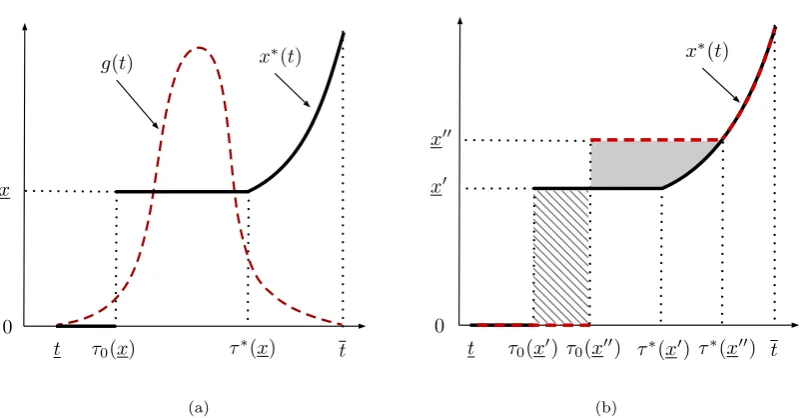
Figure 1. Quality assurance rule.
Before discussing Theorem 1, we introduce some notations. For a given threshold
¯x >0, let τ0(¯x) be the type who is indifferent between choosing 0 and¯x, and let
τ∗(
¯
x) be the type for whom quality ¯
xis the first best, so
u(τ0(
¯
x),
¯
x) = 0 and u(τ∗( ¯
x),
¯
x) = max x u(τ
∗
( ¯
x), x).
Figure 1(a) illustrates a quality assurance rule with threshold
¯x. The set of permitted quality choices is X={0} ∪[
¯
x,∞). The solid line depicts the quality choices of different types between
¯tand ¯t, and the dashed line depicts the density
gof the producer’s type. The types in the left tail of the distribution, t < τ0( ¯
x),
choose quality 0. The types in the right tail of the distribution,t > τ∗( ¯
x), choose their first best qualityx∗(t), where
(3) x∗(t) = arg maxx≥0u(t, x).
The remaining types that sit in the middle, τ0( ¯
x) ≤ t ≤ τ∗(
¯
x), choose the threshold
¯
x as their second-best choice (their first-best choice x∗(t) is unavail-able, as 0< x∗(t)<
¯x, sox
OPTIMAL QUALITY CERTIFICATION 9
To understand the tradeoff that the regulator faces, let us examine what hap-pens as a threshold rises from some
¯
x0 to a greater quality ¯
x00. The effect of this change is illustrated in Figure 1(b). The solid line and the dashed line depict the quality choices of different types before and after the change. The types between
τ0(
¯
x0) and τ0( ¯
x00) reduce their quality choice to x = 0 (in words, they stop pro-ducing). This is a negative effect, shown as the hatched area in Figure 1(b). However, the types betweenτ0(
¯
x00) andτ∗( ¯x
00) increase their quality choice to
¯
x00.
This is a positive effect, shown as the shaded area in Figure 1(b). An optimal threshold balances these two effects.
V. Pass-Fail Certification
A certification rule is calledpass-failif there is a threshold
¯x≥0 such that the consumer is informed whetherx ≥
¯
x (pass) or x <
¯
x (fail). The correspondent delegation set isX={0,
¯
x}. Under this rule, the producer either prefers to meet the threshold and get a “pass”,x=
¯
x, or choose zero quality and get a “fail”. Let us introduce an additional assumption:
(A3) u(t, x∗(¯t))≥0 for all t∈[ ¯t,t¯],
wherex∗(¯t) is the first-best quality for the highest type ¯t, given by (3). In words, any producer type gets a nonnegative payoff when choosing the qualityx∗(¯t) that
is optimal for the highest type (lowest cost) producer,t= ¯t. Intuitively it means that the difference between the highest and lowest costs is small enough, so that what is best for the most efficient producer does not drive the least efficient one out of business. The main motivation for this assumption is that random variable
t∈[
¯t,¯t] captures the regulator’s uncertainty about some unobservable variation in the producer’s cost. This variation is not too large, as otherwise the regulator is likely to observe it and condition the certification rule upon it. For example, a food standards agency might be unable to observe some cost differences between restaurants in the same category, but it will observe these differences between restaurants in different categories, and adjust the optimal certification to take into account the observables.
THEOREM 2: Let (A1), (A2), and (A3) hold, and let g be quasiconcave. Then a pass-fail rule is optimal.
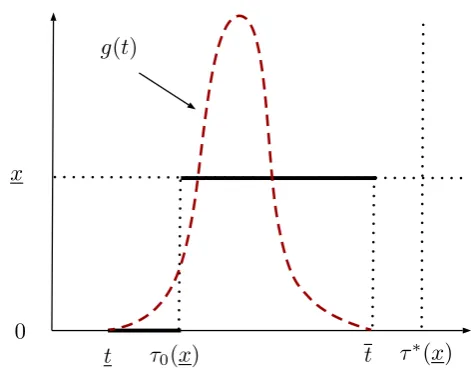
To understand the intuition, let us return to the quality assurance rule with threshold
¯
x shown in Figure 1(a). Suppose that the support of types is now smaller, so ¯t < τ∗(
¯
x), as illustrated in Figure 2. This means that the threshold
¯x is greater than the producer’s first-best choice x
∗(t) for each type t. Even if
qualities strictly above x >
¯
x were permitted, the producer would never choose them, as they are further away from his preferred choice. It is, thus, irrelevant whether choices above
¯
10 ANDRIY ZAPECHELNYUK
0
t t
x
τ0(x) τ∗(x)
[image:11.595.184.420.99.289.2]g(t)
Figure 2. Pass-fail rule.
assurance rule with threshold ¯
xinduces the same producer’s behavior as the pass-fail rule with the same threshold. Assumption (A3) is sufficient for this to be the case when the threshold
¯
xis chosen optimally. The formal proof is in Section VII.
VI. Discussion
The paper focuses on a simple model of certification that illustrates our solution method clearly and concisely. Let us outline the role of the focal assumptions.
The proof of Theorem 1 involves three steps: Representation of the certification problem as a delegation problem with a participation constraint, translation of the delegation problem into an equivalent monotone persuasion problem using Kolotilin and Zapechelnyuk (2019), and solution of the persuasion problem using Kolotilin, Mylovanov and Zapechelnyuk (2019). Let us discuss crucial assump-tions behind each of these steps.
The first step relies on the certifier’s ability to perfectly verify the producer’s quality choice. In fact, we can consider a more general model where the producer’s effort (input) stochastically translates into quality (output). What is important for this step is that input is observable and certifiable. The randomness of the output can be captured by the probability of sale at a given price, the distribution
OPTIMAL QUALITY CERTIFICATION 11
into output, so the producer cannot guarantee to achieve a certain certification rating. Though we do not carry out the formal analysis of this extension of our model, conceptually this is similar. It can be addressed using the same tools and is expected to lead to qualitatively similar results.
The first step also relies on the assumption that certification deterministically maps quality to rating. This is motivated by constraints faced by certification designers in practice. For example, if the rating assignment is deliberately ran-domized, it is difficult to verify if the certifier followed the prescribed randomiza-tion protocol, or if he made an intenrandomiza-tional choice in exchange of a bribe from an interested party. Furthermore, solving a model with general information disclos-ure rules, as in Boleslavsky and Kim (2018), can be more technically challenging. Whether the methodology of Boleslavsky and Kim (2018) can be adapted to solve our certification problem remains an open question.
In the second step, once we have a delegation problem with a participation constraint (that is, the producer can always “opt out” by choosing x = 0), we convert it into to a balanced delegation problem (in which the extreme decisions are included in the delegation set) to apply the equivalence result of Kolotilin and Zapechelnyuk (2019). This conversion relies on Assumption (A2), specifically, that the producer’s payoff eventually becomes negative as her quality decision increases. In essence, this is the condition of diminishing returns, which ensures the existence of an interior solution and which is often assumed in applications.
In the third step, we solve the monotone persuasion problem using an off-the-shelf technique of Kolotilin, Mylovanov and Zapechelnyuk (2019). This technique, as well as methods in Kolotilin et al. (2017), Kolotilin (2018), and Dworczak and Martini (2019), apply to alinear persuasion problemwhere the payoffs depend on the posterior mean state. Our problem is linear under Assumption (A1) that the consumer’s outside option θ has distribution F(θ) = θα, α > 0.7 Relaxing this assumption and addressing a nonlinear persuasion problem remains an avenue for future research.
In our model, the cost of production is fixed: it is independent of the probability of sale. Our solution method can be easily adjusted to a combination of fixed and variable costs. Curiously, in the model where the cost is variable, so the producer’s payoff isp−c(x)/tfrom a unit sold, the consumer surplus is proportional to the producer surplus when the producer chooses the price optimally. That is, the regulator’s and producer’s interests are fully aligned. So, the optimal certification is full disclosure of the quality.
We assume that a representative consumer has a private outside option. This is a standard microfoundation for a downward sloping demand. Other methods of modeling demand can also be considered.
7If we allow for general distributionF, a different way to satisfy the linearity property is to assume
that the regulator’s payoff is a convex combination of the monopolist’s payoff and the probability that the good is sold,F(x). The change of variabley=F(x) makes the regulator’s and monopolist’s marginal payoffs linear inc(F−1(y)), which is what we need to satisfy the linearity of the equivalent persuasion
12 ANDRIY ZAPECHELNYUK
We also assume that the regulator maximizes the consumer surplus. This is justified by the observation that certification is often motivated by consumer pro-tection concerns. However, our analysis can be easily adapted to the maximiza-tion of any weighted average of the producer and consumer surplus. Our results (Theorems 1 and 2) remain unchanged under a slightly stronger assumption that the density of the producer’s type is log-concave, rather than quasiconcave (see Kolotilin, Mylovanov and Zapechelnyuk 2019, Theorem 2).
Finally, there is a variety of interesting and practically relevant ways to enrich the model, such as multiple dimensions of quality and partly na¨ıve consumers, that we leave for future research.
VII. Proofs
Proof of Theorem 1. First, we use the equivalence result of Kolotilin and Zapechelnyuk (2019) (thereafter, KZ) to show that our delegation problem is equivalent to a monotone persuasion problem. Then, we apply the analysis of Kolotilin, Mylovanov and Zapechelnyuk (2019) (thereafter, KMZ) to solve the monotone persuasion problem, thus solving our delegation problem by the fact of their equivalence.
As a preparatory step, we restate our problem as a delegation problem that fits the framework of KZ. Changing the variables y=x1+α and z =G(t), so that z is uniformly distributed on [0,1], the producer’s and regulator’s payoffs become
u(z, y) =Ky−c(y
1/(1+α))
G−1(z) and v(y) =
αK
1 +αy.
Since G−1(z) ≥ G−1(0) =
¯t > 0, multiplying u(z, y) by the positive constant
G−1(z)/K does not change the producer’s objective. Similarly, multiplying v(y) by the positive constant (1 +α)/(αK) does not change the regulator’s objective. We thus obtain the equivalent expressions,
(4) u˜(z, y) =G−1(z)y−c(y1/(1+α))
K and v˜(y) =y.
The marginal payoffs are
(5) ∂u˜(z, y)
∂y =G
−1(z)−b(y) and ∂v˜(y)
∂y = 1,
where
b(y) = c
0(y1/(1+α))y1/(1+α)−1
K(1 +α)
is strictly increasing by (A2).
Observe that, by (A2), there exists a finite number ¯y such that u(z,y¯) <
OPTIMAL QUALITY CERTIFICATION 13
y≥ y¯. Therefore, we can restrict the domain of y to the interval [0,y¯] and con-sider the following delegation problem with the regulator’s and producer’s payoffs given by (4). The regulator chooses a delegation set Y, a closed subset of [0,y¯] that contains 0 and ¯y. The producer observesz, and then choosesy ∈Y to max-imize her expected payoff. Note that y = 0 is included in the delegation set by assumption (becausex= 0 is included, andy=x1+α), and the inclusion ofy= ¯y does not affect the producer’s decisions, as y = 0 is strictly preferred to y = ¯y
for all producer types. We thus have obtained abalanced delegation problem(KZ, Section 2.2).
Consider now the following monotone persuasion problem (KZ, Section 2.3). There are an agent and a principal, whose payoffs uP(y, z) and vP(y, z) depend on an agent’s decision z ∈ [0,1] and a state y ∈ [0,y¯]. The marginal payoffs w.r.t. the decision are given by
(6) ∂uP(y, z)
∂z =b(y)−G
−1(z) and ∂vP(z)
∂z =−1.
The principal chooses a monotone partitional information structure that parti-tions the state space [0,y¯] into convex sets: separating elements and pooling intervals. A monotone partition is described by a set Y ⊂ [0,y¯] of boundary points of its partition elements. Note that Y necessarily includes the extreme points 0 and ¯y.
In this problem, state y is initially unobserved. First, the principal chooses a monotone partition Y. Then the agent observes the partition element that contains the state, and chooses a decisionz∈[0,1] that maximizes his expected payoff given the posterior belief about the state. We say that a monotone partition is optimal if it maximizes the principal’s expected payoff.
The next claim is immediate by KZ’s definition of the equivalence and by The-orem 1 (KZ, Section 3.1).8
CLAIM 2: Set Y ⊂ [0,y¯] such that {0,y¯} ⊂ Y is an optimal delegation set in the balanced delegation problem with marginal payoffs (5) if and only if it is an optimal monotone partition in the monotone persuasion problem with marginal payoffs (6).
So, to find an optimal delegation set, it suffices to solve the monotone persuasion problem with marginal payoffs (6). For that purpose, we use a result from KMZ. First, let us recover the agent’s and principal’s payoffs from (6) by integrating inzwith the initial value condition uP(y,0) =vP(y,0) = 0,9
uP(y, z) =
Z z
0
(b(y)−G−1(z0))dz0 and vP(z) =−z.
14 ANDRIY ZAPECHELNYUK
Next, let us change back the variablet=G−1(z) and define
(7) ω=b(y) =b(x1+α) = c
0(x)
K(1 +α)x1+α.
We will refer toω asstate. Expressing the payoffs in these variables, we have
˜
uP(ω, t) =
Z t
¯t
(ω−t)g(t)dt and v˜P(t) =−G(t).
Let m be the posterior expectation of the state ω given the message from a disclosure rule. As the agent’s payoff ˜uP(ω, t) is linear inω, his expected payoff depends on his posterior belief about the state only through the expected state
m, so
U(m, t) =E[˜uP(ω, t)|m] =
Z t
¯t
(m−t)g(t)dt.
Asg is a positive function,U(m, t) is maximized w.r.t.t att=m, so the agent’s optimal decision ist∗(m) =m.
Let us now derive the principal’s expected payoffV(m) conditional onmwhen the agent behaves optimally:
V(m) =E[˜vP(ω, t∗(m))|m] =−G(t∗(m)) =−G(m).
As we have assumed thatg (the derivative of G) is quasiconcave, it follows that
−V(m) isS-shaped. The following result is immediate by Corollary 1 in KMZ: CLAIM 3: If −V is S-shaped, then an optimal signal is lower-censorship.
So, an optimal disclosure rule is a lower-censorship signal (KMZ, Section 2.2), i.e., there exists a cutoff ω∗ such that ω > ω∗ is disclosed and ω ≤ω∗ is pooled. By (7) and the strict monotonicity of b by (A2), this is the same as disclosing
y if y > b−1(ω∗) and pooling y for all y ≤ b−1(ω∗). Translating this solution
back to the balanced delegation problem, we obtain an optimal delegation set
Y = {0} ∪[b−1(ω∗),y¯]. Recall that adding any decisions above ¯y makes no
difference, since the producer strictly prefers 0 to any y > y¯. Therefore, the set {0} ∪[b−1(ω∗),∞) is also optimal. Finally, changing back the variable x =
y1/(1+α), we obtain an optimal delegation set for the original delegation problem,
X={0} ∪[x∗,∞), wherex∗satisfiesb((x∗)1+α) =ω∗. This is a quality assurance
rule.
Proof of Theorem 2. By Theorem 1, there exists ¯
x ≥ 0 such that X ={0} ∪
[ ¯
x,∞) is a solution to problem (2). Suppose first that
¯
x < x∗(¯t), where x∗(¯t) is the unconstrained optimal choice
for the highest type ¯tgiven by (3). By (A3), all producer types prefer x=x∗(¯t) tox= 0. So, raising the threshold
¯
OPTIMAL QUALITY CERTIFICATION 15
previously chosen quality x < x∗(¯t) to choose x∗(¯t) instead, which is a strict improvement for the regulator. Consequently,
¯
x < x∗(¯t) cannot be optimal.
We thus conclude that ¯
x≥x∗(¯t). Observe that the producer’s preferred quality
x∗(t) is increasing in the type, so x∗(t) ≤ x∗(¯t) ≤
¯
x for all t ∈ [
¯t,¯t]. As the producer’s payoff is strictly quasi-concave inx by (A1) and (A2), each producer type strictly prefers
¯
xto any qualityx >
¯
x, as
¯
xis closer to her preferred choice. It follows that the quality assurance rule with threshold
¯
x≥x∗(¯t) leads to identical choices as the pass-fail rule with the same threshold
¯
x.
REFERENCES
Albano, Gian Luigi, and Alessandro Lizzeri.2001. “Strategic Certification and Provision of Quality.”International Economic Review, 42: 267–283.
Alonso, Ricardo, and Niko Matouschek. 2008. “Optimal Delegation.” Re-view of Economic Studies, 75: 259–293.
Alonso, Ricardo, and Odilon Cˆamara.2016. “Persuading Voters.”American Economic Review, 106: 3590–3605.
Amador, Manuel, and Kyle Bagwell.2013. “The Theory of Optimal Deleg-ation with an ApplicDeleg-ation to Tariff Caps.”Econometrica, 81(4): 1541–1599.
Ben-Porath, Elchanan, Eddie Dekel, and Barton L Lipman.2017. “Dis-closure and Choice.” Review of Economic Studies, 85: 1471–1501.
Boleslavsky, Raphael, and Christopher Cotton.2015. “Grading Standards and Education Quality.”American Economic Journal: Microeconomics, 7: 248– 279.
Boleslavsky, Raphael, and Kyungmin Kim.2018. “Bayesian Persuasion and Moral Hazard.” Mimeo, available at https://dx.doi.org/10.2139/ssrn.2913669.
Chakravarty, Surajeet, and Todd R. Kaplan. 2013. “Optimal Allocation Without Transfer Payments.”Games and Economic Behavior, 77: 1–20.
Condorelli, Daniele. 2012. “What Money Can’t Buy: Efficient Mechanism Design with Costly Signals.”Games and Economic Behavior, 75: 613–624.
DeMarzo, Peter M, Ilan Kremer, and Andrzej Skrzypacz. 2019. “Test Design and Minimum Standards.”American Economic Review, 109: 2173–2207.
Dranove, David, and Ginger Zhe Jin.2010. “Quality Disclosure and Certi-fication: Theory and Practice.” Journal of Economic Literature, 48: 935–63.
Dubey, Pradeep, and John Geanakoplos.2010. “Grading Exams: 100, 99, 98,... or A, B, C?”Games and Economic Behavior, 69(1): 72–94.
Dworczak, Piotr, and Giorgio Martini. 2019. “The Simple Economics of Optimal Persuasion.”Journal of Political Economy, forthcoming.
16 ANDRIY ZAPECHELNYUK
H¨orner, Johannes, and Nicolas S Lambert. 2016. “Motivational Rat-ings.” Cowles Foundation Discussion Paper No. 2035, available at ht-tps://dx.doi.org/10.2139/ssrn.2761405.
Kamenica, Emir, and Matthew Gentzkow. 2011. “Bayesian Persuasion.”
American Economic Review, 101: 2590–2615.
Kolotilin, Anton.2018. “Optimal Information Disclosure: A Linear Program-ming Approach.”Theoretical Economics, 13: 607–636.
Kolotilin, Anton, and Andriy Zapechelnyuk.2019. “Persuasion Meets Del-egation.” Mimeo, available at https://arxiv.org/abs/1902.02628.
Kolotilin, Anton, Tymofiy Mylovanov, and Andriy Zapechelnyuk.2019. “Optimal Persuasion with an Application to Media Censorship.” Discussion Pa-per 1903, School of Economics and Finance, University of St Andrews, available at http://ideas.repec.org/p/san/wpecon/1903.html.
Kolotilin, Anton, Tymofiy Mylovanov, Andriy Zapechelnyuk, and Ming Li. 2017. “Persuasion of a Privately Informed Receiver.” Econometrica, 85: 1949–1964.
Mylovanov, Tymofiy, and Andriy Zapechelnyuk. 2017. “Optimal Alloc-ation with Ex Post VerificAlloc-ation and Limited Penalties.” American Economic Review, 107: 2666–2694.
Rayo, Luis, and Ilya Segal.2010. “Optimal Information Disclosure.”Journal of Political Economy, 118: 949 – 987.
Rodina, David. 2017. “Information Design and Career Concerns.” Mimeo, available at https://cpb-us-e1.wpmucdn.com/sites.northwestern.edu /dist/d/1398/files/2016/09/Rodina JMP-2i1a9uo.pdf.
Shapiro, Carl.1986. “Investment, Moral Hazard, and Occupational Licensing.”
Review of Economic Studies, 53: 843–862.
Zhang, Jun, and Junjie Zhou. 2016. “Information Disclosure in Contests: A Bayesian Persuasion Approach.”The Economic Journal, 126: 2197–2217.