Inhomogeneous Perforated Reflect-Array
Antennas
Mojtaba Moeini-Fard, Mohammad Khalaj-Amirhosseini
Department of Electrical Engineering, Iran University of Science and Technology, Tehran, Iran. Email: {M_Moeinifard, Khalaja}@iust.ac.ir
Received October 15th, 2010; revised February 26th, 2011; accepted February 28th, 2011.
ABSTRACT
A new reflect-array antenna structure is proposed. This structure utilizes a perforated substrate as a reflecting surface with the lattice of different holes. The effective electric permittivity of the dielectric substrate is altered by drilling holes with different diameter and spacing, which provide an in-homogeneous dielectric layer. This in-homogeneous dielectric layer can be controlled by these holes to collimate the reflected waves in the special direction. Absence of resonator elements in this structure will reduce the dielectric and conductor losses, which are the main losses in reflect-array antennas at resonance frequency. In addition, a simple method based on an equivalent circuit model is introduced for designing and analyzing this kind of antennas. Using this method, the suitable values of the diameter and spacing of the holes at each point on the reflecting surface are obtained. Some proposed antennas are designed at millimeter wave frequency and simulated by full-wave analyzer; CST Microwave Studio software to verify theoretical results.
Keywords: Perforated Substrate, Reflect-Array Antenna
1. Introduction
A reflect-array antenna is an array of resonator elements that are placed on a surface and illuminated by a primary feed antenna, which is placed at a particular distance from the array. The reflect-array surface transforms the field radiated by the feed into a phase-coherent beam in a prescribed direction. The focusing effect can be obtained by slightly modifying the shape or size of resonator ele-ments, so that the phase of the reflection coefficient lo-cally changes. Typilo-cally, only one relevant geometrical dimension is modified. Therefore, a basic step in the de-sign of reflect-array antennas is the calculation of the phase diagram, which is the plot of the phase of the re-flection coefficient versus the relevant geometrical di-mension of the element. Due to the quasi-periodicity of the structure, the phase diagram can be calculated under the hypothesis of an infinite periodic array. For a good design of reflect-array antennas, the phase diagram of the selected element should cover a wide phase range, since the focusing effect could require any phase of the reflec-tion coefficient. Microstrip patch antenna is one of the candidates, which used widely as resonator element in the reflect-array antennas. This element has given several configurations of reflect-array, in which, the required phase diagrams are obtained by varying the shape and
per-
mittivity. So, at first the phase response of the infinite substrate versus the variation of the electric permittivity is plotted and modeled with an equivalent circuit. Then, by implementing this phase curve and the effective elec-tric permittivity relation, the proper diameter and spacing of the holes at each element are calculated. Finally, the usefulness of the proposed structure and its performance are verified by two comprehensive examples. These
ex-amples are simulated by the CST Microwave StudioTM
package, which is based on the finite integration tech-nique [9].
2. Analysis of Perforated Substrate
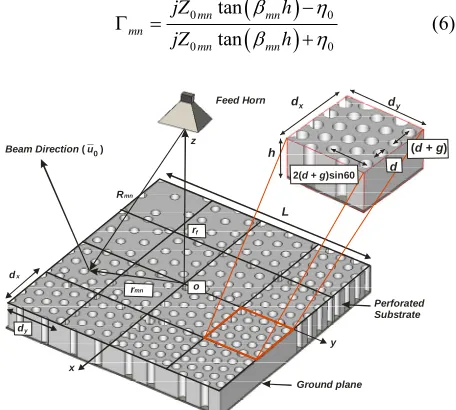
The critical feature of perforated reflect-array implemen-tation is how the individual elements are made to scatter the incident wave with the desired phases. Perforated substrate with variable holes distribution is used to con-trol the reflection phase. In practice, to implement such in-homogeneous substrate, it must be subdivided into small homogeneous elements with uniform holes distri-bution. The geometry of a subdivided perforated sub-strate and the corresponding homogeneous elements are shown in Figure 1. The diameter (d) and spacing (g) of
the holes determines the effective electric permittivity of each element. If the hole diameter and spacing remains less than a half-wavelength, it has been observed that the effective electric permittivity of the substrate will ap-proximately be the volumetric average of the free-space holes and remaining dielectric material [10]. The sub-strate perforation considered is a two-dimensional array of holes in the substrate. Each hole simply consists of removal of the dielectric material down to the ground plane. Within each column, the holes center to center
distance is and column to column center
sepa-ration is
dg
2 dg sin π3 . Finally, the effective electric permittivity can be obtained as follows
2 2
π π
1
2 3 2 3
eff r
d d
d g d g
(1)
where r is the electric permittivity of substrate. This
effective electric permittivity can be varied between 1 and r by changing the holes distribution. By using the
relation (1) each perforated element is replaced by an equivalent dielectric element with electric permittivity of
eff
. Instead of analyzing the perforated element, the
equivalent dielectric element is analyzed by simple transmission line model, and in the next section, after designing and finding the proper values of these effective electric permittivities the suitable holes distributions will be obtained. By assuming the normal incident of electric field, there exist the following boundary conditions at the surface of each equivalent dielectric element [11]
0 2
i
y x
E H Ey (2)
0 2
i
x y
E H Ex (3) ,
x y
E E and Hx,Hy are inner electric and magnetic
fields of dielectric element at , and is the
in-cident field. In these equations, 0
0
z Ei
represents the char-acteristic impedance of the free space. Using these rela-tions, equivalent circuits are obtained from the transmis-sion line analogy as shown in Figure 2. In this figure, the mn-th element, is represented as a short circuit
transmis-sion line, in which the characteristic impedance and propagation constant are expressed as
0 0mn
eff mn
Z
(4)
0
mn k eff mn
(5) where 0 is the propagation constant in the free space.
By considering the Figure 2 the reflection coefficient is
obtained as k
0 0 0 tan tan mn mn mn mn mn jZ h jZ h 0 (6)
Feed Horn
z
Rmn
rmn rf Beam Direction ( )u0
o dx dy L Perforated Substrate Ground plane h
dx dy
x
y
(d + g)
d 2(d + g)sin60
[image:2.595.311.539.343.548.2]L
Figure 1. Total view of the elements arrangement and coor-dinate system for the inhomogeneous perforated reflect- array antenna. 0 Z h Line on transmissi i E 2 0
[image:2.595.339.505.605.692.2]This reflection coefficient represents the exact reflec-tion of the fields on the surface of the mn-th equivalent
dielectric element, in which both reflections from the top layer of dielectric and the conductor plane at the bottom are involved. The reflected field on each element is computed by multiplying the reflection coefficient (mn)
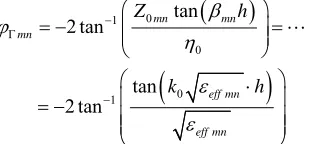
to incident field. From relations (4)-(6) the phase of re-flection coefficient is obtained as
0 1 0 0 1 tan 2 tan tan 2 tan mn mn mn eff mn eff mn Z h k h (7)It is seen from (7) that the phase of reflection coeffi-cient is dependent to the effective electric permittivity
eff
of the element. It is notable, that the phase of reflec-tion coefficient of each element has to cover 360˚ with variation of its effective electric permittivity eff in the
practical range. This fact can be seen in the Figure 3,
which shows a typical phase shift of an element with respect to its effective electric permittivity eff at
oper-ating frequency 30 GHz with thickness h = 3.125 mm. Also, Figure 3 shows that the theoretical calculations
result agree well with the result obtained by CST simula-tion, in which a simple element with variable dielectric constant is simulated with periodic boundary conditions.
It must be noted that, the in-homogeneity of the re-flect-array’s surface was not accounted in the analysis of elements. This assumption would not involve a signifi-cant error at the final results because of the smooth varia-tion of the effective electric permittivities in comparison with wavelength.
Figure 3. Phase of the reflected field for normal incidence versus the electric permittivity.
3. Design of Perforated Reflect-Array
Element
In this section, the designing approach of the perforated reflect-array is introduced. A pencil beam in an arbitrary direction is formed when the phases of the reflection co-efficients on the surface of the elements compensate the phase differences of elements in that direction. As shown in Figure 1, the scattered field from the perforated
sur-face in desired main-beam pointing direction, , will
be in the form of 0
u
0 1 1 0 0 exp M Nmn f mn
m n
mn f mn mn
E u F
jk u j
r rr r r
(8)
where F is the feed pattern function, mn is the
reflec-tion coefficient at the mn-th element position. Terms mn
and
r
f
r are the position vectors of the mn-th element and
the feed horn antenna, respectively. Phase mn is the
required phase of the scattered field from the mn-th
ele-ment. The condition for an array aperture distribution to be co-phase in the desired direction, u0, is given by
0 0 2 π, 0, 1, 2,
mn k Rmn mn p p
r u (9)
where mn is the distance from the feed source to the
mn-th array element, i.e.,
R
mn mn f
R r r . According to
the relation (7), the proper effective electric permittivity of the mn-th element (eff mn) is obtained by equating the
required phase shift mn with the phase of reflection
coefficient mn. The key technique in the design of a
perforated element is how to select the holes distribution to synthesize the element with special effective electric permittivity. By considering the relation (1), there is two degree of freedom to synthesize perforated elements: the holes diameter (d) and spacing (g) between adjacent
holes (as shown in Figure 1). There is a restriction on
selecting the holes diameter by drill machines. So, the perforated elements are synthesized by variable holes spacing with the constant holes diameter. After manipu-lating the relation (1), the required holes spacing of
mn-th element is calculated as follows
π(1 ) 1
2 3( )
r mn
eff mn r
g d
(10)
To design perforated reflect-array element, there is a factor worthy of mention. The element dimensions
x y
d d : at the relation (9) the required phase mn of
mn-th element is determined at the center of the element.
[image:3.595.96.259.188.260.2] [image:3.595.58.288.514.689.2]mechanical restriction by the holes diameter and spacing. Simulation of different element sizes shows that selecting
2
x y
d d is the best choice in constructing
perfo-rated reflect-array at operating frequency 30 GHz.
4. Design Examples
In this section, the performance of perforated reflect- array antenna is verified through presenting some exam-ples at frequency 30 GHz. In these examexam-ples both perfo-rated substrates and equivalent inhomogeneous substrates are simulated and the results are compared with each other. As the total structures of antennas are very large, these examples were modeled and simulated only by CST Microwave Studio (MWS). In this paper, the perfo-rated substrates in all cases are formed by holes drilled into the dielectric material Arlon AR1000 with the
elec-tric permittivity 10, dissipation factor 0.003 and thick-ness 3.125 mm. For the first example, we consider a
0
10 100 mm
L square perforated reflect-array with
a broadside feed and a broadside main beam. The sub-strate is subdivided into 400 elements of equal size of
2 5 mm
x y
d d
100 mm
f
r L
arranged in a lattice of 20 × 20 elements. A linearly polarized pyramidal horn is used for a feed antenna, with its phase center located a
. The holes with diameters d1 mm
are chosen for this example. First, it is interesting to know how much the phase diagram changes with fre-quency. Actually, more frequency bandwidth occurs for reflect-array antenna when the phase curves have small variation toward the central frequency (±45˚) [12]. Fig-ure 4 shows the variation of phase curves for different
frequencies centered at 30 GHz. Based on this plot, bandwidth of the reflect-array element are estimated to be about 7%.
Figure 4. Curves of the reflection phases at different frequencies, to evaluate the element bandwidth.
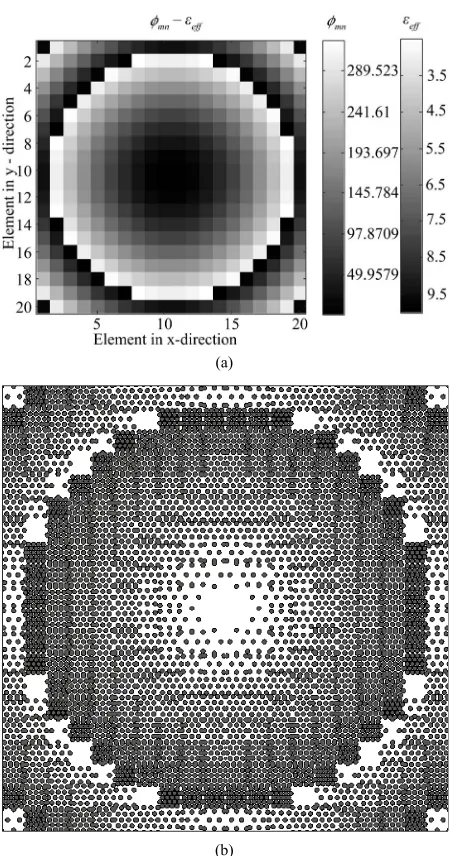
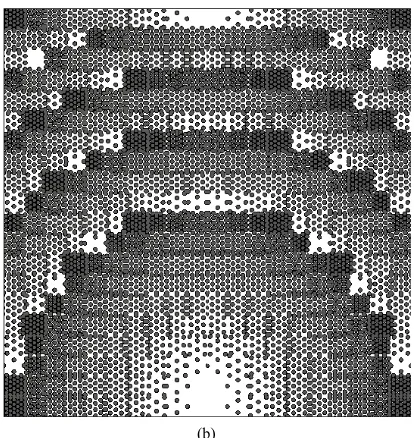
Figure 5(a) shows the required phase shift (mn
deg ) of each element and the corresponding equivalent sub-strate with effective electric permittivity (eff ). Also, theperforated substrate is shown in Figure 5(b); it consists
of 6208 holes which are drilled on the substrate. Each hole simply consists of removal of the dielectric material down to the ground. So, the dielectric mass covers only 51.3% of the perforated substrate, which equals to a solid substrate with same surface and 1.6 mm thickness. This reduction of dielectric mass causes the lower dielectric loss, which is more significant at millimeter wave fre-quencies [13].
(a)
[image:4.595.311.536.241.669.2](b)
Figure 5. The design processes of broadside perforated re-flect-array. (a) The required phase shifts of elements and corresponding eff values; (b) The geometry of the
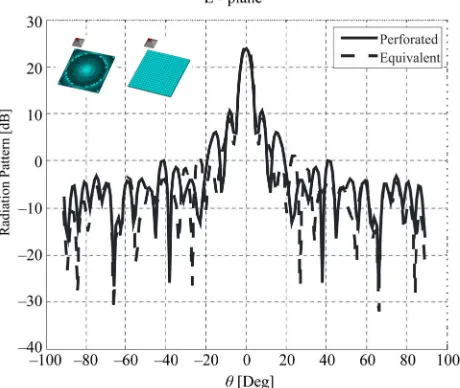
[image:4.595.59.286.516.691.2]Simulated structures beside the E-plane patterns of these antennas are shown in Figure 6. Note that the
beams are broadside, and the maximum directivity of perforated and equivalent structures are 26.9 dB, 27.48 dB, respectively. The H-plane patterns are shown in Figure 7.
The directivity of the reflect-array is defined as the ratio of the scattered intensity in the main beam direction from the reflect-array to the scattered intensity averaged over all directions. Figure 8 shows the simulated directivities
[image:5.595.58.288.252.446.2]against frequency. The 1-dB directivity bandwidths of the perforated and equivalent structures are 15.5%, 16.4%, respectively.
[image:5.595.308.537.320.498.2]Figure 6. E-plane radiation patterns of broadside perfo-rated and equivalent reflect-array.
Figure 7. H-plane radiation patterns of broadside perfo-rated and equivalent reflect-array.
To avoid the horn blockage, the reflected beam must be directed out of broadside. So, another example with the 25˚ off broadside beam direction was designed. This reflect-array consists of a square perforated substrate with dimension L100100 mm. The substrate is Arlon AR1000 with electric permittivity r 10, loss
tangent of 0.0037 and thickness 3.125 mm. It is subdi-vided into 400 elements of equal size of dx dy 2
5 mm
arranged in a lattice of 20 × 20 elements. A
linearly polarized pyramidal horn is used for a feed
an-tenna, with its phase center located at .
The holes diameter is
100 rf L mm 1 mm
d . The required phase
shift, effective electric permittivity of elements and the corresponding perforated substrate are shown in Figure 9.
[image:5.595.58.285.494.692.2]It consists of 7376 holes, which shows that only 42.06% of the perforated substrate is covered by dielectric mate-rial. This reduction of the volumetric dielectric mass will reduce the total dielectric loses.
Figure 8. Directivity variations against frequency for broadside perforated and equivalent reflect-array.
[image:5.595.313.537.547.715.2](b)
Figure 9. The design processes of 25˚ off broadside perfo-rated reflect-array. (a) The required phase shifts of elements and corresponding eff values; (b) The geometry of the
designed perforated substrate.
Figure 10 shows the patterns on the E-plane. Note that
h
[image:6.595.313.533.87.260.2] [image:6.595.57.286.489.686.2]t e beams are 25˚ off broadside, and they achieve peak gain of 24.2 dB and 25.4 dB for perforated and equiva-lent substrates, respectively.
Figure 11 shows the directivity variations with
fre-quency for both perforated and equivalent substrates. The corresponding 1-dB directivity bandwidths are 9.6%, 10.3%, respectively.
Figure 10. E-plane radiation patterns of 25˚ off broadside perforated and equivalent reflect-array.
Figure 11. Directivity variations against frequency for 2
5. Conclusions
structure was presented, which
con-REFERENCES
[1] N. Misran, R. “Reflection Phase
5˚ off broadside perforated and equivalent reflect-array.
A new reflect-array
sist of a perforated substrate with lattice of holes and a feed antenna. Perforated substrate with variable holes distribution was used to control the reflection phase. In the designing section, instead of analyzing the perforated element, the equivalent dielectric element was analyzed by a simple transmission line model, which has the dis-tinct advantages of simplicity and rapidity in designing of such antennas. Then, after designing and finding the proper value of the effective electric permittivity for each element, the suitable holes distribution was obtained. Finally, the performance of proposed antenna was veri-fied through presenting two examples at 30 GHz fre-quency.
Cahill and V. F. Fusco,
Response of Microstrip Stacked Ring Elements,” Elec-tronics Letters, Vol. 38, No. 8, April 2002, pp. 356-357.
doi:10.1049/el:20020257
[2] F.-C. E. Tasi and M. E. Bialkowski, “Design a
P.2003.818001
161-Element Ku-Band Microstrip Reflectarray of Vari-able Size Patches Using an Equivalent Unit Cell Wave-guide Approach,” IEEE Transactions on Antennas and Propagation, October 2003, Vol. 51, No. 10, pp. 2953-2962.
doi:10.1109/TA
d H. Legay, “Broadband [3] M. R. Chaharmir, J. Shaker an
Design of a Single Layer Large Reflectarray Using Multi Cross Loop Elements,” IEEE Transactions on Antennas and Propagation, Vol. 57, No. 10, October 2009, pp. 3363-3366. doi:10.1109/TAP.2009.2029600
Ap-plications,” IEEE Transactions on Antennas and Propa-gation, Vol. 54, No. 10, 2006, pp. 2827-2837.
doi:10.1109/TAP.2006.882172
[5] M. E. Bialkowski and K. H. Sayidmarie, “Investigations into Phase Characteristics of a Single-Layer Reflectarray Employing Patch or Ring Elements of Variable Size,” IEEE Transactions on Antennas and Propagation, Vol. 56, No. 11, November 2008, pp. 3366-3372.
doi:10.1109/TAP.2008.2005470
[6] M. H. Jamaluddin, R. Gillard, R. Sauleau, P. Dumon and L. Le Coq, “Reflectarray Element Based on Strip-Loaded Dielectric Resonator Antenna,” Electronics Letters, Vol. 44, No. 11, May 2008, pp. 664-665.
doi:10.1049/el:20080346
[7] M. G. Keller, J. Shaker, A. Petosa, A. Ittipiboon, M. Cu-haci and Y. M. M. Antar, “A Ka-Band Dielectric Reso-nator Antenna Reflectarray,” Proceedings of 30th Euro-pean Microwave Conference, Paris, 3-5 October 2000, pp. 272-275. doi:10.1109/EUMA.2000.338713
[8] S. H. Zainud-Deen, Abd-Elhady, A. A. Mitkees and A. A
Science Conference, New Cairo, 17-19 March 2009, pp.
In-tor
. Kishk, “Design of Dielectric Resonator Reflectarray Us-ing Full-Wave Analysis,” Proceedings ofNational Radio
1-9.
[9] CST-Microwave Studio, “User’s Manual,” ®4, 2002. [10] R. Chair, A. A. Kishk and K. F. Lee, ”Experimental vestigation for Wideband Perforated Dielectric Resona Antenna,” Electronics Letters, Vol. 42, No. 3, February 2006, pp. 137-139. doi:10.1049/el:20063987
[11] M. Khalaj-Amirhosseini, “Analysis of Lossy Inhomoge-neous Planar Layers Using Taylor’s Series Expansion,” IEEE Transactions on Antennas and Propagation, Vol. 54, No. 1, January 2006, pp. 130-135.
doi:10.1109/TAP.2005.861577
[12] M. Bozzi, S. Germani and L. Perregri Comparison of Different Elemen
ni, “Performance t Shapes Used in Printed Reflectarrays,” IEEE Antennas and Wireless Propagation Letters, Vol. 2, No. 14, 2003, pp. 219-222.
doi:10.1109/LAWP.2003.819687
[13] D. M. Pozar, S. D. Targonski and H. D. Syri