J. Range Manage.
56:255-259 May 2003
Consumption and dispersion of mesquite seeds by rumi- nants
CHARLES L. KNEUPER, CODY B. SCOTT, AND WILLIAM E. PINCHAK
Authors are former Graduate Assistant, Associate Professor, Department of Agriculture, Angelo State University, San Angelo, Tex; Professor, Texas Agricultural Experiment Station, Vernon, Tex.
Abstract
Consumption of mesquite (Prosopis glandulosa Torr. var glan- dulosa) fruit by ruminants is an important component of seed dispersal. Two experiments were conducted to estimate the role of livestock and wildlife in the dispersion of mesquite fruit. In Experiment 1, 3 trials were conducted to determine preference for mesquite fruit by different species of livestock, intake relative to fruit maturity, and seed survival of digestion. Cattle, sheep, and goats were offered immature (IM), mature off the tree (MT), or mature off the ground (MG) fruit to quantify intake and seed survival of digestion. Germination of seeds surviving digestion was also assessed. Experiment 2 assessed rate of pod disappear- ance from pastures with and without livestock grazing and attempted to quantify seed loss to wildlife. In Experiment 1, live- stock consumed more (P < 0.05) mature than immature fruit;
sheep and goats consumed more fruit than cattle on a body weight basis. Seed survival was greater (P < 0.05) from cattle than from sheep or goats. The number of seeds remaining intact after digestion was greater for mature fruit. Germination of seeds surviving digestion was similar (P > 0.05) to seeds that experienced natural weathering for 6 months. In Experiment 2, the presence or absence of livestock did not affect the disappear- ance of seeds; seeds disappeared from the ground within 3 weeks in 1999 and 5 weeks in 2000 presumably by wildlife. Deer, rac- coons, skunks, bobcats, turkeys, and other birds visited plots with fresh mesquite fruit. Collectively, these results suggest that cattle readily consume and disperse viable mesquite seeds; sheep and goat consumption of mesquite fruit may reduce the number of viable seeds; and mesquite fruit may only remain on the ground for a short period of time even without livestock grazing because of consumption by wildlife.
Key Words: Prosopis, germination, digestion, fecal dispersal, phe- nology, encroachment
Across Texas, an ever-increasing density of mesquite (Prosopis glandulosa Ton. var. glandulosa) has reduced herbaceous pro- duction on rangelands (Bedunah and Sosebee 1984, Cuda and DeLoach 1998). Mesquite infests about 22 million ha of range- land in Texas (Jacoby et al. 1990a), and control of mesquite is a major concern for ranchers (Ueckert 1974, Heitschmidt and Dowhower 1991). Herbicide application is the most common method for controlling large areas of mesquite, but most treat-
Research was funded by USDA NRI program as grant number 98-35315-6045.
Manuscript accepted 8 Aug. 2002.
Resumen
El consumo de los frutos del mezquite (Prosopis glandulosa Torr. var glandulosa) por los rumiantes es un componente com- ponente de la dispersion de semilla. Se condujeron dos experi- mentos para estimar el papel del ganado domestico y la fauna sil- vestre en la dispersion de frutos de "Mesquite". En el experi- mento 1 se realizaron 3 ensayos para determinar la preferencia del fruto de "Mesquite" por diferentes especies de ganado, el consumo en relacion a la madurez del fruto y la sobrevivencia de la a la digestion. A bovinos, caprinos y ovinos se les ofrecio frutos inmaduros (IM), frutos maduros tornados del arbol (MT) y frutos maduros tomados del suelo (MG) para cuantificar el consumo y sobrevivencia a la digestion. El experimento 2 evaluo la tasa de desaparicion de vainas de potreros con y sin apacen- tamiento de ganado y se intento cuantificar la perdida de semilla para la fauna silvestre. En el experimento 1 el ganado consumio mas frutos maduros que inmaduros (P < 0.05), los caprinos y ovi- nos consumieron mas frutos que los bovinos, esto expresado en base al peso corporal. La sobrvivencia de la semilla fue mayor (P
< 0.05) en los bovinos que en los ovinos o caprinos. El numero de semillas que permanecieron intactas despues de la digestion fue mayor en los frutos maduros. La germinacion de las semillas sobrevivientes a la digestion fue similar (P > 0.05) a la de semillas expuestas a intemperizacion natural por 6 meses. En el experi- mento 2 la presencia o ausencia de ganado domestico no afecto la tasa de desaparicion de semillas, las semillas desaparecieron del suelo en 3 semanas en 1999 y en 5 semanas en el 2000, esto pre- sumiblemente por efecto de la fauna. Venados, mapaches, zorril- los, pumas, pavos y otras ayes visitaron las parcelas con frutos frescos de "Mesquite". Estos resultados sugieren que el ganado bovino si consume y dispersa semillas viables de "Mesquite", el consumo de frutos de "Mesquite" por ovinos y caprinos puede reducir el numero de semillas viables y el fruto del "Mesquite"
puede permanecer en el suelo solo por un periodo corto de tiem- po, aun sin apacentamiento de ganado, debido al consumo de este por la fauna silvestre.
ments only last for a few years (e.g., 5-10) because some mesquite trees resprout after herbicide treatment and seedlings readily establish (Jacoby et al. 1982,1990b, Teague et al. 1997).
Encroachment and reinvasion of mesquite into grasslands is accelerated by livestock consuming and then dispersing seeds (Gibbens et al. 1992, Lerner and Peinetti 1996, Kramp et al.
1998). Mesquite produces a seed pod with 10-20 seeds/pod depending on growing conditions. Seeds are encapsulated in a hard coat that must be scarified before rapid germination will
JOURNAL OF RANGE MANAGEMENT 56(3) May 2003 255
occur; passage of seeds through the ruminant digestive tract apparently enhances seed ger- mination potential (Scifres and Brock 1969, 1972, Cuda and DeLoach 1998), and live- stock are a likely primary dispersal vector for mesquite (Kramp et al. 1998).
Little information is available on when livestock consume mesquite fruit relative to fruit maturity and on seed survival from different stages of fruit maturity. The rela- tive importance of animals as dispersal agents of mesquite seeds may depend on intake patterns relative to seed availability and maturity (Kramp et al. 1998). This study quantified intake and survival of digestion of mesquite seeds from different stages of fruit maturity by 3 species of livestock. In addition, we identified disap- pearance rate of fruit from pastures with and without the presence of livestock, and we attempted to identify other species that may consume and disperse mesquite fruit.
Methods
This research was conducted at the Angelo State University Management, Instruction, and Research (MIR) Center located in the Rolling Plains region of Texas, 9.7 km north of San Angelo, Tex (30°N, 100°W). Five freshly weaned Angus/Beefmaster crossbred steers (5 months-old, weight 250 kg), 5 castrated Ramboullet sheep (4 months-old, weight 40 kg), and 5 castrated Boer/Spanish goats (3 months-old, weight 25 kg) were placed in individual pens and offered current growing season mesquite fruit from differ- ent stages of maturity on a daily basis.
Sheep and goats were placed in 1.5 x 1.5 m metabolism stalls to facilitate fecal col- lections for Experiment 1. Steers were individually placed in 4 x 7 m pens and fecal collection bags were attached to the steers. Fecal bags were emptied twice daily because of the volume of feces pro- duced. Fecal samples for each steer were combined to estimate daily fecal produc- tion/animal. All animals were fed (1.5%
BW) an alfalfa hay/concentrate basal ration (CP% 12.3, TDN 61%, DE 2.7 mcal kg-') to meet maintenance requirements (NRC 1981, 1984, 1996). Fresh water and a calcium/phosphorus mineral with trace elements were provided ad libitum. All animals were housed in the same open-air research facility under similar environ- mental conditions.
Experiment 1
To assess intake of mesquite fruit from different stages of maturity, fruit was col- lected daily from several randomly select- ed trees on the MIR Center. Fruit was arbi- trarily categorized as immature attached to the tree (IM), mature attached to the tree (MT), and mature on the ground (MG).
Immature fruit was identified as green pods with seeds that appeared underdevel- oped. Mature attached to the tree (MT) were pods that were beginning to change from the immature green color to a mature red-brown color. The fruit was filled out and seeds appeared fully developed.
Mature on the ground (MG) represented the mature fruit that had completely changed to the red-brown color and had recently fallen to the ground. Any fruit that appeared mature and fell to the ground during harvesting was classified as MG.
Intake of 3 classes of mesquite fruit was determined in Trial 1. Livestock (cattle, sheep, and goats) were fed a single class of mesquite fruit (0.5% BW) at 0800 hours each morning for 10 min over 7
days. Feeding level was based on the amount of beans consumed in a similar feeding trial (Kneuper and Scott 1998).
The trial was divided into 3 phases. In the first 7 days, individual steers, sheep, and goats were fed IM fruit. Phase 2 consisted of feeding MT fruit. Mature on the ground fruit was fed during phase 3. Refusals were weighed to determine intake of each class of fruit. After each class of fruit was fed individually, all 3 stages of fruit devel- opment were fed simultaneously in sepa- rate containers to quantify preference.
Individuals were offered a choice between fruit classes for 10 min each day for 7 days. If fruits from any maturity stage were completely consumed during the preference trial, all remaining fruit was removed immediately.
In Trial 2, the percent of intact seeds in feces from different stages of maturity was determined by feeding seeds and collect- ing feces. Each stage of seed maturity was fed once and total fecal collections were utilized to recover seeds for 4 days there- after. Before feeding seeds from a particu- lar maturity stage, a 5-day rest period was used to ensure any seeds already in an individual's digestive system had passed.
Other studies have shown that seeds will pass up to 4 days post-ingestion (Armke and Scott 1999). The number of seeds fed was based on feeding 0.1% BW of fruit to an animal. This level was sufficient for seed recovery in feces in a previous study (Kneuper and Scott 1998). Before feeding
each stage, representative samples of each stage were weighed and the number of seeds were counted. The average number of seeds fed was used to calculate the per- cent of intact seeds surviving digestion.
Feces were collected twice daily for cat- tle and once daily for sheep and goats, and
total fecal weight was recorded.
Subsamples were taken to estimate the number of seeds surviving digestion. Fecal subsamples were washed through a series of screens and seeds were separated; whole seeds that were found, with or without an exocarp, constituted survival of digestion.
In Trial 3, germination was determined for seeds that had remained on the ground and weathered for 6 months, unweathered seeds, and for MT and MG seeds collected from cattle, sheep, and goat feces from Trial 2. One hundred and twenty seeds were used in the study, l5 seeds from each treatment. Immature seeds (IM) were excluded from this trial because few were
collected from feces. Seeds from the ground that had weathered were kept in cages to prevent loss to herbivory.
Seeds that were sealed in dry containers and stored in the laboratory were included in the trial as an unweathered control. One half of the unweathered seeds were dis- sected and the exocarp was removed to assess seed germination without the pres- ence of the exocarp. All seeds were stored at 5 °C from time of collection until initia- tion of the germination test.
Fifteen seeds of each treatment were placed between sheets of moistened filter paper in petri dishes, with 5 seeds/dish.
Samples were placed in na oven set at 30°C (Scifres and Brock 1969, 1972). Seeds were checked daily for germination for 21 days.
Once seeds germinated, they were removed from the petri dishes. Filter paper was moistened as needed to maintain imbibition.
Experiment 2
This study was conducted for 2 years. In 1999, we determined the length of time that fruit remained on the ground. Ten mature Angus cows, 40 Rambouillet ewes, and 50 Boer-Spanish cross nannies were placed in separate 30 ha pastures at a stock density of
1AU/10 ha. One additional pasture was ungrazed by livestock. Each pasture was dominated by an overstory of mesquite and an understory of sideoats grama (Bouteloua curtipendula (Michx.) Torr.), buffalograss (Buchloe dactyloides (Nutt.) Engelm.), threeawns (Aristida sp.
L), and K.R. bluestem (Bothriochloa
ischaemum L.). In each pasture, 2 tran-
sects 250 m in length were randomly
established with six, 0.33 m2 plots at 50 m spacings on each transect. Twenty-five mesquite pods were placed in each plot and monitored weekly for 4 weeks to determine disappearance rates of fruit.
There were only 4 pastures available for this experiment. Thus, class of livestock as a treatment effect was not replicated.
In 2000, the rate of fruit disappearance and consumption of mesquite fruit by other animal species was assessed.
Sixteen, 1-m diameter plots containing 20 fresh mature mesquite pods each were placed throughout the MIR Center. Plots were placed adjacent to existing dirt roads, 0.5 km apart, and 20 m from the edge of the road. The pathway was systematically chosen to represent all of the major vege- tation types on the MIR Center. Crushed lime was evenly spread across the plot on every third plot (n = 5 plots). The crushed lime was checked daily for 2 consecutive days to identify tracks of animals visiting the mesquite pod plots (Woods 1959).
Statistical analysis
For Experiment 1, Trial
1(intake and preference of maturity classes) and Trial 2 (seed survival), data were analyzed using analysis of variance for repeated measures (Hicks 1993). Stage of maturity and species of livestock were the main effects, and day of data collection was the repeat- ed measure. Individual animals served as replications nested within species of live- stock and maturity class. Differences in germination were assessed in Trial 3 using analysis of variance with replications (petri dishes) nested within livestock species and maturity class of seeds.
Differences among means were separated using a least significant difference when P
< 0.05 (Gomez and Gomez 1984). Data was analyzed using the statistical comput- er package JMP (SAS 1994).
For Experiment 2, average disappear- ance rate of fruit was calculated. The per- cent of visitation by different species of wildlife was also calculated in 2000.
Traditional statistical comparisons were not appropriate for Experiment 2 because treatment effect was not replicated and because the experimental protocol differed between years.
Results
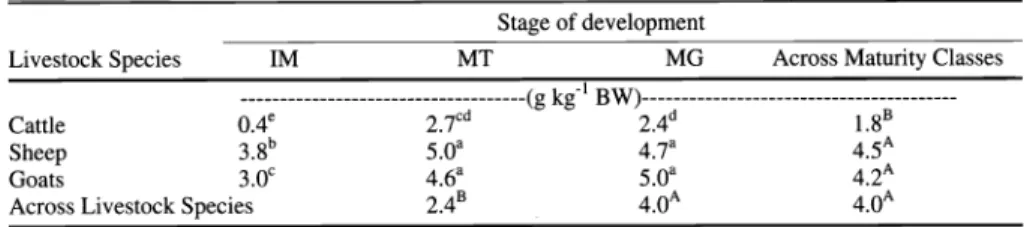
Table 1. Intake (g kg'1 BW) of 3 maturity classes of mesquite fruit by 3 species of livestock.
Livestock were offered 0.5% BW of each maturity class singly for 10 min daily for 7 days to determine intake.
Stage of development
Livestock Species IM MT Maturity Classes
---(g kg
1BW)---
Cattle 0.4e 2 7ca
Sheep 3.8b S.Oa
Goats 3.Oc 4.6a
Across Livestock Species 2.4B 4.OA
a
eValues within columns and rows with different superscripts differ (P < 0.05).
A-Values for different stages of fruit maturity or for different classes of livestock with different superscripts differ (P <
0.05).
in a significant (P < 0.05) class of live- stock by stage of maturity interaction (Table 1). All 3 classes of livestock ate less immature fruit. However, sheep con- sumed more immature attached to tree (IM) fruit than goats which consumed more IM than cattle. Sheep and goats also consumed more mature attached to tree (MT) and mature on ground (MG) fruit than cattle on a body weight basis. When comparing intake of the 2 mature stages of fruit (MT and MG), there were no differ- ences across species of livestock. Intake was similar across days of collection.
When livestock were offered a choice of the 3 maturity stages of fruit, cattle, sheep, and goats ate no immature fruit. Intake of MT and MG was similar among all 3 species of livestock (P > 0.05; 0.2 vs. 0.2 g kg1 BW).
Experiment 1, Trials 2 and 3
We were unable to estimate seed sur- vival of IM fruit for cattle because they ate few IM fruits in Trial 1. Roughly equal proportions of seeds were retrieved from feces in each of the first 3 days for each animal species and maturity class (data not shown). There was almost no survival of
Table 2. The percent (%) of each maturity class of seed that was found intact in the feces of 3 species of livestock. The percent of intact seeds in feces was determined by feed- ing each maturity class of fruit separately (0.1% BW) and separating seeds from feces for 4 days.
seeds from IM and MT fruit among sheep and goats (Table 2). Survival of MT and MG seeds was greater after passing through cattle than through sheep or goats (Table 2). Twenty-two percent of MT seeds and 92% of MG seeds survived cat- tle digestion (Table 2). Sheep and goats had a lower (P < 0.05) survival rate of mature seeds than cattle with less than 12% of the seeds surviving. Seed survival was similar between species and stage of maturity for sheep and goats.
In Trial 3, germination rates were simi- lar among seeds that survived digestion in cattle and sheep and for seeds that had weathered on the ground (Table 3). No seeds with the exocarp intact or seeds that
Table 3. Percent (%) of seeds that germinated after undergoing digestion or weathering.
Unweathered seeds were included as a con-
trol. Percent germination represents the number of seeds from each treatment that germinated.
Treatment Germination
(%) Unweathered (with exocarp) 0.0 Dissected (without exocarp) 26.7
Weathered 13.3
Cattle MT 0.0
Cattle MG 13.3
Sheep MG 13.3
Goats MG 0.0
Germination of MT seeds for sheep and goats were not assessed because of the low survival rate.
passed through goats germinated.
Stage of development
Livestock Species IM MT MG
---(%)---
Cattle -- 22.1b 92.3a
Sheep 0.3c 0.8° 11.3
Goats 0.Oc 0.Oc 9.2c
Experiment 1, Trial 1 a Survival of IM was not determined for cattle.
Intake of mesquite fruit differed by class Values within columns and rows with different super-
of livestock and stage of maturity resulting scripts differ (P < 0.05).
Experiment 2
In 1999, 96% of the mesquite fruit placed in plots had disappeared from each pasture after
1week, regardless of the livestock species or absence of livestock (data not shown), indicating that both live- stock and wildlife were eating the pods. In 2000, some mesquite pods remained on the ground for up to 6 weeks, but few seeds remained after week 4 (Table 4).
JOURNAL OF RANGE MANAGEMENT 56(3) May 2003 257
Table 4. Percent (%) of mesquite pods remain- ing on the ground each week without the presence of livestock grazing in 2000.
Week Remaining SEM
(%)
1