213
An Analysis of Source-Side Grammatical Errors in NMT
Antonios Anastasopoulos Language Technologies Institute
Carnegie Mellon University [email protected]
Abstract
The quality of Neural Machine Translation (NMT) has been shown to significantly de-grade when confronted with source-side noise. We present the first large-scale study of state-of-the-art English-to-German NMT on real grammatical noise, by evaluating on sev-eral Grammar Correction corpora. We present methods for evaluating NMT robustness with-out true references, and we use them for
ex-tensive analysis of the effects that different
grammatical errors have on the NMT output. We also introduce a technique for visualizing the divergence distribution caused by a source-side error, which allows for additional insights.
1 Introduction
Neural Machine Translation (NMT) has become the de facto option for industrial systems in high-resource settings (Wu et al., 2016; Has-san Awadalla et al., 2018; Crego et al., 2016) while dominating public benchmarks (Bojar et al., 2018). However, as several works have shown, it has a notable shortcoming (among others, see Koehn and Knowles (2017) for relevant discus-sion) in dealing with source-side noise, during both training and inference.
Heigold et al. (2018) as well as Belinkov and Bisk(2018) pointed out the degraded performance of character- and subword-level NMT models when confronted with synthetic character-level noise –like swaps and scrambling– on French, German, and Czech to English MT.Belinkov and Bisk(2018) and Cheng et al. (2018) also studied synthetic errors from word swaps extracted from Wikipedia edits.Anastasopoulos et al.(2019) fo-cused on a small subset of grammatical errors (ar-ticle, preposition, noun number, and subject-verb agreement) and evaluated on English-to-Spanish synthetic and natural data.
However, no previous work has extensively studied the behavior of a state-of-the-art (SOTA) model on natural occurring data. Belinkov and Bisk (2018) only trained their systems on about 200K parallel instances, while Heigold et al. (2018) and Anastasopoulos et al. (2019) trained on about 2M parallel sentences from the WMT’16 data. Importantly, though, none of them utilized vast monolingual resources through back-translation, a technique that has been consistently shown to lead to impressively better results (Sen-nrich et al.,2016a).
In this work, we perform an extensive analysis of the performance of a state-of-the-art English-German NMT system, with regards to its robust-ness against real grammatical noise. We propose a method for robustness evaluation without gold-standard translation references, and perform ex-periments and extensive analysis on all available English Grammar Error Correction (GEC) cor-pora. Finally, we introduce a visualization tech-nique for performing further analysis.
2 Data and Experimental Settings
To our knowledge, there are six publicly available corpora of non-native or erroneous English that are annotated with corrections and which have been widely used for research in GEC.
The NUS Corpus of Learner English (NUCLE) contains essays written by students at the National University of Singapore (Dahlmeier et al.,2013). It has become the main benchmark for GEC, as it was used in the CoNLL GEC Shared Tasks (Ng et al., 2013, 2014). The Cambridge Learner Cor-pus First Certificate in English FCE corCor-pus1 (Yan-nakoudakis et al., 2011) consists of essays col-lected from learners taking the Cambridge Assess-ment’s English as a Second or Other Language
(ESOL) exams.2 The Lang-8 corpus (Tajiri et al.,
2012) was harvested from user-provided correc-tions in an online learner forum. Both have also been widely used for the GEC Shared Tasks. An-other small corpus developed for evaluation pur-poses is the JHU FLuency-Extended GUG corpus (JFLEG) (Napoles et al.,2017) with correction an-notations that include extended fluency edits rather than just minimal grammatical ones. The Cam-bridge English Write & Improve (W&I) corpus (Andersen et al.,2013) is collected from an online platform where English learners submit text and professional annotators correct them, also assign-ing a CEFR level of proficiency (of Europe. Coun-cil for Cultural Co-operation. Education Commit-tee. Modern Languages Division, 2001). Lastly, we use a portion of the LOCNESS corpus,3a col-lection of essays written bynativeEnglish speak-ers. 50 essays from LOCNESS were annotated by W&I annotators for grammatical errors, so we will jointly refer to these two corpora as WI+loc.
All datasets were consistently annotated for er-rors with ERRANT (Bryant et al.,2017), an auto-matic tool that categorizes correction edits.3 This allows us to consistently aggregate results and analysis across all datasets.
2.1 Notation and Experimental Settings
Throughout this work, we use the following nota-tions:
• x: the original, noisy, potentially ungrammat-ical English sentence. Its tokens will be de-noted asxi.
• x˜: the English sentence with the correction annotations applied to the original sentence x, which is deemed fluent and grammatical. Again, its tokens will be denoted as ˜xi.
• y: the output of the NMT system when xis provided as input (tokens:yj).
• y˜: the output of the NMT system when ˜xis provided as input (tokens: ˜yj).
For the sake of readability, we use the terms grammatical errors, noise, or edits interchange-ably. In the context of this work, they will all denote the annotated grammatical errors in the source sentences (x). We also define the number of errors, or the amount of noise in the source, to
2https://www.cambridgeenglish.org/ 3
nucle, Lang8,fce, and WI+locare pre-annotated with
ERRANT for theBEA 2019 GEC Shared Task. We also an-notatedjfleg.
be equivalent to the number of annotated neces-sary edits that the sourcexrequires to be deemed grammatical (˜x), as per standard GEC literature.
The main focus of our work is the performance analysis of the NMT system, so our experimental design is fairly simple. We use the SOTA NMT system ofEdunov et al.(2018) for translating both the original and the corrected English sentences for all our GEC corpora.4 The system achieved the best performance in the WMT 2018 evalua-tion campaign, using an ensemble of 6 deep trans-former models trained with slightly different back-translated data.5
3 Evaluating NMT Robustness without References
When not using human judgments on output flu-ency and adequacy, Machine Translation is typ-ically evaluated against gold-standard reference translations with automated metrics like BLEU (Papineni et al.,2002) or METEOR (Banerjee and Lavie, 2005). However, in the case of GEC cor-pora, we do not have access to translations – only monolingual data (potentially with ungrammati-calities) and correction annotations.6 Quality Es-timation for MT also operates in a reference-less setting (seeSpecia et al.(2018) for definitions and an overview of the field) and is hence very related to our work, but is more aimed towards towards predictingthe quality of the translation. Our goal instead, is to analyze the behavior of the MT sys-tem when confronted with ungrammatical input. Reference-less evaluation has also been proposed for text simplification (Martin et al., 2018) and GEC (Napoles et al., 2016), while the grammat-icality of MT systems’ outputs has been evaluated with target-side contrastive pairs (Sennrich,2017). In this work, the core of our evaluation of a sys-tem’s robustness lies in the following observation:
a perfectly robust-to-noise MT system would produce the exact same output for the clean and erroneous versions of the same input sentence.
4We use all data, concatenating train, dev, and test splits.
We sample 150K sentences from Lang8.
5Refer to (Edunov et al.,2018) for further system details. 6The ideal way to potentially obtain such references of
Denoting a perfect MT system as a func-tion MTper f ect(·) over input sentences to the cor-rect output sentences ˆy, then both input sen-tencesxand ˜xwould yield the same output:
ˆ
y=MTper f ect(x)=MTper f ect(˜x).
In our case, ˆy is unknown and we only have access to a very good (but still imperfect) sys-tem MTactual(·). We propose, therefore, to treat the system’s output of the cleaned input (˜y) as refer-ence. Our assumption is that ˜yis a good approxi-mation of the correct translation ˆy:
ˆ
y≈MTactual(˜x)=y˜.
Under this assumption, we can now evaluate our system’s robustness by comparing y and ˜y using automated metrics at the corpus or sentence level. Here we list the metrics that we use and briefly discuss their potential shortcomings.
Robustness Percentage (RB): Given a GEC corpus {X,X˜}, this corpus-level metric evaluates the percentage at which the system outputs agree at the sentence level:
RB= P
x,x˜∈{X,X˜}cagree(MT(x),MT(˜x))
|X| ,
cagree(y,y˜)=
1 ify=y˜, 0 otherwise.
f-BLEU: BLEU is the most standard MT evalu-ation metric, combining n-gram overlap accuracy with a brevity penalty. We calculate sentence- and corpus-level BLEU-4 scores for everyywith ˜yas the reference. Note that the BLEU scores that we obtain in our experiments are not comparable with any previous work (as we do not use real refer-ences) so we denote our metric as faux BLEU (f-BLEU) to avoid confusion.7
f-METEOR: Same as above, we define faux-METEOR using the faux-METEOR MT metric (Denkowski and Lavie, 2014) which is more se-mantically nuanced than BLEU.
7In absolute numbers, we obtain higher scores than the
scores of a MT system compared against actual references: the best English-German system from the WMT 2018 evalu-ation (Edunov et al.,2018) obtained a BLEU score of 46.5; our f-BLEU scores are in the [37-65] range, but we consider them informative only when viewed relative to other f-BLEU scores.
Target-Source Noise Ratio (NR): A notable drawback of all the previously discussed metrics is that they do not take into account the source sen-tencesxand ˜xor their distance. However, it is ex-pected that minimal perturbations of the input (e.g. some missing punctuation) will also be minimally reflected in the difference of the outputs, while more distant inputs (which means higher levels of noise in the uncorrected source) would lead to more divergent outputs. To account for this ob-servation, we propose Target-Source Noise Ratio (NR) which factors the distance of the two source sentences into a metric. The distance of two sen-tences can be measured by any metric like BLEU, METEOR, etc. We simply use BLEU:
NR(x,x˜,y,y˜)= d(y,y˜) d(x,x˜) =
100−BLEU(y,y˜) 100−BLEU(x,x˜).
If the average (corpus-level) Noise Ratio score is smaller than 1 (NR(X,X,˜ Y,Y˜)<1) then we can in-fer that the MT system reduces the relative amount of noise, as there is higher relative n-gram overlap between the outputs than the inputs. On the other hand, if it is larger than 1, then the MT system must have introduced even more noise.8
Recently,Michel et al.(2019) proposed a crite-rion for evaluating adversarial attacks, which re-quires also having access to the correct translation ˆ
y. Using a similarity functions(·), they declare an adversarial attack to be successful when:
s(x,x˜)+ s(y,yˆ)−s(˜y,yˆ) s(y,yˆ) >1
In our reference-less setting, assuming ˆy≈y˜ leads tos(˜y,yˆ) = 1. Finally, representing the similarity function with a distance function s(·) = 1− d(·) and simple equation manipulation, the criterion becomes exactly our Target-Source Noise Ratio. We have, hence, arrived at a reference-less cri-terion for evaluating any kind of adversarial at-tacks.9
4 Analysis
We first review the aggregate results across all datasets (§4.1) and with all metrics. We also
8As presented, the NR metric assumes that the length of
the input and target sentences are comparable. In the English-German case, this is more or less correct. A more general implementation could include a discount term based on the average sentence length ratio of the two languages.
dataset number of average RB over non-robust sent NR
sentences #corr/sent. f-BLEU f-METEOR
WI+loc
A 9K 3.4 17.77 46.75 65.29 2.12
B 10K 2.6 21.17 54.72 70.80 2.39
C 5.9K 1.8 29.07 63.46 76.63 2.73
N 500 1.8 28.80 64.79 77.35 3.23
nucle 21.3K 2.0 20.69 59.97 74.6 2.92
fce 20.7K 2.4 20.48 50.45 67.49 2.43
jfleg 1.3K 3.8 12.42 42.05 61.99 2.18
Lang8 149.5K 2.4 16.06 37.15 58.89 2.20
ALL\Lang8 69K 2.4 20.94 54.65 70.64 2.55
[image:4.595.115.485.64.249.2]ALL 218.5K 2.4 17.60 42.65 62.59 2.55
Table 1: Aggregate results across all datasets. As expected, the NMT system’s performance deteriorates as input noise increases. For all metrics except NR, higher scores are better.
present findings based on sentence-level analysis (§4.2). We investigate the specific types of errors that contribute to robustness as well as those that increase undesired behavior in §4.3. Finally, in Section §4.4 we introduce the more fine-grained notion of divergence that allows us to perform interesting analysis and visualizations over the datasets.
4.1 Aggregate Results
Table 1 presents the general picture of our ex-periments, summarizing the translation robustness across all datasets with all the metrics that we ex-amined, and also providing basic dataset statistics. Note that the aggregate f-BLEU and f-METEOR scores in Table 1 are calculated excluding sen-tences where the system exhibits robustness. We made this choice in order to tease apart the dif-ferences across the datasets by focusing on the problematic instances; having between 17% and 29% of the scores be perfect 100 f-BLEU points would obscure the analysis. We also report aver-age scores across all datasets (last row) as well as scores without including Lang8, since the Lang8
dataset is significantly larger than the others.
Takeaway 1: Increased amounts of noise in the source degrade translation performance.
The first takeaway confirms the previous results in the literature (Belinkov and Bisk,2018; Anas-tasopoulos et al., 2019). The average number of corrections per sentence and the robustness per-centage (RB) column have a Pearson’s correlation coefficientρ = −0.82, while both BLEU and
f-1 2 3 4 5 6 7 8 9 10
0 20 40 60
Number of Errors in Source
Percentage
RB f-BLEU
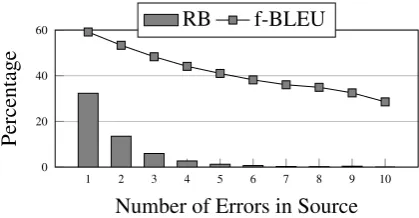
Figure 1: Effect of the number of errors on robustness.
Robustness Percentage more than halves for each addi-tional input sentence error, while f-BLEU on the non-robust sentences reduces linearly.
METEOR have lowerρ=−0.71.
This is further outlined by the results on the WI+loc datasets. The English proficiency of the
students increases from the A to B to C sub-sets, and the N subset is written by native English speakers. An increase in English proficiency man-ifests as a lower number of errors, higher robust-ness percentage, and larger f-BLEU scores.
Takeaway 2: The MT system generally mag-nifies the input noise.This is denoted by the NR column which is larger than 1 across the board. This means that the MT system exacerbated the input noise by a factor of about 2.5. This effect is more visible when the source noise levels are low, as in the WI+locC and N or thenucledatasets.
4.2 Sentence-level Findings
[image:4.595.313.523.301.410.2]<5 <10 <15 <20 <25 <30 <35 1
2 3 4 5
#errors
in
source
source sentence length
Figure 2: Robustness Percentage broken down by sen-tence length and number of source errors. The radius of each circle is proportional to the number of sen-tences and the opacity corresponds to RB score
(dark-est: RB=33%, lowest: RB≈2%). The model is more
ro-bust with few errors regardless of sentence length.
Effect of the input number of errors: Figure1 clearly shows the compounding effect of source side errors. Each additional error reduces overall robustness by more than 50%: from robust be-havior in about 32% of the 1-error instances, to 13% for the 2-errors instances, to 6% on instances with 3 errors; and so forth, to the point that the model is robust in less than 1% of instances with more than 5 source-side errors. The robustness drop when computed with f-BLEU is practically linear, starting from about 59 f-BLEU points when a single error is present, falling to about 28 when the source has more than 9 errors.
Effect of input length: One factor related to the number of input errors is the effect of the source sentence length. We find that there is a neg-ative correlation between the input length and the model’s robustness. This is to be expected, as in-put length and the number of errors are also cor-related: longer sentences are more likely to more errors, and inversely, short sentences cannot have a large number of errors.
Figure2presents the RB score across these two factors. We bin the input sentences based on their sentence lengths and based on the number of er-rors in the source. We only plot bins that have a RB score of more than 1% (reflected in the opacity of the plot). It is clear that more errors in a source sentence lead to reduced robustness, while the sen-tence length is not as significant a factor.
A closer look at sentences with a single error
Recoverable Non-recoverable
Error RB Error EB
VERB-INFL 22% CONJ 3%
VERB-SVA 22% OTHER 5%
ORTH 19% NOUN 6%
VERB-FORM 17% ADV 7%
[image:5.595.74.291.59.225.2]WO 17% VERB 7%
Table 2: Some errors are easier to translate correctly than others. The average error has an RB score of 11%.
We present the errors that fall out of the [µ±2σ] range.
reveals that the system is robust about 30% of the time regardless of their length, with a slight in-crease in accuracy as the length inin-creases. Longer sentences provide more context, which presum-ably aids in dealing with the source noise. This pattern is similar across all rows in Figure2.
4.3 Error-level Analysis
In this section we aim to study and identify the error types from which the NMT system is able to recover, or not. To avoid the compounding ef-fects of multiple source-side errors, we restrict this analysis to sentences that have a single error.
We have already discussed in Section 4.1 how the NMT system is robust on about 20% of the instances across all corpora. By selecting those instances and computing basic error statistics on them, we find that the average error is recoverable about 11% of the time (µ=0.11). Table2presents the errors that are harder or easier to translate cor-rectly. We choose to present the errors that are at the bottom and top, respectively, of the ranking of the errors, based on the average RB score that their corresponding test instances receive.
The non-recoverable errors on the right side of Table 2 are mostly semantic in nature: all five of them correspond to instances where a seman-tically wrong word was used.10 Correcting and even identifying these types of errors is difficult even in a monolingual setting as world knowl-edge and/or larger (document/discourse) context is needed. One could argue, in fact, that such errors are notgrammatical, i.e. the source sentence is flu-ent. Furthermore, one could form a solid argument for not wanting/expecting an MT system to alter the semantics of the source. The MT system’s job is exactly to accurately convey the semantics of the
I want to play with children and see theirsimleall day.
Ich will mit den Kindern spielen und sie den ganzen Tag sehen. Ich m¨ochte mit Kindern spielen und ihr L¨acheln den ganzen Tag sehen.
I want to play with children and see theirsmilesall day. counts:
relative pos:
x
MT(x) ˜
x
MT( ˜x)
+0 +1 +0 +0 +0 +0 +1 +1 +0 +0 +0 +0
[image:6.595.133.462.58.164.2]−7 −6 −5 −4 −3 −2 −1 0 1 2 3 4
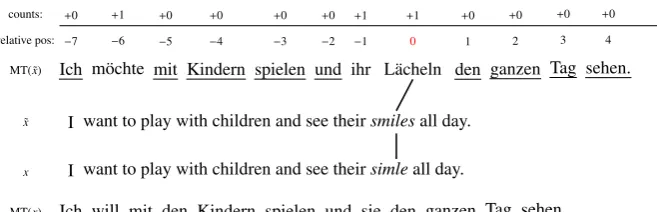
Figure 3: The procedure of computingdivergenceover a quadruple (x,y,x˜,y˜). Each token in outputynot in the
desired output ˜yis considered a divergent token (underlined=matching). The x-axis is centered around the token ˜yk
that aligns to the editxi*→ x˜j. The counts describe the caused divergence relative to the expected error’s position.
source sentence in the target language.
However, there are errors where the intended meaning is clear but ungrammatically executed, as in Table2’s left-side errors. There are three plausi-ble (likely orthogonal, but we leave such analysis for future work) reasons why these errors are eas-ier than average to correctly translate:
1. Self-attention. The encoder’s final repre-sentations are computed through multiple self-attention layers, resulting in a representation heav-ily informed by the whole source context. The VERB-INFL, VERB-SVA, and VERB-FORM er-ror categories (all related to morphology and syn-tactic constraints) apply to edits that subword modeling combined with self-attention would al-leviate. Consider the example of the verb inflec-tion (VERB-INFL) errordanceing*/dancing. The segmentation in the erroneous and the corrected version isdance|inganddanc|ingrespectively. In both cases, the morpheme that denotes the inflec-tion is the same. Verb form (VERB-FORM) errors, on the other hand, typically involve infinitive, to-infinitive, gerund, or participle forms. It seems that in those cases the self-attention component is able to use the context to recover, especially because, as in the VERB-INFL example, the stem of the verb will most likely be the same.
Also, apart from the positional embeddings, no other explicit word order information is encoded by the architecture (unlike recurrent architectures focused on by all previous work, which by con-struction keep track of word order). We suggest that the self-attention architecture makes word or-der errors (WO errors are strictly defined as ex-act match tokens wrongly ordered, e.g. know al-ready*/already know) easier to recover from.
2. The extensive use of back-translation. The SOTA model that we use has been trained on
mas-sive amounts of back-translated data, where Ger-man monolingual data have been translated into English. The integral part is that English sources were sampledfrom the De-En model, instead of using beam-search to generate the most likely output. This means that the model was already trained on a fair amount of source-side noise, which would make it more robust to such pertur-bations (Belinkov and Bisk,2018;Anastasopoulos et al.,2019;Singh et al.,2019).
Although we do not have access to the back-translated parallel data that Edunov et al. (2018) used, we suspect that translation errors are fairly common and therefore more prevalent in the fi-nal training bitext, making the model more robust to such noise. Current English-to-German SOTA systems might not have issues with translating noun phrases, coordinated verbs, or pronoun num-ber, but they still struggle with compound genera-tion, coreference, and verb-future generation (Bo-jar et al.,2018).
seg-mentations agree for 3/4 tokens. Most previous work e.g. (Belinkov and Bisk,2018) has focused on character-level modeling using compositional functions across characters to represent tokens, which are by construction more vulnerable to such errors.
4.4 Divergence
We introduce a method for computing a di-vergence distribution. Computing divergence re-quires a quadruple of (x,x˜,y,y˜). We will focus on instances where xand ˜xdiffer only with a single edit, as a simple working example.
Process: Given a source side sentence pairxand
˜x with a single grammatical error, it is trivial to identify the positioni∗of the correction in ˜x, since we work on corpora pre-annotated with grammat-ical edits at the token level. Also, using traditional methods like the IBM Models (Brown et al.,1993) and the GIZA++tool, makes it easy to obtain an alignment betweenxandy, as well as between ˜x
and ˜y. We use the alignment variable αj = i to
denote that the target wordyjis aligned to source
positioni, and equivalently the variables ˜αfor the corrected source pair. We denote as k∗ the target position that aligns to the source-side correction, such that ˜αk∗ =i∗.
We define the set of divergent tokensY∗as the set of tokens ofythat do not appear in ˜y:
Y∗={yj |yj <y˜}.
Now, we use all the previous definitions to define the setPof target divergent positions for a quadru-ple (x,x˜,y,y˜) as the set of target-side positions of the tokens that are different betweeny and ˜y, but relativeto the position of the target-side token that aligns to the source-side correction:
P(x,x˜,y,y˜)={j−k∗,∀yj ∈ Y∗}.
We provide an illustration of this process for a single-error example in Figure 3. The correction simle*/smilesis aligned to the wordy7 (L¨acheln) in the reference target, so the center of the dis-tribution is moved to k∗ = 7. For the rest of the positions in the target reference ˜y, we simply up-date the counts based on whether the word ˜yj is
present in y. The final step is collecting counts across all instances for all the relative divergent positions and analyzing the effect of a source-side error on the target sentence.
Essentially, we expect some source-side errors to have a very local effect on the translation output, which would translate in divergence distributions with low variance (since we center the distribution around k∗). Other source-side errors might cause larger divergence as they might affect the whole structure of the target sentence.
In the Figure3example, the only difference be-tweenxand ˜xis a single word towards the end of the sentence, but the outputs y and ˜y diverge on three words. One of them is 6 words away (be-fore) from where we would have expected the di-vergence to happen (in relative position 0).
After collecting divergence counts for each in-stance, we can visualize their distribution and compute their descriptive statistics. We focus on the mean µ, standard deviation σ, and the skew-ness of the distribution as measured by Pearson’s definition, using the third standardised moment, defined as:
γ1=E
" X−µ
σ 3#
.
Across all datasets and errors, the distribu-tion of the divergence caused by single errors in the source has a mean µall=0.7, standard
devia-tionσall=5.1, and a slight positive skewness with
γ1all=0.8. This means that the average error affects
its general right context, in a ±5 word neighbor-hood.
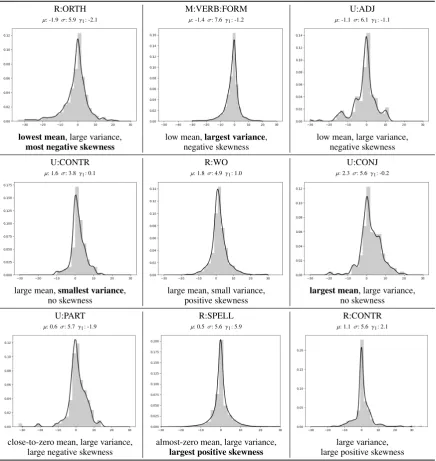
In Figure4we present several of the errors with the most interesting divergence statistics. Some errors heavily affect their left (e.g. R:ORTH) or right context (U:CONJ). Also, some errors affect a small translation neighborhood as denoted by the low variance of their divergence distribution (e.g. U:CONTR). On the other hand, verb form errors (M:VERB:FORM) have the potential to affect a larger neighborhood: this is expected because En-glish auxiliary verb constructions (e.g. ”have eaten X”) often get translated to German V2 construc-tions with an auxiliary verb separated from a final, non-finite main verb (e.g. “habe X gegessen”).
R:ORTH M:VERB:FORM U:ADJ
µ: -1.9σ: 5.9γ1: -2.1 µ: -1.4σ: 7.6γ1: -1.2 µ: -1.1σ: 6.1γ1: -1.1
lowest mean, large variance, low mean,largest variance, low mean, large variance,
most negative skewness negative skewness negative skewness
U:CONTR R:WO U:CONJ
µ: 1.6σ: 3.8γ1: 0.1 µ: 1.8σ: 4.9γ1: 1.0 µ: 2.3σ: 5.6γ1: -0.2
large mean,smallest variance, large mean, small variance, largest mean, large variance,
no skewness positive skewness no skewness
U:PART R:SPELL R:CONTR
µ: 0.6σ: 5.7γ1: -1.9 µ: 0.5σ: 5.6γ1: 5.9 µ: 1.1σ: 5.6γ1: 2.1
close-to-zero mean, large variance, almost-zero mean, large variance, large variance,
[image:8.595.82.519.62.524.2]large negative skewness largest positive skewness large positive skewness
Figure 4: Some interesting errors with statistics on theirdivergence distribution. Some errors (negative mean and
skewness:R:ORTH, M:VERB:FORM, U:ADJ) affect the left context of their translation more, while others affect their right
translation context (positive mean and skewness R:WO, U:CONJ). Errors might affect a small neighborhood (low variance: U:CONTR, R:WO) or a larger part of the translation (high variance: M:VERB:FORM, U:ADJ, R:CONTR).
first quartile (i∗<
0.25|x|)
second quartile (0.25|x| ≤i∗<
0.50|x|)
third quartile (0.50|x| ≤i∗<
0.70|x|)
fourth quartile (0.75|x| ≤i∗<|
x|)
µ: 3.8 σ: 5.6 γ1: 3.3 µ: 1.6 σ: 4.1 γ1: 1.2 µ: -0.2 σ: 3.6 γ1: -1.1 µ: -2.9 σ: 4.8 γ1: -2.5
[image:8.595.78.521.587.706.2]5 Limitations and Extensions
A major limitation of our analysis is the narrow scope of our experiments. We solely focused on a single language pair using a single MT system. Whether different neural architectures over other languages would lead to different conclusions re-mains an open question. The necessary resources for answering these questions at scale, however, are not yet available. We were limited to English as our source side language, as the majority of the datasets and research works in GEC are entirely English-centric. Perhaps small-scale GEC datasets in Estonian (Rummo and Praakli,2017) and Lat-vian (Deksne and Skadina, 2014) could provide a non-English testbed. One would then need er-ror labels for the grammatical edits, so if such an-notations are not available, an extension of a tool like ERRANT to these languages would also be required. One should also be careful in the de-cision of what (N)MT system to test, as using a low-quality translation system would not produce meaningful insights.
Another limitation is that our metrics do not capture whether the changes in the output are ac-tually grammatical errors or not. In the example in Figure3: the German words “m¨ochte” and “will” that we identified as divergent are practically in-terchangeable. Therefore, the NMT model is tech-nically not wrong outputting either of them and it is indeed generally possible that differences be-tween y and ˜y are just surface-level ones. The inclusion of f-METEOR as a robustness metric could partially deal with this issue, as it would not penalize such differences. We do believe it is still interesting, though, that a single source error can cause large perturbations in the output, as in the case of errors with large variance in their diver-gence distribution. Nevertheless, an extension of our study focusing on the grammatical qualities of the MT output would be exciting and automated tools for such analysis would be invaluable (i.e. MT error labeling and analysis tools extending the works of Zeman et al. (2011), Logacheva et al. (2016),Popovi´c(2018), orNeubig et al.(2019)).
A natural next research direction is investigat-ing how to use our reference-less evaluation met-rics in order to create a more robust MT system. For instance, one could optimize for f-BLEU or any of the other reference-less measures that we proposed, in the same way that an MT system is optimized for BLEU (either by explicitly using
their scores through reinforcement learning or by simply using the metric as an early stopping crite-rion over a development set).Cheng et al. (2018) recently proposed an approach for training more robust MT systems, albeit in a supervised setting where noise is injected on parallel data, and the proposed solutions of Belinkov and Bisk (2018) and Anastasopoulos et al. (2019) fall within the same category. However, no approach has, to our knowledge, used GEC corpora for training MT systems robust to grammatical errors. In any case, special care should be taken so that any improve-ments on translating ungrammatical data do not worsen performance on clean ones.
6 Conclusion
In this work, we studied the effects of grammatical errors in NMT. We expanded on findings from pre-vious work, performing analysis on real data with grammatical errors using a SOTA system. With our analysis we were able to identify classes of grammatical errors that are recoverable or irrecov-erable. Additionally, we presented ways to evalu-ate a MT system’s robustness to noise without ac-cess to gold references, as well as a method for visualizing the effect of source-side errors to the output translation. Finally, we discussed the limi-tations of our study and outlined avenues for fur-ther investigations towards building more robust NMT systems.
Acknowledgements
The author is grateful to the anonymous review-ers, Kenton Murray, and Graham Neubig for their constructive and insightful comments, as well as to Gabriela Weigel for her invaluable help with edit-ing and proofreadedit-ing the final version of this pa-per. This material is based upon work generously supported by the National Science Foundation un-der grant 1761548.
References
Antonios Anastasopoulos, Alison Lui, Toan Q. Nguyen, and David Chiang. 2019. Neural machine
translation of text from non-native speakers. Proc.
NAACL-HLT.
Øistein E Andersen, Helen Yannakoudakis, Fiona Barker, and Tim Parish. 2013. Developing and
test-ing a self-assessment and tutortest-ing system. InProc.
Satanjeev Banerjee and Alon Lavie. 2005. Meteor: An automatic metric for mt evaluation with improved
correlation with human judgments. InProceedings
of the acl workshop on intrinsic and extrinsic evalu-ation measures for machine translevalu-ation and/or sum-marization.
Yonatan Belinkov and Yonatan Bisk. 2018. Synthetic and natural noise both break neural machine
transla-tion. InProc. ICLR.
Ondˇrej Bojar, Rajen Chatterjee, Christian Feder-mann, Mark Fishel, Yvette Graham, Barry Had-dow, Matthias Huck, Antonio Jimeno Yepes, Philipp
Koehn, Christof Monz, et al. 2018. Proceedings
of the third conference on machine translation. In
Proc. WMT.
Peter F. Brown, Vincent J. Della Pietra, Stephen A. Della Pietra, and Robert L. Mercer. 1993. The mathematics of statistical machine translation:
Pa-rameter estimation. Computational Linguistics,
19(2):263–311.
Christopher Bryant, Mariano Felice, and Ted Briscoe.
2017. Automatic annotation and evaluation of
er-ror types for grammatical erer-ror correction. InProc. ACL.
Yong Cheng, Zhaopeng Tu, Fandong Meng, Junjie
Zhai, and Yang Liu. 2018. Towards robust neural
machine translation. InProc. ACL.
Josep Crego, Jungi Kim, Guillaume Klein, Anabel Re-bollo, Kathy Yang, Jean Senellart, Egor Akhanov, Patrice Brunelle, Aurelien Coquard, Yongchao Deng, et al. 2016. Systran’s pure neural machine translation systems. arXiv:1610.05540.
Daniel Dahlmeier, Hwee Tou Ng, and Siew Mei Wu. 2013. Building a large annotated corpus of learner
english: The nus corpus of learner english. InProc.
BEA-NLP.
Daiga Deksne and Inguna Skadina. 2014.
Error-annotated corpus of latvian. InProc. Baltic HLT.
Michael Denkowski and Alon Lavie. 2014. Meteor
universal: Language specific translation evaluation
for any target language. InProc. WMT.
Council of Europe. Council for Cultural Co-operation. Education Committee. Modern Languages Division.
2001. Common European Framework of
Refer-ence for Languages: learning, teaching, assessment. Cambridge University Press.
Sergey Edunov, Myle Ott, Michael Auli, and David
Grangier. 2018. Understanding back-translation at
scale. InProc. EMNLP.
Hany Hassan Awadalla, Anthony Aue, Chang Chen, Vishal Chowdhary, Jonathan Clark, Christian Feder-mann, Xuedong Huang, Marcin Junczys-Dowmunt, Will Lewis, Mu Li, Shujie Liu, Tie-Yan Liu, Ren-qian Luo, Arul Menezes, Tao Qin, Frank Seide,
Xu Tan, Fei Tian, Lijun Wu, Shuangzhi Wu, Yingce Xia, Dongdong Zhang, Zhirui Zhang, and Ming
Zhou. 2018. Achieving human parity on automatic
chinese to english news translation.
Georg Heigold, Stalin Varanasi, G¨unter Neumann, and
Josef Genabith. 2018. How robust are
character-based word embeddings in tagging and mt against wrod scramlbing or randdm nouse?InProc. AMTA.
Philipp Koehn and Rebecca Knowles. 2017. Six
chal-lenges for neural machine translation. In Proc. WNMT.
Varvara Logacheva, Chris Hokamp, and Lucia Specia. 2016. Marmot: A toolkit for translation quality
esti-mation at the word level. InProc. LREC.
Louis Martin, Samuel Humeau, Pierre-Emmanuel
Mazar´e, ´Eric De La Clergerie, Antoine Bordes, and
Benoˆıt Sagot. 2018. Reference-less quality
estima-tion of text simplificaestima-tion systems. InProc. ATA.
Paul Michel, Xian Li, Graham Neubig, and
Juan Miguel Pino. 2019. On evaluation of
ad-versarial perturbations for sequence-to-sequence
models. InProc. NAACL-HLT.
Courtney Napoles, Keisuke Sakaguchi, and Joel Tetreault. 2016. There’s no comparison: Reference-less evaluation metrics in grammatical error
correc-tion. InProc. EMNLP.
Courtney Napoles, Keisuke Sakaguchi, and Joel
Tetreault. 2017. Jfleg: A fluency corpus and
bench-mark for grammatical error correction. In Proc.
EACL, Valencia, Spain.
Graham Neubig, Zi-Yi Dou, Junjie Hu, Paul Michel,
Danish Pruthi, and Xinyi Wang. 2019. compare-mt:
A tool for holistic comparison of language genera-tion systems. InProc. NAACL-HLT.
Hwee Tou Ng, Siew Mei Wu, Ted Briscoe, Christian Hadiwinoto, Raymond Hendy Susanto, and Christo-pher Bryant. 2014. The conll-2014 shared task on
grammatical error correction. InProc. CoNLL.
Hwee Tou Ng, Siew Mei Wu, Yuanbin Wu, Christian
Hadiwinoto, and Joel Tetreault. 2013. The
conll-2013 shared task on grammatical error correction. InProc. CoNLL.
Kishore Papineni, Salim Roukos, Todd Ward, and Wei-Jing Zhu. 2002. Bleu: a method for automatic
eval-uation of machine translation. InProc. ACL.
Maja Popovi´c. 2018. Error classification and analy-sis for machine translation quality assessment. In
Translation Quality Assessment, pages 129–158. Springer.
Ingrid Rummo and Kristiina Praakli. 2017. T ¨U eesti
keele (v˜o˜orkeelena) osakonna ˜oppijakeele tekstikor-pus [the language learners cortekstikor-pus of the department of estonian language of the university of tartu]. In
Rico Sennrich. 2017. How grammatical is character-level neural machine translation? assessing mt
qual-ity with contrastive translation pairs. InProc. EACL.
Rico Sennrich, Barry Haddow, and Alexandra Birch.
2016a. Improving neural machine translation
mod-els with monolingual data. InProc. ACL.
Rico Sennrich, Barry Haddow, and Alexandra Birch.
2016b. Neural machine translation of rare words
with subword units. InProc. ACL.
Sumeet Singh, Craig Stewart, Graham Neubig, et al. 2019. Improving robustness of machine translation with synthetic noise. arXiv:1902.09508.
Lucia Specia, Carolina Scarton, and Gustavo Henrique
Paetzold. 2018. Quality estimation for machine
translation. Synthesis Lectures on Human Language
Technologies, 11(1):1–162.
Toshikazu Tajiri, Mamoru Komachi, and Yuji Mat-sumoto. 2012. Tense and aspect error correction for
esl learners using global context. InProc. ACL.
Yonghui Wu, Mike Schuster, Zhifeng Chen, Quoc V. Le, Mohammad Norouzi, Wolfgang Macherey, Maxim Krikun, Yuan Cao, Qin Gao, Klaus
Macherey, et al. 2016. Google’s neural machine
translation system: Bridging the gap between human and machine translation. arXiv:1609.08144.
Helen Yannakoudakis, Ted Briscoe, and Ben Medlock. 2011. A new dataset and method for automatically
grading esol texts. InProc. ACL-HLT.
Daniel Zeman, Mark Fishel, Jan Berka, and Ondˇrej Bo-jar. 2011. Addicter: what is wrong with my
trans-lations? The Prague Bulletin of Mathematical
![Table 2: Some errors are easier to translate correctlythan others. The average error has an RB score of 11%.We present the errors that fall out of the [µ±2σ] range.](https://thumb-us.123doks.com/thumbv2/123dok_us/180011.514857/5.595.74.291.59.225/table-errors-easier-translate-correctlythan-average-present-errors.webp)