70C-035MM-101 Computers
Amdahl 5890/5990 Series
MANAGEMENT SUMMARY
UPDA TE: The surprise May 1988 announcement of the Amdahl 5990 Series marked an important turning point for the computer industry and for Amdahl. The top-end model of the 5990 series, the Model 1400, smashed the 100 million instructions per second (MIPS) barrier, making it
the industry'S most powerful System/370-type mainframe. (IBM soon closed the performance gap with the announce-ment of more powerful ES/3090 S models in July 1988.) In addition to new mainframes, Amdahl subsequently an-nounced a new 5890 model, improvements to its Multiple Domain Feature, new triple-density disk products, and a new communications controller. Amdahl's new and en-hanced product announcements came at a time when its existing 5890 mainframes were continuing to sell well, generating record breaking revenues and profits. After weathering some big ups and downs in an up and down industry, Amdahl is now soaring.
The Amdahl 5990 Series is a follow-on to the 5890 main-frame line. It consists of the Model 700 dual processor, rated at 63 MIPS, and the Model 1400 four-way processor, rated at 115 MIPS. Amdahl delivered the first 5990-700 dual processors in June, and the Model 1400 during the fourth quarter of 1988. Model 700-to-Model 1400 up-grades are scheduled for availability by the first quarter of this year. Like previous Amdahl mainframes, the 5990 Series is offered as a price/performance alternative to the IBM 3090 S models and the expected IBM follow-on series known as Summit.
In addition to the new mainframe generation, Amdahl continues to enhance its previous 5890 line. The 5890-390E, a third new Amdahl'mainframe announced in May, brings the number of 5890 E models to seven. The corn-
1:>
Amdahl Corporation's 5890/5990 Series are positioned as price/performance alter-natives to the IBM ES/3090 Series. MODELS: 5890-180E, -190E, -200E, -300E, -390E, -400E, and -600E; 5990-700, -1400.
CONFIGURATION: One, two, three, or four CPUs, 32M to 512M bytes of main mem-ory, up to 2G bytes of expanded storage, and up to 128 I/O channels.
COMPETITION: IBM 4381, IBM ES/3090 E and S Series, NAS AS/EX Series.
PRICE: Prices range from $2,350,000 to $11,300,000.
CHARACTERISTICS
MANUFACTURER: Amdahl Corporation, 1250 East Arques Avenue, Sunnyvale, California 94088-3470. Tele-phone (408) 746-6000. In Canada: One First Canadian Place, Suite 3940, P.O. Box 123, Toronto, Ontario, Canada M5X 184. Telephone (416) 862-7479.
MODELS: Amdahl 5890 Series consists of the Models 180E and 190E, single processors; Models 200E and 3OOE, dual processors; Model 390E, two-way multiprocessor; Model 400E, three-way multiprocessor; and the 6OOE, four-way multiprocessor. Amdahl 5990 Series consists of the Model 700 dual processor and the Model 1400
four-way multiprocessor. ~
Billed as the most powerful general-purpose mainframe ever built for the System/ 370-compatible marketplace, the Amdahl 5990 Model 1400 has a CPU cycle time of 10 nanoseconds and can process up to 115 million instructions per second, by industry estimates.
70C-035MM-102 Computers
Amdahl 5890/5990 Series
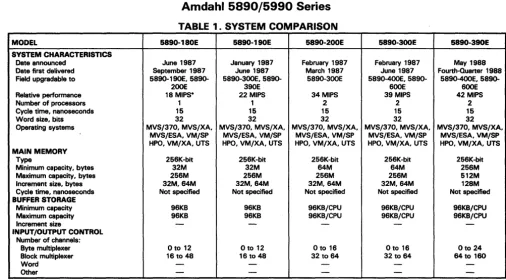
TABLE 1. SYSTEM COMPARISON
MODEL 5890-180E 5890-190E 5890-200E 5890-300E 5890-390E SYSTEM CHARACTERISTICS
Date announced June 1987 January 1987 February 1987 February 1987 May 1988 Date first delivered September 1987 June 1987 March 1987 June 1987 Fourth-Ouarter 1988 Field upgradable to 5890-190E, 5890- 5890-300E, 5890- 5890-300E 5890-400E, 5890- 400E,
5890-200E 390E 600E 600E
Relative performance 18 MIPS· 22 MIPS 34 MIPS 39 MIPS 42 MIPS
Number of processors 1 1 2 2 2
Cycle time, nanoseconds 15 15 15 15 15
Word size, bits 32 32 32 32 32
Operating systems MVS/370, MVS/XA, MVS/370, MVS/XA, MVS/370, MVS/XA, MVS/370, MVS/XA, MVS/370, MVS/XA, MVS/ESA, VM/SP MVS/ESA, VM/SP MVS/ESA, VM/SP MVS/ESA, VM/SP MVS/ESA, VM/SP HPO, VM/XA, UTS HPO, VM/XA, UTS HPO, VM/XA, UTS HPO, VM/XA, UTS HPO, VM/XA, UTS MAIN MEMORY
Type 256K-bit 256K-bit 256K-bit 256K-bit 256K-bit Minimum capacity, bytes 32M 32M 64M 64M 256M Maximum capacity, bytes 256M 256M 256M 256M 512M Increment size, bytes 32M,64M 32M,64M 32M,64M 32M,64M 128M Cycle time, nanoseconds Not specified Not specified Not specified Not specified Not specified BUFFER STORAGE
Minimum capacity 96KB 96KB 96KB/CPU 96KB/CPU 96KB/CPU Maximum capacity 96KB 96KB 96KB/CPU 96KB/CPU 96KB/CPU
Increment size
-
-
-
-
-INPUT/OUTPUT CONTROL Number of channels:
Byte multiplexer Oto 12 Oto 12 o to 16 o to 16 Oto 24 Block multiplexer 16 to 48 16 to 48 32 to 64 32 to 64 64 to 160
Word
-
-
-
-
-Other
-
-
-
-
--Millions of instructions per second.
t>
pany is marketing the two-way system as an entry-level multiprocessor that can be partitioned to operate as two uniprocessors. It's an apparent response to the IBM 3090 Model 280E, a dual processor that brought partitioning down to the two-processor level. IBM announced the 280E in February 1988.~ DATA FORMATS
Amdahl launched the 5890 processor line in October 1985, about eight months after IBM introduced its new 3090 generation of processors. It became the 5890 E Series in 1987 and now competes against IBM's nine earlier 3090 E models. The 5890 E generation continues to be well received, making Amdahl formidable IBM competition. At the time of the original 5890 announcement, Amdahl was criticized for taking so long to respond to the IBM introduction. Amdahl took the extra time to work out system bugs that invariably show up in a new product line. According to Amdahl, the delay paid off in the long run because the company wasn't forced to correct costly problems after the first units were shipped.
Amdahl manufactures its own computer systems using components obtained from Fujitsu of Japan, an early Am-dahl investor now owning almost half of the company's stock. Amdahl has also developed proprietary systems software and microcode designed specifically for Amdahl machines. Amdahl and Fujitsu developed the 5990 Series jointly over a four-year period. The Fujitsu version, the 780 Series, is not IBM compatible. Since Amdahl main-tains a substantial research and development effort to gain a competitive edge over IBM, Amdahl top execs resent being called a "marketing arm" of Fujitsu.
Amdahl R&D efforts spurred the development of its im-pressive 5990 follow-on series. The vendor rates the 5990
t>
All data formats, instruction formats, and other architec-tural features are compatible with IBM System/370 archi-tecture and System/370 Extended Archiarchi-tecture.
BASIC UNIT: Eight-bit bytes. Each byte can represent one alphanumeric character, two BCD digits, or eight bi-nary bits. Two consecutive bytes form a half word of 16 bits, while four consecutive bytes form a 32-bit word. FIXED-POINT OPERANDS: Can range from 1 to 16 bytes (l to 31 digits plus sign) in decimal mode; one half word (16 bits) or one word (32 bits) in binary mode. FLOATING-POINT OPERANDS: One word, consisting of 24-bit fraction and seven-bit hexadecimal exponent in short format; two words, consisting of 56-bit fraction and seven-bit hexadecimal exponent in long format; or four words in extended-precision format.
INSTRUCTIONS: Two, four, or six bytes in length, which usually specify zero, one, or two memory addresses, respec-tively.
INTERNAL CODE: Extended Binary-Coded Decimal In-terchange Code (EBCDIC).
MAIN MEMORY
The Main Storage Unit (MSU) on 5890 mainframes uses eight-way line interleaving and is connected to the rest of the system through 16-byte-wide data paths. The MSU of single and dual processors contains data and key storage arrays for up to 256 megabytes of main storage. The two top-end processors, the Models 5890-400E and 6OOE, have maximum main memories of 512 megabytes.
Amdahl 5890 mainframes can also be configured with the Expanded Storage feature. Users can allocate any portion of main memory as Expanded Storage at initialization time to reduce the paging and swapping load to channel- ~
COPYRIGHT © 1989 McGRAW-HILL, INCORPORATED. REPRODUCTION PROHIBITED DA T APRO RESEARCH, DELRAN NJ 08075 USA
[image:2.618.54.560.43.323.2]70C-035MM-103 Computers
Amdahl 5890/5990 Series
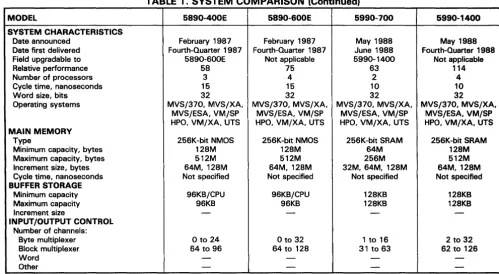
TABLE 1. SYSTEM COMPARISON (Continued)
MODEL 5890-400E
SYSTEM CHARACTERISTICS
Date announced February 1987
Date first delivered Fourth-Quarter 1987
Field upgradable to 5890-600E
Relative performance 58
Number of processors 3
Cycle time, nanoseconds 15
Word size, bits 32
Operating systems MVS/370, MVS/XA,
MVS/ESA, VM/SP HPO, VM/XA, UTS MAIN MEMORY
Type 256K-bit NMOS
Minimum capacity, bytes 128M
Maximum capacity, bytes 512M
Increment size, bytes 64M,128M
Cycle time, nanoseconds Not specified BUFFER STORAGE
Minimum capacity 96KB/CPU
Maximum capacity 96KB
Increment size
-INPUT/OUTPUT CONTROL Number of channels:
Byte multiplexer
o
to 24Block multiplexer 64 to 96
Word
-Other
-Model 1400 at 50 percent more throughput capacity than Amdahl's previous top-of-the-line system, the four-way multiprocessor 5890-600E. Model 1400's cited perfor-mance was achieved while running benchmarks in com-mercial on-line and batch environments. Gains as high as 100 percent were achieved running compute-intensive en-gineering and scientific programs, Amdahl claims. Am-dahl reduced 5990 CPU cycle time to 10 nanoseconds, compared to 15 nanoseconds for the 5890 Series.
The Model 700 has 1.5 times the throughput capacity of the 5890-300E dual processor in commercial on-line and batch environments and 1.6 times the capacity in scien-tific batch environments. A Model 700, running compute-intensive floating-point applications, provided 2.0 times the performance of the Model 300E.
The Model 700 features up to 256 megabytes of main storage, up to 1 gigabyte of optional Expanded Storage, and up to 64 channels. The Model 1400 features up to 512 megabytes of main storage, up to 2 gigabytes of Expanded Storage, and up to 128 channels. (Please refer to Table 1 for more detailed specifications.)
Amdahl said the new processor line will support IBM's newest operating environment, Enterprise Systems Architecture/370 (ESA/370), by the fourth quarter. In Sep-tember 1988, the company announced it will support ESA on the 5990 and 5890 E models at no charge beginning in the fourth quarter. Additionally, the 5990 will support MVS/XA, MVS/370, VM/XA, VM/SP HPO, and UTS, Amdahl's implementation of AT&T's UNIX.
5890-600E 5990-700 5990-1400
February 1987 May 1988 May 1988
Fourth-Quarter 1987 June 1988 Fourth-Quarter 1988 Not applicable 5990-1400 Not applicable
75 63 114
4 2 4
15 10 10
32 32 32
MVS/370, MVS/XA, MVS/370, MVS/XA, MVS/370, MVS/XA, MVS/ESA, VM/SP MVS/ESA, VM/SP MVS/ESA, VM/SP HPO, VM/XA, UTS HPO, VM/XA, UTS HPO, VM/XA, UTS 256K-bit NMOS 256K-bit SRAM 256K-bit SRAM
128M 64M 128M
512M 256M 512M
64M,128M 32M, 64M, 128M 64M,128M
Not specified Not specified Not specified
96KB/CPU 128KB 128KB
96KB 128KB 128KB
-
--Oto 32 1 to 16 2 to 32
64 to 128 31 to 63 62 to 126
-
-
--
--attached paging and swapping devices. Expanded storage is specified in four-megabyte increments.
The System Director (SD) in 5890 systems controls and monitors, but does not execute, all requests for data and access to main memory and all storage protect key func-tions to insure data integrity. All data requests are fun-neled through this unit. The SD fills all requests by searching main storage and high-speed buffers.
A 5990 MSU is composed of a single, air-cooled subsystem carrier (SSC) containing up to 128 megabytes of main storage. A SSC is a printed circuit board that can have up to 42 layers. A MSU uses 32-way interleaving. Depending on memory size, a dual processor may have one or two MSUs, while a multiprocessor may have two or four MSUs. The top-end Model 1400 can have up to 512 mega-bytes of memory.
Amdahl 5990 systems also feature an optional expanded storage unit (ESU) holding up to one gigabyte of storage. Dual processors feature one ESU while multiprocessors may have up to two ESUs. The ESU transfers data to the MSU in four-kilobyte blocks.
STORAGE TYPE: 256-kilobit Static Random Access Memory (SRAM), 5990 Series; 256-kilobit RAMS, 5890 Series.
CAPACITY: Please refer to Table 1.
CYCLE TIME: Please refer to Table 1.
CHECKING: Error checking and correction (ECC) cir-cuitry in main memory performs automatic correction of all single-bit errors and detection of all double-bit and most other multiple-bit memory errors. In 5990 processors, ECC circuitry is used in main storage, Expanded Storage, and control storage. ECC in main storage detects three- and four-bit errors within a RAM boundary. The Service Pro-~
[image:3.617.57.557.79.353.2]70C-036MM-104 Computers
Amdahl 5890/5990 Series
t>
UTS is the first version of UNIX to run natively on System/370-type machines. In 1987, Amdahl brought out UTS Version I, Release 2, which supports a broader range of processors, peripherals, communications devices, and operating environments and also offers enhanced connec-tivity features.In 1988, Amdahl announced a product and marketing agreement with Sun Microsystems Inc. that calls for inte-grating Sun's technical workstation environment with Amdahl's large systems environment. Under terms of the agreement, components of the Sun Operating System, based on UNIX, will be incorporated into Amdahl's UTS, giving workstation users transparent access to Amdahl . mainframes. Amdahl's UNIX plans are part of a market-ing strategy designed to develop products and sellmarket-ing initi-atives separate from IBM.
To further differentiate the Amdahl product line from IBM offerings and give users more than just an IBM price/performance alternative, Amdahl introduced the Multiple Domain Feature (MDF) in November 1984. The MDF attracts users because it allows them to run multiple operating environments on one machine. IBM· responded to MDF last year with Processor Resource/System Man-ager (PR/SM), a product similar in concept. MDF lets users establish up to four
real
machines or domains within a single processor complex. Multiple System Con-trol Programs (SCPs) can run independently in their own domains.As part of its May 1988 announcements, Amdahl brought out an enhanced version of its Multiple Domain Feature (MDF). Users can establish up to seven domains on the 5990 Model 1400 when running in single-image mode. In partition mode, users can set up four domains on each side of the partition. Users can establish up to four do-mains on the 5990-700 and on all 580 and 5890 Series processors. Other MDF enhancements augment I/O capa-bilities, monitoring, capacity planning, and dynamic re-distribution of central processing time.
To further diversify its product line and shield the com-pany from the ups and downs of IBM product cycles, Amdahl has been expanding its mass storage products, communications processors, and Fujitsu supercomputers that interface with Amdahl mainframes. (For information about Amdahl supercomputers, please refer to "Supercomputers-Advancing Technologies," under the Issues and Trends tab of this volume.)
Amdahl entered the storage business in 1982 with the 6000 Series Direct Access Storage Devices (DASD). In May 1988, Amdahl introduced a triple-capacity Direct Access Storage Device (DASD) coupled with new control-ler technology. This newest Amdahl DASD generation consists of the 6100 Storage Processor Series storage con-troller, the 6380K triple-capacity DASD, and the 6380J single-capacity DASD.
~ cessor logs error information on a disk and runs diagnostic programs. Amdahl 5890 processors have a similar facility. A 5990 patrol function periodically scans main storage, Expanded Storage, and some control storage, searching for and correcting intermittent single-bit errors. When a per-manent main storage error is detected, the patrol function moves the data to special alternate memory chips to reduce the potential for double-bit errors.
RESERVED STORAGE: Amdahl 5890/5990 processors reserve an area in lower memory for such purposes as interrupt handling routines, CPU ID, channel ID, and machine-check logouts. Storage protection facilities are comparable to those implemented in the IBM System/370.
CENTRAL PROCESSOR
AMDAHL 5890 SERIES CENTRAL PROCESSOR CHARACTERISTICS: The 5890 Series makes extensive use of large-scale integration (LSI) chips, using high-performance emitter-coupled logic (ECL) circuitry. Up to 400 of these circuits can be contained on a single LSI chip, compared to only 100 circuits per chip on the earlier Am-dahl 470 Series, the company's first generation processors. In spite of an increased packing density, a 5890 chip gen-erates only slightly more heat than a 470 chip. This allows the 5890, like the older 470, to be air cooled.
Amdahl developed high-speed, 4 kilobit and 16 kilobit RAM modules to handle various storage functions. The 4-kilobit chips, with an access time of 3.5 nanoseconds, are used for CPU buffers and microcode control storage. The 16-kilobit chips, with an access time of 15 nanoseconds, are used in the System Support Processor (SSP), Input/Output Processor (lOP), and as history RAM, devices that accu-mulate recent system activity data. Field engineers use such data to re-create failures or isolate failing compo-nents. Additionally, special register chips have an access time of 3.5 nanoseconds.
Amdahl combines up to 121 RAM, logic, and register chips on a Multiple Chip Carrier (MCC). High-density packing permits the implementation of an entire system function on a single MCC. Each system MCC is arranged in three-dimensional stacks. Each stack can contain 13 to 15 MCCs. MCCs are interconnected through 12-layer printed circuit board side walls. Single-processor systems contain one stack, two-processor and two-way multiprocessor sys-tems contain two stacks, and four-way multiprocessors con-tain four stacks. The stacks concon-tain CPUs, lOPs, the SSPs, the System Director (SD), and the External Director (ED).
Combining all functional units together are two ED data buses, the A-Bus and B-Bus. Each bus moves unidirection-ally and has a 72-bit-wide data path. The two buses are integral parts of the stack side walls. They provide shorter data paths and simplified physical connections, while re-ducing the number of connections required among func-tional units. In 5890 systems, the A- and B-buses carry data among the lOPs and the SSP. These 5890 compo-nents are described fully in succeeding paragraphs.
The 5890 mainframe consists of one or more CPUs, Main Storage Unit (MSU), ED, Channel Subsystem (CS), lOP, and Console Subsystem (CS).
The CPU contains the CPU Storage Unit (SU), Instruction Unit (I-Unit), Pipeline Flow, Process Control, Timing Fa-cilities, and Execution Unit (E-Unit).
The CPU SU receives and processes all I-Unit data
re-quests. The SU contains high-speed cache units and the ~
COPYRIGHT © 1989 McGRAW-HILL, INCORPORATED. REPRODUCTION PROHIBITED DA T APRO RESEARCH, DELRAN NJ 08075 USA
70C-03SMM-10S Computers
Amdahl 5890/5990 Series
1:>
The 6100 storage controller family, consisting of four models, provides up to 32 channel attachments and can execute up to 16 concurrent data transfers to and from attached host processors to reduce channel bottlenecks.To achieve optimum transfer rates, the 6100 line comes with a global cache and nonvolatile storage (NVS). Sys-tems feature up to 512 megabytes of shared storage for caching and up to 16 megabytes of NVS. The 6100 Model 100 employs four data paths to achieve concurrent data transfers to and from the host. The Model 200 features eight paths, the Model 300 features 12 paths, and the Model 400 features 16 paths. All 6100 models can address up to 128 devices. The 6100 line can be configured with the new Model J and Model K DASDs and also accom-modates the older 6380 and 6380 E DASDs to protect user investments in older hardware. The 6100 features data transfer rates of either 3.0 or 4.5 megabytes per second.
The 6380 Model K DASD, with four sealed disk enclo-sures (DEs), has a triple-density capacity of up to 7.56 gigabytes per unit and 1.89 gigabytes per DE. Average seek time is 16 milliseconds. The Model J, also with four DEs, has a single capacity of 2.5 gigabytes per unit and 630 megabytes per DE. Average seek time is 12 milliseconds. Both models use 10.5-inch platters rather than the industry-standard 14-inch platters, and both can be con-figured with optional quad pathing to provide four inde-pendent paths to each unit. J and K strings can operate in either dual or quad path modes. Users can also intermix J and K models on a single string. The Model K and J DASDs come with a one-year warranty and will be avail-able during the first quarter of this year.
The 6100 Models 100 and 200 became available in 1988, while the Model 300 and 400 are planned for the fourth quarter. The 12- and 16-channel adapter configurations will be shipped the first quarter; 6100 will be shipped the second quarter; and NVS will be shipped the fourth quar-ter.
Amdahl completed its hardware product overhaul with the May 1988 introduction of new 4745 front-end com-munications processors that replaced the earlier Amdahl 4725 models. The 4745 Models 110 and 210, which be-came available in June 1988, are said to have 20 percent greater throughput than the 4725 Series which can be field upgraded to the new models. Please refer to the COMMU-NICATIONS section of the Characteristics for more de-tails.
COMPETITIVE POSITION
When Amdahl launched its 5890 Series in 1985, the com-pany's fortunes took off like a rocket. Strong 5890 sales over the last few years produced record Amdahl earnings and turned this IBM plug-compatible mainframe (PCM) vendor into a $1 billion company. Amdahl passed the magic $1 billion mark in 1987 when it reported $l.5 billion in revenues compared to the $966 million it earned
1:>
. . Dynamic Address Translation (DAT) facility. Cache units consist of a 32-kilobyte instruction cache, which contains mostly recently accessed instructions, and a 64-kilobyte operand cache, which contains most recently accessed op-erands. The cache unit enhances CPU throughput by re-ducing accesses to main storage. The DA T facility translates virtual addresses into real addresses. It also contains a store queue to improve execution times of CPU stores.
The I-Unit controls instruction execution and processes system interrupts. Specific functions of the I-Unit include:
• Instruction fetching, decoding, and buffering
• Determining effective operand addresses
• Providing register access for operands
• Controlling machine state and processing all interrupts and machine checks
• Administering the CPU storage unit and the E-Unit to achieve overlapped pipeline execution.
After an instruction is fetched, a five-phase pipeline opera-tion takes over. The pipeline concept permits the I-Unit to have several instructions in various phases of execution simultaneously.
The Process Control Unit manages:
• Program interrupts from the pipeline
• Timer interrupts from the timing complex
• I/O interrupts from the ED
• Machine checks from the machine-check handler
• Signals from the SSP and the other CPU
Timing Facilities include various CPU clock functions such as time-of-day clock, clock comparator, CPU timer, and interval timer.
The E-Unit executes instructions using a fixed-point unit, a decimal unit, and a floating-point unit. Each sub-unit contains its own control store, arithmetic sub-unit, oper-and word register, oper-and result register.
The External Director is the primary logical and physi-cal interface between internal and external sides of 5890 processors. Internal units include the CPU, System Di-rector, and Main Storage Units. External units include the lOPs and System Support Processor. The ED per-forms 370-XA I/O path selection, I/O interrupt routing, and message routing from the CPUs. The ED also main-tains I/O configuration and path status records. The ED performs these record-keeping functions for path selec-tion and for controlling and monitoring the external uni-directional buses.
The Console Subsystem is the command center of the 5890, providing an operator's console interface. The Con-sole Subsystem lets operators perform key control func-tions such as system reset, microcode load, and Macrocode load. Other functions include monitoring and displaying system activity and status, error logging, re-covery, and problem determination, and event logging. It also includes an Amdahl Diagnostic Assistance Center (AMDAC) interface for remote problem diagnosis.
IU\;-U3bMM-l06 Computers
[image:6.623.55.551.66.268.2]Amdahl 5890/5990 Series
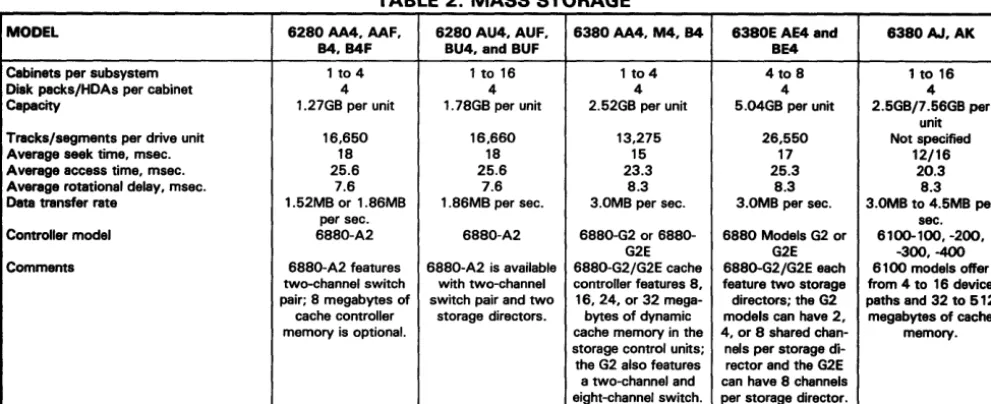
TABLE 2. MASS STORAGE
MODEL 6280 AA4, AAF, 6280 AU4, AUF, 6380 AA4, M4, 84 6380E AE4 and 6380AJ,AK 84,84F BU4, and BUF BE4
Cabinets per subsystem 1 to 4 1 to 16 1 to 4 4 to 8 1 to 16
Disk packs/HDAs per cabinet 4 4 4 4 4
Capacity 1.27GB per unit 1.78GB per unit 2.52GB per unit 5.04GB per unit 2.5GB/7.56GB per unit Tracks/segments per drive unit 16,650 16.660 13.275 26,550 Not specified
Average seek time. msec. 18 18 15 17 12/16
Average access time. msec. 25.6 25.6 23.3 25.3 20.3 Average rotational delay, msec. 7.6 7.6 8.3 8.3 8.3
Data transfer rate 1.52MB or 1.86MB 1.86MB per sec. 3.0MB per sec. 3.0MB per sec. 3.0MB to 4.5MB per
per sec. sec.
Controller model 6880-A2 6880-A2 6880-G2 or 6880- 6880 Models G2 or 6100-100, -200, G2E G2E -300, -400 Comments 6880-A2 features 6880-A2 is available 6880-G2/G2E cache 6880-G2/G2E each 6100 models offer
two-channel switch with two-channel controller features 8, feature two storage from 4 to 16 device pair; 8 megabytes of switch pair and two 16.24, or 32 mega- directors; the G2 paths and 32 to 512 cache controller storage directors. bytes of dynamic models can have 2, megabytes of cache memory is optional.
t>
a year earlier. Amdahl continued its momentum into 1988, reporting three successively strong quarters includ-ing the best first and second quarter results in its history. For the first nine months of 1988, Amdahl earned $150 million on revenues of $1.3 billion. This compares to net income of $93 million on revenues of $1 billion for the first nine months of 1987. Towards the end of the second half, Amdahl launched the 5990 Series, its new mainframe generation, even though the 5890 continued to sell well. The company also brought out new triple-density disks, new communications processors, and enhanced its MDF to complete the overhaul of the Amdahl line. Indeed, Amdahl is on a roll.The Amdahl success story should continue for some time, but analysts believe the company will be facing product transition problems ahead. Any company which, like Am-dahl, must respond to IBM product cycles, inevitably ex-periences financial ups and downs.
The success of its 5890 line, in contrast to the sluggish response to earlier versions of the IBM 3090, its targeted rival system, helped Amdahl increase sales and improve market share at IBM's expense. As of 1987, Amdahl owned a 6.1 percent share of the worldwide large-systems market. This represents a worldwide shipment value of $1.1 billion, according to International Data Corporation (IDC), the Framingham, Massachusetts market research firm. In 1986, Amdahl shipment value totaled $750 mil-lion, giving the company a 4.3 percent market share, by IDC estimates. By contrast, IBM worldwide market share fell from 74.6 percent in 1986 to 72.8 percent in 1987.
While Amdahl has tried to diversify its product line by adding storage products, communications hardware, and software and support services, mainframe sales still ac-count for an estimated 71 percent, in 1987, according to a Drexel Burnham Lambert Inc. report. Disk products ac-counted for 22 percent; communications equipment for 6 percent; and education, software, and services for 1 per-
t:>
cache memory in the 4. or 8 shared chan- memory. storage control units; nels per storage
di-the G2 also features rector and the G2E a two-channel and can have 8 channels eight-channel switch. per storage director.
~ In 5890 systems, the console subsystem consists of oper-ator consoles, a System Support Processor, Console Sup-port Processor, and System Activity Monitor. Operator consoles include a system console to handle system con-trol functions and monitoring; a backup operator console to handle controlling and monitoring functions that in-volve the System Control Program; a maintenance con-sole to monitor system functions and to diagnose problems; and an AMDAC console for communicating between dual-processor systems and the AMDAC. The main operator console contains a hard disk drive, diskette drives, modem, operator terminal, and mainte-nance panel with associated switches and lights. The System Support Processor handles system initializa-tion and reset, monitoring, diagnostic, and system recov-ery and repair functions. The SSP includes a processor, a hard disk, two diskette drives, up to four terminals, and a modem for connection to the AMDAC.
The System Activity Monitor displays system status in-formation, such as CPU busy or channel busy. The mon-itor formats data in rows, columns, and graphs. Up to 18 horizontal graphs together with titles and headings can be displayed.
AMDAHL 5990 SERIES CENTRAL PROCESSOR CHARACTERISTICS: Amdahl 5990 processors are based on very large-scale integration (VLSI) technology implemented in ECL. VLSI logic chips contain up to 3,000 logic circuits and VLSI register chips can contain up to 10,000 logic circuits. One VLSI chip implemented in ECL contains both logic and high-speed RAM. It can contain up to 1,200 logic circuits and up to 16 kilobits of RAM. This chip type is used in buffer and control stor-age. A 16-kilobit LSI chip, with access time of 15 nano-seconds, is used for storage keys and in main storage. VLSI chips and main storage array cards are packed and mounted on subsystem carriers (SSCs), the principal building block of 5990 processors. These SSCs, contain-ing up to 42 layers, can be either water cooled or air cooled. Water-cooled SCCs are encased in a conductive cooling module (CCM), which allows chilled water to flow through it to cool the SCCs. CPUs, MCUs, and Channel Subsystem Processors (CSPs) are water cooled. MSUs and non-SSC components are air cooled. Dense SSC packaging allows key components such as the CPU ~
COPYRIGHT © 1989 McGRAW-HILL. INCORPORATED. REPRODUCTION PROHIBITED DATAPRO RESEARCH. DELRAN NJ 08075 USA
70C-035MM-107 Computers
Amdahl 5890/5990 Series
t>
cent of revenues. Amdahl competes exclusively in the large-systems area, believing the big boxes generate enough margin to support substantial research and devel-opment expenditures. Since shipping its first systems in the mid-1970s, Amdahl has built an installed user base of about 2,000 systems, by industry estimates. The size of the base is critical to continued survival in this industry since mainframe vendors generate revenues over the long haul by selling upgrades and support services primarily to existing customers.Amdahl next faces the challenge of moving 580 and 5890 customers to its 5990 follow-on series. The company mounted an industry coup when it introduced the first System/370-based mainframe to exceed the 100 MIPS mark. The advantage was short lived, however. In July, IBM finally brought out its anticipated 3090 S, a 10-model series featuring 15 to 25 percent better price/performance than its previous 3090 E models. In response, Amdahl announced a new round of mainframe price reductions in August to maintain its traditional price/performance edge. The company reduced 5890/5990 prices by 10 to 14 per-cent and the cost of upgrades by 12 to 17 perper-cent. The company also raised 5890 maintenance prices by 5 per-cent. The top-end Amdahl 5990 Model 1400 now sells for about $98,260 per MIPS compared to the top-end IBM 3090 Model 600S selling for $115,235 per MIPS. At the bottom end, Amdahl's single-processor 5890 Model 190E sells for $106,818 per MIPS compared to the 3090 180S selling for $107,317 per MIPS.
On a pure performance level, Amdahl and IBM machines compare well on a model to model basis. Amdahl, how-ever, still rightly contends that its 5990 single-processor performance exceeds IBM's. Amdahl reduced cycle time on its 5990 processors to 10 nanoseconds compared to IS nanoseconds for the new IBM S models.
Outside of pure price/performance considerations, the new Amdahl models feature an expanded storage capabil-ity, a feature required to run the new IBM MVS/ESA operating system. They also feature an enhanced MD F facility, a key Amdahl selling point, and the capability of running the UNIX operating system natively. MDF has proved to be so popular, IBM began offering the PRISM logical partitioning feature for 3090 mainframes. IBM does not offer a native version of mainframe UNIX, how-ever. AIX/370, IBM's version of UNIX, can only run as a guest under VM.
In addition to its basic price/performance strengths, Am-dahl must contend with some competitive weaknesses. At the moment, Amdahl offers only two 5990 models, while IBM's 10 new S models provide existing 3090 customers IS-fold growth in performance from entry-level model to top-end system. IBM has also made it easy for 3090 base model customers and 3090 E users to migrate to the S models using up to 67 upgrade paths. Amdahl 5890 users planning to move to the 5990s will face a processor
swap-out.
t>
. . to be implemented on a single SSe. A dual processor with standard configuration consists of five SSCs, while a standard configuration multiprocessor uses 10 SSCs.
The six functional units that compose a 5990 processor are the CPU, Main Storage Unit (MSU), optional Ex-panded Storage Unit (ESU), Channel Processor (CP), and Service Processor (SVP).
The 5990 CPU consists of the Instruction Unit (I-Unit), the Execution Unit (E-Unit), and the Storage Unit (S-Unit). The I-Unit manages the instruction stream, pre-pares instructions for execution, directs their execution, delegates work to the S-Unit and E-Unit, and handles interrupts. The I-unit contains two pipelines to speed up execution, the instruction fetch pipeline and the main instruction pipeline. The instruction fetch pipeline sets up the next available instruction for the main pipeline. The main instruction pipeline can simultaneously process an instruction in six stages of execution.
The E-Unit executes instructions set up by and received from the I-Unit. The E-Unit contains the addressable register complex (ARC), arithmetic and logical units (ALUs), and control storage.
The S-Unit manages storage for the CPU. To enhance throughput and reduce time-consuming fetches to main storage, the I-Unit and E-Unit access copies of the main storage data from S-Unit high-speed local buffer storage.
The Memory Control Unit coordinates communication, data transfer, and other activities for CPUs, MSUs, ESUs, and CHPs. These units and the System Console Interface (SCI) are all connected to the MCU. Except for the SCI, all these units communicate with one another through the MCU. In multiprocessors, two MCUs are connected to coordinate storage accesses between sides.
The SCI connects the SVP to the system. Among other activities, the SCI transfers commands from the SVP to the system and sends interrupts from the system to the SVP. In multiprocessor configurations, two SCIs com-bine to make one console interface for a single controlling SVP.
The SVP controls and operates the system complex and performs diagnostic and maintenance functions. Main Operator and Remote Operator Consoles attach to the SVP. Through main and remote consoles, operators can perform power-on and power-off and reset functions and also perform initial-microprogram-Ioad (IMPL) and initial-program load (IPL) functions. Users can also cre-ate, modify, and control domains; (refer to SPECIAL FEATURE section for further explanation of domains) reconfigure CPU s, channels, and storage; and display or update the contents of registers or storage.
SVP maintenance functions include machine check pro-cessing, power, cooling and environmental monitoring, diagnostic analysis, and connection of SVP to an AM-DAC using the SVP communications adapter.
The Amdahl 5890/5990 operates in the Extended Con-trol (EC) mode. In the EC mode, the Program Status Word (PSW) and the layout of the permanently assigned lower main storage area are altered to support Dynamic Address Translation (DA T) and other new system con-trol functions; therefore, virtual-storage-oriented operat-ing systems must be used.
The 5890/5990 can also operate in Extended Architec-ture (XA) mode. This capability supports 31-bit address- . . ing with real and virtual address sizes of 2 billion bytes.
70C-035MM-108
Computers
Amdahl 5890/5990 Series
t>
To make the 5990 transition less painful, Amdahl has developed the Inter-Series Upgrade Program (ISUP). The program provides an upgrade path to the 5990 Model 700 and "a cost-effective entry into the 5990 Series," by Am-dahl's description. Under ISUP, a user can return a 5890-300E to Amdahl and pay an announced ISUP charge in exchange for a 5990 Model 700 of equal memory and channel configuration. Users with various 5890 systems must upgrade or downgrade to a Model 300E to take advantage of the offer. The ISUP program went into affect on January 1, 1989 subject to the availability of the hard-ware.While the IBM/Amdahl rivalry rages, Amdahl cannot af-ford to ignore developments brewing at NAS, its PCM rival. Last year, NAS launched the new AS/EX Series, the company's response to the 3090 S models and the Amdahl 5990 Series. The series represents a merging of the previ-ous AS/VL medium-range series and the AS/XL large-scale series. Interestingly, the new product offering is no match for the 3090 S series and 5990 Series at the high end of the performance range.
ADVANTAGES AND RESTRICTIONS
Amdahl offers a range of IBM-compatible mainframes and storage devices that offer IBM users a price/ performance alternative to IBM 3090 mainframes and storage devices. Quite simply, this continues to be the primary reason users consider an Amdahl mainframe over an IBM mainframe. Over the years, Amdahl has main-tained its traditional 15 to 20 price/performance edge over comparable IBM systems, while also maintaining IBM software compatibility.
The latest PCM challenge came early last year when IBM announced MVS/ESA, its newest operating environment. Amdahl has assured customers it will adapt its systems to ESA with minimal difficulty by the fourth quarter. Am-dahl believes the ESA changes present less severe difficul-ties than the IBM MVS/XA conversion of the early 1980s.
The new 5990 models already accommodate an optional Expanded Storage feature, a component Amdahl ma-chines must have to implement ESA effectively. Under MVS/XA, Expanded Storage eased the paging and swap-ping load and enhanced throughput. Under ESA, Ex-panded Storage is expected to play an even bigger role in extended addressing and storage constraint relief. The 5990 Model 700 can have up to one gigabyte of expanded storage, while the Model 1400 can have up to two gi-gabytes of expanded storage, the same as IBM.
The 5990 Expanded Storage option is a vast improvement over the Expanded Storage feature available for the 5890 Series. The 5890 approach allows users to allocate a por-tion of main memory for expanded storage at system initialization time. Since 5890 machines are limited to a
I:>
~ Normal EC mode supports 24-bit addressing with a max-imum of 16 million bytes of real and virtual address space per user program. The 5890/5990 support a dy-namic channel subsystem and bimodal operation, which permits user programs with 24- and 31-bit addresses to execute concurrently.
Sixteen 32-bit general registers are used for indexing, base addressing, and as accumulators. Other program-visible registers are the same as in the System/370. Machine-dependent registers contained in the 5890/5990 processors are not visible to the user and may differ from the System/370.
The Amdahl 5890/5990 instruction set consists of the complete System/370 Universal Instruction Set, includ-ing the five System/370 instructions for Dynamic Ad-dress Translation.
SPECIAL FEATURES: Amdahl features of special note include the Multiple Domain Feature and Expanded Storage, implemented differently on the 5890 and 5990 systems. These and other features are described below.
The Multiple Domain Feature lets users consolidate mul-tiple computer systems into a single processing complex, and operate multiple System Control Programs (SCPs) on a single processor. Each SCP resides in a domain, which has all the resources necessary to operate the SCPo The MDF supports up to four domains for a 5890 single or dual processor and on the 5990-700 dual pro-cessor. A 5990-1400 multiprocessor running in single-image mode supports up to seven domains. In partitioned mode, each side supports up to four domains.
Features include concurrent native support of S/370 and 370-XA; performance of at least 95 percent of native mode; no additional SCPs or software modifications re-quired; hardware isolation and protection for each do-main; dynamic allocation and redistribution of CPU time; flexible allocation of main memory and channels from a resource pool; full-screen menus; and predefined domain characteristics. The characteristics of the domain (archi-tectural mode, amount of main storage, Expanded Stor-age, channels, and CPU time allocation) are specified during domain definition and are entered at the MDF master console. The domain console is identified during domain definition, and can either be a Main Operator Console (MOC) or a Remote Operator Console (ROC). The MOC may be used for both the MDF master con-sole and the domain concon-sole functions, but Amdahl rec-ommends that the MDF master console be assigned to the MOC and each domain console be assigned to a separate ROC.
Main storage is allocated to each domain in multiples of 64 kilobytes. The MDF provides support for MVS/370, MVS/XA, VM/SP HPO, and UTS software environ-ments. If the MDF feature is removed, the system is restored to its original configuration. The MDF makes it possible to test SCPs and applications during prime shift without the need for separate processors. It also lets users convert from one SCP to another, or to convert subsystems and applications. Finally, the feature lets users move operations running on multiple systems to a single system. By doing this, Amdahl contends, users can reduce operating and software costs.
MDF enhancements augment I/O capabilities, monitor-ing, capacity plannmonitor-ing, and dynamic redistribution of central processing time. With the addition of an I/O Configuration Facility (IOCF), users can attach a larger ~
COPYRIGHT © 1989 McGRAW-HILL. INCORPORATED. REPRODUCTION PROHIBITED DA T APRO RESEARCH. DELRAN NJ 08075 USA
70C-03SMM-109 Computers
Amdahl 5890/5990 Series
t>
maximum capacity of 512 megabytes, users are forced to reduce main memory capacity to create an Expanded Storage section.On the hardware level, Amdahl machines require less floor space, consume less power, and generate less heat than comparable IBM 3090 mainframes. These features, of course, reduce power and air-conditioning require-ments.
Faster single-processor performance also allows Amdahl to match or exceed the performance of comparable IBM machines using fewer processors. An IBM Model 600S, for example, rated at 102 MIPS, requires six processors, consumes a maximum of 105.8kVAs at 400 Hz, and gen-erates a maximum of 223.8 Btu of heat to water per hour. It also occupies 974 square feet of floor space including service clearances at maximum configuration and weighs 31,590 pounds.
Amdahl's top-end Model 1400, rated at 115 MIPS, com-petes against the IBM Model 600S. The Model 1400 uses four processors, two fewer than the Model 600S. Config-ured with 128 megabytes of memory and 64 channels, the Model 1400·consumes 36.7kVAs at 400Hz and produces 138.6 Btu of heat per hour. It occupies 504.7 square feet of floor space including service clearances and weighs 17,401 pounds.
Its faster and denser 5990 mainframes forced Amdahl to move to water cooling. The earlier 5890 systems are air cooled. To ease users' transition to water cooling, Amdahl adopted an integrated closed-loop system that· makes the machine appear to users as an air-cooled system. Addi-tionally, only CPUs, the Memory Control Unit, and Channel Subsystem Processors are water cooled. The Memory Storage Unit and components that don't use Subsystem Carriers (SSCs) will continue to be air cooled.
SSC, the basic building blocks of 5990 mainframes, are either water cooled or air cooled. Water-cooled SSCs are encased in a conductive cooling module (CCM). A coolant distribution unit circulates through the CCM's water chilled externally by existing underfloor air-conditioning. The entire closed loop system is an integrated part of the 5990 Series. Customers are not required to install external plumbing. By contrast, IBM 3090 users must install spe-cial plumbing and also purchase a separate Power and Coolant Distribution Unit costing up to $121,000.
As noted in the COMPETITIVE POSITION section, us-·ers planning to migrate from the 5890 Series to the 5990
Series face a processor swap-out. At this stage in the Am-dahl product cycle, users may not be prepared for this move, particularly since the 5990 continues to compete against the IBM 3090 generation, which will be around probably for another two years.
In addition to Amdahl's key price/performance strengths, the company continues to offer products that differentiate
t>
~ number of devices to the system. Up to 16,384 physical devices can be attached, with up to 65,536 subchannels per system. The new 10CF allows each domain to have its own independent input/output configuration dataset. With a new time distribution capability, MDF dynami-cally adjusts how much CPU time each domain can use to meet actual requirements. Under this arrangement, MDF can subtract CPU time from a domain with low activity and allocate the time to a domain with high activity. Reallocation is based on user-defined, CPU-shared parameters.
The Dynamic Storage Reconfiguration (DSR) feature lets users dynamically reallocate main and expanded storage among domains without disrupting processor operation. DRS lets users move, add, or delete allocated memory from one domain to another to meet changing operational needs. The feature helps operators provide more re-sources to· certain domains to increase throughput. In a typical application, for instance, operators can take mem-ory allocated to a deactivated domain and shift it to domains that need more memory resources at a given time.
An optional interface, MDFW A TCH, lets software mon-itors report CPU usage in a domain as a percentage of system usage. Machine Readable Scheduler Data (MRSD), another optional interface, lets a program run-ning in a domain retrieve statistics from MDF on domain CPU allocation. These statistics help users plan capacity more accurately for domains and for the total system. In addition to the MDF option, 5890/5990 processors feature Macrocode, a class of firmware used to create and maintain a processing environment for an SCP. Macro-code provides facilities to manipulate resources associ-ated with a dual processor complex. It also includes model-dependent logout and recovery; configuration facil-ities that define what resources have been allocated to a domain; and facilities for creating, editing, saving, and invoking sets of operator commands called function lists. The optional Channel-to-Channel Adapter (CCA) per-mits direct communications between an Amdahl 5890
and an IBM mainframe via a standard I/O channel. It
can be attached to a block mUltiplexer channel and uses one control unit position on either channel. In an inter-connection between an Amdahl 5890 and an IBM proces-sor, either system can be equipped with the Channel-to-Channel Adapter, and it is required on only one of the interconnected channels. Up to four CCAs can be
in-stalled on a 5890 single or dual processor. ~
70C-035MM-110 Computers
Amdahl 5890/5990 Series
t>
the Amdahl line from IBM. The Multiple Domain Fea-ture is often credited with bringing new accounts into the Amdahl fold because it offers users something more than just better price/performance. The optional MDF feature lets users consolidate multiple System Control Programs (SCPs) on a single processor. MDF supports up to four domains on a 5890 single or dual processor and on the 5990-700 dual processor. A 5990-1400 multiprocessor running in single-image mode supports up to seven do-mains. In partitioned mode, each side supports up to four domains.Users can operate MVS/XA in one domain and XA test work in another domain without either one interfering with the other. Users can also set up separate domains to run CICS, TSO, and general MVS production work. Each domain can be assigned a subset of main storage, chan-nels, and processing time that correspond to the needs and requirements of each operating environment. (Please refer to the MANAGEMENT SUMMARY section for details about MDF enhancements.)
In the peripheral area, Amdahl remains competitive in the high-capacity disk storage area with the introduction of the 6100 Storage Control Unit and 6380 Models J and K DASDs. As noted in the MANAGEMENT SUMMARY section, Amdahl uses smaller platters to reduce access time. The 6100 controller also uses larger cache sizes (up to 512 megabytes) and more data paths (up to 16) than competing systems.
On the minus side, Amdahl does not offer comparable IBM-compatible tape drives and printers. This may be a disadvantage for Amdahl customers looking for Amdahl alternatives for these peripheral devices.
USER REACTION
Datapro's 1988 survey of mainframe users drew responses from seven Amdahl users. Of the seven rated systems, there are two 5890-180Es, one 5890-200E, one 5890-190E, and two 5890s not specified by model. Additionally, one site uses a 5860, a system no longer actively marketed. Most of the systems were installed during 1987 and 1988. The 5860 was installed in December 1984. No 5990 users responded to the survey. The average age of these in-stalled systems was 14.4 months at the time the survey was taken. Five of the respondents said they purchased their systems from Amdahl, while the remaining two leased from a third-party leasing organization.
Amdahl users surveyed represented a mix of industries: two public utilities, two insurance companies, one service bureau, one government agency, and one educational in-stitution. Two of the sites represent organizations employ-ing more than 10,000. Three sites employ between 1,000 and 10,000, and two sites employ between 100 and 250. Two sites had annual revenues of $100 million to less· than $1 billion, and two others had revenues exceeding $1 billion. Two others had annual revenues of $5 million to
~ PHYSICAL SPECIFICATIONS: Environmental re-quirements for 5890/5990 processors are included in the following table:
Temperature Range
5890 models: 60° to 90° F (16° to 32° C)
5990 models: 59° to 90° F (15° to 32° C)
Underfloor Temperature
5890 models: 50° to 66° F (10° to 19° C)
5990 models: 50° to 72° F (10° to 22° C)
Relative Humidity Range (noncondensing)
5890 models: 20% to 80% 5990 models: 20% to 80% Heat Output (Btu/hr)
5890 models: 68.5 to 186.0 5990 models: 69.3 to 138.6 Power Consumption
5890 models: 0.41 to 16.8kVA at 50 Hz
7.1 to 16.4kVA at 60 Hz 21.6 to 67.2kVA at 400 Hz
5990 models: 3.5 to 7.0kVA at 50 Hz
3.5 to 7.0kVA at 60 Hz
18.4 to 36.7kVA at 400 Hz Floor Space and Weight
with service clearances:
5890-180E, -190E with 232.4 sq ft, 6,461 lb 32 megabytes of memory
and 16 channels
5890-200E, 300E with 64 232.4 sq ft, 6,971 lb megabytes of memory and
32 channels
5890-390E with 256 442.1 sq ft, 12,972 lb megabytes of memory
and 64 channels
5890-400E, -600E with 442.1 sq ft, 13,480 to 128 megabytes of memory 13,992 lb
and 64 channels
5990-700 with 64 mega- 271.6 sq ft, 8,699 lb bytes of memory and
32 channels
5990-1400 with 128 504.7 sq ft, 17,401 lb megabytes of memory
and 64 channels
CONFIGURATION RULES
The 5890 Models 180E and 190E single processors feature 32 megabytes of main memory (expandable to 256 mega-bytes), and 16 channels (expandable to 48 channels), one Main Operator Console (MOC), one Power Distribution Unit (PDU), optional Multiple Domain Feature (MDF), four optional Channel-to-Channel Adapters (CCA), three optional Remote Operator Consoles (ROC), and one Hard-ware Monitor Attachment Feature (HMAF).
The 5890 Models 200E and 300E dual processors feature 64 megabytes of main memory (expandable to 256 mega-bytes), 32 I/O channels (expandable to 64 channels), one MOC, one PDU, an optional MDF, up to four optional CCAs, three ROCs, and two HMAFs.
COPYRIGHT © 1989 McGRAW-HILL, INCORPORATED. REPRODUCTION PROHIBITED DA T APRO RESEARCH, DELRAN NJ 08075 USA
JANUARY 1989
70C-035MM-111 Computers
Amdahl 5890/5990 Series
t>
less than $25 million. (One respondent did not answer the ~question.) The user mix even in this relatively small sam-pling seems to typify Amdahl's market. Since the vendor has targeted the high end of the performance range exclu-sively, accounts will tend to be big companies that prefer big mainframes.
Principal applications respondents cited most often were accounting and billing (four sites), engineering/scientific (three sites), payroll/processing (three sites), insurance (two sites), and petroleum/fuel analysis (two sites).
To determine a typical configuration mix among the Am-dahl sites surveyed, users were asked to specify the size of their terminal and memory configurations. Four Amdahl sites have more than 240 local workstations and six sites have more than 240 remote workstations. In the memory area, three sites have 64 to 128 megabytes of main mem-ory and one has more than 128 megabytes of memmem-ory. Three sites have between 16 and 64 megabytes of mem-ory. In the disk capacity area, the six who responded split three ways. Two have between 10 and 50 gigabytes of capacity; two have between 150 and 250 gigabytes of ca-pacity, and two have more than 250 gigabytes.
Users who install IBM-compatible equipment tend to be an adventurous lot who have little problem with main-taining a multivendor installation. The 1988 results reflect this. Out of the seven respondents, two installed IBM disk products, while the rest installed plug-compatible equip-ment from either Amdahl, Storage Technology, NAS, or Memorex.
In the software area, all seven sites run under IBM MVS/ XA. Two sites also use VM. Interestingly, no respondents reported using Amdahl's version of UNIX, UTS, and none had any plans to acquire a UNIX operating system. As expected, Amdahl sites continue to be primarily Cobol shops. As part of their future buying plans, two respon-dents said they plan to acquire more software from either IBM or Amdahl and five said they plan to obtain it from other suppliers. Three respondents also said they plan to expand hardware, and five specifically said they planned to acquire laser printers. They will have to acquire the laser printers through other vendors since Amdahl does not sell printers.
As part of the survey, users were asked to rate their Am-dahl equipment from excellent to poor using a 1-to-l0 point scale. One is the lowest possible score and ten is the highest. The following table lists scores in the form of a weighted average; the larger the weighted average is the higher the score. The 10-point scale replaces the four-point weighted average used in previous years.
In the 1988 survey, Amdahl repeated its strong 1987 showing and once again either topped the ratings in many key categories or came in a close second. It should be noted, however, that 29 users responded to the 1987 sur-vey, while only seven responded to the 1988 survey. Out of six mainframe vendors, Amdahl came out first in Over-
t>
The 5890 Model 390E two-way multiprocessor features 256 megabytes of main memory (expandable to 512 mega-bytes), 64 channels (expandable to 96 channels), two MOCs, two PDUs, optional MDF, up to six ROCs, up to eight CCAs, and two HMAFs.
The 5890 Model 400E three-way multiprocessor features 128 megabytes of memory (expandable to 512 megabytes), 64 I/O channels (expandable to 112 channels), two MOCs, two PDUs, optional MDF, up to eight optional CCAs, six optional ROCs, and three HMAFs.
The 5890 Model 600E four-way multiprocessor features 128 megabytes of main memory (expandable to 512 mega-bytes), 64 channels (expandable to 128 channels), two MOCs, two PDUs, optional MDF, up to eight optional CCAs, up to six ROCs, and four HMAFs.
The 5990-700 dual processor features· 64 megabytes of main memory (expandable to 256 megabytes), 128 mega-bytes to 1 gigabyte of optional expanded storage, 32 chan-nels (expandable to 64 chanchan-nels), one MOC, one Coolant Distribution and Control Unit (CDCU), optional MDF, and optional ROC.
The 5990-1400 four-way multiprocessor features 128 megabytes of main memory (expandable to 512 mega-bytes), 128 megabytes to 2 gigabytes of optional expanded storage, 64 channels (expandable to 128 channels), 2 MOCs, two CDCUs, optional MDF, and two optional ROCs.
INPUT/OUTPUT CONTROL
The 5890 Input/Output Processor (lOP) consists of three components, the I/O Controller (IOC), the Bus Handler, and the Interface Handlers associated with the channels. An lOP can support up to 16 I/O channels and each channel can have up to 256 subchannels. Channels may be configured as either byte multiplexer or block multiplexer channels.
A block multiplexer channel can operate in either interlock mode or datastreaming mode. Channel data rates in inter-lock mode are 1.86 megabytes per second, and channel rates in datastreaming mode are 3.0 or 4.5 megabytes per second. In addition to block multiplexers, users can option-ally configure up to four channels per lOP as byte multi-plexer channels.
Amdahl 5890 users can configure from 12 to 32 optional byte multiplexer channels, depending on size of machine. Byte multiplexer channels can transfer data in byte inter-leave mode at a maximum rate of 40 kilobytes per second, or in burst mode at a maximum data rate of 200 kilobytes per second. Refer to Table 1 for specific byte and block multiplexer combinations per model.
Data flowing in and out of the lOP moves over the 5890's A- and B-buses. These buses are a connecting link for the major system components. The Bus Handler is the inter-face to the A-Bus and B-Bus for the lOP and provides data buffering when needed. The 10C provides the processing capabilities of the lOP, and manages the Bus Handler and Interface Handlers. Interface Handlers provide a logical and electrical link to the peripheral device control units. They perform data transfer functions, including channel bus and tag manipulation and data buffering.
The Channel Processor (CHP) handles I/O operations in 5990 processors. A single CHP processes I/O operations for up to 64 channels. Dual processors use one CHP and
IU\.r-U.,OIVlIVl- II tt£
Computers
Amdahl 5890/5990 Series
t:>
all Satisfaction, Education, and several software catego-ries. The company came in second in maintenance and support categories. That it should get high grades in soft-ware is ironic since the company's machines run IBM software, which scored relatively lower among IBM hard-ware users. Amdahl's high softhard-ware marks are probably attributable to its high grades in the maintenance and support area. When users are happy with a vendor's main-:-tenance and support they tend to like the products better, even when the products are acquired from another ven-dor, namely IBM.Results are summarized below.
Ease of operation Reliability of system Reliability of peripherals Maintenance service:
Responsiveness Effectiveness Technical support:
Troubleshooting Education Documentation Vendor's software:
Operating system Compilers & assemblers Application programs Ease of programming Ease of conversion Overall satisfaction
Amdahl 5890 User Ratings
8.7 9.1 8.1
8.8 9.2
9.0 8.7 8.8
9.0 9.0 9.0 8.4 8.5 8.6
*Average based on a scale from 1 (Poor) to 10 (Excellent).
All seven Amdahl users said their systems did what they expected them to do, and six said they would recommend their systems to other users. One was undecided. D
~ multiprocessors use two. The CHP consists of the channel manager, four data managers, up to four I/O servers, and a storage server.
The channels themselves can be either byte or block multi-plexers. A block multiplexer channel has a maximum transfer rate of 4.5 megabytes per second. A byte multi-plexer has a maximum data rate of 75 kilobytes per second in byte mode or 1 megabyte per second in burst mode. All channels can transfer data at their maximum rates.
The channel manager, a microprogrammed unit that han-dles all 64 channels, initiates and terminates I/O opera-tions. Each CHP contains four data managers, which each handles up to 16 channels and executes the channel pro-gram of the channel manager. Each CHP also contains up to four I/O servers. These servers handle the physical I/O interface and are an extension of the data manager. Up to 16 channels can be connected to one server. CHPs interface the MCU and main storage through the storage server. Data transfer in an I/O operation occurs between a channel and main storage.
MASS STORAGE
Amdahl offers the 6000 Series of Disk Storage Units (DSU) for the Amdahl 5890 and 5990 Series. Logical and physical 6000 Series characteristics are listed in Table 2.
The Amdahl 5890/5990 Series can also use all IBM and 30XX input/output and mass storage devices as well as their plug-compatible counterparts from independent ven-dors. Please refer to Volume 2 for detailed coverage of these peripherals.
INPUT/OUTPUT UNITS
Amdahl does not offer tape units or printers.
TERMINALS
Amdahl does not offer terminals.
COMMUNICATIONS
The Amdahl 4745 Communications Processor Series con-sists of the Models 110 and 210. The Model 210 is de-signed to fit into medium-to-Iarge SNA networks, while the Model 110 is designed for smaller, high-speed require-ments such as remote concentration. Both models can run either IBM 3725 Communication Controller ACF /NCP software or IBM 3745 ACF/NCP software.
Amdahl users who installed the earlier Amdahl 4725 Com-munications Processor can upgrade to the 4745. Likewise, 4745 Model 110 machines can be upgraded to the Model 210. Additionally, 4745 machines running NCP Version 3 or 4 can be upgraded to run NCP Version 5.
The Model 210 supports up to 256 half- or full-duplex lines and six channel adapters. The Model 110 supports up to 64 lines and two channel adapters. Line rates vary from 50 bits to 256 kilobits per second. The Model 210 supports up to four megabytes of memory and the Model 110 up to two megabytes.
The machines are IBM compatible and can be intermixed in networks with Amdahl's earlier 4725 and 4705 models (no longer marketed) and IBM's 3745, 3725, 3720, and 3705 communications controllers.
SOFTWARE
OPERATING SYSTEMS: Amdahl offers complete soft-ware compatibility with IBM 370-type mainframe architec-ture. Operating systems supported include MVS/370, MVS/XA, VM/XA, VM/SP HPO, VM/SP, ACP, and ACP/TPF. Amdahl will also support MVS/ESA, IBM's newest MVS version, by the fourth quarter of 1989. Am-dahl also supports such major IBM subsystems as TSO, TCAM, JES2, JES3, VTAM, RSCS, CMS, and IPCS.
Universal Timesharing System (UTS): Current Amdahl UTS products include UTS/V Release 1.1, UTS Release 1.1, and UTS Release 1.2. Based on AT&T's UNIX Sys-tem V, UTS Release 1.2 can run as a native standalone operating system on Amdahl mainframes or as a guest under VM. Additionally, UTS can share resources with other standard IBM mainframe operating environments using the Amdahl Multiple Domain Feature.
UTS Rl.2 includes System V Interface Definition exten-sions to support a large-systems environment. UTS sup-ports an optimized standard C compiler for System/370 architecture, Fortran 77, and an ANSI standard Pascal compiler. Additionally, UTS supports MVS/XA address-ing, IBM 3270-terminal compatibility, remote job entry, bisynchronous communications, and related networking
COPYRIGHT © 1989 McGRAW-HILL, INCORPORATED. REPRODUCTION PROHIBITED DA T APRO RESEARCH, DELRAN NJ 08075 USA
70C-035MM-113 Computers
Amdahl 5890/5990 Series
and communications support. Full-duplex ASCII communi-cations is supported with the addition of UTS/F Release 1.2, a companion product.
MULTIPLE DOMAIN FEATURE: This hardware fea-ture lets users run mUltiple System Control Programs (SCPs) on a single processor. Each SCP is assigned to a domain, which operates as an independent computing envi-ronment with its own system resources. Please refer to the SPECIAL FEATURES section for a fuller description.
PROGRAMMING LANGUAGES: Amdahl systems run IBM languages and compilers. Please refer to the IBM 3090 report for details about packages and products under this category
DATA BASE MANAGEMENT: Amdahl systems run IBM data base management packages. Please refer to the IBM 3090 report for details about packages and products under this category.
DATA MANAGEMENT: Amdahl systems run IBM data management systems. Please refer to the IBM 3090 report for details about packages and products under this cate-gory.
DATA COMMUNICATIONS: Amdahl communications processors are compatible with IBM communications soft-ware and operating systems. Please refer to the COMMU-NICA TIONS section in this report and also the IBM 3090 report for details about packages and products under this category.
UTILITIES: Please refer to the IBM 3090 report for de-tails about packages and products under this category.
OTHER SOFTWARE: Amdahl supplies two performance tools called Modeling and Analysis Package (MAP) and System Utilization and Reporting Facility IIMS (SURF
1
IMS).PRICING &. SUPPORT
POLICY: The Amdahl 5890/5990 Series models are of-fered for purchase or for lease under monthly rental terms. Specific multiple-year lease plans should be worked out with Amdahl.
SUPPORT: Lease charges include maintenance. System-level maintenance pricing is listed in the price list at the end of this report. This covers 24 hours per day, seven days per week. Product-level maintenance, another maintenance option, covers 11 hours per day, five days per week.
EDUCATION: Amdahl offers courses and consulting ser-vices through its Education and Professional Serser-vices Divi-sion. Amdahl currently offers more than 50 Systems Education courses covering such areas as MVS, VM, Com-munications Systems, and Data Systems. Amdahl's Sys-tems Consulting Services provides consulting for DP managers and staff. In addition to consulting services, Con-sulting Services also offers seminars and workshops.
TYPICAL CONFIGURATION: Except for disk storage products, Amdahl does not offer its own terminals, print-ers, tape drives, and other supporting devices, making it impractical to suggest a typical configuration cost.
EQUIPMENT PRICES
PROCESSORS AND MAIN MEMORY
5890 PROCESSORS
Model 180E CPU Complex; includes 32MB of main memory, one 64KB buffer and one 32KB buffer, 16 channels, one console, and one power distribution unit
Model 190E CPU Complex; includes 32MB of main memory, one 64KB buffer and one 32KB buffer, 16 channels, one console, and one power distribution unit
Model2ooE CPU Complex; includes 64MB of main memory, one 64KB and one 32KB buffer per CPU, 32 channels, console, and power distribution unit
Model300E CPU Complex; includes 64MB of main memory, one 64KB and one 32KB buffer per CPU, 32 channels, console, and power distribution unit
Model 390E CPU complex; includes two CPUs, 256MB of main memory, 64KB buffer and one 32KB buffer per CPU, 64 channels, two operator consoles, and two power distribution units Model4ooE CPU complex; inCI:ludes three CPUs; 128MB of main memory, one 64KB buffer and one
32KB buffer per CPU, 64 channels, two consoles, and two power distribution units Model6ooE CPU Complex; includes 128MB of main memory, one 64KB and one 32KB buffer per
CPU, 64