358
Hearst Patterns Revisited:
Automatic Hypernym Detection from Large Text Corpora
Stephen Roller, Douwe Kiela, and Maximilian Nickel Facebook AI Research
{roller,dkiela,maxn}@fb.com
Abstract
Methods for unsupervised hypernym de-tection may broadly be categorized accord-ing to two paradigms: pattern-based and distributional methods. In this paper, we study the performance of both approaches on several hypernymy tasks and find that simple pattern-based methods consistently outperform distributional methods on com-mon benchmark datasets. Our results show that pattern-based models provide impor-tant contextual constraints which are not yet captured in distributional methods.
1 Introduction
Hierarchical relationships play a central role in knowledge representation and reasoning. Hyper-nym detection, i.e., the modeling of word-level hier-archies, has long been an important task in natural language processing. Starting withHearst(1992), pattern-based methods have been one of the most influential approaches to this problem. Their key idea is to exploit certainlexico-syntactic patternsto detectis-arelations in text. For instance, patterns like “NPy such asNPx”, or “NPx and otherNPy”
often indicate hypernymy relations of the formx
is-ay. Such patterns may be predefined, or they may be learned automatically (Snow et al.,2004; Shwartz et al.,2016). However, a well-known prob-lem of Hearst-like patterns is their extreme sparsity: words must co-occur in exactly the right configura-tion, or else no relation can be detected.
To alleviate the sparsity issue, the focus in hy-pernymy detection has recently shifted to distri-butional representations, wherein words are repre-sented as vectors based on their distribution across large corpora. Such methods offer rich represen-tations of lexical meaning, alleviating the sparsity problem, but require specialized similarity
mea-sures to distinguish different lexical relationships. The most successful measures to date are generally inspired by the Distributional Inclusion Hypothe-sis (DIH) (Zhitomirsky-Geffet and Dagan,2005), which states roughly that contexts in which a nar-row termxmay appear (“cat”) should be a subset of the contexts in which a broader term y (“ani-mal”) may appear. Intuitively, the DIH states that we should be able to replace any occurrence of “cat” with “animal” and still have a valid utterance. An important insight from work on distributional methods is that the definition of context is often critical to the success of a system (Shwartz et al., 2017). Some distributional representations, like positional or dependency-based contexts, may even capture crude Hearst pattern-like features (Levy et al.,2015;Roller and Erk,2016).
While both approaches for hypernym detec-tion rely on co-occurrences within certain con-texts, they differ in their context selection strategy: pattern-based methods use predefined manually-curated patterns to generate high-precision extrac-tions while DIH methods rely on unconstrained word co-occurrences in large corpora.
2 Models
In the following, we discuss pattern-based and distributional methods to detect hypernymy rela-tions. We explicitly consider only relatively simple pattern-based approaches that allow us to directly compare their performance to DIH-based methods.
2.1 Pattern-based Hypernym Detection
First, letP ={(x, y)}n
i=1denote the set of hyper-nymy relations that have been extracted via Hearst patterns from a text corpus T. Furthermore let
w(x, y)denote the count of how often(x, y)has been extracted and letW =P
(x,y)∈Pw(x, y) de-note the total number extractions. In the first, most direct application of Hearst patterns, we then sim-ply use the countsw(x, y)or, equivalently, the ex-traction probability
p(x, y) = w(x, y)
W (1)
to predict hypernymy relations fromT.
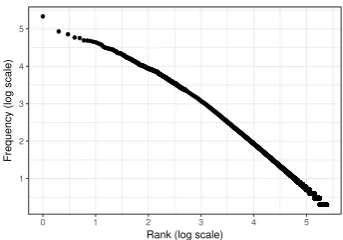
However, simple extraction probabilities as in Equation (1) are skewed by the occurrence proba-bilities of their constituent words. For instance, it is more likely that we extract(France, country)over (France, republic), just because the word coun-try is more likely to occur than republic. This skew in word distributions is well-known for nat-ural language and also translates to Hearst pat-terns (see also Figure1). For this reason, we also consider predicting hypernymy relations based on the Pointwise Mutual Information of Hearst pat-terns: First, let p−
(x) = P
(x,y)∈Pw(x, y)/W and p+(x) = P
(y,x)∈Pw(y, x)/W denote the probability that x occurs as a hyponym and hy-pernym, respectively. We then define the Positive Pointwise Mutual Information for(x, y)as
ppmi(x, y) =max
0,log p(x, y)
p−(x)p+(y)
. (2)
While Equation (2) can correct for different word occurrence probabilities, it cannot handle missing data. However, sparsity is one of the main issues when using Hearst patterns, as a necessarily incom-plete set of extraction rules will lead inevitably to missing extractions. For this purpose, we also study low-rank embeddings of the PPMI matrix, which al-low us to make predictions for unseen pairs. In par-ticular, let m=|{x: (x, y)∈ P ∨(y, x)∈ P}|
denote the number of unique terms inP. Further-more, let X ∈ Rm×m be the PPMI matrix with
● ●● ● ● ●●●●●●●●●●●●●●●●●●●●●●●●●●●●●●●●●●●●●●●●●●●●●●●●●●●●●●●●●●●●●●●●●●●●●●●●●●●●●●●●●●●●●●●●●●●●●●●●●●●●●●●●●●●●●●●●●●●●●●●●●●●●●●●●●●●●●●●●●●●●●●●●●●●●●●●●●●●●●●●●●●●●●●●●●●●●●●●●●●●●●●●●●●●●●●●●●●●●●●●●●●●●●●●●●●●●●●●●●●●●●●●●●●●●●●●●●●●●●●●●●●●●●●●●●●●●●●●●●●●●●●●●●●●●●●●●●●●●●●●●●●●●●●●●●●●●●●●●●●●●●●●●●●●●●●●●●●●●●●●●●●●●●●●●●●●●●●●●●●●●●●●●●●●●●●●●●●●●●●●●●●●●●●●●●●●●●●●●●●●●●●●●●●●●●●●●●●●●●●●●●●●●●●●●●●●●●●●●●●●●●●●●●●●●●●●●●●●●●●●●●●●●●●●●●●●●●●●●●●●●●●●●●●●●●●●●●●●●●●●●●●●●●●●●●●●●●●●●●●●●●●●●●●●●●●●●●●●●●●●●●●●●●●●●●●●●●●●●●●●●●●●●●●●●●●●●●●●●●●●●●●●●●●●●●●●●●●●●●●●●●●●●●●●●●●●●●●●●●●●●●●●●●●●●●●●●●●●●●●●●●●●●●●●●●●●●●●●●●●●●●●●●●●●●●●●●●●●●●●●●●●●●●●●●●●●●●●●●●●●●●●●●●●●●●●●●●●●●●●●●●●●●●●●●●●●●●●●●●●●●●●●●●●●●●●●●●●●●●●●●●●●●●●●●●●●●●●●●●●●●●●●●●●●●●●●●●●●●●●●●●●●●●●●●●●●●●●●●●●●●●●●●●●●●●●●●●●●●●●●●●●●●●●●●●●●●●●●●●●●●●●●●●●●●●●●●●●●●●●●●●●●●●●●●●●●●●●●●●●●●●●●●●●●●●●●●●●●●●●●●●●●●●●●●●●●●●●●●●●●●●●●●●●●●●●●●●●●●●●●●●●●●●●●●●●●●●●●●●●●●●●●●●●●●●●●●●●●●●●●●●●●●●●●●●●●●●●●●●●●●●●●●●●●●●●●●●●●●●●●●●●●●●●●●●●●●●●●●●●●●●●●●●●●●●●●●●●●●●●●●●●●●●●●●●●●●●●●●●●●●●●●●●●●●●●●●●●●●●●●●●●●●●●●●●●●●●●●●●●●●●●●●●●●●●●●●●●●●●●●●●●●●●●●●●●●●●●●●●●●●●●●●●●●●●●●●●●●●●●●●●●●●●●●●●●●●●●●●●●●●●●●●●●●●●●●●●●●●●●●●●●●●●●●●●●●●●●●●●●●●●●●●●●●●●●●●●●●●●●●●●●●●●●●●●●●●●●●●●●●●●●●●●●●●●●●●●●●●●●●●●●●●●●●●●●●●●●●●●●●●●●●●●●●●●●●●●●●●●●●●●●●●●●●●●●●●●●●●●●●●●●●●●●●●●●●●●●●●●●●●●●●●●●●●●●●●●●●●●●●●●●●●●●●●●●●●●●●●●●●●●●●●●●●●●●●●●●●●●●●●●●●●●●●●●●●●●●●●●●●●●●●●●●●●●●●●●●●●●●●●●●●●●●●●●●●●●●●●●●●●●●●●●●●●●●●●●●●●●●●●●●●●●●●●●●●●●●●●●●●●●●●●●●●●●●●●●●●●●●●●●●●●●●●●●●●●●●●●●●●●●●●●●●●●●●●●●●●●●●●●●●●●●●●●●●●●●●●●●●●●●●●●●●●●●●●●●●●●●●●●●●●●●●●●●●●●●●●●●●●●●●●●●●●●●●●●●●●●●●●●●●●●●●●●●●●●●●●●●●●●●●●●●●●●●●●●●●●●●●●●●●●●●●●●●●●●●●●●●●●●●●●●●●●●●●●●●●●●●●●●●●●●●●●●●●●●●●●●●●●●●●●●●●●●●●●●●●●●●●●●●●●●●●●●●●●●●●●●●●●●●●●●●●●●●●●●●●●●●●●●●●●●●●●●●●●●●●●●●●●●●●●●●●●●●●●●●●●●●●●●●●●●●●●●●●●●●●●●●●●●●●●●●●●●●●●●●●●●●●●●●●●●●●●●●●●●●●●●●●●●●●●●●●●●●●●●●●●●●●●●●●●●●●●●●●●●●●●●●●●●●●●●●●●●●●●●●●●●●●●●●●●●●●●●●●●●●●●●●●●●●●●●●●●●●●●●●●●●●●●●●●●●●●●●●●●●●●●●●●●●●●●●●●●●●●●●●●●●●●●●●●●●●●●●●●●●●●●●●●●●●●●●●●●●●●●●●●●●●●●●●●●●●●●●●●●●●●●●●●●●●●●●●●●●●●●●●●●●●●●●●●●●●●●●●●●●●●●●●●●●●●●●●●●●●●●●●●●●●●●●●●●●●●●●●●●●●●●●●●●●●●●●●●●●●●●●●●●●●●●●●●●●●●●●●●●●●●●●●●●●●●●●●●●●●●●●●●●●●●●●●●●●●●●●●●●●●●●●●●●●●●●●●●●●●●●●●●●●●●●●●●●●●●●●●●●●●●●●●●●●●●●●●●●●●●●●●●●●●●●●●●●●●●●●●●●●●●●●●●●●●●●●●●●●●●●●●●●●●●●●●●●●●●●●●●●●●●●●●●●●●●●●●●●●●●●●●●●●●●●●●●●●●●●●●●●●●●●●●●●●●●●●●●●●●●●●●●●●●●●●●●●●●●●●●●●●●●●●●●●●●●●●●●●●●●●●●●●●●●●●●●●●●●●●●●●●●●●●●●●●●●●●●●●●●●●●●●●●●●●●●●●●●●●●●●●●●●●●●●●●●●●●●●●●●●●●●●●●●●●●●●●●●●●●●●●●●●●●●●●●●●●●●●●●●●●●●●●●●●●●●●●●●●●●●●●●●●●●●●●●●●●●●●●●●●●●●●●●●●●●●●●●●●●●●●●●●●●●●●●●●●●●●●●●●●●●●●●●●●●●●●●●●●●●●●●●●●●●●●●●●●●●●●●●●●●●●●●●●●● ● ● ● ● ● ● ● ● ● ● ● ● ● ● ● ● ● ● ● ● ● ● ● ● ● ● ● ● ● ● ● ● ● ●●●●●●●●●●●●●●●●●●●●●●●●●●●●●●●●●●●●●●●●●●●●●●●●●●●●●●●●●●●●●●●●●●●●●●●●●●●●●●●●●●●●●●●●●●●●●●●●●●●●●●●●●●●●●●●●●●●●●●●●●●●●●●●●●●●●●●●●●●●●●●●●●●●●●●●●●●●●●●●●●●●●●●●●●●●●●●●●●●●●●●●●●●●●●●●●●●●●●●●●●●●●●●●●●●●●●●●●●●●●●●●●●●●●●●●●●●●●●●●●●●●●●●●●●●●●●●●●●●●●●●●●●●●●●●●●●●●●●●●●●●●●●●●●●●●●●●●●●●●●●●●●●●●●●●●●●●●●●●●●●●●●●●●●●●●●●●●●●●●●●●●●●●●●●●●●●●●●●●●●●●●●●●●●●●●●●●●●●●●●●●●●●●●●●●●●●●●●●●●●●●●●●●●●●●●●●●●●●●●●●●●●●●●●●●●●●●●●●●●●●●●●●●●●●●●●●●●●●●●●●●●●●●●●●●●●●●●●●●●●●●●●●●●●●●●●●●●●●●●●●●●●●●●●●●●●●●●●●●●●●●●●●●● ● ● ● ● ● ● ● ● ● ● ● ● ● ● ● ● ● ● ● ● ● ● ● ● ● ● ● ● ● ● ● ● ● ● ● ● ● ● ● ● ● ● ● ● ● ● ● ● ● ● ● ● ● ● ● ● ● ● ● ● ● ● ● ● ● ● ● ● ● ● ● ● ● ● ● ●●●●●●●●●●●●●●●●●●●●●●●●●●●●●●●●●●●●●●●●●●●●●●●●●●●●●●●●●●●●●●●●●●●●●●●●●●●●●●●●●●●●●●●●●●●●●●●●●●●●●●●●●●●●●●●●●●●●●●●●●●●●●●●●●●●●●●●●●●●●●●●●●●●●●●●●●●●●●●●●●●●●●●●●●●●●●●●●●●●●●●●●●●●●●●●●●●●●●●●●●●●●●●●●●●●●●●●●●●●●●●●●●●●●●●●●●●●●●●●●●●●●●●●●●●●●●●●●●●●●●●●●●●●●●●●●●●●●●●●●●●●●●●●●●●●●●●●●●●●●●●●●●●●●●●●●●●●●●●●●●●●●●●●●●●●●●●●●●●●●●●●●●●●●●●●●●●●●●●●●●●●●●●●●●●●●●●●●●●●●●●●●●●●●●●●●●●●●●●●●●●●●●●●●●●●●●●●●●●●●●●●●●●●●●●●●●●●●●●●●●●●●●●●●●●●●●●●●●●●●●●●●●●●●●●●●●●●●●●●●●●●●●●●●●●●●●●●●●●●●●●●●●●●●●●●●●●●●●●●●●●●●●●●●●●●●●●●●●●●●●●●●●●●●●●●●●●●●●●●●●●●●●●●●●●●●●●●●●●●●●●●●●●●●●●●●●●●●●●●●●●●●●●●●●●●●●●●●●●●●●●●●●●●●●●●●●●●●●●●●●●●●●●●●●●●●●●●●●●●●●● ● ● ● ● ● ● ● ● ● ● ● ● ● ● ● ● ● ● ● ● ● ● ● ● ● ● ● ● ● ● ● ● ● ● ● ● ● ● ● ● ● ● ● ● ● ● ● ● ● ● ● ● ● ● ● ● ● ● ● ● ● ● ● ● ● ● ● ● ● ● ● ● ● ● ● ● ● ● ● ● ● ● ● ● ● ● ● ● ● ● ● ● ● ● ● ● ● ● ● ●●●●●●●●●●●●●●●●●●●●●●●●●●●●●●●●●●●●●●●●●●●●●●●●●●●●●●●●●●●●●●●●●●●●●●●●●●●●●●●●●●●●●●●●●●●●●●●●●●●●●●●●●●●●●●●●●●●●●●●●●●●●●●●●●●●●●●●●●●●●●●●●●●●●●●●●●●●●●●●●●●●●●●●●●●●●●●●●●●●●●●●●●●●●●●●●●●●●●●●●●●●●●●●●●●●●●●●●●●●●●●●●●●●●●●●●●●●●●●●●●●●●●●●●●●●●●●●●●●●●●●●●●●●●●●●●●●●●●●●●●●●●●●●●●●●●●●●●●●●●●●●●●●●●●●●●●●●●●●●●●●●●●●●●●●●●●●●●●●●●●●●●●●●●●●●●●●●●●●●●●●●●●●●●●●●●●●●●●●●●●●●●●●●●●●●●●●●●●●●●●●●●●●●●●●●●●●●●●●●●●●●●●●●●●●●●●●●●●●●●●●●●●●●●●●●●●●●●●●●●●●●●●●●●●●●●●●●●●●●●●●●●●●●●●●●●●●●●●●●●●●●●●●●●●●●●●●●●●●●●●●●●●●●●●●●●●●●●●●●●●●●●●●●●●●●●●●●●●●●●●●●●●●●●●●●●●●●●●●●●●●●●●●●●●●●●●●●●●●●●●●●●●●●●●●●●●●●●●●●●●●●●●●●●●●●●●●●●●●●●●●●●●●●●●●●●●●●●●●●●●●●●●●●●●●●●●●●●●●●●●●●●●●●●●●●●●●●●●●●●●●●●●●●●●●●●●●●●●●●●●●●●●●●●●●●●●●●●●●●●●●●●●●●●●●●●●●●●●●●●●●●●●●●●●●●●●●●●●●●●●●●●●●●●●●●●●●●●●●●●●●●●●●●●●●●●●●●●●●●●●●●●●●●●●●●●●●●●●●●●●●●●●●●●●●●●●●●●●●●●●●●●●●●●●●●●●●●●●●●●●●●●●●●●●●●●●●●●●●●●●●●●●●●●●●●●●●●●●●●●●●●●●●●●●●●●●●●●●●●●●●●●●●●●●●●●●●●●●●●●●●●●●●●●●●●●●●●●●●●●●●●●●●●●●●●●●●●●●●●●●●●●●●●●●●●●●●●●●●●●●●●●●●●●●●●●●●●●●●●●●●●●●●●●●●●●●●●●●●●●●●●●●●●●●●●●●●●●●●●●●●●●●●●●●●●●●●●●●●●●●●●●●●●●●●●●●●●●●●●●●●●●●●●●●●●●●●●●●●●●●●●●●●●●●●●●●●●●●●●●●●●●●●●●●●●●●●●●●●●●●●●●●●●●●●●●●●● 1 2 3 4 5
0 1 2 3 4 5
Rank (log scale)
[image:2.595.330.502.62.182.2]Frequency (log scale)
Figure 1: Frequency distribution of words appear-ing in Hearst patterns.
entries Mxy = ppmi(x, y)and let M = UΣV⊤
be itsSingular Value Decomposition(SVD). We can then predict hypernymy relations based on the truncated SVD ofM via
spmi(x, y) =u⊤xΣrvy (3)
whereux,vy denote thex-th andy-th row ofU
andV, respectively, and whereΣris the diagonal
matrix of truncated singular values (in which all but therlargest singular values are set to zero).
Equation (3) can be interpreted as a smoothed version of the observed PPMI matrix. Due to the truncation of singular values, Equation (3) com-putes a low-rank embedding ofM where similar words (in terms of their Hearst patterns) have simi-lar representations. Since Equation (3) is defined for all pairs (x, y), it allows us to make hyper-nymy predictions based on the similarity of words. We also consider factorizing a matrix that is con-structed from occurrence probabilities as in Equa-tion (1), denoted by sp(x, y). This approach is then closely related to the method of Cederberg and Widdows(2003), which has been proposed to im-prove precision and recall for hypernymy detection from Hearst patterns.
2.2 Distributional Hypernym Detection
xwhich areincludedin the set of a broader term’s
features,y:
WeedsPrec(x,y) =
Pn
i=1xi∗✶yi>0
Pn
i=1xi
Second, we consider invCL (Lenci and Benotto, 2012) which introduces a notion of distributional exclusionby also measuring the degree to which the broader term contains contextsnotused by the narrower term. In particular, let
CL(x,y) =
Pn
i=1min(xi, yi)
Pn
i=1xi
denote the degree of inclusion ofxinyas proposed byClarke(2009). To measure both the inclusion ofxinyand the non-inclusion ofyinx,invCLis then defined as
invCL(x,y) =
p
CL(x,y)∗(1−CL(y,x))
Although most unsupervised distributional ap-proaches are based on the DIH, we also con-sider the distributional SLQS model based on on an alternativeinformativenesshypothesis (Santus et al.,2014;Shwartz et al.,2017). Intuitively, the SLQS model presupposes that general words ap-pear mostly in uninformative contexts, as measured by entropy. Specifically, SLQS depends on the me-dian entropy of a term’s topN contexts, defined as
Ex=medianNi=1[H(ci)],
whereH(ci)is the Shannon entropy of contextci
across all terms, andNis chosen in hyperparameter selection. Finally, SLQS is defined using the ratio between the two terms:
SLQS(x, y) = 1−Ex
Ey
.
Since the SLQS model only compares the rela-tive generality of two terms, but does not make judgment about the terms’ relatedness, we report SLQS-cos, which multiplies the SLQS measure by cosine similarity ofxandy(Santus et al.,2014).
For completeness, we also include cosine simi-larity as a baseline in our evaluation.
3 Evaluation
To evaluate the relative performance of pattern-based and distributional models, we apply them to several challenging hypernymy tasks.
Pattern
X which is a (example|class|kind|. . . ) of Y X (and|or) (any|some) other Y
X which is called Y X isJJS(most)? Y X a special case of Y X is an Y that
X is a !(member|part|given) Y
[image:3.595.319.518.73.224.2]!(features|properties) Y such as X1, X2, . . . (Unlike|like) (most|all|any|other) Y, X Y including X1, X2, . . .
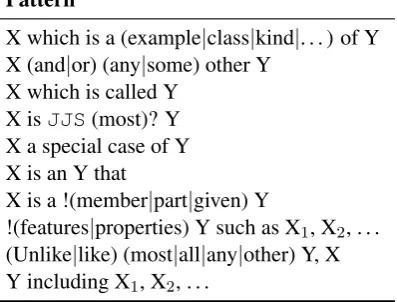
Table 1: Hearst patterns used in this study. Patterns are lemmatized, but listed as inflected for clarity.
3.1 Tasks
Detection: In hypernymy detection, the task is to classify whether pairs of words are in a hyper-nymy relation. For this task, we evaluate all mod-els on five benchmark datasets: First, we employ the noun-noun subset of BLESS, which contains hypernymy annotations for 200 concrete, mostly unambiguous nouns. Negative pairs contain a mix-ture of co-hyponymy, meronymy, and random pairs. This version contains 14,542 total pairs with 1,337 positive examples. Second, we evaluate onLEDS (Baroni et al.,2012), which consists of 2,770 noun pairs balanced between positive hypernymy exam-ples, and randomly shuffled negative pairs. We also considerEVAL(Santus et al.,2015), contain-ing 7,378 pairs in a mixture of hypernymy, syn-onymy, antsyn-onymy, mersyn-onymy, and adjectival rela-tions. EVAL is notable for its absence of random pairs. The largest dataset isSHWARTZ (Shwartz et al.,2016), which was collected from a mixture of WordNet, DBPedia, and other resources. We limit ourselves to a 52,578 pair subset excluding multiword expressions. Finally, we evaluate on WBLESS(Weeds et al.,2014), a 1,668 pair subset ofBLESS, with negative pairs being selected from co-hyponymy, random, and hyponymy relations. Previous work has used different metrics for evalu-ating on BLESS (Lenci and Benotto,2012;Levy et al.,2015;Roller and Erk,2016). We chose to evaluate the global ranking using Average Preci-sion. This allowed us to use the same metric on all detection benchmarks, and is consistent with evaluations inShwartz et al.(2017).
of words. For this task, we evaluate all models on three datasets described byKiela et al.(2015): On BLESS, the task is to predict the direction for all 1337 positive pairs in the dataset. Pairs are only counted correct if the hypernymy direc-tion scores higher than the reverse direcdirec-tion, i.e. score(x, y)>score(y, x). We reserve 10% of the data for validation, and test on the remaining 90%. OnWBLESS, we follow prior work (Nguyen et al., 2017;Vuli´c and Mrkˇsi´c,2017) and perform 1000 random iterations in which 2% of the data is used as a validation set to learn a classification threshold, and test on the remainder of the data. We report average accuracy across all iterations. Finally, we evaluate onBIBLESS(Kiela et al.,2015), a variant ofWBLESSwith hypernymy and hyponymy pairs explicitly annotated for their direction. Since this task requires three-way classification (hypernymy, hyponymy, and other), we perform two-stage clas-sification. First, a threshold is tuned using 2% of the data, identifying whether a pair exhibits hy-pernymy in either direction. Second, the relative comparison of scores determines which direction is predicted. As withWBLESS, we report the average accuracy over 1000 iterations.
Graded Entailment: In graded entailment, the task is to quantify the degree to which a hyper-nymy relation holds. For this task, we follow prior work (Nickel and Kiela, 2017; Vuli´c and Mrkˇsi´c, 2017) and use the noun part of HYPER-LEX(Vuli´c et al.,2017), consisting of 2,163 noun pairs which are annotated to what degreexis-ay
holds on a scale of[0,6]. For all models, we report Spearman’s rank correlationρ. We handle out-of-vocabulary (OOV) words by assigning the median of the scores (computed across the training set) to pairs with OOV words.
3.2 Experimental Setup
Pattern-based models: We extract Hearst patterns from the concatenation of Gigaword and Wikipedia, and prepare our corpus by tokenizing, lemmatiz-ing, and POS tagging using CoreNLP 3.8.0. The full set of Hearst patterns is provided in Table1. Our selected patterns match prototypical Hearst pat-terns, like “animals such as cats,” but also include broader patterns like “New Year is the most impor-tant holiday.” Leading and following noun phrases are allowed to match limited modifiers (compound nouns, adjectives, etc.), in which case we also gen-erate a hit for the head of the noun phrase.
Dur-ing postprocessDur-ing, we remove pairs which were not extracted by at least two distinct patterns. We also remove any pair(y, x) if p(y, x) < p(x, y). The final corpus contains roughly 4.5M matched pairs, 431K unique pairs, and 243K unique terms. For SVD-based models, we select the rank from
r ∈ {5, 10, 15, 20, 25, 50, 100, 150, 200, 250, 300, 500, 1000}on the validation set. The other pattern-based models do not have any hyperparam-eters.
Distributional models: For the distributional baselines, we employ the large, sparse distribu-tional space ofShwartz et al.(2017), which is com-puted from UkWaC and Wikipedia, and is known to have strong performance on several of the detection tasks. The corpus was POS tagged and dependency parsed. Distributional contexts were constructed from adjacent words in dependency parses (Pad´o and Lapata,2007;Levy and Goldberg,2014). Tar-gets and contexts which appeared fewer than 100 times in the corpus were filtered, and the result-ing co-occurrence matrix was PPMI transformed.1 The resulting space contains representations for 218K words over 732K context dimensions. For the SLQS model, we selected the number of con-textsN from the same set of options as the SVD rank in pattern-based models.
3.3 Results
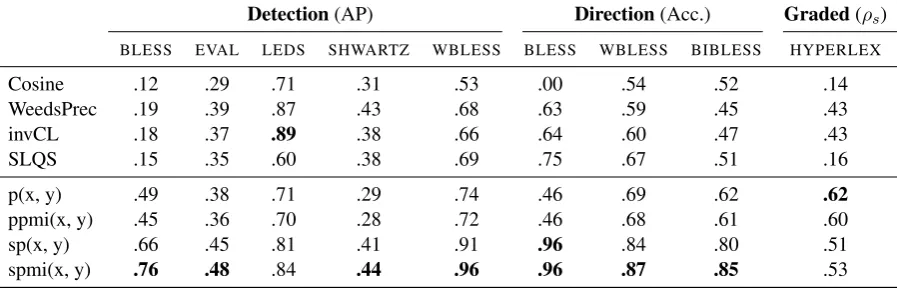
Table2shows the results from all three experimen-tal settings. In nearly all cases, we find that pattern-based approaches substantially outperform all three distributional models. Particularly strong improve-ments can be observed on BLESS (0.76 average precision vs 0.19) andWBLESS(0.96 vs. 0.69) for the detection tasks and on all directionality tasks. For directionality prediction onBLESS, the SVD models surpass even the state-of-the-artsupervised model ofVuli´c and Mrkˇsi´c(2017). Moreover, both SVD models perform generally better than their sparse counterparts on all tasks and datasets except on HYPERLEX. We performed a posthoc analy-sis of the validation sets comparing the ppmi and spmi models, and found that the truncated SVD im-proved recall via its matrix completion properties. We also found that the spmi model downweighted
Detection(AP) Direction(Acc.) Graded(ρs)
BLESS EVAL LEDS SHWARTZ WBLESS BLESS WBLESS BIBLESS HYPERLEX
Cosine .12 .29 .71 .31 .53 .00 .54 .52 .14
WeedsPrec .19 .39 .87 .43 .68 .63 .59 .45 .43
invCL .18 .37 .89 .38 .66 .64 .60 .47 .43
SLQS .15 .35 .60 .38 .69 .75 .67 .51 .16
p(x, y) .49 .38 .71 .29 .74 .46 .69 .62 .62
ppmi(x, y) .45 .36 .70 .28 .72 .46 .68 .61 .60
sp(x, y) .66 .45 .81 .41 .91 .96 .84 .80 .51
[image:5.595.76.525.66.210.2]spmi(x, y) .76 .48 .84 .44 .96 .96 .87 .85 .53
Table 2: Experimental results comparing distributional and pattern-based methods in all settings.
many high-scoring outlier pairs composed of rare terms.
When comparing thep(x, y)and ppmi models to distributional models, we observe mixed results. TheSHWARTZdataset is difficult for sparse models due to its very long tail of low frequency words that are hard to cover using Hearst patterns. On EVAL, Hearst-pattern based methods get penalized by OOV words, due to the large number of verbs and adjectives in the dataset, which are not captured by our patterns. However, in 7 of the 9 datasets, at least one of the sparse models outperforms all dis-tributional measures, showing that Hearst patterns can provide strong performance on large corpora.
4 Conclusion
We studied the relative performance of Hearst pattern-based methods and DIH-based methods for hypernym detection. Our results show that the pattern-based methods substantially outper-form DIH-based methods on several challenging benchmarks. We find that embedding methods alleviate sparsity concerns of pattern-based ap-proaches and substantially improve coverage. We conclude that Hearst patterns provide important contexts for the detection of hypernymy relations that are not yet captured in DIH models. Our code is available at https://github.com/ facebookresearch/hypernymysuite.
Acknowledgments
We would like to thank the anonymous reviewers for their helpful suggestions. We also thank Vered Shwartz, Enrico Santus, and Dominik Schlechtweg for providing us with their distributional spaces and baseline implementations.
References
Marco Baroni, Raffaella Bernardi, Ngoc-Quynh Do, and Chung-chieh Shan. 2012. Entailment above the word level in distributional semantics. In Proceed-ings of the 2012 Conference of the European Chap-ter of the Association for Computational Linguists, pages 23–32, Avignon, France.
Scott Cederberg and Dominic Widdows. 2003. Using lsa and noun coordination information to improve the recall and precision of automatic hyponymy ex-traction. In Proceedings of the Seventh Confer-ence on Natural Language Learning at HLT-NAACL 2003.
Daoud Clarke. 2009. Context-theoretic semantics for natural language: An overview. In Proceedings of the 2011 Workshop on GEometrical Models of Nat-ural Language Semantics, pages 112–119, Athens, Greece. Association for Computational Linguistics.
Marti A. Hearst. 1992. Automatic acquisition of hy-ponyms from large text corpora. InProceedings of the 1992 Conference on Computational Linguistics, pages 539–545, Nantes, France.
Douwe Kiela, Laura Rimell, Ivan Vuli´c, and Stephen Clark. 2015. Exploiting image generality for lexical entailment detection. InProceedings of the 53rd An-nual Meeting of the Association for Computational Linguistics and the 7th International Joint Confer-ence on Natural Language Processing (Volume 2: Short Papers), pages 119–124, Beijing, China. As-sociation for Computational Linguistics.
Lili Kotlerman, Ido Dagan, Idan Szpektor, and Maayan Zhitomirsky-Geffet. 2010. Directional distribu-tional similarity for lexical inference. Natural Lan-guage Engineering, 16:359–389.
Alessandro Lenci and Giulia Benotto. 2012. Identify-ing hypernyms in distributional semantic spaces. In
Omer Levy and Yoav Goldberg. 2014. Dependency-based word embeddings. In Proceedings of the 52nd Annual Meeting of the Association for Com-putational Linguistics, pages 302–308, Baltimore, Maryland. Association for Computational Linguis-tics.
Omer Levy, Steffen Remus, Chris Biemann, and Ido Dagan. 2015. Do supervised distributional meth-ods really learn lexical inference relations? In Pro-ceedings of the 2015 North American Chapter of the Association for Computational Linguistics: Hu-man Language Technologies, pages 970–976, Den-ver, Colorado.
Kim Anh Nguyen, Maximilian Keper, Sabine Schulte im Walde, and Ngoc Thang Vu. 2017. Hierarchi-cal Embeddings for Hypernymy Detection and Di-rectionality. In Proceedings of the Conference on Empirical Methods in Natural Language Processing, pages 233–243, Copenhagen, Denmark.
Maximillian Nickel and Douwe Kiela. 2017. Poincar´e embeddings for learning hierarchical representa-tions. In I. Guyon, U. V. Luxburg, S. Bengio, H. Wallach, R. Fergus, S. Vishwanathan, and R. Gar-nett, editors, Advances in Neural Information Pro-cessing Systems 30, pages 6338–6347. Curran Asso-ciates, Inc.
Sebastian Pad´o and Mirella Lapata. 2007. Dependency-based construction of semantic space models. Com-putational Linguistics, 33(2):161–199.
Stephen Roller and Katrin Erk. 2016. Relations such as hypernymy: Identifying and exploiting hearst pat-terns in distributional vectors for lexical entailment. InProceedings of the 2016 Conference on Empirical Methods in Natural Language Processing, Austin, Texas, USA. Association for Computational Linguis-tics.
Enrico Santus, Alessandro Lenci, Qin Lu, and Sabine Schulte im Walde. 2014. Chasing hypernyms in vec-tor spaces with entropy. InProceedings of the 14th Conference of the European Chapter of the Associa-tion for ComputaAssocia-tional Linguistics, volume 2: Short Papers, pages 38–42, Gothenburg, Sweden. Associ-ation for ComputAssoci-ational Linguistics.
Enrico Santus, Frances Yung, Alessandro Lenci, and Chu-Ren Huang. 2015. EVALution 1.0: An evolv-ing semantic dataset for trainevolv-ing and evaluation of distributional semantic models. In Proceedings of the Fourth Workshop on Linked Data in Linguistics: Resources and Applications, pages 64–69, Beijing, China. Association for Computational Linguistics.
Vered Shwartz, Yoav Goldberg, and Ido Dagan. 2016. Improving hypernymy detection with an integrated path-based and distributional method. In Proceed-ings of the 54th Annual Meeting of the Associ-ation for ComputAssoci-ational Linguistics, pages 2389– 2398, Berlin, Germany. Association for Computa-tional Linguistics.
Vered Shwartz, Enrico Santus, and Dominik Schlechtweg. 2017. Hypernyms under siege: Linguistically-motivated artillery for hypernymy detection. In Proceedings of the 15th Conference of the European Chapter of the Association for Computational Linguistics: Volume 1, Long Papers, pages 65–75, Valencia, Spain. Association for Computational Linguistics.
Rion Snow, Daniel Jurafsky, and Andrew Y. Ng. 2004. Learning syntactic patterns for automatic hypernym discovery. In L. K. Saul, Y. Weiss, and L. Bottou, editors,Advances in Neural Information Processing Systems 17, pages 1297–1304. MIT Press.
Ivan Vuli´c, Daniela Gerz, Douwe Kiela, Felix Hill, and Anna Korhonen. 2017. Hyperlex: A large-scale eval-uation of graded lexical entailment. Computational Linguistics, 43(4):781–835.
Ivan Vuli´c and Nikola Mrkˇsi´c. 2017. Specialis-ing word vectors for lexical entailment. CoRR, abs/1710.06371.
Julie Weeds, Daoud Clarke, Jeremy Reffin, David Weir, and Bill Keller. 2014. Learning to distinguish hyper-nyms and co-hypohyper-nyms. InProceedings of the 2014 International Conference on Computational Linguis-tics, pages 2249–2259, Dublin, Ireland.
Julie Weeds, David Weir, and Diana McCarthy. 2004. Characterising measures of lexical distributional similarity. InProceedings of the 2004 International Conference on Computational Linguistics, pages 1015–1021, Geneva, Switzerland.