37
Recognizing Complex Entity Mentions: A Review and Future Directions
Xiang Dai
CSIRO Data61 and School of IT, University of Sydney Sydney, Australia
Abstract
Standard named entity recognizers can ef-fectively recognize entity mentions that consist of contiguous tokens and do not overlap with each other. However, in prac-tice, there are many domains, such as the biomedical domain, in which there are nested, overlapping, and discontinuous en-tity mentions. These complex mentions cannot be directly recognized by conven-tional sequence tagging models because they may break the assumptions based on which sequence tagging techniques are built. We review the existing methods which are revised to tackle complex entity mentions and categorize them as token-level and sentence-token-level approaches. We then identify the research gap, and discuss some directions that we are exploring.
1 Introduction
Named entity recognition (NER), the task of iden-tifying and classifying named entities (NE) within text, has received substantial attention. This is largely due to its crucial role in conducting several downstream tasks, such as entity linking ( Lim-sopatham and Collier,2016;Pan et al.,2017), re-lation extraction (Zeng et al.,2014), question an-swering (Moll´a et al.,2007) and knowledge base construction (Zhang,2015).
Traditionally, the NER problem can be defined as: given a sequence of tokens, output a list of tu-ples< Is, Ie, t >, each of which is a NE mention
in text. Here, Is andIe are the starting and end-ing index of the NE mention, respectively, andt
is the type of the entity from a pre-defined cate-gory scheme. There are two assumptions associ-ated with this perspective:
1. An NE mention consists of contiguous to-kens, where all the tokens indexed between
IsandIeare part of the mention; and,
2. These linear spans do not overlap with each other. In other words, no token in the text can belong to more than one NE mention.
Based on these two assumptions, the most com-mon approach to NER is to use sequence tagging techniques with a BIO or BIOLU label set. Each token is assigned with a tag which is usually com-posed of a position indicator and an entity type. The position indicator is used to represent the to-ken’s role in a NE mention. In the BIOLU schema, B stands for the beginning of a mention, I for the intermediate of a mention, O for outside a men-tion, L for the last token of a menmen-tion, and U for a mention having only one token (Ratinov and Roth,
2009).
Sequential tagging models, such as linear-chain CRFs and BiLSTM-CRF, have achieved start-of-the-art effectiveness in many NER data sets ( Lam-ple et al., 2016; Ma and Hovy, 2016; Chiu and Nichols, 2016), since most training data sets are also annotated based on these two assumptions.
However, in practice, there are many domains, such as the biomedical domain, which involve nested, overlapping, discontinuous NE mentions that break the two assumptions mentioned above. We categorize these mentions as complex entity mentions, and note that standard tagging tech-niques cannot be applied directly to recognize these mentions (Muis and Lu, 2016; Dai et al.,
2017). In the following paragraphs, we explain these complex entity mentions in details.
Nested NE mentions One NE mention is
cor-Figure 1: Examples involving overlapping, discontinuous and nested NE mentions. In (a), ‘HIV-1 en-hancer’ and ‘HIV-1’ are nested NE mentions. In (b), ‘intense pelvic pain’ and ‘back pain’ overlap, meanwhile, ‘intense pelvic pain’ is a discontinuous mention.
pus (Kim et al.,2003). Here, ‘HIV-1 enhancer’ is a DNA mention, and it contains another mention ‘HIV-1’, which is a virus.
Multi-type NE mentions An extreme case of
nested NE mentions is one on which an NE men-tion has multiple entity types. For example, in the EPPI corpus (Alex et al.,2007), proteins can also be annotated as drug/compound, indicating that the protein is used as a drug to affect the function of a cell. Such a mention should be classified as both protein and drug/compound. In this case, we consider this mention as two mentions of different types, and these two mentions contain each other.
Overlapping NE mentions Two NE mentions
overlap, but no one is completely contained by the other. Figure1b is an example taken from the CADEC corpus (Karimi et al.,2015), which is an-notated for adverse drug events (ADE) and rele-vant concepts. In this example, two ADEs: ‘ in-tense pelvic pain’ and ‘back pain’, share a com-mon token ‘pain’, and neither is contained by the other.
Discontinuous NE mentions The mention
consists of discontiguous tokens. In other words, the mention contains at least one gap. In Fig-ure 1b, ‘intense pelvic pain’ is a discontinuous NE mention since it is interrupted by ‘and back’.
These complex NE mentions can hold very use-ful information for downstream tasks. Some-times, the nested and overlapping structure itself are already good indicators of the relationship be-tween different entities involved. For example, an ORG mention ‘University of Sydney’ contains a LOC mention ‘Sydney’. This structure has im-plied the location of the organization, and recog-nition of these mentions can potentially speed up the construction of a knowledge base. In addi-tion, such entities often have fixed representations
in different languages. Therefore, recognizing NE mentions, especially these discontinuous NE men-tions, can improve the performance of a machine translation system (Klementiev and Roth, 2006). Furthermore, we notice that similar complex struc-tures also exist in other NLP tasks, such as multi-word expressions recognition (Baldwin and Kim,
2010). The ideas proposed for a NER task can thus be applied to tackle similar difficulties in other tasks.
Below, we briefly review existing methods to recognize complex mentions and discuss their strengths and limitations. We also discuss the re-search directions we are exploring to address the research gaps.
2 Token-level Approach
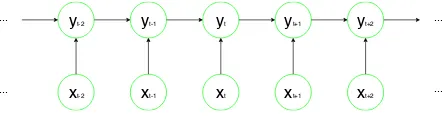
Sequence tagging techniques take the representa-tion of each token as input and output a label for each token. These local decisions are chained to-gether to perform joint inference. Figure 2is an illustration of a linear-chain CRF model where the tag of one token depends on both the features of that token in context and the tag of the previous token. The tag sequence predicted by the tagger is finally decoded into NE mentions using explicit rules. Here, the intermediate outputs for each to-ken are usually BIO tags in standard NER tasks. However, since the BIO tags cannot effectively represent complex NE mentions, a natural direc-tion is to expand the BIO tag set so that different kinds of complex entity mentions can be captured. We categorize the methods based on conventional sequence tagging as token-level approach.
[image:2.595.76.538.64.130.2]xt-2 xt-1 xt xt+1 xt+2 yt-2 yt-1 yt yt+1 yt+2
...
...
...
...
[image:3.595.75.296.62.122.2]Figure 2: In a linear-chain CRF model, the out-put for each token depends on the features of that token in context and the output for the previous token.
Figure 3: An encoding example of two NE men-tions: ‘intense pelvic pain’ and ‘back pain’. Here, we keep only the position indicator and remove the entity type, since this schema can only repre-sent overlapping mentions of the same entity type.
of Discontinuous body, Beginning of Head, and
Inside ofHead. Here, the word sequences which are shared by multiple mentions are called head, and the remaining parts of the discontinuous men-tion are called body. Figure3is an encoding ex-ample using this schema. ‘pain’ is the beginning of the head that is shared by two mentions, and therefore tagged asBH. ‘intense pelvic’ is the body of a discontinuous mention, while ‘back’ is the be-ginning of a continuous mention. We note that, even in this simple example, it is still impossible to represent several discontinuous mentions unam-biguously. For example, this encoding can also be decoded as having three mentions: ‘intense pelvic pain’, ‘back pain’ and ‘pain’.Muis and Lu(2016) introduced the notion ofmodel ambiguityand the-oretically demonstrated that the models based on BIO variants usually have high ambiguity level, and therefore low precision in practice. Another limitation of this schema is that it supports only overlapping mentions of the same entity type.
Schneider et al. (2014) also proposed several BIO schema variants to encode multiword expres-sions with gaps and nested structure. They include two strict restrictions which are motivated linguis-tically in their work:
1. An expression can be completely contained within another expression, but no overlap-ping is allowed; and,
2. A contained expression cannot contain other expressions. In other words, the nested struc-ture has maximum two levels.
We note that these strict restrictions cannot be ap-plied directly on our NER tasks.
Alex et al. (2007) proposed three approaches based on a maximum entropy model (Curran and Clark,2003) to deal with nested NE mentions:
Layering The tagger first identifies the innermost
(or outermost) mentions, then the following taggers are used to identify increasingly next level mentions. Finally, the output of the tag-gers on different layers is combined by taking the union.
Joined labeling Each word is assigned a tag by
concatenating the tags of all levels of nesting. Then a tagger is trained on the data contain-ing the joined labels. Durcontain-ing inference, the joined labels are decoded into their original BIO format for each entity type.
Cascade Separate models are trained for each
en-tity type or by grouping several enen-tity types without nested structures. Similar to the lay-ering approach, the latter models can utilize the outputs from previous models as input features. Despite the difficulty of ordering and grouping entity models and the fact that this approach cannot deal with nested men-tions of the same entity type, the cascade ap-proach still achieves the best results among these three approaches.
Byrne(2007) andXu et al.(2017) used a sim-ilar approach to deal with nested NE mentions. They concatenated adjacent tokens (up to a certain length) into potential mention spans. Then these spans, together with their left and right contexts, are fed into a classifier (a maximum entropy tag-ger in (Byrne,2007) and a feedforward neural net-work in (Xu et al.,2017)). The classifier is trained to first predict whether the span is a valid NE men-tion, and then its entity type if it is a NE mention.
3 Sentence-level Approach
Figure 4: An example of sentence with three NE mentions. P(ER) and L(OC) refer to the entity types.
McDonald et al. (2005) proposed a new per-spective of NER as structured multi-label classifi-cation. Instead of starting index and ending index, they represent each NE mention using the set of to-ken positions that belong to the mention. Figure4
is an example of this representation, with each to-ken tagged using an I/O schema. This representa-tion is very flexible as it allows NE menrepresenta-tions con-sisting of discontiguous tokens and does not re-quire mentions to exclude each other. Using this representation, the NER problem is converted into the multi-label classification problem of finding up tokcorrect labels among all possible labels, where
k is a hyper-parameter of the model. Labels can be decoded to all possible NE mentions in the sen-tence. They do not come from a pre-defined cate-gory but depend on the sentence being processed.
McDonald et al.(2005) used large-margin online learning algorithms to train the model, so that the scores of correct labels (NE mentions) are higher than those of all other possible incorrect mentions. Another advantage of this method is that the out-puts of the model are unambiguous for all kinds of complex entity mentions and easy to be decoded, although the method suffers from aO(n3T) infer-ence algorithm, where nis the length of the sen-tence andT is the number of entity types.
[image:4.595.81.275.78.122.2]Finkel and Manning(2009) used a discrimina-tive constituency parser to recognize nested NE mentions. They represent each sentence as a con-stituency tree, where each mention corresponds to a phrase in the tree. In addition, each node needs to be annotated with its parent and grandparent la-bels, so that the CRF-CFG parser can learn how NE mentions nest. Ringland(2016) also explored a joint model using the Berkeley parser (Petrov et al., 2006), and showed that it performed well even without specialized NER features. However, one disadvantage of their models, as in (McDonald et al.,2005), is that their time complexity is cubic in the number of tokens in the sentence. Further-more, the high quality parse training data, which
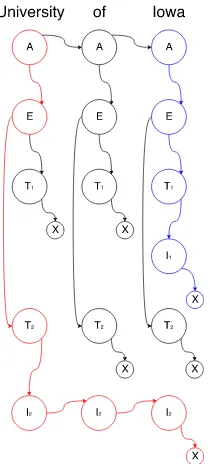
Figure 5: An example sub-hypergraph with two nested NE mentions: ‘University of Iowa’ (ORG) and ‘Iowa’ (LOC). Here, one mention corresponds to a path consisting of (AETI+X) nodes. Note that this hypergraph cannot be used to represent discontinuous mentions, but, in (Muis and Lu,
2016), they expand the hypergraph representation to capture discontinuous mentions through two new node types: B for within the mention, and O for part of the gap.
is not always available, plays a crucial role in the success of the joint model (Li et al.,2017).
Lu and Roth (2015), extended by Muis and Lu (2016), proposed a novel hypergraph to compactly represent exponentially many possible nested mentions in one sentence, and one sub-hypergraph of the complete sub-hypergraph can there-fore be used to represent a combination of men-tions in the sentence. Figure 5 is an example of such a sub-hypergraph, which represents two nested NE mentions.
The training objectives of these models are to maximize the log-likelihood of training instances consisting of the sentence and mention-encoded hypergraph. During inference, the model will first predict a hypergraph among all possible sub-hypergraph of the complete sub-hypergraph, and pre-dicted mentions can be decoded from the output sub-hypergraph.
contained by another mention with the same en-tity type and their boundaries are all different, the hypergraph can be decoded in different ways. This ambiguity comes from the fact that, if one node has multiple parent nodes and multiple child nodes, there is no mechanism to decide which of the parent node is paired with which child node.
4 Research Plan
We note that the drawbacks of existing meth-ods can be broadly categorized into: (1) lack of expressivity; and (2) computational complexity. Most of token-level approaches were proposed for some specific scenarios or data sets, therefore usu-ally with strict restrictions. For example, the BIO variant schema in (Schneider et al.,2014) was de-signed for nested structure with maximum depth of two. Therefore, it is difficult to be applied on GENIA corpus (Kim et al.,2003), which contains nested entities up to four layers of embedding. In addition, these token-level methods are usually de-vised to deal with only either nested or discontinu-ous mentions, and seldom can be used to tackle all kinds of complex entity mentions simultaneously. In contrast, sentence-level approaches are over-all more flexible and less ambiguous, however with higher computational cost. For example, both
Finkel and Manning (2009) andMcDonald et al.
(2005) methods suffer from a high time complex-ity which is cubic in the number of tokens in the sentence. Our aim is to propose a model that rec-ognizes all kinds of complex entity mentions, with low ambiguity level and low computational com-plexity. Some specific directions include:
• The representation in (McDonald et al.,
2005), introduced in Section 3, is most flex-ible and straightforward among all schemes designed for representing complex entity mentions. It can be used to represent all nested, overlapping and discontinuous entity mentions with unbounded length and depth. We are exploring recent advances in multi-label classificationmethods (Xu et al.,2016;
Shi et al.,2017) to reduce the computational complexity of this approach.
• Sequence-to-sequence models (Sutskever et al., 2014; Cho et al., 2014) had achieved great success in machine translation and text generation tasks, especially after enhanced by attention mechanisms (Luong et al.,
2015). We are exploring extending the encoder-decoder architecture to recognize complex entity mentions. During inference stage, instead of one tag sequence capturing all mentions in the sentence, the decoder can produce multiple sequences, each of which corresponds to one possible mention combination, analogous to several possible target sentences in machine translation tasks.
• Supervised learning NER methods are af-fected by the quantity and quality of the available annotated corpora. However, since annotating mentions with complex structure requires more human efforts than annotat-ing only the outermost or longest continu-ous spans, training data for complex entity mention recognition is rare. Furthermore, the medical domain is where complex mentions widely exist, such as disorder mentions and adverse drug events. The cost of producing gold standard corpus in such a domain is very high, due to the expertise required and the limited access to some medical text, such as electronic health records.
Active learning aims to reduce the cost of constructing a labeled dataset by allowing a human-in-the-loop (Settles and Craven,
2008; Stanovsky et al., 2017). The model selects one or several most informative in-stances and presents these inin-stances to the an-notators. Since only these most informative instances need to be manually annotated by human experts, it can reduce the need for hu-man effort and therefore the cost of construct-ing large labeled dataset. We are explorconstruct-ing this method to relieve the pain of lacking training data.
• Finally, we are going to utilize recent ad-vances in NER domain to improve the ef-fectiveness of complex entity mentions rec-ognizers, such as character-level embedding (Kuru et al., 2016) and joint models (Luo et al.,2015).
contains all three kinds of complex mentions, e.g., GENIA (Kim et al.,2003) only contains nested en-tity mentions, and CADEC (Karimi et al., 2015) and SemEval2014 (Pradhan et al., 2014) contain overlapping and discontinuous mentions. In ad-dition, ACE 1 and NNE (Ringland, 2016) are newswire corpora with nested entity mentions.
On these data sets, we will use standard evalua-tion metrics for NER tasks, namely micro-average precision, recall and f1-score, to evaluate the ef-fectiveness of proposed methods in recognizing both complex and simple mentions. However, due to the complexity of complex NE mentions, we will include different boundary matching re-laxation, such as partial match and approximate match (Tsai et al.,2006), to measure the proposed methods in identifying these complex mentions.
5 Summary
We reviewed the existing methods of recogniz-ing nested, overlapprecogniz-ing and discontinuous en-tity mentions, categorizing them as token-level and sentence-level approaches, and discussed their strengths and limitations. We also identified the research gap and introduce some directions we are exploring.
Acknowledgments The author thanks Sarvnaz
Karimi, Ben Hachey, Cecile Paris and Data61’s Language and Social Computing team for their support and helpful discussions. The author also thanks three anonymous reviewers for their in-sightful comments.
References
Beatrice Alex, Barry Haddow, and Claire Grover. 2007. Recognising nested named entities in biomedical text. InACL Workshop on Biological, Translational, and Clinical Language Processing, pages 65–72, Prague, Czech Republic.
Timothy Baldwin and Su Nam Kim. 2010. Multi-word expressions. In Handbook of Natural Lan-guage Processing, pages 267–292.
Kate Byrne. 2007. Nested named entity recognition in historical archive text. In International Con-ference on Semantic Computing, pages 589–596, Irvine, California.
Jason Chiu and Eric Nichols. 2016. Named entity recognition with bidirectional lstm-cnns.
Transac-1
https://www.ldc.upenn.edu/collaborations/past-projects/ace
tions of the Association for Computational Linguis-tics, 4:357–370.
Kyunghyun Cho, Bart van Merrienboer, Caglar Gul-cehre, Dzmitry Bahdanau, Fethi Bougares, Holger Schwenk, and Yoshua Bengio. 2014. Learning phrase representations using rnn encoder–decoder for statistical machine translation. InConference on Empirical Methods in Natural Language Process-ing, pages 1724–1734, Doha, Qatar.
James Curran and Stephen Clark. 2003. Language in-dependent ner using a maximum entropy tagger. In Conference on Natural Language Learning, pages 164–167.
Xiang Dai, Sarvnaz Karimi, and Cecile Paris. 2017. Medication and adverse event extraction from noisy text. InAustralasian Language Technology Work-shop, pages 79–87, Brisbane, Australia.
Jenny Rose Finkel and Christopher D. Manning. 2009. Nested named entity recognition. InConference on Empirical Methods in Natural Language Process-ing, pages 141–150, Suntec, Singapore.
Sarvnaz Karimi, Alejandro Metke-Jimenez, Madonna Kemp, and Chen Wang. 2015. CADEC: A corpus of adverse drug event annotations. Journal of Biomed-ical Informatics, 55:73–81.
J-D Kim, Tomoko Ohta, Yuka Tateisi, and Junichi Tsujii. 2003. Genia corpusa semantically anno-tated corpus for bio-textmining. Bioinformatics, 19(suppl 1):i180i182.
Alexandre Klementiev and Dan Roth. 2006. Weakly supervised named entity transliteration and discov-ery from multilingual comparable corpora. In Inter-national Conference on Computational Linguistics and Annual Meeting of the Association for Compu-tational Linguistics, pages 817–824, Sydney, Aus-tralia.
Onur Kuru, Ozan Arkan Can, and Deniz Yuret. 2016. Charner: Character-level named entity recognition. InInternational Conference on Computational Lin-guistics, pages 911–921, Osaka, Japan.
Guillaume Lample, Miguel Ballesteros, Sandeep Sub-ramanian, Kazuya Kawakami, and Chris Dyer. 2016. Neural architectures for named entity recognition. InAnnual Conference of the North American Chap-ter of the Association for Computational Linguis-tics: Human Language Technologies, pages 260– 270, San Diego, California.
Nut Limsopatham and Nigel Collier. 2016. Normalis-ing medical concepts in social media texts by learn-ing semantic representation. In Annual Meeting of the Association for Computational Linguistics, pages 1014–1023, Berlin, Germany.
Wei Lu and Dan Roth. 2015. Joint mention extrac-tion and classificaextrac-tion with menextrac-tion hypergraphs. In Conference on Empirical Methods in Natural Lan-guage Processing, pages 857–867, Lisbon, Portugal.
Gang Luo, Xiaojiang Huang, Chin-Yew Lin, and Za-iqing Nie. 2015. Joint entity recognition and disam-biguation. InConference on Empirical Methods in Natural Language Processing, pages 879–888, Lis-bon, Portugal.
Minh-Thang Luong, Hieu Pham, and Christopher D Manning. 2015. Effective approaches to attention-based neural machine translation. InConference on Empirical Methods in Natural Language Process-ing, pages 1412–1421, Lisbon, Portugal.
Xuezhe Ma and Eduard Hovy. 2016. End-to-end se-quence labeling via bi-directional lstm-cnns-crf. In Annual Meeting of the Association for Computa-tional Linguistics, pages 1064–1074, Berlin, Ger-many.
Ryan McDonald, Koby Crammer, and Fernando Pereira. 2005. Flexible text segmentation with struc-tured multilabel classification. InHuman Language Technology Conference and Conference on Empiri-cal Methods in Natural Language Processing, pages 987–994, Vancouver, Canada.
Alejandro Metke-Jimenez and Sarvnaz Karimi. 2015. Concept extraction to identify adverse drug reac-tions in medical forums: A comparison of algo-rithms. CoRR abs/1504.06936.
Diego Moll´a, Menno Zaanen, and Steve Cassidy. 2007. Named entity recognition in question answering of speech data. InAustralasian Language Technology Workshop, pages 57–65, Melbourne, Australia.
Aldrian Obaja Muis and Wei Lu. 2016. Learning to recognize discontiguous entities. InConference on Empirical Methods in Natural Language Process-ing, pages 75–84, Austin, Texas.
Xiaoman Pan, Boliang Zhang, Jonathan May, Joel Nothman, Kevin Knight, and Heng Ji. 2017. Cross-lingual name tagging and linking for 282 languages. In Annual Meeting of the Association for Compu-tational Linguistics, pages 1946–1958, Vancouver, Canada.
Slav Petrov, Leon Barrett, Romain Thibaux, and Dan Klein. 2006. Learning accurate, compact, and in-terpretable tree annotation. In International Con-ference on Computational Linguistics and Annual Meeting of the Association for Computational Lin-guistics, pages 433–440, Sydney, Australia.
Sameer Pradhan, No´emie Elhadad, Wendy Chapman, Suresh Manandhar, and Guergana Savova. 2014. Semeval-2014 task 7: Analysis of clinical text. InInternational Workshop on Semantic Evaluation, pages 54–62, Dublin, Ireland.
Lev Ratinov and Dan Roth. 2009. Design challenges and misconceptions in named entity recognition. In Conference on Natural Language Learning, pages 147–155, Boulder, Colorado.
Nicky Ringland. 2016. Structured Named Entities. Ph.D. thesis, University of Sydney.
Nathan Schneider, Emily Danchik, Chris Dyer, and Noah A Smith. 2014. Discriminative lexical se-mantic segmentation with gaps: Running the mwe gamut. Transactions of the Association for Compu-tational Linguistics, 2:193–206.
Burr Settles and Mark Craven. 2008. An analysis of active learning strategies for sequence labeling tasks. InConference on Empirical Methods in Nat-ural Language Processing, pages 1070–1079, Hon-olulu, Hawaii.
Haoran Shi, Pengtao Xie, Zhiting Hu, Ming Zhang, and Eric P. Xing. 2017. Towards automated icd coding using deep learning.CoRR abs/1711.04075.
Gabriel Stanovsky, Daniel Gruhl, and Pablo N Mendes. 2017. Recognizing mentions of adverse drug reac-tion in social media using knowledge-infused recur-rent models. InConference of the European Chap-ter of the Association for Computational Linguistics, pages 142–151, Valencia, Spain.
Ilya Sutskever, Oriol Vinyals, and Quoc V Le. 2014. Sequence to sequence learning with neural net-works. In Conference on Neural Information Processing Systems, pages 3104–3112, Montreal, Canada.
Richard Tzong-Han Tsai, Shih-Hung Wu, Wen-Chi Chou, Yu-Chun Lin, Ding He, Jieh Hsiang, Ting-Yi Sung, and Wen-Lian Hsu. 2006. Various criteria in the evaluation of biomedical named entity recog-nition.BMC Bioinformatics, 7(1):92.
Chang Xu, Dacheng Tao, and Chao Xu. 2016. Ro-bust extreme multi-label learning. In Conference on Knowledge Discovery and Data Mining, pages 1275–1284, San Francisco, California.
Mingbin Xu, Hui Jiang, and Sedtawut Watcharawit-tayakul. 2017. A local detection approach for named entity recognition and mention detection. InAnnual Meeting of the Association for Computational Lin-guistics, pages 1237–1247, Vancouver, Canada.