89
MSnet: A BERT-based Network for Gendered Pronoun Resolution
Zili Wang
CEIEC Chengdu, China
Abstract
The ptrained BERT model achieves a re-markable state of the art across a wide range of tasks in natural language processing. For solving the gender bias in gendered pronoun resolution task, I propose a novel neural net-work model based on the pre-trained BERT. This model is a type of mention score classi-fier and uses an attention mechanism with no parameters to compute the contextual sentation of entity span, and a vector to repre-sent the triple-wise semantic similarity among the pronoun and the entities. In stage 1 of the gendered pronoun resolution task, a vari-ant of this model, trained in the fine-tuning approach, reduced the multi-class logarithmic loss to 0.3033 in the 5-fold cross-validation of training set and 0.2795 in testing set. Besides, this variant won the 2nd place with a score at 0.17289 in stage 2 of the task.
The code in this paper is available at:
https://github.com/ziliwang/ MSnet-for-Gendered-Pronoun-Resolution
1 Introduction
Coreference resolution is an essential field of nat-ural language processing (Sukthanker et al., 2018) and has been widely used in many systems such as dialog system (Niraula et al., 2014; Wessel et al., 2017), relation extraction (Wang et al., 2018) and question answer (Vicedo and Ferr´andez, 2000). Up to now, various models for coreference resolu-tion have been proposed, and they can be generally categorized as (1) mention-pair classifier model (Webster and Nothman, 2016), (2) entity-centric model (Clark and Manning, 2015), (3) ranking model (Lee et al., 2017, 2018). However, some of these models implicate gender bias (Koolen and van Cranenburgh, 2017; Rudinger et al., 2018). To address this, Webster et al. (2018) presented and
released Gendered Ambiguous Pronouns (GAP) dataset.
Recent work indicated that the pre-trained lan-guage representation models benefit to the coref-erence resolution (Lee et al., 2018). In the past years, the development of deep learning meth-ods of language representation was swift, and the newer methods were shown to have significant effects on improving other natural language pro-cessing tasks(Peters et al., 2018; Radford and Sal-imans, 2018; Devlin et al., 2018). The latest one is Bidirectional Encoder Representations from Transformers (BERT) (Devlin et al., 2018), which is the cornerstone of the state of the art models in many tasks.
2 Model
As the target of the Gendered Pronoun Resolu-tion task is to label the pronoun with whether it refers to entity A, entity B, or NEITHER. I aim to learn the reference probability distribution
P(Ei|D)from the input documentD:
P(Ei|D) =
exp(s(Ei|D))
P
j∈Eexp(s(Ej|D))
whereEi is the candidate reference entity of pro-noun,E = {A,B,NEITHER}andsis the score function which is implemented by a neural net-work architecture, which is described in detail in the following subsection.
2.1 The Mention Score Network
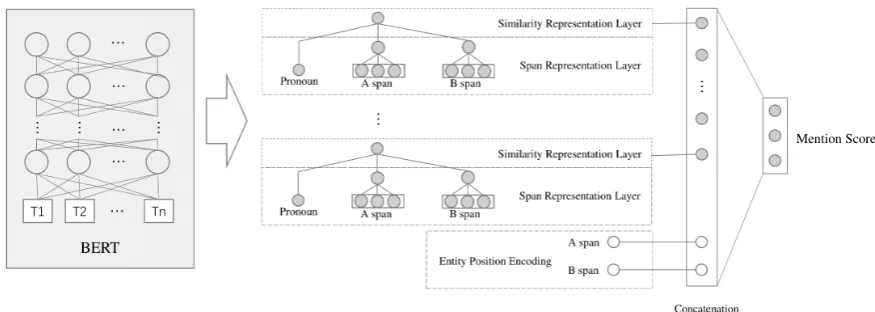
The mention score network is build on the pre-trained BERT model (Figure 1). It has three layers, the span representation layer, the similarity layer, and the mention score layer. They are described in detail in the following part.
Span Representation Layer: The contextual representation is crucial to accurately predict the relation between the pronouns and the entities. In-spired by Lee et al. (2017), I adopt the hidden states of transformers of the pre-trained BERT as the contextual representation. As Devlin et al. (2018) showed that the performance of the con-catenation of token representations from the top hidden layers of pre-trained Transformer of BERT is close to fine-tuning the entire model, the top hidden states will be given priority to compute the representation of entity spans. Since most en-tity spans consist of various tokens, the contextual representation of them should be re-computed to maintain the correspondence. I present two meth-ods to re-compute the span representations: 1)
Meanpooling method:
x∗(j,l)= 1 ˆ
N
X
i∈Spanj x(i,l)
wherex(i,l)denotes the hidden states ofi-th token inl-th layer of BERT, andx∗(j,l) denotes the
con-textual representation of entity spanj, andNˆis the token counts of spanj. 2)Attention mechanism:
Instead of weighting each token equality, I adopt the attention mechanism to weight the tokens by:
s(i,l)=
1
√
dH
norm(x(i,l))·x(p,l)
a(i,j,l) =
exp(s(i,l)) P
k∈Spanjexp(s(k,l))
,i∈Spanj
x∗(j,l)= X i∈Spanj
a(i,j,l)x(i,l)
The weightsa(i,j,l)are learned automatically from the contextual similarity s(i,l) between pronoun x(p,l) and the tokenx(i,l)in the spanj. Different
from the commonly used attention functions, the above one has no parameters and is more space-efficient in practice. The scaling factor dH de-notes the hidden size of BERT and is designed to counteract the effect of extremely small gradi-ents caused by the large magnitude of dot products (Vaswani et al., 2017).
Similarity Layer: Inspired by the pairwise similarity of Lee et al. (2017), I assume a vector ˆsl to represent the triple-wise semantic similarity among the pronoun and the entities of l-layer in BERT:
al=x∗(a,l)
bl =x∗(b,l)
pl=x(p,l)
ˆsl=WT[pl, al, bl, al◦pl, bl◦pl] +b
whereal,blandpldenote the contextual represen-tation of the pronoun, entity A and entity B of the
l-th layer in BERT,·denotes the dot product and
◦denotes the element-wise multiplication. Theˆsl can be learned by a single layer feed-forward neu-ral network with the weightsWand the biasb.
Mention Score Layer: Mention score layer is also a feed-forward neural network architecture and computes the mention scores given the dis-tance vectordbetween the pronoun and its candi-date entities and the concatenated similarity vector ˆs:
da= tanh(wdist(START(A)−START(P)) +bdist)
db = tanh(wdist(START(B)−START(P)) +bdist)
d= [da, db]
ˆs= [ˆs0,ˆs1, ...,ˆsl, ...,ˆsL]
s(Ei|D) =WEi·[ˆs,d] +bEi
Figure 1: The architecture of MSnet.
the span. wdist is a learnable weight for encoding
the distance which corresponds to a learnable bias
bdistandWEi is the learnable weights for scoring
entity Ei which corresponds to a learnable bias bEi.
3 Experiments
I train the model on the Kaggle platform by us-ing scripts kernel which usus-ing the computational environment from the docker-python 1. I em-ploy pytorch as the deep learning framework, and
the pytorch-pretrained-BERT package 2
to load and tune the pre-trained BERT model.
3.1 Dataset
The GAP Coreference Dataset 3 (Webster et al., 2018) has 4454 records and officially split into three parts: development set (2000 records), test set (2000 records), and validation set (454 records). Conforming to the stage 1 of Gendered Pronoun Resolution4task, the official test set and validation set are combined as the training dataset in the experiments, while the official development set is used as the test set correspondingly.
1
https://github.com/Kaggle/docker-python
2
https://github.com/huggingface/ pytorch-pretrained-BERT
3
https://github.com/google-research-datasets/gap-coreference
4
https://www.kaggle.com/c/gendered-pronoun-resolution
3.2 Preprocessing
In the experiments, the WordPiece is used to tok-enize the documents. To ensure the token counts less than 300 after tokenizing, I remove the head or tail tokens in a few documents. Next, the spe-cial tokens[CLS]and[SEP]are added into the head and end of the tokens sequences.
3.3 Hyper-parameters
Pre-trained BERT model: As increasing model sizes of BERT may lead to significant improve-ments on very small scale tasks (Devlin et al., 2018), I explore the effect of BERTBASE and
BERTLARGE in the experiments. I employ
the uncased_L-12_H-768_A-12 5 as the
BERTBASE and cased_L-24_H-1024_A-16
6 as the BERT
LARGE, and both of them are
trans-formed into the pytorch-supported format by the script inpytorch-pretrained-BERT.
Hidden Layers for Representation: Devlin et al. (2018) showed that using the representation from appropriate hidden layers of BERT can im-prove the model performance, the hidden layersL
(described in Section 2) is therefore utilized as a hyper-parameter tuned in the experiments.
Dimension of Similarity Vector: Since a vec-tor is used to represent the task-specific semantic similarity, its dimensionˆsdim may have potential influence the performance. A smaller dimension
5https://storage.googleapis.com/bert_
models/2018_10_18/uncased_L-12_H-768_A-12.zip
6https://storage.googleapis.com/bert_
will partly lose information, while a bigger one will cause generalization problems.
Span Contextual Representation: As section 2 described, both the meanpooling and attention method can be used to compute the contextual rep-resentation of the tokens span of the entity. There-fore, the choice of them is a hyper-parameter in the experiment.
Tunable Layers: I use two different approaches to train the MSnet model. The first one is the feature-based approach which trains MSnet with freezing the BERT part. The second one is the fine-tuning approach, which tunes the parameters of BERT and MSnet simultaneously. Howard and Ruder (2018) showed the discriminative fine-tuning gets a better performance than the ordi-nary, which possibly means that the pre-trained language model has a hierarchical structure. One possible explanation is that the lower hidden lay-ers extract the word meanings and grammatical structures and the higher layers process them into higher-level semantic information. In this, I freeze the embedding layer and bottom hidden layers of BERT to keep the completeness of word meaning and grammatical structure and tune the top hidden layersLtuning.
3.4 Training Details
For improving the generalization ability of the model, I employ the dropout mechanism (Srivas-tava et al., 2014) on the input of the feed-forward neural network in the similarity layer and the con-catenation in the mention score layer. The rate of dropout is set at 0.6 which is the best setting af-ter tuned on it. I also apply the dropout on the representation of tokens when using the attention mechanism to compute the contextual representa-tion of span, and its dropout rate is set at 0.4. Ad-ditionally, I adopt the batch normalization (Ioffe and Szegedy, 2015) before the dropout operation in the mention score layer. As introduced in sec-tion 3.3, I use the feature-based approach and the fine-tuning approach separately to train the MSnet, and the training details are described in the follow-ing.
Feature-based Approach: In the feature-based approach, I train the model by minimizing the cross-entropy loss with Adam (Kingma and Ba, 2014) optimizer with a batch size of 32. To adapt to the training data in the experiments, I tuned the learning rate and found a learning rate of 3e-4 was
the best setting. The maximum epoch set at 30 and early stopping method is used to prevent the over-fitting of MSnet.
Fine-tuning Approach: In the fine-tuning ap-proach, the generic training method was not work-ing. I adopt a two-step tuning strategy to achieve the fine-tuning. In step 1, I train the MSnet in the feature-based approach. And in step 2, MSnet and BERT are tuned simultaneously with a small learning rate.
Since the two steps have the same optimization landscape, in step 2, the model may not escape the local minimum where it entered in step 1. I adopt two strategies of training in step 1 to reduce the probability of those situations: 1) premature. The MSnet is trained to under-fitting by using a small maximum training epoch which is set at 10 in the experiments. 2) mature. In this strategy, MSnet is trained to proper-fitting, and it is applied by adopt-ing a weight decay at 0.01 rate, an early stoppadopt-ing at 4 epoch, and the maximum training epoch at 20 in the experiments. In addition, other training parameters of the two strategies have the same set-ting as in the feature-based approach.
In step 2, I also trained the model by mini-mizing the cross-entropy loss but with two dif-ferent optimizers. For BERT, I used the Adam optimizer with the weight decay fix which imple-mented bypytorch-pretrained-BERT. For MSnet, the generic Adam was used. Both of the two optimizers are set with a learning rate at 5e-6 and a weight decay at 0.01. The maximum train-ing epoch is set at 20, and the early stopptrain-ing is set at 4 epoch. The batch size was 5 as the GPU memory limitation.
3.5 Evaluation
I report the multi-class logarithmic loss of the 5-fold cross-validation on train and the average of their predictions on the test. Also, the running time of the scripts is reported as a reference of the performance of the MSnet.
4 Results and Discussion
4.1 Feature-based Approach
Model# BERT L ˆsdim Span 5-fold CV on train test runtime(s)
1 BASE 1 32 Meanpooling 0.5247±0.0379 0.4891 232.8
2 BASE 4 32 Meanpooling 0.4699±0.0431 0.4270 317.3
3 LARGE 4 32 Meanpooling 0.4041±0.0532 0.3819 358.3
4 LARGE 8 32 Meanpooling 0.3783±0.0468 0.3519 372.2
5 LARGE 12 32 Meanpooling 0.3879±0.0461 0.3546 415.4
6 LARGE 8 8 Meanpooling 0.3758±0.0430 0.3490 436.2
7 LARGE 8 16 Meanpooling 0.3736±0.0465 0.3488 415.0
8 LARGE 8 64 Meanpooling 0.3780±0.0441 0.3518 447.6
[image:5.595.92.508.60.204.2]9 LARGE 8 16 Attention 0.3582±0.0435 0.3349 828.2
Table 1: Results of Feature-based Aproach.
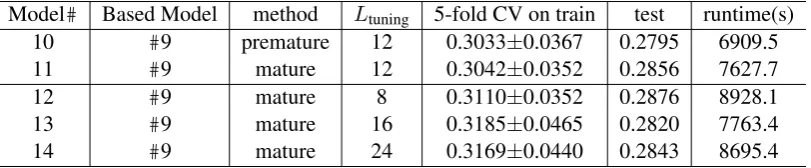
Model# Based Model method Ltuning 5-fold CV on train test runtime(s)
10 #9 premature 12 0.3033±0.0367 0.2795 6909.5
11 #9 mature 12 0.3042±0.0352 0.2856 7627.7
12 #9 mature 8 0.3110±0.0352 0.2876 8928.1
13 #9 mature 16 0.3185±0.0465 0.2820 7763.4
14 #9 mature 24 0.3169±0.0440 0.2843 8695.4
Table 2: Results of Fine-tuning Aproach.
layer. The possible reason is that the seman-tic information about gender may be partly trans-formed to the higher level semantic information during the hidden layers in BERT. In addition, changing BERTBASE to the BERTLARGE reduces
the loss in 5-fold CV on train from 0.4699±0.0431 to 0.4041±0.0532, which demonstrate increasing model size of BERT can lead to remarkable im-provement on the small scale task. The explo-ration of contextual representation layers shows the proper representation layers is proportionate to the number of hidden layers of BERT. In other words, the modeling ability of BERTLARGE is
more powerful than BERTBASE by using a more
complex function to do the same work.
The comparison among the model #4, model
#6, model#7 and model#8 shows the dimension of the similarity vector has a slight affection for the performance of MSnet (Table 1) and the best loss is 0.3736±0.0465 with the dimension set at 16. Changing the method for computing the span contextual representation from meanpooling to at-tention mechanism reduces the loss in CV on train by ∼0.02, which demonstrates that the attention mechanism used in the experiment is effective to compute the contextual representation of the entity span. To the best of my knowledge, it is a novel attention mechanism with no learnable parameters and more space-efficient and more explainable in
practice.
4.2 Fine-tuning Approach
The experiments in fine-tuning approach was based on model #9, and the results are shown in table 2. The comparison between model#10 and model#11 shows that their difference on perfor-mance is slight. Also, both of them are effec-tive to the fine-tuning of MSnet and reduce loss in the CV of train by ∼0.054 compared to the feature-based approach. Furthermore, the tuning on Ltuningshows the best setting is tuning top 12
hidden layers in BERT, and more or fewer layers will reduce the performance of MSnet. The possi-ble reason is that tuning fewer layers will limit the ability of the transformation from basic semantic to gender-related semantic while tuning more bot-tom layers will damage the extraction of the un-derlying semantics when training on a small data set.
[image:5.595.98.504.234.318.2]per-formance of the model was observed in the exper-iments.
4.3 Results in Stage 2
The gendered pronoun resolution was a two-stage task, and I submitted the model #10 and #11 in stage 2 as their best performances in 5-fold cross-validation of the training dataset. The final scores of the models were 0.17289 (model#10 ) and 0.18361 (model #11). This result featurely demonstrates the premature strategy is better than the mature one and can be explained as former one keeps more explorable optimization landscape in step 2 in the fine-tuning approach.
5 Conclusion
This paper presented a novel pre-trained BERT based network model for the gendered pronoun resolution task. This model is a kind of mention score classifier and uses an attention mechanism to compucate the contextual representation of en-tity span and a vector to represent the triple-wise semantic similarity among the pronoun and the entities. I trained the model in the feature-based and the two-step fine-tuning approach respec-tively. On the GAP dateset, the model trained by the fine-tuning approach with premature strategy obtains remarkable multi-class logarithmic loss on the local 5-fold cross-valication at 0.3033, and 0.17289 on the test dataset in stage 2 of the task. I believe the MSnet can serve as a new strong baseline for gendered pronoun resolution task as well as the coreference resolution. The code for training model are available at:https: //github.com/ziliwang/MSnet-for-Gendered-Pronoun-Resolution
Acknowledgments
I want to thank the kaggle company for its public computing resources.
References
Kevin Clark and Christopher D Manning. 2015. Entity-centric coreference resolution with model stacking. In Proceedings of the 53rd Annual Meeting of the Association for Computational Linguistics and the 7th International Joint Conference on Natural
Lan-guage Processing (Volume 1: Long Papers), vol-ume 1, pages 1405–1415.
Jacob Devlin, Ming-Wei Chang, Kenton Lee, and Kristina Toutanova. 2018. Bert: Pre-training of deep bidirectional transformers for language understand-ing.arXiv preprint arXiv:1810.04805.
Jeremy Howard and Sebastian Ruder. 2018. Universal language model fine-tuning for text classification.
arXiv preprint arXiv:1801.06146.
Sergey Ioffe and Christian Szegedy. 2015. Batch nor-malization: Accelerating deep network training by reducing internal covariate shift. arXiv preprint arXiv:1502.03167.
Diederik P Kingma and Jimmy Ba. 2014. Adam: A method for stochastic optimization. arXiv preprint arXiv:1412.6980.
Corina Koolen and Andreas van Cranenburgh. 2017. These are not the stereotypes you are looking for: Bias and fairness in authorial gender attribution. In
Proceedings of the First ACL Workshop on Ethics in Natural Language Processing, pages 12–22.
Kenton Lee, Luheng He, Mike Lewis, and Luke Zettle-moyer. 2017. End-to-end neural coreference resolu-tion. Proceedings of the 2017 Conference on Empir-ical Methods in Natural Language Processing.
Kenton Lee, Luheng He, and Luke Zettlemoyer. 2018. Higher-order coreference resolution with coarse-to-fine inference. arXiv preprint arXiv:1804.05392.
Nobal B Niraula, Vasile Rus, Rajendra Banjade, Dan Stefanescu, William Baggett, and Brent Morgan. 2014. The dare corpus: A resource for anaphora resolution in dialogue based intelligent tutoring sys-tems. InLREC, pages 3199–3203.
Matthew E. Peters, Mark Neumann, Mohit Iyyer, Matt Gardner, Christopher Clark, Kenton Lee, and Luke Zettlemoyer. 2018. Deep contextualized word rep-resentations.
Alec Radford and Tim Salimans. 2018. GPT: Improv-ing Language UnderstandImprov-ing by Generative Pre-Training.arXiv, pages 1–12.
Rachel Rudinger, Jason Naradowsky, Brian Leonard, and Benjamin Van Durme. 2018. Gender bias in coreference resolution. arXiv preprint arXiv:1804.09301.
Nitish Srivastava, Geoffrey Hinton, Alex Krizhevsky, Ilya Sutskever, and Ruslan Salakhutdinov. 2014. Dropout: a simple way to prevent neural networks from overfitting. The Journal of Machine Learning Research, 15(1):1929–1958.
Ashish Vaswani, Noam Shazeer, Niki Parmar, Jakob Uszkoreit, Llion Jones, Aidan N. Gomez, Lukasz Kaiser, and Illia Polosukhin. 2017. Attention is all you need. InNIPS.
Jos´e L Vicedo and Antonio Ferr´andez. 2000. Impor-tance of pronominal anaphora resolution in question answering systems. InProceedings of the 38th An-nual Meeting of the Association for Computational Linguistics.
Yanshan Wang, Liwei Wang, Majid Rastegar-Mojarad, Sungrim Moon, Feichen Shen, Naveed Afzal, Sijia Liu, Yuqun Zeng, Saeed Mehrabi, Sunghwan Sohn, et al. 2018. Clinical information extraction appli-cations: a literature review. Journal of biomedical informatics, 77:34–49.
Kellie Webster and Joel Nothman. 2016. Using men-tion accessibility to improve coreference resolumen-tion. In Proceedings of the 54th Annual Meeting of the Association for Computational Linguistics (Volume 2: Short Papers), volume 2, pages 432–437.
Kellie Webster, Marta Recasens, Vera Axelrod, and Ja-son Baldridge. 2018. Mind the gap: A balanced cor-pus of gendered ambiguous pronouns. In Transac-tions of the ACL, page to appear.
Michael Wessel, Girish Acharya, James Carpenter, and Min Yin. 2017. An ontology-based dialogue man-agement system for virtual personal assistants. In