393
Deep Neural Models for Medical Concept Normalization in
User-Generated Texts
Zulfat Miftahutdinov Kazan Federal University,
Kazan, Russia [email protected]
Elena Tutubalina Kazan Federal University,
Kazan, Russia
Samsung-PDMI Joint AI Center, PDMI RAS, St. Petersburg, Russia
Abstract
In this work, we consider the medical con-cept normalization problem, i.e., the prob-lem of mapping a health-related entity men-tion in a free-form text to a concept in a con-trolled vocabulary, usually to the standard the-saurus in the Unified Medical Language Sys-tem (UMLS). This is a challenging task since medical terminology is very different when coming from health care professionals or from the general public in the form of social media texts. We approach it as a sequence learning problem with powerful neural networks such as recurrent neural networks and contextual-ized word representation models trained to ob-tain semantic representations of social media expressions. Our experimental evaluation over three different benchmarks shows that neural architectures leverage the semantic meaning of the entity mention and significantly outper-form an existing state of the art models.
1 Introduction
User-generated texts (UGT) on social media present a wide variety of facts, experiences, and opinions on numerous topics, and this treasure trove of information is currently severely under-explored. We consider the problem of discovering medical concepts in UGTs with the ultimate goal of mining new symptoms, adverse drug reactions (ADR), and other information about a disorder or a drug.
An important part of this problem is to translate a text from “social media language” (e.g., “can’t fall asleep all night” or “head spinning a little”) to “formal medical language” (e.g., “insomnia” and “dizziness” respectively). This is necessary to match user-generated descriptions with medical concepts, but it is more than just a simple matching of UGTs against a vocabulary. We call the task of mapping the language of UGTs to medical
termi-nologymedical concept normalization. It is espe-cially difficult since in social media, patients dis-cuss different concepts of illness and a wide array of drug reactions. Moreover, UGTs from social networks are typically ambiguous and very noisy, containing misspelled words, incorrect grammar, hashtags, abbreviations, smileys, different varia-tions of the same word, and so on.
Traditional approaches for concept normaliza-tion utilized lexicons and knowledge bases with string matching. The most popular knowledge-based system for mapping texts to UMLS identi-fiers is MetaMap (Aronson,2001). This linguistic-based system uses lexical lookup and variants by associating a score with phrases in a sentence. The state-of-the-art baseline for clinical and scientific texts is DNorm (Leaman et al., 2013). DNorm adopts a pairwise learning-to-rank technique using vectors of query mentions and candidate concept terms. This model outperforms MetaMap signif-icantly, increasing the macro-averaged F-measure by 25% on an NCBI disease dataset. However, while these tools have proven to be effective for patient records and research papers, they achieve moderate results on social media texts (Nikfarjam et al.,2015;Limsopatham and Collier,2016).
Recent works go beyond string matching: these works have tried to view the problem of matching a one- or multi-word expression against a knowl-edge base as a supervised sequence labeling prob-lem. Limsopatham and Collier (2016) utilized convolutional neural networks (CNNs) for phrase normalization in user reviews, while Tutubalina et al.(2018),Han et al.(2017), andBelousov et al. (2017) applied recurrent neural networks (RNNs) to UGTs, achieving similar results. These works were among the first applications of deep learning techniques to medical concept normalization.
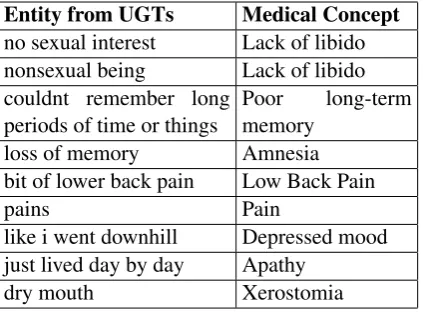
represen-Entity from UGTs Medical Concept
no sexual interest Lack of libido nonsexual being Lack of libido couldnt remember long
periods of time or things
Poor long-term memory
loss of memory Amnesia
bit of lower back pain Low Back Pain
pains Pain
like i went downhill Depressed mood just lived day by day Apathy
dry mouth Xerostomia
Table 1: Examples of extracted social media entities and their associated medical concepts.
tation model BERT (Devlin et al.,2018) and Gated Recurrent Units (GRU) (Cho et al., 2014) with an attention mechanism, paired with word2vec
word embeddings and contextualized ELMo em-beddings (Peters et al., 2018). We investigate if a joint architecture with special provisions for do-main knowledge can further improve the mapping of entity mentions from UGTs to medical con-cepts. We combine the representation of an en-tity mention constructed by a neural model and distance-like similarity features using vectors of an entity mention and concepts from the UMLS. We experimentally demonstrate the effectiveness of the neural models for medical concept normal-ization on three real-life datasets of tweets and user reviews about medications with two evalua-tion procedures.
2 Problem Statement
Our main research problem is to investigate the content of UGTs with the aim to learn the tran-sition between a laypersons language and formal medical language. Examples from Table1 show that an automated model has to account for the se-mantics of an entity mention. For example, it has to be able to map not only phases with sharedn -gramsno sexual interestandnonsexual beinginto the concept “Lack of libido” but also separate the phasebit of lower back painfrom the broader con-cept “Pain” and map it to a narrower concon-cept.
While focusing on user-generated texts on so-cial media, in this work we seek to answer the fol-lowing research questions.
RQ1: Do distributed representations reveal im-portant features for medication use in user-generated texts?
RQ2: Can we exploit the semantic similarity be-tween entity mentions from user comments and medical concepts? Do the neural mod-els produce better results than the existing effective baselines? [current research]
RQ3: How to integrate linguistic knowledge about concepts into the models? [current research]
RQ4: How to jointly learn concept embeddings from UMLS and representations of health-related entities from UGTs? [future re-search]
RQ5: How to effectively use of contextual infor-mation to map entity mentions to medical concepts? [future research]
To answer RQ1, we began by collecting UGTs from popular medical web portals and investigat-ing distributed word representations trained on 2.6 millions of health-related user comments. In par-ticular, we analyze drug name representations us-ing clusterus-ing and chemoinformatics approaches. The analysis demonstrated that similar word vec-tors correspond to either drugs with the same ac-tive compound or to drugs with close therapeutic effects that belong to the same therapeutic group. It is worth noting that chemical similarity in such drug pairs was found to be low. Hence, these rep-resentations can help in the search for compounds with potentially similar biological effects among drugs of different therapeutic groups (Tutubalina et al.,2017).
To answer RQ2 and RQ3, we develop sev-eral models and conduct a set of experiments on three benchmark datasets where social media texts are extracted from user reviews and Twitter. We present this work in Sections3and4. We discuss RQ4 and RQ5 with research plans in Section5.
3 Methods
[image:2.595.77.289.62.218.2](1) bidirectional LSTM (Hochreiter and Schmid-huber, 1997) or GRU (Cho et al., 2014) with an attention mechanism and a hyper-bolic tangent activation function on top of 200-dimensional word embeddings obtained to answer RQ1;
(2) a bidirectional layer with attention on top of deep contextualized word representations ELMo (Peters et al.,2018);
(3) a contextualized word representation model BERT (Devlin et al.,2018), which is a multi-layer bidirectional Transformer encoder.
We omit technical explanations of the neural net-work architectures due to space constraints and re-fer to the studies above.
Next, the learned representation is concate-nated with a number of semantic similarity fea-tures based on prior knowledge from the UMLS Metathesaurus. Lastly, we add a softmax layer to convert values to conditional probabilities.
The most attractive feature of the biomedical domain is that domain knowledge is prevailing in this domain for dozens of languages. In particular, UMLS is undoubtedly the largest lexico-semantic resource for medicine, containing more than 150 lexicons with terms from 25 languages. To answer RQ3, we extract a set of features to enhance the representation of phrases. These features contain cosine similarities between the vectors of an input phrase and a concept in a medical terminology dic-tionary. We use the following strategy, which we call TF-IDF (MAX), to construct representations of a concept and a mention: represent a medical code as a set of terms; for each term, compute the cosine distance between its TF-IDF representation and the entity mention; then choose the term with the largest similarity.
4 Experiments
We perform an extensive evaluation of neu-ral models on three datasets of UGTs, namely
CADEC(Karimi et al.,2015),PsyTAR(Zolnoori et al., 2019), and SMM4H 2017 (Sarker et al., 2018). The basic task is to map a social media phrase to a relevant medical concept.
4.1 Data
CADEC. CSIRO Adverse Drug Event Corpus (CADEC) (Karimi et al.,2015) is the first richly
annotated and publicly available corpus of med-ical forum posts taken from AskaPatient1. This dataset contains 1253 UGTs about 12 drugs di-vided into two categories: Diclofenac and Lipi-tor. All posts were annotated manually for 5 types of entities: ADR, Drug, Disease, Symptom, and Finding. The annotators performed terminology association using the Systematized Nomenclature Of Medicine Clinical Terms (SNOMED CT). We removed “conceptless” or ambiguous mentions for the purposes of evaluation. There were 6,754 en-tities and 1,029 unique codes in total.
PsyTAR. Psychiatric Treatment Adverse Reac-tions (PsyTAR) corpus (Zolnoori et al., 2019) is the second open-source corpus of user-generated posts taken from AskaPatient. This dataset in-cludes 887 posts about four psychiatric medica-tions from two classes: (i) Zoloft and Lexapro from the Selective Serotonin Reuptake Inhibitor (SSRI) class and (ii) Effexor and Cymbalta from the Serotonin Norepinephrine Reuptake In-hibitor (SNRI) class. All posts were anno-tated manually for 4 types of entities: ADR, withdrawal symptoms, drug indications, and sign/symptoms/illness. The corpus consists of 6556 phrases mapped to 618 SNOMED codes.
SMM4H 2017. In 2017, Sarker et al. (2018) organized the Social Media Mining for Health (SMM4H) shared task which introduced a dataset with annotated ADR expressions from Twitter. Tweets were collected using 250 keywords such as generic and trade names for medications along with misspellings. Manually extracted ADR ex-pressions were mapped to Preferred Terms (PTs) of the Medical Dictionary for Regulatory Activi-ties (MedDRA). The training set consists of 6650 phrases mapped to 472 PTs. The test set consists of 2500 mentions mapped to 254 PTs.
4.2 Evaluation Details
We evaluate our models based on classification accuracy, averaged across randomly divided five folds of the CADEC and PsyTAR corpora. For SMM4H 2017 data, we adopted the official train-ing and test sets (Sarker et al., 2018). Analy-sis of randomly split folds shows that Random KFolds create a high overlap of expressions in exact matching between subsets (see the base-line results in Table 2). Therefore, we set up a
specific train/test split procedure for 5-fold cross-validation on the CADEC and PsyTAR corpora: we removed duplicates of mentions and grouped medical records we are working with into sets re-lated to specific medical codes. Then, each set has been split independently intokfolds, and all folds have been merged into the final k folds named
Custom KFolds. Random folds of CADEC are adopted from (Limsopatham and Collier, 2016) for a fair comparison. Custom folds of CADEC are adopted from our previous work (Tutubalina et al.,2018). PsyTAR folds are available on Zen-odo.org2. We have also implemented a simple
baseline approach that uses exact lexical match-ing with lowercased annotations from the trainmatch-ing set.
4.3 Results
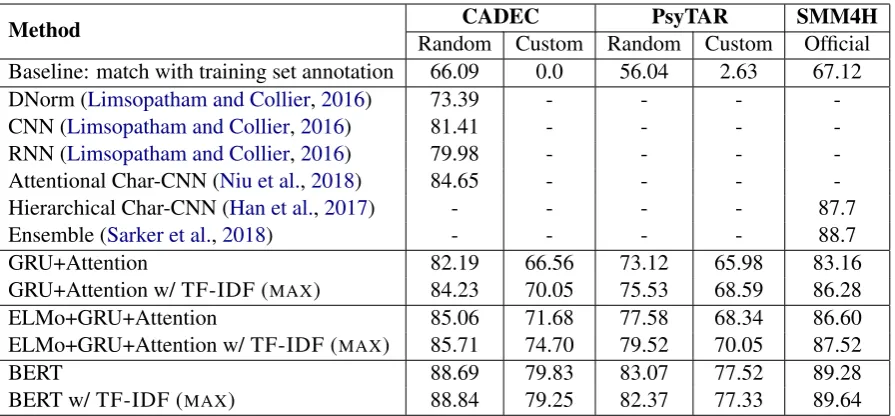
Table2shows our results for the concept normal-ization task on the Random and Custom KFolds of the CADEC, PsyTAR, and SMM4H 2017 corpora. To answer RQ2, we compare the performance of examined neural models with the baseline and state-of-the-art methods in terms of accuracy. Attention-based GRU with ELMo embeddings showed improvement over GRU with word2vec
embeddings, increasing the average accuracy to 77.85 (+3.65). The semantic information of an entity mention learned by BERT helps to im-prove the mapping abilities, outperforming other models (avg. accuracy 83.67). Our experiments with recurrent units showed that GRU consistently outperformed LSTM on all subsets, and atten-tion mechanism provided further quality improve-ments for GRU. From the difference in accuracy on the Random and Custom KFolds, we conclude that future research should focus on developing extrinsic test sets for medical concept normaliza-tion. In particular, the BERT model’s accuracy on the CADEC Custom KFolds decreased by 9.23% compared to the CADEC Random KFolds.
To answer RQ3, we compare the performance of models with additional similarity features (marked by “w/”) with others. Indeed, joint mod-els based on GRU and similarity features gain 2-5% improvement on sets with Custom KFolds. The joint model based on BERT and similarity features stays roughly on par with BERT on all sets. We also tested different strategies for
con-2https://doi.org/10.5281/zenodo.
3236318
structing representations using word embeddings and TF-IDF for all synonyms’ tokens that led to similar improvements for GRU.
5 Future Directions
RQ4. Future research might focus on develop-ing an embedddevelop-ing method that jointly maps ex-tracted entity mentions and UMLS concepts into the same continuous vector space. The methods could help us to easily measure the similarity be-tween words and concepts in the same space. Re-cently,Yamada et al.(2016) demonstrated that co-trained vectors improve the quality of both word and entity representations in entity linking (EL) which is a task closely related to concept nor-malization. We note that most of the recent EL methods focus on the disambiguation sub-task, ap-plying simple heuristics for candidate generation. The latter is especially challenging in medical con-cept normalization due to a significant language difference between medical terminology and pa-tient vocabulary.
RQ5. Error analysis has confirmed that mod-els often misclassify closely related concepts (e.g., “Emotionally detached” and “Apathy”) and antonymous concepts (e.g., “Hypertension” and “Hypotension”). We suggest to take into account not only the distance-like similarity between en-tity mentions and concepts but the mention’s con-text, which is not used directly in recent studies on concept normalization. The context can be repre-sented by the set of adjacent words or entities. As an alternative, one can use a conditional random field (CRF) to output the most likely sequence of medical concepts discussed in a review.
6 Related Work
Method CADEC PsyTAR SMM4H
Random Custom Random Custom Official Baseline: match with training set annotation 66.09 0.0 56.04 2.63 67.12
DNorm (Limsopatham and Collier,2016) 73.39 - - -
-CNN (Limsopatham and Collier,2016) 81.41 - - -
-RNN (Limsopatham and Collier,2016) 79.98 - - -
-Attentional Char-CNN (Niu et al.,2018) 84.65 - - -
-Hierarchical Char-CNN (Han et al.,2017) - - - - 87.7
Ensemble (Sarker et al.,2018) - - - - 88.7
GRU+Attention 82.19 66.56 73.12 65.98 83.16
GRU+Attention w/ TF-IDF (MAX) 84.23 70.05 75.53 68.59 86.28
ELMo+GRU+Attention 85.06 71.68 77.58 68.34 86.60
ELMo+GRU+Attention w/ TF-IDF (MAX) 85.71 74.70 79.52 70.05 87.52
BERT 88.69 79.83 83.07 77.52 89.28
[image:5.595.77.525.61.269.2]BERT w/ TF-IDF (MAX) 88.84 79.25 82.37 77.33 89.64
Table 2: The performance of the proposed models and the state-of-the-art methods in terms of accuracy.
and 2017 labs addressed the problem of ICD cod-ing of free-form death certificates (without speci-fied entity mentions). Traditionally, linguistic ap-proaches based on dictionaries, association mea-sures, and syntactic properties have been used to map texts to a concept from a controlled vocabu-lary (Aronson, 2001; Van Mulligen et al., 2016; Mottin et al., 2016; Ghiasvand and Kate, 2014; Tang et al., 2014). Leaman et al. (2013) pro-posed the DNorm system based on a pairwise learning-to-rank technique using vectors of query mentions and candidate concept terms. These vectors are obtained from a tf-idf representation of all tokens from training mentions and concept terms. Zweigenbaum and Lavergne (2016) uti-lized a hybrid method combining simple dictio-nary projection and mono-label supervised classi-fication from ICD coding. Nevertheless, the ma-jority of biomedical research on medical concept extraction primarily focused on scientific litera-ture and clinical records (Huang and Lu, 2015). Zolnoori et al. (2019) applied a popular dictio-nary look-up system cTAKES on user reviews. cTAKES based on additional PsyTAR’s dictionar-ies achieves twice better results (0.49 F1 score on the exact matching). Thus, dictionaries gathered from layperson language can efficiently improve automatic performance.
The 2017 SMM4H shared task (Sarker et al., 2018) was the first effort for the evaluation of NLP methods for the normalization of health-related text from social media on publicly released data. Recent advances in neural networks have been
utilized for concept normalization: recent stud-ies have employed convolutional neural networks (Limsopatham and Collier,2016;Niu et al.,2018) and recurrent neural networks (Belousov et al., 2017;Han et al.,2017). These works have trained neural networks from scratch using only entity mentions from training data and pre-trained word embeddings. To sum up, most methods have dealt with encoding information an entity mention it-self, ignoring the broader context where it oc-curred. Moreover, these studies did not examine an evaluation methodology tailored to the task.
7 Conclusion
repre-sentation model BERT in terms of accuracy. Dif-ferent setups of evaluation procedures affect the performance of models significantly: the accu-racy of BERT is 7.25% higher on test sets with a simple random split than on test sets with the proposed custom split. Moreover, we have dis-cussed some interesting future research directions and challenges to be overcome.
Acknowledgments
We thank Sergey Nikolenko for helpful discus-sions. This research was supported by the Russian Science Foundation grant no. 18-11-00284.
References
Alan R Aronson. 2001. Effective mapping of biomed-ical text to the UMLS Metathesaurus: the MetaMap program. InProceedings of the AMIA Symposium, page 17. American Medical Informatics Associa-tion.
M. Belousov, W. Dixon, and G. Nenadic. 2017. Using an ensemble of generalised linear and deep learn-ing models in the smm4h 2017 medical concept normalisation task. CEUR Workshop Proceedings, 1996:54–58.
Kyunghyun Cho, Bart van Merrienboer, C¸ aglar G¨ulc¸ehre, Fethi Bougares, Holger Schwenk, and Yoshua Bengio. 2014. Learning phrase representa-tions using RNN encoder-decoder for statistical ma-chine translation.CoRR, abs/1406.1078.
Jacob Devlin, Ming-Wei Chang, Kenton Lee, and Kristina Toutanova. 2018. Bert: Pre-training of deep bidirectional transformers for language understand-ing. arXiv preprint arXiv:1810.04805.
Omid Ghiasvand and Rohit J Kate. 2014. Uwm: Disor-der mention extraction from clinical text using crfs and normalization using learned edit distance pat-terns. InSemEval@ COLING, pages 828–832.
S. Han, T. Tran, A. Rios, and R. Kavuluru. 2017. Team uknlp: Detecting adrs, classifying medication intake messages, and normalizing adr mentions on twitter. CEUR Workshop Proceedings, 1996:49–53.
S. Hochreiter and J. Schmidhuber. 1997. Long Short-Term Memory. Neural Computation, 9(8):1735– 1780. Based on TR FKI-207-95, TUM (1995).
Chung-Chi Huang and Zhiyong Lu. 2015. Community challenges in biomedical text mining over 10 years: success, failure and the future. Briefings in bioinfor-matics, 17(1):132–144.
Sarvnaz Karimi, Alejandro Metke-Jimenez, Madonna Kemp, and Chen Wang. 2015. Cadec: A corpus of adverse drug event annotations. Journal of biomed-ical informatics, 55:73–81.
Robert Leaman, Rezarta Islamaj Do˘gan, and Zhiy-ong Lu. 2013. DNorm: disease name normaliza-tion with pairwise learning to rank. Bioinformatics, 29(22):2909–2917.
Nut Limsopatham and Nigel Collier. 2016. Normal-ising Medical Concepts in Social Media Texts by Learning Semantic Representation. InACL.
Luc Mottin, Julien Gobeill, Ana¨ıs Mottaz, Emilie Pasche, Arnaud Gaudinat, and Patrick Ruch. 2016. Bitem at clef ehealth evaluation lab 2016 task 2: Multilingual information extraction. In CLEF (Working Notes), pages 94–102.
Azadeh Nikfarjam, Abeed Sarker, Karen OConnor, Rachel Ginn, and Graciela Gonzalez. 2015. Phar-macovigilance from social media: mining adverse drug reaction mentions using sequence labeling with word embedding cluster features. Journal of the American Medical Informatics Association, 22(3):671–681.
Jinghao Niu, Yehui Yang, Siheng Zhang, Zhengya Sun, and Wensheng Zhang. 2018. Multi-task character-level attentional networks for medical concept nor-malization.Neural Processing Letters, pages 1–18.
Matthew E. Peters, Mark Neumann, Mohit Iyyer, Matt Gardner, Christopher Clark, Kenton Lee, and Luke Zettlemoyer. 2018. Deep contextualized word rep-resentations. InProc. of NAACL.
Abeed Sarker, Maksim Belousov, Jasper Friedrichs, Kai Hakala, Svetlana Kiritchenko, Farrokh Mehryary, Sifei Han, Tung Tran, Anthony Rios, Ramakanth Kavuluru, et al. 2018. Data and sys-tems for medication-related text classification and concept normalization from twitter: insights from the social media mining for health (smm4h)-2017 shared task. Journal of the American Medical Informatics Association, 25(10):1274–1283.
Yaoyun Zhang1 Jingqi Wang1 Buzhou Tang, Yonghui Wu1 Min Jiang, and Yukun Chen3 Hua Xu. 2014. Uth ccb: a report for semeval 2014–task 7 analysis of clinical text.SemEval 2014, page 802.
Elena Tutubalina, Zulfat Miftahutdinov, Sergey Nikolenko, and Valentin Malykh. 2018. Medical concept normalization in social media posts with recurrent neural networks. Journal of biomedical informatics, 84:93–102.
EV Tutubalina, Z Sh Miftahutdinov, RI Nugmanov, TI Madzhidov, SI Nikolenko, IS Alimova, and AE Tropsha. 2017. Using semantic analysis of texts for the identification of drugs with similar therapeutic effects. Russian Chemical Bulletin, 66(11):2180–2189.
Ikuya Yamada, Hiroyuki Shindo, Hideaki Takeda, and Yoshiyasu Takefuji. 2016. Joint learning of the em-bedding of words and entities for named entity dis-ambiguation. InProceedings of The 20th SIGNLL Conference on Computational Natural Language Learning, pages 250–259.
Maryam Zolnoori, Kin Wah Fung, Timothy B Patrick, Paul Fontelo, Hadi Kharrazi, Anthony Faiola, Yi Shuan Shirley Wu, Christina E Eldredge, Jake Luo, Mike Conway, et al. 2019. A systematic ap-proach for developing a corpus of patient reported adverse drug events: A case study for ssri and snri medications. Journal of biomedical informatics, 90:103091.